Disclosure: Some links in this post are affiliate links. As an Amazon Associate I earn from qualifying purchases, at no extra cost to you. Learn more
Specs are compiled from manufacturer listings and verified buyer reviews and can change over time — please confirm the key details on the product page before buying.
You want a kayak that lives in your trunk, not on a roof rack. A well-built inflatable tracks straight, carries two adults, and shrugs off rocks; a cheap one leaves you bailing water mid-lake. The list below separates boats that paddle well from ones that only look the part.
This guide is built by comparing the manufacturers’ published specifications and the patterns across verified customer reviews, so you get each pick’s real strengths and trade-offs instead of marketing spin.
What decides a good blow up kayak is simple: a stiff floor under your feet, chambers that hold air, and a hull that tracks without constant correction. The picks below cover both ends of that scale, from a compact solo starter to a whitewater-capable tandem, and this breakdown of every blow up kayak explains exactly where each boat earns its place on the water.
Top Picks


How To Choose The Best Blow Up Kayak
The single biggest decision is floor construction. An inflatable floor is a tube of air you sit on; a drop-stitch floor is thousands of threads inside the fabric that hold it flat and firm when pumped up. That is why an air-tube boat feels like a pool toy and a drop-stitch boat feels like a paddleboard with sides.
Floor Type And What It Changes
A drop-stitch floor pumped to its rated pressure turns the hull rigid, so your paddle strokes convert into forward motion instead of squish. Boats with that floor, like the Sea Eagle 380x and the UPWELL, tend to track better and feel more predictable in chop. Standard air-tube floors are lighter and cheaper, and they are fine for calm lakes and short trips.
Weight Capacity And Legroom
Match the stated capacity to what you actually load — body plus gear plus a cooler. A solo boat rated 220 pounds is a different animal from a tandem rated 507 pounds, and the wider hull that comes with higher capacity usually means a more stable, drier ride. Check interior length too, because long legs in a short cockpit is the most common first-trip complaint.
Chambers, Valves And Inflation Time
Three independent air chambers mean a single puncture does not sink the whole boat, and they inflate separately so you can balance the hull. Hand pumps with a pressure gauge get you to the right PSI without guessing; without a gauge you are pumping blind. Budget extra time on the first inflation and much less once you know the sequence.
Side-by-Side Comparison
| Model | Best For | Weight Capacity | Weight | Seating | Amazon |
|---|---|---|---|---|---|
| INTEX Challenger K1★ Best Overall | Solo lake days | 220 lbs | 26 lbs | 1 | Amazon |
| Advanced Elements AdvancedFrame ConvertibleBest Two-Person Build | One or two paddlers, travel | 550 lbs | 52 lbs | 2 | Amazon |
| Goplus Tandem 12.5FTTandem Value Pick | Two adults on a budget | 507 lbs | 39 lbs | 2 | Amazon |
| Retrospec Coaster | Solo paddlers with a dog | 220 lbs | 23 lbs | 1 | Amazon |
| GYMAX 12.5Ft Tandem | Fishing and touring with a partner | 507 lbs | 39 lbs | 2 | Amazon |
| TIGERXBANG 10.2′ SUP-Kayak | Stand-up-or-sit versatility | 500 lbs | 11.25 kg | 2 | Amazon |
| UPWELL 13’6” | Long tandem touring | 650 lbs | 32 lbs | 2 | Amazon |
| OCEANBROAD Sit-in V420 | Big paddlers, big water | 308 lbs | 51.7 lbs | 2 | Amazon |
| Sea Eagle 380x Explorer | Whitewater and rough water | 750 lbs | 40 lbs | 3 | Amazon |
Detailed Reviews
1. INTEX Challenger K1 Inflatable Kayak
Our pick — 4.0+★ from 21,000+ verified ratings; the strongest balance of quality and price.
Twenty-six pounds of boat that packs into a bag and still tracks a straight line.
If you want to know what a blow up kayak feels like with almost no commitment, this is the one. It runs 9 feet long by 2.6 feet wide and 1.1 feet tall when inflated, carries a 220-pound capacity, and folds down into the supplied carry bag. The removable skeg — a fin clipped to the underside — is what keeps it from spinning in circles, and it makes a real difference on open water.
The construction is a SuperStrong PVC formulation the maker describes as high-impact and abrasion-resistant. In practice that translates to a hull you can drag ashore over gravel without babying it. It sits higher in the water than a hard-shell kayak, which is a comfort win for anyone with sore muscles who needs to shift positions mid-paddle. Setup and teardown run about 10 minutes once you have the routine down.
Where it stumbles is deflation. The one-way valves have no air suction, so you have to roll the boat and sit on it to push the air out lakeside. The included paddle is short and a known weak point — plan on upgrading it early. Wind is the other honest limit: this hull catches gusts and there is no anchor point built in.
What earns it first place
- Packs into a trunk and sets up in roughly 10 minutes
- Sits high in the water and resists tipping for beginners
- SuperStrong PVC shrugs off branch scrapes and gravel launches
Where it asks patience
- Deflating means rolling and pressing the air out by hand
- Included paddle is short and cracks under regular use
- Drifts in gusty wind with no anchor point
First boat, right boat: beginners, casual lake paddlers, and anyone who wants a kayak that lives in the trunk rather than on a rack.
Budget for a paddle: the stock one is the first thing most owners replace.
2. Advanced Elements AdvancedFrame Convertible
The one that paddles like a hardshell until you fold it into the trunk.
Built-in aluminum ribs at the bow and stern are the trick here. They give the hull a defined nose and tail, and that shape is why this boat tracks so cleanly compared with a flat-tube inflatable. At 180 inches long and 32 inches wide, it is a genuine 15-foot kayak that happens to deflate — the longest hull in this group by a clear margin.
Three layers of material build the puncture resistance, and the pre-assembled shell means you simply unfold, inflate, and clip the seats in. Three seat positions let you paddle solo from the middle or tandem with a partner. Folded, it measures 35 x 21 x 12 inches, and the 52-pound carry weight is the tax you pay for that hull.
The honest catch is the pump. It inflates quickly but sits low to the ground, and reaching down to work it is hard on your back — enough that swapping in a slower foot pump is a common move. Air retention is the other thing to watch; a few boats need a recheck after the first hour.
The tracking payoff: the aluminum-rib nose and stern hold a line, which is the difference between a relaxed paddle and constant correction.
Weight honesty: at 52 pounds it is the heaviest hull here — against the 26-pound INTEX Challenger, that is double the load to haul from car to shore.
Worth the haul if: you paddle lakes and slow rivers with a partner and want hardshell manners without the roof rack.
Have a second pair of hands: the folded boat is awkward to carry solo, and a foot pump will save your back.
3. Goplus Tandem Inflatable Kayak 12.5FT
Two adults, two paddles, one bag — the tandem that gets a pair on the water without a second mortgage.
The number that matters here is 507 pounds of capacity across a 12.5-foot hull that weighs 39 pounds. That is a full two-person load with room left for gear, and the reinforced laminated PVC with mesh backing is built to take wave impact without scuffing through. Two aluminum paddles, a hand pump, a repair kit, and a carry bag all come in the box.
Rigidity comes from a high-pressure drop-stitch floor insert, and owners consistently describe that floor as the part that makes the boat feel solid underfoot. The three-chamber layout inflates to a maximum of 2.18 PSI, and a pressure gauge needle tells you when the hull is genuinely plump rather than just full of air. Two fins at the stern help it track straight, and four handles make it easy to move to the waterline.
Seats are the split opinion. Some find the EVA backrests supportive for a full day; others sit lower than they would like, and the paddle holders sit right where your hands travel, which can mean a knuckle knock on the recovery stroke. Accessories beyond the boat itself — pump, bag, stock paddles — are the weak links rather than the hull.
Where the money goes: the drop-stitch floor and the puncture-proof laminate are the real spend here, and both show up in how the boat handles a busy, wavy lake.
The upgrade path: budget for a better pump and a comfier seat set, and this boat’s honest limits mostly disappear.
Reach for this if: you want a genuine two-person inflatable with a rigid floor and full accessory kit at the entry tier.
Look elsewhere if: you need cushioned, high-back seating straight out of the bag.
4. Retrospec Coaster Inflatable Kayak

Twenty-three pounds, three fins, and enough room for a dog who insists on coming along.
For solo paddlers who hate the weight of a kayak more than they hate the paddle, this is the answer. It weighs 23 pounds — the lightest hull in this group — and folds to 24.5 x 17 x 10 inches, which is small enough to live in a closet. Inflated, it runs 9 feet 10 inches by 37 inches with a 220-pound capacity.
The fabric is 900-denier puncture-resistant material with a heavy-duty tarpaulin hull, and that denier number is a real measure of thread thickness rather than a marketing word. Three fins help it hold course. The included dual-action pump, paddle, footrest, and carry bag get you on the water in minutes, and the seat snaps in without tools.
Two things to know before you buy. The bottom is not reinforced to the same level as the sides, so dragging over sharp rock is a risk. And the bow-to-stern handles on the paddle are sliding-prone when wet — adding grippers solves it. Weight is also a bit optimistic; the packed backpack feels heavier than the stated number.
Transport is the whole pitch: at 23 pounds it lifts onto a truck bed or into a back seat without a second thought, which is the exact reason solo paddlers pick it over a full tandem.
Where it flexes thin: the floor wants care around jagged launches, and the stock paddle slides when wet.
Best fit: solo paddlers, dog owners, and anyone whose kayak has to fit in a hatchback.
Keep it off the rocks: the reinforced hull sides are tough; the floor is not.
5. GYMAX 12.5Ft Tandem Inflatable Kayak
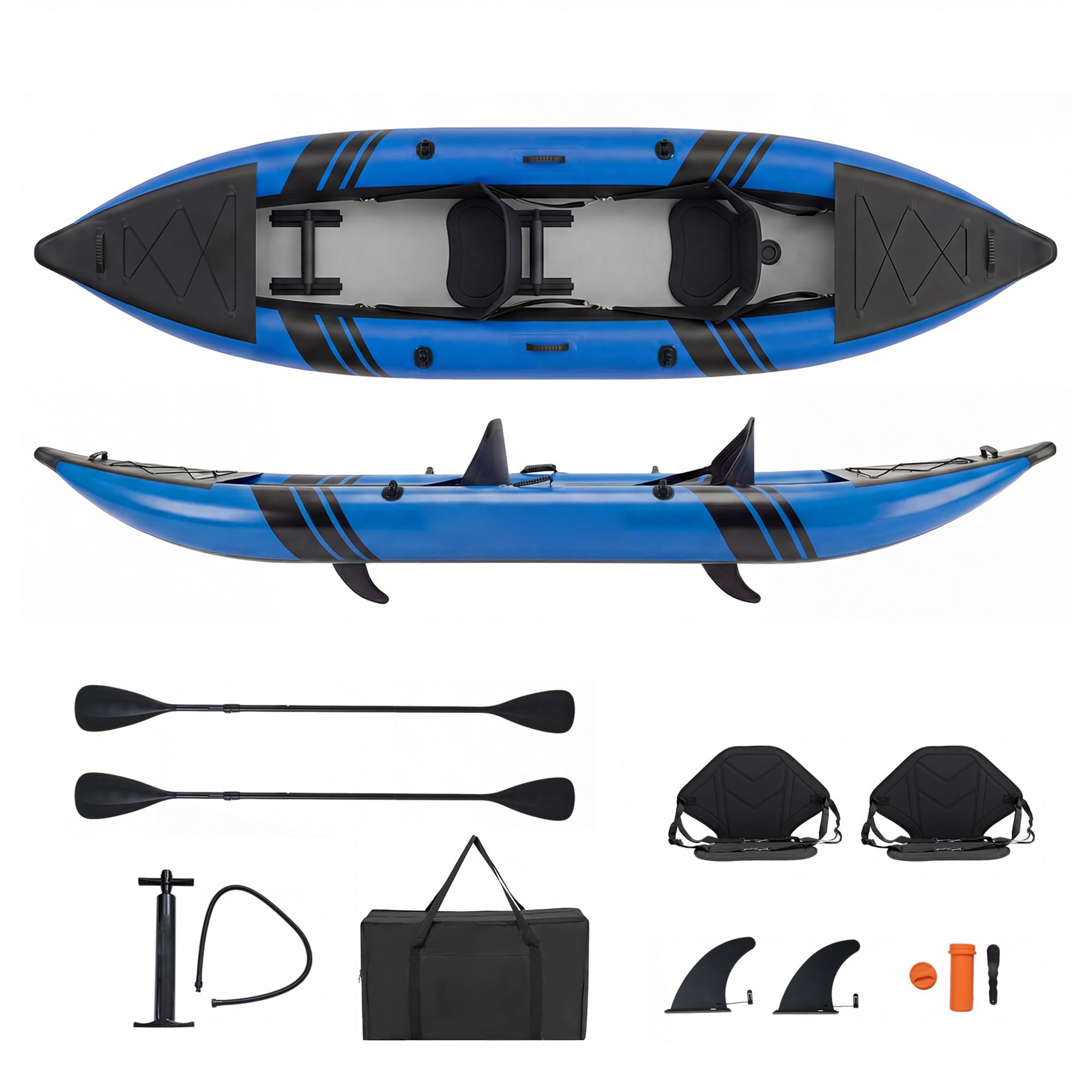
A drop-stitch floor stiff enough that an adult can stand on it without it bowing.
The floor on this boat is the headline. It is a removable high-pressure drop-stitch platform that acts as the third air chamber, and it is stiff enough to stand on. The rest of the spec sheet follows suit: 12.5 feet long, 507 pounds of capacity, 39 pounds of hull, and three independent chambers for inflation and safety.
That capacity spread is the widest in the group at this tier — against the single-seat INTEX Challenger, this is a two-person hull with double the seating and full tandem legroom. Two padded EVA seats with three-position footrests, two aluminum paddles, two fins, a hand pump, a carry bag, and a repair kit all ship together. Zippered storage behind the seats plus bungee cord up front keeps gear out of the footwell.
Durability is the honest split. The hull material and seams hold up well on the water; a small number of boats develop seam issues under hard use. The stock seats lack real back support, so buyers with lower-back needs often upgrade them. Also expect the whole setup to take 20-25 minutes the first time out.
The floor is the proof: a deck that holds an adult standing on it paddles like a much more expensive boat.
Seats are the weak link: buy better seats on day one and this becomes a much more comfortable long-day boat.
Pick it for: fishing and touring pairs who want maximum capacity and a genuinely rigid deck.
Budget for seats: the included ones sit you low and offer limited back support.
6. TIGERXBANG 10.2′ Inflatable SUP-Kayak

A board you can stand on and a kayak you can sit in — the same hull does both.
This is the crossover pick. It is 10 feet 2 inches long, 35 inches wide, and 8 inches thick, built from double-sided sandwich fabric with high-density drop stitches under a reinforced layered PVC shell. That construction is why it can carry 500 pounds and still sit stable whether you are seated or standing. It weighs in at 11.25 kg.
Rigid enough to stand on, wide enough to move, and fitted with a removable center fin for tracking. The detachable seat converts it from kayak to paddleboard in seconds. Baggage straps on the bow and stern hold a daypack, a side paddle holder frees your hands, and there is even a fishing rod holder. The included hand pump has a digital pressure gauge so you know exactly when it is full.
Comfort on the stock seat is middling — functional but not plush, so long days benefit from a pad. The paddle clips that hold the shaft are too small for some paddles, and the repair kit arrives without glue. Inflating by hand is a workout, and anyone with shoulder issues should use an electric PSI pump.
Two boats in one bag: the removable seat and rigid hull let you switch between paddling and standing on the same trip.
Fit and finish notes: paddle clips are undersized and the repair kit needs glue you supply, so assume a small top-up purchase.
Choose it when: you want one inflatable that doubles as a paddleboard and a fishing platform.
Plan the pump: a hand pump gets it done but is a shoulder workout; an electric gauge pump is the better call.
7. UPWELL 13’6” Inflatable Recreational Kayak

Thirteen and a half feet of hull that tracks like it came off a rack, yet folds into a bag.
Length is the whole story. At 13 feet 6 inches by 38 inches wide and 12.5 inches tall, this is the longest hull here, and that length buys you tracking. The 650-pound capacity is the highest of any boat in this group — against the OCEANBROAD’s 308-pound rating, it is more than double — so a big tandem pair plus a full cooler still paddles level. It weighs 32 pounds.
Construction is a 0.55mm-thick PVC inner hull wrapped in a 1000-denier ripstop nylon cover, seam-welded for abrasion resistance and air retention. That 1000-denier figure is the thread weight, and it is what lets the cover take UV and shore scrapes. The drop-stitch floor runs at 7 PSI in the center with side tubes at 2 PSI, giving a firm deck that does not rock side to side.
Two honest limits. The included carry bag is thin, and hauling the boat alone after use is a chore. The stock hand pump sometimes arrives with a broken gauge, and the seat snap hooks are cheap plastic. Long-legged paddlers also feel cramped in the front seat, which sits high with a weight imbalance.
Length earns its keep: the extra hull length plus a single tracking fin keeps you off the constant course correction that shorter tandems demand.
The bag lets the side down: the boat is genuinely good; the carrying solution is not.
Go for it if: you want maximum capacity and long-water tracking from a foldable hull.
skip it if: you solo-carry often — the folded package is awkward for one person.
8. OCEANBROAD Sit-in Inflatable Kayak V420

A 13.7-foot tandem built around tall paddlers and gear-heavy trips.
Height matters as much as length here. This boat is 13.7 feet long and 2.95 feet wide, and the drop-stitch floor plus 36-inch beam means a six-foot-three paddler has room to stretch.
Materials are heavy-duty vinyl with a drop-stitch floor for rigidity, and three chambers plus Halkey-Roberts valves — valves that seal well and hold pressure. The padded EVA seat, footrest, drain hole, and 4-piece paddle kit cover everything from a quiet lake to a moderate rapid. Inflation with the included hand pump runs about five to six minutes, and deflation is quick through the open valves.
Two details to size before you buy. The seats are the soft spot; the zippers fail on some boats and a replacement seat is often the answer. And the self-bailing scuppers are small, so water that comes over the skirt can pool on the floor rather than drain away cleanly. Those are fixable but worth knowing.
Room to move: the combination of 36-inch width and drop-stitch floor is why tall, heavier paddlers report feeling both stable and unconfined.
Seat swaps happen: the boat holds up; the seat zipper is the part most likely to need replacing.
Suits taller paddlers: anyone six feet and up who wants legroom in a tandem without giving up stability.
Know going in: the seat may need a swap, and the small scuppers can leave water in the footwell.
9. Sea Eagle 380x Explorer Inflatable Tandem Kayak
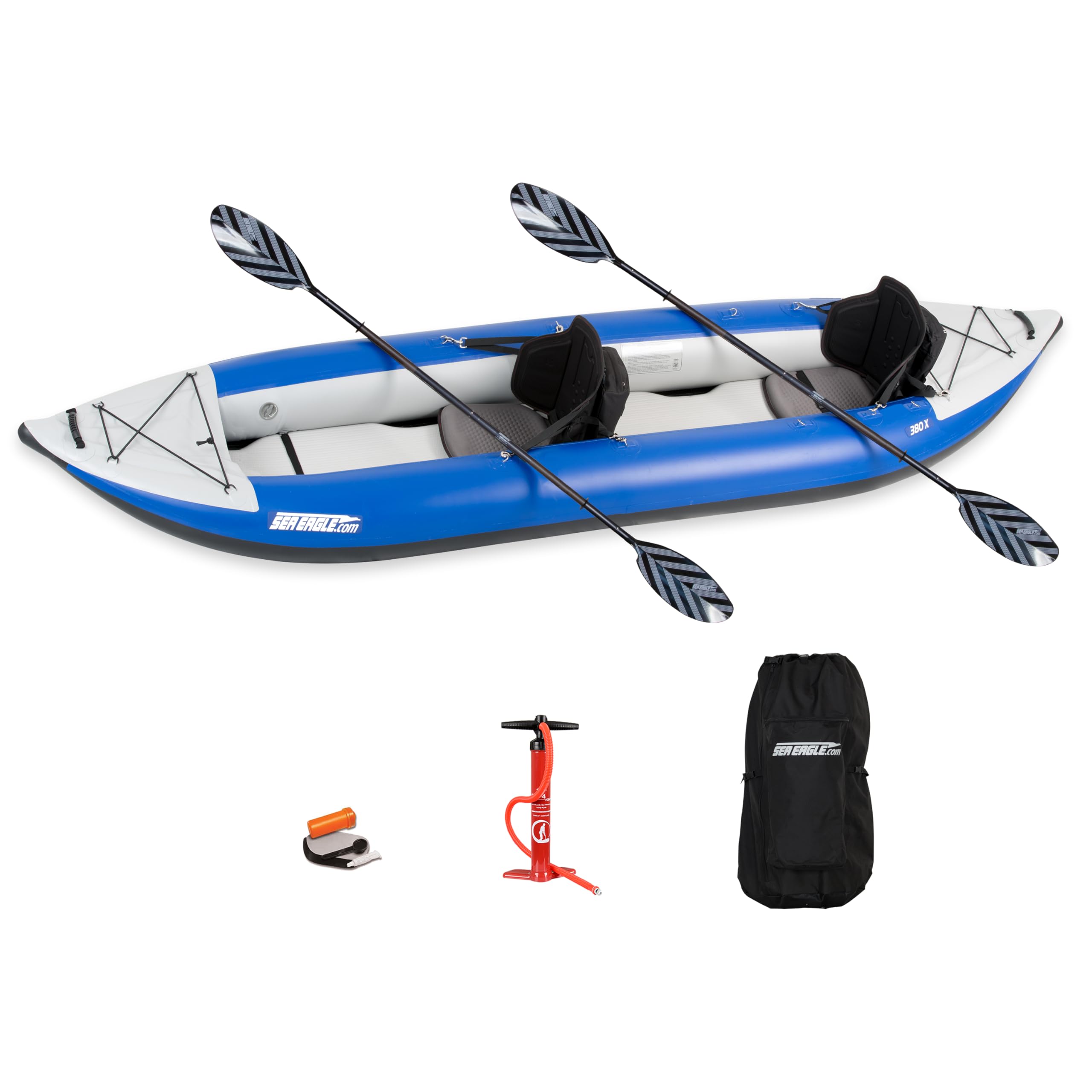
A boat rated past the rapids most paddlers ever attempt, with a floor you can stand on.
The headline spec is the whitewater rating — up to Class IV, which puts this in a different league from a lake-touring tandem. That rating is backed by 16 self-bailing drain valves that open to dump water on a wild river and close for dry flatwater touring. The 1000-denier PVC shell and quadruple-overlapped glued seams take rock blows that would end a lighter hull’s day.
Capacity is the other standout: 750 pounds, the highest here, scaled for two adults plus substantial gear, and rated to carry three paddlers. Against the 507-pound Goplus and GYMAX tandems, it carries a meaningful load margin. The removable drop-stitch floor inflates to 10 PSI, and that is high enough to feel like a hard deck underfoot. Length is 12 feet 5 inches with a 39-inch beam.
The one practical catch is the pump. The included hand pump is rated to a lower pressure than the 10-PSI floor wants, so it will not get you all the way there. Buyers end up with a proper high-pressure gauge pump. Also budget for the skeg — this hull veers left and right without it, but tracks well with it in place.
Where the spec pays off: the Class IV rating and 16 drain valves mean this is the one boat here that can legally and safely run a real rapid.
Don’t skip the skeg: it is essential on open water and the boat is directionless without it.
Right boat for: whitewater paddlers, lake-and-river crossovers, and heavier loads of gear.
Get the right pump: the stock one will not reach the floor’s 10-PSI ceiling.
Know the Specs
Floor Type: Drop-Stitch vs I-Beam vs Air Tube
A drop-stitch floor has thousands of threads inside the fabric that hold the deck flat and firm when inflated. That flatness turns paddle strokes into forward motion instead of squish, which is why drop-stitch boats like the 380x, UPWELL, and TIGERXBANG feel closer to a hardshell. A plain air-tube floor is lighter and cheaper, and is fine on a calm lake.
Denier and PSI
Denier numbers like 900-denier or 1000-denier measure thread weight — higher numbers mean thicker fabric that resists punctures and UV. PSI is the inflation pressure; a drop-stitch floor typically runs at 7-10 PSI while side chambers run much lower, so the right gauge pump matters. Low-pressure hand pumps will struggle to reach a floor’s rated PSI.
Tracking Fins and Rails
A skeg or fin is a small blade at the stern that stops the boat weathervaning in the wind. One fin helps; two fins are a stronger track. Long hulls track better than short ones, so the 13.6-foot UPWELL tracks well past what a 9-foot solo boat manages. Removing the fin is fine on tight rivers but a bad idea in open lake water.
Chambers, Valves, and Self-Bailing
Three independent chambers mean one puncture does not sink the boat. Halkey-Roberts valves hold pressure reliably and seal without fuss. Self-bailing valves drain water out the hull — a flatwater luxury but a safety feature on a real rapid. Boats without a self-bailing design need to be drained by hand on shore.
Common Questions
How long does it take to inflate a blow up kayak?
Will a blow up kayak hold air all day?
Is a drop-stitch floor worth the extra cost?
How much weight can a two-person inflatable kayak carry?
Can I use an inflatable kayak on a river with rapids?
Do I need a skeg to paddle straight?
How do I store an inflatable kayak without it getting damaged?
What is the difference between denier and PSI?
Can one person paddle a two-person inflatable kayak?
The Bottom Line
The strongest all-rounder is the INTEX Challenger K1 — it packs into a trunk, sits high enough to resist tipping, and sets up in about 10 minutes, which is what most people need from a blow up kayak. If you want a partner along and a rigid deck, the GYMAX 12.5Ft Tandem delivers 507 pounds of capacity and a floor stiff enough to stand on. For serious water, the Sea Eagle 380x Explorer is the only boat here rated up to Class IV rapids, and that rating is the decision-maker if your plans include moving water.
How we choose
We do not accept paid placement. Every pick is matched to a real buyer and a real use-case; we do not hands-on test units.
Sources
Specifications: manufacturer listings and product documentation. Review insights: verified customer reviews, as of October 2026. Pricing: not shown on this page (it changes often); check the current price via the retailer link.
As an Amazon Associate, Aappliancez earns from qualifying purchases. This does not affect which products we feature.