Disclosure: Some links in this post are affiliate links. As an Amazon Associate I earn from qualifying purchases, at no extra cost to you. Learn more
Specs are compiled from manufacturer listings and verified buyer reviews and can change over time — please confirm the key details on the product page before buying.
If your upper arm measures wider than a standard cuff allows, the reading you get is not your blood pressure — it is an error dressed up as a number. That is the whole problem with this category. A cuff that cannot close comfortably around your arm squeezes the artery unevenly, and the monitor reports whatever it felt. So the first thing to check is not the brand or the app. It is the cuff range printed on the box, in inches. Every monitor below lists a real arm circumference it fits, and the top pick covers 9 to 17 inches, which is the widest single-cuff span here.
This guide is built by comparing the manufacturers’ published specifications and the patterns across verified customer reviews, so you get each pick’s real strengths and trade-offs instead of marketing spin.
A home monitor only earns its place when the cuff fits your arm and the readings hold steady from one week to the next. Below you will find the best blood pressure monitor with extra large cuff for your arm size, your budget, and how you like to track readings.
Top Picks

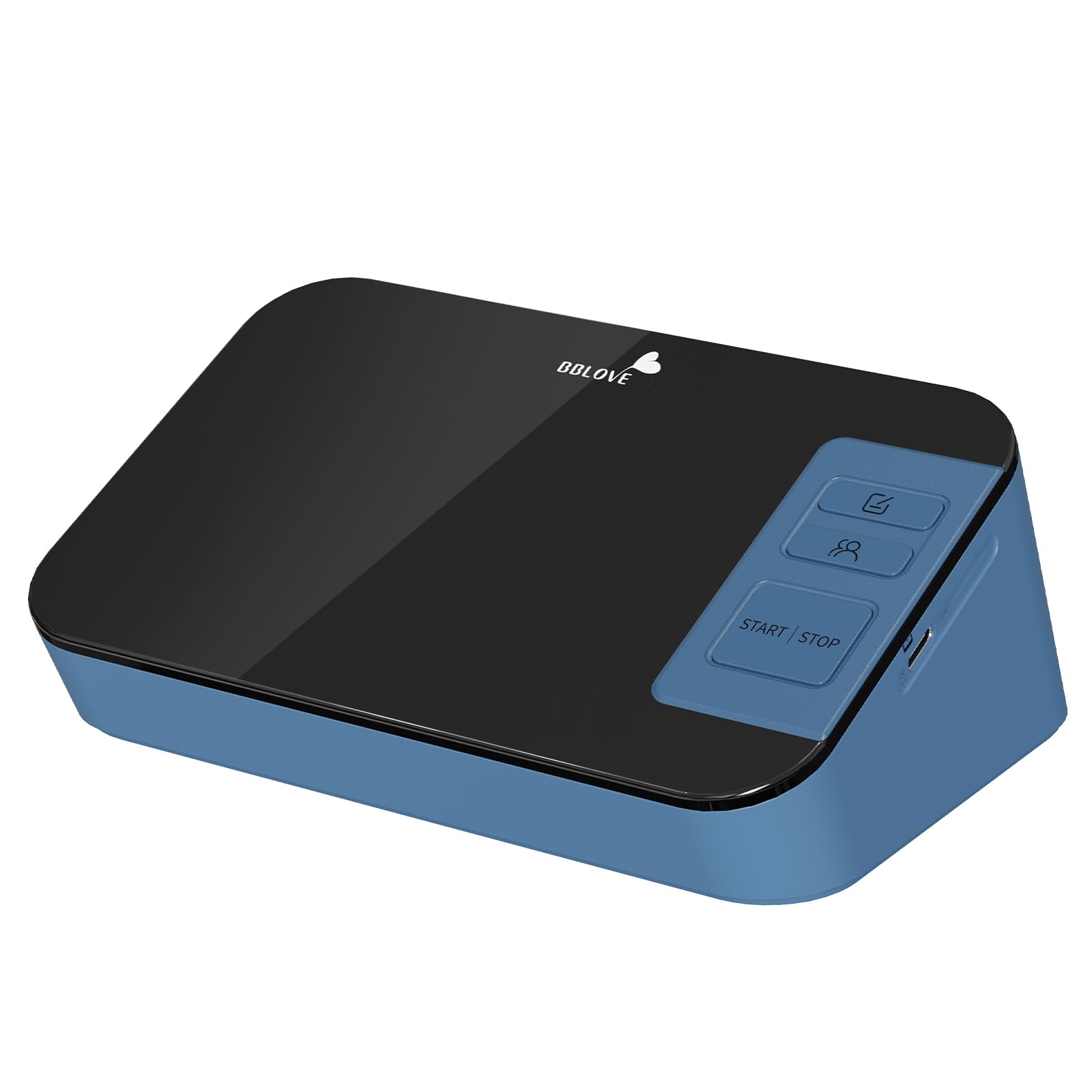
How To Choose The Best Blood Pressure Monitor With Extra Large Cuff
Measure your upper arm first, halfway between your shoulder and your elbow, with the arm relaxed at your side. Write that number down in inches. Then buy only a monitor whose printed cuff range contains it. Everything else — the screen, the app, the memory — is a convenience layered on top of that one measurement.
Read the cuff range, not the word “large”
“Large” and “extra large” mean whatever the manufacturer decided they mean. The Greater Goods cuff covers 15.7 to 20.5 inches. The A&D UA-789AC covers 16.5 to 23.6 inches. Those are different arms. A 21-inch arm fits one and not the other, so check the number. A cuff that is too small reads high because it has to squeeze harder to close.
Upper arm beats wrist for a big arm
Every monitor here wraps the upper arm, which is the placement that gives the most repeatable results. A wrist cuff is smaller and easier to travel with, but it must sit exactly at heart height to read correctly, and that is hard to hold steady. For a wide arm, the upper-arm cuff is the safer choice.
Decide how you want to keep records
Memory matters more than most buyers expect. The Invaxe stores 199 readings for each of two users. The Greater Goods stores 60 per user. The A&D UA-789AC holds 60 readings total and averages the last three. If you take a reading every morning and want a month of history, you need the bigger number. If you just want to hand your doctor a printout, Bluetooth syncing to a phone app does that job.
Side-by-Side Comparison
| Model | Best For | Cuff Range | Stored Readings | Power | Amazon |
|---|---|---|---|---|---|
| Invaxe Automatic Upper Arm Monitor★ Best Overall | Widest single-cuff fit and the most memory | 9″–17″ | 199 per user, 2 users | 4 AAA batteries or USB | Amazon |
| Alicn Home Use Monitor with BagRechargeable Pick | Rechargeable, no battery swaps | — | Dual-user profiles | USB charger | Amazon |
| Greater Goods XL Cuff Monitor | Largest arm fit plus phone tracking | 15.7″–20.5″ | 60 per user, 2 users | 4 AAA batteries or USB-C | Amazon |
| A&D Medical UA-910BLE | Four users and travel-friendly size | 8.6″–16.5″ | 120 per user, 4 users | AC adapter or batteries | Amazon |
| OMRON Gold BP5360 | Irregular heartbeat screening plus app | 9″–17″ | Dual-user memory | 4 AA batteries | Amazon |
| A&D Medical UA-789AC | The very widest arms | 16.5″–23.6″ | 60 readings | 4 AA batteries or AC adapter | Amazon |
Detailed Reviews
1. Invaxe Automatic Upper Arm Blood Pressure Monitor
Our pick — 4.5+★ from 2,500+ verified ratings; the strongest balance of quality and price.
One cuff spans 9 to 17 inches, so most adults never need to buy a second one.
The number that carries this monitor is 199. It stores 199 readings for each of two separate users, which is why it suits a household where two people both track their blood pressure. Compare that with the Greater Goods, which stores 60 per user — the Invaxe holds 199 readings per user versus 60. If you take one reading a morning, that is many months of history before anything rolls off. The monitor also averages your last three measurements automatically, which smooths the day-to-day noise out of a single spike.
The screen is a 4.5-inch backlit LCD, set at a 45° angle so you read it while seated rather than leaning over the unit. Numbers are large and the buttons are big, which matters if your eyesight or grip is not what it was. One-button start means there is no menu to learn. Power comes from four included AAA batteries or a USB cable, so you are not stranded when the cells run down mid-week.
The cuff itself is the real story. It fits 9 to 17 inches and runs the monitor through a position check before measuring, so it tells you if the wrap is off before it gives you a number. It also flags an irregular heartbeat during the reading and uses 6 color-coded pressure levels so you can see at a glance where you landed. Reviewers keep coming back to the solid build and the one-button routine, which is what makes a daily morning check feel easy. The honest catch is the metal clip on the cuff, which catches on the fabric when you thread it. Buyers report: “The cuff is a little difficult to put on because of the metal clip that always catches.” A small annoyance, not a reason to skip it.
Where it earns its place
- 199 stored readings per user across 2 users, the deepest memory here
- 9″–17″ cuff covers a genuinely wide arm range without a second purchase
- 4.5″ backlit display angled at 45° for seated reading
- Runs on 4 AAA batteries or USB, so no dead-unit mornings
- Irregular heartbeat detection built into every measurement
What to think about first
- The cuff’s metal clip snags during threading — guide it slowly with two hands
- 17 inches is the ceiling, so a very wide arm needs the A&D UA-789AC instead
Reach for this if: two people in the house share a monitor and you want months of history without an app.
Measure first: if your arm tops 17 inches, this cuff will not close properly — go to the UA-789AC.
2. Alicn Blood Pressure Monitors
No battery drawer to empty — plug it in, charge it, done.
The rechargeable battery is the feature that changes daily life here. There are no AAA cells to swap at the worst moment, just a USB charger you top up now and then. That single design choice is why this one suits a household that checks pressure every morning and has grown tired of hunting for AAA batteries. It also explains the feedback that keeps surfacing — the rechargeable build is repeatedly the favourite detail, ahead of anything on the screen. It weighs 1.34 pounds on its own, heavier than the Invaxe at 1.1 pounds, so it sits planted on a counter rather than sliding around.
The large display and one-click start are the combination that makes it work for older parents. A dual-user mode keeps two sets of records apart on the same machine, and you can set up profiles so each person’s history stays with them. Readings come back in seconds, and the automatic inflation removes the pumping and stethoscope work of a manual cuff. As owners put it: “I’ve used it several times and the readings have been consistent.”
Worth being straight about the range of experiences. This model’s published material does not spell out a cuff circumference in inches, so if your arm is well above average, confirm the fit with the seller before you commit — the Invaxe at 9″–17″ or the Greater Goods at 15.7″–20.5″ gives you a printed number to check against. There is also an occasional report of readings jumping around between back-to-back measurements, which is the sort of thing that usually traces to cuff placement or arm movement. Take three readings a minute apart and average them, and the picture settles.
The daily reality: A rechargeable monitor you never think about, with a screen big enough to read across the room and profiles that keep two people’s numbers apart.
The gap to close: No stated cuff range in inches, so measure your arm and confirm the fit before ordering.
Worth it for: anyone who wants a set-and-charge routine and a display readable from a chair.
Check before you buy: your arm measurement against the seller’s stated cuff fit, since this listing does not print one.
3. Greater Goods Blood Pressure Monitor XL Cuff
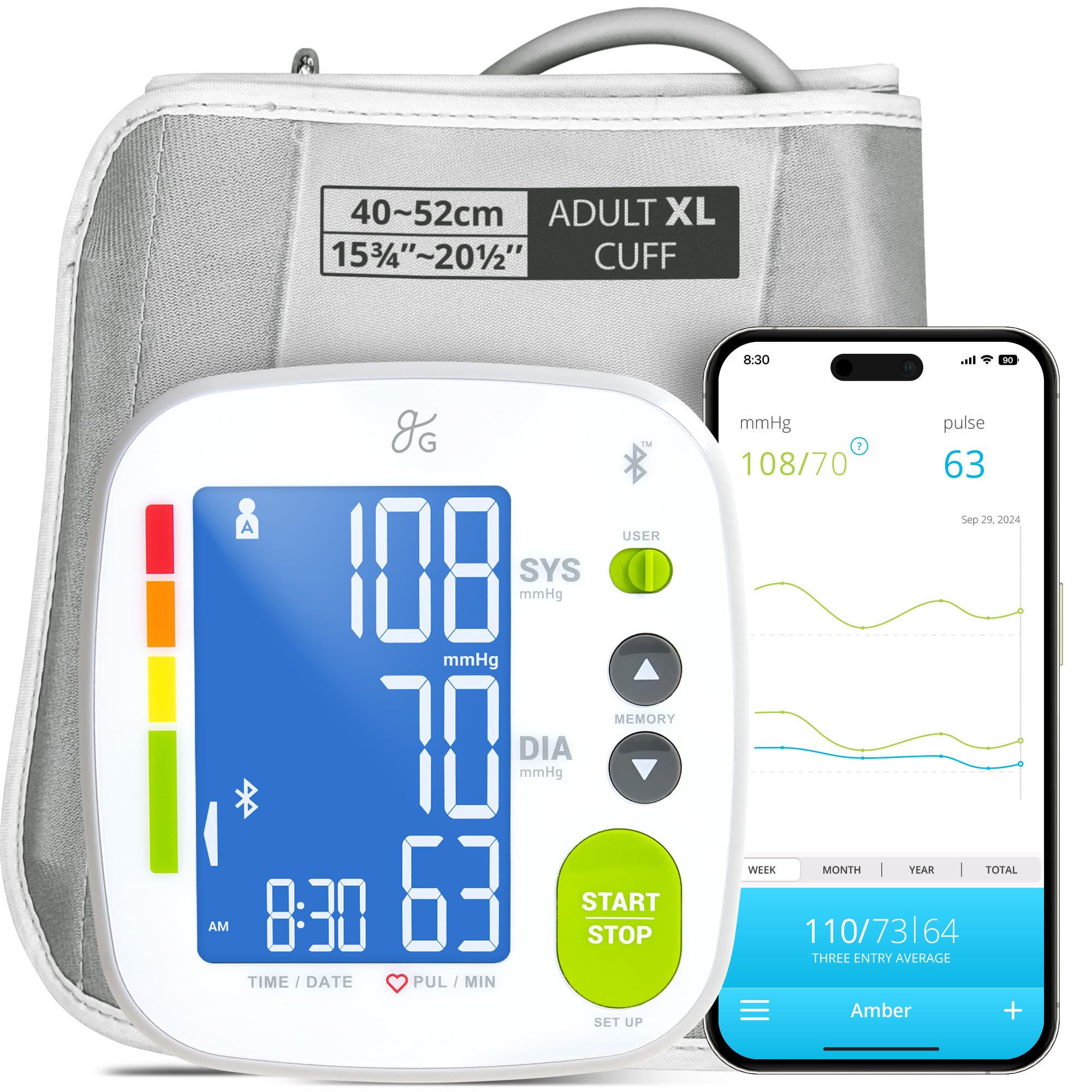
A cuff built for 15.7 to 20.5 inches, and a phone app that logs every reading for you.
Start with the cuff, because that is the whole point of this category. This one is tapered and preformed to fit arms from 15.7 to 20.5 inches, and it carries an artery alignment guide so you know which way the tube should face. That range is wider than the Invaxe’s 9″–17″ upper limit, so an arm at 19 or 20 inches fits here and not there. It is a heavier build, at 9.76 ounces against the Invaxe’s 1.1 pounds, and it sits in a travel case when you are not using it.
The tracking side is where it pulls ahead. Bluetooth pairs with the Balance Health app on your phone, and readings save automatically so you can hand your doctor a trend chart instead of a scribbled list. Two users each get 60 readings of memory, 120 total on the device, so a couple can share it and still stay separate. The backlit display shows bold numbers with a color-coded range indicator, so you see at a glance whether you landed in the usual zone, and it alerts you if it spots an irregular heartbeat. One-touch start handles the inflation for you.
Two things to know before you commit. The cuff is hard to tighten with one hand, especially on the right arm, so most people will want to wrap it with the other arm helping. And the E1 error appears when the wrap is not snug enough — the fix is to readjust and run it again, not to distrust the machine. Syncing aside, it works perfectly well as a standalone monitor, which matters if you would rather not keep a phone nearby.
What makes it the tracker’s choice
- 15.7″–20.5″ XL tapered cuff with an artery alignment guide
- Bluetooth sync to the Balance Health app builds a shareable trend record
- 60 readings per user for two users, 120 on board
- Color-coded range indicator and irregular heartbeat alert
- Works fine without the app when you do not want a phone involved
The honest friction
- Wrapping the cuff one-handed is awkward, particularly on the right arm
- An E1 error means the wrap was loose — refit and retry rather than reading it as a fault
The right pick if: your arm is past the 17-inch mark and you want readings logged automatically for appointments.
Look elsewhere if: you want to strap it on solo with one hand — the preformed cuff fights that.
4. A&D Medical UA-910BLE Blood Pressure Monitor for Home Use
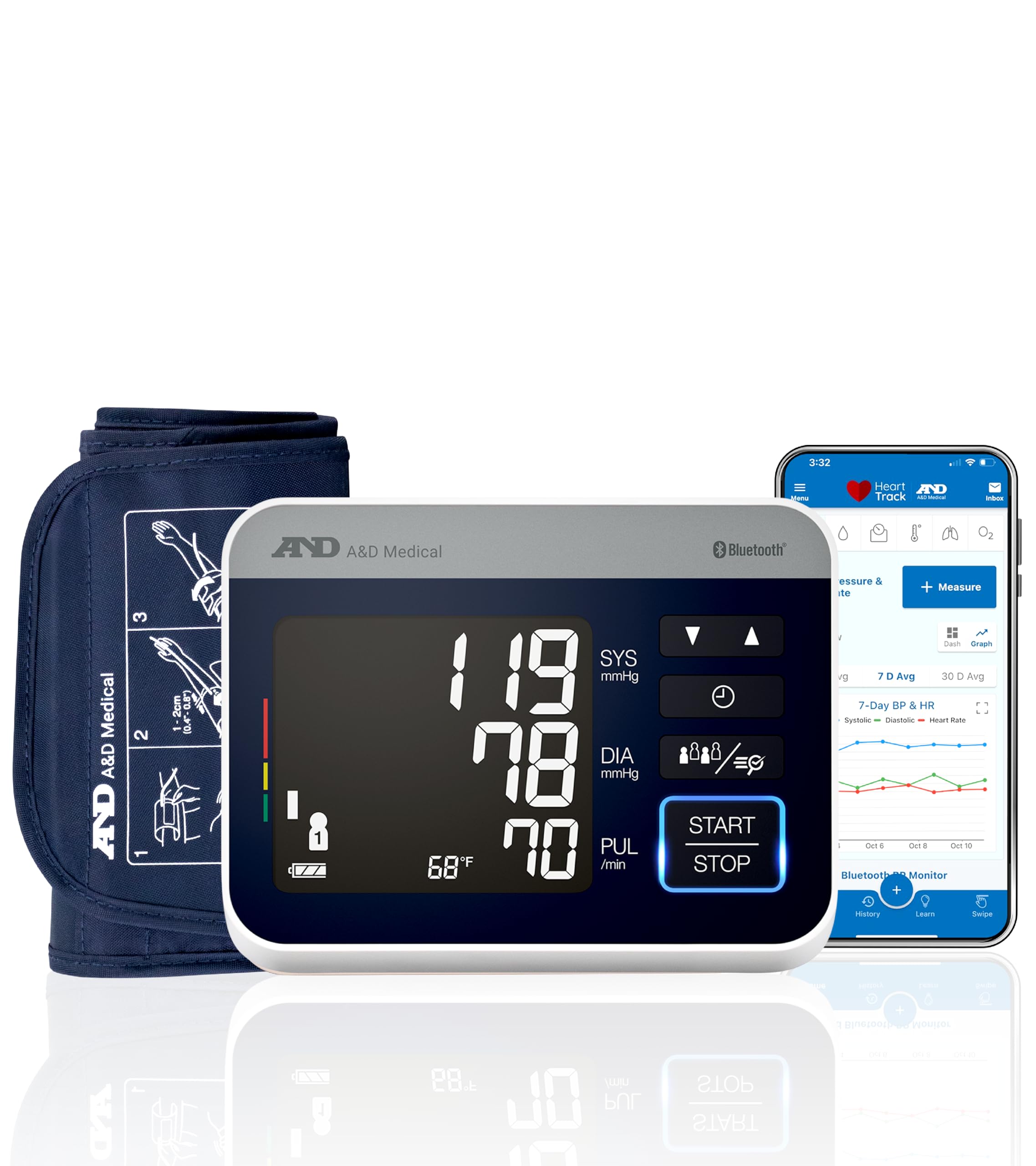
Four separate user profiles on a machine that packs into a bag for the weekend.
Most home monitors are built for two people. This one supports up to 4 users, with 120 readings stored per user on the device, so a whole household or a carer looking after several relatives can keep every record apart. It ships with a preformed wide-range cuff that fits 8.6 to 16.5 inches, which is a touch wider than the Greater Goods at the bottom end but tops out lower at 16.5. The preformed shape slides on more easily than a velcro wrap, and there is a cuff leak check and a fit error alert to catch a bad wrap before it skews the number.
It is built to travel. The unit measures 4.3 x 2.5 x 5.5 inches and weighs 1.79 pounds, so it drops into the included carrying bag and goes in a suitcase without eating space. Power comes from an included AC adapter or batteries. The screen uses oversized digits to show pulse, systolic and diastolic clearly, and the one-button design means no setup ritual. The A&D Heart Track app syncs unlimited measurements over Bluetooth, and it also displays ambient room temperature, which is an unusual extra if you want to see whether a cold room shifts your readings.
The trade-off is at the edges of its range. At 16.5 inches the cuff tops out below the Greater Goods and the Invaxe, so a genuinely wide arm needs a different monitor — A&D sells separate cuffs up to 17.7 inches, but those are sold separately. Battery life is the other repeat note, with some users getting about three weeks at under a reading a day.
Multi-person strength: Four users at 120 readings each is the most separate profiles on this list, and the preformed cuff is easier to put on than a velcro wrap.
Boundary to respect: 16.5 inches is the ceiling here, so measure before you buy if your arm runs wide.
Made for: a household or carer tracking several people, and anyone who wants a monitor that travels.
Not for: an arm above 16.5 inches, unless you also buy the larger A&D cuff separately.
5. OMRON Gold Blood Pressure Monitor
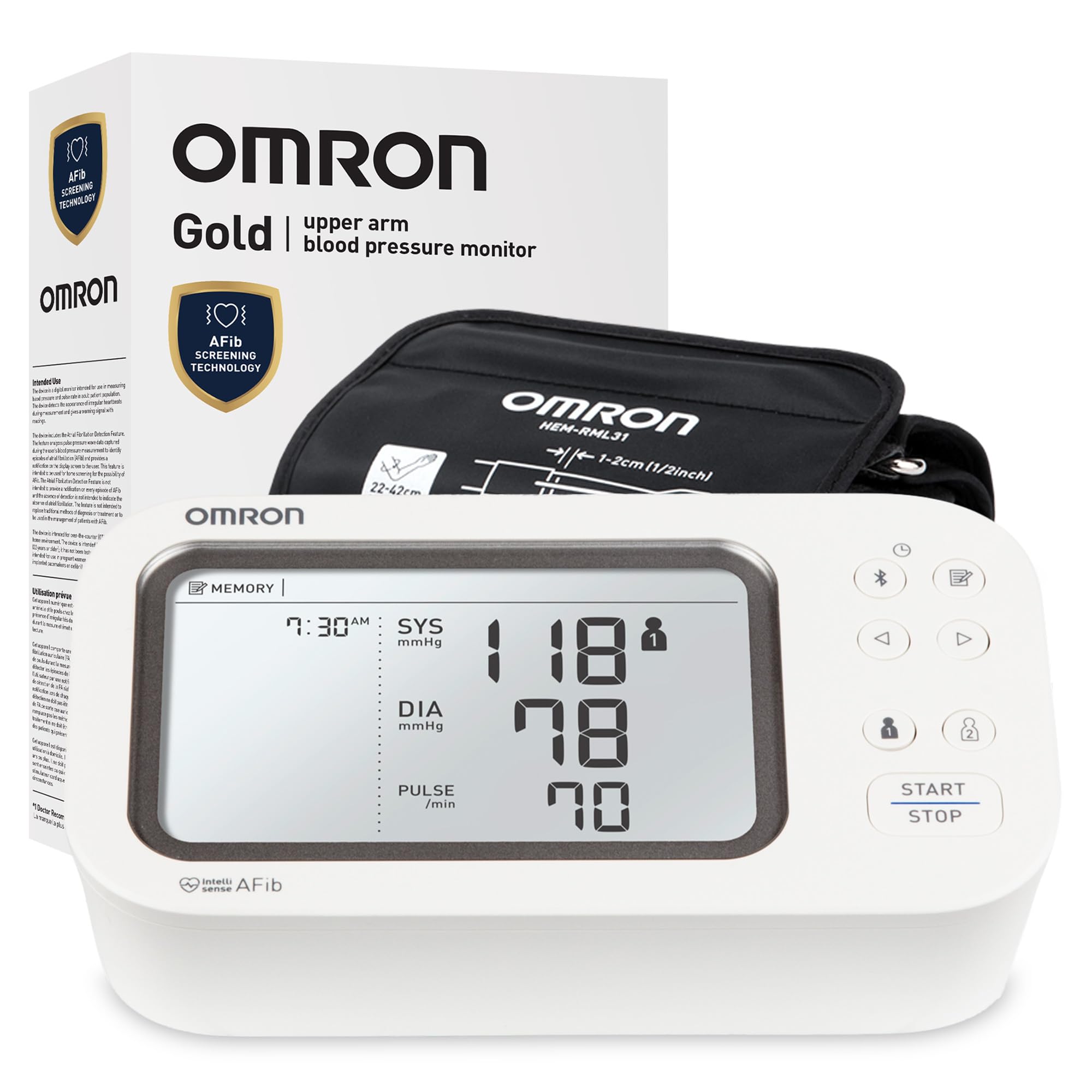
It screens your heart rhythm on every reading, not just your pressure.
The feature that stands out here is Atrial Fibrillation detection, which runs each time you measure. It looks for an unusual heart rhythm alongside your pressure reading and flags it, so you have something concrete to raise with your doctor. The monitor also uses a High Morning Average Indicator to catch pressure spikes in the morning hours. Neither of those is a diagnosis — they are screening flags, and the value is in what you do with them at an appointment. The unit runs TruRead, which averages 3 consecutive readings into one result automatically, and a physical User 1 / User 2 toggle keeps two people’s history separate on a large on-device log.
The physical design supports a consistent morning routine. A dual display shows your current reading beside your previous one, so you see a trend without digging into memory. A cuff wrap guide light confirms the D-ring cuff is tight enough before the measurement starts — that cuff fits arms 9 to 17 inches, matching the Invaxe’s range. Bluetooth connects to the free OMRON connect app, which stores unlimited readings and shares reports with Apple Health and Google Fit. Four AA batteries come in the box, along with a storage case and quick start guide.
Two limitations need saying plainly. The app has a reputation for losing unsaved data logs during a sync, so export or screenshot anything you want to keep. And for anyone with a known irregular heartbeat, the monitor may not display a reading at all when it detects AFib — an FDA-derived behaviour that appears in the manual’s fine print rather than on the box.
Why it stands apart
- Atrial Fibrillation detection on every measurement
- TruRead averages 3 readings into a single result
- Dual display shows current reading beside the last one
- Cuff wrap guide light confirms a tight wrap before measuring
- 9″–17″ D-ring cuff with storage case and 4 AA batteries included
Know these going in
- The app can drop unsaved logs during syncing — back up anything you need
- If you have known AFib, the unit may withhold the reading entirely
- The premium D-ring cuff is bulky to pack for travel
Choose it when: rhythm screening and morning-spike tracking matter to you as much as the pressure number.
Think twice if: you already have a diagnosed irregular heartbeat — check the AFib behaviour against your situation first.
6. A&D Medical UA-789AC Blood Pressure Monitor for Home Use
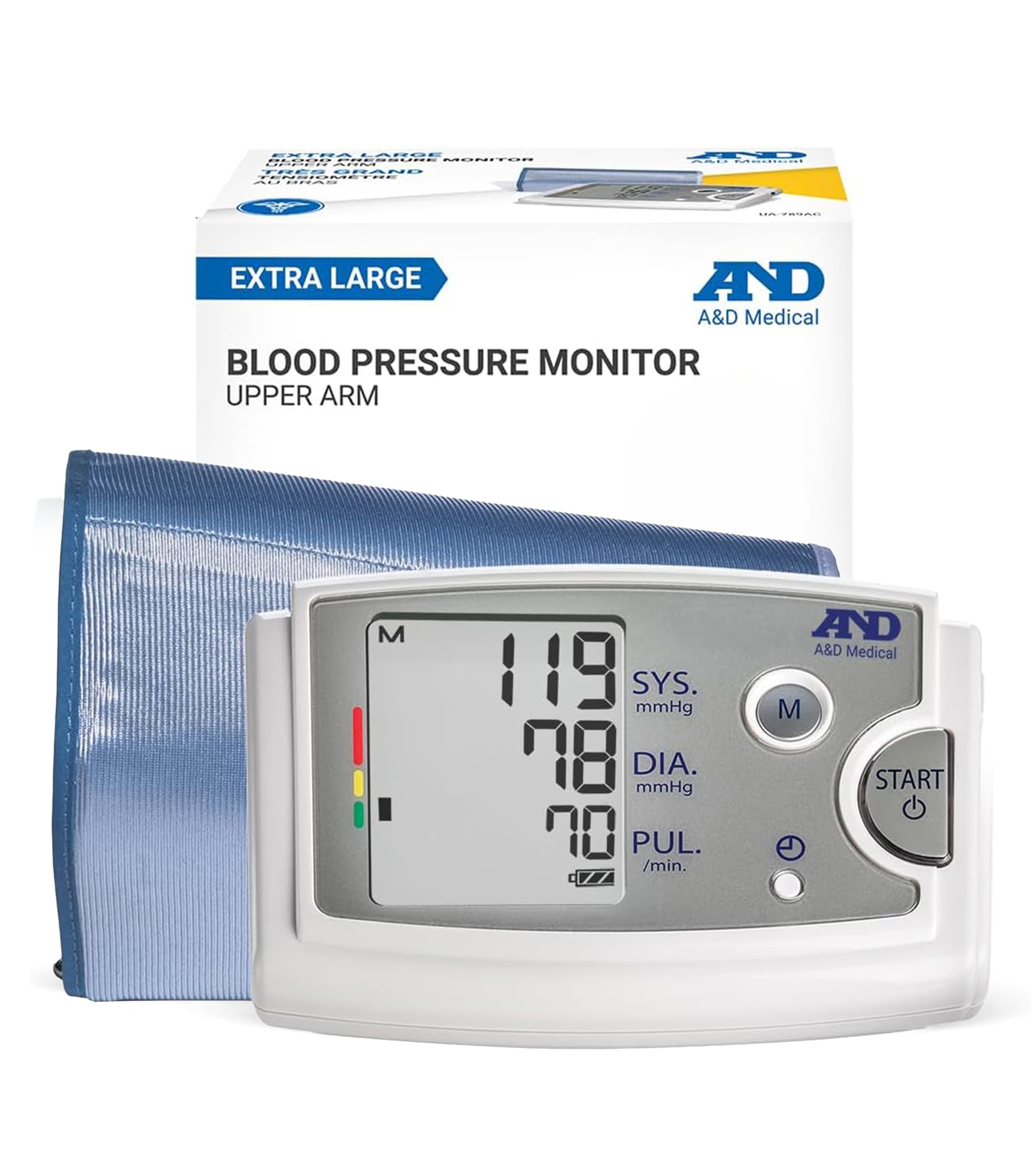
The only cuff here that closes around a 23.6-inch arm.
If the other five monitors stop too soon, this is where the search ends. The cuff is tapered and preformed to fit upper arms from 16.5 to 23.6 inches, and that upper figure is the widest on this list by a clear margin — the Greater Goods tops out at 20.5 inches. For a genuinely large arm, that difference is the whole buying decision, because no amount of screen quality rescues a cuff that will not close. The monitor arrives with the extra-large cuff, an AC adapter, a carrying case, and two quick start guides, and it runs on either the adapter or four AA batteries.
Operation is deliberately plain: one button starts the measurement, and the cuff inflates and deflates on its own. One button starts the measurement, the cuff inflates and deflates with two pumps for a fast result, and the large LCD shows oversized digits for pulse, systolic and diastolic. It stores 60 readings with date and time stamps and averages the last three, which gives you a rolling baseline rather than a single number. Three programmable reminders nudge you toward a consistent routine, which is the part most people let slide.
A few practical notes. The cuff is preformed and does not over-tighten or dig in, which owners of wide arms tend to notice immediately after years of fighting smaller wraps. The A&D Heart Track app is manual logging rather than Bluetooth syncing, so you type readings in rather than having them appear — fine if you like a paper-style record, slower if you do not. And the cuff is large enough that a smaller arm will find it loose, so this is a monitor to buy for its fit, not as a household spare.
The fit case: 16.5″–23.6″ covers arms that every other cuff on this page leaves out, and it does so without over-tightening.
The routine cost: App tracking is manual entry, and the preformed cuff will hang loose on a smaller arm.
Buy this one if: your upper arm measures past 20.5 inches — nothing else here will fit properly.
Hold off if: your arm sits under 16.5 inches, where the smaller A&D UA-910BLE or the Invaxe is the better call.
Know the Specs
Cuff circumference range, in inches
This is the number that decides whether a monitor is usable at all. It is printed as a low and high figure, such as 9 to 17 inches or 16.5 to 23.6 inches. Your upper arm needs to fall inside that window, measured halfway between shoulder and elbow. A cuff below your size cannot close evenly and tends to read high. A cuff far above your size sits loose and can read low. Measure once, write it down, and match it to the printed range before anything else.
Stored readings and user profiles
Memory is what turns a single measurement into a trend your doctor can use. Some units store 199 readings per user across two users; others hold 60 in total. More capacity means more history before the oldest entries drop off. Separate user profiles keep two or four people’s records from blending together on a shared machine. Automatic averaging of the last three readings is a related feature — it reports a steadier figure than any single measurement on its own.
Power: batteries versus adapter
Most of these monitors run on AAA or AA batteries, and several also accept a USB cable or an included AC adapter. Dual power means a set of flat batteries does not lock you out of a morning reading. Rechargeable models skip the battery drawer entirely but need charging time. Whichever you pick, keep a spare set of cells or the adapter cable near the monitor so the routine never breaks.
Irregular heartbeat and rhythm alerts
Some monitors check for an unusual heart rhythm during each measurement and display a flag if they find one. This is a screening alert, not a diagnosis, and the useful move is to bring the flag up with your doctor. Note that a unit built to detect irregular rhythms may withhold a pressure reading when it detects one, which is worth knowing before you rely on it.
Common Questions
How do I know if my arm needs an extra large cuff?
Will a cuff that is too small give a wrong reading?
Is an upper arm monitor better than a wrist monitor for a large arm?
How many readings should a home monitor store?
Do I need Bluetooth on a blood pressure monitor?
Can two people share one blood pressure monitor?
What does irregular heartbeat detection actually tell me?
Why does my monitor show an error instead of a reading?
Should I bring my home monitor to a doctor appointment?
How often should I replace the cuff?
The Bottom Line
For most people, the blood pressure monitor with extra large cuff to buy is the Invaxe Automatic Upper Arm Monitor, because its 9″–17″ cuff covers a wide arm and its 199 readings per user across two profiles means months of history without a phone. If your arm runs past 17 inches, the Greater Goods XL Cuff Monitor covers 15.7″–20.5″ and syncs every reading to an app. And for the widest arms, the A&D Medical UA-789AC reaches 23.6 inches, which nothing else on this list does. Measure your arm first, then pick the model whose printed range contains it — that one step decides whether the numbers you get are worth trusting.
How we choose
We do not accept paid placement. Every pick is matched to a real buyer and a real use-case; we do not hands-on test units.
Sources
Specifications: manufacturer listings and product documentation. Review insights: verified customer reviews, as of October 2026. Pricing: not shown on this page (it changes often); check the current price via the retailer link.
As an Amazon Associate, Aappliancez earns from qualifying purchases. This does not affect which products we feature.