Disclosure: Some links in this post are affiliate links. As an Amazon Associate I earn from qualifying purchases, at no extra cost to you. Learn more
Specs are compiled from manufacturer listings and verified buyer reviews and can change over time — please confirm the key details on the product page before buying.
Blood flow restriction cuffs are not one product — the name covers two completely different tools, and buying the wrong one is the mistake that costs people the most. Manual sphygmomanometer cuffs clamp an arm to measure pressure for a reading. Training BFR bands and pump cuffs partially slow blood flow during light-weight lifting. Neither one replaces the other, and neither works well if the cuff does not fit your limb. That split is the first thing to settle before you spend anything.
This guide is built by comparing the manufacturers’ published specifications and the patterns across verified customer reviews, so you get each pick’s real strengths and trade-offs instead of marketing spin.
Your arm size and how you control pressure decide which of these six cuffs fits you. Each pick below lists its cuff range, its pressure control method, and the honest gripes that matter for your arm, your leg, or your gym bag. Measure your limb first, then choose between a dial you read and a pump you squeeze. This breakdown of the blood flow restriction cuffs options makes that call simple.
Top Picks

How To Choose The Best Blood Flow Restriction Cuffs
The first decision is not brand or budget — it is which job you are buying for. A cuff that measures blood pressure and a cuff that restricts it during training look similar and behave nothing alike. Get that wrong and no amount of research on the rest helps.
Measure your limb before you read anything else
Cuff fit is measured in circumference, not length. A large adult cuff rated for 34–50 cm will not seal correctly on a skinny arm, and a small pediatric cuff rated for 12–17 cm will not close around an adult bicep. Write your actual measurement down first, then only consider cuffs whose stated range covers it. Fit issues are the single most common reason a cuff gets returned.
Decide between a dial gauge and a pump
A manual gauge cuff gives you a needle reading you watch and interpret yourself. A pump-based training cuff lets you dial in a pressure number and release it with a valve. The pump version is easier to repeat session to session, but it adds bulk and one more part that can fail. Simple nylon straps are the lightest option and the least precise — you tighten them by feel.
Check the hardware, not the marketing
Buckles, valves, and hoses are where these products break. A metal buckle with grip teeth holds tension better than a plastic clip. A filter screen valve keeps dust out of the manometer. Read what the maker lists for hardware before you read what they claim about results.
Side-by-Side Comparison
| Model | Best For | Type | Cuff / Strap Range | Pressure Method | Amazon |
|---|---|---|---|---|---|
| McKesson Aneroid Sphygmomanometer, Large★ Best Overall | Large adult arms, manual readings | Aneroid gauge cuff | 34–50 cm | 300 mmHg dial + bulb | Amazon |
| McKesson LUMEON Blood Pressure Cuff, GreenPediatric Pick | Children and small arms | Aneroid gauge cuff | 12–17 cm | 300 mmHg luminescent dial + bulb | Amazon |
| Dr. Gains Nylon BFR Bands | Arm training with metal buckle | Nylon strap bands | 1-inch strap width | Spring-loaded EZ-Adjust lever | Amazon |
| lewitools BFR Resistance Training Bands | Full-set home gym kit | Pump cuff system | Arms and legs | Hand pump | Amazon |
| Lisxeoc BFR Training System | Dial-in pressure with quick release | Pump cuff system | 41.5″ L x 3.93″ W | Precision pump + gauge | Amazon |
| Puxhoea BFR Training Bands | Full-body four-band kit | Pump cuff system | 2 arm + 2 leg bands | Precision pump + pressure guidance | Amazon |
Detailed Reviews
1. McKesson Aneroid Sphygmomanometer Large
Our pick — 4.5+★ from 500+ verified ratings; the strongest balance of quality and price.
A 34–50 cm cuff that finally closes around a bigger arm.
If your home monitor keeps throwing error codes on your bicep, the problem is usually the cuff, not the electronics. This McKesson is a manual aneroid sphygmomanometer — a dial gauge cuff that clamps the arm to take a pressure reading — and its large burgundy cuff is rated for arm circumferences of 34 cm to 50 cm. That range is why the quality shows up in the write-ups: the cuff actually fits the arm first, and everything else follows from there.
What wins people over here is the build. The manometer reads to 300 millimeters Hg (the pressure unit on the dial) with heavy chrome plating, and a filter screen valve keeps dust from collecting in the mechanism. Expanded graduation marks on the dial make the needle easier to read at a glance. The maker backs the inflation side for 3 years and calibration for life — coverage you rarely see on a drugstore cuff.
The honest catch is in how you use it. A manual cuff asks you to inflate, watch a needle, and listen for the systolic and diastolic tones — it takes some dexterity and decent hearing to do solo. A short gauge cord also forces some awkward positioning if you are reading flat on a table. Buyers report: “Our old cuff and lines were dried out. Saw this item and its larger size cuff for bigger arms.” Treat it as a tool for careful, hands-on readings rather than a press-one-button device.
Where The Build Pays Off
- Large 34–50 cm cuff range covers bigger arms that most home cuffs miss
- Heavy chrome-plated 300 mmHg manometer with a dust-filtering screen valve
- 3-year inflation and lifetime calibration warranty from the maker
- Expanded graduation marks keep the needle readable
Read This Before You Buy
- Manual inflation means you listen for tones — harder to do alone
- The gauge cord runs short, so reading while lying flat takes some adjusting
- Not a training tool; it is built to measure, not to restrict for lifting
Right fit: Buyers with larger arms who want a manual, professional-style gauge cuff they can trust for careful readings.
Wrong fit: Anyone expecting a one-button automatic monitor, or a training band for lifting.
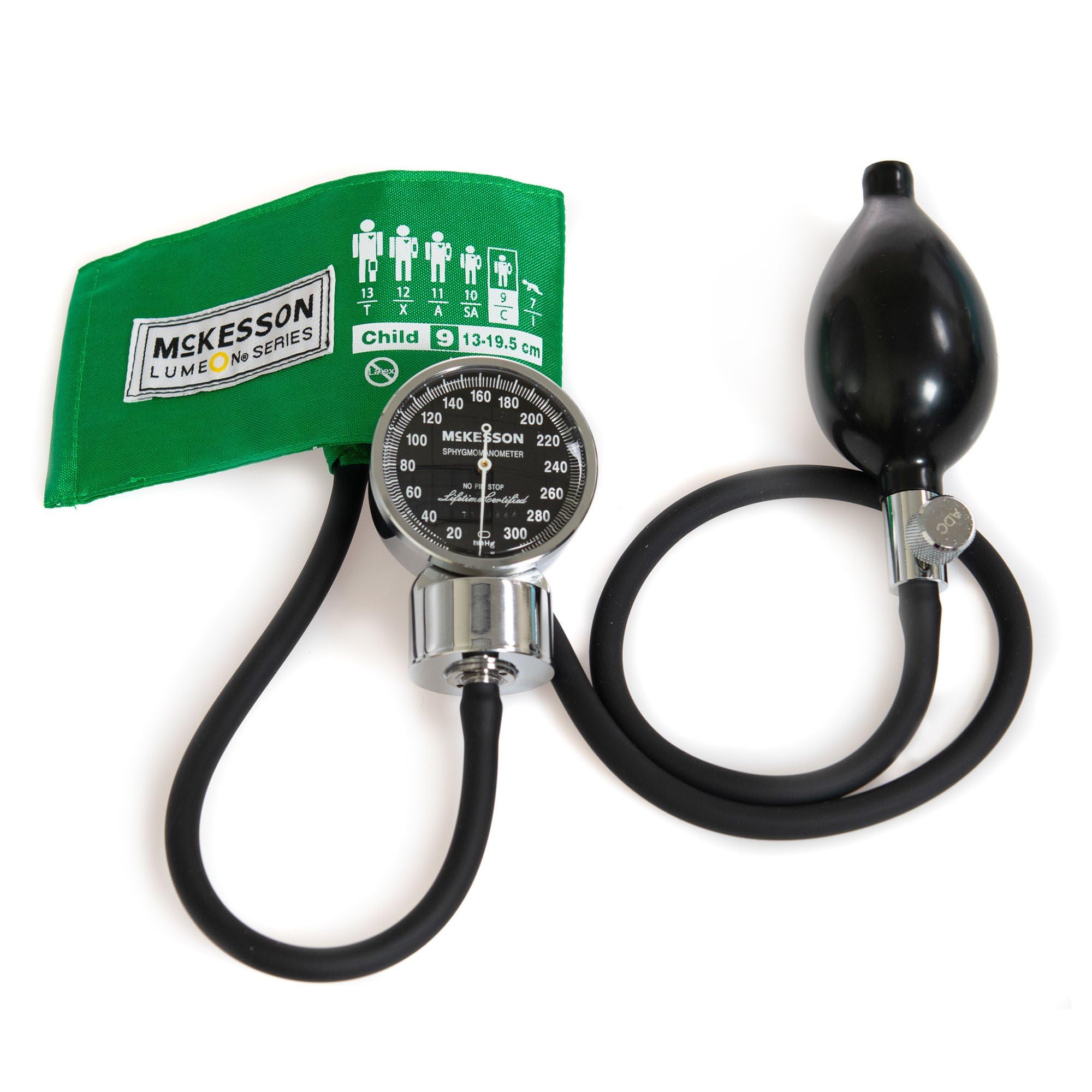
2. McKesson LUMEON Blood Pressure Cuff
The small-arm cuff that finally fits a toddler, not an adult.
Standard adult cuffs swallow a child’s arm, which is why pediatric readings so often come back wrong. This LUMEON exists to fix that: a small green cuff built for arm circumferences of 12 cm to 17 cm, aimed squarely at children. The pump tubes run 21.6 inches each, so you get working room between the cuff and the bulb while you hold a squirming arm still.
Where it earns its keep is in the reading itself. The dial is luminescent, so you can see the needle in dim light or at an awkward angle — genuinely useful with a kid on your lap. The same 300-millimeter Hg chrome-plated manometer and filter screen valve as the adult model is here, so dust and buildup stay out of the mechanism. Compared with the 34–50 cm McKesson above, the fit difference is the whole point: this one is scaled for small limbs and the other is scaled for large ones.
The claim that sells it: It measures what an adult cuff cannot — a real reading from a small arm, backed by a calibrated gauge.
One thing to plan for: The 12–17 cm range is tight and specific. Measure the arm carefully before ordering; this is not a cuff for older kids at the upper end of a growth curve.
Who it serves: Parents and home-health caregivers taking pediatric readings on children, where small-arm fit is the entire requirement.
Who should scroll on: Anyone needing an adult cuff — 12–17 cm simply will not close around a grown arm.
3. Dr. Gains Blood Flow Restriction Bands
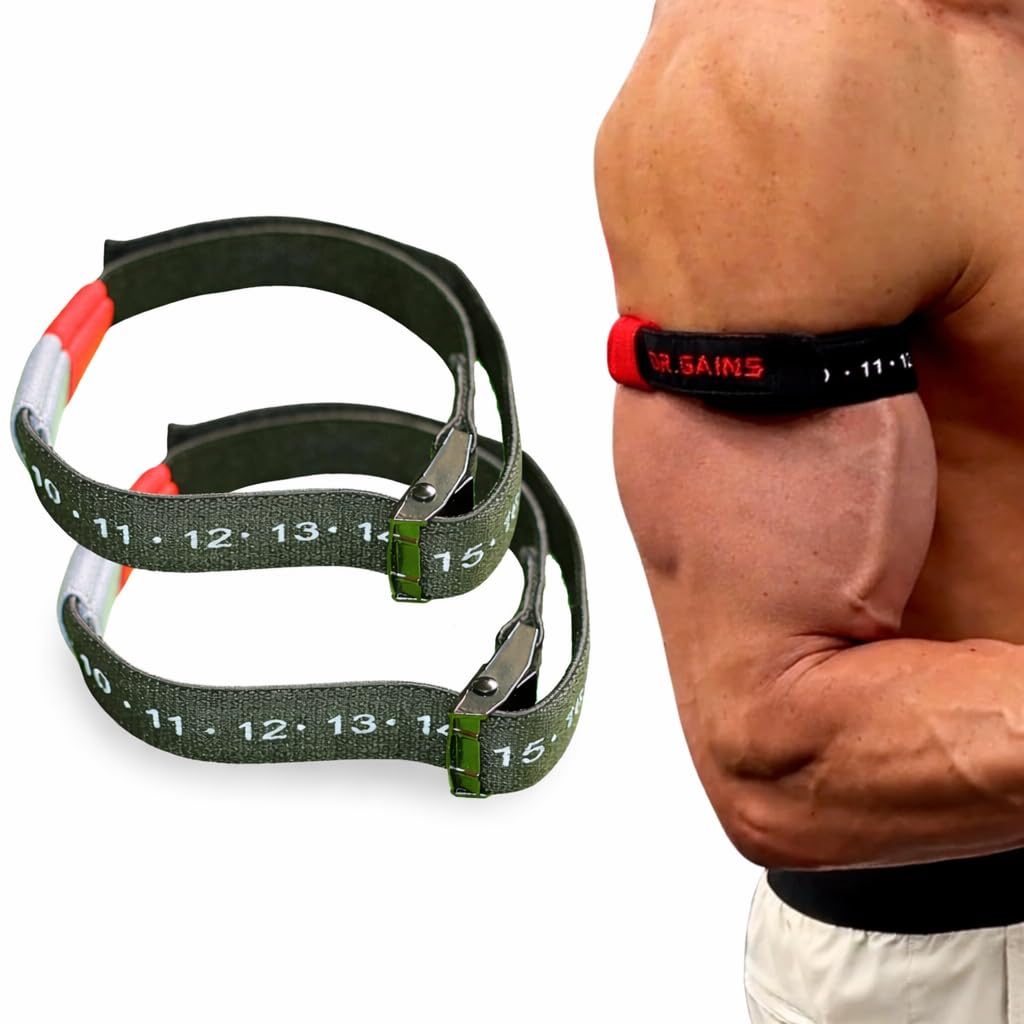
Strap-and-buckle training bands for lifters who want to feel the tension, not read it.
These are the simplest kind of BFR band: a 1-inch-wide nylon strap you tighten yourself with a metal buckle, no pump and no gauge. For a lifter who wants quick on and off between sets, that is the appeal. The metal buckle has grip teeth designed to stay locked under pressure, and an EZ-Adjust lever with a spring-loaded auto-grip lets you tighten or loosen with one or two fingers. The maker pitches a 1-inch width as a deliberate middle ground — wide enough to slow flow, narrow enough not to choke the working muscle.
Where the design shines is the hardware. The buckle and strap-holding loops are made to keep the slack tidy and the fit stable through a whole workout, and the whole set packs into a compact carrying case. Compared with the pump-based options further down, these trade precision for speed and portability.
Here is the honest limit. Thick nylon that holds its shape can also feel stiff, and tightening it hard by hand takes some getting used to. Strap width matters more than you would think — calf and bicep work rewards a thinner strap that sits where you place it. If even pressure and a number on a gauge matter to you, the pump cuffs lower down will suit you better than these straps.
What it does well: Fast, tool-free tightening with a metal buckle and spring-loaded lever, plus elastic loops that keep the excess strap out of your way.
What to weigh: You set pressure by feel, not by a reading — so consistency between one set and the next is on you.
Reach for this if: You want light, portable arm bands that go on and off fast between sets.
Look elsewhere if: You need a measured pressure number to train the same way every session.
4. lewitools BFR Resistance Training Bands

A pump-and-cuff kit aimed at building muscle with light weights at home.
The pitch here is convenience: a pump you attach to the cuff so you apply a set pressure to arms and legs without strapping a tourniquet around a limb. It is a cotton-blend set with a door anchor included, sized to cover arms, legs and glutes in one kit. The pitch is that lighter loads and shorter sets can still build muscle — useful if heavy loading is off the table for you.
That said, this is the one pick where you should read the fine print about durability before you commit. The pump-and-cuff approach is the least forgiving part of any BFR kit, and this set leans on it heavily. Treat it as a starter system for a home setup where you are learning the technique, not as a buy-once-and-forget-it tool.
What the set covers: Full-body training zones — arms, legs and glutes — plus a door anchor, in one ready-to-use kit.
The fair caveat: Pump-based kits like this put their weakest link at the connection point and the pump itself, so inspect it as you go and store it carefully.
Think of it as: An entry point into pump-based BFR for a home trainer who wants a complete kit in one box.
Pause if: You want the most sturdy hardware for long-term, heavy use — the pump is the part worth scrutinizing.
5. Lisxeoc BFR Training System
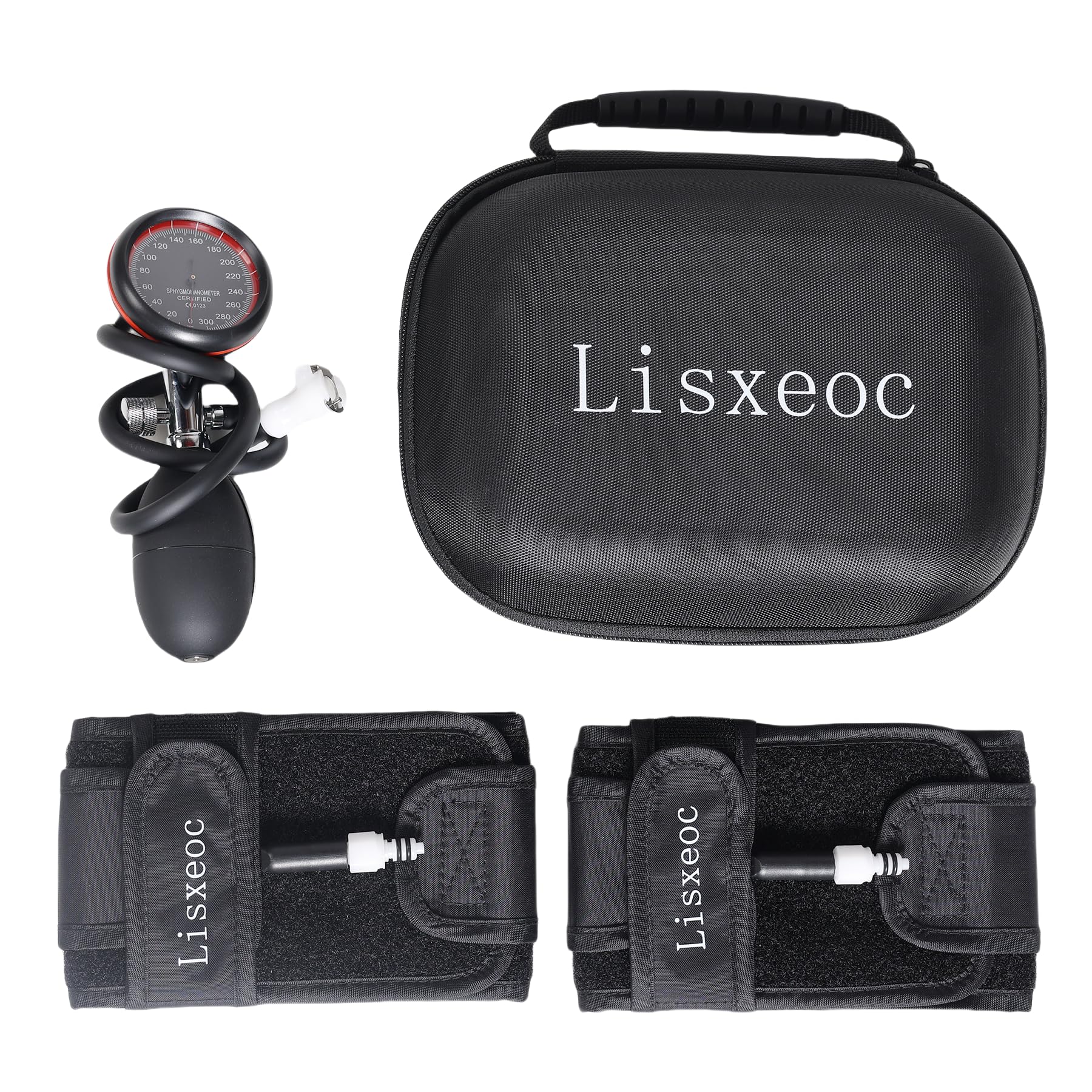
Dial in a precise pressure, then dump it fast with a detachable pump.
For anyone who wants BFR to feel the same every session, the Lisxeoc’s selling point is control. It uses a precision pump to set pressure on the inflatable cuffs, with a quick-release valve so you can drop compression the instant a set ends rather than wrestling a strap loose. The cuffs measure 41.5 inches long by 3.93 inches wide, made of a cotton-blend material, and the whole kit runs 1.4 pounds with a door anchor included.
The hardware behaves like a blood-pressure cuff, and that is the strongest argument for it. The pump detaches, so you can inflate, read the pressure, then release cleanly — good for tracking results workout to workout. It suits home use with the case and manual included. The trade-off is bulk and branding: compared with a bare nylon strap, there is more gear to manage and it is harder to slip into a gym bag.
The draw: Consistent, repeatable pressure plus a fast release valve — the two features that make BFR easier to train consistently.
The trade-off: More equipment to carry and set up than a simple strap, so it is best kept as a home or studio tool.
Best for: A home trainer who wants to log a pressure number and repeat it, rather than guess each set.
Not the pick for: Someone who wants the smallest, simplest thing to toss in a duffel on the way to the gym.
6. Puxhoea BFR Training Bands
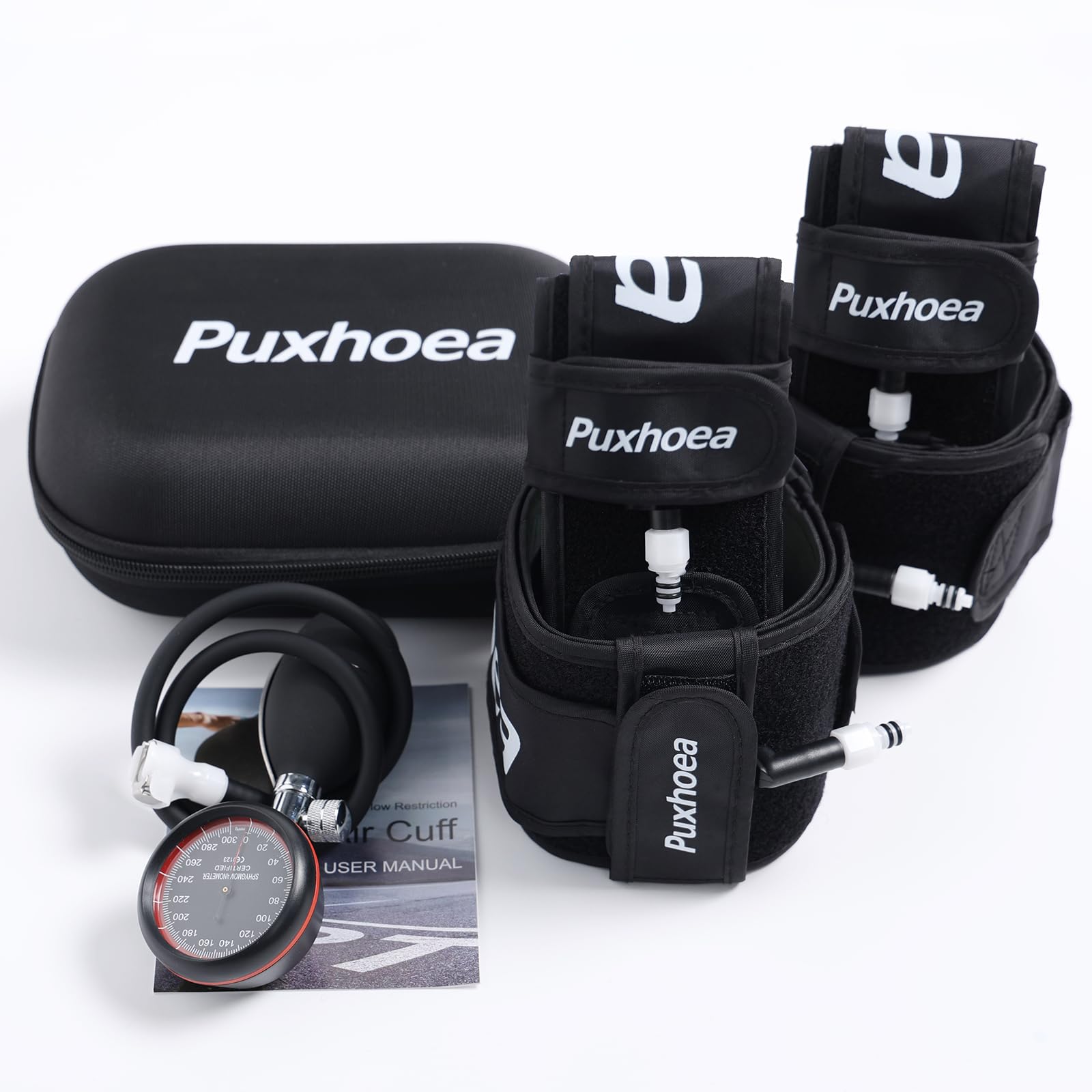
Four bands and a multi-chamber pump for a full-body occlusion session.
This is the most complete kit on the list. You get 2 arm bands and 2 leg bands, a precision pump with pressure guidance, a multi-chamber design for even compression, and a carry bag with an instruction manual. The bands adjust, so the same set fits a wide range of limbs — arms, biceps, thighs, glutes — without buying separate sizes. At 1.6 pounds the whole thing still packs down for travel.
The pressure control is the reason to pick this over simple straps. A pump with a gauge lets you set a PSI target and hold it, which is the difference between a repeatable session and a guess. Four bands also mean you can train a specific zone while leaving the others in the bag — a real advantage if you mostly work biceps or thighs. Compared with the single-strap nylon picks, the Puxhoea trades portability for full-body coverage and measurable pressure.
The fair caveat is that more parts means more places to wear. The multi-chamber cuffs and hose fittings are the pieces to keep an eye on, and the manual’s own guidance is worth following on how many bands to wear at once. This is a serious kit for someone committed to BFR, not an impulse buy for a casual try.
Why It Earns The Extra Parts
- 2 arm and 2 leg bands cover a full-body session in one kit
- Precision pump with pressure guidance and a multi-chamber design for even compression
- Adjustable cuffs fit a wide range of arm and leg sizes
- Carry bag and manual included for structured training on the go
Keep An Eye On
- More components means more wear points — the hose fittings and cuffs take the load
- Bulkier and more involved to set up than a single strap
- The highest-tier kit here, so it suits committed users over casual ones
Go for it if: You want one kit that covers arms and legs with a repeatable pressure setting.
skip it if: You only train one zone and prefer minimal gear — a single pair of straps will serve you.
Know the Specs
Cuff Circumference Range
This is the measurement around the limb the cuff is built to fit — such as 34–50 cm for a large adult arm or 12–17 cm for a child. If you buy a cuff whose range does not cover your measurement, it will not seal evenly, and the reading or the occlusion pressure becomes unreliable. Always measure the actual circumference before you buy. It is the one spec that decides whether a cuff works at all.
Pressure Method: Gauge vs Pump vs Strap
A manual gauge cuff uses a dial you inflate with a bulb and read yourself. A pump-based training cuff lets you set a target pressure and release it with a valve, which makes repeat sessions more consistent. A simple nylon strap tightens by feel with no number at all. Each method trades precision for simplicity — the more precise the pressure, the more parts and setup it tends to require.
Millimeters Hg and PSI
Millimeters Hg (mm Hg) is the pressure unit a blood-pressure manometer reads on its dial. PSI is the pressure unit some training pumps use to set occlusion. Both are simply ways to state how hard a cuff is squeezing. A higher number means more compression, and the right number depends on your limb and your goal — not simply “more is better.”
Strap Width and Buckle Hardware
Strap width affects how the compression feels and where it sits — a 1-inch band is designed to sit between muscle groups rather than choke them. The buckle is the part that holds tension: metal with grip teeth resists slipping better than a plastic clip under load. On any cuff, check the buckle, the valve, and the hose connections first, because those are the parts that wear out.
Common Questions
What is the difference between a blood pressure cuff and a BFR training band?
How do I measure my arm for a BFR cuff?
Are pump cuffs better than manual nylon straps?
Can I use BFR bands on my legs as well as my arms?
How tight should a blood flow restriction cuff be?
What is the best BFR cuff for a child or toddler?
Do metal buckles or plastic clips hold BFR pressure better?
Can I read a manual gauge cuff by myself?
How long should a BFR band last?
Is BFR training safe to do at home?
The Bottom Line
For most people, the blood flow restriction cuffs winner is the McKesson Aneroid Sphygmomanometer. It is a manual gauge cuff with a 34–50 cm range (about 13–20 inches around), a 300 mmHg chrome-plated manometer (the pressure dial), and a lifetime calibration warranty. That combination makes it the most reliable choice for careful readings on larger arms. If you need a pediatric fit, the McKesson LUMEON cuff covers 12–17 cm (about 5–7 inches). And if you are training rather than measuring, the Puxhoea BFR kit gives you four bands and a pump for full-body occlusion work. Match the cuff to the job — that is the whole decision.
How we choose
We do not accept paid placement. Every pick is matched to a real buyer and a real use-case; we do not hands-on test units.
Sources
Specifications: manufacturer listings and product documentation. Review insights: verified customer reviews, as of October 2026. Pricing: not shown on this page (it changes often); check the current price via the retailer link.
As an Amazon Associate, Aappliancez earns from qualifying purchases. This does not affect which products we feature.