Disclosure: Some links in this post are affiliate links. As an Amazon Associate I earn from qualifying purchases, at no extra cost to you. Learn more
Specs are compiled from manufacturer listings and verified buyer reviews and can change over time — please confirm the key details on the product page before buying.
If you want the shortest honest answer: the Pelsee P12 Pro is the pick most drivers should start with, because it puts a 4K front camera, a 1080P rear view and a blind spot warning into one mirror you already look at anyway. Everything else on this list solves a narrower problem — pure radar for a metal-bumper car, a wide side camera for a trailer, or a big touchscreen for an RV. Below you get each one explained in plain words, so you can match the system to your vehicle instead of guessing.
This guide is built by comparing the manufacturers’ published specifications and the patterns across verified customer reviews, so you get each pick’s real strengths and trade-offs instead of marketing spin.
Blind spot gear splits into two families, and knowing which one you need saves you a wasted weekend. Radar kits see through plastic bumpers and warn with a light; camera kits show you a picture you have to read yourself. This breakdown of the blind spot detection systems covers both families so you buy the right one for your bumper and your wiring skills.
Top Picks

How To Choose The Best Blind Spot Detection Systems
The first question is not which brand — it is what your bumper is made of. Radar sensors send out radio waves (millimeter-wave radar, meaning a very short high-frequency signal) and those waves bounce off metal. Mount a radar head behind a steel bumper and you get nothing useful, or endless false alerts. Behind a plastic bumper, the same sensor reads cleanly through the cover. Check that before anything else, because it removes half the list instantly.
Decide if you want a warning or a picture
A radar kit tells you a car is there with a light and a beep. A camera kit shows you the car, and you judge the gap yourself. Warning-only systems demand less attention at speed; camera systems are better for slow work like parking, reversing and tight loading docks, where seeing the corner of your bumper matters more than a beep.
Work out your wiring before you order
Almost every kit on this list needs power, a ground, and a tap into your turn-signal wires if you want the lane-change beep. Radar kits usually also need the sensors angled to a set degree, and a few degrees off is the difference between accurate and constant false alarms. If the idea of removing a bumper panel makes you uneasy, plan on paying an installer — and factor that into your decision, not your gear choice.
Match the monitor to the vehicle
A 4.3-inch screen is fine in a compact car but useless across a motorhome cab. Long vehicles also break wireless links, which is why the big-rig kits here run aviation-style cables instead of a radio signal. Decide your screen size and your cable run before you decide the brand.
Side-by-Side Comparison
| Model | Best For | Detection Tech | Coverage / Range | Screen & Alerts | Amazon |
|---|---|---|---|---|---|
| Pelsee P12 Pro★ Best Overall | Everyday cars wanting video plus blind spot alerts | Camera + BSD algorithm | 150° field of view | 12″ touch mirror, LED + alerts | Amazon |
| RexingUSA M2Best Mirror Alternative | Mirror-style recording with lane assist | Radar BSD + ADAS | 170° field of view | 12″ IPS touch, GPS logging | Amazon |
| Venluna Wireless RV SystemBest for Trailers | Trailers and fifth wheels needing rear view | Wireless camera + BSD alert | Up to 500 ft open area | 7″ IPS touch, DVR recording | Amazon |
| Venluna CarPlay RV Kit | Large rigs wanting four-camera coverage | Wired camera + BSD alarm | 4 cameras at 145° each | 10.36″ touch, CarPlay / Android Auto | Amazon |
| BlueDex 24GHz BSD Kit | Plastic-bumper cars wanting radar only | Dual 24GHz radar | 1–32.8 ft (0.3–10 m) | LED pillars + buzzer | Amazon |
| EASYGUARD EBS001 | Replacing a dead factory blind spot system | Dual 24GHz radar | 6–12 m | LED light + buzzer | Amazon |
| PDZGZ 6.25″ Side View | Seeing both sides on one small screen | Dual side cameras | 170° field of view | 6.25″ touch, BSD + ped warning | Amazon |
| GRLATG A65S | Vans and Sprinters in tight city work | Dual cameras, AHD | 120° side view each | 6.25″ IPS touch, sound + light | Amazon |
| Wilove BSM Kit | Budget alerting on a small car | 58KHZ ultrasonic | 0–5 m | LED light + buzzer | Amazon |
| Pyle PLBLSP40 | Low-cost ultrasonic starting point | 2 ultrasonic sensors | 0–5 m, ±3 cm | LED indicators + buzzers | Amazon |
| 3T6B Side Camera Kit | No-drill camera on a door | Single side camera | 120° field of view | 4.3″ LCD, 30 FPS | Amazon |
Detailed Reviews
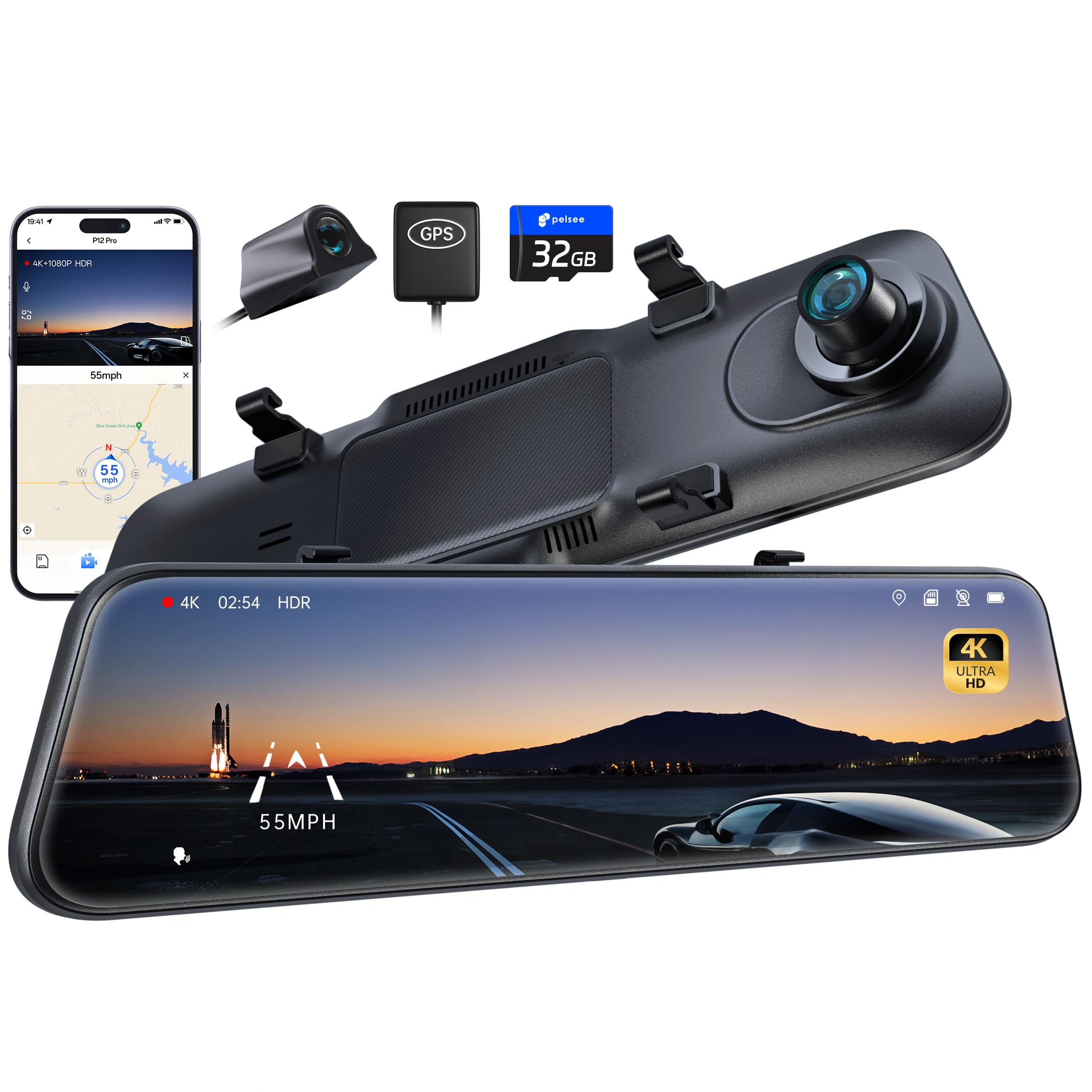
1. Pelsee P12 Pro 4K Mirror Dash Cam with ADAS and BSD
Our pick — 4.0+★ from 2,500+ verified ratings; the strongest balance of quality and price.
The widest-viewing rear camera here, and it replaces the mirror you already use.
For a driver who wants the blind side covered without adding a second screen to the dash, this is the most complete single-box answer on the list. It records the road ahead in 4K Ultra HD while the rear camera records in 1080P, and clips leave the camera over 5.8GHz WiFi at speeds up to 20MB/s — fast enough that a whole trip segment is on your phone before you leave the parking lot.
The blind spot help comes two ways. The BSD algorithm watches the dangerous zone beside you during lane changes and while reversing. On top of that, the ADAS system fires five separate alerts: forward collision, pedestrian collision, lane departure, headway monitoring and forward movement. The 150° rear field of view is the widest here, and it is what makes the mirror work — owners consistently say the wide angle simply covers the areas a standard mirror cannot show.
What people like most is that it just works as a mirror. The HomeLink garage buttons still function, the strap mount is discreet, and a 4-month support story ended with a replacement unit that fixed a screen delay — buyers report “6 months in a 2017 Avalon, works fine, easy install.” The honest trade-offs: the touchscreen responds slowly, rear objects look closer than they are, and night vision splits opinion — some drivers find the blind spot view sharp after dark, others find it murky. One thing to check before ordering: at 11.81 inches long it may not fit mirrors shorter than 6.3 inches, and its 19.6 ft rear cable will not reach the back of a van or full-size SUV without the separately sold extension.
What earns its place first
- 4K front plus 1080P rear recording in one mirror-mounted unit
- 150° rear field of view — the broadest on this list
- 5 ADAS alerts plus a dedicated BSD algorithm for lane changes
- GPS logging and a 32GB card included, so evidence is timestamped
Points to weigh up
- Touchscreen input is slow to respond
- Subjective night vision — split opinion on how clear the dark view is
- Parking mode needs a separate hardwire kit you must buy
Buy this if: you drive a normal car, want a factory-style mirror with recording and blind-spot alerts together, and you would rather not bolt sensors into a bumper.
Think again if: your truck or van has a long run to the rear window — you will need the extension cable alongside it.
2. RexingUSA M2 Smart BSD ADAS Dual Mirror Dash Cam
Where the Pelsee shoots 4K up front, this one stays FHD and adds a 170° lens.
The Rexing M2 records both front and rear at 1080P and streams the rear image across a 12-inch IPS touch screen built into the mirror. Both halves record in full high definition at the same time, so there is no trade-off between the view and the evidence. The 170° field of view is wider on paper than the Pelsee’s 150°, and it also logs GPS so time, date, location and speed are burned into each clip.
Where it separates itself is convenience at the tail end of a trip. A hardwire kit is included in the box, so the 24/7 parking monitor — which wakes and records a 20-second clip on vibration — works without buying anything else. That is a real difference from the Pelsee, where the same feature needs a separate kit. The radar-based BSD with Lane Change Assist gives you the same light-and-warning logic, and the auto backup camera view takes over the mirror whenever you shift into reverse.
Set your expectations on the picture itself. As a mirror replacement the view is narrower than a real rearview glass — you lose the amount of scene a plain mirror gives you, and with the display switched off you see nothing behind at all. The lens also favours the right side, which means off-centre mounting and fiddling to balance the view across both lanes. Treat it as a safety camera that doubles as a mirror, not as a true mirror replacement.
A fair read on the trade: you swap a little rear view for dual 1080P recording, radar blind spot monitoring and a parking monitor that runs straight from the start with no extra purchase.
The thing to accept upfront: the view is tighter than the glass mirror it replaces, and the lens leans right — if seeing emergency lights far behind you matters, keep your side mirrors in the loop.
Reach for this if: a full parking-monitor setup with the hardwire kit bundled in appeals to you more than maximum front resolution.
Look elsewhere if: you want the mirror to feel exactly like a mirror — the narrower view will bother you.
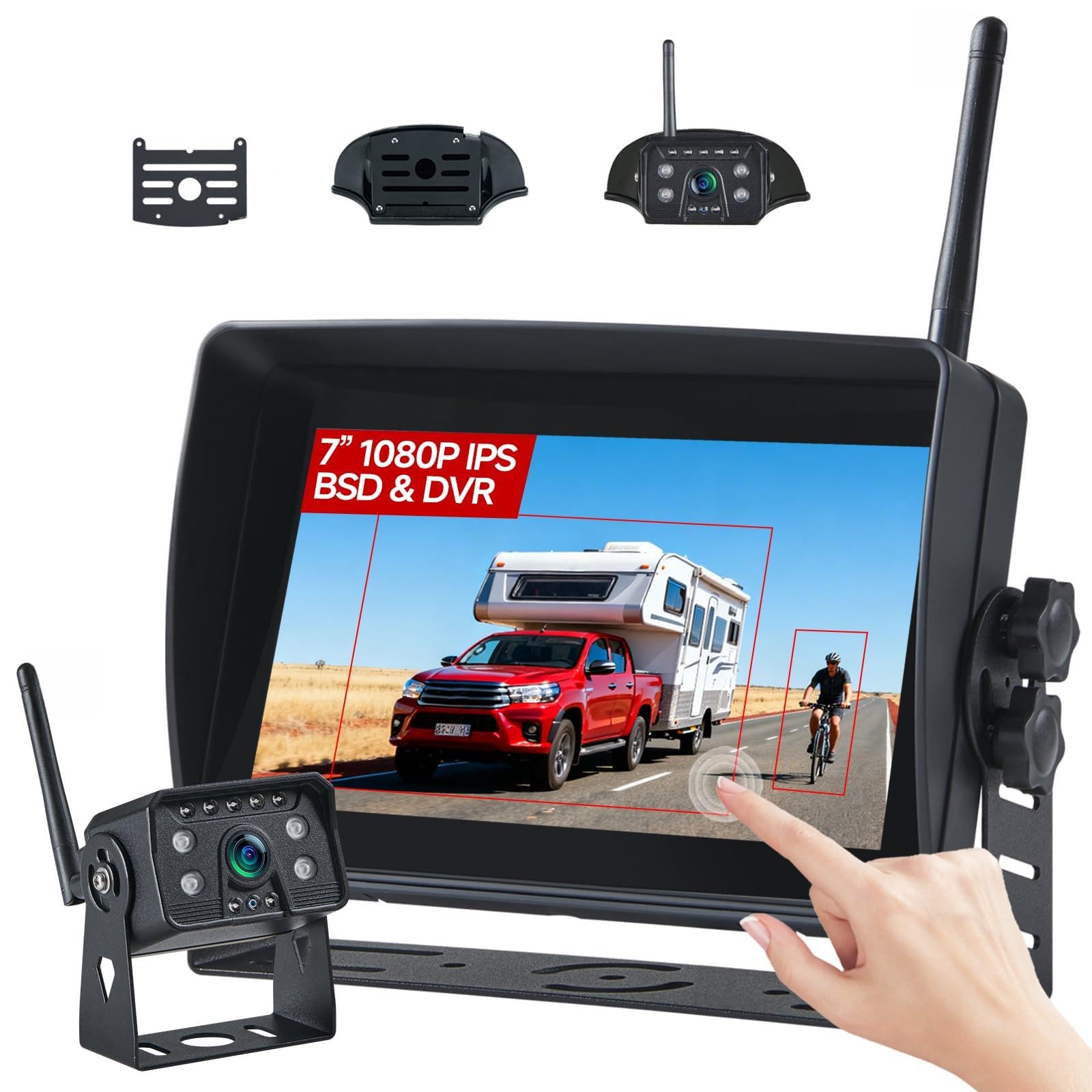
3. Venluna Wireless RV Backup Camera System with BSD Alert
Half a thousand feet of wireless range, built for the vehicle behind you.
Trailers, campers and fifth wheels are a different problem from a sedan — the car you need to see is a long way back and the cab is noisy. This kit answers with a 500ft transmission range in open areas, a 1080P camera and a 7-inch IPS touch monitor. The camera is rated IP69K waterproof, which is the highest-pressure wash rating of the group, so a truck wash or a heavy storm does not shut it down. Infrared night vision carries the picture up to 60ft in the dark.
The blind spot logic here is proactive rather than passive. It runs an AI human detection routine that flags pedestrians and obstacles in your blind spots and alerts you immediately, which matters when reversing something bulky. The monitor records in 1080P and overwrites the oldest footage when the card fills, and a cigarette-lighter plug powers the whole thing. Quality is what wins people over in the feedback — the display is bright and clear enough to see vehicles 100-plus yards behind the trailer, and mirror mode makes it usable for lane changes as well as reversing.
Here is the catch, and it is worth reading before you buy: “wireless” describes only the link between camera and monitor. Both ends still need a power cable, and more than one buyer found that out on the driveway. Long trailers with a lot of metal and city interference can also drop the signal — one 31-foot camper owner reports dropouts in built-up areas. Get the antennas tight and repositioned, and most of the reported lag clears up.
The short version: the strongest option here for a towed vehicle, because 500ft of range and an IP69K camera are built for the back of a trailer, not a parking space.
Know before you order: you will still run a power wire to the camera — plan for it rather than being surprised.
4. Venluna RV Camera System with CarPlay and Android Auto

Four cameras, eleven split-screen layouts, and no radio signal to drop.
If the wireless kit above worries you because big metal bodies cut signal, this is the wired counter-argument. Four IP69 waterproof cameras at 145° each feed a 10.36-inch HD touch screen through aviation-grade cables — one 55ft, one 33ft and three 16ft — so there is no radio link to flicker in a city. It also brings Apple CarPlay and Android Auto to the cab, which means navigation, music and calls run through the same screen as your camera views. Eleven split-screen modes let you stack front, rear and both sides at once.
The blind spot feature is audible as well as visual, and the detection range is adjustable to suit how early you want the warning. Reliability is the part that lands best in owner feedback — one 16ft box truck owner reports it “clears up issues we had with blind spots on both sides and the rear,” and a 2003 Blue Bird skoolie conversion runs the whole system on under 10W, comfortably inside a modest battery bank.
Two honest notes. The built-in microphone is the weak link — hands-free calls through the system are hard for the other person to hear, and there is no port for an external mic, so if calls are your priority use your phone directly. Picture quality is genuinely mixed in the reviews: the screen is bright and clear in daylight, but bright lights at night blur the image and there is no infrared, so it relies on ambient light. Build quality draws split opinion too.
What you get for the money: the most coverage of any kit here — four cameras, a 10.36-inch screen, flight-grade cabling and CarPlay in one install.
What to accept: night video needs external light to stay sharp, and the microphone will not carry a phone call cleanly.
Meant for: long rigs and conversions where a signal dropout is unacceptable and you want navigation on the same glass as your camera feed.
Not for: anyone who plans to run conference calls over the dash — use the phone in your hand instead.
5. BlueDex Blind Spot Monitoring 24GHz

Two radar heads, no screen, and alerts that change with your turn signal.
This is what a blind spot system looks like without any camera involved. Twin 24GHz millimeter-wave radar sensors (radio sensors that read a moving vehicle by the way it reflects a high-frequency signal) watch 1–32.8 ft from your bumper, and the warning logic is genuinely smarter than a plain beep. Indicator light only when a car sits in the zone. Signal on and the light flashes with three buzzer beeps. Hazard lights on and it flashes and beeps continuously. The kit includes an angle alignment tool, and that tool is not a gimmick — it is the difference between working and beeping all day.
Quality is the thing owners rate highest here, and the professional-install crowd is the happiest group. One shop runs it commercially and says it fires every single time, unlike another brand whose sensor behaved randomly. A driver who set the sensitivity to 22 degrees reports no false alarms and only a brief ding when a car is genuinely alongside. Highway use is where it shines — a 2013 VW Beetle owner calls it the best mod on the car, especially after dark.
The trade-off is honesty about what radar can do. It sees metal, so it also sees trees, signs, fences and guard rails if the angle is a shade off — the loudest criticism is constant beeping on a badly aimed install. Some drivers also report the sensors reaching two or three lanes over on the freeway. Professional fitment, a correct 22-degree angle and a willingness to tinker with mounting brackets turn this into a reliable system; a rushed Saturday job turns it into a nuisance. Sensors also cannot see through metal bumpers, so a plastic or taped-on rear bumper is mandatory.
Why drivers stick with it
- Three-stage warning tied to your turn signal and hazards, not just a constant light
- 1–32.8 ft detection plus an included alignment tool for accurate angling
- Works in rain, fog and after dark when a camera view gets hard to read
Where it asks patience
- Out-of-spec mounting angle is the main source of constant beeping
- Can pick up traffic two or three lanes away at speed
- Needs a plastic bumper and a professional-standard install
Pick it when: you want no screen on the dash and you are happy to pay an installer to angle two sensors properly.
Leave it if: you plan a driveway install with no angle tool — a poorly aimed radar head will beep at every tree.
6. EASYGUARD EBS001 Blind Spot Monitor System

Built to stand in for a factory system that has already given up.
The most convincing use for this kit is not upgrading a car — it is replacing a dead factory blind spot monitor without paying dealer prices. It runs two 24GHz microwave sensors and watches neighbouring lanes from 6 to 12 metres, faster than the ultrasonic kits here, and only when the closing speed between you and the other car is over 0.5 metres per second. That filter is why it ignores parked cars and focuses on traffic actually overtaking you.
The warning escalates with the situation. A light flashes when something enters the zone. Turn the indicator on and it flashes faster with three buzzer beeps. One owner replaced a failed factory system with it and had it running correctly after two months. Another highway test found it accurate every time: light on with a car in the blind spot, flash and beep with the signal. The install is the barrier: it wants the plastic bumper skin off, sensor mounting at roughly 20 degrees, and a tap into the taillights and a 12V socket.
Budget an afternoon and buy a trim removal kit. Wiring can run short of the dashboard on some cars — a Honda Accord needed a couple of feet of splice — and the sensor angle often wants tuning down from 20 to about 17 degrees to quiet false alerts. One right-side sensor working intermittently is the kind of thing that happens with a rushed fitment; done slowly, the system is dependable. Metal bumpers are a hard no, since the radar cannot read through them.
The use case that fits: a car whose factory blind spot lights no longer work and a driver who wants the same light-and-beep logic back without a dealer invoice.
The reality check: plastic bumper only, bumper skin off, and enough patience to land the sensor angle just right.
Right for you if: your existing system has failed and you already know your way around a trim panel.
Wrong for you if: the car has a metal bumper or you want a bolt-on-and-go job.
7. PDZGZ 6.25″ Car Side View Blind Area System

Two side images on one small screen, so you see the gap instead of guessing.
Some drivers cannot twist far enough to check a shoulder, and no beep replaces seeing the space. This kit puts a 6.25-inch single screen with both left and right camera views on it, a 170° wide lens on each side, and an all-aluminium body that stays cool and disappears into the trim. The touchscreen handles everything — the bottom left corner silences the warnings, the bottom right opens the warning area settings, and the bracket is magnetic so you can position it wherever you can see it.
What wins people over is the picture at night. Several owners rate its night image above the camera systems in far more expensive cars, and the feedback keeps returning to blind spot visibility — the screen is bright and clear enough to spot what is alongside you in low light. A driver with a limited range of motion reports it helps avoid blind spot conflicts on a routine basis, and the no-drill installation is genuinely quick.
The catch is the lens itself. A fisheye view that wide flattens distance, so an approaching car looks further away than it is — one driver came close to a collision trusting it as a sole reference, and everyone who has lived with it says keep using your side mirrors. The touchscreen runs warm even when idle, the firmware sometimes mistakes a tree or sign for a vehicle, and the constant current draw means a car left sitting can see its battery run down.
The verdict on the picture: night vision is the standout — it out-reads cameras fitted to far more expensive vehicles — and two views on one 6.25-inch screen is a smart use of dash space.
The honest limit: a 170° fisheye makes gaps look bigger than they are, so this is a supplement to your mirrors, never a replacement.
Suits: drivers with limited neck movement or a wide vehicle who want both sides visible at a glance.
skip it if: you want a system that removes the need to check mirrors — this one adds to them.
8. GRLATG A65S Blind Spot Camera and Display System

A 7.36-ounce side camera taped to the door, no drilling involved.
City driving in a Sprinter or a box van is where a side camera earns its keep, and this kit is built for exactly that — a 6.25-inch IPS screen showing left and right images at once, 1080P high definition through an AHD signal, and two rotating cameras with a 120° side view. You adjust the horizontal angle of each camera to suit the vehicle, and the screen brightness steps up or down automatically with the time of day, so it is not glaring at night and not washed out at noon. Picture position can be nudged up, down, left or right to land the view where you want it.
The mounting is the smart part. Each camera is a sealed shark fin shape, rated IP68 waterproof (built to survive submersion, not just rain) and fixed with double-sided tape to the side of the door, so there is no hole to drill and nothing ugly on the outside. It weighs 7.36 ounces for the whole kit and includes both a car charging lead and a fuse-box power lead, so you have a choice of how to feed it. A Sprinter owner in busy traffic says the cameras make city driving much more comfortable to handle.
Two things a buyer should know. The wiring is real — two cameras means two cable runs, and one owner who preferred this to a Bluetooth setup still routed cable under the roof liner. And the screen size is modest at 6.25 inches; if you need to read fine detail from a big cab, you may want more glass. The wired signal is the reason it responds quickly and keeps video quality up, so that trade is deliberate.
If you want a picture, not a beep: this gives you both flanks on one small screen with no drilling and no wireless dropout.
Accept the trade: two cables to route and a 6.25-inch screen — the wired connection is what buys you the fast response.
9. Wilove Car Blind Spot Monitoring System

Small-car alerting, with door-open warning as a useful extra.
The Wilove kit uses 58KHZ ultrasonic sensors (the same kind of sound-wave sensing a parking sensor uses) to watch 0–5 metres of the lane beside you, flashing an LED when a moving object enters the zone. It suits a compact car or a small MPV on a 12V system and comes with a light-and-buzzer warning for lane changes. There is one genuinely handy extra: when you are about to open the door, it warns you if something is moving up behind you — a classic city-cycling scenario that most of the radar kits ignore.
Be realistic about the limits. Ultrasonic sensing is short-range compared to the 24GHz radar kits on this list, and the feedback makes clear that range and placement matter enormously. Curb, trees, rails and guard rails are all capable of setting the light off, and there is no adjustment on the unit to tune that out. Several owners also found the instruction sheet too thin for a confident DIY fit, and a couple of units arrived not working.
So the honest read is: this is the cheapest way to try a warning light in a small car, and the install is basic rather than beginner-friendly because it still needs holes drilled. If you accept a little false alerting and want that door-open safety angle, it works. If you want a system that reads distance accurately and quietly, spend the money on the radar kits instead.
Where it makes sense: the door-open warning is a real safety extra at a budget tier, and a compact car with a short flank is within its 0–5 metre comfort zone.
Where it falls short: fixed sensitivity and thin instructions mean you get more false alerts than the radar options — treat this as a trial, not a permanent install.
Worth a go if: you drive a small car, want the door-open alert, and do not mind a warning light that occasionally cries wolf.
Better to upgrade if: accurate range and quiet running matter more to you than the lowest entry point.
10. Pyle PLBLSP40 Ultrasonic Blind Spot Detection System

The lowest entry into a three-function warning system, and it shows.
Pyle bundles two ultrasonic sensors, two LED warning lamps with buzzers, and the harness into one kit that covers three jobs: blind spot detection, lane change assist, and rear cross traffic alert. The sensing reads 0–5 metres with ±3 cm accuracy, and the working temperature spans -40°F to +185°F, so heat and cold are covered. It fits 12V vehicles and pulls a maximum of 5W, which is negligible against your alternator.
The sensor heads sit inside the tail light housing on some vehicles and end up looking close to factory — barely visible and well out of the way. On a 2015 Jeep Wrangler with no existing system, a taped and wired install took around 2.5 hours and worked cleanly afterwards. Owners mention “~2.5 hours install with clean wiring; works well,” and that is the right expectation for a job like this: a weekend morning, a drill, and some panels to shift.
The limits at this price are real and worth saying plainly. The instruction sheet is almost non-existent, so you decide drill locations and depth yourself. One unit produced only a tone with a stuck LED and never worked, and support did not pick up the pieces. Treat the cheap kit as the entry point for someone with mechanical confidence, not as a plug-and-play safety device, and you get what it is good at — a budget alert system with a real cross traffic function.
For the confident DIYer: three functions, ±3 cm accuracy and a 5 metre range for the least money here.
Not for the first-timer: almost no instructions and no support safety net if a sensor turns out dead.
11. 3T6B Side View Camera and 4.3″ Monitor Kit

A glue-on side eye for a pickup or trailer, cheap and quick to fit.
This is the simplest idea on the list: one 120° wide-angle camera, stuck to the side of the car with strong adhesive tape, feeding a 4.3-inch colour LCD screen at 30 frames per second. There is no drilling and no holes to rust, the camera sits small and hidden against the body, and colour night vision keeps the surroundings visible after dark. It suits pickups, trailers, SUVs and RVs — vehicles with a long, high side where a mirror misses the near corner.
On a pickup it does a useful second job, adding a side view that blends in with the vehicle’s own shape when the camera sits on the front door edge. Mounting is quick — the screen weighs little and tucks into the corner of the windshield without blocking your view. It works day and night, and one owner was pleased that the cable route stayed clean and out of sight.
The image itself is the weak spot, and several owners say so. Daylight picture quality is soft on some units, and a couple arrived with a faulty screen or camera. The design also has one fixed angle: the camera cannot be rotated on its mount, so to get the view you need the screen itself has to be turned sideways into portrait — which cuts the visible field. And the adhesive, in one case, did not hold.
What it does well: no-drill mounting, a compact 4.3-inch screen and colour night vision make it a low-fuss way to add one blind-side view.
What you trade: soft daytime image quality and a fixed camera angle that forces the screen into portrait for some views — fine as a supplement, not a complete system.
A sensible buy if: you want one cheap extra view of a long flank and you are happy to glue rather than drill.
Look elsewhere if: you need adjustable angles or the sharpest daytime picture.
Know the Specs
Radar vs ultrasonic sensing
Millimeter-wave radar (24GHz, a high-frequency radio signal) reaches further and works in rain, fog and darkness, and it can read closing speed — which is why the radar kits here ignore parked cars. Ultrasonic sensing uses sound waves over a short range and is cheaper, but it is more easily confused by curbs, signs and rails. Neither sees through a metal bumper; radar in particular needs a plastic or non-metallic cover to read cleanly.
Field of view and fisheye distortion
Field of view is the angle a camera can see, measured in degrees. A wider angle covers more of the flank but flattens distance, so an approaching car looks smaller and further away than it is. Cameras at 120° to 145° are a practical middle ground for a side or rear view; the 170° lenses show the most but demand the most judgement from you, and should always be used alongside your mirrors.
Waterproof ratings explained
An IP rating has two digits: the first is dust protection, the second is water. The second digit runs from 0 to 9K, and 9K is the toughest of the shower-style tests, built for high-pressure, high-temperature washing. An IP68 camera handles being submerged in water, which matters for a bumper-mounted camera on a vehicle that gets rained on and pressure-washed. Anything exposed on the outside of a car wants at least IP68 or IP69K.
Wired vs wireless transmission
Wireless means the link from camera to monitor travels by radio signal. It is quick to install but drops in long trailers, heavy metal bodies and city interference, and it adds a fraction of a second of lag. A wired connection runs a cable end to end and gives a stable, lower-lag picture — the reason the big-rig kits on this list use aviation-grade cables. Remember that even a “wireless” system still needs a power cable to each device.
Common Questions
Will a radar blind spot sensor work behind a metal bumper?
Do I still need my side mirrors with a blind spot camera?
How long does it take to install a blind spot detection system?
Why does my blind spot system beep constantly at parked cars and trees?
What is the difference between BSD, LCA and RCTA?
Can I install a blind spot monitoring system myself?
Will a blind spot system drain my car battery when parked?
Is radar better than a camera for detecting a car in the next lane?
How far behind my car should a blind spot system detect a vehicle?
Do these systems work on a 24V truck as well as a 12V car?
Will a wireless camera system lag on a long trailer?
The Bottom Line
For most drivers the blind spot detection systems decision depends on one question: do you want to see the gap or be told it exists? If you want both at once, the Pelsee P12 Pro is the pick — a 4K front camera, a 1080P rear view and a blind spot algorithm in a mirror you already glance at, and it carries the strongest owner consensus on this list: 4.0+ stars from 2,500+ ratings.
If your vehicle is a trailer or a fifth wheel, reach for the Venluna wireless RV kit instead — its 500ft range and IP69K camera are built for the back of a towed body. And if you have a plastic rear bumper and want a pure radar alert with no screen on the dash, the BlueDex 24GHz kit is the one to fit, provided you take the time to aim it properly.
One buying note worth acting on: the highest-rated pick here is also among the most affordable, so there is no reason to trade down to a shorter-range kit to save a little — start with the mirror choice and work backwards from your vehicle, not from the price tag.
How we choose
We do not accept paid placement. Every pick is matched to a real buyer and a real use-case; we do not hands-on test units.
Sources
Specifications: manufacturer listings and product documentation. Review insights: verified customer reviews, as of October 2026. Pricing: not shown on this page (it changes often); check the current price via the retailer link.
As an Amazon Associate, Aappliancez earns from qualifying purchases. This does not affect which products we feature.