Disclosure: Some links in this post are affiliate links. As an Amazon Associate I earn from qualifying purchases, at no extra cost to you. Learn more
Specs are compiled from manufacturer listings and verified buyer reviews and can change over time — please confirm the key details on the product page before buying.
If you want a smoke alarm that blends into a dark ceiling instead of glaring white against it, the BRK First Alert 9120BFF is the safest bet on this list, and the X-Sense SC06 is the one to grab if you also want carbon monoxide coverage plus a live CO readout. Everything below is about matching the alarm to the ceiling you actually have — hardwired or battery, smoke-only or smoke-plus-CO — so you are not drilling holes you did not need to drill.
This guide is built by comparing the manufacturers’ published specifications and the patterns across verified customer reviews, so you get each pick’s real strengths and trade-offs instead of marketing spin.
You will see which units run on house wiring, which run on sealed batteries, and which watch for carbon monoxide too. By the end you will know exactly which of these black colored smoke detectors belongs on your ceiling.
Top Picks

How To Choose The Best Black Colored Smoke Detectors
Buying a black smoke detector is really two decisions stacked on top of each other: what the alarm does inside, and how it mounts and powers itself. Get the second one wrong and the first one never gets a chance to matter — you end up with a box in a drawer and a bare ceiling socket. Start by looking at what is already up there, then match the alarm to it.
Hardwired versus battery-powered — check your ceiling first
If you have an existing alarm wired into the house, replacing it with a hardwired unit is usually a straight swap rather than a new project. The BRK First Alert 9120BFF runs on 120-volt household current with a 9V battery backup, so it keeps watching during a power outage. If your ceiling has no wiring at all, a sealed-battery alarm like the X-Sense SC06 skips the electrician entirely — it carries a 10-year sealed lithium battery and needs no rewiring.
Smoke-only or smoke-plus-CO
A standard smoke alarm senses smoke particles and nothing else. A combination unit adds a second sensor for carbon monoxide — an odorless gas you cannot see or smell, which is why it gets its own detector. Both the First Alert SMICO100 and the X-Sense SC06 pair a smoke sensor with a CO sensor in one housing, and the X-Sense adds a display that shows real-time CO readings rather than just sounding an alarm.
Sensor type changes what your alarm is good at catching
Ionization sensors respond quickly to fast, flaming fires — the kind that flare up from paper or grease. Photoelectric sensors are more sensitive to slow, smoldering fires that produce light smoke and little heat, and can smolder for a long time before flames appear. If your alarm sits near a kitchen, a photoelectric unit with a false-alarm filter is often the calmer choice, because it is tuned to ignore everyday steam and cooking smoke.
Sizing the footprint and the mounting hardware
Alarms are not all the same diameter, and the difference is bigger than you would guess. The BRK First Alert 9120BFF measures 5.6″D x 5.6″W x 2.2″H — the largest footprint here — while the battery-powered SITERWELL GS525A comes in at 3.93″D x 3.93″W x 1.38″H, a much more compact disc. If you are covering a wall rather than a ceiling, a smaller housing draws less attention, which is rather the point of choosing black in the first place.
Side-by-Side Comparison
| Model | Best For | Power Source | Sensor Type | Alarm Volume | Amazon |
|---|---|---|---|---|---|
| BRK First Alert 9120BFF★ Best Overall | Whole-home hardwired replacement | 120V AC with 9V backup | Ionization | 85 dB | Amazon |
| SITERWELL GS525ABest Value | Tool-free battery install | 10-year sealed lithium | Photoelectric | 85 dB | Amazon |
| Kidde 20SDR | Bedrooms and long hallways | 2 AA batteries | Smoke detector (multi-sensor) | 85 dB | Amazon |
| First Alert SMICO100 | Combined smoke and CO coverage | Battery powered | Smoke and CO sensors | — | Amazon |
| X-Sense SC06 | Sealed-battery CO monitoring with readout | 10-year sealed lithium | Photoelectric plus electrochemical CO | — | Amazon |
Detailed Reviews
1. BRK First Alert 9120BFF Smoke Detector
Our pick — 4.5+★ from 19,000+ verified ratings; the strongest balance of quality and price.
The old-alarm swap that takes minutes and needs no ceiling repair.
This is the pick for anyone looking up at an alarm that has already outlived its usefulness and wants the replacement to be boring. It runs on 120-volt household current — standard house wiring — with a 9V battery backup that keeps it watching through a power cut. When it detects smoke, you get an 85 decibel alarm, roughly the volume of a blender at full speed, loud enough to carry through a closed bedroom door.
Where it wins is the swap itself. The mounting bracket and AC connector match the existing BRK footprint, so there is typically no new drilling and no ceiling patching. It can also be interconnected with other compatible BRK or First Alert alarms, which means when one detects smoke, they all sound — useful if you are rebuilding a linked system one failure at a time. Line the replacement up against the SITERWELL GS525A here and the trade is obvious: the BRK ties you to house wiring, while the SITERWELL runs on a sealed battery with no wires at all.
The honest catch is the sensor inside. This uses an ionization sensor, which is quick on fast flaming fires but not the gentler option near a kitchen, where cooking smoke can set it off. The battery situation is also worth knowing about before you climb the ladder — units have arrived with a 9V already in place and units have arrived with a flat one, so have a spare on hand. And it is a smoke alarm, not a carbon monoxide detector, so if you want CO coverage you need one of the combination units further down this page.
Where this one wins
- Still works in a blackout thanks to the 9V battery backup sitting behind the 120V main power.
- Interconnects with compatible BRK and First Alert alarms so the whole house sounds together.
- Single test/silence button and a tamper-resistant locking bracket keep things simple.
- Dust cover, new bracket and connector come in the box for a job-site-friendly install.
What to weigh first
- Ionization sensing is fast on flaming fires but more reactive to kitchen smoke than a photoelectric unit.
- It only detects smoke — no carbon monoxide sensor inside.
- Some units ship with a fresh 9V battery and some with a dead one, so check before mounting.
Straight answer: if your ceiling already has wiring and a bracket, this is the least disruptive way to get a working alarm back up there.
Hold off if: you have no existing wiring, or you need carbon monoxide coverage in the same unit.
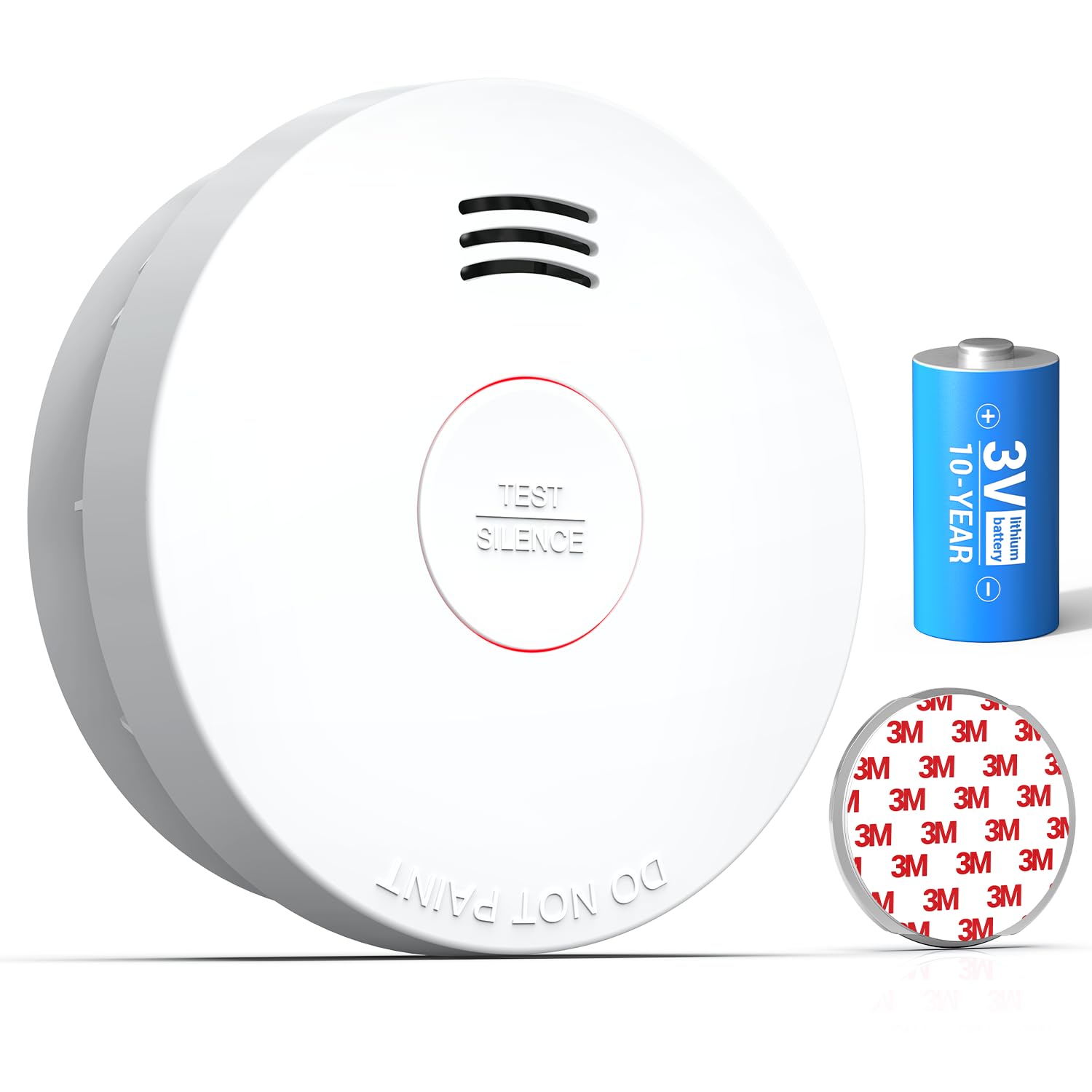
2. SITERWELL Smoke Detector 10 Year Battery
No wires, no battery swaps — a sealed disc that sticks up and stays put.
Start with the number that decides the whole job: 3.93″D x 3.93″W x 1.38″H. That is a notably small disc, and it matters most when you are mounting to a wall rather than a ceiling, where a smaller round face simply reads as less of an eyesore. Against the BRK First Alert above — 5.6″D x 5.6″W x 2.2″H — this is the visibly compact option of the two.
The sensor here is photoelectric, which is the type that responds to the slow, smoldering fires that throw off light smoke and very little heat and can creep along for a long while before anything bursts into flame. It is tested to UL 217, the industry standard for smoke alarms. A 3V lithium battery is built in and is not replaceable — the maker states it runs for 10 years and warns you when it is running low or has faulted. There is an 85-decibel alarm plus a test and mute button big enough to find in the dark. The housing is polycarbonate, so it is a hard plastic shell rather than a decorative one.
What people like most is how quickly it goes up. It ships with both magnets and screws, so you can choose a magnetic mount and skip tools entirely — buyers report capping off the wires from hardwired 1994-era detectors and using wall plates instead, with one describing an easy 30-minute install for five units and no battery chirps afterward. Two things to plan around: the 3V lithium battery inside is not replaceable, so when the fault warning sounds the whole unit is done rather than the battery; and the maker notes magnet plates are packed randomly, so some boxes will not include one. It is also solely a smoke alarm, with no carbon monoxide sensing.
Why the mounting wins: magnets and screws are both in the box, so the install is genuinely tool-free if you take the magnet route.
Plan around this: the sealed 3V lithium battery cannot be swapped, so a low-battery or fault warning means replacing the alarm itself.
Reach for this if: you want a compact, tool-free alarm with no wiring and no yearly battery ritual.
Look elsewhere if: you need a replaceable battery or carbon monoxide detection.
3. Kidde Smoke Detector, AA Battery-Powered, 20SDR, 1 Pack
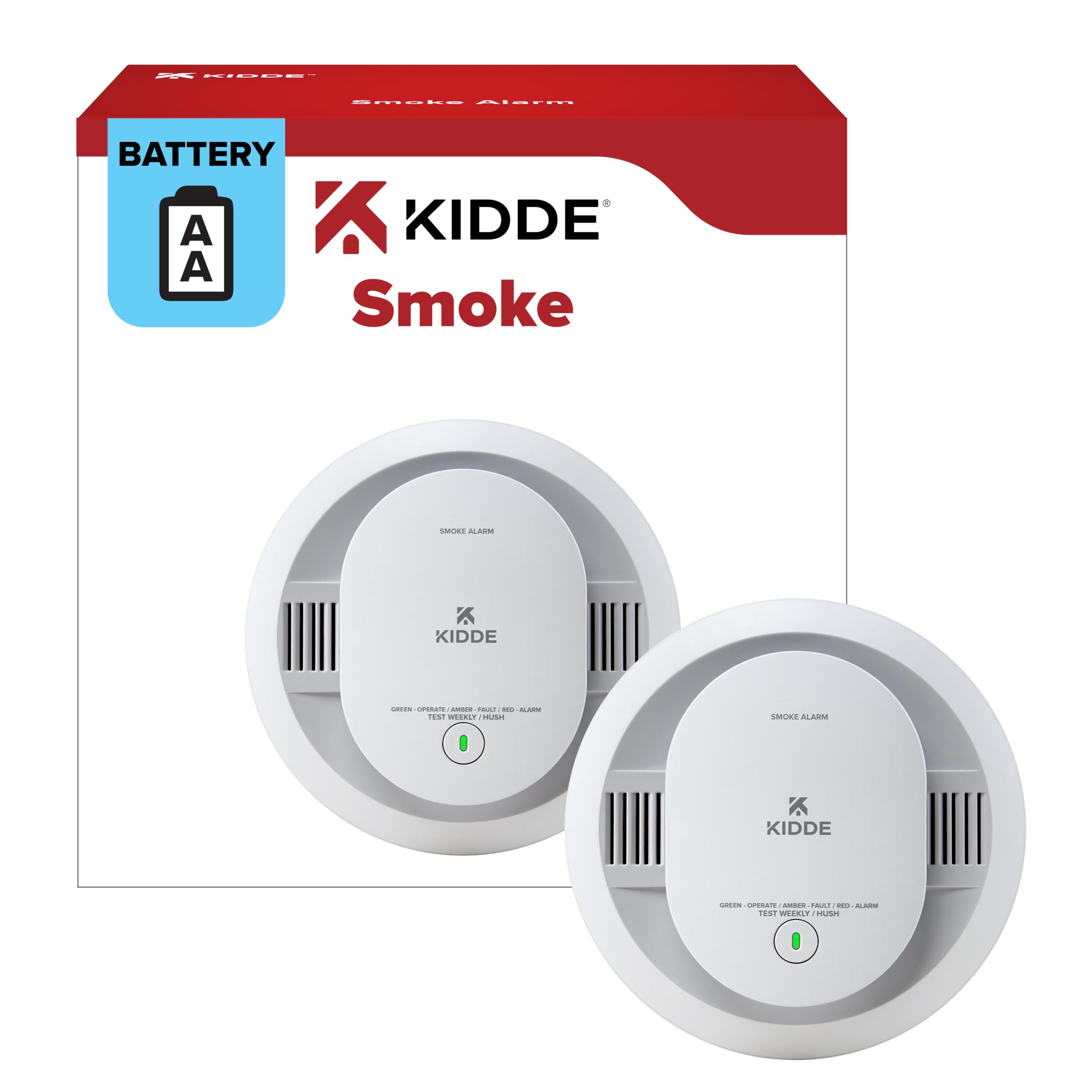
Built to be heard at the far end of the house, not just the room it sits in.
The Kidde 20SDR is aimed at anyone who has ever stood in a stairwell wondering whether the alarm upstairs would actually wake them. It runs on two AA batteries, which are included, so there is no wiring to run and no electrician to book. The alarm sounds at 85 decibels with a red LED for a visual warning, and it is tested to meet UL 217 10th Edition and FCC standards. The loud side of that is not theoretical — owners in large multi-level homes describe it carrying from the stairwell all the way through the house.
Kidde claims this model detects smoke over 25% faster, and its sensing technology is tuned to tell real smoke apart from cooking or steam. That false-alarm filtering is the feature that keeps a detector in service rather than yanked off the ceiling in frustration. There is also a test and hush button, so you can silence a nuisance alert without disabling the detector and leaving yourself uncovered. It carries a 10-year limited warranty from the purchase date.
One recurring quirk is worth knowing before it annoys you at 2 a.m.: the green status LED has a habit of drawing small flying insects, which can trip the alarm at night. Covering the light with a small piece of electrical tape solves it, and the detector itself keeps working normally. It is also, like the SITERWELL, a smoke-only alarm — no carbon monoxide sensor.
Dead simple, loudly effective: two included AA batteries, an 85-decibel siren and a clear red LED mean setup takes minutes and there is nothing to program.
Fit note: this is a smoke alarm only — carbon monoxide needs one of the combination units on this list.
Worth it for: big, spread-out homes where the alarm needs to carry across rooms and floors.
Think twice if: you are mounting near bright windows where insects gather, or you want CO protection included.
4. First Alert Battery Combination Smoke & Carbon Monoxide Alarm

One housing that watches for smoke and for the gas you cannot smell.
Two hazards, one mounting point — that is the pitch, and it is why this unit suits hallways and landings where you would rather not bolt two separate boxes to the ceiling. It uses First Alert’s Precision Detection sensing, which the maker says meets new industry standards to cut cooking nuisance alarms while still warning early in a fire. It runs on battery, so installation and maintenance stay simple, and there is a test/silence button for checking without disabling it. An end-of-life warning tells you when the alarm itself needs replacing.
One detail buyers keep coming back to is the battery decision. Because this runs on a replaceable battery rather than a sealed cell, it is not a throw-away unit — the head stays on the ceiling and you swap the battery as needed, testing along the way. Owners running several of these describe wanting to replace every alarm in the house in one go for consistency, which tells you it is a unit people are happy to standardize on. The carbon monoxide side is the bonus that a smoke-only alarm just does not have.
The consistent friction point is the mounting base, not the electronics. The head arrives seated tightly in its bracket, and getting it to rotate cleanly into place across all three mounting slots can take a few tries before it locks. Do that once, before you are up a ladder, and the actual ceiling job gets much easier. It is also slightly slimmer than the hardwired BRK up top — 5.6″D x 5.6″W x 2″H against 5.6″D x 5.6″W x 2.2″H — for whatever that half-inch of depth is worth to your ceiling line.
Two sensors, one hole: a smoke sensor and a carbon monoxide sensor share a single battery-powered housing, so you cover both without a second install.
Loosen it before you mount it: rotating the head into the base takes some persuasion from the start.
Pick this one when: you want both smoke and CO covered from one ceiling position and you prefer a battery you can replace.
Skip the upgrade if: you only need smoke detection and want to keep things as simple as possible.
5. X-Sense Smoke & Carbon Monoxide Alarm, SC06, 1-Pack
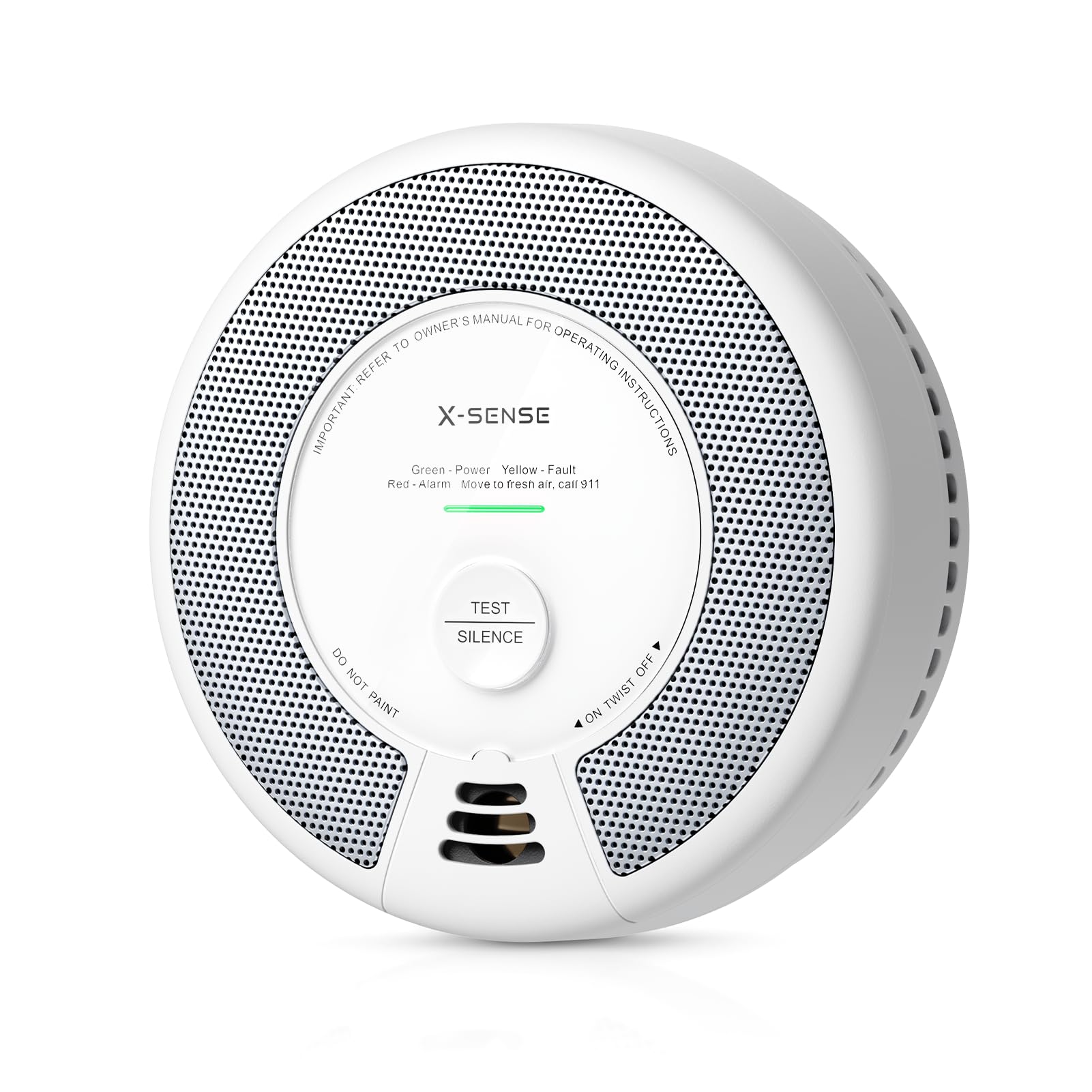
The one that shows you the carbon monoxide number instead of just screaming at you.
Where the First Alert SMICO100 above gives you smoke and CO detection, this unit adds something the others do not: a large LCD screen that displays real-time carbon monoxide levels in the surrounding air, along with its battery level and working status. If you like knowing what the air is actually doing rather than only learning about it when an alarm trips, that display is the difference-maker. Detection runs on two sensors — a photoelectric smoke sensor for smoldering fires and an electrochemical CO sensor specifically for carbon monoxide.
Power comes from a sealed 10-year lithium battery, and the maker frames the battery’s average life at 10 years. There is no rewiring to plan: it mounts to any wall or ceiling with the included bracket, screws and anchor plugs. It is tested to UL 217 for smoke and UL 2034 for carbon monoxide, and the housing is heat-resistant PC plastic. X-Sense covers it with a 60-day money-back guarantee, a 5-year warranty and lifetime technical support.
Here is where to be careful. Some owners mention units failing well inside that sealed-battery window, so a date check on arrival is worth doing. A 10-year sealed battery also means the alarm is done when the cell is — you replace the whole unit rather than the battery, exactly like the SITERWELL above.
The feature nobody else here has: a live LCD readout of carbon monoxide levels, so the air quality is visible rather than a mystery until an alarm fires.
Be aware: the sealed battery is not user-replaceable, so the alarm’s life and the battery’s life end together.
Best for: anyone who wants smoke and CO covered plus a screen that shows what the air is doing right now.
Don’t pick it for: a spot where you would rather not have an illuminated display at eye level.
Know the Specs
Ionization versus photoelectric sensing
An ionization sensor reacts fast to flaming fires and is the classic choice for general coverage. A photoelectric sensor is more sensitive to slow, smoldering fires that generate light smoke and little heat, and may smolder for hours before flames appear. Neither replaces the other — the choice is really about what is likely to burn near that particular alarm.
Hardwired with backup versus sealed battery
A hardwired alarm runs on 120-volt household current with a 9V battery backup, so it keeps working through a power cut and can usually be linked to the other alarms in the house. A sealed-battery alarm skips wiring entirely and carries a lithium cell rated for 10 years, but the battery is not replaceable — when it faults, the whole unit is finished.
What 85 decibels actually gets you
An 85-decibel alarm is the standard siren volume across this category. In plain terms it is around the loudness of a blender running at full speed, which is why it carries through a closed door and down a stairwell rather than staying in the room. If your bedrooms are far from the alarm, that volume is the whole reason you would choose one model over another.
Combination alarms and the CO sensor
A combination alarm pairs a smoke sensor with a separate carbon monoxide sensor in one housing. Carbon monoxide is odorless and invisible, which is why it needs its own dedicated sensor rather than being caught by the smoke side. An electrochemical CO sensor is the type used here, and a display that shows real-time CO levels is a genuinely different feature from simply sounding an alarm.
Common Questions
Can I replace a hardwired smoke detector with a battery-powered one?
Do black smoke detectors work as well as white ones?
What is the difference between a photoelectric and an ionization smoke alarm?
How long does a 10-year sealed battery smoke alarm actually last?
Will a smoke alarm go off from cooking steam or burnt toast?
Is a combination smoke and carbon monoxide alarm worth it over a smoke-only unit?
Do I need the alarm hardwired, or does battery power meet code?
How loud is an 85-decibel smoke alarm in a large home?
Can smoke alarms be interconnected so they all sound together?
Why did my new smoke detector arrive with a dead battery?
The Bottom Line
The black colored smoke detectors that earns the top spot is the BRK First Alert 9120BFF, because it slides into an existing hardwired socket with no ceiling work, keeps watching through a blackout on its 9V backup, and links to the other alarms in the house. If you would rather skip wiring altogether, the SITERWELL GS525A mounts with magnets and runs 10 years on a sealed cell with no battery swaps. And if carbon monoxide is the thing keeping you up at night, the X-Sense SC06 is the one to reach for — its LCD readout shows live CO levels rather than just sounding the alarm, and its smoke and CO sensors are both covered by the UL 217 and UL 2034 standards.
How we choose
We do not accept paid placement. Every pick is matched to a real buyer and a real use-case; we do not hands-on test units.
Sources
Specifications: manufacturer listings and product documentation. Review insights: verified customer reviews, as of October 2026. Pricing: not shown on this page (it changes often); check the current price via the retailer link.
As an Amazon Associate, Aappliancez earns from qualifying purchases. This does not affect which products we feature.