Disclosure: Some links in this post are affiliate links. As an Amazon Associate I earn from qualifying purchases, at no extra cost to you. Learn more
Specs are compiled from manufacturer listings and verified buyer reviews and can change over time — please confirm the key details on the product page before buying.
If you want firmer-looking skin without a needle, a microcurrent or red-light device can do real work at home — but only if you pick one you will actually use every week. The eight devices here split cleanly into two jobs: handheld microcurrent tools that send tiny electrical pulses into facial muscles, and LED masks that bathe your whole face in red and near-infrared light. This guide sorts both types by what they genuinely do well and where each one makes you compromise.
This guide is built by comparing the manufacturers’ published specifications and the patterns across verified customer reviews, so you get each pick’s real strengths and trade-offs instead of marketing spin.
A face tool only earns its keep if it fits your hand, charges without fuss, and finishes a session fast enough that you actually do it. Below is an honest breakdown of each option so you can match a device to your own routine. This shortlist covers eight biostimulators for face — microcurrent wands and LED masks — chosen for specs and review patterns that survive weekly use.
Top Picks


How To Choose The Best Biostimulators for Face
Start by deciding which of the two jobs you actually want done. A microcurrent tool works on muscle tone — it sends a low-level current into the face and neck to make muscles contract, which is why people describe a lifted look. An LED mask works on skin surface and depth through light wavelengths, which is why the talk is about glow and texture instead of lift. Buying the wrong type is the single most common mistake: people expect a light mask to sculpt a jawline, or expect a microcurrent wand to fade pigmentation, and then blame the device.
The gel question comes before the power setting
Every microcurrent device needs a conductive layer between the metal and your skin, or the current has nothing to travel through. That is why most of these tools ship with a gel or serum, and why the ones that do not will have you hunting for a compatible one. Budget for that refill from day one. A device with a strong setting and dry skin will feel like a sting rather than a treatment.
Time per session decides whether you keep the habit
A three-minute treatment is a different commitment than a fifteen-minute one, and the numbers vary widely across this list. Short sessions suit a rushed morning; longer ones suit a wind-down at night. Be honest about which you will actually do — a fifteen-minute routine you skip is worth less than a three-minute one you keep.
Fit and coverage matter more than bead counts
A mask that pokes into your nose or leaves your forehead bare will annoy you every single time, no matter how many light beads it carries. Look at whether the device wraps your contours, whether the strap holds, and whether you can still see or move while wearing it. For handhelds, look at the shape of the head — a contoured tip that sits flat on a jaw works better than a flat probe you have to angle by hand.
Side-by-Side Comparison
| Model | Best For | Type | Weight | Power Source | Amazon |
|---|---|---|---|---|---|
| INIA FLARE 3-in-1★ Best Overall | All-in-one microcurrent routine | Handheld microcurrent + red light | 1.94 lb | Rechargeable | Amazon |
| MyoGlow Arm Sculpting DeviceMost Versatile | Face, jaw, arms and thighs | Handheld LED + sonic vibration | 9.59 oz | Rechargeable, cordless | Amazon |
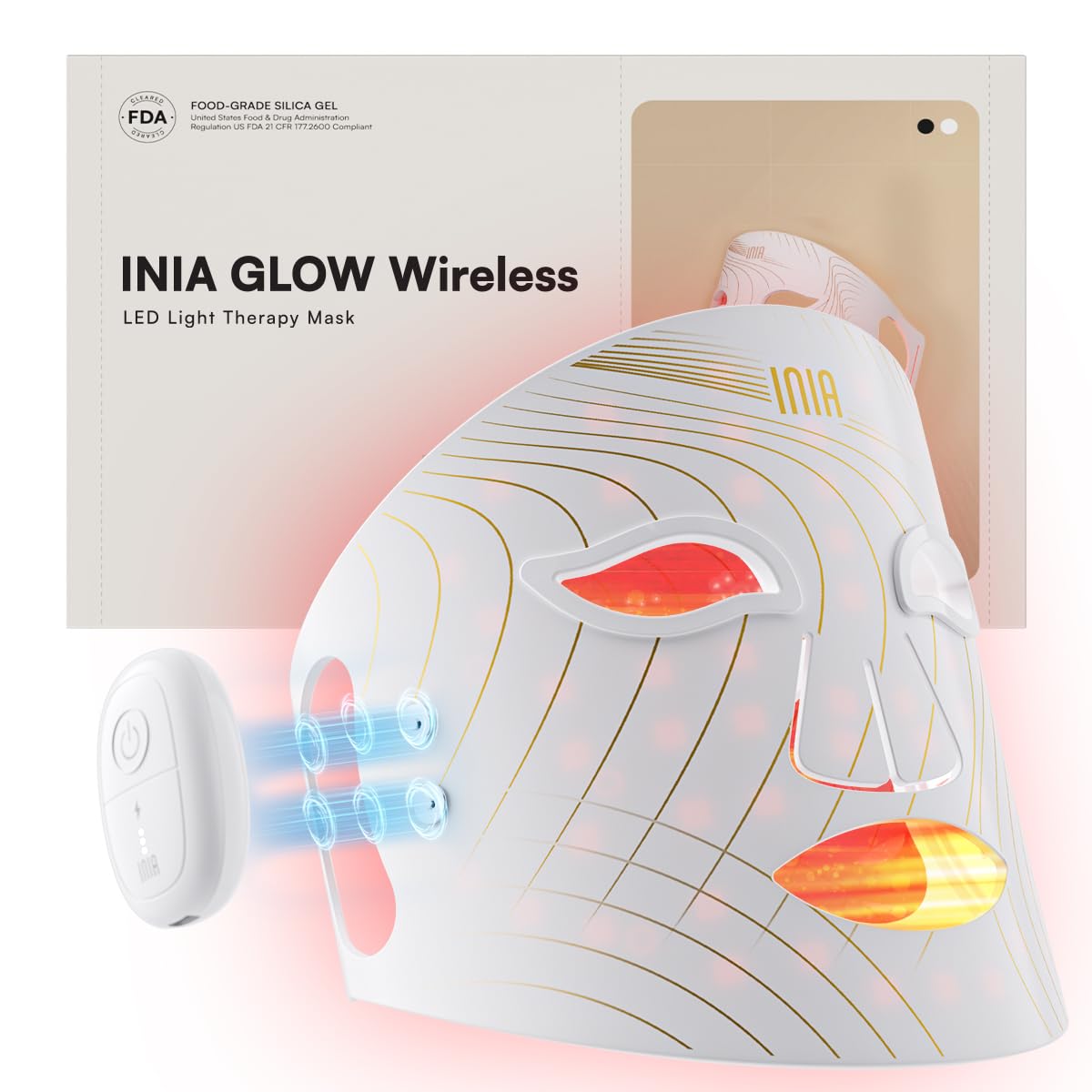
| INIA GLOW Wireless MaskBest Hands-Free | Hands-free sessions anywhere | LED mask, 272 LEDs, 850nm NIR | 1.48 lb | 2 magnetic batteries | Amazon |
| FOREO Bear | Quick microcurrent lift | Handheld microcurrent | 3.2 oz | USB rechargeable | Amazon |
| Red Light Therapy 9-Mode Mask | Nine light colors in one mask | LED mask, 280 beads, 630nm + 850nm | 7.05 oz | 2500mAh, Type-C | Amazon |
| ONLUKY LED Face Mask | Mask plus neck coverage | LED mask, 103 beads, 630nm | 1.43 lb | Type-C rechargeable | Amazon |
| Microcurrent 5-in-1 Facial Machine | Budget multi-mode entry | Handheld microcurrent + 5 light colors | 1.17 lb | Charging dock | Amazon |
| FOLOKE LED Light Therapy Mask | Basic red and NIR mask | LED mask, 630±5nm + 830nm | 1.26 lb | Type-C rechargeable | Amazon |
Detailed Reviews
1. INIA FLARE 3-in-1 Microcurrent Facial Device
Our pick — 4.0+★ from 550+ verified ratings; the strongest balance of quality and price.
One wand that combines microcurrent, red light and an infusion mode for a single evening routine.
What you get here is a handheld tool with three named modes — LIFT, TIGHTEN and INFUSE — and adjustable intensity on each, so you can dial the strength to what your face tolerates. The LIFT mode pairs vibration with red light for a sculpted look, TIGHTEN pairs red light with gentler vibration for texture, and INFUSE adds negative ions plus electroporation (a technique meant to help skincare ingredients sink in further). It ships with an INIA Hydrating Gel and a PDRN Pink Glow Serum, which matters because a microcurrent device needs a conductive layer or the current has nothing to travel through.
It is a big-feeling tool in the hand at 1.94 pounds, and the articulating head is built to follow your cheek and jaw curves rather than skid across them. At 3 x 2 x 9 inches it also takes up real drawer space. What wins people over is the build — owners talk about the solid, weighty feel more than any single mode. As owners put it, you can feel it working, and the lift shows up right after a session. The honest split in results is that some faces respond and some do not, and a few find the current uncomfortable at higher settings. The gel also runs out, which is a running cost to plan for.
There is a durability catch worth knowing: at least one unit quit after three uses, with only the lights coming on and no microcurrent or vibration on any setting. That is not the typical experience, but it is real, and it is why registering the device and keeping the packaging matters. Used on alternating modes on separate days rather than all three in one sitting, this is the most complete single device on the list.
Where it earns its keep
- Three modes cover lift, texture and ingredient absorption in one tool
- Adjustable intensity lets you start gentle and build up
- Ships with both the conductive gel and a serum, so you can start the same night
- Articulating head follows facial contours for steady contact
Where it asks more of you
- 1.94 lb is heavy for a handheld — a real factor if your grip tires
- Higher settings can sting without a generous layer of gel
- Replacement gel is an ongoing cost
- Results vary by face; not everyone sees lift
Buy this if: you want one device that does microcurrent and red light and you do not mind a heavier wand in exchange for a more substantial build.
Look elsewhere if: you want a light, quick, low-effort tool or you know your skin reacts badly to current at higher settings.
2. MyoGlow Arm Sculpting Device
A palm-sized glider that brings warmth, light and vibration to your jaw, neck and arms in one pass.
You get red LED light (light-emitting diode light, the kind used for skin treatments) and sonic vibration (fast buzzing that helps product sink in) in one handheld body, built to glide over a serum. The contoured head sits flat along the jaw, the neck, the back of the upper arm and the thigh, so it works beyond the face even though it is not a dedicated face device. Two buttons do everything, with three brightness steps to choose from. It is rechargeable and cordless with no dock and no attachments, and at 9.59 ounces it slips into a wash bag for a week away.
Owners single out the build quality — it feels solid in the hand, and the vibration and gentle heat turn a serum step into something closer to a spa minute. Owners describe their skin looking brighter and more toned, with the jawline firming over weeks of steady use. Morning puffiness settling faster is a recurring theme, and it replaces a gua sha for a lot of people because the gliding motion does the work without a technique tutorial. The vibration itself draws a mixed reaction — some love it, some want it stronger.
Here is the trade-off: this is not a biostimulator in the strict sense, so if you want deep light penetration across the whole face, a mask does that job better. The MyoGlow’s strength is coverage and massage, not power density. It is best understood as a supporting tool in a routine, not a replacement for a dedicated microcurrent or full-face LED device.
The pattern in the reviews: buyers report it is easy to add to a daily habit — this is a tool people actually reach for, and the warmth makes the ten minutes feel like a treat rather than a chore.
The catch worth naming: the vibration intensity is a matter of taste, and anyone chasing a full-face light treatment will want a mask alongside it.
Reach for this if: you want a cordless glider for jaw, neck and arms and you like the idea of warmth plus vibration while your serum soaks in.
Pass on it if: you want the deepest possible red-light coverage over the whole face — that is a mask’s job.
3. INIA GLOW Wireless Red Light Therapy Mask
Two swappable batteries and 272 LEDs mean you can wear this mask and walk into the kitchen.
The defining number here is 272 LEDs pushing 105mW/cm² of energy — a density figure that tells you this mask is aiming at serious output rather than decoration. It covers 850nm near-infrared, which is the wavelength that reaches deeper into the skin than surface-level light. There are three treatment modes, and the magnetic battery doubles as the remote, so you click through settings without hunting for a controller. Five to ten minute sessions, three to five times a week, is the routine the maker lays out.
The wireless design is the real win: with two interchangeable batteries, you swap one in and keep going instead of sitting tethered to a cable. It is lightweight and folds flat for travel, and the silicone is easy to wipe clean. Owners mention brighter, smoother-looking skin after steady use, and the blue-light mode has fans who find it calms their breakouts. The silicone sits comfortably for a full session, which matters when the routine runs five to ten minutes.
The mixed side is battery life and fit. Some wearers find the fit tight around the nose and say it leaves marks, and a few note the battery drains quicker than they expected. There is also one report of the mask failing to power up after three months — handled with a fast replacement, but a reminder to register the device and keep the box. A missing auto shutoff at ten minutes is a small annoyance that a phone timer solves.
The strong suit
- 272 LEDs at 105mW/cm² puts real energy behind the treatment
- Two batteries swap in and out for cord-free sessions
- Lightweight and folds flat for travel
- Three modes, including near-infrared at 850nm and a blue mode
The honest limits
- Tight fit leaves marks around the nose on some faces
- Battery drain is a common gripe
- No built-in auto shutoff at the ten-minute mark
- Small number of units have failed early
Made for: anyone who wants to wear a mask while doing dishes, reading or working, and who values output density over a lower price.
Not the pick if: your face runs small and you know tight nose fits bother you, or you want a timer that switches off on its own.
4. FOREO Bear Microcurrent Facial Device, Fuchsia

Three minutes, one charge good for up to 90 uses, and an anti-shock system that reads your skin.
FOREO built this around speed: a three-minute session that targets the 65-plus muscles in your face and neck, with T-Sonic pulsations that relax tension points and help your serum absorb. The anti-shock system scans your skin’s resistance to electricity and adjusts the microcurrent intensity automatically, which is the feature that makes a three-minute treatment feel safe rather than nerve-wracking. It runs on a single USB charge for up to 90 uses, and it carries a two-year warranty against workmanship defects if you register before first use.
Owners who stick with it describe a fuller face within a month and a forehead that looks smoother the morning after a session. The eye area is where people notice lift fastest, and a few say a two-minute guided treatment gives them definition in the cheekbones. At 3.2 ounces it feels like nothing in your hand, and the Fuchsia shell is a small joy on the shelf. It is also the quickest routine of any microcurrent tool here — faster than the NuFace Trinity, according to more than one comparison.
The catch is real but specific: the Bear depends on the phone app for guided treatments, and offline mode has been unreliable for a couple of users, with a device refusing to work without the app after registration. Some also find a subscription and app requirement tiresome. Effectiveness is genuinely mixed — some faces lift, others see no difference, and a handful of units stop working early, though FOREO’s service has been quick to fix those. At 4.0+ stars, this is the lowest-rated device on the list, and the value question is the loudest complaint.
What it does brilliantly: the three-minute routine and the auto-adjusting current make it the easiest microcurrent device to actually keep using, and 90 uses per charge means you rarely think about the cable.
What you should weigh: the app dependency, a subscription requirement, and results that vary by face — this is a device to buy for the speed, not a guarantee of lift.
Right for you if: you want the shortest possible microcurrent session and you are comfortable running it through a phone app.
Think twice if: you want a device that works entirely on its own without an app or subscription, or you have not seen results from microcurrent before.
5. Red Light Therapy for Face 9 Modes

Nine wavelengths, 280 beads and a 2500mAh battery that outlasts most masks on this list.
You can try nine different light colors to see which one your skin responds to: red at 630nm, near-infrared at 850nm, a red plus near-infrared combo, blue at 460nm, yellow at 590nm, green at 525nm, purple at 410nm, indigo at 495nm, and a white setting that blends all wavelengths (nm means nanometer, the wavelength of each light color). The 280 high-energy beads put out 120mW/cm² (milliwatts per square centimeter, a measure of light intensity), a density figure in the same territory as the INIA GLOW. The usual routine is three to four times a week, and the maker suggests giving it four weeks before expecting a visible change.
The 2500mAh battery is the star for anyone who travels. It powers a week of daily sessions on a single charge per owner reports, and at 7.05 ounces it is light enough to forget you are wearing it. The 3D ergonomic silicone contours to your face and rolls up into a bag. Owners describe a glow after use and skin that feels smoother and firmer, and the nose opening keeps it from getting stuffy inside.
Two things to weigh honestly. First, the mask runs on the warmer side of results — some see a change in their complexion, others do not. Second, customer service has been uneven: one owner had a smooth replacement when LEDs failed, another describes months of unanswered emails after a failure. Registering the device and keeping the receipt is the sensible move. For skin tones in the deeper range, the Fitzpatrick IV to VI caution about hyperpigmentation is worth a word with a professional before you start.
Why it stands out
- Nine light colors let you target different concerns with one mask
- 2500mAh battery runs roughly a week of daily sessions per charge
- 280 beads at 120mW/cm² deliver serious output
- Light, flexible, rollable and travel-ready
What to keep in mind
- Deeper skin tones should check the hyperpigmentation caution first
- Customer service has been inconsistent on failures
- Results vary — some see no complexion change
- NIR LEDs have failed in isolated units
Best suited to: travelers and experimenters who want every light color available and a battery that survives a week on the road.
Hold off if: you want a single simple treatment, or you need a company with a proven service record behind the warranty.
6. ONLUKY Red Light Therapy for Face

A silicone mask that snaps to a neck piece, so the light reaches past your jawline.
The point of difference is the neck attachment: it clicks onto the mask, which means you can treat your neck in the same session as your face. The mask uses 103 LED beads with 3-in-1 chip technology, emitting 630nm red light in ten-minute preset sessions. It is built from soft silicone that contours gently, and it runs on a Type-C charge that takes three to four hours. Five brightness levels let you fine-tune the intensity. You also get a power bank so it can run cord-free while you read or walk the dog.
Owners who like it find it easy and comfortable to wear, and the ten-minute preset makes the routine simple. The soft silicone is the high point — it sits on the face without pressing. It is also one of the cheaper-feeling premium masks here, though the box includes light-benefit instructions that help first-time buyers.
The mask has had a rocky design history: some buyers compare it to older versions and say the current fit is smaller, does not lay flat, leaves the forehead uncovered, and pokes out at the sides. The Velcro can pop loose, and a few units arrived missing the red-light mode altogether. Battery life has also been a complaint — one unit needed charging every session after two weeks. At 1.43 pounds it is not heavy, but for anyone with a smaller or wider face, fit is the thing to check first.
The case for it: the neck attachment is the reason to buy this — it extends the treatment area beyond what most masks cover, and the ten-minute preset keeps the habit light.
What could bug you: the fit and the Velcro strap are the recurring grumbles, and the battery has let a few owners down — check the mask sits flat on your face before you commit.
For you if: your neck is part of your routine and you want one device that treats face and neck in a single ten-minute sitting.
Consider another pick if: you have a face that struggles with mask fit, or you want a battery that holds through many sessions without a top-up.
7. Microcurrent Facial Device 5-in-1

Five named modes and a flat probe that wipes clean — the simplest place to start with microcurrent.
This one is all about the modes: FR for firming and de-puffing, BT for brightening and evening tone, RP for repair and oil balance, ST for soothing breakouts, and LT for lifting and fine lines. The flat probe design is easier to wipe clean than a convex tip, which matters if you want a hygienic routine without fuss. It also replaces four separate tools in one body — light wand, vibrator, heated massager and metal roller — and it ships with a charging dock. At 1.17 pounds it is the heaviest handheld here, though the ergonomic handle is shaped to make that manageable.
The big honest caveat is power. The microcurrent here is gentle to the point of being subtle, and a couple of owners who expected a stronger current returned it. What the gentle setting does buy you is a low-risk starting point if you have never used microcurrent before, and the light modes are pleasant without being intense. The maker recommends three to four times a week with your own skincare, and warns that results are gradual.
The metal-dental-implant caution is worth flagging: one buyer could not use it at all because of titanium posts. If that is your situation, ask your dentist before buying. Otherwise, treat this as an entry-level multi-tool rather than a replacement for a dedicated microcurrent device.
Worth picking if: you want to try microcurrent plus light therapy with a low upfront commitment and a flat probe you can wipe down.
Look past it if: you want a current you can feel working, or you have metal dental implants.
8. LED Light Therapy Mask

A bare-bones red and near-infrared mask for anyone who wants light therapy and nothing else.
This is a no-frills take on the category: red light at 630±5nm and near-infrared at 830nm, aimed at the appearance of wrinkles, with no colored modes and no app. It uses flexible silicone with adjustable straps to contour to your face, runs a ten-minute preset session, and charges via Type-C in three to four hours to a full battery. Five brightness levels let you step the intensity up. The maker suggests fifteen to twenty minutes, three to four times a week, with the option to extend the light to your neck and shoulders.
What it has going for it is simplicity — plug in, pick a mode, relax. The mask is lightweight at 1.26 pounds and takes up little shelf space. Owners describe a noticeable difference with steady use. But there are real warning signs here: the few reviews on record are thin, and several units arrived with the red light not working, or stopped charging after a few months. The mask also lacks the customer service support you get with the bigger brands, and there is no auto-off safety net.
If you want to try red light therapy with minimal outlay, this is the most stripped-back option on the list. Just check the unit works fully on arrival — all modes lit — and keep the packaging in case you need a replacement.
What you get: a lightweight silicone mask with 630nm red and 830nm NIR, five brightness levels and a ten-minute preset — a clean, simple introduction to light therapy.
What you give up: the reliability and service you would get from a larger brand, plus the extra modes, timers and battery capacity that more expensive masks offer.
Right for you if: you want to try red light therapy on a lean budget and you are willing to test the unit on arrival.
Think twice if: you need a warranty you can rely on or you want more than a single red and near-infrared setting.
Know the Specs
Microcurrent and why gel matters
Microcurrent devices send a very low-level electrical current into the face. The current needs a conductive path, which is why a gel or serum sits between the metal and your skin. Without that layer the current has nothing to travel through and the treatment feels like a sting. The strength of the current varies widely — some tools let you dial it up and down, others run a single gentle setting. If a device ships with a gel, that is a sign the maker expects you to use one; if not, plan to buy a conductive gel separately.
Wavelengths and what each light color does
Red light around 630nm and near-infrared around 830 to 850nm are the two wavelengths most masks pair together. Red light works closer to the surface for a brighter look, while near-infrared reaches deeper into the skin. Blue light at around 460nm is the one people use for oil and breakouts. Yellow, green, purple and indigo appear on multi-mode masks as extra options. Bead count and energy density — measured in mW/cm² — tell you how much light the mask actually puts out, which matters more than the number of colors on offer.
Weight and fit for daily wear
A mask you wear for ten minutes should not press into your nose or leave marks. Silicone masks contour more comfortably than rigid shells, but the strap and the cut around the eyes and nose decide whether it stays put. For handheld tools, weight matters more than you would think — a 1.94-pound wand tires your wrist faster than a 3.2-ounce one. Pick the weight and shape you can hold comfortably for the session length you can actually commit to.
Batteries, charging and the multi-session question
Most masks here charge in three to four hours. The thing to compare is how many sessions that charge buys you — a mask that runs a week of daily sessions is a different experience from one that needs plugging in every time. For microcurrent tools, USB charging is the norm. If you travel, magnetic swappable batteries are the easiest setup, since one battery can be on the charger while the other is on your face.
Common Questions
Can I use a microcurrent device without gel?
How often should I use a red light therapy mask?
What is the difference between red light and near-infrared light?
Is microcurrent safe if I have metal dental implants?
How long does a red light mask battery last on a charge?
Can I use a LED mask if I have sensitive skin?
Do red light masks work on deeper skin tones?
How long before I see results from a microcurrent device?
Can I use a red light mask and a microcurrent device in the same routine?
What should I do if my device stops working?
The Bottom Line
For most people, the biostimulators for face winner is the INIA FLARE 3-in-1 because it does microcurrent (a low-level electrical current used for facial treatments) and red light in one device, ships with the gel and serum, and gives you three modes to find what your face responds to. If you want the lightest, most hands-free way to treat your whole face, the INIA GLOW Wireless Mask is the one — 272 LEDs (light-emitting diodes, the bulbs that shine the light), 850nm near-infrared and two swappable batteries. And for a quick, targeted lift, the FOREO Bear delivers a three-minute session. Whichever you pick, none of these devices does anything unless you use it several times a week.
How we choose
We do not accept paid placement. Every pick is matched to a real buyer and a real use-case; we do not hands-on test units.
Sources
Specifications: manufacturer listings and product documentation. Review insights: verified customer reviews, as of October 2026. Pricing: not shown on this page (it changes often); check the current price via the retailer link.
As an Amazon Associate, Aappliancez earns from qualifying purchases. This does not affect which products we feature.