Disclosure: Some links in this post are affiliate links. As an Amazon Associate I earn from qualifying purchases, at no extra cost to you. Learn more
Specs are compiled from manufacturer listings and verified buyer reviews and can change over time — please confirm the key details on the product page before buying.
Here is the short answer most ring shoppers need: buy for the sensor that measures what you actually care about, and check the battery spec before anything else. A ring that dies mid-week leaves gaps in your sleep chart, not a usable trend. The picks below split cleanly into two camps — full lifestyle trackers that log sleep, heart rate and blood oxygen, and dedicated oxygen monitors built to alarm when your levels dip. Sizing is the other thing that quietly ruins a purchase: these rings use their own sizing standards, not jewelry-store sizes, so every serious buyer needs the maker’s sizing kit before ordering.
This guide is built by comparing the manufacturers’ published specifications and the patterns across verified customer reviews, so you get each pick’s real strengths and trade-offs instead of marketing spin.
You will see which rings run subscription-free, which ones survive a swim, and where each one falls short, so you can pick the finger-worn tracker that matches your week. Read on for the honest breakdown of these biometric rings.
Top Picks
How To Choose The Best Biometric Rings
Most first-time ring buyers assume the sensor is the hard part. It is not. Fit and battery life decide whether you’re still wearing the ring in month three, and both are checkable before you order.
Size with the maker’s kit, never your jewelry size
Every ring here uses its own internal sizing standard because the sensor pod needs to sit against the palm side of your finger. Your wedding-band size will steer you wrong. Order the maker’s sizing kit, wear the test ring overnight, and pick the size that still feels snug when your fingers swell in the morning.
Battery life decides whether the data is continuous
A ring rated for 14 days between charges means charging roughly twice a month. One that runs five days means a charging ritual every week. Both are fine — you just need to know which you are signing up for. The charging case on several of these picks buys you an extra top-up while travelling, which matters more than a big number on the spec sheet.
Check what the free tier actually includes
Some rings hand you the full app with no monthly fee. Others include a trial and then charge monthly for the scores. Over two years, a monthly fee can add hundreds of dollars to the purchase price, so read the app terms before you buy.
Water ratings and daytime wear
IP68 and 5ATM both mean you can wash dishes and take a shower without removing the ring. If you swim laps, confirm the rating is spelled out explicitly in the listing. Titanium and stainless steel shells resist scratching far better than plated finishes, and a thin, lightweight profile keeps the ring from pressing on your finger overnight.
Side-by-Side Comparison
| Model | Best For | Battery Life | Water Rating | Subscription | Amazon |
|---|---|---|---|---|---|
| RingConn Gen 3 Smart Ring★ Best Overall | Vascular trend tracking | 14 days | IP68 | None | Amazon |
| LOOKEE Ring Pulse OximeterBest for Oxygen Alerts | All-day oxygen alerts | 16 hours | — | Free app | Amazon |
| Pachira Smart Ring | Gold-tone styling | 7 days | 5ATM | None | Amazon |
| RENPHO Lynx Smart Ring | Tracking on a budget | 7 days | 5ATM | None | Amazon |
| Wellue O2 Pulse Oximeter | Overnight SpO2 records | 72 hours | — | Free app | Amazon |
| RingConn Gen 2 Air | All-day comfort | 10 days | IP68 | None | Amazon |
| Oura Ring 4 | Deep sleep analysis | up to 8 days | Water resistant | Membership required | Amazon |
Detailed Reviews
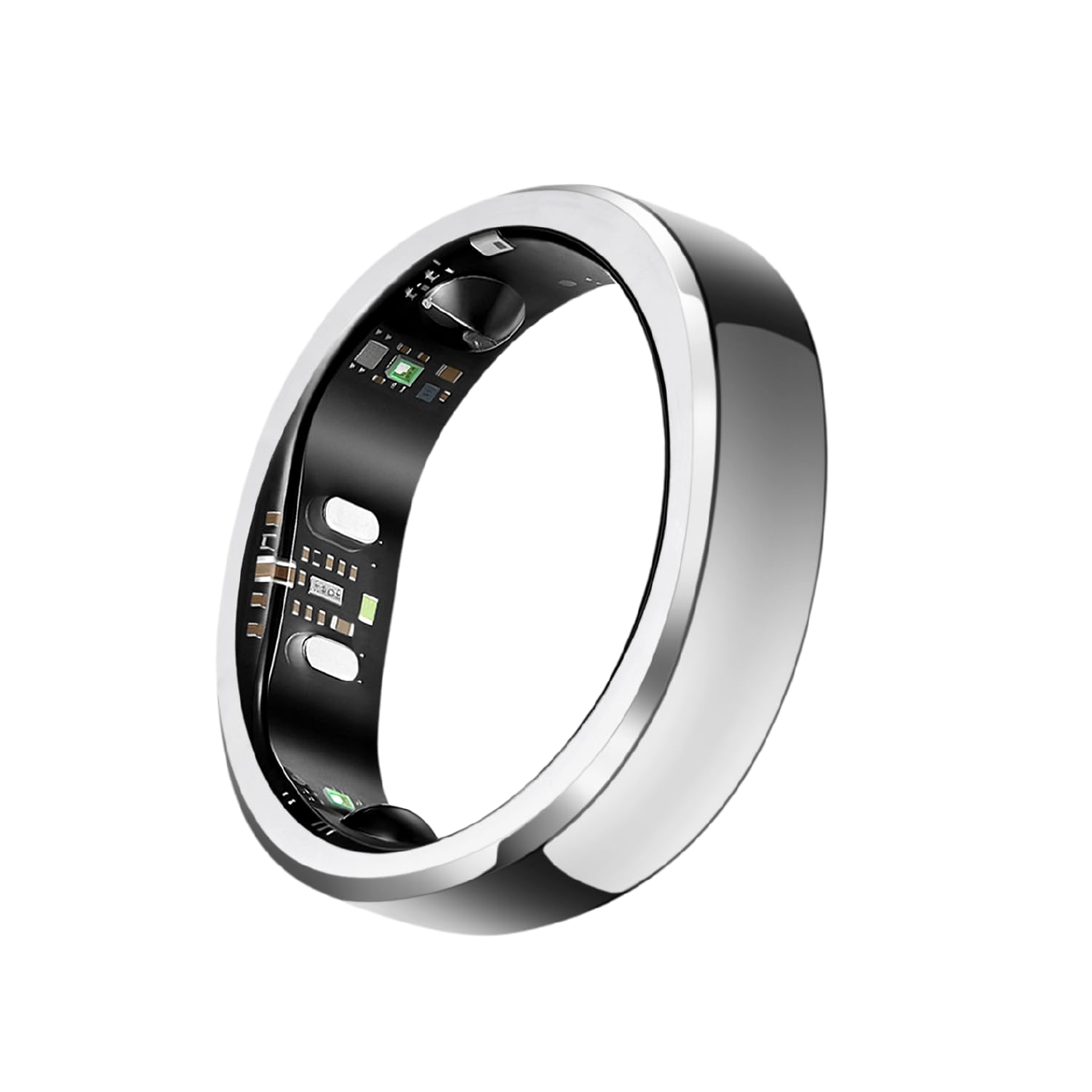
1. RingConn Gen 3 Smart Ring Size 10
Our pick — 4.0+★ from 1,000+ verified ratings; the strongest balance of quality and price.
Two weeks between charges and a vascular trend chart you have to calibrate once.
The headline here is stamina: RingConn rates this ring at up to 14 days of tracking, driven by its EcoPower Tech 2.0 battery setup. That is twice the 7 days the Pachira claims, and it is the difference between charging on a Sunday routine and charging whenever you happen to remember. Buyers report real numbers close to the claim — “Battery ~11 days (recharged at 9%),” as the review pages put it. A 90-minute charge gets you back to full, and the ring ships with a charging case that keeps it topped up in a bag.
What it actually measures is where this one earns its spot. After a one-time calibration it reads multiple physiological signals and builds a vascular load trend, so you can see how sleep, activity and stress move that number over weeks. The app covers sleep, heart rate, HRV (heart rate variability — the tiny gaps between beats that hint at recovery), activity, stress, SpO₂ (blood oxygen) and sleep apnea screening. It is HSA/FSA eligible, which takes some of the sting out of the outlay. Titanium construction and IP68 water resistance mean handwashing, showers and swimming are all fine.
No subscription is the other quiet win — every feature is live in the app the moment you pair it, which puts it in a different cost bracket from the Oura Ring 4 over a couple of years. The honest catch is fit and comfort: RingConn’s own sizing differs from standard jewelry sizes because of the inner sensor layout, so the sizing kit is a required step, not a suggestion. A smaller group of owners find the workout menu thin at roughly five options, even though auto-detection fills most of the gap. This is a lifestyle ring, not a training log.
What earns it first place
- Up to 14 days of battery, double what the Pachira manages, plus a 90-minute charge time
- Vascular load trends after a single calibration — a signal most rings do not publish
- IP68 water resistance covers swimming and showers without removing it
- No subscription fees, and HSA/FSA eligible
- Haptic vibration alerts on the finger for inactivity, health signals and low battery
Where it asks something of you
- Requires the RingConn sizing kit — standard ring sizes will not translate
- Roughly five workout options, so serious training data lives elsewhere
- Battery alerts drain the cell faster, so 14 days is a best case
Reach for this if: you want continuous vascular and sleep data with no monthly bill and you charge on a fortnightly rhythm.
Look elsewhere if: you lift or run hard and need a deep workout library rather than auto-detected walks.
2. LOOKEE Ring Continuous Pulse Oximeter
A single-job ring that buzzes your finger when your oxygen slips below your own threshold.
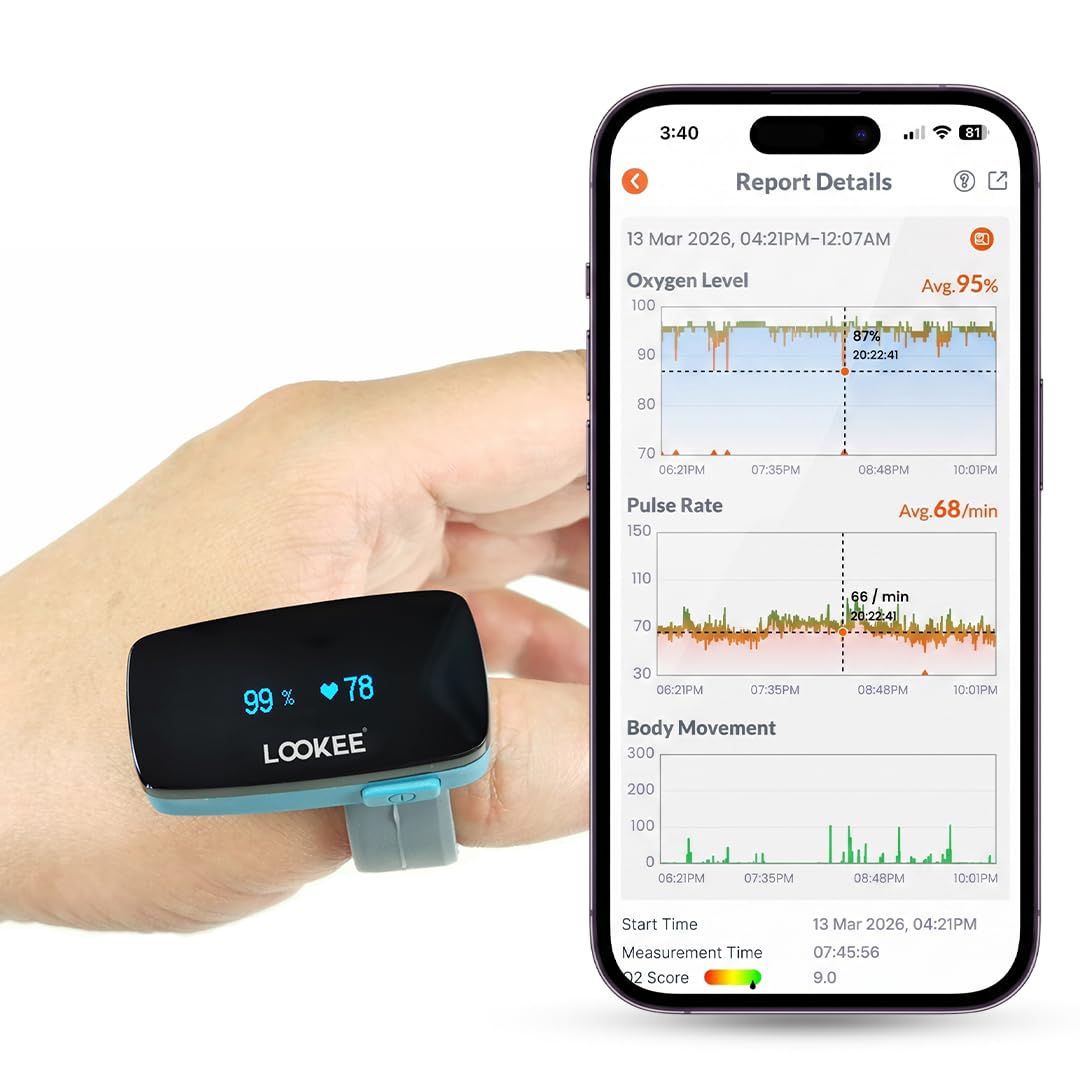
This is not a lifestyle tracker and it does not pretend to be. The LOOKEE Ring monitors blood oxygen saturation, pulse rate and body motion continuously, and it notifies you — with a vibration and a mark in the report — when your O₂ falls under a level you preset. A full charge runs up to 16 hours, which is a daytime shift, not an overnight week. Built-in memory holds four groups of 10-hour data and uploads automatically once you connect the free app, which handles iOS 9.0 or above, iPhone 4s/iPad 3 or above, and Android 5.0 or above.
The everyday experience, according to owners, is convenience. What people like most is simply that it works as a continuous monitor — it is the functionality that keeps coming up positively, followed by how easy the whole thing is to wear and run. The soft silicone sensor ring is patented and built so it does not numb your finger or slide off mid-session, and the app produces graphic O₂ and pulse-rate reports plus unlimited PDF and CSV exports you can hand to a clinician.
Now the honest part. The oxygen number itself draws mixed feedback — some owners cross-check it against a clip oximeter or a watch and find it lines up, while a minority see readings that are plainly off, with one account describing a gap of up to 8 points against a medical-grade forehead device. Treat this as a personal trend tool rather than a clinical instrument, and confirm anything concerning with a proper device. Note too that LOOKEE states it is not a medical device and is intended for sports and aviation use.
The case for it: if you want a discreet ring that pings you the moment your oxygen dips — while you sleep, or during a hike at altitude — this is the narrowest tool on the list for that exact job, and the free app with shareable reports makes it easy to bring data to an appointment.
One thing to plan around: at 16 hours per charge, this is a day-use monitor, so you need to build a charging slot into your routine rather than expecting a week of wear.
Pick it when: oxygen threshold alerts matter more to you than step counts or sleep stages.
Pass if: you want a general health tracker that also covers activity — this ring only watches O₂, pulse and motion.
3. Pachira Smart Ring, Dual 14K Gold Inlays
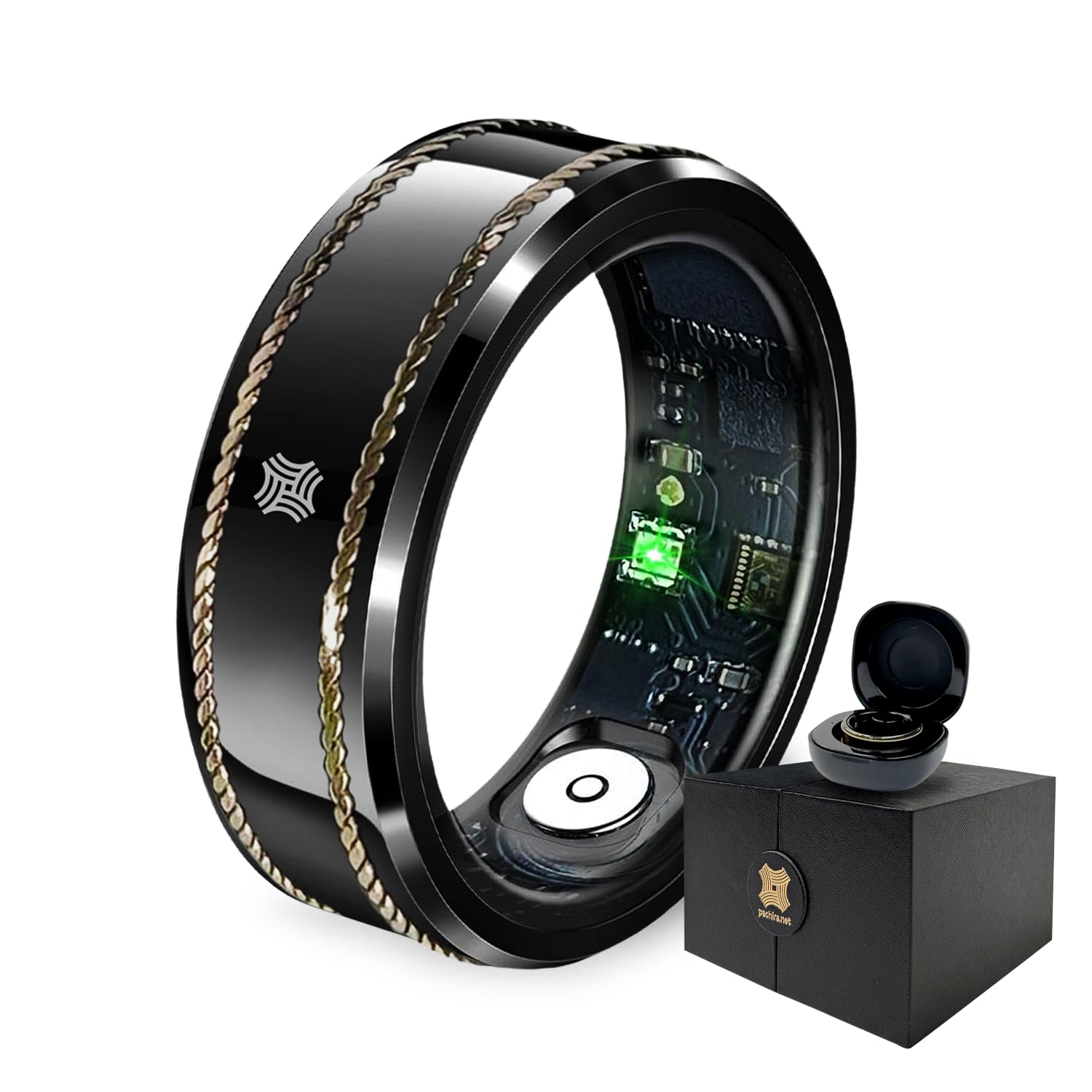
Dual 14K gold inlays on a stainless shell — a ring that reads as jewelry first.
Aesthetics drive this one. Pachira wraps an ultra-thin stainless steel body in two 14K gold inlays and builds it for both men and women, so it sits on a finger like a piece you would wear with a suit rather than a gadget you apologize for. Battery life is rated at up to 7 days — half the RingConn Gen 3’s fortnight — with a magnetic charger and a portable charging case to top it up on the move. Its cell is listed at 15 milliamp-hours, which is the small-capacity end of this category and explains the shorter runtime.
On the tracking side, the ring continuously logs heart rate, blood oxygen, sleep stages, stress, steps, calories and menstrual data, with more than 170 sport modes and real-time insights. The Pachira Smart App is free for life with no subscription, works with both iOS and Android, and includes Apple Health integration. 5ATM waterproofing covers swimming and showers. Extras include remote camera control, a Find My Ring function and female health reminders. It is HSA/FSA eligible.
Here is the caveat you should weigh properly: this is a young model with a very thin review base, and it does not yet have the track record the two RingConn rings have built. If you want a piece that looks like fine jewelry and tracks the basics without a monthly fee, the design and feature list deliver. If you want proven long-term reliability, the more established picks above carry the confidence. Either way, confirm your size with the official kit first — the fit here is not a standard jewelry size.
Style-first, sensibly specced: 14K gold inlays, 5ATM waterproofing and a subscription-free app make this the pick for a buyer who wants the ring to look good on a dinner reservation, not just on a sleep chart.
The honest limit: 7 days of battery and a small 15 mAh cell mean more charging sessions than the RingConn Gen 3, and the ring’s shorter market history is the real reason to hesitate.
Best fit for: jewelry-focused buyers who want the look of a gold band with continuous health basics and no subscription.
Think twice if: you want years of documented reliability before you commit — this model has not built that record yet.
4. RENPHO Lynx Smart Ring, Black, Size 9
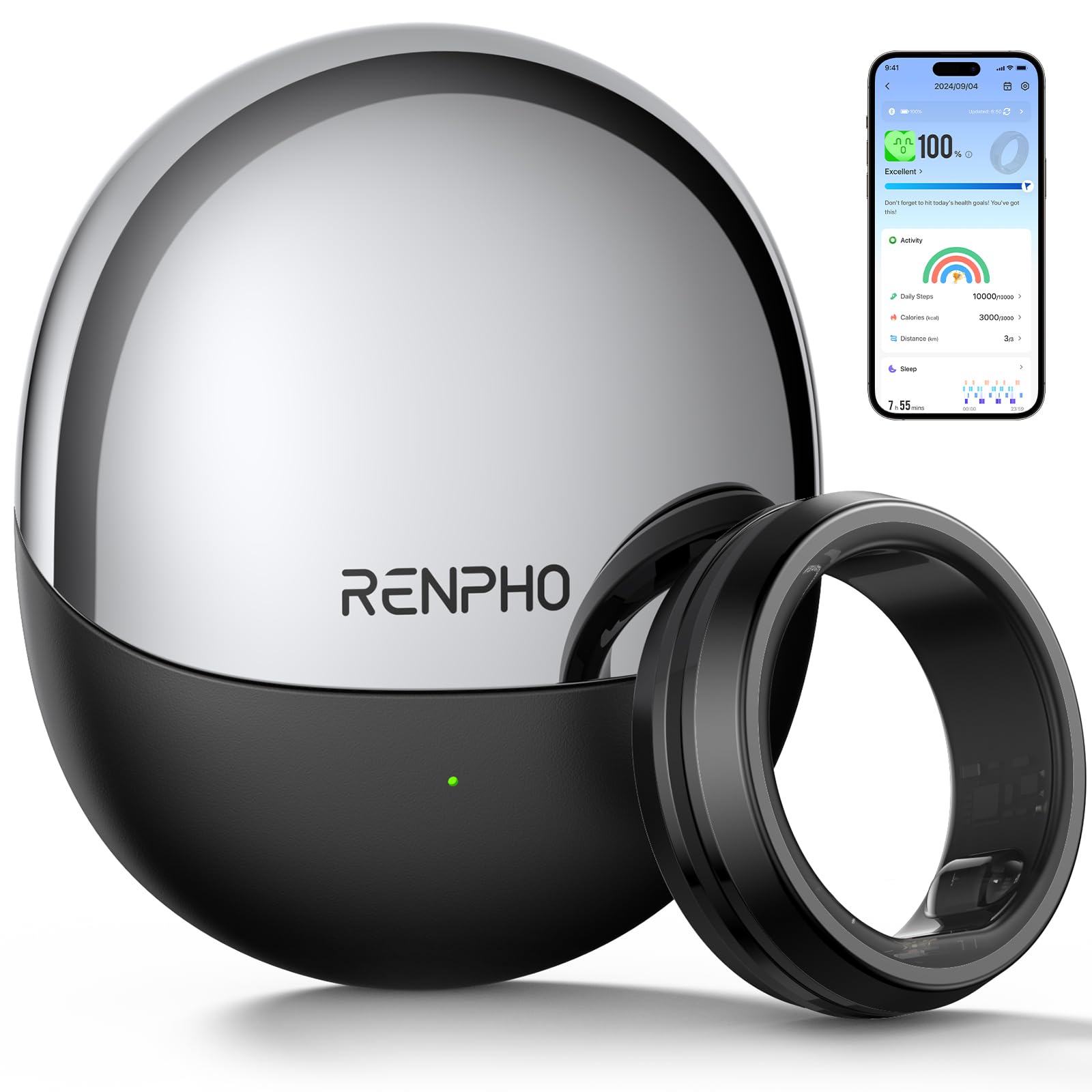
A titanium ring with a charging case and no subscription — the sensible middle.
If you want most of the Oura experience without the monthly membership, this is the pick that lands closest. The RENPHO Lynx tracks sleep, blood oxygen, stress, heart rate, steps, distance and calories, and stretches into walking and running workouts with detailed insight. A titanium exterior and 5ATM waterproofing mean it survives swimming and hiking, and a charging case gives you an extra top-up plus safe storage on a trip. It syncs with the Renpho Health App on iOS and Android, including Apple Health and Google Health Connect, and it is HSA/FSA eligible.
Battery sits around a week on paper, and the live reports run longer than that when you are not hammering the app. Wearers describe connections that hold without fuss and heart-rate numbers that line up with a chest strap or a watch. The sleep-stage mapping gets called out as the closest to accurate part of the package, alongside solid HRV and pulse-ox readings. One thing to note on fit: the ring has a thicker, curved profile than the flattest options here, which is invisible during the day but can press during gym work.
The real conversation with this ring is longevity, and the honest version is mixed. Plenty of owners mention months of clean syncing, while a smaller number hit a connection that stops after roughly two months — and because warranty support runs through RENPHO directly rather than through a reseller, that path can get awkward. Sized at 9, this specific listing needs the official RENPHO Sizing Kit to confirm fit, since the brand’s sizing does not match standard jewelry rings. For the price tier, it remains the most complete feature set per dollar on this list.
Why it holds the value slot
- Titanium build with 5ATM waterproofing at a mid-tier price
- No subscription fees, with Apple Health and Google Health Connect syncing
- Charging case extends runtime and protects the ring in a bag
- Sleep-stage mapping and HRV readings that track close to a watch
The trade-offs worth knowing
- Thicker curved profile can annoy during weight training
- Warranty claims go through RENPHO directly, not the retailer
- Requires the RENPHO sizing kit — the fit does not follow standard ring sizes
Go with it if: you want titanium durability, sleep tracking and no monthly fee without climbing into the premium tier.
Skip if: you need the deepest workout library or you want retailer-backed returns as your safety net.
5. Wellue O2 Pulse Oximeter with Smart Reminder

Three nights of oxygen data on one charge, with alerts loud enough to wake a heavy sleeper.
For anyone charting breathing through the night — CPAP users especially — the battery is the reason to look here. Wellue rates this at up to 72 hours of continuous use per charge, which is three full nights without reaching for a cable. That is a different league from the 16 hours the LOOKEE Ring offers, and it is the spec that decides whether you get a usable week of overnight charts. Built-in memory stores four groups of 10-hour data and uploads automatically over Bluetooth to the free ViHealth app or the O2 Insight Pro software on a computer.
The alert system is the standout feature. If your blood oxygen drops under your chosen threshold, the unit vibrates and makes a repeated “drip” sound, and both intensity levels are adjustable — a combination that wakes heavy sleepers. The measuring range is 70%–100% for oxygen and 30 to 250 bpm for heart rate. The patented soft silicone ring sensor is built so it will not numb your finger, and owners talk about wearing it comfortably for very long stretches. Data exports in PDF and CSV, and CPAP users can pull the records straight into OSCAR for sleep analysis. HSA/FSA eligibility applies here too.
The honest trade-offs sit in the strap and the long-run build. The band is a hard rubber design that some owners with arthritis find fiddly to fasten, and durability is the recurring theme in the lower-scored notes — bands and sensors have needed replacement, though the company’s support is described as quick to ship a new one. The charging cable is a non-standard USB type, so keep it somewhere you will find it. Note that Wellue states this is for sports and aviation use and not a medical device.
The overnight specialist: 72 hours of runtime and four 10-hour memory blocks make this the ring to beat if your goal is a week of continuous sleep-oxygen data you can hand to a clinician.
Plan for the band: the hard rubber wrist strap is the part most owners single out — it takes a moment to fasten, and the sensor is the piece that needs eventual replacement.
The right tool for: CPAP users and anyone collecting multi-night oxygen records with clinician-shareable exports.
Not the right tool for: daytime activity tracking or anyone who wants a ring they never have to think about fastening.
6. RingConn Gen 2 Air Ultra-Thin Smart Ring (Size 8, Dune Gold)
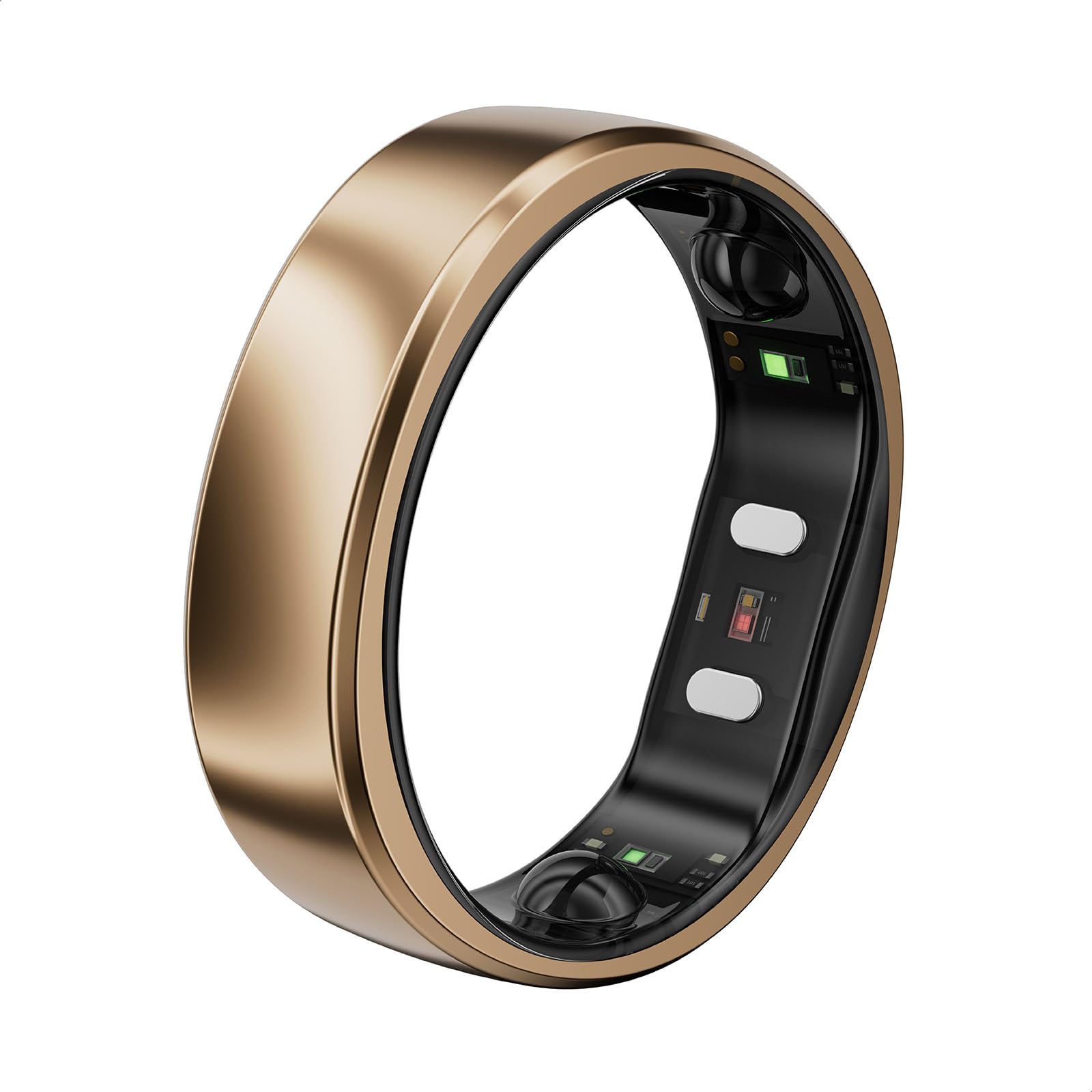
A 2.5g ring just 2mm thin — the one you forget is on your finger overnight.
Comfort is the whole pitch, and the numbers back it up. The Gen 2 Air weighs 2.5g and measures 2mm across the profile, which keeps it from pressing on your finger when you sleep or grip a bar. It tracks sleep, heart rate, stress, blood oxygen, physical activity and menstrual cycles, with an AI assistant pulling the multi-sensor data into a personal report. Battery is rated at up to 10 days on a full charge, and that charge takes 90 minutes. IP68 water resistance is tested to depths of 100m/328ft, so showers, rain and laps are all covered. It is HSA/FSA eligible, and no subscription is needed for the standard features.
Owners put most of their praise on it simply doing its job — the functionality is the thing that wins people over, with tracking accuracy for steps, sleep and heart rate close behind. The app syncs to Apple Health and MyFitnessPal, and the Dune Gold finish prompted one buyer to call it “rose-gold” in look and classy in person, though a different purchaser read the same colour as a dark bronze. A Find Your Ring feature inside the app walks you through locating it if it slips off.
Sizing is the mandatory first step, because RingConn’s own standard runs unlike jewelry rings — one owner usually in 12.5 to 13 needed a size 14, and another found the provided kit ran loose. Battery is the mixed column: most get the promised 10 days, while a minority see the charge collapse early or stop holding altogether within a year. Durability follows the same pattern, so treat the 10-day figure as a best case with heavy app use.
The featherweight argument
- 2.5g weight and a 2mm profile make it the least noticeable ring here
- 10 days of battery per charge, topped up in 90 minutes
- IP68 tested to 100m/328ft covers swimming and diving
- No subscription for the standard features
- AI-generated personal reports from combined sensor data
What a buyer should weigh
- Battery can fade early for a minority of owners, and some units stop holding charge within a year
- Dune Gold reads more bronze than gold in person
- Needs the RingConn sizing kit; the fit does not map to standard sizes
Choose this one if: you sleep with a ring on and want the lightest thing available with a 10-day charge.
Look at the Gen 3 instead if: you want the extra battery headroom and vascular trend data that the newer model adds.
7. OURA Ring 4 Smart Ring – Silver – Size 8

The deepest sleep breakdown you can buy on a finger — with a monthly bill attached.
Oura tracks more than 50 health metrics, and its Smart Sensing system adapts the readings to you across sleep, activity, stress, heart health and women’s health. The ring is all titanium, and the redesigned shape is built for round-the-clock wear with water resistance. It syncs with iOS and Android and integrates with more than 40 apps, including Apple Health, Google Health Connect, Natural Cycles, Flo and Strava. Battery is rated up to 8 days, and the technical listing puts average life closer to 5 days on an 80-minute charge.
What you get for that membership is the most detailed overnight picture on this list. Sleep staging lands minute-accurate for many owners, alongside HRV, temperature, respiratory rate and a sleep-debt figure that nudges you to stay in bed longer. Menstrual-cycle prediction and conception tracking draw consistent praise. The membership’s first month is included, and it then runs monthly — tied to your account rather than the ring itself, which is worth knowing if you ever sell the hardware on. HSA/FSA funds can cover the ring and chargers.
The subscription is the obvious friction point, and owners are split on it. Some find the depth of insight justifies the fee; others call the mandatory monthly charge frustrating when the hardware already costs premium money. Battery life runs shorter than the 8-day headline in real use, and a smaller number of owners see the cell degrade within a year — Oura has replaced failed rings through its support channel, but that help is mostly handled by an AI assistant, and reaching a human can be a slog. Verify sizing with the Oura Ring 4 Sizing Kit before ordering.
Why it earns the premium label: 50+ metrics, all-titanium construction, 40+ app integrations and the sharpest sleep staging in the group make it the analyst’s pick for anyone who wants their nights decoded in detail.
The catch built into the model: the monthly membership is required for the full picture, and real-world battery runs below the 8-day claim, so the cost of ownership keeps climbing after purchase.
Worth it for: sleep-obsessed buyers who will use the deep staging, HRV and cycle data every day and can absorb the monthly membership.
Better to skip if: a recurring fee is a deal you refuse — the RingConn Gen 3 gives you similar categories of data with no subscription.
Know the Specs
Battery Life and Charge Time
Battery life decides how often you interrupt your routine to charge. Continuous SpO₂ logging and haptic alerts pull more power, so a claimed 14-day figure can drop to 11 days in real use. Charge time matters too — 90 minutes is a common figure across these rings, and 80 minutes is the quickest here. Shorter runtimes, like 16 hours on the LOOKEE or 72 hours on the Wellue, suit specific monitoring jobs rather than all-day wear.
Water Resistance Ratings
IP68 and 5ATM both mean you can wear the ring through handwashing, showers and a swim. IP68 is a dust-and-water standard, and one ring here is tested to depths of 100m/328ft. 5ATM is a pressure rating suited to swimming and showering, not deep diving. If the listing only says “water resistant,” confirm the actual rating before you swim laps in it.
Sizing Kits and Fit
These rings use their own sizing standards because the sensor pod needs to sit against the palm side of your finger. Your everyday jewelry size will mislead you, and one owner needed a size 14 despite normally wearing 12.5 to 13. Order the maker’s sizing kit, wear the test ring overnight, and pick the size that still feels snug when fingers swell.
SpO₂ and Sensor Accuracy
Blood oxygen tracking differs by device. Some rings sample all day, others read only at night, and dedicated monitors log continuously for hours. Accuracy varies, and a device can drift from a medical-grade meter. For personal trends, the numbers are useful. For anything clinical, pair the readings with a proper device and your doctor’s input.
Common Questions
Can I use my normal ring size when ordering a biometric ring?
Do any of these biometric rings require a subscription fee?
What is the difference between a smart ring and a ring oximeter?
How long does a biometric ring battery actually last between charges?
Can I swim or shower with these rings on?
How accurate are the heart rate and oxygen readings on a finger ring?
Will a biometric ring work with my iPhone or Android phone?
Can I pay for a biometric ring with HSA or FSA funds?
How long do these rings last, and what happens if one fails?
Is a sleep tracking ring better than a smartwatch for overnight data?
The Bottom Line
For most people shopping for biometric rings, the RingConn Gen 3 is the one to buy — up to 14 days of battery, vascular trend tracking after a single calibration, IP68 protection and no subscription to keep paying. If the lightest possible ring on your finger overnight is the priority, the RingConn Gen 2 Air at 2.5g and 2mm gives you 10 days between charges. And if you are collecting overnight oxygen records for a clinician, the Wellue O2 Pulse Oximeter and its 72-hour runtime is the specialist that fits that job. Whichever you pick, order the sizing kit first — a ring that doesn’t fit your finger won’t stay on long enough to track anything.
How we choose
We do not accept paid placement. Every pick is matched to a real buyer and a real use-case; we do not hands-on test units.
Sources
Specifications: manufacturer listings and product documentation. Review insights: verified customer reviews, as of October 2026. Pricing: not shown on this page (it changes often); check the current price via the retailer link.
As an Amazon Associate, Aappliancez earns from qualifying purchases. This does not affect which products we feature.