Disclosure: Some links in this post are affiliate links. As an Amazon Associate I earn from qualifying purchases, at no extra cost to you. Learn more
Specs are compiled from manufacturer listings and verified buyer reviews and can change over time — please confirm the key details on the product page before buying.
The fastest fix for a garage that has turned into a bike pile-up is a rack that lifts every bike off the concrete. You do not need to drill six holes or spend a weekend on it. What you need is a stand that matches your bike count, your wall space, and how much lifting you are willing to do. This guide covers floor stands, wall rails, and vertical tension racks, and it tells you plainly which one suits which garage.
This guide is built by comparing the manufacturers’ published specifications and the patterns across verified customer reviews, so you get each pick’s real strengths and trade-offs instead of marketing spin.
Every pick below is judged on how it actually gets bikes out of your way. Before you pick one, check your wall studs, your tire widths, and how many bikes you really own. These seven picks cover that range well, and this is the shortlist for the best bike stand for multiple bikes.
Top Picks


How To Choose The Best Bike Stand for Multiple Bikes
Three things decide which rack you should buy: how many bikes you are actually storing, whether you are allowed to drill into a wall, and how heavy your heaviest bike is. Answer those three and the shortlist drops to one or two racks. Get them wrong and you buy a rack that bows, wobbles, or cannot hold your fat-tire e-bike.
Floor stand, wall rail, or tension pole
A freestanding floor stand needs no drilling and slides around when you reshuffle the garage. It also claims floor space, which is the trade-off for skipping the drill. A wall rail takes zero floor space but needs solid studs or masonry behind it, and it holds the most bikes of any design here. A tension pole wedges between floor and ceiling, which suits renters because it leaves no holes — but it usually tops out at two bikes and depends on a firm ceiling.
Tire width is the number that catches people out
Wall hooks and floor cradles are built around a rim width or tire width, and fat bikes and wide e-bike tires often exceed it. One rail here takes rims under 3.5 inches, while a vertical swivel hanger takes tires up to 3.54 inches. Measure your widest tire at the knobby tread before you buy. A hook that is slightly too narrow will still grab the bike, but it presses on the rim and spokes instead of cradling them.
Per-hook weight versus total capacity
Some racks list one big total number and leave you guessing about the rest. Look for the per-hook figure, because that is what protects your heaviest bike. One rail here rates each hook at 55 lbs with a 330 lb total, and a vertical hanger rates 66.2 lbs each. If you own an e-bike, match its weight to the per-hook rating, not the total.
Side-by-Side Comparison
| Model | Best For | Bike Capacity | Mount Type | Per-Hook / Total Load | Amazon |
|---|---|---|---|---|---|
| BIRDROCK HOME 2 Bike Stand★ Best Overall | Garage gear hub | 2 bikes | Freestanding | — / — | Amazon |
| SPAREHAND Q-Rack IIBest for Rentals | Small flats and renters | 2 bikes | Floor-to-ceiling tension | — / 80 lbs | Amazon |
| monTEK 6 Bike Hanger Rail | Large households | 6 bikes | Wall stud / masonry | 55 lbs / 330 lbs | Amazon |
| monTEK Swivel Wall Mount (4-Pack) | Mixed-size family fleet | 4 bikes | Wall stud / concrete | 66.2 lbs / — | Amazon |
| Mythinglogic 3-Bike Rack | Families with gear to park | 3 bikes | Freestanding | — / — | Amazon |
| Delta Floor Stand (2-Pack) | Easiest daily parking | 2 bikes | Freestanding | — / — | Amazon |
| WALMANN 4-Bike Stand | No-drill four-bike storage | 4 bikes | Freestanding | 70 lbs / — | Amazon |
Detailed Reviews
1. BIRDROCK HOME 2 Bike Stand
Our pick — 4.5+★ from 950+ verified ratings; the strongest balance of quality and price.
The garage organizer that parks two bikes and swallows the helmets, bags, and pumps that usually end up on the floor.
This is the pick for the household where the bikes are only half the mess. Bikes go upright in the cradle without a single wall hook, and an extra-wide basket on top holds the helmets and bags that normally get dumped on the concrete. Adjustable hooks on the side add a spot for helmets and rackets. High-strength steel carries the whole thing, and it stands just 41 inches tall, so it tucks under most garage shelving.
At 5 pounds it is the lighter of the two garage freestanding stands by a wide margin — the SPAREHAND tension pole lists 9 pounds. That lightness is exactly why it is easy to shift when you want to sweep underneath. What buyers talk about most is how fast it goes together. As buyers report: “Easy one-person assembly in 15 minutes; fairly sturdy, well made.” That matches the pattern across the listings — assembly and build quality are the two things that keep coming up.
The honest catch is stability and storage capacity, both of which draw mixed feedback. Wide handlebars and fat tires can crowd the cradle, and the open basket works best for soft gear. It holds road, mountain, hybrid, electric, and kids’ bikes per the maker. The crowd consensus here is strong at 4.5+ stars across 900+ ratings, which explains why it takes the top slot. The budget-priced Delta pack has more ratings overall, but this one holds the higher score.
What earns its top spot
- Steel frame on a freestanding base — no drilling, no studs, no landlord conversation
- Top basket plus adjustable hooks turn the stand into a whole gear station
- 15-minute one-person assembly by buyer accounts
- 5 pounds, so it moves for cleaning and reshuffling without a fight
Where it gives ground
- Storage capacity is the mixed note — wide handlebars and fat tires crowd the cradle
- Stability feedback runs mixed, so keep the load balanced
- Needs a Phillips head screwdriver, which is not in the box
Buy this one if: you want bikes parked and helmets off the floor in one freestanding unit that needs no wall.
Look past it if: you own very wide tires or plan to stack the basket with heavy gear.
2. SPAREHAND Q-Rack II
A floor-to-ceiling pole that holds two bikes upright in a flat too small for a rack and a car at once.
Renters get the worst deal in bike storage: no drilling, no garage, no floor space. This pole sidesteps all three. It wedges between floor and ceiling with a tension design and no permanent mounting, so you leave no holes behind. Movable arms adjust with a turn of a plastic bolt to fit sloping top tubes and full-suspension frames. The supporting pole extends to 10 feet, which covers most apartment ceilings.
The footprint is where it wins outright. At 4 inches deep and 16 inches wide, it is a sliver of space compared with the BIRDROCK’s 21.5-inch depth. It holds up to 80 lbs across two bikes, and the maker excludes e-bikes from that rating. Size is what people rave about — the compact profile is the single most-discussed strength here, and it is the reason this design works in a studio.
Two things demand honesty. Sturdiness draws mixed feedback: the aluminum tubing is thin, and the piping bows under heavier tension. Some riders find the top hook awkward to reach once two full-size adult bikes are loaded. The tension fit also depends on a firm ceiling — anchor to a stud and do not overtighten. There is no getting around the lifting for the upper bike. If that is fine with you, this is the least intrusive two-bike rack in the group.
Roommate-friendly design: the 4-inch depth and 16-inch width mean it disappears into a corner, and the swivel arms let you open a door wider. Assembly is quick by most accounts, though the directions have been called unclear.
Load it sensibly: the 80 lb total is real, but the thin tubing and mixed stability feedback say keep your heaviest bike low and skip the e-bike.
Reach for this if: you rent a small flat and need two bikes off the floor with zero holes in the wall.
Think twice if: your heaviest ride is an e-bike or your ceiling is soft and hard to anchor.
3. monTEK 6 Bike Hangers

Six bikes on one wall, hung by the front wheel and lifted clean off the garage floor.
If your garage has become a bike parking lot, this rail is the answer. It runs a 78.5-inch steel rail across the wall and carries six J-hooks, each rated to 55 lbs for a 330 lb total. Lifting each bike off the floor frees the entire footprint for a car, a workbench, or actual walking room. The J-hook shape is built to follow the curve of the hub, and the rubber coating eases pressure on the rim and spokes.
Hooks slide along the rail, so the rack grows with your fleet instead of locking you in. It takes rims under 3.5 inches — mountain, road, folding, city, and kids’ bikes all hang fine, but fat tires over that width do not. Installation is meant for standard 16-inch, 18-inch, or 24-inch wall studs, or solid concrete and masonry. The 5-year manufacturer warranty is the longest coverage in this group, and it backs the one thing you actually worry about: a rail that bends and drops a bike.
The build quality is mostly excellent, though one unit reportedly arrived with poorly threaded thumb screws, brackets that needed hammering, and plastic covers that did not fit. A couple of users also find the arms sit too close to the wall, letting rear tires mark the paint. Both are fixable — swap the hardware, add a spacer. For most households this is the most space-efficient way to store six bikes, and the functional reputation is strong.
Built for a full fleet: a 78.5-inch rail and six repositionable hooks are far more capacity than a two-bike floor stand, with nothing touching the ground.
The one wrinkle: hardware consistency is the weak point, so check the threads and brackets before you load it up.
The fit: a family with four, five, or six bikes and a clear stretch of stud wall.
The mismatch: fat-tire owners, or anyone without solid studs to mount the rail into.
4. monTEK Swivel Bike Wall Mount 4 Pack
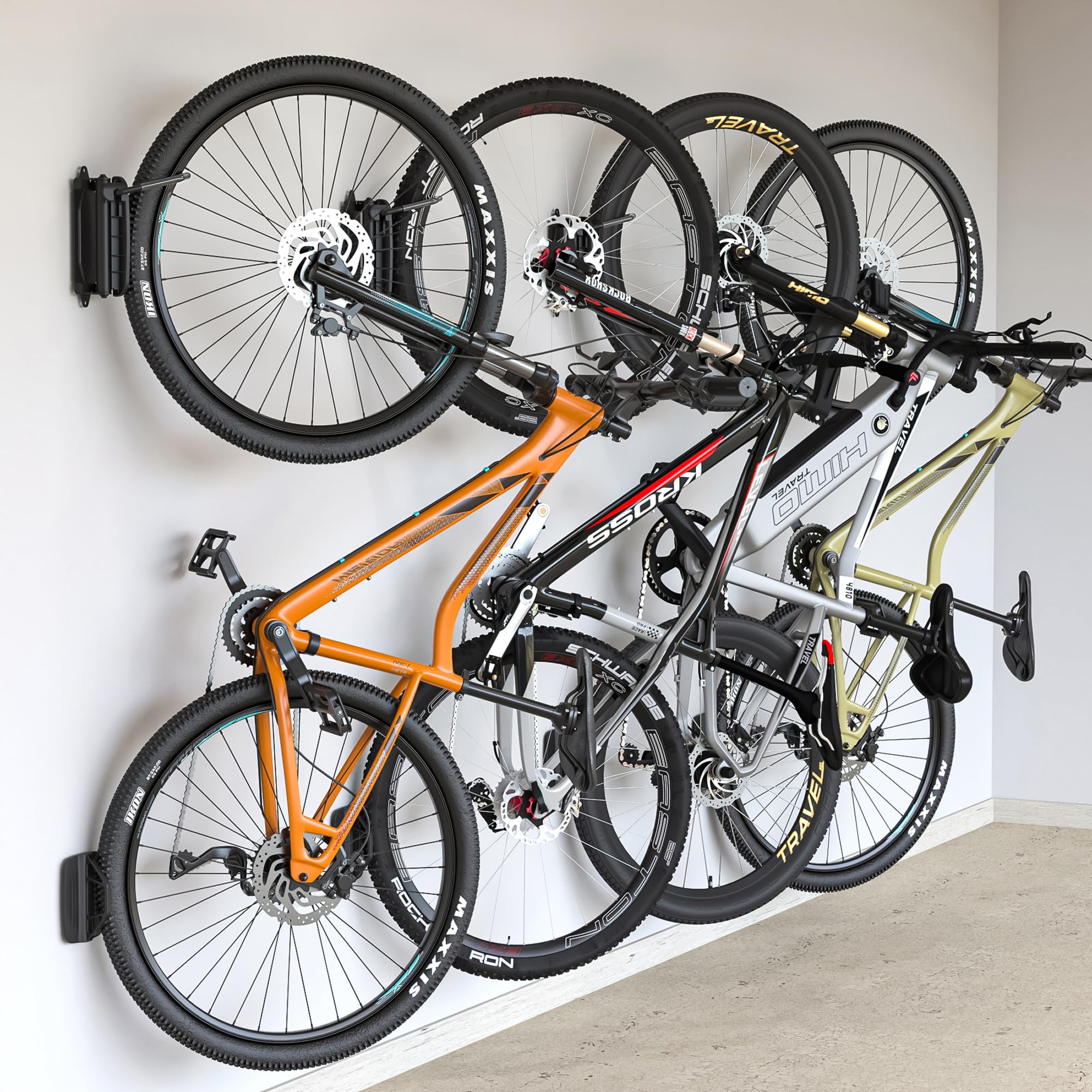
Four individual hangers that swing sideways so you can walk between your bikes instead of around them.
Four separate mounts, one per bike, each rated to 66.2 lbs. That per-hanger figure is the standout — it beats the monTEK rail’s 55 lb hook by a clear margin, and it means a heavier e-bike or beach cruiser hangs securely. The 150° swivel uses a bearing system, so you pivot a bike left or right with a +65°/-85° range. Parked flush, four bikes along a wall take up a sliver of the width a floor stand would claim.
The hanger takes tires up to 3.54 inches wide and rim-to-hub depth up to 3.15 inches. It fits road, MTB, e-bikes, beach cruisers, BMX, kids’ bikes, and bikes with fenders. A rubber-coated hook eases pressure on rims and spokes, and a wheel stop at the bottom keeps the tire off the wall. Installation is rated at about 5 minutes per hanger, and the maker lists screws for concrete, masonry, or stud walls — with an explicit warning to avoid plasterboard unless there is a stud behind it.
The weakness worth naming is the mounting hardware, which draws mixed feedback. Mount it to solid studs or concrete and it is rock solid; mount it hopefully to drywall and it will disappoint you. The other point is lifting — heaving a heavy e-bike upright takes effort every single time, which is the price of vertical storage. Buyers who tried two and came back for four shows the trade is worth it.
Where the swivel earns out
- 66.2 lbs per hanger handles e-bikes the rail’s 55 lb hooks cannot
- 150° swivel with a bearing system parks bikes flush and opens up walk space
- Rubber-coated hook and lower wheel stop protect rims and wall paint
- About 5 minutes per hanger to install, four in the pack
Before you commit
- Mounting hardware gets mixed feedback — solid wall or nothing
- Lifting a heavy e-bike vertically takes real effort each time
- Not suitable for tires wider than 3.54 inches
Worth it for: a mixed-size fleet that wants vertical storage without permanently tying up the wall the way a rail does.
Skip the drill if: your wall is unsupported plasterboard or your tires run past 3.54 inches.
5. Mythinglogic 3-Bike Garage Storage Rack

Three bikes up front and a basket full of balls, helmets, and pads up top — the family garage in one stand.
It parks up to three bicycles in an open floor station and adds a wire basket up top for basketballs, soccer balls, helmets, and pads. Side hooks take helmets, bags, pads, and pumps, and they reposition to suit your setup. The powder-coated metal frame measures 35 inches wide by 20.9 deep and 33.1 high, and adjustable leveling feet steady it on an uneven garage slab.
It works best with kids’ bikes, road bikes, hybrids, scooters, and a mix of bike sizes — which is exactly the family case. Assembly and sturdiness are the two things that draw the warmest response here, and the design keeps riding gear off the ground rather than piled by the door. Unlike the BIRDROCK two-bike stand, this one is built around a three-bike family and the gear that comes with them, and it sits lower on the floor.
Two honest limits. The maker says capacity drops with wide handlebars, fat tires, or closely packed adult bikes, so check brake rotors and derailleurs for clearance. The top basket also draws some criticism for feeling flimsy, and a few find the shelf design a little odd and space-hungry. Assembly can take two people, though it is straightforward. For a family that wants bikes and sports gear in one place, the way it organizes a garage is the reason it stays.
For the busy household: three bikes, a gear basket, and side hooks replace a whole corner of clutter, and the open design keeps everything visible.
The honest catch: wide adult bikes and fat tires shrink real capacity, and the top basket is the part most likely to feel light.
Made for: a family with kids’ bikes, scooters, and sports gear that all need one home.
Not the one for: three full-size adult bikes with wide handlebars and fat tires.
6. Delta Single Bike Stand 2-Pack

Two stands that hold a bike by the rear wheel so you never have to lift it — roll it in and walk away.
Not everyone wants to hoist a bike onto a hook, and this pair of floor stands is built for the riders who would rather not. Each stand catches the rear wheel in a cradle and keeps the bike upright on its own, so daily parking is a roll-in rather than a lift. Adjusting the width takes integrated thumb screws and no tools, which suits standard 700cc road, MTB, fat tire, BMX, and kids’ bikes. The industrial-grade steel wears a hammered powder coat, and the rubberized feet keep the garage floor scratch-free.
The footprint is 17 by 15 by 22 inches per stand, small enough for an apartment corner or a shed. Assembly takes four thumb screws. A buyer with a Trek hybrid reports both front and rear tire placement work well, and adjustability across tire widths is the recurring strength. Two fixed screws still need a screwdriver, while the rest is hand-tightened. The 2-pack means two bikes get separate stands rather than sharing one cradle.
Stability is the trade-off to know about. The uprights flex by design, and there is a tip-risk if a bike is badly balanced — a sandbag on the base settles it. One e-bike owner found it tippy. Fold and transport is easy, though: loosen the knobs and knock out the two rubber base supports. For a rider who parks and pulls out a bike several times a day, the no-lift design is worth the trade.
Daily-driver parking: rear-wheel cradles mean no overhead lift and no wall at all, and the tool-free thumb screws adjust for any tire width in a couple of turns.
Weight it down: the flexy uprights want a well-balanced bike, so a heavy e-bike may need a sandbag on the base.
Good match for: a rider who parks a bike many times a day and refuses to lift it over a hook.
Wrong turn if: your bike is a heavy e-bike or you want one stand to hold several bikes.
7. WALMANN Freestanding Bike Stand 4 Bikes

Four bikes hung vertically on a freestanding frame that needs no drill and no wall behind it.
Here is the rare combination: vertical storage on a rack that does not need a wall. The frame stands on its own base, holds up to four bikes on four welded hooks, and each hook carries 70 lbs. That per-hook rating is the highest single figure on this list, above both monTEK designs. Because it is freestanding, you can slide it around the garage when you rearrange, and it works in a shed or rental bay where drilling is off the table.
Assembly is the note that keeps coming back, and mostly in a good way — the frame goes together quickly with clear instructions, and one buyer with five bikes and about 80 lbs of weight reports it holds them all well. It fits light road and mountain bikes as readily as heavier ones. The compact vertical format groups bikes neatly and frees floor space, which is the whole point.
The mixed note is fit: some hooks do not sit well with certain road or mountain frame shapes, so check how your top tube will hang before you commit. As with any vertical rack, lifting a heavier bike takes effort. One unit arrived with a pre-drilled hole missing its threads and support that never answered, so inspect the hardware the day it lands. Sized right, this is the cheapest route to four bikes off the floor without a single hole.
The value read: 70 lbs per hook and four-bike capacity with no mounting at all is a hard combination to match for the outlay.
Check first: frame shape and hardware threads, since the fit is the mixed note and one unit arrived with a bad hole.
Ideal for: four bikes, no wall, and no appetite for drilling.
Not ideal for: road bikes whose frame shape fights the hook, or anyone wanting zero assembly fiddling.
Know the Specs
Per-Hook vs. Total Weight Capacity
The total is the headline number, but the per-hook rating is what keeps your heaviest bike safe. Wall rails here list 55 lbs per hook and 330 lbs total; a vertical hanger lists 66.2 lbs each; a freestanding frame lists 70 lbs per hook. If you own an e-bike, match that bike’s weight to the per-hook figure, not the total. Total capacity only tells you what four or six average bikes.
Tire and Rim Width Clearance
Hooks and floor cradles are built around a maximum width. One rail takes rims under 3.5 inches; a swivel hanger takes tires up to 3.54 inches wide and a rim-to-hub depth up to 3.15 inches. Measure your widest tire at the knobby tread — that is the number that has to fit. A hook slightly too narrow still grabs the bike, but it presses hard on the rim and spokes. If you ride fat tires, check this figure before anything else.
Wall Stud Spacing and Mounting
Wall rails need solid backing. One rail is built for 16-inch, 18-inch, or 24-inch stud spacing, or solid concrete and masonry. Hitting a stud is not optional — plasterboard alone will not hold a loaded rack. A stud finder and a drill are the tools the job needs. If you rent, a freestanding or tension-mounted stand avoids the question entirely.
Seated Fit and Ceiling Height for Tension Racks
A tension rack wedges between floor and ceiling instead of bolting in. One pole extends to 10 feet, and a user notes it works with 9-foot ceilings. Anchor the top against a stud and do not overtighten, because the bracket holds the load. The trade is total capacity: these racks hold two bikes, so they suit small households, not families.
Common Questions
How many bikes can each type of stand realistically hold?
Will a wall-mounted rack fit if my studs are 16 inches apart?
What tire width will a hook or cradle accept?
Can a vertical rack hold a heavy e-bike?
Do I need to drill into my wall for bike storage?
How long does assembly usually take?
Will a rack scratch my bike’s rims or the wall?
How much floor space does a freestanding stand take up?
Are wall rails or floor stands better for a family with several bikes?
The Bottom Line
For most households, the bike stand for multiple bikes winner is the BIRDROCK HOME 2 Bike Stand because it parks bikes and clears the helmets and bags in one freestanding unit that needs no wall. If you want the most bikes off the floor and have solid studs, the monTEK 6 Hook Rail holds six on one 78.5-inch rail. And for a small flat where wall drilling is off the table, the SPAREHAND Q-Rack II wedges into a corner and holds two without a hole. Whatever you pick, confirm your tire width and per-hook load before you commit — those two numbers decide whether the rack fits your bikes.
How we choose
We do not accept paid placement. Every pick is matched to a real buyer and a real use-case; we do not hands-on test units.
Sources
Specifications: manufacturer listings and product documentation. Review insights: verified customer reviews, as of October 2026. Pricing: not shown on this page (it changes often); check the current price via the retailer link.
As an Amazon Associate, Aappliancez earns from qualifying purchases. This does not affect which products we feature.