Disclosure: Some links in this post are affiliate links. As an Amazon Associate I earn from qualifying purchases, at no extra cost to you. Learn more
Specs are compiled from manufacturer listings and verified buyer reviews and can change over time — please confirm the key details on the product page before buying.
If you ride with a partner or a small group, the thing that ruins a good ride fastest is not the hills — it is the shouting. You want to point out gravel ahead, warn about a car, or just say “wait up,” and instead you get wind and a sore throat. A bicycle to bicycle communication system fixes that by putting a live voice link inside your helmets. The short answer: the Cardo Packtalk Outdoor is the strongest all-round pick here, and the Sena BiKom 20 is the lightest specialist for pure road and trail talk. The rest of this list covers the specific cases where a cheaper or helmet-included option makes more sense.
This guide is built by comparing the manufacturers’ published specifications and the patterns across verified customer reviews, so you get each pick’s real strengths and trade-offs instead of marketing spin.
Range, battery hours and Bluetooth version decide most of these purchases, so the picks below are grouped by who each one actually suits. If you only have a minute, start with the fastest-pairing unit on the list, which is my top pick for a bicycle to bicycle communication system.
Top Picks

How To Choose The Best Bicycle to Bicycle Communication System
The first thing to get straight is that two rider units are the baseline, not a bonus. Most of these systems are sold as a single unit or a two-pack, and a single unit can only ever talk to itself. If you plan to ride with one partner, buy the pair. If you ride solo with GPS audio, a single is fine.
Read the range number as a best case
A unit rated for 300 meters in open ground will not hold that in a gully or behind a ridge. Terrain is the biggest range killer, and every rider in this list reports dropouts earlier than the spec suggests. Ride single file on open trail and most of these hold their link well.
Full-duplex or one-at-a-time
Full-duplex means both riders can talk and hear at the same moment, like a phone call. One-at-a-time intercom means you take turns. For a two-rider group, full-duplex is the feature you feel in the first minute, and several picks here state it plainly in their specs.
Battery hours versus charge hours
Charging time matters more than people expect. A unit that charges in three hours and one that needs thirteen hours can both claim a full day of riding — but only one recovers overnight without planning. Check the charge time alongside the talk time.
Side-by-Side Comparison
| Model | Best For | Bluetooth Version | Intercom Range | Talk Time | Amazon |
|---|---|---|---|---|---|
| Cardo Packtalk Outdoor★ Best Overall | Helmet riders and families | 5 | 1 km | 10 hours | Amazon |
| Fodsports FX-SFastest Pairing | Two-rider value | 5.4 | 1000 m | — | Amazon |
| Roamee | Open-ear awareness | 5.1 | 300 m | 8 hours | Amazon |
| Interphone Aerial | Solo GPS audio | 5.1 | 300 m | — | Amazon |
| Sena R2 | All-in-one helmet | — | — | — | Amazon |
| Sena BiKom 20 | Group rides | 4 | 0.5 miles | 7 hours | Amazon |
| EJEAS V6 | Budget two-pack | 3 | 1200M | 18 hours | Amazon |
Detailed Reviews
1. Cardo Packtalk Outdoor Helmet Communication System
Our pick — 4.5+★ from 250+ verified ratings; the strongest balance of quality and price.
Ten hours of talk time on a single charge, enough for a full day of riding plus the drive home.
It links up to 15 riders at a stated range of up to 1 km (0.6 mi) over a direct wireless link that needs no Wi-Fi and no mobile signal — exactly what you want on a mountain with no bars. Voice control means you say “hey Cardo” to change a setting instead of peeling off a glove. And the speakers are 40mm high-definition units tuned by JBL, with three audio profiles you can switch between, so music and conversation both come through cleanly under a helmet.
Talk time is the real selling point at 10 hours. Two riders in this list get wildly different recovery times, and the gap is worth knowing: this unit needs 13 hours on the charger while the EJEAS V6 fills in 3 hours. Owner experience broadly backs the 10-hour figure — all-day sessions finishing with a healthy chunk of charge left in warm weather, with the honest caveat that cold drains it faster. Weather is handled by an IP67 rating (dust-tight and protected against water immersion), so rain, mud and snow are not a reason to unclip it. Helmets mount either by a glue plate or a V-strap clip, and a 3.5mm-to-USB-C adaptor lets you run wired headphones for helmet-free use.
As owners put it: “Hands-free ski communication works reliably; battery 50-75% after 9am-4pm in warm temps.” The recurring friction points are small and predictable. On a chairlift you will want the mic muted — the link can echo between units at close quarters — and the automated “connection lost” announcement is longer than anyone asked for. The other thing nobody mentions on the box: with terrain blocking, real-world range drops to around half a mile, so treat the kilometre figure as open-ground only. This is a helmet system, not a bare-bike one — the included speaker and mic fit into helmet ear pads.
What earns its place at the top
- 10 hours of talk time, with the 13-hour charge window the price of that endurance
- Up to 15 riders on one network at up to 1 km, no phone signal required
- IP67 rating shrugs off rain, snow, mud and dust
- JBL-tuned 40mm speakers with three audio profiles
- Voice control keeps both gloves on the bars
Where it asks more of you
- 13 hours on the charger means overnight planning, not a quick top-up
- Mic needs muting on lifts to avoid echo between close units
- Real range falls to roughly half a mile with terrain in the way
The verdict: if you ride in cold, wet mountains with a partner or kids and want the link to just work, this is the one to buy.
Look elsewhere if: you leave the charger until the morning of the ride — the 13-hour charge time will bite you.
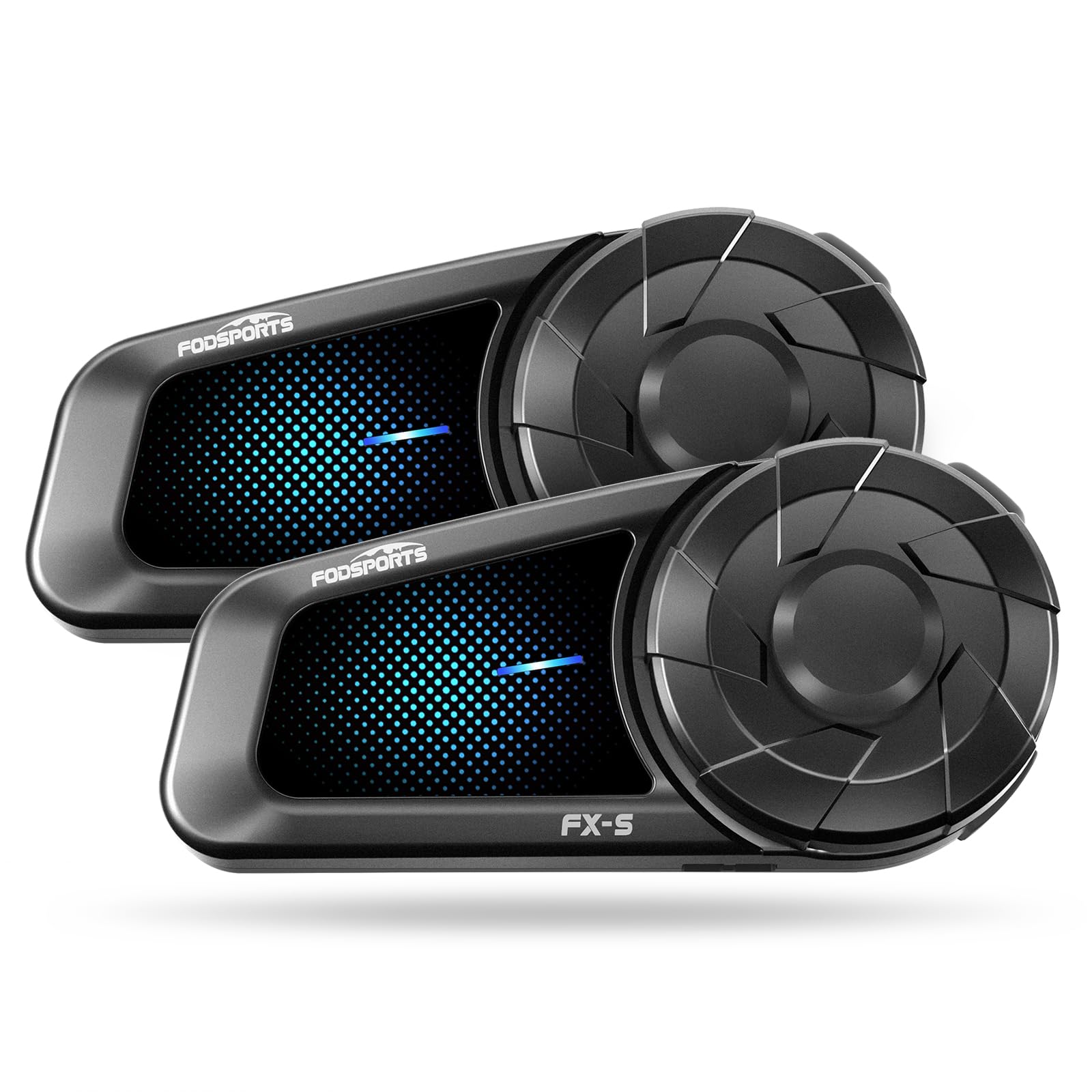
2. Fodsports FX-S Motorcycle Bluetooth Headset
Bluetooth 5.4, the newest standard on this list, in a two-pack priced like a single entry-level unit.
Bluetooth 5.4 is the newest wireless standard on this entire list, and it is the reason this pair pairs quickly and holds its signal. The Qualcomm chip inside keeps latency low, so you hear your partner’s warning without a gap. Two riders can talk over a stated range of up to 1000 m, and the 40mm Hi-Fi speakers are slim enough (9mm deep) to sit in a helmet without pressing on your ears. A CVC and DSP noise-cancelling system (two-tier filtering that strips engine and wind noise) keeps the voice channel clean, and it can hold two phones at once so you switch between them without re-pairing.
On range, this beats the Interphone Aerial clearly — 1000 m stated versus 300 m for the Aerial. That difference is the whole point for riders who fall behind on descents. The two included mics cover you either way: a button mic for full-face helmets and a boom mic for open-face. At 0.08 pounds it adds almost nothing to your helmet, and the oversized buttons are built for gloved thumbs. Charging runs through USB-C in 2 hours, and you can ride while it charges. An IP67 rating covers rain, wind and dust.
The honest limit: it is a two-person intercom only. It pairs with one other headset, so a group of three or more needs a different system. Sound quality is bright in the upper range, with light bass — earplugs tame it if the treble bothers you. As buyers report: “Great price, awesome range, easy to use and install.” The mounting hardware is generous, with adhesive and slide-on options plus a two-allen-screw clamp.
Reach for this if: you ride as a pair and want the newest Bluetooth version without paying premium money.
Think twice if: your group is three or more — this will not link them together.
3. Roamee Bluetooth Hands-Free Kit for Bikers

Hear your partner and the traffic behind you at the same time.
The open-ear design keeps the speaker away from the ear canal, so city noise, car horns and tyre hum still reach you. Cyclists who ride in traffic tend to value that more than raw audio quality. Talk time runs to 8 hours on a charge, over a range of 300 meters for up to 2 users in two-way mode. The audio chain uses dual microphone beam forming (two mics aimed forward at your voice) plus full-duplex so you can both speak at once, with noise cancellation filtering the rest.
The installation is the part that wins people over — the maker claims a “5 seconds” setup with self-adhesive holders and strong magnets, and it fits any bicycle helmet. What cyclists comment on most is the fitness side of it: the open-ear fit and secure mount clearly suit sweaty, moving rides. The conversation quality comes close behind it, with users reporting they can hold a real talk rather than trading clipped words. Range holds up on open ground around 300 feet, though as with every unit in this list, terrain shortens it.
The catch is the magnets. When you lift the helmet off your head, one or both units can slide off their magnetic pads — an easy re-seat, but something to expect daily. Pairing is also inconsistent: some riders find it instant, others have to re-pair on every power-on because the units do not reconnect themselves. And there is one limit worth knowing before you buy: you cannot listen to music while using the intercom, since one press toggles between them.
The everyday read: at 300 meters with 8 hours of talk time, this is a solid commuter-and-greenway unit. The open-ear fit is a real safety benefit, and the magnetic mount is genuinely fast on and off.
Choose it when: you ride in traffic and refuse to close off your ears to the world.
Pass on it if: you want to chat and stream music on the same ride — the two modes do not run together.
4. Interphone Aerial Bluetooth Bicycle Helmet Intercom
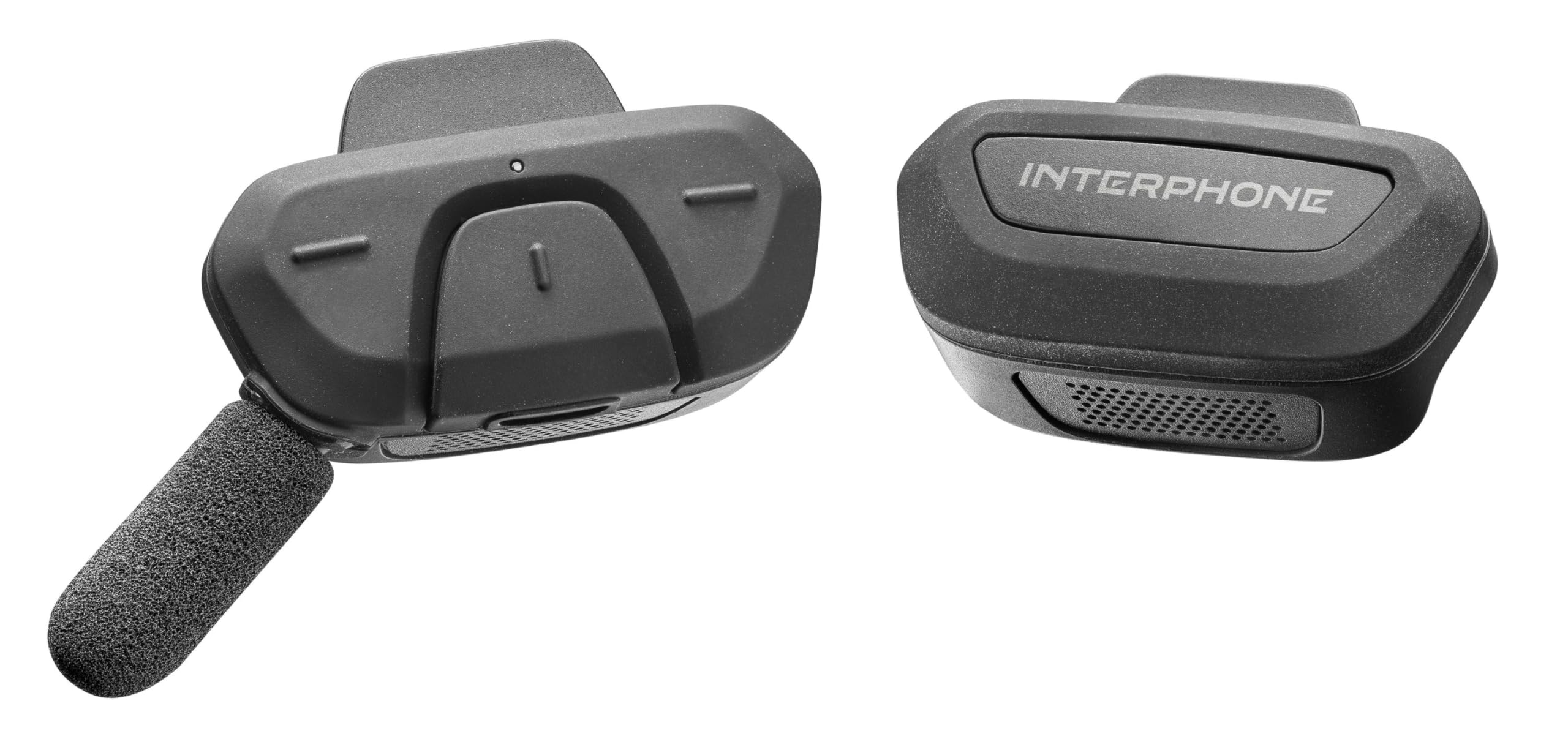
A single helmet unit built for GPS directions, calls and audio rather than rider-to-rider chat.
Read the listing carefully here, because this is one unit, not a pair. To link two riders you need two of these — the box gives you a single rider’s kit. Bluetooth 5.1 is the newer standard on this pick; it sits above the EJEAS V6’s Bluetooth 3 and below the Fodsports FX-S on 5.4. The 300-meter range for two cyclists is the shortest stated figure in this lineup, and riders report the link fading after about 200 meters with terrain in between, which is fine in single file and not fine on a spread-out descent.
Where this shines is the non-communication jobs. It pairs with GPS navigation devices and smartphones for turn-by-turn directions, calls and audio while you pedal. A built-in wind noise filter (a small mic setting that drops rushing-air frequencies) keeps instructions understandable at speed. The open-ear earpiece leaves your ear canal clear, and mounting is by a magnet onto a pre-glued bracket with the cable routed inside the helmet. Weather is covered by a waterproof build and a USB-C charging port.
Owners who buy two get along well — pairing is instant, mounting integrates neatly, and communication is described as audible over ambient noise. There is one undocumented trick worth knowing: hold the middle button for about six seconds until you hear a second melody, and that is how you power it off. The honest caveat is that the listing can read as if it ships as a pair — check the quantity before you commit.
Off-the-bike verdict: priced as a single unit, it is a reasonable GPS-and-audio solution for a solo rider, and a fair pair only when you buy two.
Best for: the solo cyclist who wants navigation prompts and occasional calls piped in.
Not your pick if: you expect two riders to talk from the start — you will need a second unit.
5. Sena R2 Smart Bluetooth Road Cycling Helmet

The speakers and microphone are built into the helmet shell, so there is no separate intercom to mount.
Buying a helmet and an intercom separately means two purchases and a mounting job. This skips both: the speakers and microphone are built into the shell, with a Bluetooth intercom and smartphone pairing for music, GPS and calls. There is also an integrated LED taillight, which makes you more visible on evening rides, and the whole package weighs 394 g with a polycarbonate outer and expanded-polystyrene inner (the hard shell and the shock-absorbing foam inside). It is a single helmet that has the communication system already installed.
The quality of the shell is what people comment on most — it is described as well-made, sturdy and well-cushioned, with adjustable straps and a padded cover. Couples who ride together say the biggest win is not having to stop or turn around to talk. With the built-in speakers and mic, you hear your partner clearly over blocks of distance and there is no wind noise creeping into the channel. Pairing is easy out of a QR code, and you do not need to re-pair the next day — powering on brings the link back.
Two notes before you buy. Sizing runs small, so check the fit chart rather than guessing your usual size. And the one thing it cannot do is play separate audio to each helmet: both of you hear the same stream, and it can cut in and out while you ride. Battery covers a 2 to 3 hour ride comfortably. The side strap clamps have been known to break on some units, so treat the strap with a little care when you take it off.
The value angle: one purchase replaces a helmet plus a clip-on kit, and it includes an LED taillight the clip-ons do not. For a couple wanting the simplest possible setup, this is the least fuss on the list.
Pick it for: couples and pairs who want to talk on every ride with zero mounting work.
Skip if: you have a favourite helmet already, or you need two different music streams.
6. Sena BiKom 20 Ultimate Cycling Communication System

A 20-gram unit that clips to your helmet strap, with 6 channels and noise control that keeps wind out of your voice.
The number that matters here is 20 grams — the weight of each unit, light enough to clip onto a helmet strap and forget about. Talk time runs up to 7 hours over a stated 0.5-mile range, and the system covers virtually unlimited users spread across 6 communication channels, which is the feature that separates it from every two-rider pick on this list. Advanced Noise Control keeps your voice clear in traffic and wind, and firmware updates arrive over the air through the app, so you do not need a cable to update it.
What riders value most is the audio quality. Voices come through and wind does not — as owners mention: “We really love these on long rides! Easy to use and comfortable with my helmet. Voices carry… but wind noise doesnt.” A 6-hour ride test came through with clean conversation and no wind intrusion. Range holds at least 150 yards in real use, and multiple units plus a Bluetooth phone pairing can run at once for a group. Private channel settings stay put after power-off, so you do not reconfigure every ride.
The honest trade-offs are real but small. The buttons are stiff enough that some riders speculate it is for water resistance — meaning you press them with intent rather than by feel. It is a specialised communication device, not a hi-fi headset, so do not expect deep bass. And at 2.5 hours to charge, it is quicker to top up than the Cardo’s 13-hour window. This is a helmet-strap unit, not a helmet — you supply the helmet.
Where it stands: this is the pick for a cycling club rather than a pair. Six channels and unlimited users means the whole group can stay in touch, and at 20 grams you will not feel it there.
The fit: group riders and clubs who need more than one conversation channel.
The trade-off: stiff buttons and modest audio fidelity — this is a talk device, not a music system.
7. EJEAS V6 Motorcycle Bluetooth Headset (2 Pack)

A two-pack with 18 hours of intercom talk time and a 3-hour charge.
This is a two-pack, so you and a partner get two complete units in one box — ear speakers, mics, mount posts, clips and Type-C cables. The headline figure is a 1200M maximum intercom range, the longest stated distance in this article. It supports up to 6 device connections, but only 2 people can talk to each other at a time — the host picks one of the five sub-devices. That is the full-duplex limit to understand before you buy.
Battery life is the standout: an 850mAh rechargeable cell, 18 hours of intercom time and 25 hours of music playback, with 260 hours of standby. Charging takes just 3 hours. Compared to the Cardo Packtalk Outdoor’s 13-hour charge time, this fills up far faster — useful if you are the sort of rider who plugs in last minute. It pairs with most full-face and three-quarter helmets and ski helmets that cover the ears, and the Bluetooth 5.1 chip auto-answers or rejects calls within 5 seconds. The build is waterproof, dust-proof and sun-proof.
Sound quality is the honest weak spot: the noise cancellation handles wind and background well, but the audio itself is basic, and the mic can sound muffled at speed. The button layout is clumsy for gloved fingers. This is a value pick rather than an audiophile one — if clean music and accurate navigation prompts matter most to you, a pricier system earns its keep. For pure rider-to-rider talk at a low outlay, it delivers. As customers note after trail riding: “they worked really well.”
The last word: 18 hours of talk time and a 3-hour charge make this the endurance pick at the entry tier, and the 1200M range is the longest stated in this round-up.
For you if: you want two complete units in one box and long battery life over audio polish.
Not for you if: you ride with three or more — this two-person system will not support it.
Know the Specs
Intercom range in meters and kilometers
This is the best-case distance in open ground between two riders, usually quoted in meters or miles. It is not a guarantee. Hills, trees, buildings and even body position can shorten it, and riders routinely report dropouts well before the rated figure. Read range as the ceiling, then assume half for real trails.
Bluetooth version
The number tells you which generation of wireless standard the unit uses. Higher is generally newer, with faster pairing and a steadier signal over distance. A unit on Bluetooth 5.4 is a newer generation than one on Bluetooth 3, though version alone does not decide audio quality — speaker size and tuning matter just as much.
Talk time and charge time
Talk time is how many hours of intercom you get on a charge; charge time is how long the battery needs to refill. A long talk time paired with a long charge time is fine for planned rides but awkward for last-minute ones. It pays to match both figures to your riding habits.
Full duplex versus one-at-a-time
Full duplex means both riders can speak and listen at the same moment, the way a phone call works. One-at-a-time modes mean you take turns, which can feel choppy. If you ride with one partner and want natural back-and-forth, full duplex is the feature to check for.
Common Questions
How far apart can two riders realistically stay in touch?
Do I need to buy two units or does one kit do both riders?
Will this work with my existing bike helmet?
Can I listen to music while talking to my partner?
Which unit has the longest battery life?
What does the IP rating actually protect against?
Can three or more riders join the same conversation?
Is built-in voice control worth having, or is a button fine?
Do I need a phone signal for the intercom to work?
Can I mount one of these on a helmet-free headset and use it without a helmet?
The Bottom Line
For most riders, the winner in this bicycle to bicycle communication system round-up is the Cardo Packtalk Outdoor, because its 10-hour talk time, up-to-1-km range and IP67 build handle cold, wet mountain rides without fuss. If you ride as a pair and want the newest Bluetooth standard on a budget, the Fodsports FX-S on Bluetooth 5.4 is the smarter buy. And for a cycling club that needs more than two people talking, the Sena BiKom 20 with its six channels and 20-gram weight is the one to reach for. Whichever you pick, pair the units at home before you get to the trailhead — save the troubleshooting for the kitchen table, not the mountain.
How we choose
We do not accept paid placement. Every pick is matched to a real buyer and a real use-case; we do not hands-on test units.
Sources
Specifications: manufacturer listings and product documentation. Review insights: verified customer reviews, as of October 2026. Pricing: not shown on this page (it changes often); check the current price via the retailer link.
As an Amazon Associate, Aappliancez earns from qualifying purchases. This does not affect which products we feature.