Disclosure: Some links in this post are affiliate links. As an Amazon Associate I earn from qualifying purchases, at no extra cost to you. Learn more
Specs are compiled from manufacturer listings and verified buyer reviews and can change over time — please confirm the key details on the product page before buying.
Turning a regular bicycle into a motorized ride depends on one question: do you want to bolt a small gas engine onto your frame, or swap your rear wheel for an electric hub motor? Both routes work, but they fail in completely different ways. A gas kit asks you to mix fuel and oil by hand, tighten bolts that vibrate loose, and expect to spend an afternoon tuning a carburetor before your first real ride. An electric hub kit bolts on in a fraction of the time and runs silent, but it cannot move until you supply your own battery. Getting this choice right saves you from buying the wrong kit entirely, since a mismatch between kit and bike is the most common reason builds stall halfway.
This guide is built by comparing the manufacturers’ published specifications and the patterns across verified customer reviews, so you get each pick’s real strengths and trade-offs instead of marketing spin.
The kits below split into gasoline and electric, and each one fits a different frame and demands a different level of mechanical patience. This breakdown of the best bicycle motor kits covers mounting clearance, sprocket teeth, and the parts that actually break first.
Top Picks


How To Choose The Best Bicycle Motor Kits
The single most common reason a motor kit gets returned is that it never physically fits the bike. A gas engine needs open space inside the frame triangle, and an electric hub needs the exact width between your fork tips. Measure before you buy anything, because neither problem can be fixed with better tools or more patience.
Frame clearance and the V-frame rule
Most gasoline kits are built for what sellers call a V-frame — a bicycle whose top tube and down tube form an open triangle above the pedals. The engine hangs inside that triangle, so you need roughly 10 inches or more of open height between the bottom bracket (the bearing assembly your pedals spin on) and the top bar. A step-through cruiser or a compact mountain bike often will not accept a gas engine no matter how you angle it.
Rear dropout spacing and wheel size
Electric hub kits replace your existing wheel, so the motor has to slide into the slots at the ends of your frame — called the dropouts. Those slots come in different widths, and a hub built for one width will not squeeze into another without spreading the frame. The rim diameter has to match too: a 26-inch kit wheel will not replace a 20-inch or 24-inch wheel.
Two-stroke versus electric: pick by routine, not by spec
A two-stroke gas engine needs you to mix gasoline with oil at a set ratio, and it rewards regular tinkering. An electric hub needs no fuel at all but needs a battery you buy separately, and the range you get depends entirely on that battery. If your commute is short and quiet matters, electric wins. If you want unlimited range with a fuel can, gas is the practical route.
Side-by-Side Comparison
| Model | Best For | Motor Type | Power Output | Item Weight | Amazon |
|---|---|---|---|---|---|
| BAFANG BBS02B/BBS-HD Mid Drive Kit★ Best Overall | Riders who want pedal-assist on their existing gears | Mid-drive, brushless | 750W (500W/750W/1000W options) | — | Amazon |
| IMAYCC 100cc Motorized Bike KitLong-Range Gas Pick | Long-distance riders who want max displacement | 2-stroke, air-cooled single cylinder | 2kW / 6500rpm | 26.4 pounds | Amazon |
| Ktaxon 48V 1000W Conversion KitBudget Hub Pick | Budget D.I.Y. builders upgrading a 26″ bike | Hub, brushless gearless | 1000W | 21.4 pounds | Amazon |
| YYDIPO 100cc 2-Stroke Petrol Engine Kit | First-time builders on a tight budget | 2-stroke, air-cooled single cylinder | — | — | Amazon |
| WBGANG 100CC Bike Engine Kit | Heavier riders hauling loads on flat ground | 2-stroke, air-cooled | — | 22.3 pounds | Amazon |
| H-YEEU 110cc 2-Stroke Engine Kit | Tuners chasing high RPM and jetting control | 2-stroke, air-cooled | 3.8Kw / 6000rpm | 25.9 pounds | Amazon |
| IMAYCC 80cc Motorized Bike Kit | Builders who want a cheap, rebuildable base engine | 2-stroke, air-cooled single cylinder | 2.1Kw / 5000rpm | — | Amazon |
| Bdujhit 48V 1500W Snow E-Bike Kit | Wide-tire and snow builds needing climbing torque | Rear hub, brushless gearless | 1500W | — | Amazon |
| NBPOWER 72V 2000W Rear Wheel Kit | Speed builds using 72V batteries and rim brakes | Rear hub, sine wave controller | 2000W | — | Amazon |
Detailed Reviews
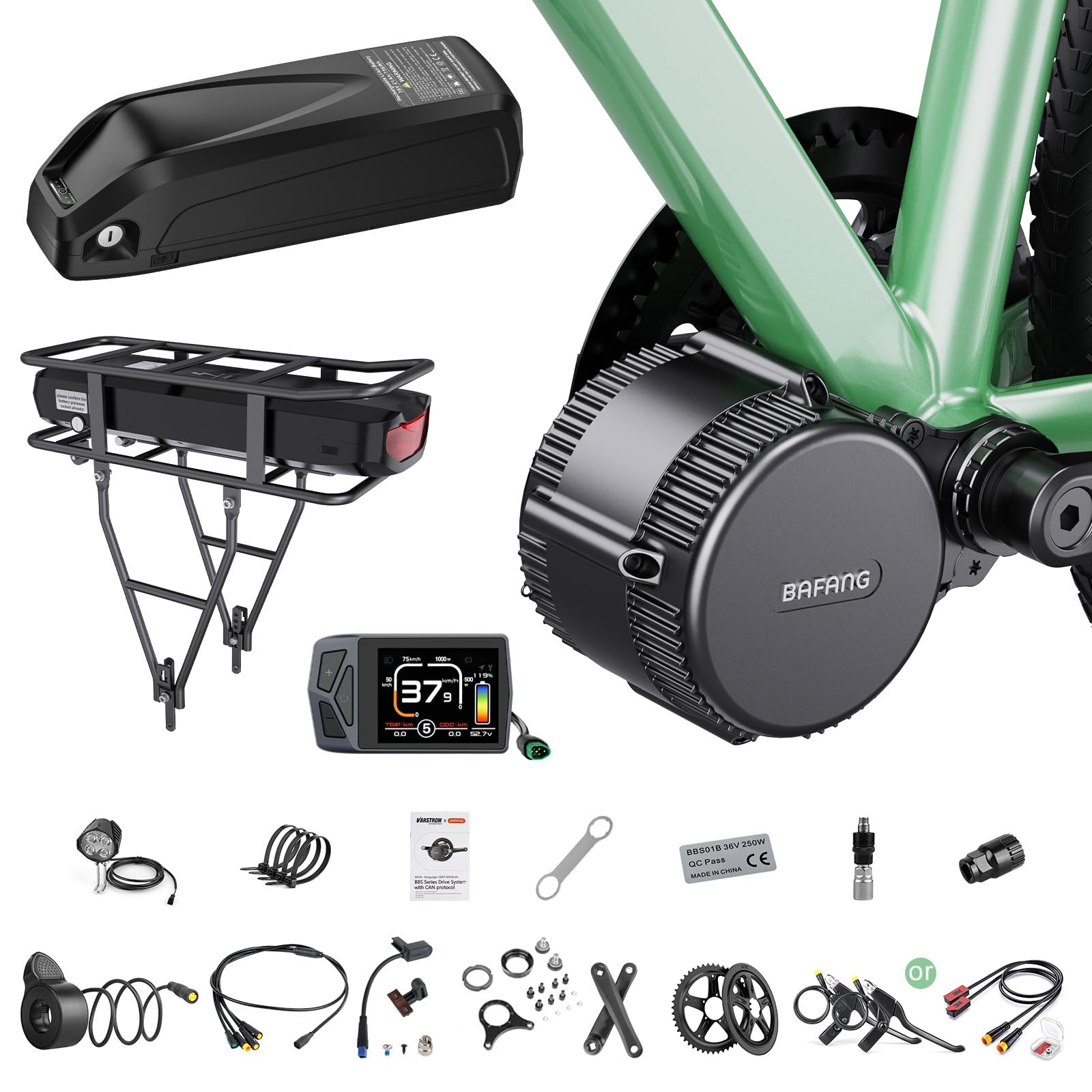
1. BAFANG BBS02B BBS-HD Mid Drive Electric Bike Conversion Kit
Our pick — 4.0+★ from 80+ verified ratings; the strongest balance of quality and price.
A mid-drive motor that pushes through your own gears instead of fighting them.
This kit sits at the crank instead of in a wheel, which is why it feels so different from a hub build. It routes the motor’s effort through your bike’s existing cassette and derailleur, so the same torque that flattens a hill also works in any gear you pick. Owners lean on exactly that combination — this is the crowd favorite among the electric kits here at 4.0+ stars across 80+ ratings, and the reviews are stacked with installs on frames as different as a medium Giant Talon.
The headline number is torque. Depending on which version you select, BAFANG rates the motor at 100, 120, or 160 N.m — and that spacing matters, because a single Newton-meter unit of twist on a folding chair would be meaningless, while this is the same figure car makers quote for wheel-pulling force. The kit spans 500W, 750W, and 1000W versions on a 48V or 52V system, with a rated speed of 34 miles per hour. Think of wattage here as the total electrical muscle and voltage as the current’s push behind it; more of either means stronger climbing and faster cruising.
Battery freedom is the other reason this tops the list. It is not locked to BAFANG packs — it runs on 48V 13Ah, 16Ah, 18.2Ah, or 20Ah batteries, and also 52V 20Ah, provided the pack uses a male XT60 connector (that is the small yellow-tipped plug joining motor to battery). Amp-hours measure how long the pack can sustain a draw, so a bigger number means a longer ride between charges. On the frame side you need a bottom bracket of 68mm to 73mm, 100mm, or 120mm in length with a 33.5mm to 36mm inner diameter, matching the JIS standard used on most bikes. Chain-driven frames with disc or V-brakes are the target; a belt-drive bike will not work.
What the build gets right
- Runs through your existing gears, so 100/120/160 N.m of torque is usable in any ratio
- Accepts 48V packs from 13Ah to 20Ah and 52V 20Ah, so you are not tied to one brand
- Display options like the DPC010 and DPC080 let you tune motor parameters without a USB cable
- Covers 68mm, 100mm, and 120mm bottom brackets, which suits fat bikes as well as road frames
Where it gets fiddly
- The instruction documentation is thin, and assembly guidance is the most common route to frustration
- 73mm mounting screws are not included
- Your battery must arrive with a compatible connector, or you are sourcing adapters
Build this if: you want pedal-assist that still feels like riding a bike, and your frame has a 68mm-to-120mm bottom bracket with disc or V-brakes.
Budget for: a separate battery with an XT60 plug and a set of screws if your bracket measures 73mm.
2. IMAYCC Bike Motor Kit 100cc Motorized Bike Kit 2 Stroke Gas Bicycle Engine Conversion Kit Fit for 26-28″ Bikes Black
The biggest displacement and the highest weight in this lineup, and the two are related.
At 26.4 pounds this is the heaviest kit on the list, and the comparison with the Ktaxon hub kit is the clearest way to see what that means — the Ktaxon comes in at 21.4 pounds on the same scale. That gap is the physical reality of a cast-metal engine, fuel tank, and exhaust versus an electric hub. What you trade for it is range without a charging cable: the kit carries a 3L black teardrop fuel tank rated at 2.5L of fuel per 100km.
Under the tank sits a 2-stroke single-cylinder gasoline engine rated at 2kW at 6500rpm, fed by CDI ignition (a capacitor discharge setup that fires the spark without moving breaker points) and started by foot pedal. The drive side runs a 44-tooth sprocket with a 110-knot chain across 36 spokes. Engine displacement of 100cc sets the general power class — more cc means more pull, which is why this engine has a stronger reputation for torque than smaller kits in the same family.
Owners who keep it running tend to be the ones who respect the break-in. Owners put it this way: “iv had this kit for 5 months now, iv rode the bike pretty hard and the only problem I had was the chain tentioner, I bought the case mounted spring one and it runs flawless.” That experience is the pattern, not the exception — a well-assembled unit with an upgraded tensioner keeps going. First-time builders often find it harder than the listing suggests, and the honest read is that this is a kit for someone with a wrench set and patience, not a plug-and-play install. One buyer’s verdict lands the tone: “It’s not bad if you don’t mind the speed and vibrations.”
The displacement argument: 100cc with more torque than the smaller kits in this family means you are not fighting hills as hard.
The honest catch: heavier than the 21.4-pound electric hub kit and needs a 16:1 fuel-oil mix when new, rising to 20:1 after the first 500km — get the mixture wrong and you damage the engine, not just the ride.
Worth it for: a rider who wants maximum engine size, a fuel can, and no charging routine.
Look elsewhere if: you want something you can unbox and ride the same afternoon.
3. Ktaxon 48V 1000W Electric Bike Conversion Kit 26″ Front/Rear Wheel
A noiseless gearless hub that swings the weight balance back toward your charging port.
The number that sells this kit is on the scale. At 21.4 pounds it undercuts the IMAYCC 100cc gas kit’s 26.4 pounds, which matters the moment you have to lift the bike onto a rack. The trade you accept is a battery. Ktaxon does not include one, so the total build cost depends entirely on the pack you supply, and the kit expects 48V.
The motor itself is a 48V 1000W brushless, gearless hub — gearless meaning fewer moving parts inside the wheel to wear, at the cost of slightly lower torque from a standstill. It fits most 26-inch bikes with 3.93 inches of front dropout spacing, wraps the rim in lightweight aluminum alloy, and runs 36 high-carbon steel spokes rated for a 220-pound rider. A Pedal Assist Sensor reads your pedaling cadence and feeds power without you touching the throttle, and the LCD screen shows battery level, speed, mileage, mode, and error codes so you can troubleshoot without guessing. Four modes cover it: throttle, presets, pedal assist, and manual.
What buyers praise most is the install itself — a smooth bolt-on build with video help and a kit that plays nicely with a 48V battery. The recurring gripe is durability at the controller end, and it is worth naming honestly: occasional units have arrived that rattled and resisted the wheel, so buy from a seller with a clear return path and test the motor’s direction before you mount the tire. The written instructions have odd translations, so lean on the videos. Long-term riders rate it highly, with one calling it “a must to buy for your bike.”
Where the value sits: a gearless 1000W hub with PAS, LCD display, and 4 riding modes, spec-for-spec the strongest budget electric option here.
Read before you buy: battery not included, and the instructions involve some translation guesswork — the install video is your real manual.
The right call for: a D.I.Y. builder upgrading a 26-inch frame who already owns or plans to buy a 48V battery.
Think twice if: you expect everything in the box or need front-suspension clearance, since it will not fit fat forks.
4. YYDIPO 100cc 2 Stroke Petrol Gas Engine Kit for 26-28″ V-Frame Bicycles (36 Tooth Sprocket)

A smaller sprocket and a bigger bore, aimed at riders who want a fiddly build on a shoestring.
Two details separate this from the bigger 100cc kits. First, the sprocket: 36 teeth against the 44 teeth you will find on the IMAYCC 100cc kit. Fewer teeth on the rear gear means a taller final ratio, which is the usual way builders chase top speed at the expense of low-end pull. Second, the cylinder: a single-piece 50mm bore head, which the maker says increases load carrying capacity and reduces operating temperature.
The rest of the package is a complete conversion — a 2-stroke, air-cooled, single-cylinder engine, an adjustable high-performance carburetor with a rocker on the handlebar for on-the-fly mixture control, a red high-speed carburetor, and an upgraded capacitor discharge ignition. Four bolts tie the engine to the frame. The instructions walk through each assembly step, and the maker asks you to add lubricant to the cylinder before the first start — skip that and you risk a dry first stroke.
It fits most 26-inch to 28-inch V-frame bikes, mountain and road and cruiser shapes alike. Build quality lands where you would expect at this position on the list: owners are generally pleased with the result, with the recurring notes being a small pin hole in the gas tank on a unit or two and a foot pedal that broke on another. Neither is a systemic flaw, but both point to the same lesson — check every connection before your first ride and expect to fettle small parts.
The honest read: a 50mm bore cylinder, a 36-tooth sprocket for speed bias, and an adjustable carburetor, priced at the entry tier of gas kits.
The honest caveat: small-part quality is the weak link — inspect the fuel tank and pedals carefully before riding.
Buy it if: you want to test whether gas conversion suits you without committing to a premium build.
skip it if: you value a long warranty or a support line you can call.
5. WBGANG 100CC Bike Engine Kit 2-Stroke Gas Motorcycle Kit

Quiet for a two-stroke, and built to carry more weight than most frames will allow.
The load rating is the standout figure — the maker lists support for up to 440 pounds, which is far above the 220 pounds the Ktaxon electric kit rates its wheel for. The engine uses a durable aluminum block with reinforced iron components, and the maker equates that to a sturdier build for heavier riders or a rider hauling cargo.
Noise is the second reason this one stands out. The maker rates operation at roughly 75 dB — the sound level of a normal conversation, which is unusually restrained for a two-stroke. A UV-resistant black tank cuts fuel evaporation, and the maker quotes approximately 100km of range per 0.66 gallons, with a 0.53-gallon tank on the bike. Rounded edges are there to prevent scratches, and the sandblasted, painted surfaces are meant to hold up over time.
Top speed is listed at 28 MPH. Install is designed for V-frame bikes and includes all hardware, but the honest pattern in owner experience is this: you will spend more time reading the manual than bolting parts on, and anyone without prior motorcycle knowledge will find the instructions confusing. The recurring advice from people who have done the build is to swap the sprocket and tensioner bolts for new hardware with threadlocker before your first ride, and to fit a new chain. Speed tolerance matters too — one rider with a 100cc engine measured about 25 MPH, well under the maker’s 28 MPH figure.
The strongest case: a 440-pound load rating and a noise figure of around 75 dB make this the pick for heavier riders or cargo duty.
The catch: confusing instructions and the need for upgraded bolts and a fresh chain push this firmly into experienced-hands territory.
Pick this one for: heavier riders or anyone hauling gear who wants quieter running than a typical two-stroke.
Not the one for: someone expecting bolts and chain to survive the first long ride without swapping in better hardware.
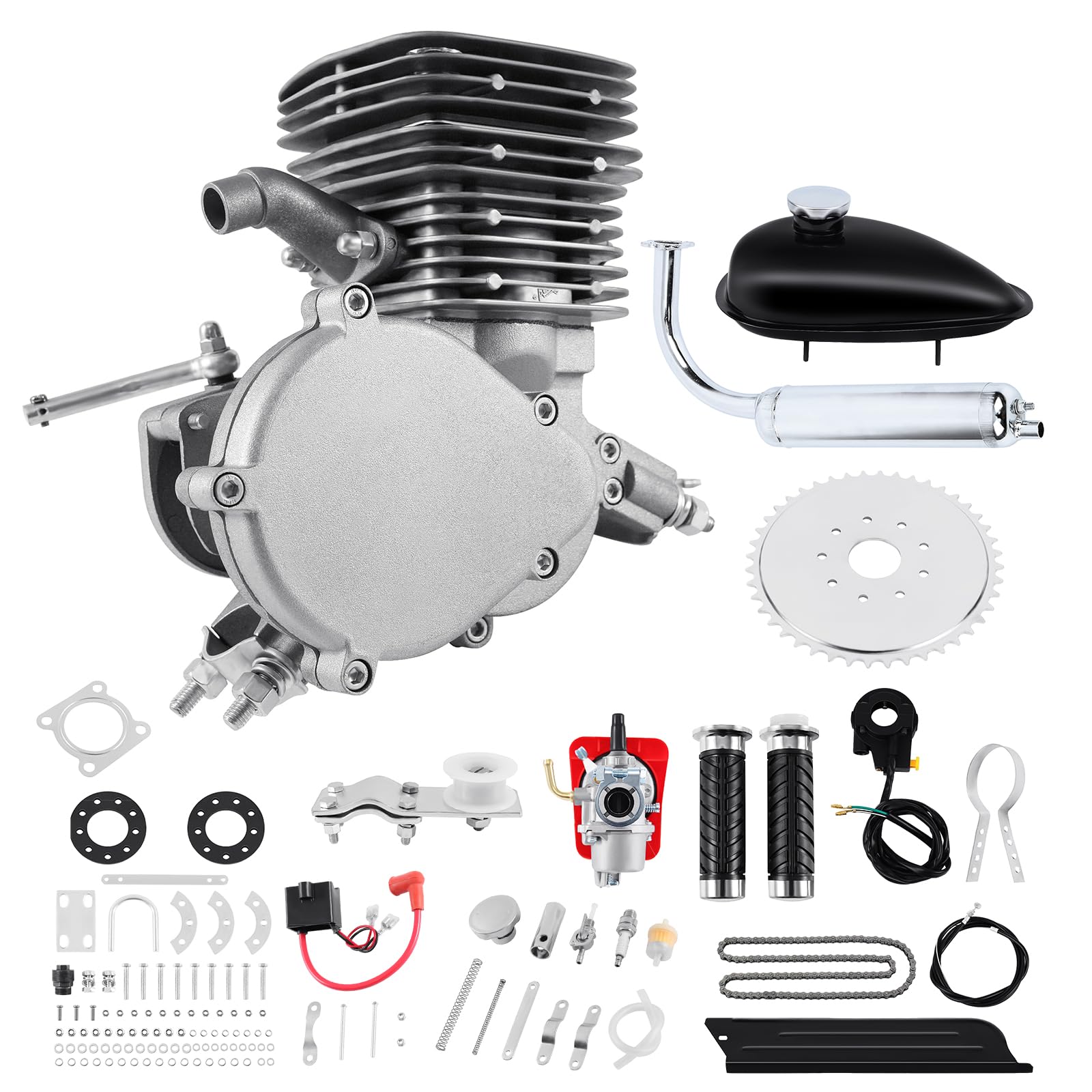
6. H-YEEU 110cc 2-Stroke Bicycle Gasoline Engine Motor Kit
The largest displacement in the lineup, with jetting notes that suggest it rewards a tinkerer.
Displacement is where this kit separates itself. It runs a 110cc engine with a bore of 52mm and a stroke of 40.2mm, delivering a maximum of 3.8Kw at 6000rpm, which the maker pegs at roughly 5.5 to 6.5 horsepower. That is the largest displacement here, and the maker claims 150 miles per gallon on top of it.
Fuel economy at that figure comes from the engine’s efficiency, but the maker is upfront that running it too long without attention can score the cylinder — the bore and stroke come together at the piston face where heat builds. The rule the maker sets is a mix of gasoline and two-stroke oil at 18:1 for new units, and lubricant oil added before every single start. Either two-stroke oil or general engine oil is acceptable for that lubrication. Air-cooling means no radiator to maintain, and the unit weighs 25.9 pounds.
The tuning reviews here are unusually detailed, and they tell you something honest about the kit’s ceiling. One owner reports that with a 66 main jet — the fuel-metering nozzle inside the carburetor — the engine revs to 7,000 RPM under load, reaching 28mph on a small wheel, and 11,500 RPM free revving. The stock jet, by contrast, held it to 5,000 RPM and 20mph. Clutch-in with no load, it hit 12,000 RPM. That is a kit with headroom, but you have to be willing to swap jets and pay attention to jetting to reach it.
Why tinkerers like it
- 110cc engine with a 52mm bore and 40.2mm stroke
- Maker-rated 150 miles per gallon for cheap running costs
- Owners measure 7,000 RPM under load with a 66 main jet versus a stock 5,000 RPM
What to expect
- Requires 18:1 fuel-oil mix when new and lubricant oil before every start
- Some units arrive hard to start or prone to flooding
- The 150 MPG figure is the maker’s claim, not a measured guarantee
Fits you if: you are comfortable swapping jets and reading spark plug color to dial the mixture in.
Pass if: you want to add fuel and go without touching the carburetor again.
7. IMAYCC 80cc Motorized Bike Kit 2 Stroke Gas Engine Kit

The value engine — cheap to buy, rebuildable, and full of upgrade potential.
This is the little brother to the 100cc IMAYCC kit, and it shares that kit’s frame requirements: 10 inches or more of clearance between the bottom bracket and the top bar of a 26-inch to 28-inch V-frame bike. Its engine is a 2-stroke, 80cc single-cylinder unit rated at 2.1Kw at 5000rpm, running a 44-tooth sprocket and a 110-knot chain on 36 spokes. It carries a 2.5L black teardrop tank.
The fuel story is straightforward: 90-octane gasoline mixed with engine oil at 16:1 when new and 20:1 after the first 500km of run-in riding. On a smooth road at 20-25Km/h, the maker quotes 2 to 2.5L per 100km of fuel consumption. Slower than the 100cc kit, and lighter on the wallet as a result.
There is one clear cultural fact about this kit that experienced builders repeat: it is a base engine meant to be modified, not ridden stock. The tweaks that show up again and again are an upgraded carburetor and exhaust, a 32-tooth sprocket for higher top speed, and a piece of inner tube under the engine mounts to damp vibration. The chain is the part that bites builders — it is wider than a standard bicycle chain, so a standard chain breaker will not cut it, and it needs careful alignment plus a good tensioner, since the stock one is a known weak spot. The 80cc displacement means less power than the 100cc kits, but proportionally less heat and stress too, and the seller’s 30-day return window softens the learning curve. Test-fit everything on the frame before you commit to tightening.
The value case: an 80cc engine at 2.1Kw with an active upgrade community behind it, meaning parts and tutorials are easy to find.
The friction: the stock chain tensioner and the wider-than-standard chain demand attention early, and the included guidebook is less useful than YouTube for the assembly.
Start here if: this is your first conversion and you want a low-risk engine you can improve over time.
Might not suit if: your frame is a 19-inch 26-inch MTB with a large bottom tube — the smaller the frame, the harder this kit fits.
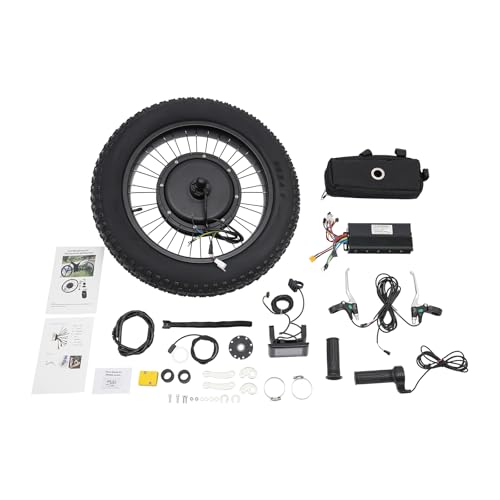
8. Bdujhit 48V 1500W Ebike 20″ Rear Hub Motor Wheel Kit
A 1500W hub at a 20-inch wheel — small diameter, big climbing torque.
A 20-inch wheel mated to a 1500W hub is a specific recipe: smaller tires spin up faster and multiply torque at the contact patch, which is why this combination turns up on fat-tire and snow builds. The motor is brushless and gearless, rated at over 82% efficiency, and built from rust-resistant rubber, stainless steel, aluminum, and copper. The load rating sits at roughly 330.69 pounds, well above the 220 pounds the Ktaxon wheel is rated for.
Control is thoughtful for the price. A Pedal Assist Sensor takes over the pedaling, cycling, and climbing load, cutting fatigue on long climbs. The LCD shows speed, battery level, mode, and faults, so you get warning before a problem strands you. A power-off brake lever kills the motor the instant you squeeze the brakes, and the widened 3.94-inch rubber wheel improves grip — a real benefit when you are running wide tires on loose ground. Add 7 gears and both commuting and short-distance riding are covered.
Owner experience centers on two things: reliability and how straightforward the install is. The kit is wiry but plug-and-play, and the controller is beefier than typical generic units, with max current and model printed right on it. Top speed reports run around 35mph when paired with a 48V 20Ah battery, open up and with the wheel lifted. The honest gaps are axle dimensions not being listed — buyers fit spacers to line up disc rotor and caliper — and the controller offering only a single 2-pin JST-SM light output when some riders want two 4-pin connectors. The stock throttle also tends to stick, and the wiring benefits from additional waterproofing if you ride in rain.
Why it earns its spot: 1500W, over 82% efficiency, a 330.69-pound load rating, and 7 gears — this is the strongest mid-tier electric kit here.
The small print: no axle dimensions published, a single light output on the controller, and a throttle that sticks — budget for waterproofing and maybe a better throttle.
Suits you if: you are building a snow or wide-tire bike and need climbing torque more than top-end speed.
Reconsider if: you need a controller with multiple light outputs, or you ride in heavy rain without sealing the wiring.
9. NBPOWER 135mm Dropout Rear 72V 2000W Rear Wheel Motor Kit

The most powerful kit here — a 72V system built for riders who want speed and range together.
This is the ceiling of the lineup: a 72V 2000W rear hub motor that lands at the top of the power range. The comparison to the 1500W kit above is stark — 2000W versus 1500W, and 72V versus 48V. Higher voltage means the chain of current flows with more push, which is why a 72V build can hold speed on a long straight where a 48V setup starts to sag.
The hardware backs it up. A 48-72V 45A controller with 18 MOSFETs (the electronic switches inside the controller that handle the load) runs sine wave, which smooths the current into a quieter, cooler feed than a square-wave controller. The MTX33/39 double-wall alloy rims resist denting under the motor’s weight, and the SW900 multifunction display gives you speed, battery level, and mode readouts. A 7-speed freewheel comes included, and the kit ships with a charger. The default shipped configuration is 72V, but the controller accepts 48V too, and you can change the voltage setting from the display.
The owner data on this pick is small but enthusiastic. One long-term rider reports 400 miles on this 2000W 72V 24-inch rear hub setup mounted on a 2005 Giant Stiletto, with a 200-pound, 6-foot-2 rider reaching 45mph easily and covering 60 to 80 miles round trip at 15mph in eco mode with pedal assist and a 20Ah 72V battery. The hub is described as super quiet. The one honest limitation is a fitment note: this is a 135mm dropout rear hub, so measure your frame’s dropout spacing before buying, and the kit also expects a rim brake, not a disc. Anyone with a standard-width frame will need to look at the 1500W kit instead.
what separates it
- 72V 2000W rear hub — the highest voltage and wattage in this lineup
- 45A sine wave controller with 18 MOSFETs for smoother, quieter power delivery
- Owner reports 45mph on flat and 60-80 mile round trips at eco speed with pedal assist
The fitment reality
- Requires a 135mm rear dropout measurement, which excludes many standard frames
- Rim brake only — disc brake bikes will not accept it without work
- The controller’s default 72V setting expects a matching high-voltage battery
The exact rider it suits: someone with a 135mm-dropout frame and a 72V battery who wants the fastest, highest-range build on the list.
The one thing to check first: your frame’s dropout width and brake type — get either wrong and this kit will not go on.
Know the Specs
Sprocket tooth count and final drive ratio
The rear sprocket’s tooth count sets your final drive ratio — the ratio between the engine turning and the wheel turning. Fewer teeth spin the wheel faster at a given engine speed, trading low-end pull for top-end speed. A 36-tooth and a 44-tooth sprocket will feel noticeably different on the same engine, so match the tooth count to if you need hill torque or flat-road speed.
Voltage and wattage on electric kits
Voltage is the push behind the current — a 48V system and a 72V system feed the motor differently. Wattage is the total power the motor can put out. Higher numbers mean more climbing ability and higher top speed, but both require a battery that matches. A controller rated 48-72V, like the one on the NBPOWER kit, gives you room to change the voltage setting from the display.
Dropout width and bottom bracket length
Dropout width is the gap between the slots at the rear of your frame where a wheel axle sits. Hub kits are built for a specific width — 135mm on the NBPOWER kit, 3.93in front spacing on the Ktaxon kit — and a mismatch means spreading your frame or fitting spacers. Bottom bracket length, measured in millimeters on mid-drive kits, is the equivalent measurement at the pedals.
Fuel-oil mix ratios on two-strokes
A two-stroke engine has no separate oil sump — the oil goes into the fuel. Every gas kit here carries a stated mix ratio, from the IMAYCC 100cc kit’s 16:1 when new (rising to 20:1 after 500km) to the H-YEEU 110cc kit’s 18:1. Getting the oil content wrong is the fastest way to damage a two-stroke, so check the ratio before the first tank.
Common Questions
Will a bicycle motor kit fit my existing bike?
Can I install a bicycle motor kit myself?
What fuel mix does a two-stroke bicycle engine need?
What is the difference between a mid-drive motor and a hub motor?
How fast can a bicycle motor kit go?
Do electric bicycle conversion kits include a battery?
Is a chain tensioner upgrade worth it on a gas kit?
What is the difference between a 100cc and an 80cc bicycle engine kit?
Can I use a bicycle motor kit on a step-through frame?
The Bottom Line
For most riders, the best bicycle motor kits choice is the BAFANG BBS02B/BBS-HD Mid Drive Kit because it drives through your existing gears, takes batteries from 13Ah to 20Ah, and delivers up to 160 N.m of usable torque across a 68mm-to-120mm bottom bracket range. If raw displacement and a fuel can suit your routine better, the IMAYCC 100cc Motorized Bike Kit gives you the most engine here. And if you want electric power without a mid-drive install, the Bdujhit 48V 1500W Kit pairs a 330.69-pound load rating with a 7-speed drivetrain for wide-tire builds. Whichever route you take, measure your bottom bracket or dropout width first — that number decides fit more than any spec on the box.
How we choose
We do not accept paid placement. Every pick is matched to a real buyer and a real use-case; we do not hands-on test units.
Sources
Specifications: manufacturer listings and product documentation. Review insights: verified customer reviews, as of October 2026. Pricing: not shown on this page (it changes often); check the current price via the retailer link.
As an Amazon Associate, Aappliancez earns from qualifying purchases. This does not affect which products we feature.