Disclosure: Some links in this post are affiliate links. As an Amazon Associate I earn from qualifying purchases, at no extra cost to you. Learn more
Specs are compiled from manufacturer listings and verified buyer reviews and can change over time — please confirm the key details on the product page before buying.
Most people shopping for a bike that handles both smooth pavement and loose trail end up with the wrong tool for one of the two jobs. A 25c road bike chatters over gravel; a 4.0″ fat-tire bike drags on tarmac. The bikes below split that difference in genuinely different ways — some lean road, some lean dirt, and a few are electric — and the right one for you depends on which surface you actually ride more.
This guide is built by comparing the manufacturers’ published specifications and the patterns across verified customer reviews, so you get each pick’s real strengths and trade-offs instead of marketing spin.
This list runs from carbon race frames to aluminum gravel bikes, hybrids, folding e-bikes, and one three-wheeled hauler. Each entry tells you what the bike is genuinely good at and where it asks you to compromise. That way you pick the one that matches your roads, your body, and your storage space, not the loudest label on the box.
Top Picks

How To Choose The Best Bicycle for Road and Trail
The first decision is not brand or budget — it is surface split. Be honest about the ratio: if 80 percent of your riding is smooth asphalt with the occasional packed-dirt path, a road-leaning bike with narrow tires rewards you with speed. If your weekend loop includes loose gravel, fire roads, or broken pavement, you want tire volume and clearance first.
Tire width is the real dividing line
A road bike running 700x25c tires (about an inch wide) rolls fast but sinks and slips in loose material. A gravel or adventure bike on 700x38c to 700x40c tires floats over the same surface with far more grip. Fat-tire bikes go wider still — 20″x4.0″ — and are built for sand, snow, and rough ground rather than efficient pavement miles. Match the width to the loosest surface on your regular route, not the smoothest.
Gear count and what it buys you
More gears do not automatically mean faster — they mean a wider spread between your easiest climbing gear and your hardest descending gear. A 24-speed setup gives you smaller jumps between gears so you can keep a comfortable pedaling rhythm on a long climb. A 14-speed or 21-speed drivetrain covers the same hills with fewer, bigger steps. Neither is wrong; the 24-speed just lets you hold a steadier cadence on a long climb.
Frame material, weight, and what you carry
Carbon fiber frames and wheelsets are light and stiff, which is why race-oriented bikes use them. Aluminum sits in the middle — light enough to ride briskly, tough enough for everyday use. High-carbon steel is heavier but absorbs vibration and often comes on cargo-capable and electric models. If you plan to add racks, panniers, or a passenger, check the mounting points and the stated load capacity before anything else.
Fit beats almost everything else
A bike outside your height range will not get ridden, no matter how good the parts list looks. Watch the stated rider height range and frame size on each listing. Several models here are one-size or limited-size, and drop-bar bikes in particular feel very different at the edge of their range. When in doubt, size down on a drop-bar bike if you are between sizes.
Side-by-Side Comparison
| Model | Best For | Frame Material | Drivetrain | Tires / Wheels | Amazon |
|---|---|---|---|---|---|
| SAVADECK Carbon Fiber Road Bike★ Best Overall | Fast pavement riding | Carbon Fiber | 24-speed (2×12) | 700x25c carbon wheelset | Amazon |
| SAVADECK Carbon Gravel BikeBest All-Terrain | Mixed road and dirt | Carbon Fiber | 20-speed GRX400 | 700x40c | Amazon |
| Jasion X-Hunter Folding E-BikeBest Folding E-Bike | Commuting with power | Aluminum | 7-speed, 1400W peak | 20″x4.0″ fat tires | Amazon |
| Tiniover Creek Pro Electric Trike | Cargo and passengers | High-carbon steel | 7-speed, 1200W | 4.0″ fat tires, 3 wheels | Amazon |
| Tommaso Sentiero Gravel Bike | First gravel bike | Aluminum | 24-speed (3×8) | 700x40mm | Amazon |
| Tommaso La Forma Hybrid | Fitness and commuting | Aluminum with carbon fork | 27-speed (3×9) | 700x32c | Amazon |
| Schwinn Network 3.5 Hybrid | Upright comfort riding | Aluminum | 21-speed | 700c, linear pull brakes | Amazon |
| ZNH Electric Bike | Low-step electric cruising | High-carbon steel | 7-speed, 500W | 24×2.12″ tires | Amazon |
| Mongoose Elroy Adventure Bike | Touring with luggage | Aluminum | 14-speed (2×7) | 700c, 40mm tires | Amazon |
| Schwinn Sporterra RX Gravel Bike | Budget mixed-terrain | Aluminum | 14-speed | 700x38c | Amazon |
Detailed Reviews
1. SAVADECK Carbon Fiber Road Bike
Our pick — 4.5+★ from 70+ verified ratings; the strongest balance of quality and price.
A full carbon race bike at 19.4 lb that climbs like it costs twice as much.
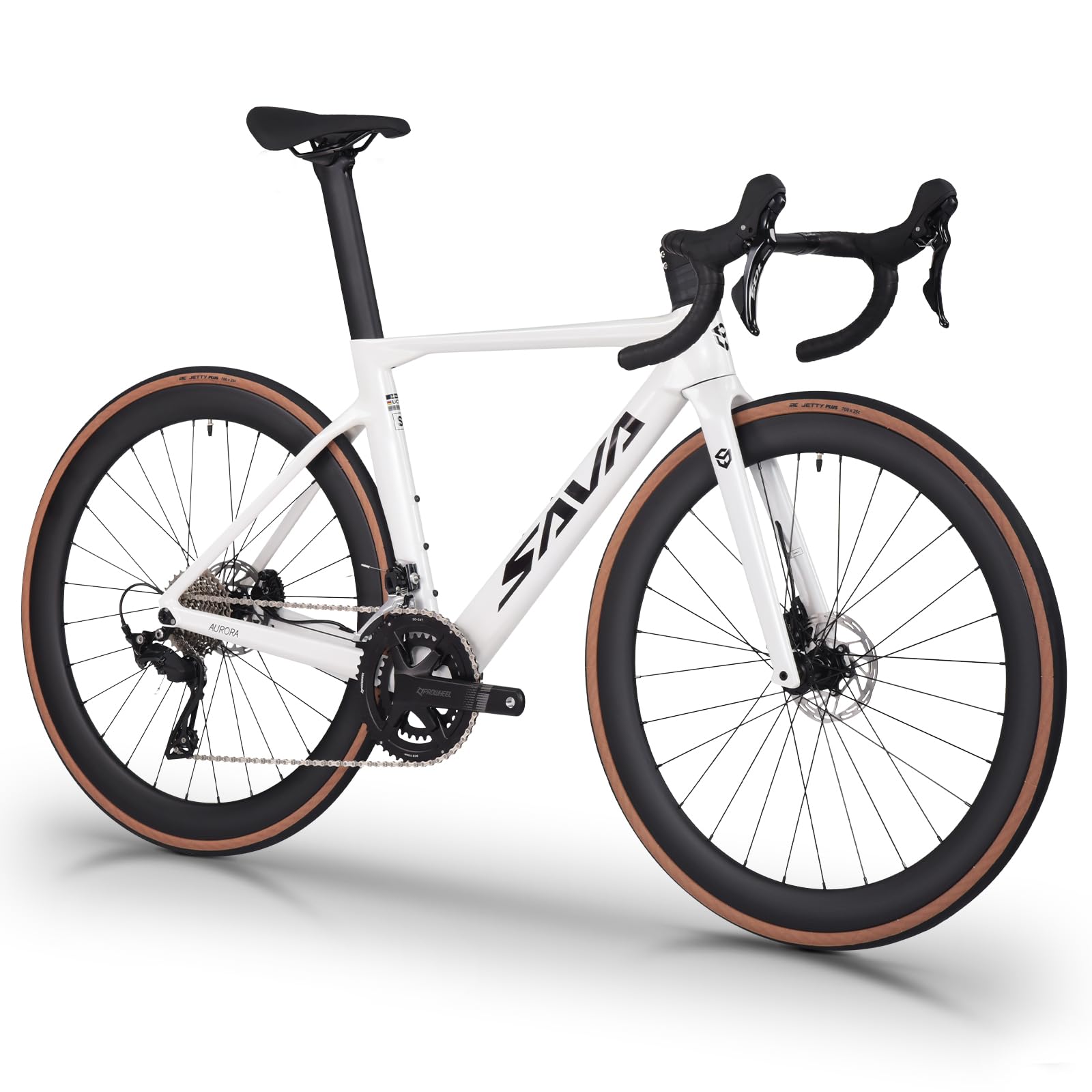
If your roads are smooth and you want to go fast, start here. The entire frame, front fork, seat post, and wheelset are T800 carbon fiber, and the whole bike weighs 19.4 lb. That combination is what makes the difference on a hill: less mass to push up, and a stiff bottom bracket that puts your effort straight into the road instead of flexing away.
SAVADECK builds this around Shimano’s 105 series — R7120 hydraulic disc brake levers with R7170 calipers, and a 24-speed (2×12) shift set with R7100 front and rear derailleurs. In plain terms: 24 gears with small steps between them, so you can find a comfortable pedaling rhythm on a long climb rather than jumping between big gaps. That is ten more gears than the 14-speed Schwinn Sporterra RX lower down this list, which matters most when the road tilts upward.
What wins people over is the bike itself — the build quality is the thing riders keep coming back to, and the value for a full-carbon machine runs a close second. The finish on the frame draws a lot of comment too. It arrives about 90 percent pre-assembled, and experienced riders report a setup in roughly 20 minutes with no gear or brake adjustment needed. A 5’9″ rider with a 34-inch inseam fits the 56cm frame; a 5’11” rider fits the 54cm comfortably. One buyer’s long-term note is worth repeating: “430+ miles, zero issues; plans second bike for 2026 bikepacking.”
carbon frame speed
- 19.4 lb total weight with carbon frame, fork, seat post, and wheelset
- 24-speed Shimano 105 gearing with hydraulic disc brakes for confident stops from speed
- Fully internal cable routing keeps the front end clean and quiet in crosswinds
- 700x25c tires with an anti-skid tread pattern on both shoulders for high-speed cornering
- About 90 percent pre-assembled from the start, with a pair of clipless pedals included
firm carbon ride
- The saddle is the first thing most riders swap; it is the most consistent complaint
- Bar and stem spacer installation is fiddly — a torque wrench set makes it much easier
- This is a road bike for pavement and urban terrain, not a gravel machine
- The freewheel cassette can arrive running loud until a shop re-greases it
race-day ready: riders with smooth tarmac on their route who want race-bike acceleration without race-bike money.
budget stretch: your loop includes loose gravel — the 25c tires are not the tool for it, and the 40mm tires on the SAVADECK gravel model below are.
2. SAVADECK Carbon Gravel Bike
The one bike here that genuinely splits pavement and dirt without apology.
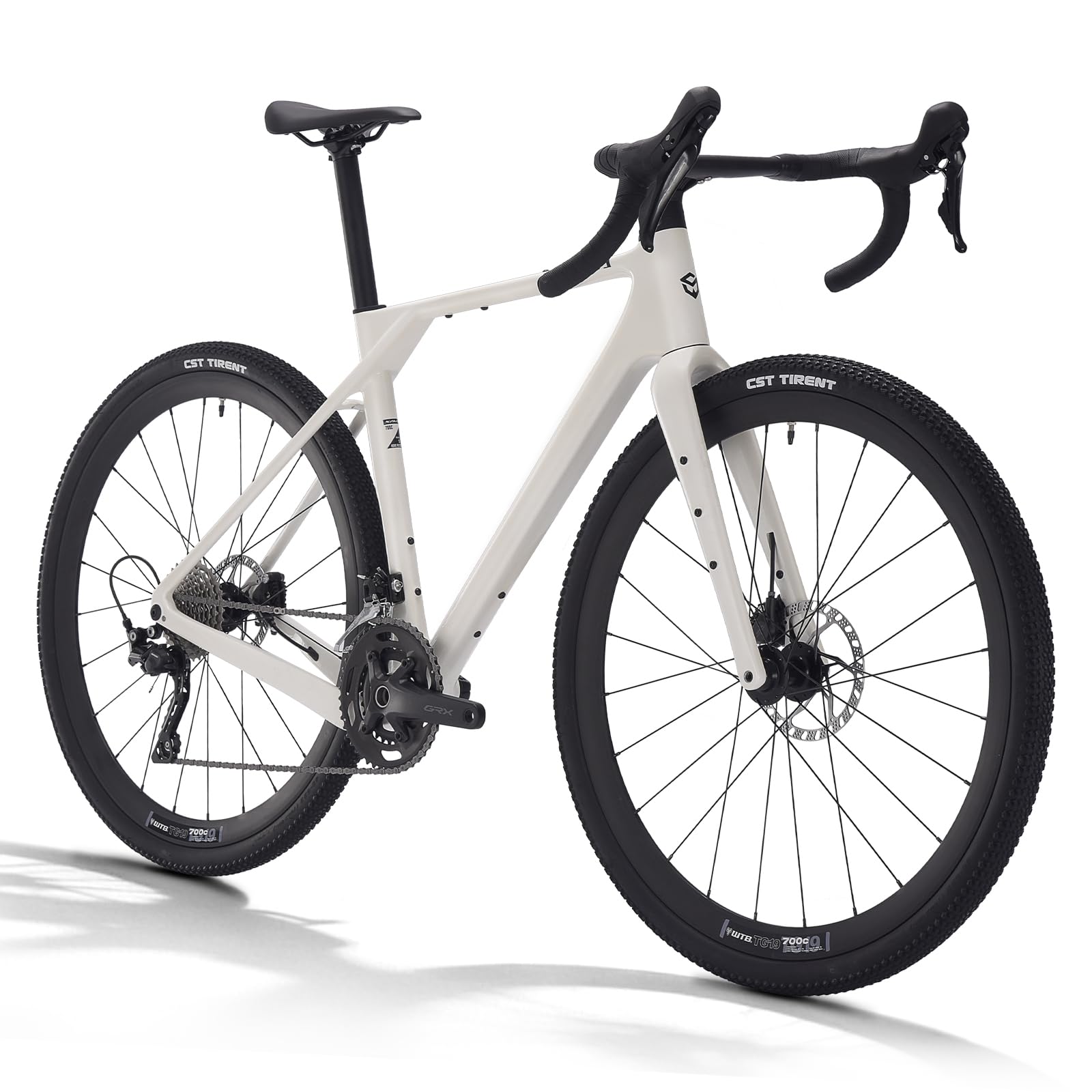
This is the pick for the rider whose Saturday loop starts on asphalt and ends on a gravel fire road. The T800 carbon frame and fork keep the whole bike at 10.4kg (22.92 lbs), and the frame is built with a more upright riding position than a pure race bike. That upright posture is what keeps your back and wrists fresh over long mixed-surface miles.
The gravel-specific hardware is the story. Shimano’s GRX400 groupset — GRX400 shift levers with RX400 front and rear derailleurs — gives you 20 speeds, and the RX400 hydraulic disc brakes deliver stopping power in wet or dusty conditions. The 700x40c tires on 45-spoke rims are the real reason it works off-road: 40mm of width floats over loose gravel where the 25c tires on the road model above would dig in and slip. Fully internal cable routing and a tapered head tube tighten up the handling on rough ground.
Owners describe a bike that arrives with everything you need — tools included in the box — and needs only about 20 minutes of assembly. One rider put over 100 flawless miles on the stock build as delivered. The honest caveat is a rear derailleur that can arrive slightly out of adjustment and cause a chain tangle, which is a five-minute fix at a shop. Shipping can be slow and uses a single courier with limited tracking, so plan around it rather than expecting next-day delivery.
gravel tire clearance: if you want one bike to cover road and trail instead of buying two, this is the strongest case for it on the list. A carbon frame keeps it light, 20-speed gravel gearing gives you a gear for climbs and flats, hydraulic brakes (fluid pressure squeezes the rotor for strong, consistent stopping) handle wet and dusty rides, and 40mm tires stay planted when the pavement ends.
heavier than road: there are no printed assembly instructions in the box, and the hidden Allen bolt under the headset cap is easy to miss.
mixed terrain pick: your riding genuinely mixes surfaces and you want hydraulic brakes and a gravel drivetrain on a carbon frame.
pure road need: you need the bike tomorrow — shipping is the weak point.
3. Jasion X-Hunter Folding Electric Bike
Folds to 33″x16″x30″, hits 30 MPH, and swallows a beach or a mountain road.
For an apartment dweller or a commuter who needs to fit the bike in a trunk, this is the practical answer. The aluminum frame folds down to 33 inches by 16 inches by 30 inches and weighs 71 lbs, so it stores in a car trunk or rides public transit with you. The 20″x4.0″ fat tires are the traction story — they carry you across beaches, mountains, and city streets alike.
On power, the 1400W peak brushless motor reaches a top speed of 30 MPH, and the 48V 13Ah removable battery is rated for 55-70 miles per charge. An 80mm front air suspension fork plus a rear shock absorb rough ground, and the smart LCD shows speed, battery, and distance. You get 3 riding modes, 7-speed gearing, disc brakes, and LED lights, all on a bike that arrives 90 percent pre-assembled.
A 4.0+ star rating across a crowd of 200+ owners is a strong signal for a bike in this class, and the recurring thread through the reviews is that the build feels solid for the money. The honest caveat has nothing to do with the ride: customer service is the weak link. A couple of riders had motor or shutdown problems that took weeks to resolve, with back-ordered parts and slow email replies. Buy from a seller with a clear return path and you sidestep most of that.
commuter friendly: storage space and hauling range matter more to you than a traditional frame, and folding seals the deal.
long trips only: you want fast warranty response — the ride is strong, the support is slower.
4. Tiniover Creek Pro Folding Electric Tricycle
Three wheels, 550 lbs of capacity, and a reverse gear for the grocery run.
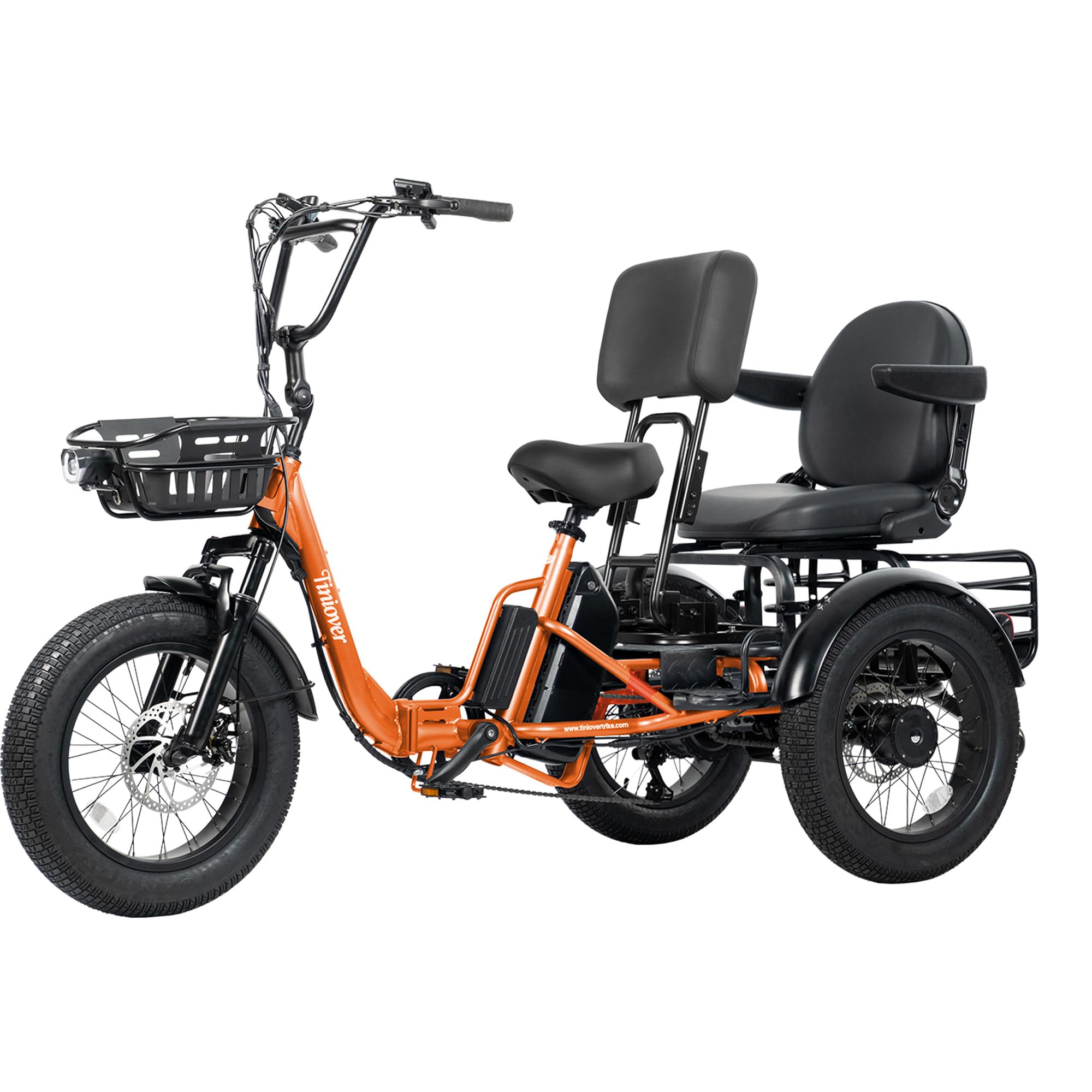
Not everyone wants two wheels. This trike is built for riders who want stability, cargo room, and a low step-over, and it delivers with a 550 lbs (250 kg) maximum load capacity — enough for a passenger, a week of groceries, or both. A rear brushless motor (an electric motor with fewer wearing parts) produces up to 1200W with 90 N·m of torque (twisting force for pulling loads) and a 20 MPH top speed. The 48V 20Ah removable battery is rated up to 100 miles of range, so a full week of short errands can pass without a recharge.
The engineering details are what make it usable. A rear differential lets the back wheels turn at different speeds in a corner, which keeps the trike planted instead of hopping. Triple hydraulic brakes with 180mm rotors and an integrated parking system give you a firm, immediate stop — important when the rig is loaded. A mid-axis torque sensor reads your pedaling effort and adjusts assist to match, so the power feels natural rather than jerky. An IP65 dust and water rating and 4.0-inch all-terrain tires cover wet and rough conditions.
Families with older riders are the core of this bike’s following — it has taken 74- and 76-year-olds out on city paths and grocery runs, and a 76-year-old assembled one alone. A 5’2″ rider did find the driver seat sits too close for her, so check your fit. The recurring friction is assembly: QR codes in the manual can fail, instructions are thin, and holes on the basket and passenger kit can misalign enough to need widening. Watching the maker’s videos first saves real time.
stable three wheels: the modular rear swaps between passenger seat and cargo rack, and the reverse gear turns a tight driveway into an easy maneuver.
bulky to store: this arrives partially in separate packages — the trike, kits, and backrest can land on different days, so do not plan your first ride around a single delivery date.
errand hauler: you need a stable three-wheel base for an older rider, cargo hauling, or a passenger seat.
tight hallways: you want to pedal aggressively up steep hills — with two riders aboard, that is where it works hardest.
5. Tommaso Sentiero Gravel Bike

A 24-speed aluminum gravel bike that gets beginners onto dirt without a race-bike price.
Twenty-four gears is the headline here. Shimano’s Claris drivetrain in a 3×8 setup gives you three chainrings up front, which widens the gear range and makes climbing noticeably gentler than a 14-speed or 21-speed bike. The aluminum frame keeps weight down while the steel fork soaks up some vibration from rough ground. 40mm tires put it in proper gravel territory.
Riders describe it as fast and fun to ride, and the fit and finish get consistent praise — one owner called it sturdy yet lighter than most bikes in its range. A 5’6″ rider who ordered the small frame wished she had gone one size smaller, so check the sizing chart carefully. Assembly runs under an hour for most, and a professional shop setup earns its keep on the shifting and braking.
Two honest notes. First, heavier riders have reported going through rear inner tubes repeatedly; if you are well over 200 lbs, budget for a rim strip or tire upgrade from the start. Second, a small number of bikes arrive with a warped rotor or stripped pedal threads, so inspect the box before assembly and buy from a seller with an easy return window.
balanced gravel geometry: the 24-speed Claris drivetrain with mechanical disc brakes and 40mm tires is a serious mixed-surface setup for a first gravel bike.
basic stock saddle: the stock saddle gets uncomfortable past the one-hour mark, so plan a swap if you ride long.
weekend explorer: someone stepping into gravel riding who wants 24 speeds and 40mm tires without carbon-frame outlay.
racing ambitions: riders at the top of the weight range who need a beefier wheel and tire package from the start.
6. Tommaso La Forma Hybrid Bike

Twenty-seven gears and flat bars — the fitness-and-commute middle ground that actually fits daily life.
This is the bike for someone who wants to ride to work, get some exercise, and not lean over drop bars in traffic. Flat handlebars, an aluminum frame with a carbon fork, and a Shimano Acera 3×9 drivetrain add up to 27 speeds — the widest gear spread on this list — with cantilever rim brakes and 700x32c tires. The carbon fork shaves weight off the front end compared with a steel fork, which helps on climbs.
The pattern across buyers is that it arrives mostly assembled and, once dialed in, shifts cleanly and rides smoothly. Mounts for two water bottles and a rear rack are there if you want to commute with gear, and it ships with touch-up paint and a signed assembly note. The one long-term note to weigh: a handful of buyers report bottom bracket trouble after about 18 months of steady use. That is a serviceable wear part and a small fraction of a large owner base, but worth knowing before you commit to a daily high-mileage routine.
city cruising: you want upright bars, 27 speeds, and a light frame for everyday fitness and commuting.
hill heavy routes: you want hydraulic or disc brakes — the cantilever rim brakes are the older, simpler design.
7. Schwinn Network 3.5 Hybrid Bike

A swept-back bar and suspension fork built for backs that would rather not bend.
The geometry is the point. A high-rise stem and swept-back handlebar put you upright, which is easy on the lower back and ideal if you are returning to riding after years off. An aluminum frame and alloy rims keep weight down, a suspension fork softens pavement seams and unpaved paths, and 21-speed twist shifters handle the hills. It fits riders from 5’5″ to 6’0″ on 700c wheels.
Riders describe it as smooth and easy to cruise on, and the blue-grey finish gets noticed. Assembly can be pleasant or frustrating — one owner reported it arrived 80 percent put together with only easy parts left, while another at 5’4″ spent four hours fighting vague instructions and adjusting brakes. Plan for either outcome by having a shop check the brakes and gear indexing before your first real ride.
Two practical notes from the road: the stock saddle is the first upgrade most riders make, and the frame runs tall, so shorter riders should sit on one if they can. A front child seat needs modification because the handlebar-to-seat-bottom distance is too short for the standard mount.
daily commuter: casual riders and older backs that want an upright, cushioned, low-effort cruising position.
trail detours: your height — it fits 5’5″ to 6’0″, and at 5’4″ the frame can feel tall.
8. ZNH Electric Bike
A step-thru commuter with five riding modes and a fat-tire footprint for city paths.
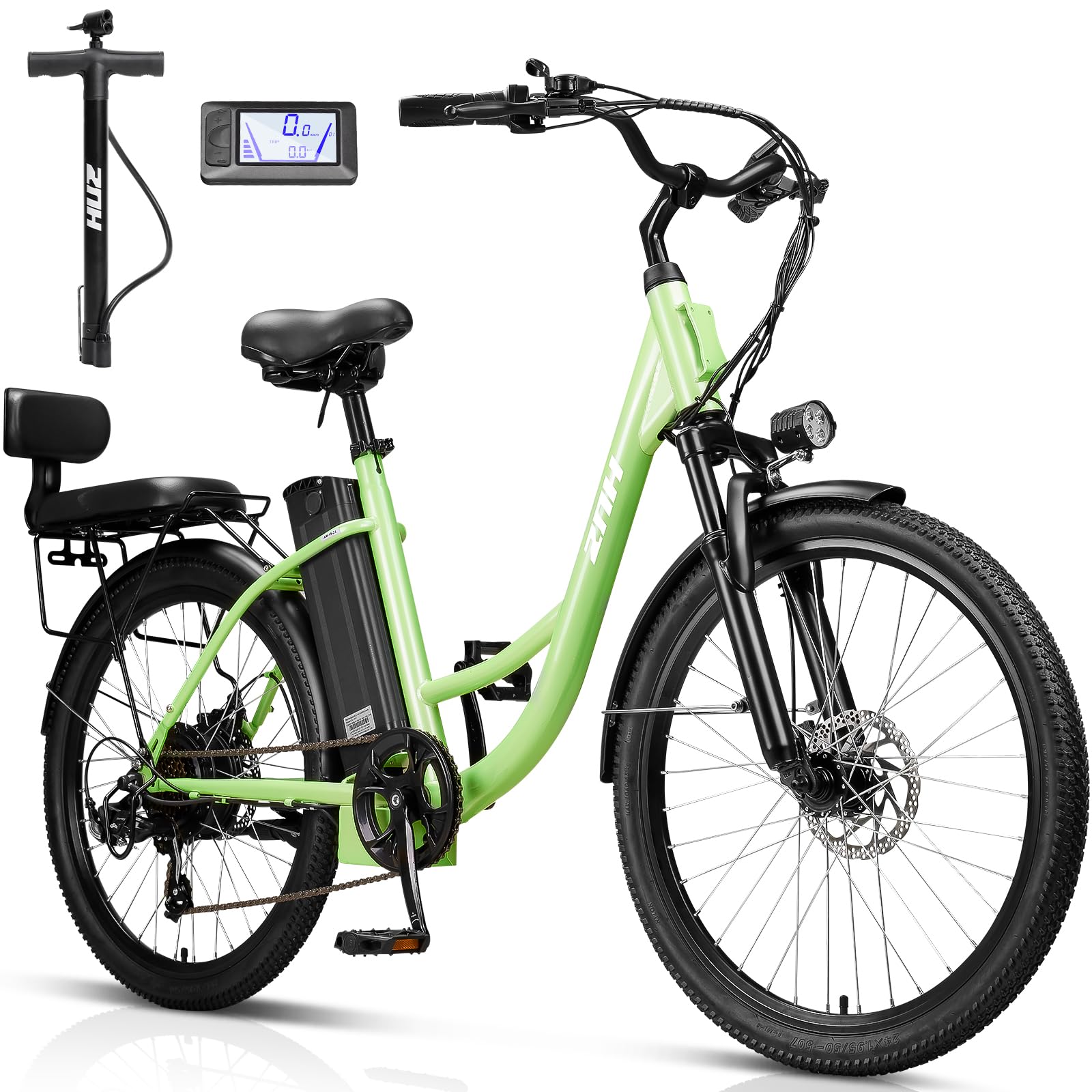
If swinging a leg over a high top tube is the thing that stops you riding, this frame solves it. The step-thru design makes mounting easy, and dual suspension with wide 24×2.12″ tires and a cushioned saddle with backrest absorb bumps on bike lanes and uneven pavement. A 500W brushless motor with 65 N·m of torque handles hills, and the 7-speed drivetrain gives you gears for the terrain.
You choose how much work you want to do: five riding modes and five levels of pedal assist cover pure electric for easy cruising, pedal assist for exercise, normal bike for a traditional ride, plus cruise and booster modes. The 48V 19.6Ah removable battery is rated up to 90 miles per charge, so most commutes run several days between charges. It meets UL 2271 (a battery safety standard) and UL 2849 (a whole-e-bike safety standard). Dual disc brakes and an LCD display round out the package, and it arrives 90 percent pre-assembled, so setup is mostly unfolding and tightening.
One word of caution on the listing: a rider who measured the components found the frame to be steel rather than aluminum and the battery label reading a lower capacity than advertised. Check the components on arrival. Separately, a few units have shipped with control-panel or battery-connection faults; the seller’s support has responded quickly with replacement parts in those cases.
budget e-ride: you want a low step-over, five assist modes, and a cushioned seat for relaxed city cruising.
brand loyalists: the battery label and frame material against the listing, so you can raise any mismatch inside the return window.
9. Mongoose Elroy Adventure Bike

Five bottle mounts, an integrated frame bag, and a front rack with a bottle opener.
This is a touring bike disguised as a starter bike. The aluminum frame with a steel fork carries a front rack big enough for two panniers (with a bottle opener built in), rear rack mounts, an integrated frame bag, and internal cable routing (cables run inside the frame) that leaves room for three water bottle cages — plus two more on the fork. A 2×7 drivetrain (two front chainrings and seven rear gears) with Shimano Tourney derailleurs and mechanical disc brakes gets you rolling, and it sits on 700c wheels at a 54cm frame size.
Value and performance are what buyers talk about most. One long-distance rider took it on a five-month tour from California to Michigan to Alabama and back without major issues, and a 5’11” rider found it comfortable and light-feeling on the climbs. The frame is well-made and accepts plus-sized tires, which makes it a genuine gravel option after a wheel upgrade.
The honest part: the brakes are the weakest link and often need a shop setup rather than an out-of-box adjustment, and quality control varies — a bent fork and a poorly welded front rack have shown up on some units. The 40mm tires are basic, and most owners replace them and the saddle early. Do a full inspection before your first ride and this is a capable budget tourer.
offroad curious: you want maximum carrying capacity — racks, frame bag, and seven bottle mounts — on a budget touring frame.
speed seekers: you want brakes and drivetrain that need zero shop attention from the start.
10. Schwinn Sporterra RX Gravel Bike

The cheapest way onto a drop-bar gravel bike that still rolls on 38c tires.
Fourteen speeds and 700x38c multi-terrain tires are the two numbers that define this one. It is an aluminum gravel frame with a rigid fork, mechanical disc brakes for all-weather stopping, and a drop bar for an aerodynamic riding position. It fits riders from 5’6″ to 6’0″, and a quick-release seatpost lets you change saddle height without tools.
Look at the gear count next to the SAVADECK road bike at the top of this list: this 14-speed setup versus that 24-speed is a big spread, and the extra ten gears make long climbs noticeably easier to pace. The trade-off is straightforward — this bike costs far less and gets you onto drop bars and wide tires for mixed terrain, which is exactly the entry point most first gravel buyers want.
The ownership picture is more mixed than the spec sheet suggests. Appearance and build quality are what owners like most. But quality, value, and comfort draw split opinions, and the assembly experience swings from smooth to daunting. Brakes often arrive rubbing or weak, and shifters can be fussy. Durable long-term ownership is possible — “Over 1,100 miles in 3 years: replaced pedals, front tire/tube, bottom bracket bearings; durable, easy to maintain, good for commuting.” Have a shop check the brakes and wheels before you ride hard.
light trail rides: a first drop-bar gravel bike where the initial outlay matters most and you can do a little tuning.
muddy singletrack: anyone who wants a bike that needs no shop visit before the first long ride.
Know the Specs
Tire Width And What It Does
Tire width tells you what surface the bike is built for. A 700x25c tire is about an inch wide and designed for smooth pavement where low rolling resistance matters. A 700x38c or 700x40c tire adds volume so it can float over loose gravel rather than dig into it. The fat tires here — 20″x4.0″ on the Jasion and 4.0″ on the Tiniover trike — are wider still and built for sand, snow, and rough ground. Wider tires are not automatically better; a 40c knobby adds weight and drag on smooth asphalt.
Frame Material And Rider Weight
Carbon fiber can be built light and stiff, which is why race and premium gravel bikes use it — the SAVADECK road bike comes in at 19.4 lb total. Aluminum is the everyday middle ground, light enough to ride briskly and tough enough for commuter duty. High-carbon steel is heavier, but it absorbs road vibration and shows up on cargo and electric models like the ZNH and the Tiniover trike. Heavier riders should also check the load capacity and wheel build before buying.
Gear Count And Climbing
The number before “speed” is your total gear combinations. A 24-speed setup like the SAVADECK road bike’s 2×12 or the Tommaso Sentiero’s 3×8 gives you smaller steps between gears, which makes keeping a steady effort on a climb easier. A 14-speed setup covers the same terrain with fewer, bigger jumps. More gears do not equal more speed — they equal smaller steps between gears on a climb.
Brakes And Stopping Power
Hydraulic disc brakes use fluid pressure to squeeze the rotor, which gives strong, consistent stopping in wet or dusty conditions — the SAVADECK gravel bike’s RX400 hydraulic brakes and the Tiniover’s triple hydraulic brakes with 180mm rotors are examples. Mechanical disc brakes use a cable instead and need more adjustment over time. Rim brakes, like the cantilever setup on the Tommaso La Forma, are the simplest and lightest but less effective when wet.
E-Bike Battery And Range
Battery capacity is listed in voltage and amp-hours, and the maker’s range figure assumes ideal conditions. The Jasion carries a 48V 13Ah battery rated 55-70 miles, the ZNH a 48V 19.6Ah rated up to 90 miles, and the Tiniover a 48V 20Ah rated up to 100 miles. Real range drops with hills, rider weight, and how much you use the throttle rather than pedal assist. A removable battery means you can charge it indoors without moving the bike.
Rider Height And Frame Fit
Every listing states a rider height range or frame size, and staying inside it matters more than any component upgrade. The Schwinn Sporterra RX fits 5’6″ to 6’0″, the Schwinn Network 3.5 fits 5’5″ to 6’0″, and the Mongoose Elroy uses a 54cm frame. Drop-bar bikes in particular can feel stretched at the top of their range. If you sit between sizes, sizing down usually gives you a more comfortable position on a drop bar.
Common Questions
Can one bike really handle both road and gravel trails?
How many gears do I actually need for hills?
What size bike fits my height?
Are hydraulic disc brakes worth it over mechanical disc brakes?
How far can an electric bike actually go on one charge?
Do I need to pay a shop to assemble a bike that ships in a box?
Will a gravel bike feel slow on paved roads?
Can I carry cargo or a passenger on an electric trike?
What does the gear count difference actually mean in practice?
Is a folding e-bike practical for daily commuting?
The Bottom Line
For most riders shopping for a bicycle for road and trail, the smartest call is the SAVADECK Carbon Gravel Bike, because it is the one bike here that genuinely earns the “road and trail” label: carbon frame, 20-speed gravel gearing, hydraulic brakes, and 40mm tires that stay planted when the pavement ends. If you ride mostly smooth tarmac and want speed, the SAVADECK Carbon Fiber Road Bike at 19.4 lb is the sharper tool. And if the goal is stability and hauling — a passenger, groceries, or a rider who prefers three wheels — the Tiniover Creek Pro trike is the one to reach for.
One nudge before you close the tab: the gravel SAVADECK and road SAVADECK both hold 4.5+ stars, and for a category where most bikes sit in the low fours, that is the strongest signal on this page. Pick the one that matches the surface you actually ride, have ashop check the brakes and wheels, and you will spend far more happy miles than you would chasing a bigger spec sheet.
How we choose
We do not accept paid placement. Every pick is matched to a real buyer and a real use-case; we do not hands-on test units.
Sources
Specifications: manufacturer listings and product documentation. Review insights: verified customer reviews, as of October 2026. Pricing: not shown on this page (it changes often); check the current price via the retailer link.
As an Amazon Associate, Aappliancez earns from qualifying purchases. This does not affect which products we feature.