Disclosure: Some links in this post are affiliate links. As an Amazon Associate I earn from qualifying purchases, at no extra cost to you. Learn more
Specs are compiled from manufacturer listings and verified buyer reviews and can change over time — please confirm the key details on the product page before buying.
The right bike after knee surgery is one you can mount and dismount without wincing, then pedal with a knee that stays slightly bent and never locks straight. That usually means a recumbent — a bike with a wide seat and a backrest where you sit low and reach the pedals forward. The top pick here, the MERACH S19, has the deepest track record of owners using it for exactly that recovery job, so it is the safest first buy.
This guide is built by comparing the manufacturers’ published specifications and the patterns across verified customer reviews, so you get each pick’s real strengths and trade-offs instead of marketing spin.
You will see recumbents, a folding trike, a full-body cross trainer and one electric trike, each matched to a different stage of recovery. Read on for the full breakdown of the bicycle after knee replacement options that keep your joints out of the danger zone.
Top Picks

How To Choose The Best Bicycle After Knee Replacement
The first thing to get right is the shape of the bike, not the brand on the frame. A recumbent lets you sit with your back supported and your legs reaching forward, which keeps the knee from bending past a comfortable angle. An upright bike or a spin bike puts your body weight over the pedals and asks for a deeper bend — the exact motion that feels wrong in the weeks after surgery.
Step-over height and getting on safely
Look at how much frame sits between you and the seat. A wide step-through gap means you can lift your leg over without swinging it high, which matters most in the first months when hip and knee mobility is still coming back. Some upright models place the seat and handlebars far apart, and that high step-over is the single most common complaint from shorter riders. A recumbent’s low, open frame solves it.
Seat adjustment range versus your leg length
You want the seat to slide far enough forward that your knee stays slightly bent at the bottom of the pedal stroke. Too far away and the knee over-extends; too close and it jams up. Models here list seat adjustment in real measurements — the MERACH stretches to a 35.43-inch extended seated leg length, the VANSWE slider covers a 29-inch to 37-inch inseam, and the Niceday fits users up to 6’3″. Match that range to your height before anything else.
Resistance levels and how gentle the start is
A rehab knee needs a lowest setting that is genuinely light, then a slow ramp up as strength returns. Magnetic resistance is the type to look for because it runs quiet and the steps between levels are smooth. The bikes here range from 8 levels up to 16 and even 100 on one model, so there is a fit for early gentle motion and for later, harder cardio.
Side-by-Side Comparison
| Model | Best For | Weight Capacity | Resistance Levels | Seat / Fit Range | Amazon |
|---|---|---|---|---|---|
| MERACH S19 Recumbent★ Best Overall | Best overall recovery recumbent | 330 lb | 8 | 28.35–35.43 in leg length | Amazon |
| Fully-Enclosed Flywheel Magnetic BikeBest Value | Budget-friendly upright cardio | 350 lb | 100 | 8 seat heights | Amazon |
| XVGVSV 2-in-1 Elliptical RecumbentMost Versatile | Arm and leg workout together | 400 lb | 16 | Lever-based adjustment | Amazon |
| MOPHOTO Folding Tricycle | Outdoor errands with three-wheel balance | 350 lb | 7-speed | 20/24/26 in wheels, 4’8″–6’2″ | Amazon |
| VANSWE Recumbent Elliptical | Full-body rehab cross trainer | 400 lb | 8 | 29–37 in inseam | Amazon |
| Niceday RC88 Recumbent | Physical therapy focus, tall riders | 400 lb | 16 | 8 positions, up to 6’3″ | Amazon |
| VANSWE RB4056 Light Commercial | Heavy riders, auto resistance | 450 lb | 16 | 29–40 in leg length | Amazon |
| JOROTO JH50 Recumbent | Near-assembled convenience | 400 lb | 16 | Wide step-through | Amazon |
| ESKUTE E Trike | Throttle-only outdoor riding | 350 lb | 3 ride modes | 4’8″–6’2″ | Amazon |
| Sunny Elite Cross Trainer | Programmed elliptical variety | 300 lb | 16 | Easy seat adjuster | Amazon |
| Teeter FreeStep LT7 | Premium zero-impact stepper | 350 lb | 20 | 4’11″–6’6″ | Amazon |
Detailed Reviews
1. MERACH Recumbent Exercise Bikes for Home High-end
Our pick — 4.5+★ from 900+ verified ratings; the strongest balance of quality and price.
The recumbent that gets the recovery job done, and it does it without a single squeak.
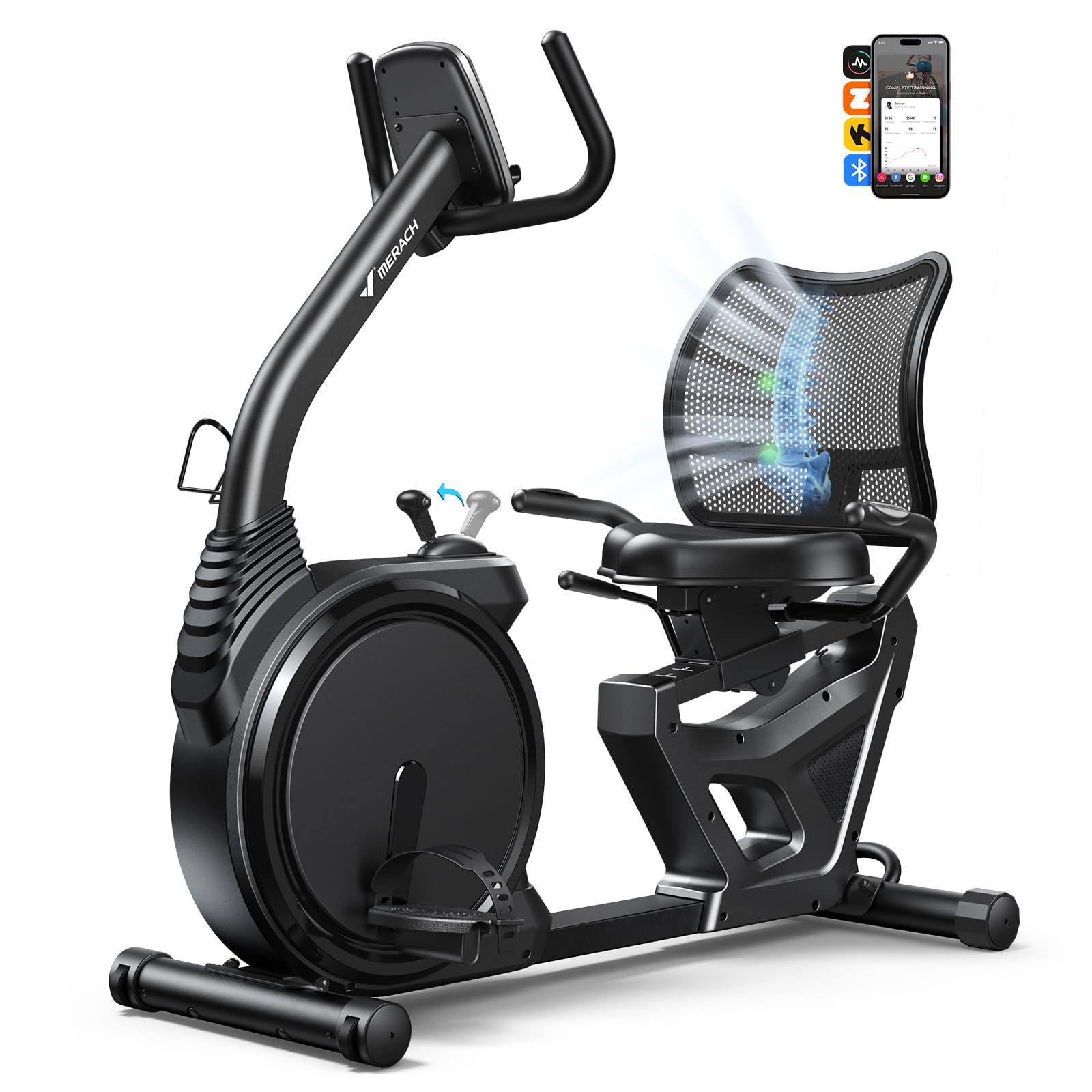
The MERACH S19 is the pick to start with because it is built around the body that is healing, not the body that is racing. You sit on a thicker seat with a breathable mesh backrest, and the seat slides through 8 positions so your leg length sets the reach — the extended seated leg length is listed at 28.35 to 35.43 inches. That range keeps your knee slightly bent at the bottom of each pedal stroke instead of locking straight. What wins people over is the overall build; quality is the thing buyers bring up more than any other trait by a wide margin, and the frame feels solid under you rather than flexing.
The dual-belt drive keeps the ride quiet enough for a shared room. A dual-belt drive with a 6.6 lb perimeter-weighted flywheel keeps the pedaling smooth and the noise low, and the resistance shifts through 8 car-style levels with a single lever. One detail that sets this apart from an upright: mounting and dismounting happen from a seated, reclined angle, so you are not swinging a stiff knee over a tall frame. The whole bike is 80% pre-assembled and most buyers report getting it together well under the 45 minutes MERACH aims for, even though the box is heavy to haul inside on your own.
This bike is heavy at 84.9 lb and holds up to 330 lb, so it is not a featherweight and will not suit a rider well past that limit. Tall buyers should also check the numbers: the recommended height range is 5’2″ to 5’10”, so a six-footer will feel cramped. Even so, the seat and backrest support you through a longer, slower session, which seals it for post-surgery use. The MERACH app plus a Bluetooth connection give you a reason to keep showing up.
Why it earns the top spot
- Seat slides through 8 positions across a 28.35–35.43 inch leg-length range, so your knee stays softly bent.
- Dual-belt drive and a 6.6 lb weighted flywheel pedal smoothly and quietly enough for a shared room.
- Heart-rate handle, LCD metrics, iPad holder and the MERACH app keep a long recovery session interesting.
- Frosted, non-slip handlebars stay grippy when your hands get sweaty.
Where it asks you to compromise
- At 84.9 lb it is a two-person lift to unbox and place.
- The 330 lb capacity and 5’2″–5’10” height band exclude bigger and taller riders.
- Pulse readings from the handle can be less accurate than a wrist watch.
Made for: the rider in the first months of recovery who wants one dependable, well-supported seat to pedal from daily.
Think twice if: you are over 5’10” or beyond the 330 lb limit — a different pick below fits you better.
2. Fully-Enclosed Flywheel Magnetic Exercise Bike for Home
A 100-setting resistance dial and a sealed flywheel, wrapped in one of the leaner frames here.
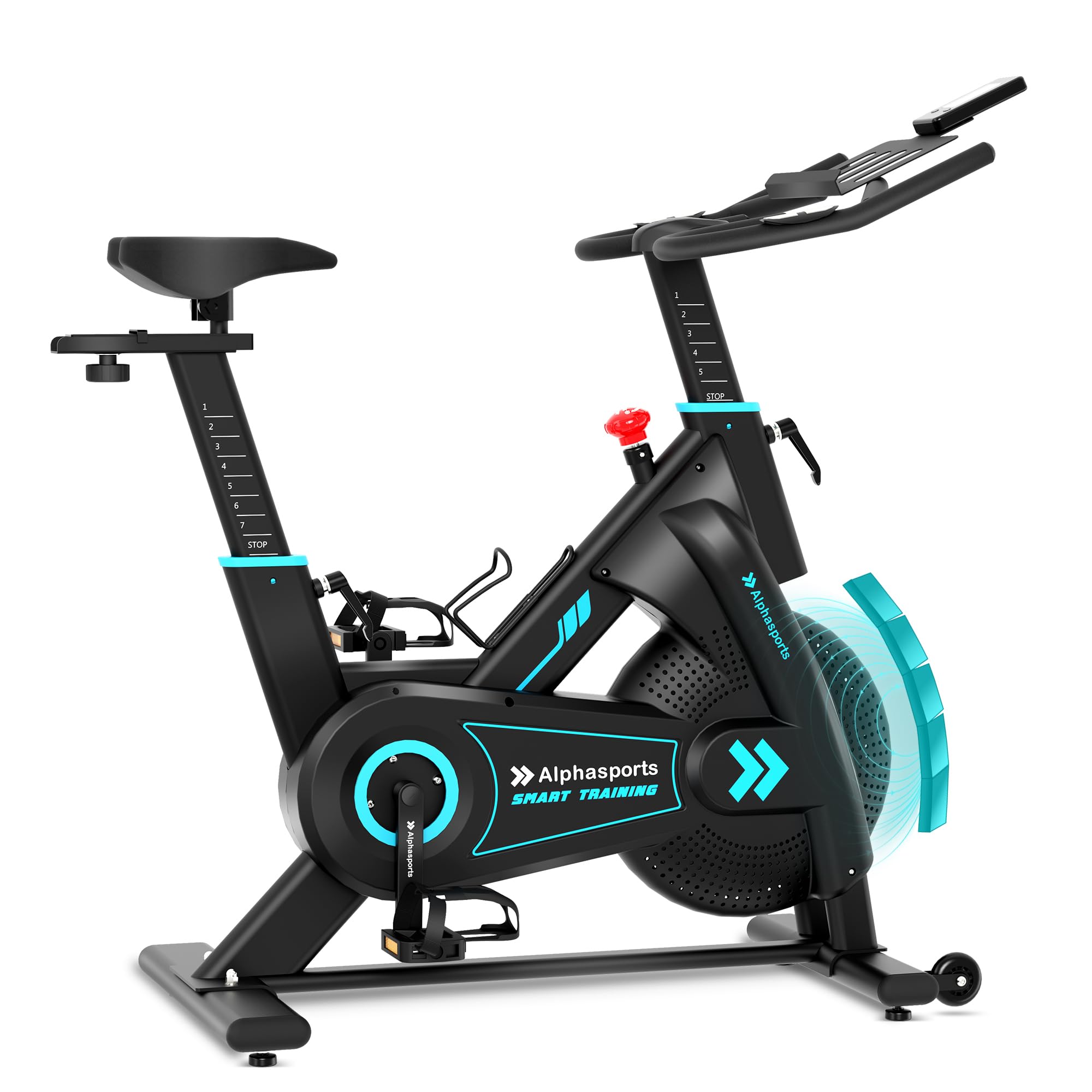
If you are further along and want a simple upright bike rather than a recliner, this one gives you the finest control. It carries 100 resistance settings — versus 8 on the MERACH recumbent — so you can nudge the effort up a hair at a time, which helps when a knee tolerates a tiny bit more load each week. The fully enclosed flywheel is the safety story: there is no spinning wheel exposed near your feet, and the magnetic system keeps a smooth pedal stroke with less noise.
Owners tend to talk most about home use, quiet operation and sturdiness, and the heavy-duty steel frame backs the last of those. Eight seat heights adjust the fit, and a built-in cup holder and KINOMAP app sync round out the daily-use details. The trade-off to know: this is an upright geometry, so there is more frame between you and the seat than on a recumbent, and getting a stiff knee over that gap takes more care.
Fit check first: the seat and handlebars sit far enough apart that a shorter rider has to lift a leg higher to mount, so measure your confidence before buying.
The honest read: the controls and magnetic smoothness are strong for the price tier, but assembly time varies a lot — some finish inside the hour, others get stuck and call in help.
Reach for this if: your knee has good bend back and you want a compact upright cardio machine with fine resistance steps.
Look elsewhere if: you need the low, backed seat of a recumbent to get on and off without strain.
3. Recumbent Exercise Bike
Ride it like a bike, push it like an elliptical — one machine, two ways to save the knee.
The XVGVSV earns its place by letting you move your arms at the same time as your legs, which spreads the effort and takes load off a healing joint. It blends a recumbent seat with an elliptical stride, so you can switch between pedaling and the forward-and-back elliptical motion depending on how the knee feels that day. Sixteen resistance levels step you from a gentle start toward real cardio, and a commercial-grade steel frame holds up to 400 lb. Owners rate it easy on the knees and lower back compared to upright bikes, and the wide padded seat with backrest supports a longer, slower session.
Its magnetic resistance runs whisper-quiet, and front transport wheels let you roll the 66 lb machine between rooms. Assembly runs about 30 minutes because it arrives 85% pre-assembled, and a multi-function LCD shows time, speed, distance, calories, odometer and heart rate through built-in pulse sensors. There is no screen login or subscription to fuss with — the display is simple and self-contained.
Here is the honest wrinkle: the seat gets mixed feedback. A cushion solves most of it, but if you plan long daily rides you may want to plan for one. At 66 lb it is also not a one-hand carry, though far easier to shift than the 84.9 lb MERACH and its 330 lb rating.
What the rehab rider gains
- Arm exercisers share the workload, so the legs and knee work less hard for the same cardio.
- 16 resistance levels and a 400 lb steel frame handle a wide range of riders.
- 85% pre-assembled, roughly 30 minutes to set up, with wheels to move it around.
What to keep in mind
- The seat is firm and can feel unforgiving on longer sessions without a cushion.
- At 66 lb it stays put once placed but is not a light lift between rooms.
Great match for: someone who wants to work arms and legs together and values a quiet, self-contained machine.
Less ideal if: you want a plush seat straight from the start for marathon sessions.
4. MOPHOTO Adult Folding Tricycle
Three wheels mean you never have to balance a healing knee at a stop sign.
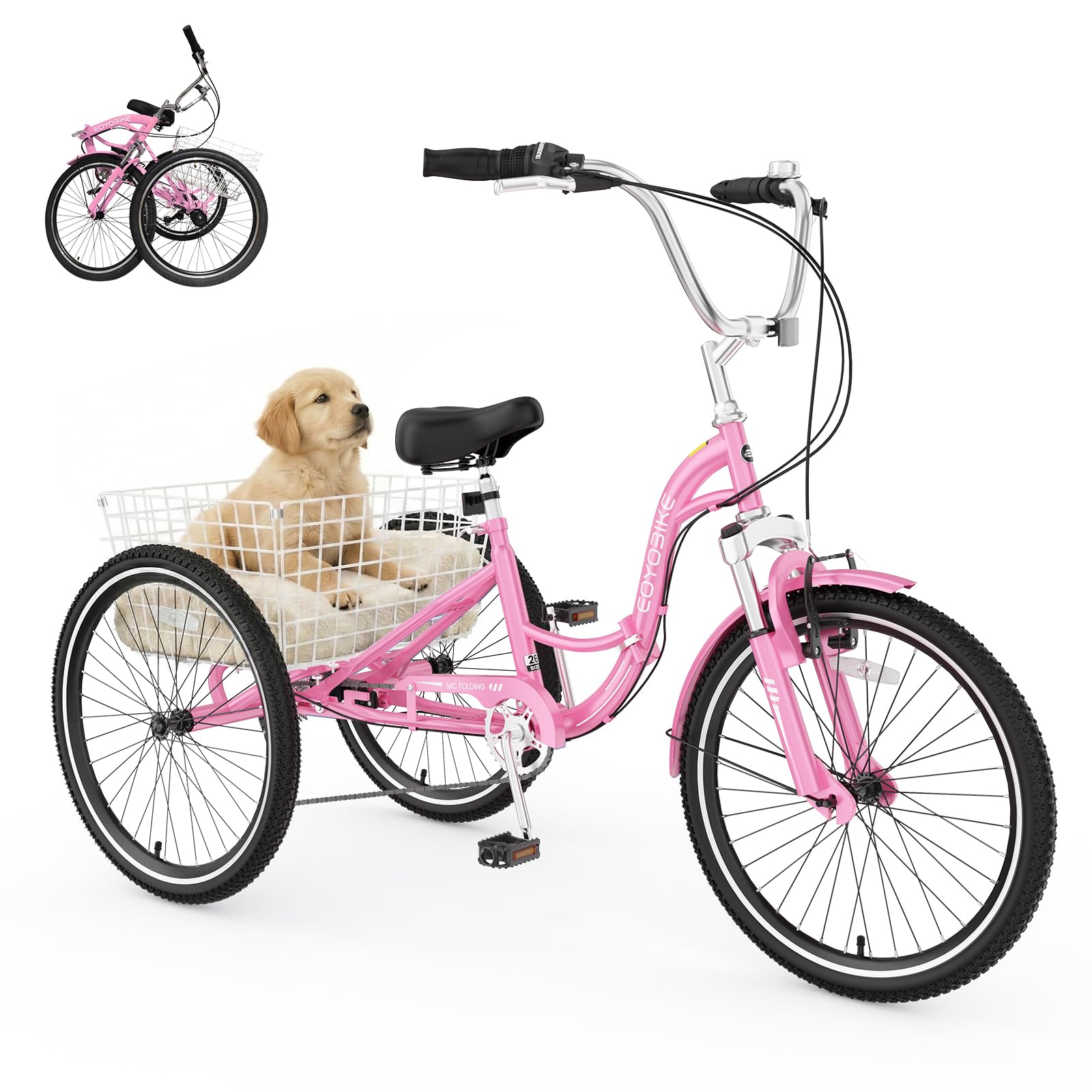
This is the pick for anyone who wants to get back outside, not just spin indoors. The three-wheel design stands on its own, so you are never holding a bike up with one leg while the other is still recovering. A low step-through frame lets you mount and dismount without lifting a knee high, and a 7-speed derailleur with a twist-grip shifter helps on flat streets and light slopes. It is available in 20-inch, 24-inch and 26-inch wheels and fits roughly 4’8″ to 6’2″ with a 350 lb weight capacity.
The quick-fold frame stores in an apartment, garage or SUV trunk, and a large rear cargo basket carries groceries or daily essentials — one buyer’s little dog rides up front. The high-carbon steel frame feels stable under daily use. What you should budget for is time at the start: assembly is the recurring sore point, with several owners ending up at a local bike shop to get it right. There is also a learning curve coming off two wheels, though most say it clicks after the first ride.
The trade you make: you gain self-standing balance and a cargo basket, but the trike is heavier than a two-wheeler and takes noticeably longer to build.
Small footprint upside: fold it down and it slides into a small SUV with the seats lowered.
For you if: balance is a worry and you want outdoor errands with a basket and a frame that stands on its own.
Not your pick if: you would rather avoid a multi-hour build or hire shop time.
5. VANSWE Recumbent Elliptical Exercise Bike with Arm Exerciser
A reclined seat that fits inseams from 29 to 37 inches while your arms push along with your legs.
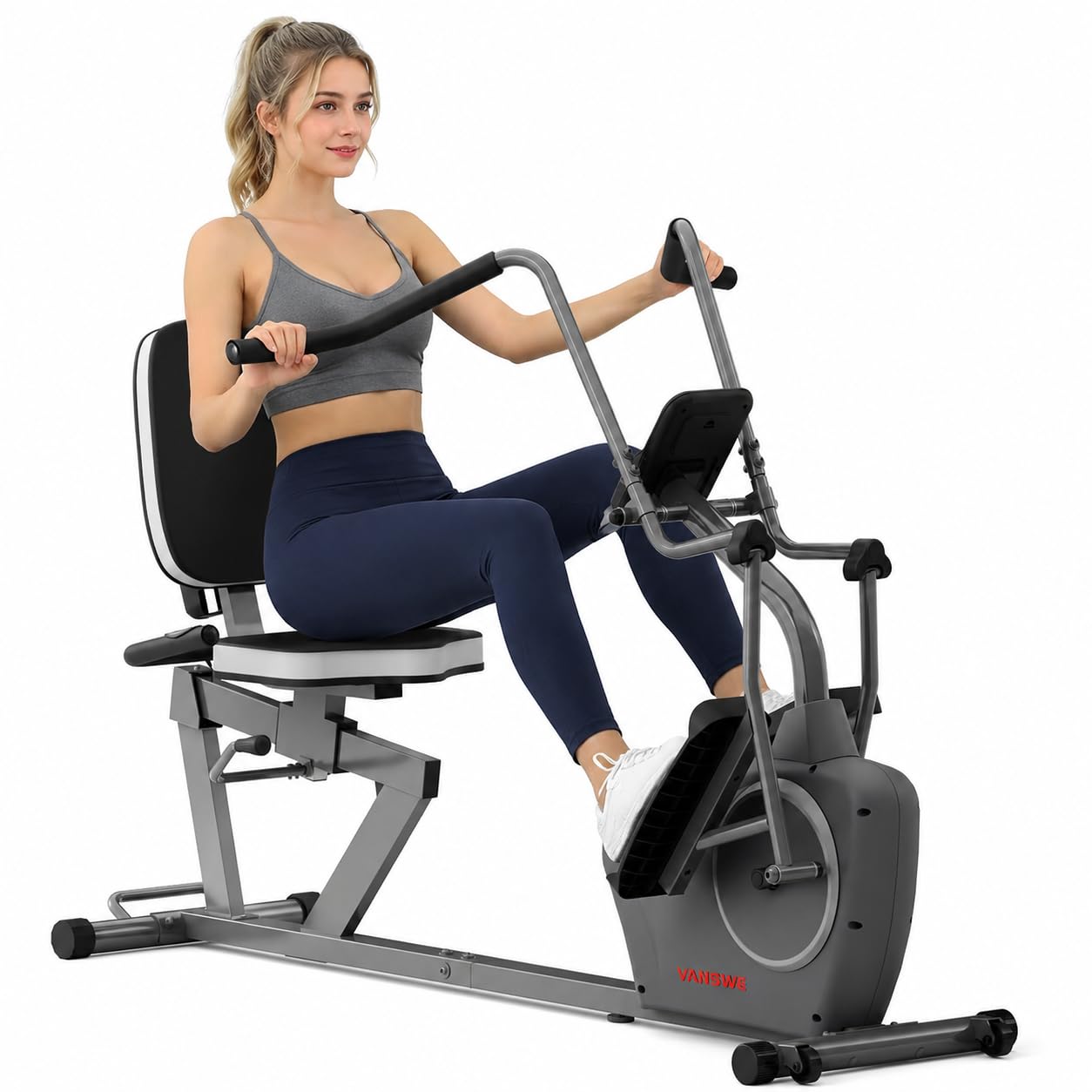
The VANSWE turns the recumbent into a full-body trainer. Moveable arm handles and elliptical-sized foot pedals work your upper and lower body at once, so the legs and knees carry less of the effort for the same cardio. The seat slider is the standout: it adjusts across a 29-inch to 37-inch inseam range, fitting riders from 5’2″ to 6’5″ — a wider stretch than the MERACH’s 5’2″–5’10” band. The steel frame holds up to 400 lb, and its reclined, supported position takes the load off your back, knees, hips and ankles instead of pressing on them the way an upright does.
The 8-level magnetic resistance runs whisper-quiet for early-morning or late-night sessions, and front transport wheels let you roll this 75 lb machine out of the way. Built-in Bluetooth and a back-lit monitor track time, speed, distance, calories and heart rate, and the tablet holder keeps a longer session entertaining. It arrives 80% pre-assembled, and most owners are riding within about an hour of opening the box.
Where it asks patience: it is a big footprint at 57 by 20 by 47 inches, and the included tools are worth swapping for your own real ones to tighten it properly. Owners describe it as knee-friendly and quiet, but the pulse reading is not lab-grade, so treat heart rate as a rough guide rather than a number to train to.
The recovery advantages
- Seat slider spans a 29–37 inch inseam, so riders from 5’2″ to 6’5″ get a proper knee bend.
- Arm exercisers take load off the knee by sharing the session with the upper body.
- 400 lb capacity and whisper-quiet 8-level magnetic resistance.
- 80% pre-assembled with Bluetooth, app sync and a tablet holder.
Room to weigh
- At 57 inches deep it claims a real corner of the room.
- The included assembly tools are basic — use your own for a firmer build.
- Handle-based heart rate is a rough reading, not a precise one.
Best suited to: a household of different heights that wants one machine for full-body, joint-friendly cardio.
Consider other options if: floor space is tight or you only want leg work.
6. Niceday Recumbent Exercise Bike for Home with APP Training

The workhorse recumbent built for physical therapy, with a 400 lb frame and 16 honest resistance levels.
The Niceday’s whole pitch is rehab. It is designed to cut the burden on your back and put less pressure on the joints, aimed at people working their mobility back after replacement surgery. The seat adjusts through 8 positions and offers leg room for riders up to 6’3″, the frame carries up to 400 lb, and an ergonomic high-density sponge cushion with a breathable mesh backrest keeps the sitting end comfortable. A mechanical knob lets you dial 16 progressive resistance levels, and the build feels like the part owners trust most — build quality is the trait they bring up more than anything else.
Assembly is the other strong point: the remaining 10% comes together with user-friendly manuals and videos, and most riders are set up in about 45 minutes. The belt drive keeps it smooth and quiet, and Bluetooth connects to Kinomap and Zwift through the LED monitor and iPad holder. If you want a tall fit, this beats the MERACH on headroom — 6’3″ versus 5’10” — for a similar seated position.
The recurring gripe is the LCD. It reads dark and the labeling is thin, and some fit a small clip light to see it clearly. The seat is also just adequate rather than plush, and the resistance tops out at a moderate level, so a very strong rider will want more. None of that undercuts the core job, though: a stable, quiet, well-built recumbent you can pedal for 40 minutes without pain.
The reliable core: a 400 lb frame, 16 resistance levels and a comfortable seat make this a set-and-go daily machine.
The honest limits: a hard-to-read display, an average seat, and resistance that stops at moderate — fine for recovery, less so for advanced training.
A smart pick for: taller riders and anyone who wants an easy build and a proven rehab-friendly frame.
Look past it if: you need a bright display from the start or want a hard resistance ceiling to grow into.
7. VANSWE Recumbent Exercise Bike
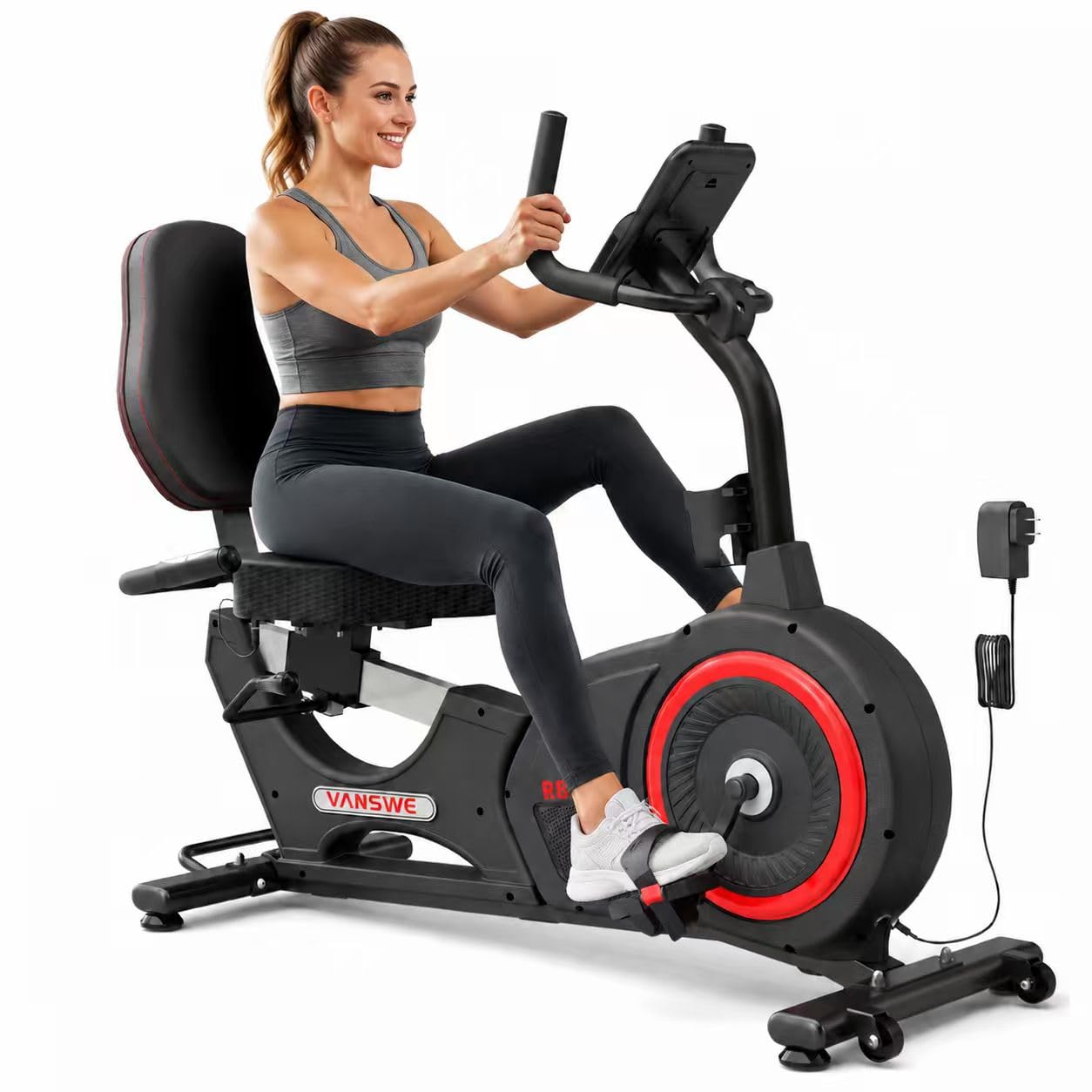
The 450 lb frame with button-controlled resistance and a seat that slides to the millimetre.
This VANSWE is the heaviest-duty recumbent on the list, built for a 450 lb capacity in a wobble-free steel frame. Its resistance is electronically controlled rather than turned by a knob — an 11 lb precision-balanced flywheel and 16 levels respond at the touch of a button, so you can ramp the effort without reaching down mid-pedal. The Infinite Slider Seat is the precision feature: leg length adjusts from 29 to 40 inches, covering roughly 5’1″ to 6’4″, so you can dial in an exact knee bend. A 3.4-inch extra-thick padded cushion and a contoured backrest support the sitting end.
The backlit LED monitor shows large digits and offers 19 built-in programs, and Bluetooth syncs to Kinomap and Zwift for virtual rides. It arrives 80% pre-assembled with tools and a video, and transport wheels move this 73 lb machine around the house. That it is a bigger, premium machine than the MERACH is clear in its 450 lb rating, and its 29–40 inch leg-length slider leaves the MERACH’s 35.43-inch top end behind.
The picture is not all rosy on the review side. Feedback is thin, and a couple of buyers felt the build did not match the description — worth knowing before you commit at the premium end. Weigh the strong spec sheet against that limited track record.
The draw: a 450 lb commercial-style frame, push-button resistance, and a seat that slides a full 29–40 inches for a precise knee angle.
The caution: an early review base, with a minority questioning the build — read the current reviews before buying at this tier.
Worth a look if: you need the highest weight capacity here and want electronic resistance control at your fingertips.
Hold off if: you would rather buy on a long, proven review record than a strong spec sheet.
8. JOROTO Recumbent Exercise Bike JH50 with 400LBS, Smart App

Ninety-five percent built when it lands — you add the seat, handles and footrests and you are done.
For anyone whose knee makes leaning over a half-built bike a chore, the JH50 is the answer. It arrives 95% assembled, so you install the seat, handles and footrests and you are riding, with a video guide and brand support behind you. The frame is built for a 400 lb capacity with a wide step-through gap for easy access, and an 11 lb magnetic flywheel drives 16 resistance levels from gentle to rigorous. A backlit LCD tracks your stats and heart rate, and a tablet holder lets you stream while you pedal.
The seat is a large cushioned one, roomy enough for long rides, and it holds quiet through a session — the motor-driven resistance keeps noise low. Bluetooth syncs to the JOROTO app plus Kinomap and Zwift, and a custom dust cover is included to protect it between uses. Transport wheels roll this 83 lb machine from room to room.
If you want to be pedaling the same day it arrives, the shorter review record is a trade most buyers accept.
Why the convenience wins
- 95% pre-assembled with a video guide — you fit the seat, handles and footrests.
- Wide step-through for easy access, plus a large cushioned, quiet seat.
- 16 magnetic resistance levels and a backlit LCD with tablet holder.
What to weigh
- A newer listing with a shorter review record to lean on.
- At 83 lb it is stable but heavy to reposition without its wheels.
Lands well for: the buyer who wants the least setup friction and a wide, easy-access frame.
Maybe not if: you prefer to buy only on a deep track record of owner feedback.
9. ESKUTE E Trike Electric Bike, Folding Trike 18×3.0 Fat Tire

The trike that lets you skip the pedaling entirely and still get outside on a bad knee day.
Three ride modes set this apart: pedal, pedal-assist, and throttle. On the throttle you let the motor do the work with no pressure on the knees at all, which is the whole point for a rider who wants fresh air without a workout. A quiet 500W motor peaking at 1200W pushes you up to 18+ MPH, and a removable 48V 13Ah battery is rated for up to 65 miles per charge. The 18 x 3.0 inch fat tires and a rear differential keep it steady on uneven roads, and a low step-thru frame makes mounting easy.
It fits riders from 4’8″ to 6’2″ with an adjustable seat, and the folding frame plus a rear cargo rack make it a genuine errand machine — groceries, bags or a pet carrier. A padded seat with backrest eases strain on longer rides. Just know the numbers: it is a 350 lb capacity and the battery energy lists at 499 watt-hours, so plan your charging routine to the removable battery.
Reliability is the caveat to look at closely. The ride experience draws mixed feelings — some find the throttle smooth and the battery strong, while others hit drivetrain trouble that sent them to a shop, and more than one found the three-wheel handling needs practice. Read the current reviews and set expectations around a little tinkering rather than a turn-key ride.
The standout: throttle-only mode plus a rated 65-mile battery makes this the least knee-demanding way to run errands outdoors.
The trade-off: mixed owner reports on drivetrain reliability and a real learning curve on three wheels.
A fit for: riders who want motorized outdoor travel with zero pedaling on difficult days.
Skip if: you want a low-maintenance machine with no post-purchase adjustments.
10. Sunny Health & Fitness Elite Recumbent Cross Trainer

Sixteen electromagnetic levels, 12 built-in programmes and a free app with thousands of workouts.
The Sunny Elite gives you a recumbent elliptical with a deep well of structure. There are 16 electromagnetic resistance levels, 12 pre-programmed workouts and room for 4 custom user programmes, so you never stare at a blank screen wondering what to do. The free SunnyFit app adds 1,000+ trainer-led workouts and 10,000+ scenic tours with no membership fee. For a rebuilding knee, the low-impact design, comfortable seat and contoured mesh back support keep the motion gentle, and owners find it easy on the knees and hips.
The easy on-off design puts minimal obstruction between the handlebars and seat, so you step through and sit down before starting. An easy seat adjuster lets you change height without getting off. Moveable handles and elliptical pedals work both body halves, or you can isolate arms and legs. The performance monitor tracks time, speed, RPM, distance, watts, calories and heart rate, and the sturdy frame holds up to 300 lb.
The main cost is setup and plug-in: it needs to be powered for the programmes and tension, assembly runs about two hours with two people, and the unit at 113.1 lb is heavy even with its transport wheels. It also has the lowest weight capacity here at 300 lb, so bigger riders should look at the 400 lb picks.
What stands out: programmed variety — 12 built-in workouts, 4 user slots and a free app library — keeps a long recovery engaging.
What to plan for: a two-hour build, a plug-in requirement, and a 300 lb ceiling.
A strong choice for: a rider who wants guided, varied workouts and full-body low-impact motion.
Reconsider if: you are near or over 300 lb, or want a machine that works without a power outlet.
11. Teeter FreeStep Recumbent Cross Trainer Stepper LT7

The top-tier trainer that trades cycling for a seated, zero-impact stepping motion.
Instead of pedaling in a circle, the FreeStep moves your legs in a natural stepping stride. Teeter says that stroke aligns the joints for better muscle engagement with less stress on the hips, knees and ankles than a cycle-motion recumbent, and it uses a patented natural stride licensed from commercial physiotherapy steppers. A 20-level magnetic resistance system, controllable from console quick-keys across a 0–105 lb range, runs friction-free and whisper-quiet. A 9-inch colour LCD shows 7 tracking metrics and supports 21 pre-programmed, goal-based workouts, and Bluetooth pairs with a heart-rate monitor sold separately.
The rest of the machine is built for confidence: a 13-inch media rack with a USB charging port, an electronic step lock for easy entry and exit, dual cup holders and transport wheels. It is rated for users 4’11” to 6’6″ and up to 350 lb, with a maximum stride length of 11 inches. The free Teeter Move app adds trainer-led classes, and owners mention it is quiet and smooth and does not aggravate joints the way a standard elliptical does.
This is the heaviest and largest machine here at 150 lb and 59 by 32.7 by 54.8 inches, so it wants a permanent spot and a second set of hands to place. The seat raises easily but can be stiff to lower. Move up to it once a circular pedal stroke aggravates the knee and a stepping stride feels better.
What makes it premium
- Patented physiotherapy-style stepping stride is gentler on hips, knees and ankles than cycle motion.
- 20 magnetic resistance levels across a 0–105 lb range, plus 21 pre-programmed workouts.
- 9-inch colour LCD, media rack with USB charging, electronic step lock and transport wheels.
- Rated for riders 4’11” to 6’6″ and up to 350 lb.
What it costs you
- At 150 lb it wants two people to move and a fixed place to live.
- The seat raises easily but can be stiff to lower.
- It is a stepper, not a bike — you are giving up pedaling entirely.
Designed for: the rider who wants a PT-style zero-impact stride and is ready to dedicate floor space and a budget.
Pass if: you still want the familiar feel of pedaling, or need something easy to shift around.
Know the Specs
Resistance levels
Resistance is the braking force the bike applies against your pedaling, and the level count tells you how finely you can tune the effort. A low setting lets a healing knee move through a gentle range; stepping up one level at a time builds strength without a jump. Magnetic resistance runs quiet and changes smoothly, which is why most recumbents here use it — and why one model with 100 settings lets you climb one tiny notch at a time.
Weight capacity
This is the maximum rider weight the frame is rated to hold, and it reflects how sturdily the bike is built. A higher figure usually means a heavier steel frame that stays planted and does not wobble while you pedal. Lighter frames with lower ratings can still be perfectly stable for a smaller rider, so match the number to your own body rather than assuming more is always better for you.
Seat adjustment and leg length
The seat’s travel range decides whether your knee stays slightly bent at the bottom of the pedal stroke — the position that keeps a recovering joint comfortable. Too far from the pedals and the knee over-extends; too close and it jams up. Look at the listed leg-length or inseam range and match it to your height. A slider that moves in small increments beats fixed holes, since it lets you find the exact spot.
Step-over and mounting height
Step-over height is how much frame sits between you and the seat when you get on. A wide step-through gap lets you lift a leg over without swinging it high, which matters most in the first months after surgery when mobility is still returning. Upright bikes tend to place the seat and handlebars far apart, raising the height a shorter rider must clear. Recumbents and trikes use a low, open frame so you can sit down first and then settle your feet on the pedals.
Flywheel weight
The flywheel is the weighted wheel that keeps the pedaling motion smooth and steady, and its weight is listed in pounds on the models that have one. A heavier flywheel keeps momentum between strokes, so the pedal doesn’t feel jerky under a stiff knee. A 6.6 lb perimeter-weighted flywheel and an 11 lb precision-balanced one both aim for that same fluid feel, letting you pedal in an even circle rather than push through dead spots.
Common Questions
Is a recumbent or an upright bike better after knee replacement?
How much knee bend should I have before I start pedaling again?
Can I use an exercise bike with limited knee flexion?
What is the difference between magnetic and friction resistance on these bikes?
Do I need to plug these bikes in to use them?
How much weight can a recovery recumbent hold?
How long does assembly take on these bikes?
Is a three-wheel trike easier to ride than a two-wheel bike after surgery?
Can the whole family share one of these recumbents?
Do these bikes connect to fitness apps?
The Bottom Line
For most people starting to pedal again, the winner is the MERACH S19 Recumbent because it pairs a backed, adjustable seat with a pedal stroke you can do every day without dreading the mount. If you want the widest full-body fit for a household of different heights, the VANSWE Recumbent Elliptical stretches from a 29 to 37 inch inseam. And if a stepping stride suits your joints better than pedaling, the Teeter FreeStep LT7 is the one to reach for.
The crowd favorite is the Niceday — 4.0+ stars and a long record of owners who trust its build — but its dim LCD and moderate resistance ceiling are the honest gaps to weigh. The rest of the field splits by your body and your space: a trike for outdoor errands, an electric trike for throttle-only days, and a heavy-duty frame when you need the highest weight capacity here. Pick the one whose seat range matches your knee’s bend today, then fine-tune the slider from there.
How we choose
We do not accept paid placement. Every pick is matched to a real buyer and a real use-case; we do not hands-on test units.
Sources
Specifications: manufacturer listings and product documentation. Review insights: verified customer reviews, as of October 2026. Pricing: not shown on this page (it changes often); check the current price via the retailer link.
As an Amazon Associate, Aappliancez earns from qualifying purchases. This does not affect which products we feature.