Disclosure: Some links in this post are affiliate links. As an Amazon Associate I earn from qualifying purchases, at no extra cost to you. Learn more
Specs are compiled from manufacturer listings and verified buyer reviews and can change over time — please confirm the key details on the product page before buying.
Your shoulders and hands are doing their job — but if the bench wobbles or the pad is too narrow, the lift fails anyway. A bench press bench is the platform everything else sits on, and the wrong one shows up as a rocking frame, a slippery pad, or a height that feels wrong under your feet. This guide covers nine benches worth loading, split by what each one actually does best.
This guide is built by comparing the manufacturers’ published specifications and the patterns across verified customer reviews, so you get each pick’s real strengths and trade-offs instead of marketing spin.
The details that decide a bench — frame thickness in gauge, pad width and thickness, bar height, and rated capacity — come down to matching the bench to your body and lifting loads. What follows is the shelf sorted for anyone searching a practical bench press bench that holds steady.
Top Picks
How To Choose The Best Bench Press Bench
Start with the obvious: what are you actually pressing? If you lift barbells with a spotter or in a rack, a flat bench with a firm pad and a stable frame beats any adjustable model at the same money. If you also do incline presses, flyes, and ab work, an adjustable bench adds movement variety but brings more parts — and therefore more places for wobble or a wobbling seat gap to appear.
Match the pad to your shoulders, not just the frame
The pad width decides how your shoulder blades sit. A 12-inch wide pad supports the shoulder blades and lets you retract them for a solid pressing base, which matters more than most first-time buyers expect. A narrower pad can force your shoulders forward. The pad thickness matters too: a 2.5-inch pad is the common thickness on heavy-duty benches, and the firmer it is, the more of your drive goes into the bar rather than into sinking foam.
Read the capacity number, then check the build
A rated capacity — the maximum load the bench is tested to hold — tells you the bench has been tested to hold that number. What it doesn’t tell you is how it feels under your heaviest set. Frame gauge (thicker numbers are stronger), the number of welds, and the base geometry all determine whether a bench stays flat and level when you press, not just what number sits on the box.
Height and bar distance affect your setup
Bar height is the distance from the floor to the top of the pad — the higher the pad, the higher your arms start. An IPF-standard height of 17.7 inches inches is a common target for a competition-style setup. That said, the value of any exact number depends on your height and foot placement; a lower stance suits taller lifters who need their feet flat on the floor with their knees bent.
Side-by-Side Comparison
| Model | Best For | Capacity | Pad Width | Frame Material | Amazon |
|---|---|---|---|---|---|
| REP Fitness Flat Weight Bench★ Best Overall | Home and light commercial flat pressing | 750 lb | 12 in | 11 gauge alloy steel | Amazon |
| Titan Fitness Elite Series Single Post Flat BenchBuilt Like A Tank | Serious lifters who move big loads | 1,000 lb | 2.5 in thick pad | Alloy steel | Amazon |
| YOLEO Commercial Weight BenchCommercial Grade | Commercial-grade flat and incline work | 2315 lb test load | 32 in backrest | 8-gauge alloy steel | Amazon |
| FLYBIRD WB7 Weight Bench | Tall lifters wanting an adjustable bench | 1300 lb | 34 in backrest | Alloy steel | Amazon |
| pooboo Adjustable Weight Bench | Fast setup with FID flexibility | 1500 lb | 31.5 in backrest | Alloy steel | Amazon |
| GMWD Chest Press Machine | Press training without a spotter | 1200 lb | Bench with 3 positions | Alloy steel | Amazon |
| MAJOR FITNESS Weight Bench | Garage gym adjustability | 1300 lb | 31.5 in backrest | Alloy steel | Amazon |
| BowFlex 5.1S Bench | Stowable space-saving home setup | 600 lb | — | Alloy steel | Amazon |
| REP FID Foldable Weight Bench | Tighter spaces needing FID range | 1000 lb | — | Alloy steel | Amazon |
Detailed Reviews
1. REP Fitness Flat Weight Bench
Our pick — over 4.5★ from 500+ verified ratings; the strongest balance of quality and price.
The budget-tier flat bench that punches well above its size.
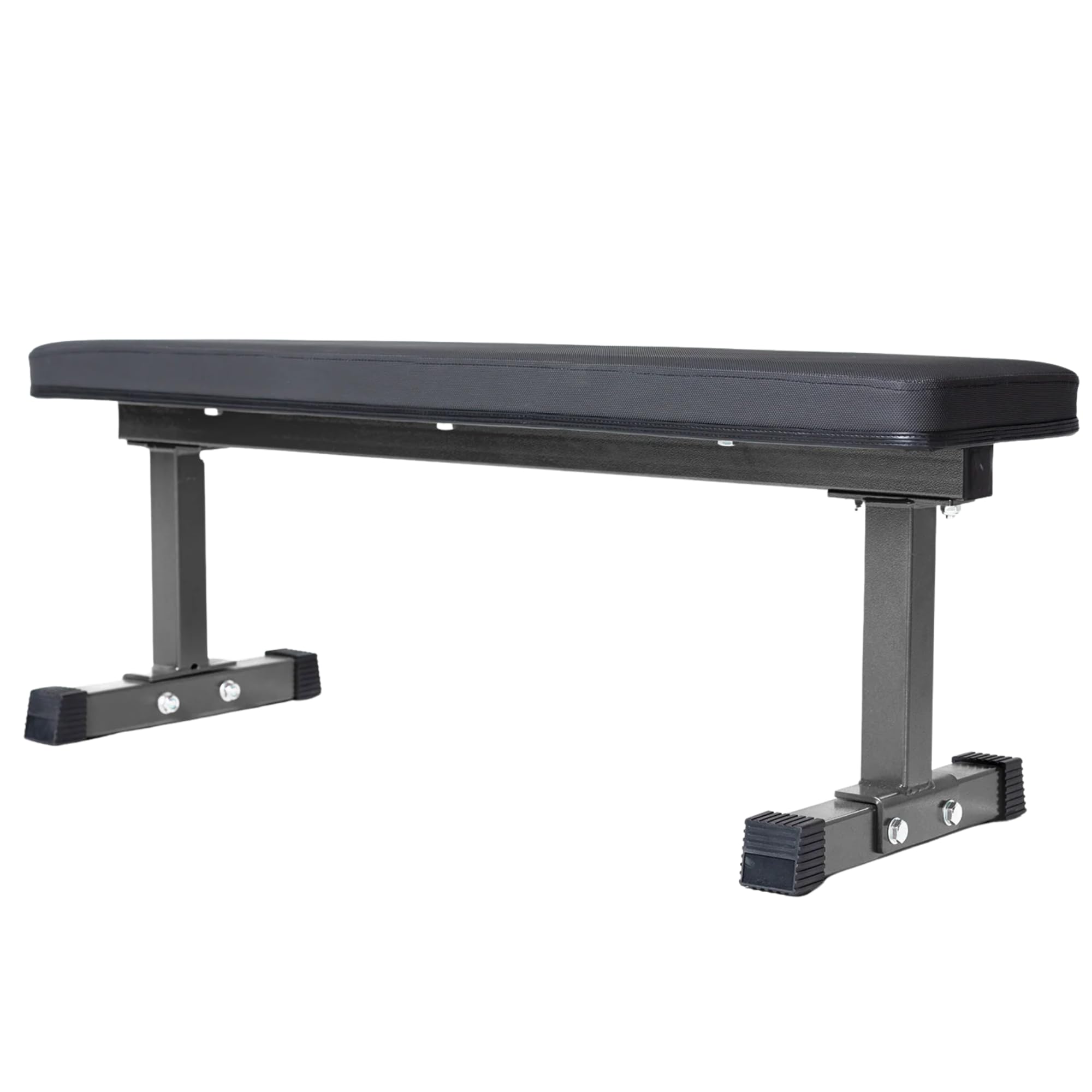
Start with what makes this stand apart: 11-gauge steel (the thicker the gauge number drops, the stronger the tube). That gauge, a thick plywood base layer instead of particle board, and a 12-inch wide pad give this bench its firmness. The top surface of the pad sits 17.5 inches from the floor — a target most lifters recognize as the standard bench height for a natural press. And it weighs just 20 pounds, which makes it one of the easiest benches in this list to slide out of the way when the session is over. By comparison, the Titan Fitness bench below weighs 56 pounds, a real difference in how much you have to muscle it around.
The pad here is 2.5 inches thick with a grippy cover, and it’s built for dumbbell, barbell, and core work on a flat surface — there’s no incline to fuss with. If your routine is flat pressing and rows, the fixed angle is all you need. The frame is rated to 750 pounds, which clears the working sets of most home lifters with room to spare.
Owners rate it 4.7 stars and single out one thing: the pad doesn’t shift under a loaded bar. The most-mentioned theme is how solid this bench feels — over 250 owners single out sturdiness — followed by how easy it is to assemble, with more than 140 calling that out. Value for money is the third most-cited point. The recurring gripe isn’t a wobble or a wobble-prone frame; it’s the levelness of the bench, which a handful of owners notice and a few find worth mentioning. Tighten the bolts with the bench laid on its side, then set it down and finish tightening — that’s how you get it flat.
Why it’s the winner
- 11-gauge steel with a plywood base layer, not particle board
- 12-inch wide pad gives shoulder support — compared to a 9.5-inch Body Solid, that’s a wider press surface
- 750 lb rated capacity covers most home lifters
- Weighs 20 lb, so it moves and stores without a fight
Where it gives a little
- Levelness comes up as a mixed point — a few buyers find it slightly off
- No incline or decline adjustment; flat work only
- Pad finish is grippy, but the cover wipes clean rather than being built for abuse
Best if…: you want a flat bench for barbell and dumbbell work that stays firm and doesn’t have a wobble to chase.
skip it if…: you need incline or decline angles — that’s where the FID benches later in this list come in.
2. Titan Fitness Elite Series Single Post Flat Bench
Two knurled handles and two wheels turn a 56-pound bench into a rolling fixture.
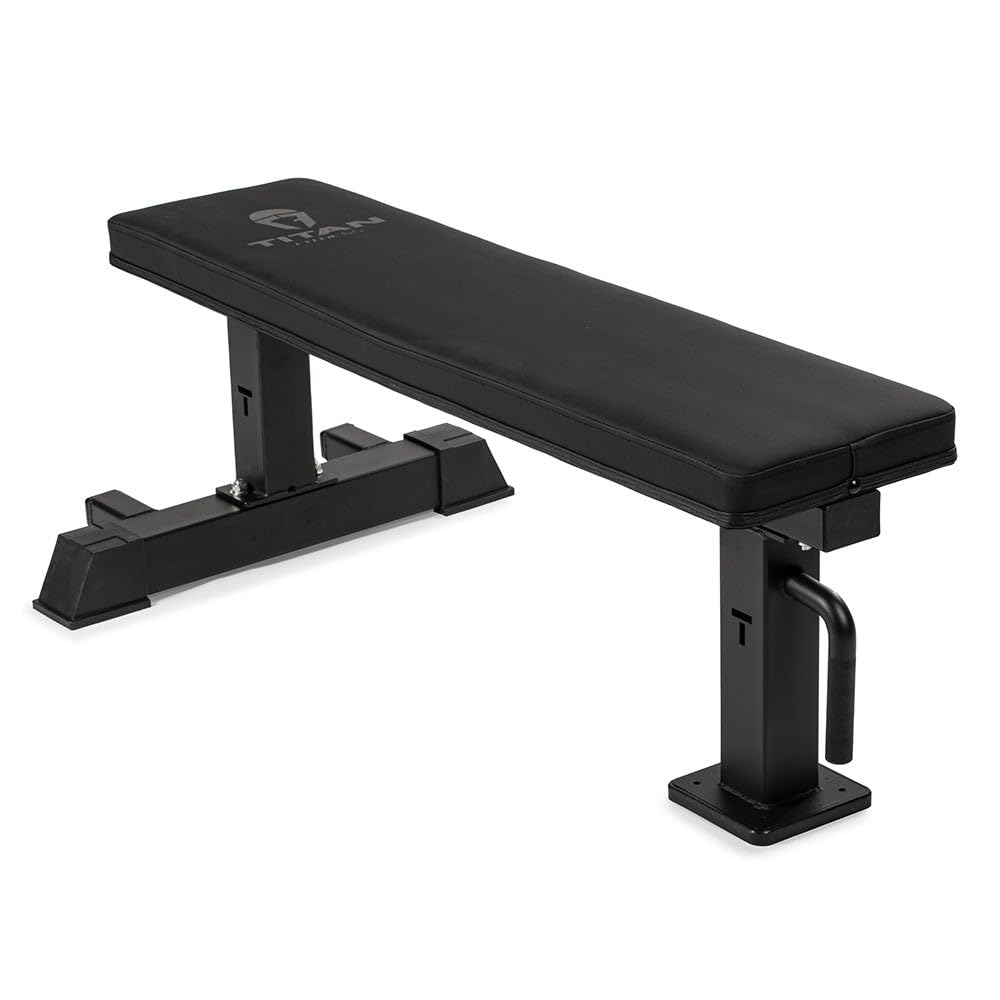
You get a bench rated to 1,000 pounds, so it holds up under a heavy press. The single-post base (one leg instead of two side rails) keeps your feet exactly where you put them. That design opens up foot positioning, so you can plant your heels and get a smoother back arch under a heavy bar. The 2.5-inch thick HeftyGrip vinyl pad gives you a firm surface that won’t sink. Transport wheels and a knurled handle (a textured grip) make it easy to roll into a corner when you’re done.
At 56 pounds, this bench stays put when you press. Compare it to the REP bench above: 56 pounds versus 20 pounds is a 2.8x gap, and you feel that weight when you bump it across a garage floor. The payoff is a bench that does not move. Its footprint is 48 inches deep by 26.38 inches wide by 17 inches tall, so it takes up more floor than a stripped-down flat bench — measure your space before you commit.
Owners rate it 4.8 stars and cite the same reason: the frame holds up year after year. The quality of the build is the most-cited point, followed closely by sturdiness, with value for money ranking third. Buyers report the assembly instructions had a couple of blank pages and the box arrived banged up, so plan on a screwdriver and some patience — the parts themselves come through fine. Once it’s together, the review pages sum it up: “Nice and sturdy. The handle and wheels made it easy to move around.”
The honest trade-off: This bench is a flat-only design — no incline, no decline. If your training lives at 0°, that’s not a limitation, it’s a purpose-built tool. Just know you’re buying one job and buying it done right.
Reach for this if…: you’re a serious lifter who moves heavy weight and wants a bench that rolls away between sessions.
Look elsewhere if…: you need a foldable bench for a tight corner — this one is a permanent piece of furniture for your gym.
3. YOLEO Commercial Weight Bench, 2315LB ASTM Certified
A 2315-pound test load backed by a 10-year frame coverage — this one is built for a punishing gym floor.
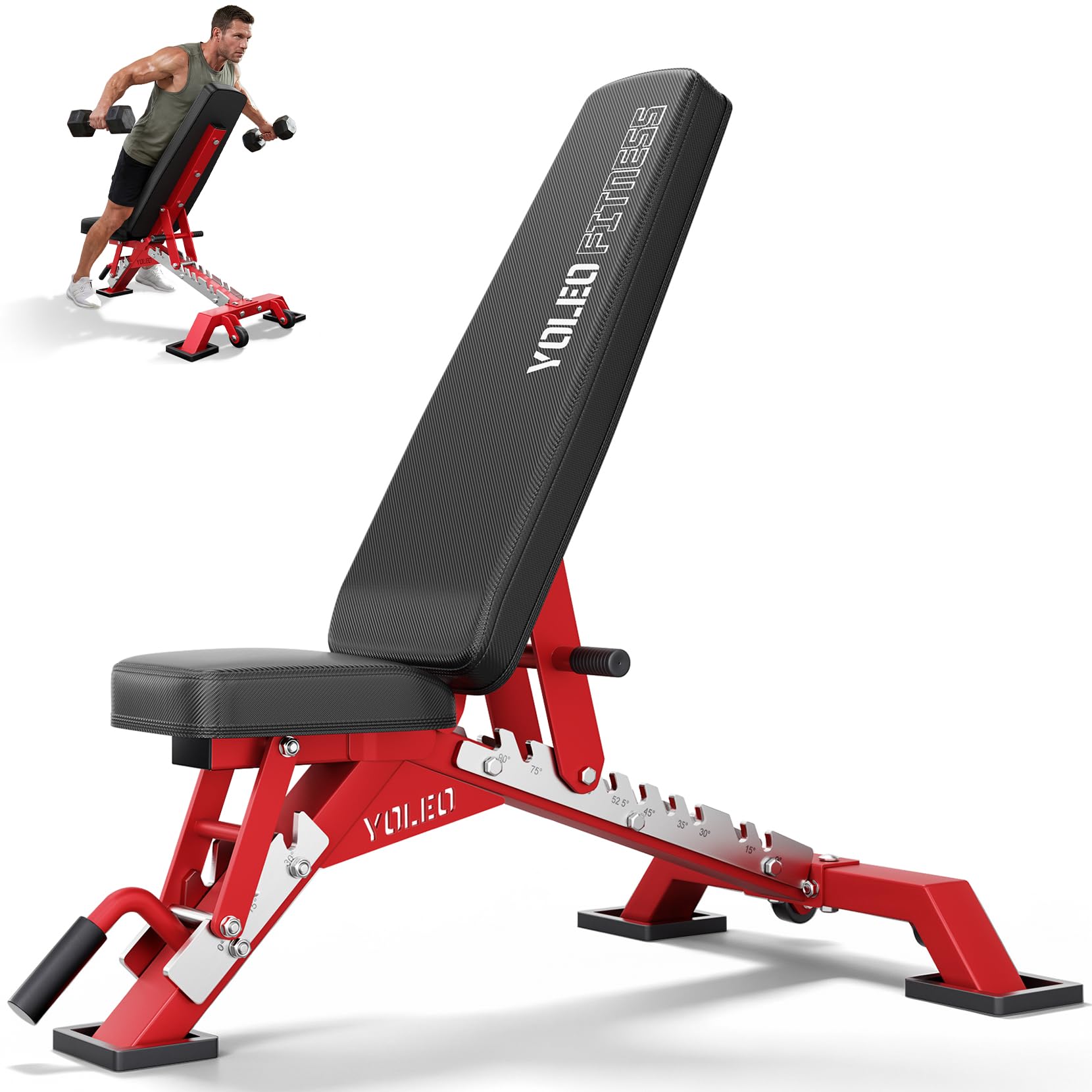
This bench handles 2315 pounds of tested load capacity, so you can press heavy without worry. It’s built on an 8-gauge steel frame (the lower the gauge, the thicker the tube) with a 2.4-inch by 1.2-inch steel structure and 0.12-inch reinforced iron sheets. Compare that to the Titan Fitness bench’s 1,000-pound rating — a real jump in the load the bench is built to take. The 3-post design spreads that load across the base, which keeps it planted under a hard press. The IPF-standard 17.7-inch height puts your arms at a natural start point.
The adjustability is where this bench earns its keep for anyone who presses on inclines too. Ten backrest positions run from -15° all the way to 90°, and three seat settings run 0° to 30°. The C-shaped locking mechanism is a one-hand lever: you reposition the backrest in about a second, no pin-pulling. The 32-inch backrest supports your head fully, and the 2.4-inch 160D pearl sponge pad sits under PU twill leather — that’s a fabric that holds up to years of use better than PVC.
What owners say backs the spec sheet: high quality, easy assembly, and worth the money, with adjustability and mobility running close behind. The bench comes mostly pre-assembled, and owners mention getting it together in around 20 minutes with the included hardware. The two wheels make it easy to move around, and the steps catch the rest. One buyer summed the whole thing up: “This Yoleo Weight Bench works as expected, definitely of good quality and solid.”
One thing to weigh: That 2315-pound capacity and 10-year frame coverage are commercial-grade claims, and the bench is priced accordingly. If your working sets never get close to 1,000 pounds, you’re paying for a heavier, more durable bench than you may ever need. It’s a buy-once bench, not a value pick.
The right call for…: anyone prioritizing the highest tested load rating and the longest frame coverage on this list.
Not the one for…: a light home setup where a simpler flat bench at the lower weight rating would do the job.
4. FLYBIRD WB7 Weight Bench
A 34-inch backrest built for the long-torso crowd, from 6-foot pressers on down.
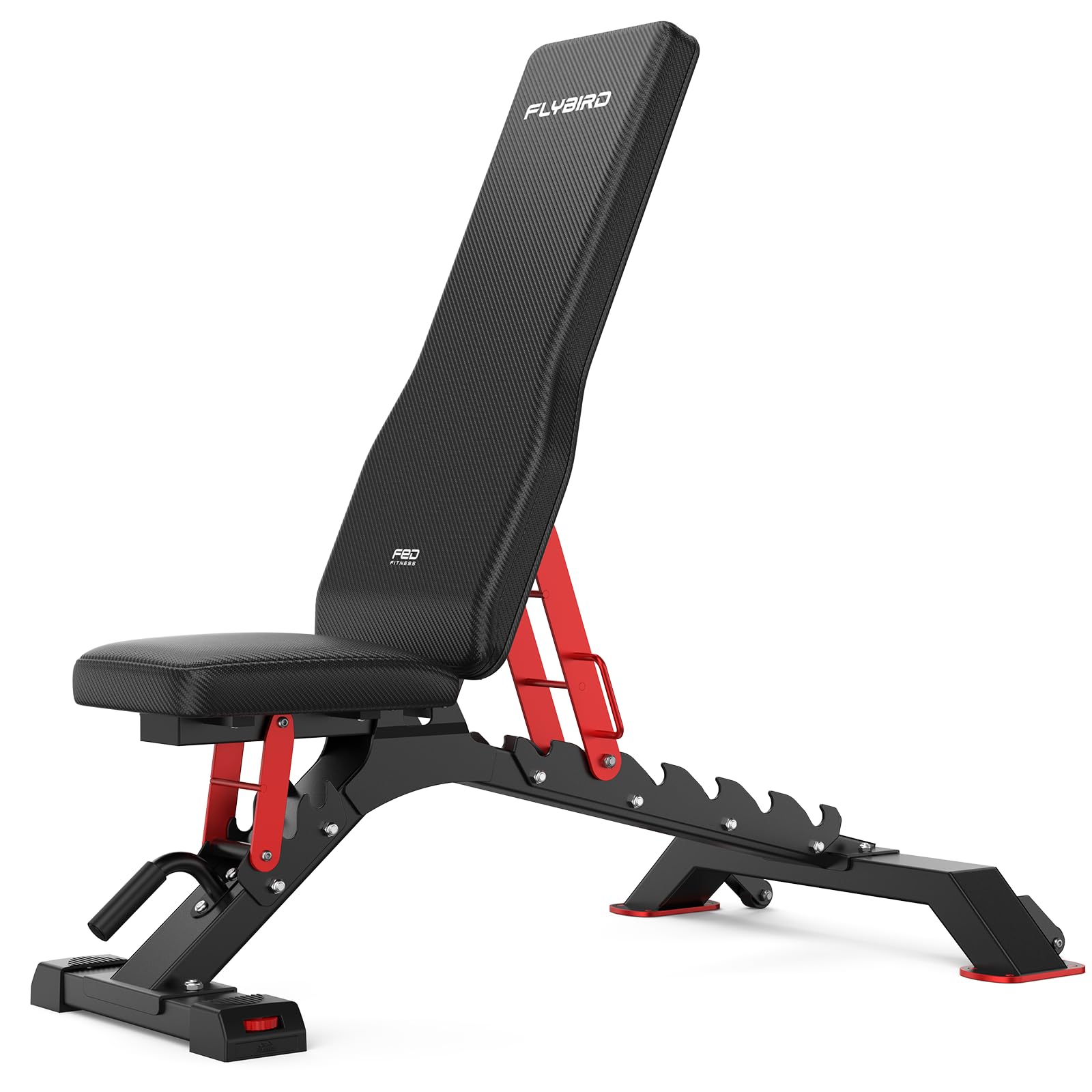
If you’re tall, most benches leave your head hanging off the top of the pad. Not this one: the backrest is 34 inches from end to end, which fully supports the head and neck for users over 6 feet. You get 6 backrest angles (0° to 90°) and 3 seat angles (0° to 25°), set by a C-shaped buckle that releases and locks in about a second. The IPF-standard 17.7-inch height puts your starting arm position right where a flat bench press wants it.
The frame is beefy: 3.2-inch by 1.6-inch tubular steel with a triangle-reinforced design, a 25-inch rear tube, and oversized non-slip feet. That’s a 1300-pound rated capacity. Unlike the Titan Fitness bench above, this one folds — the frame is built to be adjusted, so you get incline and decline work at the cost of a little more hardware. Dual wheels and a handle let you roll it around a home gym floor with one hand.
What wins people over is the build: quality and sturdiness together account for the two most-cited points by a wide margin, followed by assembly and stability. A 6-foot-4, 250-pound lifter running 400-pound working sets found it stable for a body of that size, and a 40-year lifter who’s been at it since the days of fixed gym benches called it solid for the price. The recurring gripe is the upholstery: it’s a woven leather cover over 2.5-inch high-density padding, and the finish feels thin to some owners over time. Treat the pad cover with care, and it holds up — owners running it three to four times a week reported no tears or stretching after well over a year.
One more thing worth knowing: Like all adjustable benches, this one gains a lot of versatility but brings more moving parts than a flat-only model. Set the C-buckle, check that the seat and back are locked, and load the bar behind the stops — the mechanism is fast, but it needs to seat fully before you press.
Best fit for…: taller lifters who want incline and decline range without giving up head support.
A hard pass for…: anyone who only wants a flat press bench and no adjustment hardware to think about.
5. pooboo Adjustable Weight Bench,1500 LBS FID Bench for Home
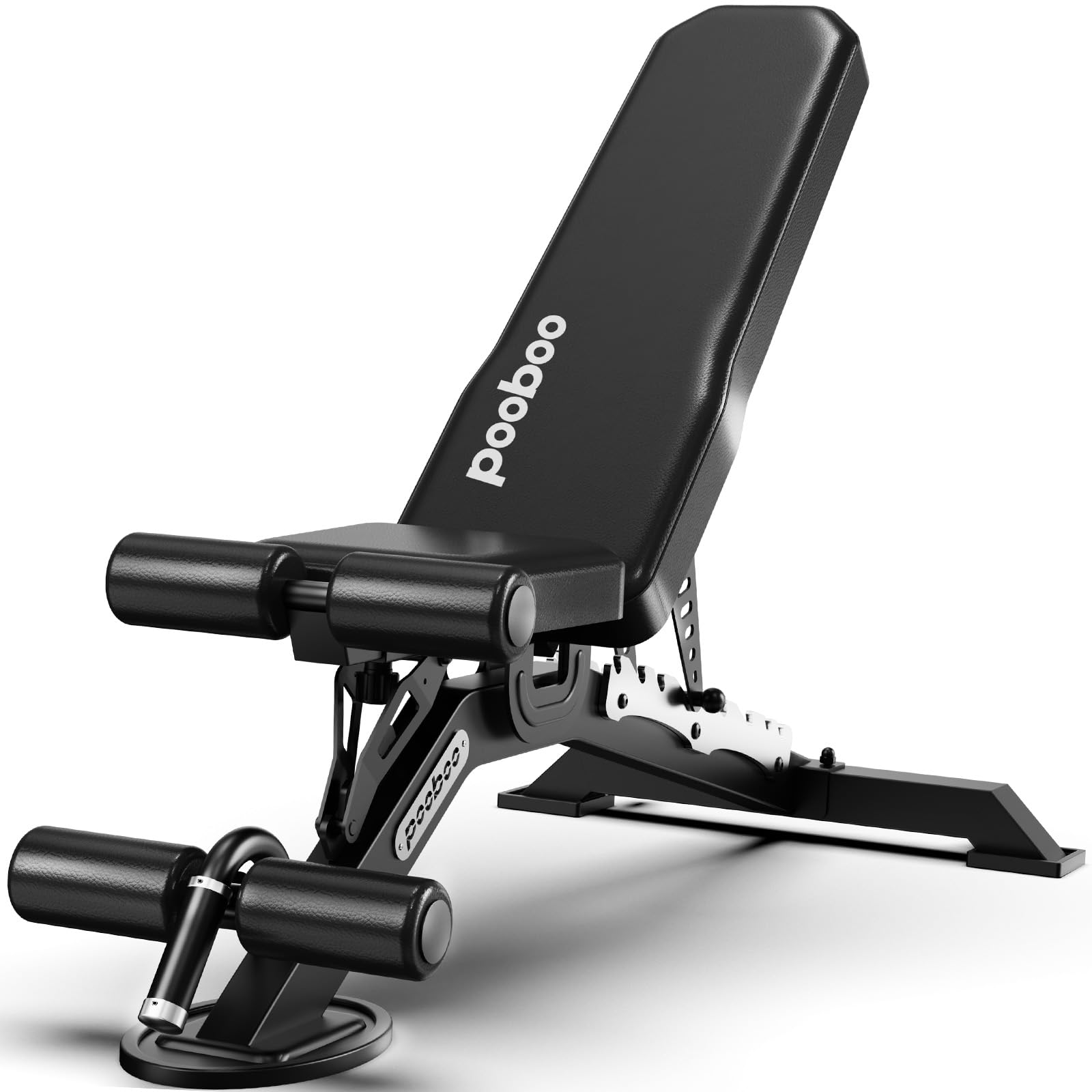
Arrives 96% assembled, so you’re pressing within ten minutes of unboxing.
What makes this one stand apart is the number that saves you a Saturday: 96% pre-assembled, with all hardware numbered and an install video to follow. Owners regularly report being set up in 5 to 10 minutes. That’s the practical difference over the Titan Fitness bench above, which customers note came with blank instruction pages and took real effort to piece together. The 1500-pound rated capacity is built on commercial-grade square steel with an integrated main frame, a triangular structure, and dual back supports.
The adjustable side is a genuine FID setup: 8 backrest positions and 3 seat settings, so you get flat, incline, and decline work from one bench. The C-shaped lock catch resets the backrest angle in a moment. A 2.5-inch thick padded cushion and a 31.5-inch extended backrest carry the body support, and the seat has an extra pair of foam pads at the rear for leg comfort during decline work. Anti-slip rear leg tubes help hold it steady on flat floors. Two transport wheels and a built-in handle make it easy to tuck away.
Buyers give this bench a 4.7-star rating, and they keep mentioning the same things: sturdiness and quality lead the field, followed by assembly and value for money. It feels stable during heavier lifts, and it stands up to years of daily use. The rear foam leg pads support your legs during incline presses, when your feet would otherwise dangle.
One honest note: Anti-slip rear feet help on flat floors but won’t grip through a slick mat or uneven garage floor. Set the bench on a hard, level surface for the steadiest press — the triangular structure does the rest.
Pick this one if…: you want FID range and the fastest possible setup without a long assembly project.
Consider a flat bench instead if…: you never press at an incline and would rather have fewer moving parts under your bar.
6. GMWD Chest Press Machine
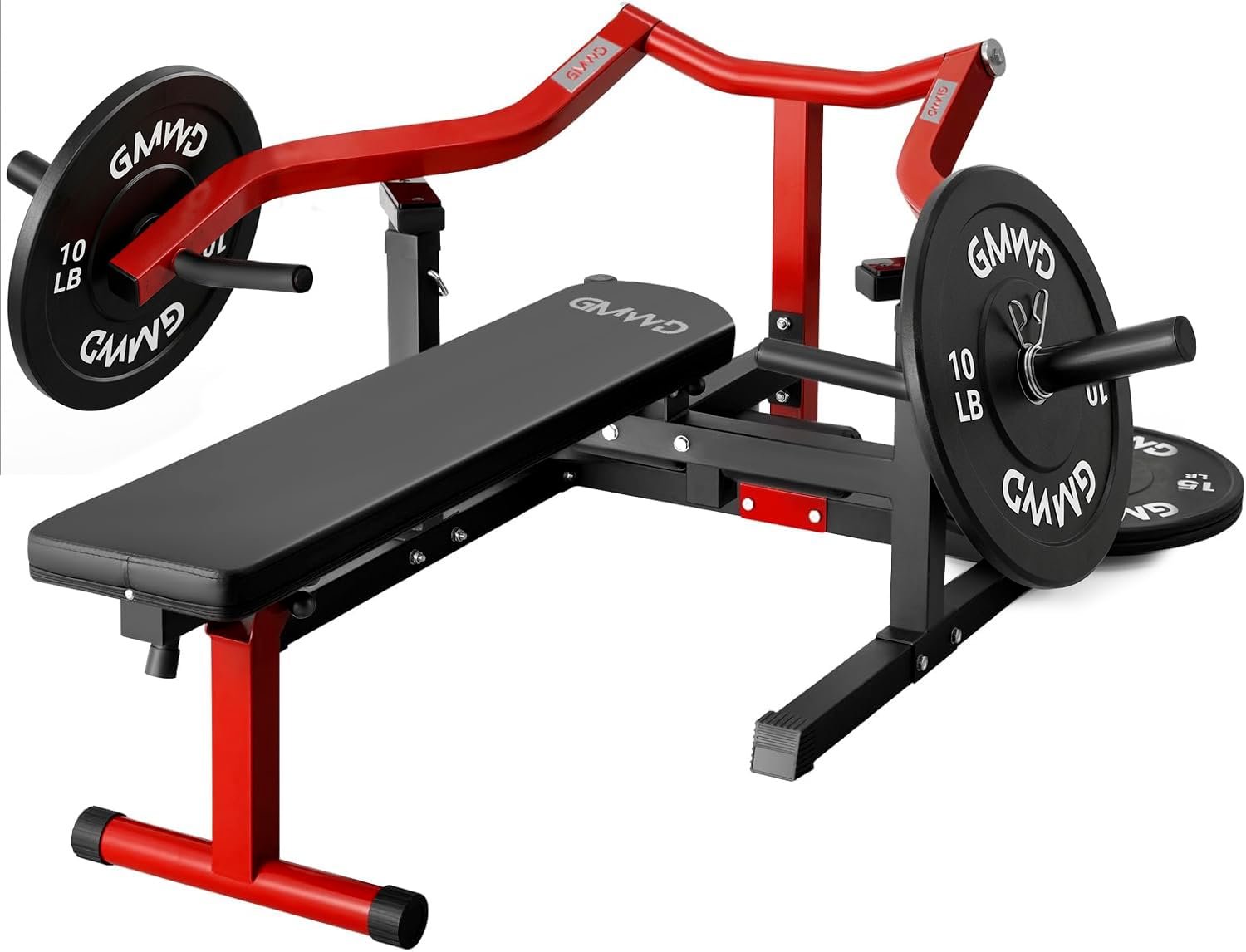
A freestanding press that lets you max out without a spotter standing over you.
This is the only bench on the list that lets a solo lifter train to failure with nobody standing over the bar. The GMWD is a chest press machine first and a bench second: two independent arms move on 11 adjustable leverage positions, and each arm moves on its own so you can correct a left-right strength imbalance. That’s the difference between pressing a barbell and pressing two arms that arc toward each other — the converging motion lines up with how your pecs actually pull, and it lets your chest do the work at the top of the motion with no bar to touch down on.
Build-wise, it’s 2-inch by 2-inch 14-gauge steel tube on 4 anti-slip foot bases. Total capacity is 450 pounds, with 200 pounds per arm and 200 pounds per weight holder. It takes both 1-inch and 2-inch plates via detachable sleeves. The overall footprint is 64.8 by 55.8 by 26.8 inches, but pull the locking pin and it folds down to about 8 square feet of floor — that’s a small footprint for a machine with moving arms. The bench itself is a 3+2 adjustable setup: three positions up front (upright, incline, flat) plus a leg attachment with 2 adjustments per level.
What wins people over is the build quality — the most-cited theme by a wide margin — with value for money and assembly close behind. A 6-foot, 230-pound lifter who switched from a Smith machine to spare their shoulders reported the smooth converging arc and no shoulder pain. Another regular reported it was still stable while handling 285 pounds. The recurring note is on the setup experience: some owners received arms with minor dents or found the pop pins stiff on first use, and a few wanted clearer instructions. Assembly runs around two hours solo with the right wrenches.
Where it earns its slot: For a home gym with no training partner and limited floor space, this is the pick that takes the spotter out of the equation. Just budget a couple of hours and a socket set for the build.
Made for…: lifters who press solo and want to reach failure without a spotter, or anyone training chest and shoulders in a cramped space.
Not a match if…: you want a traditional barbell bench press — this machine trains a different movement path.
7. MAJOR FITNESS Weight Bench
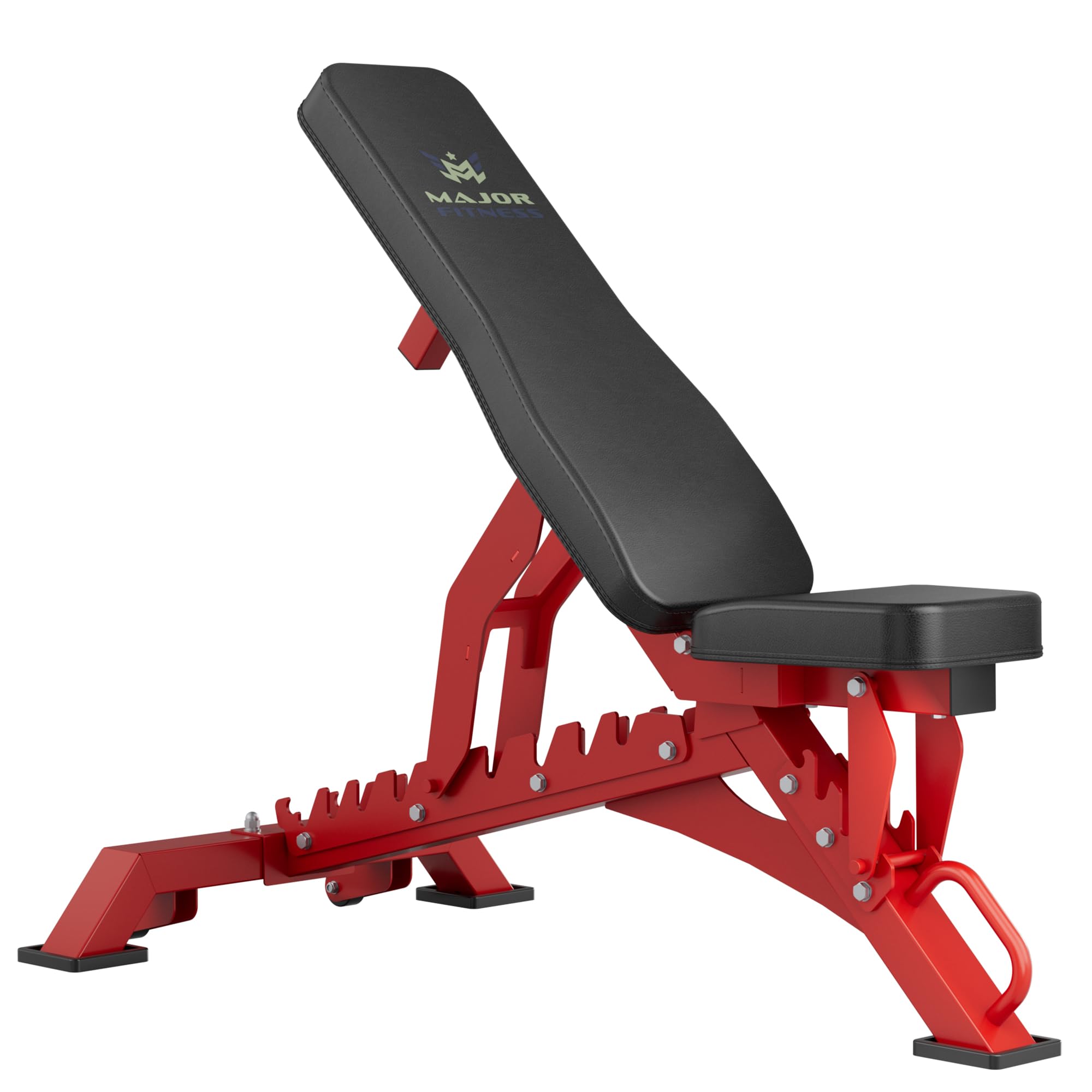
Thirty-six adjustment combinations, a C-shaped lock catch, and a frame that shrugs off a garage.
Most adjustable benches give you two or three seat settings and a handful of backrest angles. This one offers 9 backrest positions and 4 seat positions, and it hits a full 90° at the top of the incline range. Set it down, pull the C-shaped lock catch, and you’re done with no pin to fumble into the right hole. The 1300-pound rated capacity sits on commercial-grade square steel with a triangular structure, and the dual-track backrest support bar keeps it stiff when the bar comes down hard.
The pad is 2.5 inches thick on a 31.5-inch backrest designed to support the head and neck through a full range of motion. PU leather covers it — a waterproof, wear-resistant material that wipes clean after a sweaty session. And unlike the BowFlex 5.1S bench further down this list, this one folds flat enough to slide into a wall gap with the help of two built-in wheels. Its footprint is compact for a 59-pound bench.
Owners rate it 4.6 stars and describe it as built for a garage gym. Quality leads the praise, sturdiness is a close second, and value for money rounds out the top three. One owner running it three-plus months with 345-pound working sets said the welds looked clean, the pad held without cracking or shrinking, and the whole thing fit a 6-foot-2 user with no wobble. The honest caveat is size: the bench itself is 8.46 inches by 48 inches by 16.53 inches, and a few owners find that footprint narrow for wide-grip presses. Try a wide-grip bench press in your mind before buying if you’re a big-framed lifter.
The practicality read: This is the pick for a real garage gym — it adjusts quickly, holds a wide load rating, and moves out of the way when you’re not using it. The trade-off is the narrower-than-average footprint, which some owners feel more than others.
Worth owning if…: you’re building a versatile garage setup and want more adjustment positions than most benches offer.
Skip if…: you’re a large-framed lifter who needs the widest possible pad surface under a wide grip.
8. BowFlex 5.1S Bench

One button click folds this bench up and frees over half your floor.
The stowable design is the whole point: click the button, lift the frame, and the bench folds up for what the manufacturer describes as over 50% space saved when it’s not in use. It offers 6 total angles — 30°, 45°, 60°, 90°, flat, and decline — set by an easy selection knob, and the 600-pound load capacity covers most home dumbbell and barbell routines. The 28.25-inch frame width is worth measuring against your doorway before you buy, since a bench this shape needs to fit where you stash it, not just where you press.
Here’s the piece a lot of shoppers don’t spot until they’re pressing: there’s a space between the seat and the backrest when the bench is flat, and reviewers describe it as noticeable. If your press routine has you flat 90% of the time with a bar over your chest, that gap sits right under your upper back. The removable leg hold-down brace is a real plus, on the other hand — it stabilizes the lower body on decline work, and it comes off with the bolts when you don’t want it.
Owners keep coming back to build quality — it’s the most-cited point, with sturdiness close behind, and assembly takes around 30 to 45 minutes. The adjustability, comfort, and value themes are mixed, and the gap is the recurring gripe. This bench lives and dies on its stowability. If a home gym in a shared space is the goal, that fold-away design is a real advantage. If your routine needs a flat, smooth press surface, measure the gap before you commit.
The chief compromise: The seat-to-backrest gap is the single most-flagged complaint, and it’s most noticeable in the flat position. Owners who press flat most of the time are the ones most likely to feel it.
Built for…: apartment and small-home setups where the bench needs to disappear when the workout ends.
Think twice if…: you press flat every session and need a continuous pad under your back.
9. REP FID Foldable Weight Bench

At 89.3 pounds, this folding bench carries a frame that refuses to move.
Weigh 89.3 pounds and a bench doesn’t slide. That figure is the defining number here, and it’s why this REP model presses like a fixed commercial bench even though it folds for storage. The frame is premium steel with high-density padding, rated to 1000 pounds, and built for a full range of motion on incline, decline, and flat work. A 55.6-inch depth and 17.1-inch height gives a slightly lower stance than most — that matters for taller lifters, whose feet want to stay planted with their knees bent at the bottom of a press.
Compared to the BowFlex 5.1S bench above, this one trades stowability for stability. Where the BowFlex folds smaller, this REP relies on integrated wheels and a secure base to move around the room — heavy, but mobile. The 1000-pound capacity gives real headroom over the 600-pound BowFlex, so it’s the better pick if you’re moving serious loads and only giving up a little floor space. The trade-off is weight: at 89.3 pounds, this is a bench you move with two hands and your back straight, not one arm.
Owners describe it as heavy and solid — the exact qualities the spec sheet implies. Quality is the leading theme, followed by assembly and stability, with a specific call-out that there is zero wiggle or shaking while heavy weights are moving. One owner climbing over 6 feet tall appreciated that the lower stance suited them better than a taller bench. A second owner who replaced a Body Solid bench said this one was a genuine improvement in comfort and width.
One honest caveat: This bench doesn’t have a built-in vertical storage option, so it takes up floor space when folded. And it’s heavy enough that moving it is a two-handed job. You trade floor space for that stability.
Best suited to…: home lifters moving serious weight who want commercial-bench feel in a package that still folds.
Not ideal for…: anyone short on floor space or looking for a bench they can tuck away without lifting anything heavy.
Know the Specs
Weight capacity rating
A bench’s rated capacity is the total load the frame has been tested to hold — you plus the weight you’re pressing. A higher rating generally means a beefier frame and a more stable press under your working sets. But the rating is a benchmark, not a guarantee of feel. What makes a bench steady under your heaviest set is how the frame responds to shifting loads, not the number on the box. If your flat press runs at 315 pounds and your body weight is 200, you want a rating that leaves headroom above your combined load. Ratings on this list run from 600 pounds to 2315 pounds, and matching the rating to your actual working weight matters more than chasing the biggest number.
Pad width and thickness
The pad width decides how your shoulder blades rest, and the pad thickness decides how much of your leg drive goes into the bar instead of into the foam. A 12-inch wide pad is a common flat-bench width and gives solid shoulder support, while a narrower 9.5-inch pad leaves less surface under the shoulders during a heavy press. Thicker pads — 2.5 inches is a common figure on heavy-duty benches — feel firmer and more supportive than thin padding, but only if the foam underneath is dense. A firm 2.5-inch pad holds its shape under load while a soft pad compresses and steals tension from your press. Open-cell foam sinks; high-density foam stays firm. The cover material matters too — PU leather wipes clean, while woven covers wear faster.
Frame thickness and gauge
The gauge of the tube — how thick the steel walls are — drives how much the frame flexes under a bar. The lower the gauge number, the thicker and stronger the tube. An 11-gauge frame, for example, is thicker than a 14-gauge one, and an 8-gauge frame is thicker still. Gauge alone doesn’t tell you how the bench behaves: how the frame is welded and how the base is shaped share the job of keeping the pad flat when you press. A well-made triangular base spreads load across more of the floor, while a single-post design gives your feet more room to plant. Look at welds, base shape, and gauge together rather than any one alone.
Bar height and setup
Bar height — the distance from the floor to the top of the pad — sets where your arms start and how much leg drive you can load into a press. An IPF-standard 17.7-inch height is a common target among adjustable benches, and for good reason: it lets most lifters plant their feet while keeping a usable arch. The right height for you depends on how tall you are and how you press. A lower stance often suits taller lifters, who need their feet flat on the floor with knees bent; a slightly taller setup can work better for lifters with shorter legs who can’t get their feet down with a lower pad. Pick the height that keeps your feet flat on the floor.
Common Questions
How much weight capacity do I actually need on a bench press bench?
Will a 12-inch wide pad support my shoulders on a heavy press?
Is a flat bench or an adjustable bench better for bench pressing?
What is the standard height for a bench press bench?
Can I use a folding bench for heavy bench presses?
How do I stop my bench from wobbling during a press?
How long does a home gym weight bench last?
Does a weight bench come pre-assembled?
Can I use a 1-inch or 2-inch plate on a bench press machine?
What is the difference between a flat bench and an FID bench?
How we choose
We do not accept paid placement. Every pick is matched to a real buyer and a real use-case; we do not hands-on test units.
Sources
Specifications: manufacturer listings and product documentation. Review insights: verified customer reviews, as of October 2026. Pricing: not shown on this page (it changes often); check the current price via the retailer link.
As an Amazon Associate, Aappliancez earns from qualifying purchases. This does not affect which products we feature.