Disclosure: Some links in this post are affiliate links. As an Amazon Associate I earn from qualifying purchases, at no extra cost to you. Learn more
Specs are compiled from manufacturer listings and verified buyer reviews and can change over time — please confirm the key details on the product page before buying.
Most people who buy a belt for sciatica pain put it in the wrong place. They cinch it around the waist like a weightlifting belt — but sciatic nerve pain that starts at the sacroiliac (SI) joint needs compression lower, across the hips and just under the bellybutton. Get that placement right and a surprisingly cheap belt can do more for you than an expensive one worn two inches too high. This guide separates the hip-hugging SI belts from the lumbar braces, explains which one matches your pain pattern, and tells you the sizing mistake that wrecks more purchases than any other.
This guide is built by comparing the manufacturers’ published specifications and the patterns across verified customer reviews, so you get each pick’s real strengths and trade-offs instead of marketing spin.
Some picks here wrap the pelvis, others stabilize the lumbar spine, and one is a drug-free nerve stimulator rather than a belt at all. Below you’ll find honest notes on sizing, wear time, and which brace actually suits a desk-bound day versus heavy lifting, so you can pick the right belt for sciatica pain the first time.
Top Picks


How To Choose The Best Belt for Sciatica Pain
Sciatica is a symptom, not a single condition, and the belt that helps depends on where your pain starts. If it begins in the sacroiliac joint — the small joint where your pelvis meets your lower spine — you want a narrow band that sits low across the hips. If it radiates from the lumbar spine itself, a taller brace with stays and a lumbar pad is the better tool. Buying the wrong shape is the number one reason a belt “doesn’t work.”
Measure your hips, not your waist
SI belts are sized by hip circumference, measured around the widest part of your hips and rear. A lumbar brace is sized by waist, measured at the navel. Mixing the two up is the classic error: a belt sized to your waist will ride up off your hips the moment you sit down. Grab a soft tape measure and check the widest point before you order anything.
Match the height to the pain pattern
Low, narrow bands target the SI joint and pelvic girdle, pressing across the sacrum to limit the small motions that irritate the nerve. Taller lumbar braces wrap the whole lower back with vertical stays and a pad, which suits disc and muscle pain higher up. Some people with referred hip and leg pain do best with the low band, while heavy lifters and long-shift workers tend to prefer the taller brace.
Plan your wear time
A brace is a support, not a cure, and most people wear one during activity and flare-ups rather than around the clock. A physical therapist quoted in the review pages advised against constant wear to avoid muscle loss — a reminder to use the brace as a tool for the tasks that hurt, not a permanent fixture. Pair it with movement and, where relevant, your clinician’s guidance.
Decide if you want compression or stimulation
Belts work mechanically: they compress, stabilize, and limit motion. A TENS unit works differently, sending a mild electrical current through electrode pads to interrupt pain signals. Neither is “better” — they solve different problems, and some people keep both on hand for different days.
Side-by-Side Comparison
| Model | Best For | Type | Sizing Basis | Key Support Element | Amazon |
|---|---|---|---|---|---|
| TENS 7000 Digital TENS Unit★ Best Overall | Drug-free nerve-pain sessions | TENS stimulator | Not sized (universal pads) | Reusable electrode pads | Amazon |
| BLITZU SI Joint BeltBest for SI Joints | Low SI-joint compression | SI hip belt | Hip circumference | Dual-pull tension straps | Amazon |
| Sparthos Back Brace | Heavy lifting and long shifts | Lumbar brace | Waist | Removable lumbar pad + vertical stays | Amazon |
| Apecore SI Hip Belt | Plus-size SI support | SI hip belt | Hip circumference | Anti-slip neoprene + twin tension straps | Amazon |
| NEENCA Back Brace | Asymmetric or curved-spine support | Lumbar brace | Waist at navel | Metal lumbar pad + spring stays | Amazon |
| FEATOL Back Brace | All-day low-back stability | Lumbar brace | Waist at navel | 3 aluminum stays + 2 support plates | Amazon |
| MAXAR Bio-Magnetic Back Brace | Warmth plus magnetic support | Lumbar brace | Waist | 25 back magnets + rear gel-pack pocket | Amazon |
Detailed Reviews
1. TENS 7000 Digital TENS Unit with Accessories
Our pick — 4.5+★ from 112,500+ verified ratings; the strongest balance of quality and price.
Not a belt at all — and that’s exactly why it tops this list for nerve pain.
If your sciatica is nerve pain rather than joint instability, a belt can only do so much. The TENS 7000 takes a different route: it’s an over-the-counter electrical stimulator that sends mild pulses through four reusable pads to interrupt pain signals. You program the intensity, mode, and timer yourself, then let it run for a session. For a flare-up that runs down the leg and refuses to settle, this does a job no compression strap can.
Reviewers agree on one point: it works, including on stubborn nerve pain. Buyers report relief from “chronic back/sciatica/fibromyalgia pain after failed PT, injections, chiro,” and one stood for two hours pain-free with it on. Others used it to aid recovery after a fall. Many owners buy a second unit as a gift. At 13.7 ounces it’s about a third of a pound heavier than the BLITZU SI belt listed below, so it lives on a shelf rather than in a pocket.
The catch is power. It runs on a single 9V battery, and the battery-life feedback is genuinely mixed — some sessions stretch, others drain it fast. Buyers also find it takes a few tries to dial in the right mode and intensity. That’s normal for TENS therapy; it’s a dial-in device, not a one-button fix.
What it genuinely nails
- Four reusable electrode pads and everything needed to start in one hard case
- Adjustable intensity, rhythm, and timer so you can dial in your own setting
- Works on nerve pain that compression belts can’t touch
Where it makes you work
- Battery life is inconsistent on the included 9V
- You’ll spend a few sessions finding the best mode for your pain
- Pads need replacing once they lose their stick
Reach for this if: your pain is nerve-driven and runs down the leg, or you’ve tried belts and braces without much change.
Look elsewhere if: you want something you strap on and forget — an SI belt suits that better.
2. BLITZU SI Joint Belt for Women & Men
A slim band that sits low on the hips — the shape that actually targets the SI joint.
The BLITZU is the belt for anyone whose pain starts where the pelvis meets the lower spine. It’s a narrow, thin SI belt — 58 inches long, 4.3 wide, and only 0.25 inches thick — designed to wrap around your hips, not your waist. Two adjustable double-pull tension straps run from your L1 lumbar vertebra down to the sacrum, tightening compression where the joint is. It slips under clothes, and the breathable mesh makes it tolerable for longer stretches.
Sit down in it and the placement really matters: it must sit below the bellybutton, across the hips, not at the waist. Owners who get it right describe it as the first belt that didn’t ride up — a genuinely different fit from bulky braces. A 5’10” buyer with a heavier build found the XL works if you stretch it on below the waistline. It’s thin enough to wear under jeans on looser days, and it machine-washes, which not every brace here allows.
The honest wrinkle is sizing. There’s nothing between the S-M and L-XL sizes, so a between-sizes buyer can end up with an L-XL that feels huge. This belt is built for joint and pelvic stability, not for heavy weightlifting — that’s a different job. If your pain sits higher in the lumbar spine, a taller brace is the better tool.
What it does well: targets the SI joint with real precision, stays in place when placed correctly, and disappears under clothing.
The sizing note to plan around: measure your hips carefully and expect a loose fit if you fall between the two size ranges.
Suits you if: your pain is low, in the hips and sacrum, and you want something thin enough to wear daily.
Think twice if: your pain is in the upper lumbar spine or you lift heavy — a full back brace covers that better.
3. Sparthos Back Brace for Women & Men
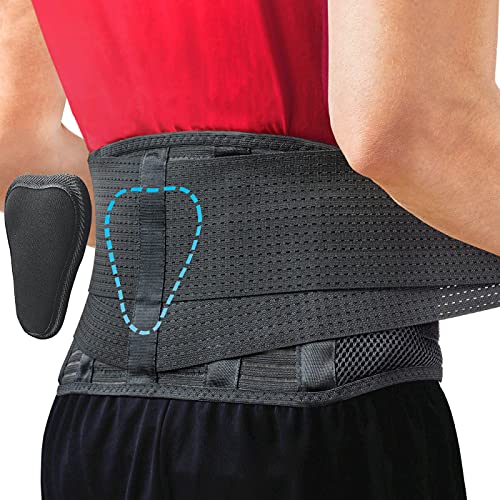
Built for the days you bend, lift, and shift — not for lounging on the couch.
Sparthos has been a fixture in lumbar braces for years, and it’s the pick for anyone whose job involves bending, hoisting, or long hours on their feet. It wraps the whole lower back with a removable lumbar pad for targeted compression and vertical support stays that keep the brace from rolling. The breathable fabric keeps it wearable under a shirt. At 9.53 x 2.56 x 6.38 inches packed, it’s a packable brace, not a rigid shell.
The compression is the star here. What wins people over is how firmly the pad presses exactly where the ache sits, while the stays stay put through squats and lifts. Workers and lifters describe it as firm but not restrictive — you can still bend. The 3D mesh does a decent job in heat, and it’s thin enough that most shirts hide it. If you’ve worn flimsy braces that bunch up the moment you move, this is a real step up.
Two things to know. First, the sizing chart can run generous — buyers who wear an XXL elsewhere have found they need an XXL regardless of what the chart suggests. Second, it warms up on long walks and limits deep bending a little. That’s the trade-off for real vertical support.
The standout: the removable lumbar pad plus vertical stays give genuine compression without the brace sliding around.
Honest limit: it traps heat during extended wear and discourages deep bending — fine on the job, less fun on a long walk.
Best for: warehouse shifts, lifting work, and anyone whose sciatica flares with bending.
Not for: low SI-joint pain that needs hip-level compression — grab an SI belt for that.
4. Apecore Sacroiliac SI Hip Belt
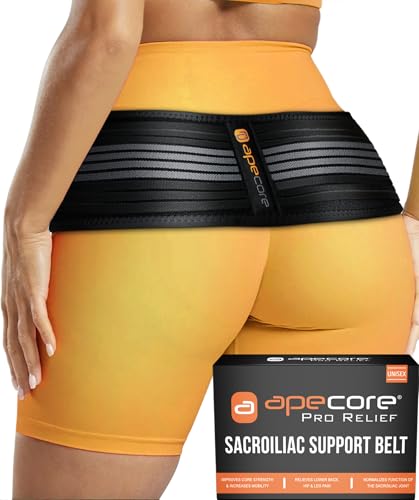
An SI belt that goes up to a 56-inch hip — and stays put doing it.
The Apecore solves the problem that sinks a lot of SI belts: range. The XL-XXL fits hips from 47 to 56 inches, and the regular covers 32 to 47 inches, so more body sizes land in a real fit. It’s a unisex design worn under or over clothes, with an anti-slip surface that stops it riding up your hips during the day. The neoprene band plus twin elastic tension straps let you fine-tune how tight it presses across the sacrum.
What people keep coming back to is how well it stays in place — the anti-slip material doing its job through walking, resting, and outdoor work. The strong hook-and-loop closures hold firm and are easy to peel apart with the tabs. It’s comfortable enough to forget you’re wearing it, and effective enough for the joint pain that makes walking miserable. For lifting and walking as prevention, it earned its keep for many buyers.
The one thing to get right is sizing — measure your hips, not your waist, and allow roughly an inch of adjustment room. The rubberized mesh runs warm in hot weather, so you’ll feel it after a long stretch outside. And if worn over clothes, you’ll need to remove it for restroom breaks.
Why it earns its spot: genuine plus-size coverage, anti-slip grip, and strong closures that don’t budge.
The trade-off: the neoprene and rubberized mesh hold heat, and over-clothes wear means taking it off for the restroom.
Choose it if: you need an SI belt sized for wider hips that won’t slide around.
Consider another if: you run hot or want something for all-day summer wear — a breathable mesh belt handles heat better.
5. NEENCA Back Brace for Lower Back Pain
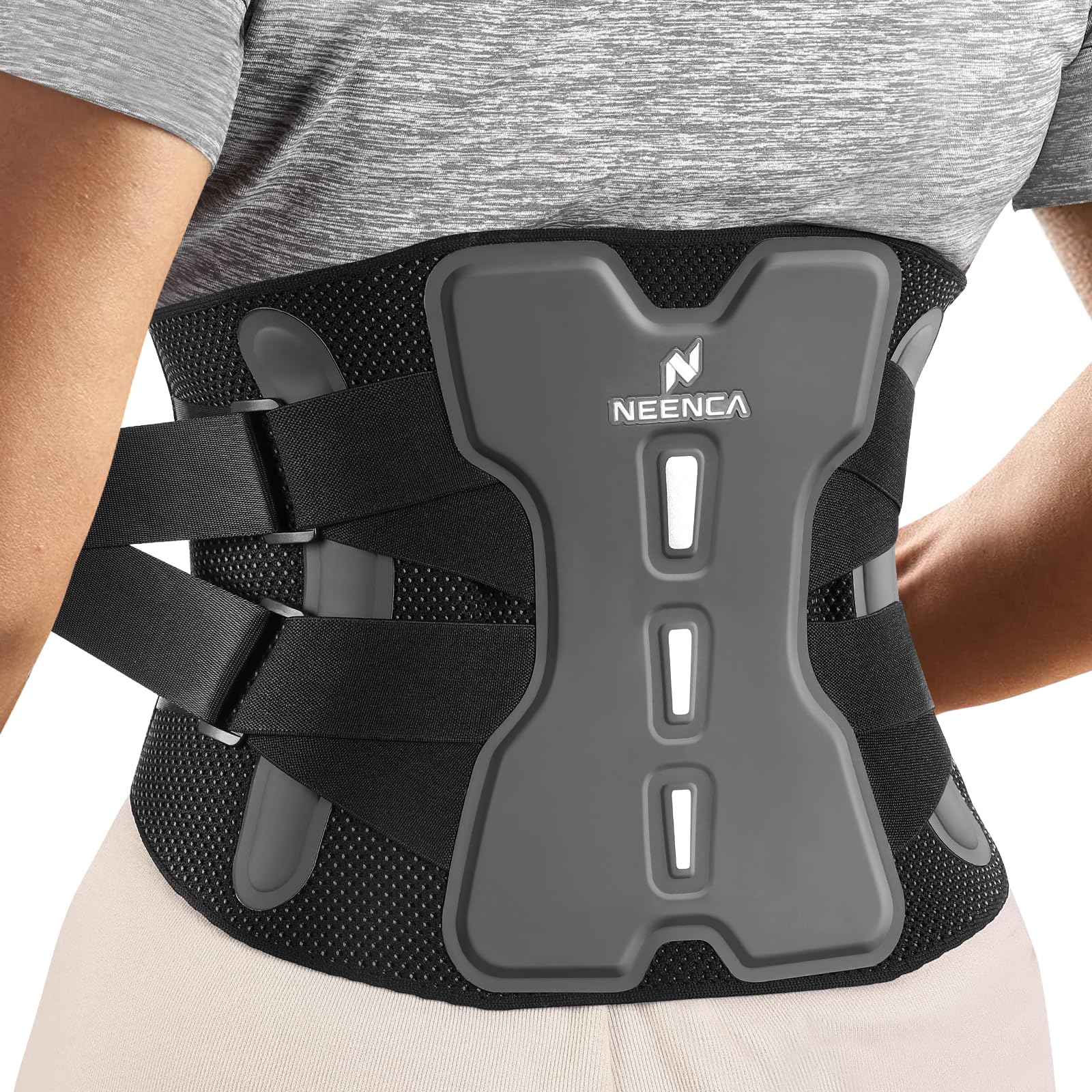
The brace for anyone whose spine curves — because each side tightens on its own.
Most back braces assume a symmetrical spine. The NEENCA doesn’t. It uses a bionic support system — two bionic bone lumbar panels, two memory-aluminum stays, and two flexible springs — wrapped in a soft 3D knit bandage. The result is firm support that still lets you move. The 16-hole air mesh keeps air flowing, and the velvet inner layer is gentle against skin. Sizing runs waist-at-navel from a Small at 25.9 to 30.7 inches up to an XX-Large at 51.2 to 65 inches.
The features that matter are the independent side adjustments. Owners with pronounced lumbar curves report walking and standing without the usual ache once the brace is set right. It’s not bulky, it allows flexibility, and most shirts cover it. The pulley system makes it easy to put on solo.
Watch the fit. The brace can ride up during movement, which lessens the support until you re-adjust it. And a few owners with specific disc issues found the rigid supports didn’t perfectly follow the natural contour of the spine. That’s a shape mismatch, not a defect — it’s worth trying a session before committing to a full day.
Where it shines: the independent side straps and memory-metal stays give targeted support for curved or uneven spines.
What to watch: it can creep upward during activity, and the rigid panels won’t suit every spine contour.
Built for: scoliosis, asymmetric lumbar pain, and anyone who needs one-sided tightening.
skip it if: you want a soft, flexible belt with no rigid panels.
6. FEATOL Back Brace for Lower Back
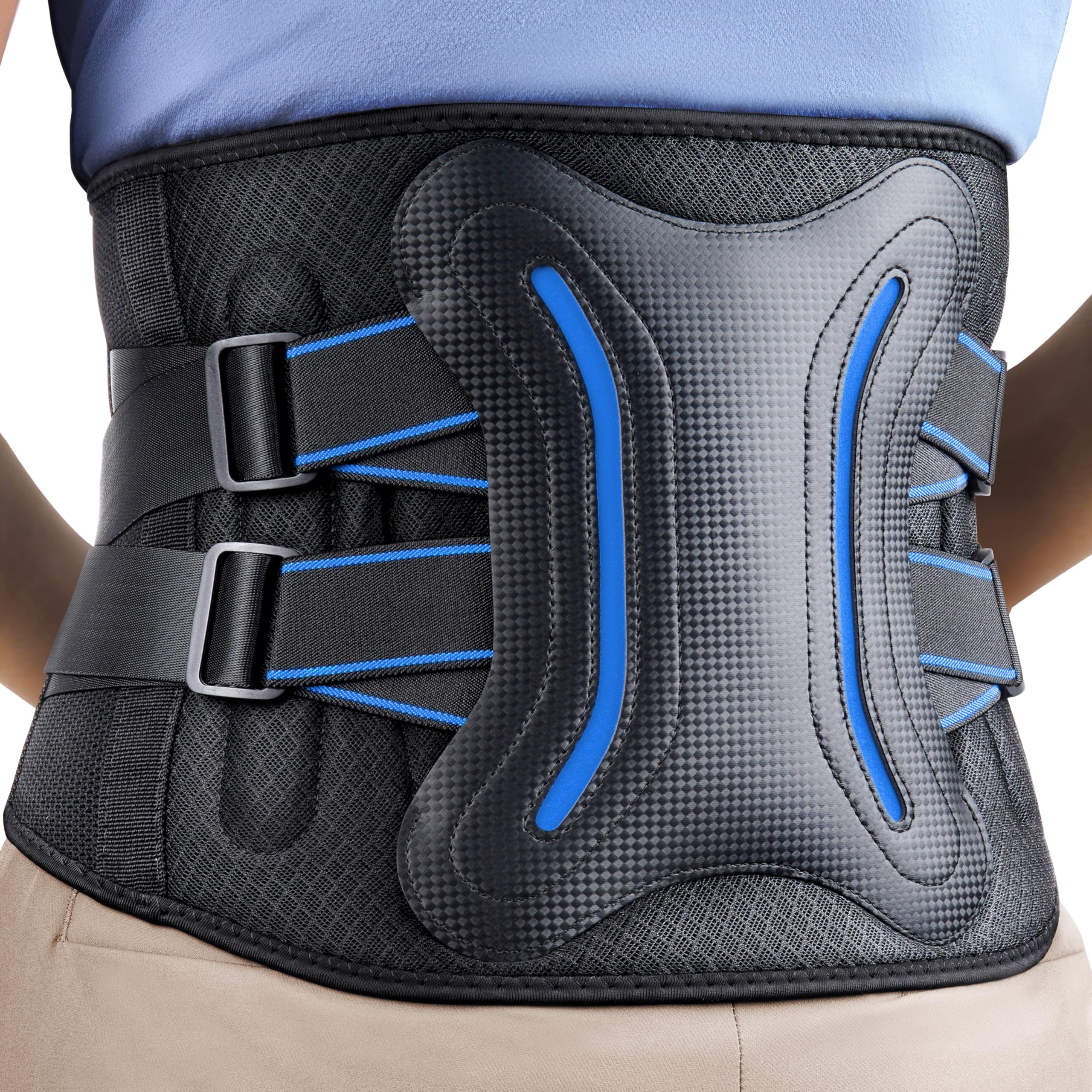
Rigid support that stays put through a full moving day — and hides under a shirt.
The FEATOL’s five stays — three memory-aluminum and two support plates — deliver 360° stability to the lumbar region. The low-profile, soft elastic build hugs your lower back like a second skin, and finger loops make it quick to pull on. It runs from a Small at 25.6 to 27.5 inches all the way to a 5XL at 57.6 to 65 inches, measured at the navel. For all-day wear under normal clothes, that combination is hard to match.
Beyond the stays, the dual-tension straps let you dial in snugness for a walk versus a heavy lift. The lateral stays keep the brace from rolling or bunching when you sit. Breathable mesh vents heat so it doesn’t turn swampy after an hour. People moving house, doing yard work, or handling a desk-and-recliner routine that made their back worse found the end-of-day ache eased when they wore it fully tightened. Heavy-duty Velcro holds up over time.
Two honest points. It’s bulky under tight clothing, so it works best under something loose. And it isn’t washable, which means you’ll want to air it out between uses. A few buyers also found it ran slightly large, so measure at the navel and check the chart before ordering.
The clincher: five stays plus dual-tension straps give stability that survives sitting, lifting, and walking without rolling up.
The catch: it’s bulky under tight clothes, and it can’t go in the wash.
Go with it if: you want one brace to cover work, chores, and daily activity without re-adjusting constantly.
Pass if: you need something near-invisible under slim clothing or washable for daily sweat.
7. MAXAR Bio-Magnetic Back Brace
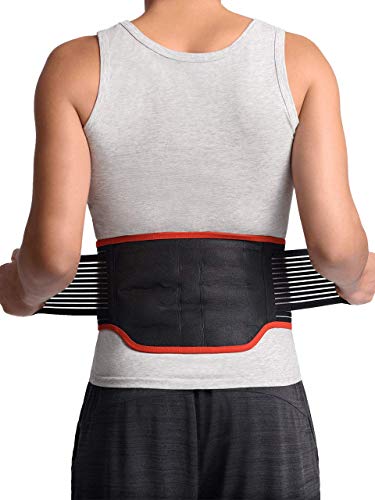
A lumbar brace built around warmth and magnets rather than straps and springs.
The MAXAR takes a different approach: 25 magnets in the back and 6 in the front, plus a Cera heat material that holds your body heat against the lower back. Two adjustable double-pull hook-and-loop closures tighten the band for compression. It’s a polyester, nylon, rayon, and spandex blend, and there’s a back pocket for a hot or cold gel pack. If your pain eases with warmth and light compression, this suits that need.
Feedback on the magnets is consistent: owners describe the back warming up, the magnets sitting correctly in place, and stiffness easing through the day. The extra waist-tightening strap reaches the low back, which owners call a plus. One buyer found relief wrapping it around a swollen, twisted knee after a fall. For recovery-phase pain rather than a peak flare, it stays comfortable through a stretch of the day.
On a full-blown acute flare, this brace gives less relief than it does as the pain starts to settle. Sizing is also the weak point — several buyers found it ran small, and one had to size down because their size wasn’t available. Check the chart carefully and consider ordering one size up if you’re between sizes.
The selling point: body-heat retention plus 34 magnets make it a warm, comfortable brace for recovery days.
The honest limit: it’s a support for easing pain, not a peak-flare fix, and it tends to run small.
Fits you if: warmth and light compression help your back, and you want a brace for recovery rather than acute pain.
Look elsewhere if: you’re mid-flare and need maximum rigid support, or you’ve had trouble with small sizing before.
Know the Specs
Hip Circumference vs Waist Measurement
SI belts are sized by the distance around the widest part of your hips, measured around your rear, not your belly. Lumbar braces are sized by waist, measured at the navel. This single difference decides whether a belt sits on the sacrum or slides up onto your stomach. Always measure both before ordering an SI belt, and follow the chart’s specific instruction rather than your pants size.
Stays, Pads, and Compression Straps
Vertical stays are firm strips set into a brace to keep it from rolling. Memory-aluminum and spring stays bend to your shape; plastic stays are stiffer. A lumbar pad adds focused pressure at the point of pain. Double-pull or twin tension straps let you tighten one side more than the other, which helps uneven pain or a curved spine. More stays means more rigid support, less flexibility, and often more bulk.
Mesh vs Neoprene
Breathable mesh moves air and suits long wear in warm conditions. Neoprene is denser and grips the skin, which helps an SI belt hold its place but traps heat. If you run hot or wear a brace for hours, mesh is the kinder choice. If slip-resistance matters more than cooling, neoprene does the job.
TENS vs Compression
A TENS unit sends a mild electrical current through electrode pads to interrupt pain signals; it doesn’t support or stabilize anything. A belt compresses and limits motion to calm an irritated joint. They treat different mechanisms, and some people use both — a TENS session for nerve pain, a belt for activity. Neither replaces a clinician’s diagnosis of what’s causing your sciatica.
Common Questions
Should a sciatica belt sit at my waist or on my hips?
How do I measure for an SI belt?
Will a TENS unit work if a belt hasn’t helped?
How long should I wear a back brace each day?
Can I wear a sciatica belt under my clothes?
Is a lumbar pad worth having?
Are magnetic belts proven to relieve sciatica?
What’s the difference between a back brace and an SI belt?
Can I wear a sciatica belt to bed?
Do I need to replace a belt or brace over time?
The Bottom Line
If shooting nerve pain runs down your leg, the belt for sciatica pain most buyers land on is the TENS 7000. It is a 4.5+ star device with 112,000+ ratings, and it works on nerve pain in a way a compression strap cannot. If your pain starts in the hips, the BLITZU SI Joint Belt gives you low, targeted compression right where it starts. For lifting days or long shifts, the FEATOL Back Brace adds firm lumbar stability so you keep moving. Whichever you pick, measure before you order — the right size is what turns a good belt into a working one.
How we choose
We do not accept paid placement. Every pick is matched to a real buyer and a real use-case; we do not hands-on test units.
Sources
Specifications: manufacturer listings and product documentation. Review insights: verified customer reviews, as of October 2026. Pricing: not shown on this page (it changes often); check the current price via the retailer link.
As an Amazon Associate, Aappliancez earns from qualifying purchases. This does not affect which products we feature.