Disclosure: Some links in this post are affiliate links. As an Amazon Associate I earn from qualifying purchases, at no extra cost to you. Learn more
Specs are compiled from manufacturer listings and verified buyer reviews and can change over time — please confirm the key details on the product page before buying.
If you are buying a hernia belt, the one thing that matters is whether the pad sits exactly over your hernia and stays there while you stand, bend, or walk — a belt that slides is worse than no belt at all. So the short answer: the DOREIPA Abdominal Binder is the strongest all-round pick here, and the BLITZU Inguinal Truss is the better call if your hernia is in the groin rather than the belly. Everything below is sorted by where the hernia actually is, because that single detail decides which of these seven you should own.
This guide is built by comparing the manufacturers’ published specifications and the patterns across verified customer reviews, so you get each pick’s real strengths and trade-offs instead of marketing spin.
Hernia belts live or die on two things: pad placement and a closure that holds its grip. Below you will find the specs that matter, the fit notes buyers learn the hard way, and a clear pick for each hernia type — the honest shortlist behind any real search for the belt for hernia.
Top Picks
How To Choose The Best Belt for Hernia
A hernia belt is a support garment, not a cure. What it does is press gently on the spot where tissue pushes through, so the bulge stays put and the ache eases while you work, walk, or wait for surgery. Pick the wrong shape and you get a stiff band that rides up your ribs or a pad that drifts off the hernia by lunchtime.
Match the belt shape to where your hernia is
An umbilical or belly-button hernia needs a wide abdominal wrap with a raised pad sitting dead centre over the navel. A groin (inguinal) hernia needs a narrow truss with a small pad low on one side, plus a leg strap to keep it from sliding. If you have a hernia on both sides, look for a belt that ships with two pads, like the BLITZU Bilateral. Buying a belly wrap for a groin hernia is the most common mismatch out there.
Measure around your hips, not your waist
Nearly every sizing chart on these belts is built on hip circumference — the measurement around the widest part of your hips, below the waistband. Belly wraps are usually sized by the torso instead. If you land between two sizes, the safe move is the larger one for comfort or the smaller one for firmer compression. Getting this number wrong is the single biggest reason a belt goes back in the box.
Check the closure before anything else
Almost every belt here uses a hook-and-loop closure — the Velcro-style grip that lets you set the tightness anywhere along the strap. A strong closure holds firm and lets you loosen the belt when you sit down and tighten it when you stand. A weak one lets the belt creep. Where the strap overlaps matters too: a wide overlap spreads the load and keeps the edge from digging in.
Decide how discreet it needs to be
If you wear the belt under a shirt at work, thickness and profile decide whether you can live with it. The slimmest options here are the BLITZU truss at 0.25 inches thick and the FlexaMed at 0.13 inches, both of which tuck under trousers. Wide abdominal wraps hide less well but support more of the torso. Choose thickness by what you wear over it, then pick the pad shape.
Side-by-Side Comparison
| Model | Best For | Hernia Type | Size / Fit Basis | Notable Spec | Amazon |
|---|---|---|---|---|---|
| DOREIPA Abdominal Binder★ Best Overall | All-day abdominal and lower-back support | Abdominal, post-surgery, postpartum | X-Large | Bamboo charcoal fibre, hook & loop | Amazon |
| BLITZU Inguinal Hernia BeltBest for Groin Hernias | One-sided groin hernia, left or right | Inguinal, femoral | S/M hips 33.5–45 in; L/XL 45.5–56 in | 0.25 in thick, removable pad | Amazon |
| Fitomo Umbilical Hernia Belt | Belly-button hernia with a raised pad | Umbilical, doubles as lumbar support | L/XL | 3D dome pad, removable | Amazon |
| BLITZU Bilateral Hernia Belt | Hernias on both sides | Inguinal, femoral, umbilical, incisional | Small/Medium | Two removable compression pads | Amazon |
| Velpeau Umbilical Hernia Belt | Breathable wear against bare skin | Umbilical, navel, ventral, epigastric | L | Ventilated polyether pad, no latex | Amazon |
| Armstrong America Plus Size Binder | Larger torsos and postpartum recovery | Umbilical, inguinal, incisional | XXXL (measure torso, not waist) | 9 ½ inches wide | Amazon |
| FlexaMed Right Inguinal Truss | Right-side inguinal hernia, trim fit | Reducible inguinal | Medium, hips 32–36 in | 0.13 in thick, over-the-brief style | Amazon |
Detailed Reviews
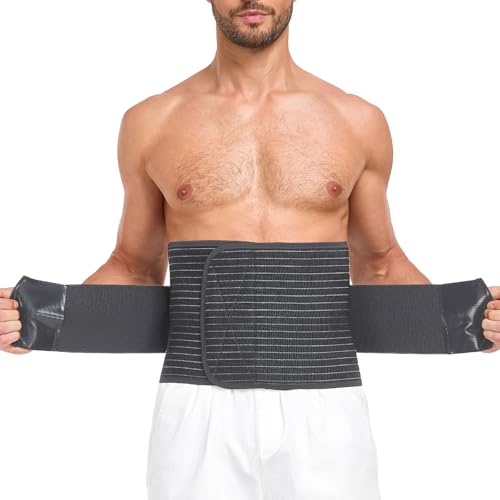
1. Abdominal Binder
Our pick — 4.0+★ from 500+ verified ratings; the strongest balance of quality and price.
The wrap that holds its shape through a full day without riding up or curling.
This is a wide abdominal binder, not a groin truss, and it is the best all-rounder here for anyone with a belly-button or post-surgical hernia. The material is a polyester made with bamboo charcoal fibre — a soft knit woven with charcoal-treated yarn, worn directly against the skin. At 0.4 kg it has enough body to stay flat against your torso instead of bunching. The closure is hook-and-loop, so you set the compression where you want it and reset it when you go from sitting to standing.
What wins people over is the hold. Owners describe a strong hook-and-loop strip that runs all the way to the edge of the band, which gives you a flat, smooth seal instead of a stiff tab poking into your ribs. The wide panel keeps the core muscles steady and does not roll down under a shirt. The wide panel also braces the lower back, which helps on long shifts standing. One buyer with an umbilical hernia put it plainly: “I have an umbilical hernia.. this binder offers great support both on the abdominal and lower back.”
The catch is heat. The fabric is described by owners as not especially breathable, so it runs warm in summer and you will notice it under heavy clothing. It is also hand-wash only, and the stiffness that keeps it from rolling is the same stiffness that makes it feel firm rather than soft. If you want a gentle, stretchy band, this is not that belt — it is the one that stays put.
Why it takes the top spot
- Hook-and-loop grip reaches the edge for a flat, secure seal that resists rolling
- Wide panel steadies the abdomen and adds genuine lower-back support
- Thin enough to wear under clothing without a visible ridge
- Sizing is generous — an X-Large wraps most adult torsos
Where it asks something of you
- Warm to wear in hot weather — the fabric is not built for breathability
- Hand wash only, so it needs a little care routine
- Firmer feel than a soft elastic band; not for anyone wanting stretch
Reach for this if: your hernia is at the belly button or you are recovering from abdominal surgery and want steady, flat compression.
Look elsewhere if: your hernia sits in the groin — you need a truss with a low pad and a leg strap, not a wide wrap.
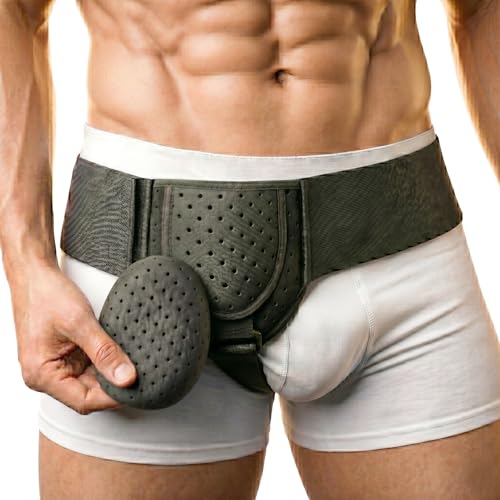
2. Inguinal Hernia Belt
A groin truss slim enough to vanish under jeans and steady enough to work in.
For a one-sided inguinal hernia, this is the belt to beat. It measures 0.25 inches thick — a low-profile truss that slips under trousers and stays there. The pad is removable and sits inside the belt, so you position it over the hernia and the wide strap spreads the load across your hip instead of pinching one spot. It works on the left or right side, and the groin loop comes off if you prefer without it.
The sizing is where most people get this right or wrong. It is measured around the hips, not the waist: size S/M covers 33.5–45 inches and L/XL covers 45.5–56 inches. A 60-year-old buyer at 5’9″, 210 lb and a 37–38 inch waist reported the small fitting “with room to spare” — a useful reminder to measure honestly and not default to the bigger size. The cotton-spandex blend plus anti-slip silicone strips keeps the belt anchored through movement, and it can go in the machine on wash day.
Trade-off time. The compression has to be firm to do its job, and that firmness is what some buyers find uncomfortable after a long stretch in it. The belt helps, but it will not fully reduce a hernia — it manages the bulge while you get on with your day. It works best as a bridge before or after surgery, not as a replacement for seeing someone about the hernia itself.
Where it earns its place: the wide strap and silicone grip keep the pad on the hernia through bending and lifting, and the low profile means you forget you have it on under clothing. It is the closest thing here to a belt you can genuinely wear to work.
The honest caveat: it is a support garment, so it eases the bulge rather than removing it, and firm pressure is the price of it staying put.
The right call for: a single groin hernia you need to get through the working day with, before or after surgery.
Not the one for: a belly-button hernia — the pad is shaped for the groin, not the navel.
3. Umbilical Hernia Belt L/XL

The raised dome pad that keeps pressure exactly where the bulge is.
Most hernia pads are flat. This one is a 3D dome — a raised centre that presses into the hernia spot like a fingertip rather than a flat palm. For an umbilical hernia, that shape is the whole point: the pad sits over the navel and keeps contact through bending and twisting, and it comes out entirely if you want to wear the belt as plain lumbar support. The strap tightens with a hook-and-loop pressurised band that holds its elasticity over time.
Comfort is the headline here, and it is consistency over months rather than a first-impression delight. The smooth nylon sits quietly against the skin, and owners who wear it all day for lifting and bending report it does not poke or curl up at the edges. It is also the belt that gets bought twice — people who wear it daily tend to pick up a backup. Repeat buyers are the clearest sign the dome pad stays on the navel through daily wear.
The fit note deserves its own sentence. The waistband runs generous, but plenty of buyers find it comes up small against the stated size, and the hook-and-loop can creep during heavy movement. If you are near the top of the L/XL range, measure carefully — or look at the Velpeau, which shares the dome-pad idea with a slimmer footprint.
What the dome pad does for you
- Raised centre keeps pressure on the hernia rather than sliding off it
- Pad is removable so the belt doubles as lumbar support
- Front-wearing design makes it easy to put on after surgery
- Holds up to daily washing — one buyer machine washed and hang dried it daily for two months and it held shape
Fit notes to heed before you order
- Runs small against the stated size for some torsos
- The hook-and-loop can shift under hard movement, so check the fit before you trust it
- Back panel can fold on a very full torso, reducing support
Suits you if: you want a belly-button hernia supported by a raised pad and a belt you can also wear as a back brace.
Think twice if: you sit near the very top of the L/XL range — the sizing leans snug, and you may need a larger wrap.
4. Bilateral Hernia Belt
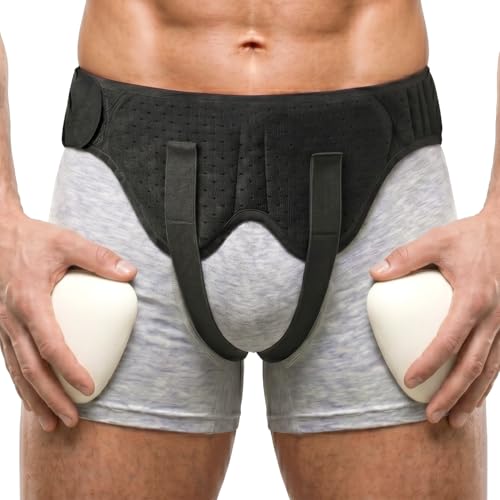
Two pads, two sides — the belt for a hernia that refuses to pick a corner.
Hernias on both sides are awkward: a single-pad truss covers one and leaves the other unsupported. This BLITZU ships with two removable compression pads, so you cover one side or both depending on the day. It is built from neoprene — a spongy, stretchy synthetic rubber — with a breathable cover, and it is designed to sit under clothing without a visible ridge. The sport list spells out who it is aimed at: golf, running, tennis, walking, weightlifting.
Effectiveness is what this belt is bought for, and it delivers. Buyers report the two pads holding both groin hernias steady through a full shift, with the hook-and-loop strap keeping tension where they set it. One buyer who was still deciding whether to go ahead with surgery summed up the practical case: it provides “bilateral hernia support and stability, easing discomfort” while they worked. The Small/Medium size caught out buyers who assumed the bigger size by default, so measure first.
The honest trade-off is lifespan. The elastic in this belt does not last as long as the shell, and with heavy daily wear you will see the stretch go before anything else fails. It is a belt you replace, not one you hand down. If durability outranks price for you, the FlexaMed below is built from a heavier elastic weave.
On balance: the two-pad design is the reason to pick this one — no other belt here lets you back both sides at once. It is the practical answer for a bilateraling hernia before or after surgery.
The catch worth knowing: the elastic has a finite life under daily wear, so budget for a replacement if you live in it.
Pick it for: hernias on both sides, or anyone who wants the option to move a pad to whichever side is flaring today.
skip it if: you need one belt to last years of hard daily wear — the elastic is the part that gives out first.
5. Velpeau Umbilical Hernia Belt L
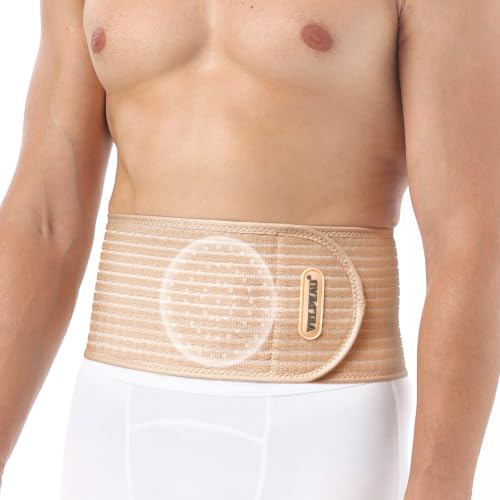
The breathable one — mesh fabric and a vented pad for skin that overheats.
If heat is what stops you wearing a belt, start here. The Velpeau is built from breathable mesh fabric with elongated strips that let air move, so sweat does not pool under the band. The pad is a lightweight polyether — a soft medical-style polymer — with ventilation holes punched through it. The whole thing is made without neoprene or latex, which matters if your skin reacts to either. It comes in khaki, so it stays hidden under light clothing better than black.
The belt is a genuine multi-tasker: it works as an abdominal binder, a belly wrap, and a post-surgery support, and it wears directly against the skin without chafing. It holds its shape and elasticity over time, and the open structure makes it quick to put on and adjust. That is why it turns up as the pick for anyone who needs all-day wear, including during pregnancy. Size up if you are between sizes — the L is the largest listed and it runs close.
The friction point is the closure. The hook-and-loop is described as scratchy at the edge when the pad is off, and a small number of buyers find the belt does not run long enough for a fuller waist. It is also hand wash only. Those are small prices for the airflow, but they are real if you have sensitive skin or a larger frame.
Where it shines: airflow. Mesh fabric plus a perforated pad means you can wear it through a warm day without the clammy build-up that stops people using stiffer belts.
What to watch: the scratchy closure edge and a length that can run short on a bigger waist — both fixable with a tissue or a size check, but worth knowing before you order.
For you if: you overheat easily, have sensitive skin, or need a belly-button belt you can wear all day in warm weather.
Elsewhere if: you have a wide torso — measure the length carefully, since the L runs close and there is no XL listed.
6. Plus Size Hernia Belt XXXL

A nine-and-a-half-inch wrap built for torsos the standard belts miss.
Size is the reason this belt exists. At 9 ½ inches wide, it covers far more of the abdomen than the narrower wraps, and it comes in XXXL with four sizes across the range. That width matters for a full torso: more panel means more support spread across the belly instead of a thin band biting in. The removable pressure pad and adjustable tightening straps let you put compression exactly over an umbilical, inguinal, or incisional hernia, and it works as a postpartum binder too.
The measurement instruction is the most important line on the page. Measure around your torso, not your waist — the two numbers can be several inches apart on a larger frame, and the wrong one puts you in a belt that does not fit. Buyers with fuller builds report it is roomy enough not to dig in, and the nylon blend holds up to hand washing. The 9 ½ inch panel stays comfortable through a full day on a larger torso.
Rolling is the known wobble. The top edge can curl after a while, particularly on a very round abdomen, and it is more likely under a loose waistband than a firm one. It is a minor annoyance rather than a failure, and a firm belt underneath keeps it flatter. If rolling is your main worry, the DOREIPA above is the stiffer, flatter option.
Why larger frames pick this one
- The wide 9 ½ inch panel spreads compression instead of pinching
- Comes in XXXL with four sizes, measured by torso for a truer fit
- Removable pad lets you move the pressure spot
- Doubles as a postpartum or post-surgery abdominal binder
The compromises to weigh
- Top edge can roll on a full torso after extended wear
- Hand wash only, like most belts in this category
- Sizing depends on you measuring the torso, not the waist — get that wrong and it will not fit
Buy this if: you have a fuller torso and standard belts never run wide or long enough.
Only one caveat: expect the top edge to curl now and then — tuck it under a firm waistband and it behaves.
7. FlexaMed Right Inguinal Hernia Truss Medium
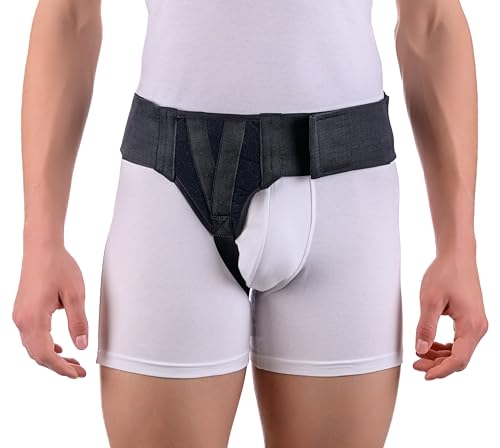
A 0.13-inch truss that tucks under a brief and disappears under a shirt.
This is the thinnest belt on the list at 0.13 inches — about the thickness of a few sheets of card stacked — and it is designed to wear over your underwear like a support brief. For a right-side reducible inguinal hernia, that low profile is the draw: it hides under clothing, wears comfortably for hours, and can stay on in the bath or the pool. Cottons and elastics in the blend make it breathable enough to wear all day, and the pad is removable so you can place the pressure precisely.
The fit measurement is worth reading twice. FlexaMed sizes by hip circumference, not waist: Medium covers 32–36 inches, Large 38–42, and the small 26–30. If you land between two sizes, go larger for comfort or smaller for firmer compression. Buyers who match the 32–36 inch hip range report walking and light exercise without the pad slipping. The leg strap is the part to set carefully — too tight and it chafes, so keep it snug rather than clamped.
Two small niggles turn up again and again. The black version is made from two layers of elastic rather than the single heavier layer on the white, so it can roll more readily and squeeze the hips on some frames. And the leg strap is sized for a large leg, so it can hang loose on a narrower thigh. It is still the most compact truss here — but order by your hips and size up if you are unsure.
Why it earns the slim-fit label: nothing else here disappears under clothing like it, and the over-the-brief design keeps the pad on the right spot with no awkward ring digging into your thigh.
The real limit: it is a right-side truss — if your hernia is on the left or on both sides, look to the BLITZU truss or bilateral belt instead.
The best match for: a right-side groin hernia and a life that involves suits, shorts, or swimwear rather than loose workwear.
Choose another belt if: your hernia is left-side or bilateral, or you have a narrow thigh that the leg strap will not grip.
Know the Specs
Pad Type and Placement
The pad is the part that actually does the work. A flat pad spreads pressure across a wide area; a raised 3D dome pad, like the one on the Fitomo, concentrates it on the hernia spot. Where the pad sits matters as much as its shape — an umbilical pad needs to be centred over the navel, while an inguinal pad sits low and to one side. A removable pad lets you reposition it as your body changes, which is why most belts here make it detachable.
Hip vs Torso Sizing
Inguinal trusses are measured around the hips, at the point of wear below the waistband — the BLITZU S/M covers 33.5–45 inches and the FlexaMed Medium covers 32–36 inches. Abdominal wraps are sized to the torso instead, and the Armstrong America explicitly asks you to measure the torso, not the waist. Get this wrong and the belt either will not close or will not stay put. When in doubt, size up for comfort and down for firmer compression.
Thickness and Discretion
A low-profile truss under trousers gets worn daily; a bulky wrap often stays in the drawer. Thickness is the clearest signal: the FlexaMed at 0.13 inches and the BLITZU truss at 0.25 inches both tuck away, while a wide 9 ½ inch abdominal wrap offers more support but a visible outline. Match the profile to where you need to wear it, not just to how much compression you want.
Closure and Breathability
Hook-and-loop closure is standard on every belt here, and it is what lets you adjust on the move. A strip that reaches the edge of the band lies flat and holds better than a short tab. Breathability is the other daily factor: mesh fabric and a ventilated pad, as on the Velpeau, move air and cut sweat, while a denser wrap runs warmer but holds firmer. Neither is universally better — it depends on whether you run hot or need maximum stability.
Common Questions
Can a hernia belt fix my hernia permanently?
Should I measure my waist or my hips for an inguinal hernia belt?
How do I know if I need an umbilical belt or an inguinal truss?
What is the difference between a flat pad and a 3D dome pad?
Can I wear a hernia belt all day and overnight?
How should I wash a hernia belt without ruining the closure?
Can I wear a hernia belt under a suit or jeans?
Will a hernia belt help if I have hernias on both sides?
Do these belts have latex or neoprene in them?
How long will a hernia belt hold its elasticity?
The Bottom Line
The best belt for hernia depends entirely on where your bulge sits — but if you want the safe default, the DOREIPA Abdominal Binder is the strongest all-rounder for a belly-button or post-surgical hernia. The hook-and-loop strip that runs to the edge and the wide panel that will not roll are why it holds the top spot. For a one-sided groin hernia, grab the BLITZU Inguinal Hernia Belt; the wide strap and silicone grip keep the pad on the hernia through a full day. And if you have hernias on both sides, the BLITZU Bilateral is the only belt here with two pads.
One last nudge: the belts here span a small, mid-size, and fuller-torso range, so measure before you buy and pick by the shape of your hernia, not by the biggest panel on the page. Match the belt to your hernia type and hip measurement, and it stays put under clothes all day.
How we choose
We do not accept paid placement. Every pick is matched to a real buyer and a real use-case; we do not hands-on test units.
Sources
Specifications: manufacturer listings and product documentation. Review insights: verified customer reviews, as of October 2026. Pricing: not shown on this page (it changes often); check the current price via the retailer link.
As an Amazon Associate, Aappliancez earns from qualifying purchases. This does not affect which products we feature.