Disclosure: Some links in this post are affiliate links. As an Amazon Associate I earn from qualifying purchases, at no extra cost to you. Learn more
Specs are compiled from manufacturer listings and verified buyer reviews and can change over time — please confirm the key details on the product page before buying.
If you fish from a belly boat, a float tube, or a one-man pontoon, the water right under your seat is a blind spot — and that is exactly where the fish hold. A castable fish finder fixes that by floating a sonar pod out on your line and streaming what is below straight to the phone already in your pocket. The short answer: the Garmin STRIKER Cast is the one to buy for most belly boat anglers, because it pairs instantly over Bluetooth, shows depth, water temperature, and fish targets in real time, and runs for a long day on its own rechargeable battery. Two things decide whether you will love yours or leave it in the truck — how it talks to your phone, and how deep it can actually read.
This guide is built by comparing the manufacturers’ published specifications and the patterns across verified customer reviews, so you get each pick’s real strengths and trade-offs instead of marketing spin.
Belly boat fishing means quiet water, light gear, and no room for a console-mounted screen. That is why castable sonar exists, and this guide breaks down which units earn their place on a float tube. Our picks range from a compact entry-level handheld to a GPS-mapping sonar ball, and each one is matched to a real way you fish. Read on for the belly boat fish finder that fits how you actually fish.
Top Picks


How To Choose The Best Belly Boat Fish Finder
Fishing from a belly boat has one rule that overrides everything else: you cannot mount a screen anywhere. No console, no dash, no rod holder worth bolting down. So the entire category solves one problem — getting sonar onto the water without drilling a hole in your gear. The three things that actually change your day are how deep the unit reads, how it connects to your phone, and how it stays alive long enough to matter.
Depth range: know your water before you buy
Read your lake’s depth chart before you spend anything. A shallow farm pond or a canal rarely runs past thirty feet, so a 147-foot reading ceiling is already more than you will ever need. Deep reservoirs and big natural lakes are a different story — if the bottom drops past 147 feet, you need a unit rated for 330 feet or the screen just reads off the chart at the worst moment.
App sonar or standalone screen
Phone-app units stream everything to a display you already own, which keeps the gear in your hands to a single floating pod and a tether. Standalone handhelds carry their own 2.4-inch screen, so they work when your phone is dead, wet, or zipped in a dry bag. Pick based on whether you trust your phone battery more than a spare device.
Battery and connection: what ends the trip early
Two failures cut float-tube sessions short — a sonar ball that dies mid-drift and a signal that drops the moment you cast past the receiver’s comfort zone. Look for a stated runtime in hours and a connection type (Bluetooth or Wi-Fi) that pairs quickly, then check whether the unit sleeps when it leaves the water so it is not draining while you paddle back.
Side-by-Side Comparison
| Model | Best For | Max Depth | Weight | Connection | Amazon |
|---|---|---|---|---|---|
| Garmin STRIKER Cast★ Best Overall | Most belly boat anglers | — | 75 g | Bluetooth to phone app | Amazon |
| Deeper MAXDeepest Reader | Deep water and mapping | 330 feet | 3.2 ounces | Wi-Fi to Fish Deeper app | Amazon |
| DANOPLUS DP-104 | Budget paddle-and-scan | 147 feet | 5.28 ounces | Wireless to handheld screen | Amazon |
| LUCKY FF-1108-1CWLA | Shore-and-boat versatility | 147 feet | 5.28 ounces | Wireless, 492 ft range | Amazon |
| LUCKY Y2020-CWLA | Longest battery and range | 147 feet | 0.3 kg | Wireless, 656 ft range | Amazon |
Detailed Reviews
1. Garmin STRIKER Cast, Castable Sonar
Our pick — 4.0+★ from 500+ verified ratings; the strongest balance of quality and price.
The pod that pairs over Bluetooth the second it hits the water.
Cast it out, tie it on, and your phone becomes the screen. The Garmin STRIKER Cast is a castable sonar pod that streams to the free STRIKER Cast app on an Apple or Android phone, so you are not strapping anything to the frame of your float tube. Setup is genuinely fast: download the app, pair your device, start fishing.
What wins people over is reliability. Seasoned owners consistently report the depth and water temperature readings stay steady and believable, and the thing survives being dragged across a lake attached to a line. You get traditional 2-D sonar plus an ice fishing flasher mode, streaming from up to 200 feet away, and the internal battery is rated at 10+ hours on a USB charge. Weighing 75 g and measuring 6″L x 2.1″W x 3″H, it is a palm-sized pod you can tuck in the included bag. That footprint is also why it is a genuinely different animal from the Deeper MAX, which is a chunkier 4″L x 4″W x 4″H pod — the STRIKER Cast is the smaller, simpler shape to slide into a float tube pouch.
Here is the catch worth knowing before you buy. The pod powers on when it floats and shuts off when you lift it out, which stretches the battery but means your data stops the moment you net it. Connectivity is the other honest limit — owners describe a clean signal until the receiver drifts too far, so a wide cast on open water can go quiet. Clearwater sensitivity is the recurring gripe: it can paint soft-mud bottom structure as fish-like marks, so read the arches rather than trusting a single symbol. None of that makes it a bad unit; it makes it a unit for people who want quick, cheap, phone-based sonar and know how to read a screen.
What earns it first place
- Instant Bluetooth pairing to a free Apple or Android app — no console, no wiring, no mount
- 10+ hours on the internal USB-rechargeable battery, and it self-manages by sleeping out of water
- Reliable depth and water temperature readings plus both 2-D and ice flasher sonar modes
- Rated to stream up to 200 feet away, and Quickdraw map downloads add up to 1′ contour detail
Where it asks for patience
- Signal fades if the pod drifts too far from your phone, so a long cast can cut the feed
- In clear water over soft mud it can flag structure as fish — read the display rather than trusting every icon
- Basic graphics with no bite indication, and the charging connector is a proprietary one
Fits you if: you fish from a float tube or one-man pontoon and want sonar running off the phone already in your pocket within minutes of arriving.
Pass on it if: you fish deep reservoirs that drop past your unit’s rated depth, or you need GPS mapping baked into the sonar pod itself.
2. Deeper MAX Castable GPS Fish Finder
Built for the angler who wants 330-foot scans and personal 3-D bottom maps.
If your home water is deep, this is the deepest-reading castable unit on the shortlist by a wide margin. The Deeper MAX scans to 330 feet, while the DANOPLUS DP-104 and both LUCKY units stop at 147 feet — more than double the reach for the lakes where the bottom falls away. It pairs with the free Fish Deeper app on Android or iOS, and it carries a real GPS with a range of up to 400 feet plus a 2-year warranty.
Where it changes your fishing is mapping. The MAX builds personal 3-D depth maps of the bottom, so you are not guessing where the drop-off sits — you are looking at last trip’s picture of it. Functionality is what carries this unit with the people who own it; the map-and-log workflow is the reason they keep it. For a belly boat specifically, that means you can paddle out blind, cast, and come back with a contour record to fish again tomorrow. It also arrives with a neoprene pouch, night cover, attachment bolts, and a charging cable.
The honest trade-off is connection speed. Buyers report the MAX can take a long time to link over Wi-Fi, and quite a few compare it unfavorably to the Garmin STRIKER Cast, which pairs nearly instantly over Bluetooth. Mapping has a limitation too: at least one owner found the map only refreshes when the pod leaves the water, which is awkward if you are towing it behind a bait boat. The deeper scan and the 3-D mapping are the reasons to choose it — the pairing wait is the price.
The case for it: 330 feet of scan depth and a GPS accurate enough for personal 3-D mapping put it in a class the shallower castables cannot reach. If deep structure is where your fish live, this is the tool.
Know before you cast: Wi-Fi pairing is slow compared with the Bluetooth-based Garmin, and the live map updates only once the pod is back on land.
Reach for this if: the water under your float tube drops well past 147 feet and you want to build bottom maps you can fish again next weekend.
Look elsewhere if: you want to be scanning within seconds of hitting the water and you fish shallow, structure-light water where 330 feet of range is wasted.
3. DANOPLUS Portable Fish Finder DP-104

The entry ticket into sonar with its own 2.4-inch color screen instead of your phone.
Not everyone wants their smartphone hanging over open water. The DANOPLUS DP-104 hands you a self-contained kit — a handheld with a 2.4-inch color LCD screen and a wireless sonar sensor you cast out on a line. The sensor reads to 147 feet and covers a 90-degree detection angle, so it sweeps a wide cone beneath the pod rather than a narrow pencil beam.
For a float tube, the screen detail is the selling point at this level. You get fish size icons shown with depth, water temperature, water depth, bottom contour, and the water surface reading, with 21 operating languages and a fish alarm that sounds when something moves through the sensor’s coverage. The sensor and its lamp turn on automatically the moment they touch water, which attracts fish and means one less switch to fumble with while you are balancing in a float tube. The whole handheld measures 4.92″L x 2.87″W x 0.98″H and tips the scale at 5.28 ounces.
Reliability is what carries this unit with the people who run it, and it is repeatedly called out as good value for the money. The charging cable is the small drama — it uses a proprietary magnetic connector rather than USB-C, and losing it renders the unit useless. Owners are blunt about guarding that cable above everything else in the kit. The thin antenna is another gentle-handling item; it works fine unraised and holds its connection, but it is not built to be crushed in a gear bag.
Why it earns a spot: a 2.4-inch color screen with fish size, depth, temperature, and bottom contour, plus a 90-degree beam and a 147-foot reading ceiling, in one handheld package.
Handle with care: the magnetic charging cable is proprietary, and one lost connector sidelines the entire finder.
Best for: bank and float-tube anglers on a tight budget who want their own screen and do not want to drain their phone battery on the water.
Think twice if: you refuse to keep track of a proprietary charging cable, or you regularly fish water deeper than 147 feet.
4. LUCKY Portable Fish Finder FF-1108-1CWLA
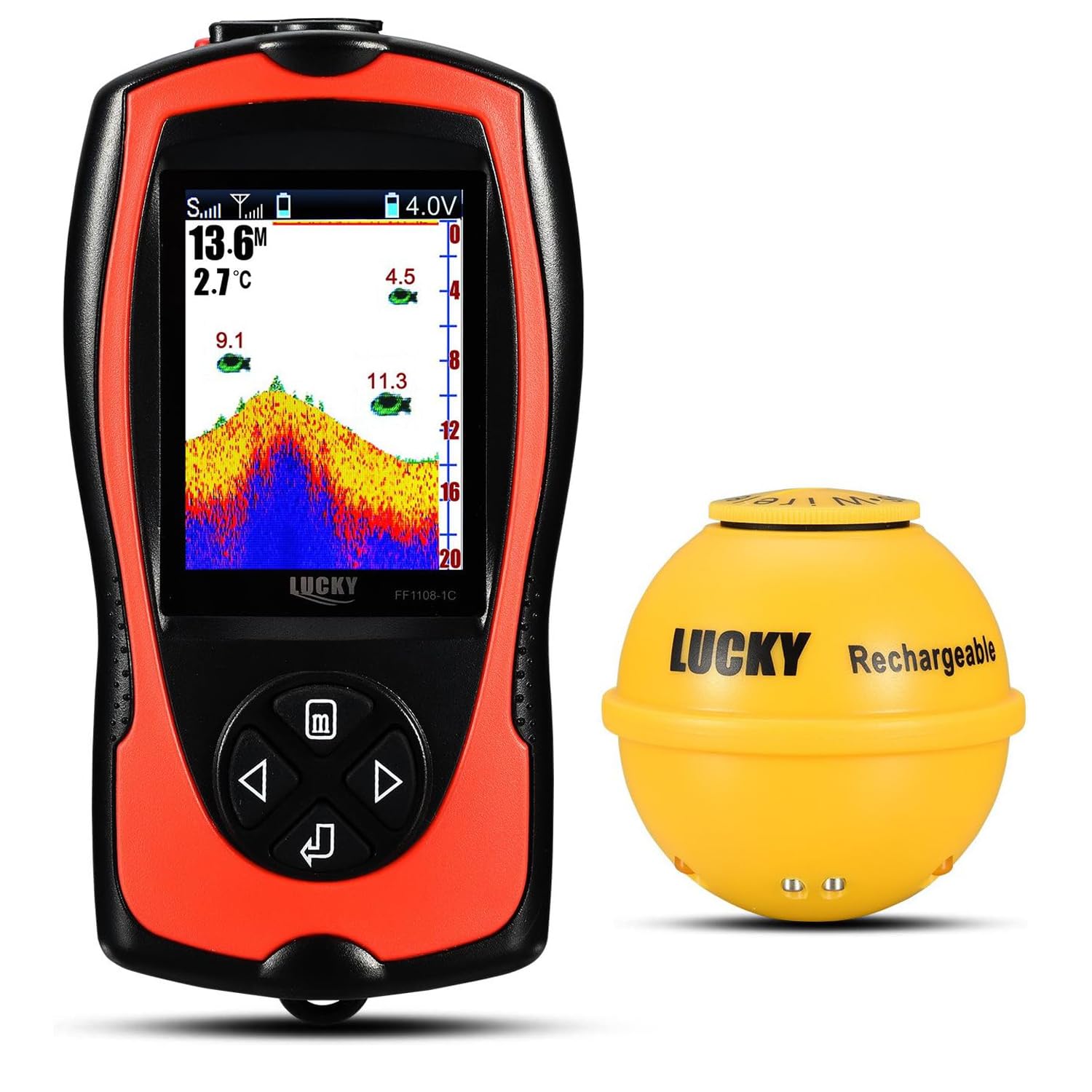
Wireless sonar with a 492-foot range and a pull-out antenna you extend before casting.
This one is the tinkerer’s option. The LUCKY FF-1108-1CWLA pairs a handheld with a 2.4-inch TFT color LCD screen and a wireless sonar transducer you cast on a line, and it gives you a 492-foot wireless operating range — roughly three times the tether length you would ever need from a float tube — with 147 feet of depth detection. There is a pull-out antenna on the top left of the handheld, and you need to extend it.
The feature list is deep for the money: adjustable sensitivity, screen brightness, depth range, zoom, depth alarm, fish alarm, fish icons, unit switching, and language choice, all in a handheld that weighs 5.28 ounces. The transducer carries a fish-attracting lamp and a transparent replacement cover so you can see the sensor’s glow at night, and there is even a simulation mode so you can learn every function on dry land before you trust it over water. Both the handheld and the sonar are rechargeable and charge from the included USB cable, with the handheld rated for 4 hours and the sonar for 10 hours on a full charge.
The fair caveat here is consistency. This unit has a lot of satisfied owners who find it easy and fun, but reliability and accuracy draw a mixed reaction in the reviews — some casting sessions read clean and deep, and some owners mention signal loss on long casts or a unit that quit transmitting entirely. The antenna is the fragile point; treat it as a delicate part, not a carrying handle. For the angler who wants maximum configuration for the money and accepts a little variance, the range and feature set are the draw.
Why bank-and-boat anglers like it
- 492-foot wireless operating range with a 147-foot depth ceiling, plus a pull-out antenna to extend it
- Deep settings menu — sensitivity, brightness, depth range, zoom, depth alarm, fish alarm, fish icons, and units
- Simulation mode lets you learn every function before you ever float it, and the night cover glows so you can see the sensor
The honest limits
- Consistency is the wide-open question — long casts can drop signal, and some units have quit transmitting
- The antenna and the handheld-to-transducer link both ask for careful handling
- Handheld runs 4 hours per charge versus 10 hours for the sonar pod, so the screen is the limiting battery
Worth buying if: you want the widest settings menu and the longest cast range at this level, and you are happy to run a simulation pass before your first real cast.
Skip over it if: you want a set-and-trust screen and would rather pay for a more predictable connection than for extra features.
5. LUCKY Portable Sonar Fish Finder Y2020-CWLA

The waterproof handheld that floats if you drop it overboard.
Most castable finders are only as safe as your grip. This LUCKY Y2020-CWLA is the exception — the handheld is waterproof in rain and floats if you drop it overboard, so a clumsy moment over the tube does not end the trip. The sonar transducer supports up to 656 feet of wireless operation with 147 feet of depth detection, and it weighs 0.3 kg.
The sonar itself is the reason this one keeps ending up on boats. It runs 125Khz with a 90-degree beam angle and a fish-attracting lamp, and the screens show water depth, fish location and approximate fish size in small, middle, or big, water temperature, and bottom contour. You can pick a particular underwater area on the display to inspect it more closely, switch freely between FT/M and ℉/℃, and there is a replaceable glowing transparent cap so you can spot the sonar ball at night. Tether it through the small hole on the transducer and you can cast it exactly like any other rig.
Battery life is the standout. The unit works 5 to 6 hours continuously on a full charge, and switching on the battery-save mode stretches it past 10 hours — enough for a long float-tube drift without a recharge. The honest note is the same one that follows every wireless handheld: the antenna is a weak point and some owners have had one break or a unit stop charging. Customers note depth readings landing within a foot and fish alerts tracking the marks, but the antenna is the part to protect on this otherwise sturdy, floating handheld.
The standout: a waterproof, floating handheld with 656 feet of wireless range and, in battery-save mode, more than 10 hours of continuous sonar — the longest runtime on this list by a clear margin.
The one weak spot: the antenna is the part to protect, and one owner has had the unit stop charging after two months of use.
Pick this one if: you want a waterproof, floating handheld with the longest runtime here and 656 feet of range for float-tube and kayak days.
Choose differently if: you need the deepest possible reading — this unit caps at 147 feet, the same as the other budget-tier handhelds.
Know the Specs
Maximum Measuring Depth
The deepest point a sonar unit can still read and report. A unit rated at 147 feet simply stops trusting the bottom past that depth, while a unit rated at 330 feet keeps reading in deep reservoirs and natural lakes. Match this number to the deepest spot in your local water, then add a margin — the bottom you care about is often the deepest shelf.
Sonar Beam Angle
The shape of the sound cone the transducer pings downward. A 90-degree beam sweeps a wide circle beneath the pod, covering more bottom at once but with less fine detail per square foot. A narrower beam gives more precision over a smaller footprint. Wider beams suit float-tube and bank anglers casting randomly; narrower beams suit boat anglers trolling a known line.
Wireless Range and Connection Type
How far the sonar pod can sit from the receiver before the feed drops. Bluetooth pairing connects near-instantly, while Wi-Fi can carry a longer range but often takes longer to link. On a float tube you rarely cast far enough to test the limit, but the connection type decides how fast you are scanning once the pod hits the water.
Runtime and Charging
How many hours of continuous sonar you get per charge, and how the unit refills. A sonar ball rated for 10 hours covers a long day; a handheld screen rated for 4 hours is usually the limiting device in a two-piece kit. Proprietary charging connectors save space but cost you the trip if the cable is lost, while USB-C and standard USB refills are easy to replace.
Common Questions
Can I use a castable fish finder from a float tube or belly boat?
How deep can these castable fish finders actually read?
Do I need my phone out on the water to use one of these?
Will the sonar signal drop on long casts?
How long does the battery last on a full charge?
What line and tether should I use so I do not lose the sonar pod?
Is the Deeper MAX better than the Garmin STRIKER Cast for a belly boat?
Do these fish finders show water temperature and bottom contour?
Can I use one of these units for ice fishing too?
What breaks first on a portable castable fish finder?
The Bottom Line
For a full day on the float tube, the winner here is the Garmin STRIKER Cast. It pairs over Bluetooth in seconds, streams depth, water temperature, and fish targets straight to the phone you already carry, and runs 10+ hours on its own rechargeable battery — exactly what you need when there is nowhere to mount a screen. If you fish deep water and want personal 3-D bottom maps to fish again next weekend, the Deeper MAX reads down to 330 feet and maps the floor as you go. And if you want the longest runtime on the water with a waterproof, floating body, reach for the LUCKY Y2020-CWLA, which stretches past 10 hours in battery-save mode and sends its signal as far as 656 feet.
How we choose
We do not accept paid placement. Every pick is matched to a real buyer and a real use-case; we do not hands-on test units.
Sources
Specifications: manufacturer listings and product documentation. Review insights: verified customer reviews, as of October 2026. Pricing: not shown on this page (it changes often); check the current price via the retailer link.
As an Amazon Associate, Aappliancez earns from qualifying purchases. This does not affect which products we feature.