Disclosure: Some links in this post are affiliate links. As an Amazon Associate I earn from qualifying purchases, at no extra cost to you. Learn more
Specs are compiled from manufacturer listings and verified buyer reviews and can change over time — please confirm the key details on the product page before buying.
If you are buying your first drone as an adult, the thing that matters most is not camera megapixels — it is whether the drone comes home. A beginner drone for adults needs three basics working together: a GPS lock that holds the drone in place while you think, a return-to-home button that brings it back on its own, and a weight light enough to skip the registration paperwork. Get all three and your first flight stays fun instead of turning into a chase across a field. Miss them and you are chasing a drone across a field.
This guide is built by comparing the manufacturers’ published specifications and the patterns across verified customer reviews, so you get each pick’s real strengths and trade-offs instead of marketing spin.
Every pick below is a real beginner-friendly design, sorted by what it actually does for a nervous first-time pilot. Below are nine owner-tested drones, the specs that actually decide your first flights, and plain answers to the questions new pilots ask most.
Top Picks
How To Choose The Best Beginner Drone for Adults
Most first-time buyers assume the camera is the whole story and spend their budget on megapixels. In practice, the drone that frustrates beginners is almost never the one with the weaker camera — it is the one that drifts in wind, refuses to lock GPS, or dies mid-flight. Start with control and safety, then look at the lens.
Start with weight, because it decides your paperwork
A drone under 249 g sits in the lightest class, which means no FAA registration and no extra Remote ID module in most beginner situations. That single number is why so many first drones hover just beneath it. Go over that line and you are filling in forms before your first takeoff. Several picks here stay under 249 g, and one — the Holy Stone HS600 — weighs 541 g and ships with integrated Remote ID already built in, so you register but avoid buying a separate module.
Then look for GPS and a working return-to-home
GPS is the invisible instructor. It locks the drone’s position so it hovers where you left it, and it powers the return-to-home button that flies the drone back when the signal drops or the battery runs low. For a first flight, this is the feature that keeps the drone out of a neighbor’s tree. A drone with optical flow only — no GPS — will drift indoors and outdoors alike.
Read the flight-time number carefully
Plenty of listings quote total flight time across two batteries and let you assume it is per charge. If a drone says “45 mins” and includes two batteries, that is usually roughly half per battery. Real air time also tends to fall short of the claim in wind or sport mode. Buy for the realistic per-battery figure, not the headline total.
Understand what a gimbal adds over a fixed camera
A gimbal is a motorized mount that keeps the camera level as the drone tilts and shakes. Without one, every wobble and gust shows up in your video. A 2-axis or 3-axis gimbal plus EIS (electronic image stabilization, which smooths the remaining shake in software) is the difference between footage you keep and footage you delete. Budget drones often skip the gimbal entirely — check before you assume.
Side-by-Side Comparison
| Model | Best For | Weight | Flight Time (Claimed) | Range | Amazon |
|---|---|---|---|---|---|
| DJI Neo 2 (Drone Only)★ Best Overall | Easiest first flight | 151 g | One battery included | 10 km | Amazon |
| REDRIE HK33 GPS (B0F37MYK6N)Long Flight Bundle | Long battery bundle | 249 g | 45 mins total (2 batteries) | 1640 ft | Amazon |
| Oddire Drone with 4K CameraBudget Trainer | Budget learning tool | — | Two batteries included | 1640 ft | Amazon |
| REDRIE HK33 Foldable (B0DG9VCNG7) | Gimbal on a beginner budget | Under 250 g | 40–45 mins total (2 batteries) | 500 m | Amazon |
| PLEGBLE 710 Screen Drone | No-phone flying | Under 249 g | 70 mins total (2 batteries) | — | Amazon |
| Potensic ATOM LT | Best starter all-rounder | 249 g | 80 mins total (2 batteries) | 4000 m | Amazon |
| Holy Stone HS600 | Wind and range | 541 g | One battery included | 10000 ft | Amazon |
| Bwine F7MINI | Photo quality and screen | 249 g | 64 mins total (2 batteries) | 6 km | Amazon |
| DJI Neo 2 Motion Fly More Combo | FPV flying | 151 g | Three batteries included | — | Amazon |
Detailed Reviews
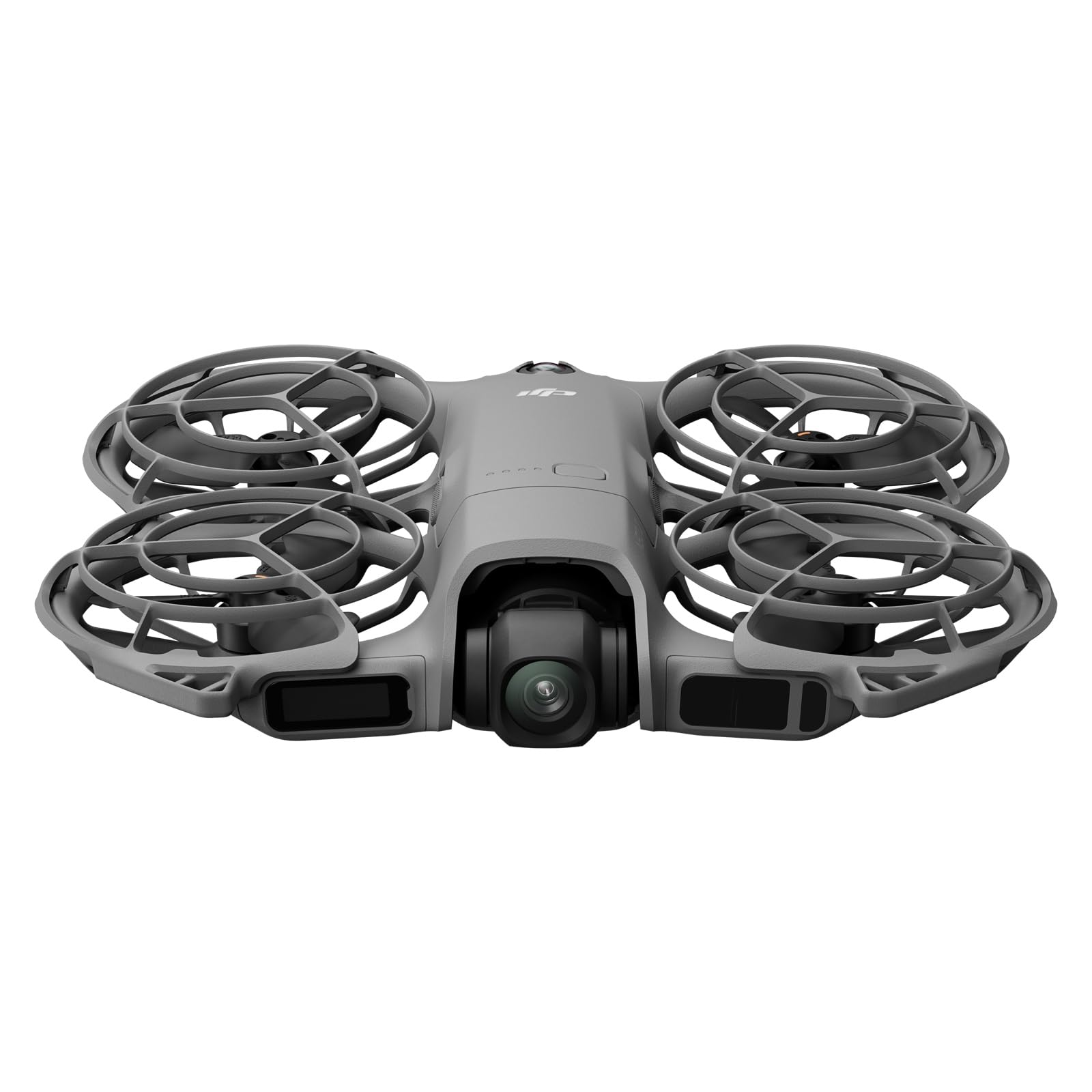
1. DJI Neo 2 (Drone Only), Lightweight 4K Drone With Camera
Our pick — 4.5+★ from 1,000+ verified ratings; the strongest balance of quality and price.
Lift it off your palm, wave your hand, and it follows you — no controller required.
At 151 g this is the lightest thing on the list, and that is the whole pitch. Compare it with the REDRIE HK33 at 249 g and you are carrying well over a third less mass in your bag — a difference you feel every time you toss it in a jacket pocket. It is C0 certified and wears full-coverage propeller guards, so the blades are shielded when it is knocking around your car. For a first-time adult pilot, that weight and those guards remove the two biggest sources of nerves: bulk and exposed blades.
What wins people over here is sheer build quality — it is the most-praised thing about this drone by a distance, and the attention to finish shows the moment you pick it up. The flying itself is unusually forgiving: palm takeoff, gesture control and ActiveTrack mean a first-timer can launch and follow without touching a joystick. Palm takeoff and landing means you literally launch it from your hand. Gesture control lets you fly hands-free. ActiveTrack keeps a subject in frame while omnidirectional obstacle sensing watches for things in every direction around the drone. Buyers report clear 4K30fps footage — one sums it up neatly: “Captures clear 4K30fps roof video; follow-me and phone-as-mic features work well.” A beginner who has never flown anything can get airborne in the first minute.
The catch is flight time. Expect roughly 10 to 12 minutes of real air per battery, and note this listing includes one battery. Buyers also flag that the DJI Fly app no longer sits on Google Play, so you download it from DJI’s own site. And for US buyers, there are real service questions worth understanding before you buy — DJI’s US warranty picture is complicated, so know your return window. None of that changes how easy it is to fly; it changes who should buy it. If you want the smoothest possible first flight and do not mind buying spare batteries, this is the one.
Where it earns its keep
- Featherweight 151 g with guarded props — pocketable and safe to transport
- Palm takeoff, gesture control and ActiveTrack make it genuinely hands-free
- 4K resolution with omnidirectional obstacle sensing for confidence
- The best-built drone in this lineup by owner consensus
What to plan around
- Roughly 10–12 minutes of flight per battery; only one included here
- App must be sideloaded from DJI’s site, not Google Play
- Serious US service and warranty questions are worth checking first
Reach for this if: you want the easiest, best-made first drone and will pick up extra batteries.
Look elsewhere if: long uninterrupted flight time is your top priority.
2. GPS Drones with Camera for Adults 4K
Two batteries in the box, a lens that fights shake, and GPS that brings it home.
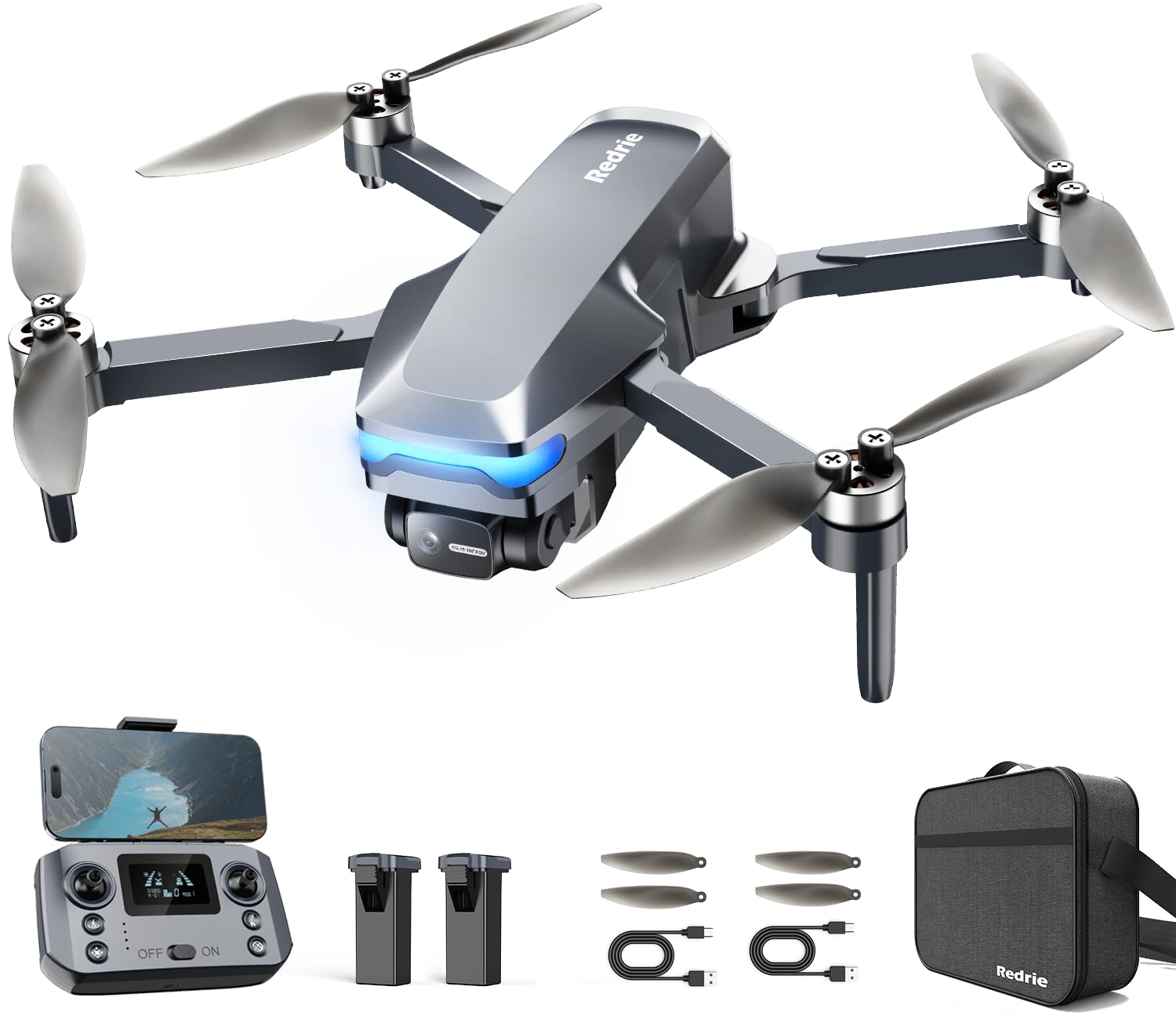
Start with what is physically in the case: two 1800mAh batteries, a folding body, and a carrying case in the box. The 45-minute flight figure advertised on the listing is the total across both packs, not per battery — split it and you are looking at roughly half per charge. That is still a very practical starter setup, because one battery can charge while the other flies. Compare its footprint with the DJI Neo 2 and this thing is noticeably bigger: 11″L x 7.5″W x 3″H versus the DJI’s 6.74″L x 5.8″W x 1.59″H. It folds, but it is the more luggage-like of the two.
The camera is built to fight motion. It has an F2.15 110° wide-angle lens with physical vibration reduction and a 90° remote-adjustable angle, so you can tilt the view from the controller without landing. Stills arrive at 4096x3072P and video at 2048x1088P, saved either to a microSD card or straight to your phone. The 5G WiFi link pushes stable FPV video up to 985 feet, and a repeater in the controller extends total flight distance to 1640 feet. GPS adds auto-return, follow, route planning and fly-around. Brushless motors give it resistance up to level 5 wind, which for a learner means it will not be thrown around by every gust.
Here is the honest part: the flight and value experience split opinion. Plenty of owners call it a great learning drone with fast GPS lock and a rock-steady flat hover, while others hit connection dropouts at distance and shaky camera quality. One verified buyer put it bluntly: “It starts moving without touching the controller, and you can’t fly it far without losing connection.” Treat this as a practice machine with a nice lens rather than a reliable long-range camera ship, and keep it closer than you would a premium drone. An occasional unit also arrives with a charging fault. Know those and it is a fair way to learn the controls.
Fair-value trade-off: you get a vibration-reduced lens, a second battery and GPS return for a beginner price, and most owners fly it happily at close range.
Size reality: the folding body is bigger and heavier in the hand than the palm-sized DJI, so it lives in the included case rather than a pocket.
Good match for: a learner who wants two batteries and a stabilized wide lens right from the start.
Steer away if: you expect DJI-grade connection stability on long flights.
3. Oddire Drone with 4K Camera
The practice drone you are not scared to crash while you learn the sticks.
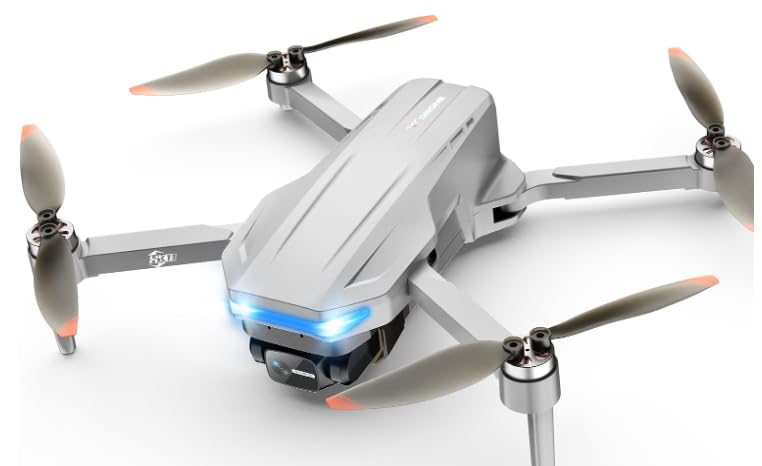
What is the cheapest way to learn to fly without wrecking something precious? This one. Its effective still resolution lands at 12.3 mp — a hair above the DJI Neo 2’s 12 mp — and it uses a CMOS sensor (the light-catching chip) recording MP4 video, all from a remote. GPS adds return-to-home that lands within about 3-4 feet of where it launched. Range tops out at 1640 feet. For an adult who has never touched a controller, GPS return-to-home within a few feet of launch plus a 1640-foot range is a forgiving place to learn the sticks.
The most-praised trait is simple suitability — it is the drone owners keep recommending as a starter, and that is the whole job. Value for money runs close behind, with fun not far off. The X Drone Go app gets it paired, a compass and gyro calibration each start keeps it steady, and flight control holds up even in gusty wind. What it is not is cinematic. It has no gimbal, so every tilt and gust shows in your video, and photos come out decent rather than polished. The one phrase to remember: “This was the perfect drone I needed for my daytime photography.” That is the ceiling — good daytime photography, not film production.
Functionality and flight performance are where opinion splits. Some owners have it drift on its own and call the controls unresponsive; others fly it smooth and fast without issue. Battery life runs shorter than the listing suggests, and a low-battery auto-return can climb toward obstacles if you have not kept clear space above. None of that makes it a bad buy for the job it does — a low-stakes trainer — but it does mean you should keep it in open space while you build confidence.
Why beginners keep it
- 12.3 mp CMOS camera with MP4 video at a trainer price
- GPS return-to-home lands within a few feet of takeoff
- Most-cited reason owners like it: it is genuinely suited to starters
- Flies controllably in gusts once you calibrate each start
Set your expectations
- No gimbal, so video shows every shake
- Drift and control responsiveness vary unit to unit
- Battery falls short of the advertised time
If you are learning and nervous: this is the low-risk drone to make your first mistakes on.
If you want finished footage: spend more for a gimbal elsewhere on this list.
4. Drones with Camera for Adults 4K
A 2-axis gimbal in a first-drone package — that is the rare part here.
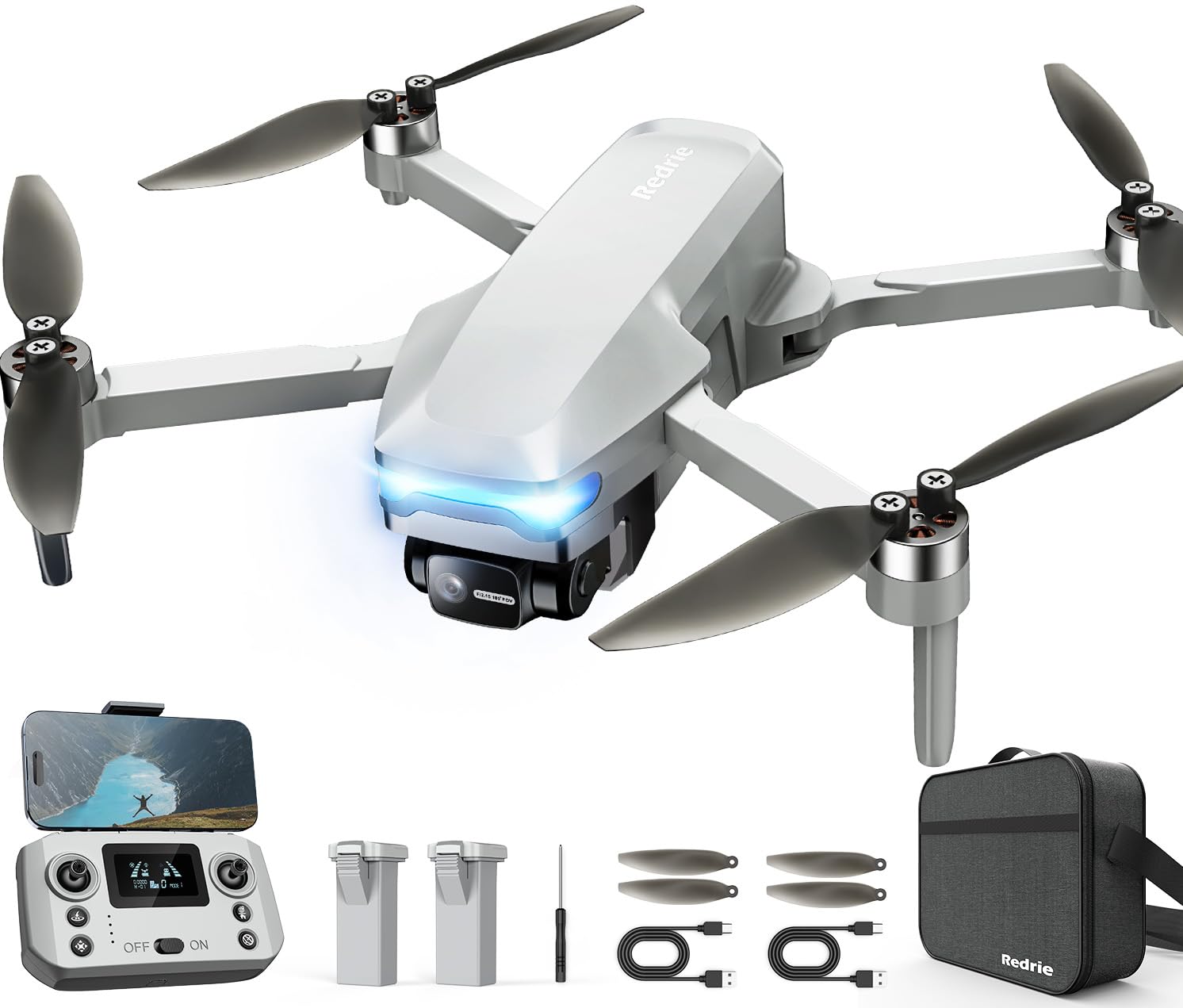
A gimbal is the motorized camera mount that keeps footage level while the drone pitches and rolls, and most beginner drones leave it out. This HK33 includes a 2-axis gimbal plus EIS, which together knock out the shake a fixed camera would show. The lens is an F2.15 large aperture with a 110° ultra-wide view, and a 90° remote adjuster flips between horizontal and vertical framing without landing. It shoots 4K photos at 4096x3072P and 2K video at 2048x1088P. Two 1800mAh batteries give a total of 40-45 minutes across both packs, with a live battery indicator on the remote and in the app.
Suitability is what owners emphasize most — they keep calling it a great starter — with value for money right behind. Brushless motors hold it steady up to level 5 wind, and the 5G WiFi link pushes low-latency video 985 feet with a 1640-foot signal range through the controller’s repeater. GPS handles auto-return on lost signal, out-of-range or low battery, plus follow, route planning and fly-around. Foldable body, carrying case, spare props and a controller that pairs without creating an account. The smart modes are the easy part; one-key takeoff and landing means a total novice can be flying in minutes.
The caveat is stability, which splits opinion. Owners describe it as solid but not precise in wind or during quick movements. There are also reports of defective units arriving — a loose gimbal wire, a battery that would not charge — so test everything on day one and use the return window. And the phone holder is a known weak spot. The footage limitation is real: video is “okay” in owner terms, not crisp. For a beginner who wants a real gimbal without spending premium money, that is a reasonable set of trade-offs.
What you are buying: genuine gimbal-stabilized photo and video, two batteries, GPS return and brushless motors — a lot of beginner kit in one folding body.
Check on arrival: the gimbal wires, both batteries and the phone holder, since a minority of units arrive with a fault.
Pick it when: you want stabilized footage without paying premium prices.
Pass if: you need precision control in wind and cannot tolerate a bad-unit lottery.
5. PLEGBLE Drones with Camera for Adults 4K
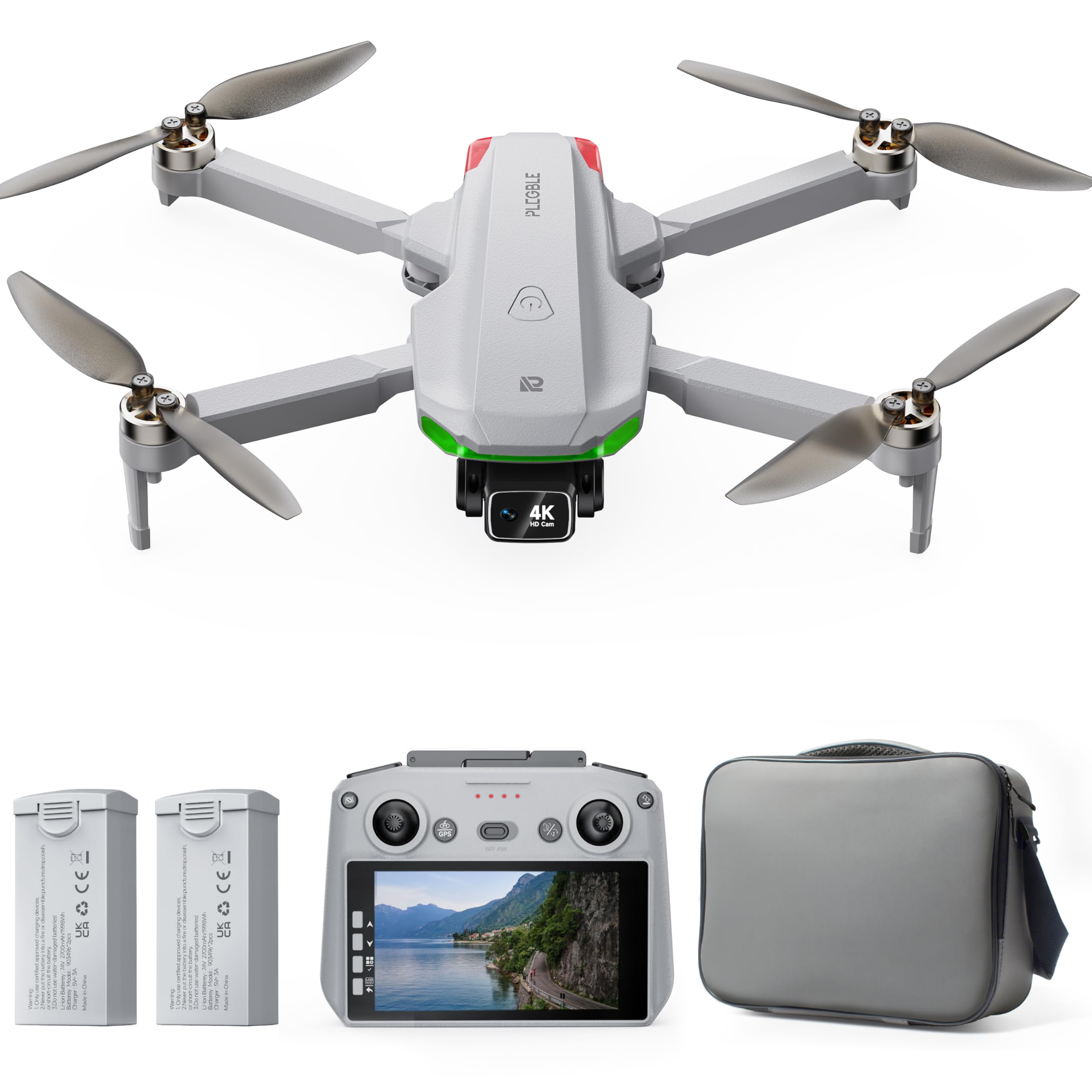
The controller already has a screen, so your phone never has to leave your pocket.
Two 7.6V 2700mAh batteries give a claimed 70 minutes of total flight — again, that is across both packs. The larger number is the 5.0″ HD screen built into the controller, which shows live FPV video, photo and video previews and SD-card formatting with no smartphone or app involved. For an adult who does not want to fiddle with phone tethering, that is the appeal in one line. It weighs under 249 g, folds, and runs brushless motors with resistance to level 5 wind.
Beginner suitability is the most-cited strength, and ease of use follows right behind — most owners agree the on-screen video is clear and lag-free. It shoots 4K@30fps with a 130° wide-angle lens, a 90° adjustable tilt, EIS stabilization and optical flow positioning. GPS locks position and adds smart return-to-home, low-battery return, signal-loss return and compass calibration. Follow Me, Waypoint Fly and Circle Flight let it track your movement hands-free. One-key takeoff, speed switching, and altitude and distance limits round out the safety net.
The recurring gripe is the range claim. The manual reportedly lists a 600 m maximum despite far bigger numbers in the marketing text, and owners who tested it found real range well under a kilometer, with follow-me performing poorly. Real battery life also runs closer to around 15 minutes per pack than the headline. The HD screen can be hard to read in direct sunlight, and you need to supply your own 5V chargers since none are included. Keep it close, treat the range claim with a grain of salt, and it is a genuinely convenient first drone.
The screen is the selling point
- 5.0″ controller screen means no phone and no app hunting
- 4K@30fps, 130° wide lens, EIS and optical flow
- Two 2700mAh batteries and a carry case in the box
- GPS auto-return plus usable follow and orbit modes
Know before you fly far
- Real range sits far below the advertised figure
- Around 15 minutes per battery in practice
- Screen washes out in bright sun; chargers are not included
Best for: flyers who want live video without a phone attached to the controller.
Think twice if: you plan on long-distance flights — plan to stay close.
6. Potensic ATOM LT GPS Drone

Two 3000mAh batteries, a Sony sensor, and enough range to actually explore.
The standout number is 4 KM of transmission — roughly 13123 feet of PixSync 2.0 video link through the dedicated controller. Compare that with the REDRIE HK33’s 500-meter signal range and the gap in reach is dramatic. Owners routinely see about 2000 feet before the feed drops, which is far more real-world scope than a beginner usually gets. It weighs 249 g, sits under the registration line, and folds small enough to pocket. The 2.5K camera delivers 2560×1440 stills and 2.5K@30fps video with ShakeVanish 2.0 stabilization, a 118° field of view, and a camera that tilts from +20° to -90°.
Drone quality is the trait owners highlight most, and the pictures back it up — this is repeatedly held up against much pricier DJI models and comes out respectable. Four satellite systems (GPS, GLONASS, Galileo and BeiDou) keep position lock tight, and that feeds the auto return, Follow Me, Waypoint Fly and Circle Fly modes. An important practical note from the maker: the ATOM LT only flies in GPS mode, so start outdoors in an open area. Brushless motors hold up in level 5 wind. The app needs iOS 11 or Android 7.0 and up, and it ships with both Type-C and Lightning adapter cables for your phone.
Battery life is the mixed part. You get 40 minutes per 3000mAh pack for a claimed 80 total, but a lot of owners mention closer to 30 minutes each, and charging is slow unless you own a fast brick. It is also a compact build, so in a stiff wind it will demand a little extra care. Those are the honest prices of admission for a starter drone with this much range. At this price, with two batteries and a 4 KM link, it is the pick I would hand to almost any adult starting out.
The case for it: 2.5K EIS footage from a Sony sensor, four-system GPS, a 4 KM link and two big batteries — a serious starter kit that punches above its tier.
The honest limit: real flight per battery runs nearer 30 minutes than 40, and the slow charge time means a fast charger is worth adding.
My default for most beginners: if you want one drone that does it all without overspending, start here.
Also honest: if you cannot spare a fast charger, expect longer waits between flights.
7. Holy Stone HS600 2-Axis Gimbal Drones

A heavier, steadier camera ship that shrugs off wind a light drone cannot.
The defining number is 541 g — heavier than the DJI Neo 2’s 151 g. That mass is the point: it gives the HS600 resistance up to level 6 wind, one notch above the level 5 rating on several drones here. It also means you fly heavier, which owners describe as noticeably more stable in a real breeze. The 2-axis gimbal plus EIS keeps 4K/30FPS footage steady, and the Sony sensor-enhanced camera renders sharp, vivid images. Transmission runs to 20,000 feet with a WiFi repeater built into the controller, and the smartphone connects through a single cable — no WiFi pairing needed.
Quality is what wins people over most here, comfortably ahead of value for money and ease of use. That quality shows up in a well-padded case, a controller, and reliable behavior in the air. Integrated Remote ID means no separate module to buy — the FAA requirement is already met, though this one is over the weight line so you do still register. One-key takeoff lands cleanly, GPS hover holds steady, and return-to-home brings it back near its launch point. Follow mode and waypoint mode let you chart a route and let the drone fly it while you focus on the shot.
Reliability and battery life both get mixed reactions depending on who you ask. Controls err on the sensitive side, and the controller screen can be dim in direct sunlight. Some owners saw unacceptable drift in light wind, and there are reports of a short delay when capturing photos. The slow battery charge is a common note. On balance this is the drone to reach for when the forecast is breezy and you want footage that holds up — just budget for patience while it charges.
Built for the breezy days
- 541 g body with level 6 wind resistance holds steadier
- 2-axis gimbal plus EIS for stabilized 4K/30FPS
- Integrated Remote ID — no extra module to buy
- 20,000 ft transmission and single-cable phone connection
Trade-offs to know
- Over 249 g, so you do need to register it
- Sensitive controls and a dim controller screen in sun
- Slow battery charging; only one battery in this listing
Choose it when: your flying days are windy and you want stable footage to show for it.
Skip the registration hassle if: you refuse to register — stay under 249 g instead.
8. Bwine F7MINI Drones with Camera
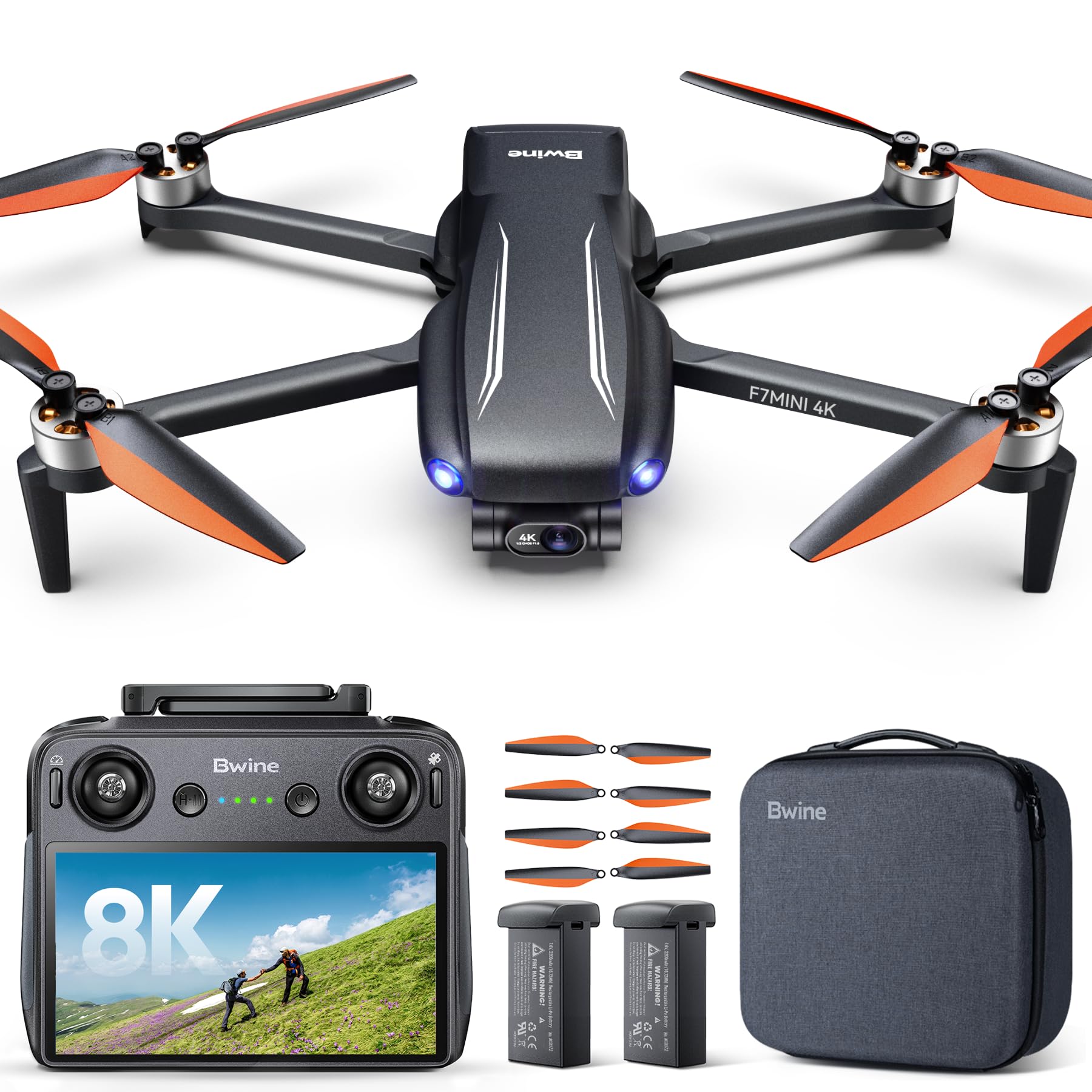
Three-axis gimbal, 48 megapixel stills, and a big bright screen on the remote.
If photos are why you are buying, this is the class of the field. Effective still resolution reaches 48 mp — four times the 12 mp on many drones here and beyond. The camera uses an F1.8 aperture, 5x zoom and vertical shooting with filters, all stabilized by a 3-axis brushless gimbal plus EIS. The controller carries a 5.5″ 1080P screen at 60Hz and 500 nit, with 32GB of internal storage and 3 hours of remote run time. For an adult documenting hikes or shooting vlogs, that screen-and-gimbal pairing is the reason to pay more.
Quality is the runaway strength owners keep praising, with value for money and camera quality close behind — clear, stable performance even in mild wind. GPS runs smart modes across the board: ActiveTrack follows a partner at 0.5m accuracy, Cruise Control holds a steady speed, Orbit Flight circles a spot 360°, Waypoint Planning flies a drawn route, and Precise Hover locks altitude. It sits under 249 g, so no registration. A 120dB buzzer in the app helps find the drone if you lose it, and a dynamic home point keeps the return location updating with your controller. Two batteries give a claimed 64 minutes total across both packs, and it supports PD 3.0 fast charging with the charger sold separately.
Battery life is the caveat, and it splits opinion — some owners see strong run time, others report packs lasting around 12 to 15 minutes. The joysticks are sensitive, so be gentle in wind or low light. Support is a genuine plus: a replacement drone went out after one was lost to a controller failure, and another after a water crash, plus a 2-year warranty and lifetime firmware updates. One buyer put the experience plainly: “This has been a really fun drone for me.” It is the pick for someone who wants the best stills on this list and will forgive shorter flights.
Photo-first pick: 48 mp stills, an F1.8 lens with 5x zoom, and a full 3-axis gimbal for footage that stays level.
Battery reality: the 64-minute claim covers both packs, and real per-charge time can land near 12–15 minutes.
Reach for it if: still photos and stabilized video matter most and you want a big screen to see them on.
Look elsewhere if: flight duration is your deciding factor.
9. DJI Neo 2 Motion Fly More Combo
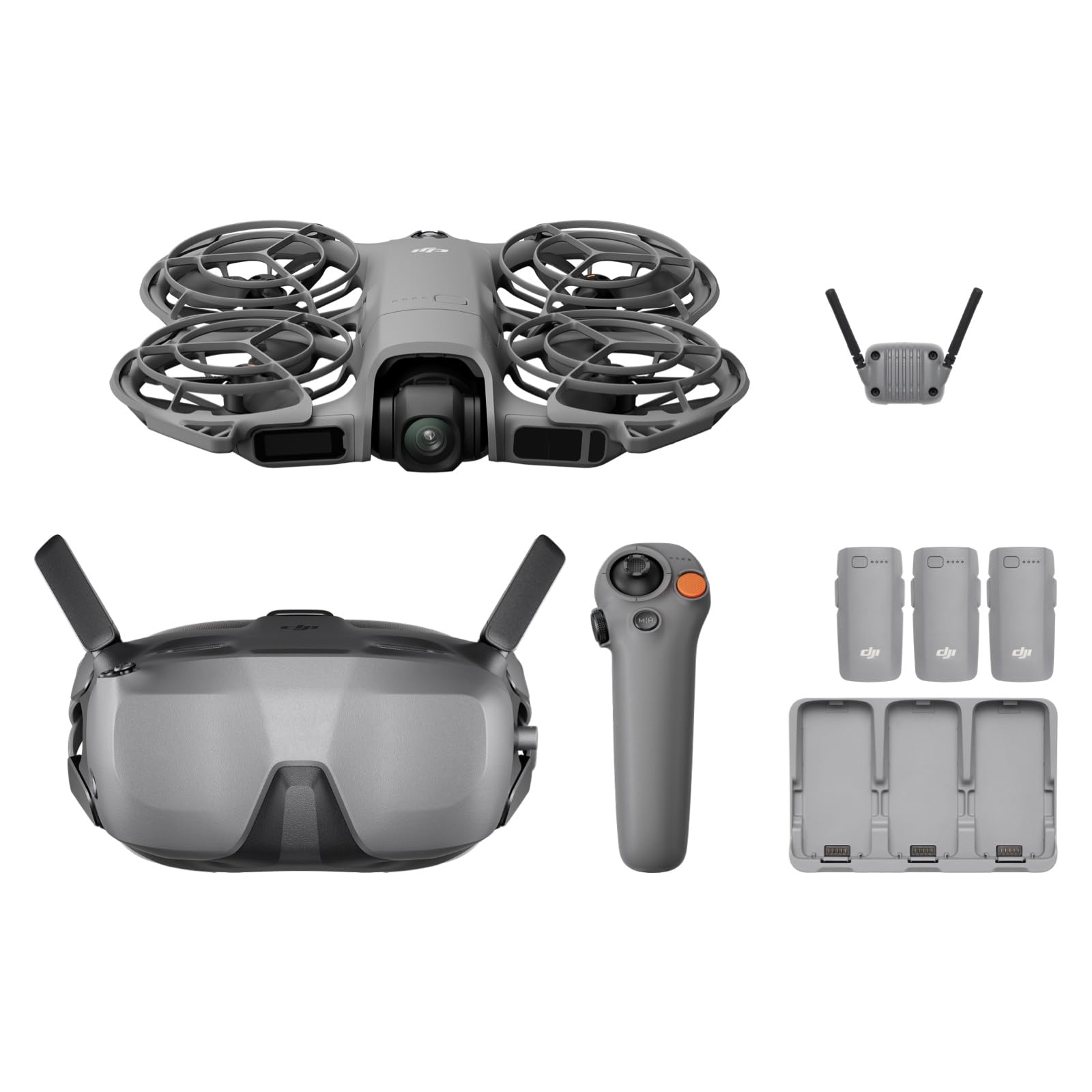
Put on the goggles, tilt your wrist, and the drone banks like you are inside it.
This is the same 151 g Neo 2 airframe as the top pick, but bundled with the gear that turns it into an FPV (first-person-view) experience: DJI Goggles N3, the RC Motion 3 hand controller, a digital transceiver, and three 1606mAh batteries with a charging hub. Rather than tilting a joystick, you tilt your hand and the drone responds to the motion. Quality is the trait owners praise most, and with the goggles on, the 1080p display fits over prescription glasses with no light bleed. The drone still captures 4K, with omnidirectional obstacle sensing and ActiveTrack on board.
Ease of use as an FPV device is the second thing everyone notes — the motion control becomes intuitive after a short learning curve. Goggles give a clear, responsive live feed, and the gimbal delivers sharp, vibrant, stabilized video. The Fly More parts matter because flights are short: the three batteries extend your session where the drone-only version leaves you waiting. ActiveTrack keeps a subject framed, palm takeoff and landing skip the controller, and SelfieShot snaps a quick self with a tap. Setup is quick and the whole kit is compact, so it travels easily.
Flight time is the one flaw everyone agrees on. Expect roughly 8 to 12 minutes per battery, with a forced return at 25% that is locked in firmware. In hot weather the airframe can overheat in sport mode. The goggles are heavier with no passthrough view, and the charging hub fills batteries one at a time with no LCD and no 90% stop. So the price of the immersion is short hops and a bit of battery management. Buy the combo if the FPV feeling is why you want a drone in the first place — otherwise the drone-only version gives you the same easy flying.
What sells the combo
- RC Motion 3 hand control plus Goggles N3 for true FPV flight
- Three 1606mAh batteries and a hub keep sessions going
- Sharp, stabilized 4K and omnidirectional obstacle sensing
- Goggles fit over prescription glasses; no light bleed
The immersion tax
- Roughly 8–12 minutes per battery; return forced at 25%
- Overheats in sport mode on hot days
- Heavier goggles with no passthrough; sequential charging hub
Buy it if: the goggles-and-motion-controller FPV feeling is exactly what drew you to drones.
Save your money if: ordinary line-of-sight flying is all you want — the drone-only version does that.
Know the Specs
Weight and the 249 g line
Weight is the first spec that changes your life as a beginner. A drone under about 250 g can often skip FAA registration and extra modules, which is why so many first drones hover just under it. The number also affects wind handling: a 151 g body is easier to pocket but gets pushed around more, while a 541 g body like the Holy Stone HS600 is steadier in a breeze. Pick the weight for the kind of flying you plan.
Flight time per battery
A “45 minute” or “80 minute” claim usually means the total across two batteries, not the time from a single charge. Divide the total by the battery count for the realistic per-flight number, then assume it drops in wind or sport mode. Carry a spare if you want a longer session, and budget charge time — some packs refill slowly without a fast charger.
Gimbal vs. fixed camera
A gimbal is a motorized mount that keeps the camera level as the drone moves. A 2-axis or 3-axis gimbal plus EIS produces footage you keep; a fixed camera without one shows every wobble. If smooth video matters, check for a gimbal before you compare megapixels — the mount does more for your footage than a bigger sensor in a shaky body.
Range and transmission
The advertised range is the best case. Real distance depends on the link type and the terrain. A repeater in the controller extends total distance, and dedicated systems tend to hold a video feed farther than a basic WiFi link. Start with the range your manual states and keep the drone within your comfort zone until you know how it behaves.
Common Questions
Do I need to register a beginner drone under 249 g?
How long does a beginner drone actually fly on one battery?
What does return-to-home do on a GPS drone?
Is GPS better than optical flow for a beginner?
Do I need a microSD card, or can I save to my phone?
Can a beginner drone fly in wind?
What is the difference between a 2-axis and 3-axis gimbal?
Do I need a controller, or can I fly with just my phone?
How hard is it to learn to fly a drone as an adult beginner?
Why do the chargers and batteries sometimes need extra parts?
The Bottom Line
If you want one drone that gets everything right for a first-time adult pilot, the DJI Neo 2 (Drone Only) is the pick — it is the easiest to launch, the best built, and packed with palm takeoff, gesture control and obstacle sensing that make a nervous first flight feel safe. If you would rather have more range and two larger batteries for the money, the Potensic ATOM LT is the strong all-rounder. And for the clearest stills on this list, with a 3-axis gimbal and a big screen on the controller, the Bwine F7MINI delivers the sharpest photos of the group.
The honest nudge: the drone you will fly most is the one that matches your wind and your flying space, not the one with the biggest spec sheet. Breezy fields and long sights favor the Holy Stone HS600 and its 20,000-foot range; calm backyards and quick clips favor the lighter 151 g DJI. Decide where and how often you will actually fly, then pick the weight, wind rating and range that fit those conditions.
How we choose
We do not accept paid placement. Every pick is matched to a real buyer and a real use-case; we do not hands-on test units.
Sources
Specifications: manufacturer listings and product documentation. Review insights: verified customer reviews, as of October 2026. Pricing: not shown on this page (it changes often); check the current price via the retailer link.
As an Amazon Associate, Aappliancez earns from qualifying purchases. This does not affect which products we feature.