Disclosure: Some links in this post are affiliate links. As an Amazon Associate I earn from qualifying purchases, at no extra cost to you. Learn more
Specs are compiled from manufacturer listings and verified buyer reviews and can change over time — please confirm the key details on the product page before buying.
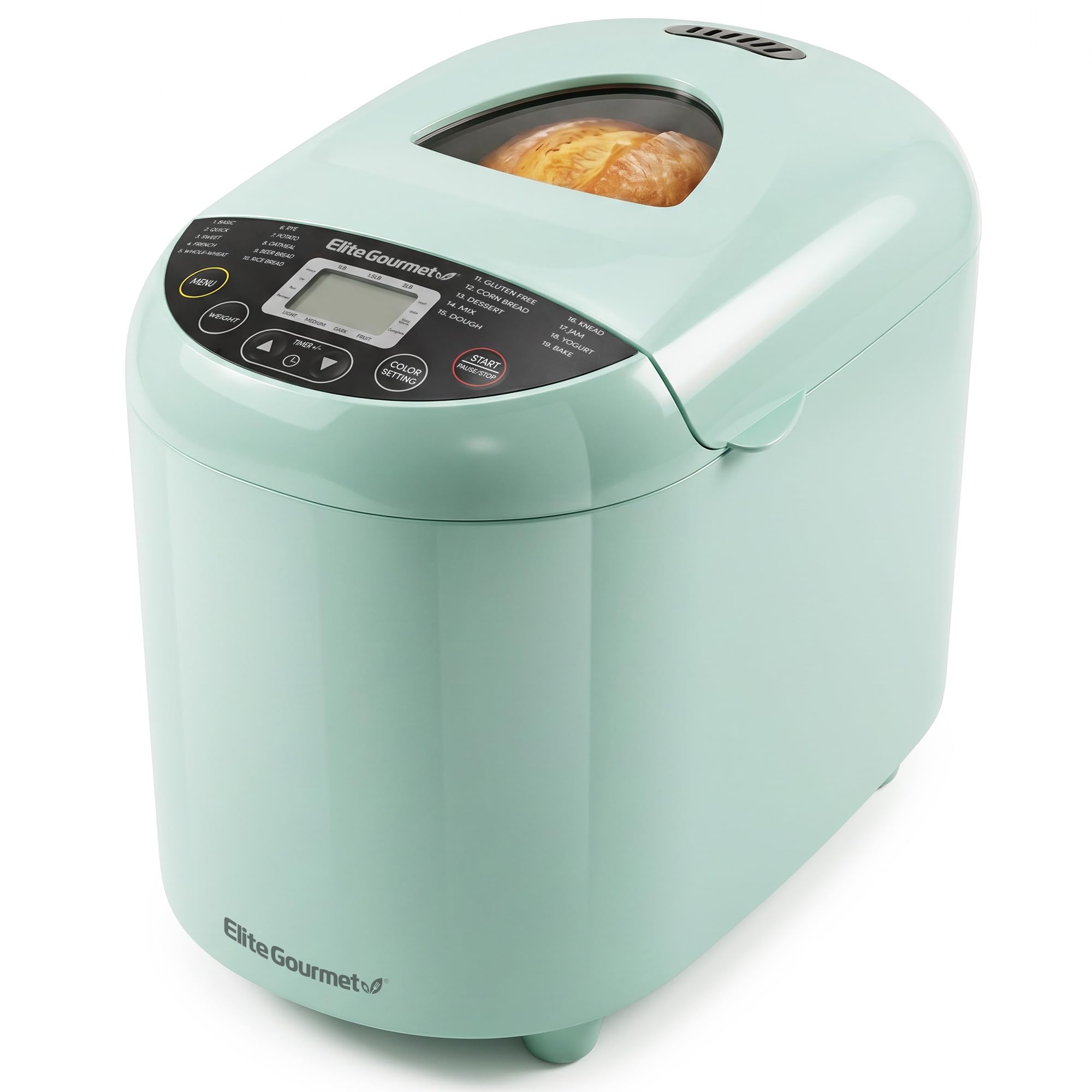
If you have never baked a loaf in your life, the machine you want is one that kneads, rises, and bakes on a single button press — and the Elite Gourmet 2 Lb Programmable Bread Maker in Mint does exactly that with 19 one-touch programs. It is the pick most first-timers should start with. Everything below is ranked by how little guesswork it demands from you, not by how many features the box lists.
This guide is built by comparing the manufacturers’ published specifications and the patterns across verified customer reviews, so you get each pick’s real strengths and trade-offs instead of marketing spin.
The practical difference between these machines is small on paper and large on your counter: loaf size, how loudly the motor kneads, and whether the pan releases cleanly. Here is how each one actually behaves once the flour comes out, so you can choose a beginner bread maker that fits your kitchen and your patience.
Top Picks

How To Choose The Best Beginner Bread Maker
A bread machine does three jobs you would otherwise do by hand: it kneads the dough, lets it rise at a controlled warmth, and bakes it in the same pan. For a beginner, the whole purchase hinges on how much of that the machine handles without you standing over it. Get these four things right and your first loaf is likely to work.
Match the loaf size to your household
A 2 lb loaf feeds a family and leaves leftovers for toast. A 1 lb loaf suits one or two people who eat bread fresh rather than storing it. Several machines here let you choose between 1 lb, 1.5 lb, and 2 lb loaves in the same pan, which is the most flexible arrangement for a beginner still learning how much bread you actually eat in a week.
Count the programs you will truly use
Nineteen presets sound impressive until you realize most beginners use three: basic white, whole wheat, and dough. What genuinely helps is a gluten-free setting if anyone in your house avoids gluten, and a dough-only cycle if you want to shape and bake rolls in your own oven. The rest are bonuses you may grow into.
Check the delay timer and keep-warm window
A delay timer lets you load ingredients at night and set the machine to finish at breakfast. A keep-warm function holds the finished loaf at temperature afterward. Both are standard on most models here, but the length of the delay window and the keep-warm duration differ, so compare those numbers before you decide.
Look at the pan and paddle for cleanup
The non-stick pan is what you will wash after every bake. A removable pan with a genuinely non-stick coating releases the loaf in one tip. The kneading paddle stays lodged in the bread, leaving a small hole in the bottom slice — every machine does this. Some designs collapse or remove the paddle mid-cycle to shrink that hole.
Side-by-Side Comparison
| Model | Best For | Programs | Loaf Capacity | Delay Timer | Amazon |
|---|---|---|---|---|---|
| Elite Gourmet EBM8103M (Mint)★ Best Overall | First-time bakers wanting the simplest start | 19 | 2 lb (1 / 1.5 / 2 lb) | 15 hours | Amazon |
| Elite Gourmet EBM8103SS (Stainless)Best Value | Small kitchens and stainless-steel styling | 19 | 2 lb (1 / 1.5 / 2 lb) | 15 hours | Amazon |
| OSIPOTO BM8708 | Families of 4–6 who want a starter kit included | 17 | 2 lb (3 sizes) | 15 hours | Amazon |
| KITCHENARM 851011 | Nervous beginners who want recipes in the box | 19 | 2 lb (1 / 1.5 / 2 lb) | 15 hours | Amazon |
| Zojirushi BB-HAC10 | One- and two-person households tight on counter space | 9 | 1 lb | 13 hours | Amazon |
| Breville BBM800XL | Bakers ready to build and save their own recipes | 13 | 2.5 lb (1–2.5 lb) | — | Amazon |
Detailed Reviews
1. Elite Gourmet 2 Lb Programmable Bread Maker Mint
Our pick — 4.5+★ from 3,000+ verified ratings; the strongest balance of quality and price.
The mint machine that turns four ingredients and one button into a loaf a beginner can be proud of.
Nineteen one-touch programs is the headline, and for a first machine it is a genuinely useful number. Basic white, whole wheat, rye, French, sweet bread, quick bread, pizza dough, cake, and jam all sit on the menu, plus a gluten-free cycle for anyone avoiding gluten. You pick the program, load the pan in the order the manual tells you, and press start. The machine handles kneading, rising, and baking — a full 2 lb loaf finishes in roughly three hours at the top size.
What wins people over is the ten-minute prep: load the pan, press start, and walk away. The prep runs about ten minutes, and the suction feet keep it planted on the counter while it kneads, so it does not wander. The non-stick pan lets loaves release cleanly with a single turn. Owners who have run theirs near-daily for months describe loaves that look handmade rather than machine-pressed, and the machine stays quiet enough to forget it is running. It also bakes without heating your whole kitchen the way a full oven does, which matters in a small apartment or on a hot day.
The honest limit is the 2 lb setting. A full-size loaf rises against the viewing window, sticks there, and looks rough — that is the recurring gripe, and it makes cleanup fiddlier than a smaller bake. Drop to 1.5 lb and the same recipe comes out neat and easy to wash up after. Expect the kneading paddle to leave a hole in the bottom slice of every loaf; that is normal across all bread machines, and the crust browning is gentle rather than deep, so if you want a dark, crackly top you will finish it under an oven broiler. The crowd of owners behind it — 4.5+ stars across 3,000+ ratings — tells you the trade-offs are ones most people happily live with.
What earns it top spot
- 19 one-touch programs cover white, whole wheat, rye, French, sweet, quick bread, pizza dough, cake, jam, and gluten-free
- Three loaf sizes — 1 lb, 1.5 lb, 2 lb — in one pan, so you can scale to your household
- 15-hour delay timer plus 60-minute keep-warm fits a workday schedule
- Compact 14″D x 9.75″W x 11″H body with suction feet that hold steady while kneading
Where it pushes back
- A full 2 lb loaf can rise into the viewing window and stick, making the top messy and the pan harder to clean
- Crust comes out on the pale side rather than deeply browned
- The kneading paddle leaves a hole in the bottom slice
Right call for: a first bread machine where you want one button and a real loaf, especially if a 1.5 lb bake suits your table.
Think twice if: you always want a tall 2 lb sandwich loaf with a crisp dark crust — the window contact and gentle browning will annoy you.
2. Elite Gourmet 2 Lb Programmable Bread Maker Stainless
Same 19 presets and 15-hour timer as the top pick, dressed in stainless with a slightly different footprint.
This is the Elite Gourmet formula in a stainless finish, and it carries the same 19 programmed menus, the same three loaf sizes, and the same 15-hour delay timer with a 60-minute keep-warm. What changes is the footprint: it measures 13.98″D x 11.89″W x 9.45″H, which is lower and a bit wider than the mint version — worth checking against your counter depth if you plan to slide it under a cabinet. The stainless body is wiped clean with a damp cloth, so exterior upkeep is a quick job.
Performance is what carries this one: it kneads, rises, and bakes without fuss, and the recipe booklet is plain enough for someone who has never proofed yeast. The machine kneads, rises, and bakes without fuss, and the recipe booklet is written plainly enough for someone who has never proofed yeast. The gluten-free setting is a real asset here — a 35-year gluten-free baker finally got an airy, light loaf that sliced cleanly by adjusting the recipe with more liquid and a gluten-free flour blend. The jam cycle is a bonus beginners often forget until they try it, and making a 1 lb loaf plus a batch of jam in the same machine is a tidy first-week project.
The catch to know about is the pan seating. A few machines have arrived with a pan that will not settle onto the paddle, and that is a defect, not a design flaw — the fix is a return, and the refund process is straightforward. The more common everyday note is that the pan takes a firm twist to seat and does not click into place, so you learn the feel of it after a couple of bakes. It also runs at 4.0+ stars from a smaller pool of owners than the mint version, so it is the slightly less proven of the two Elites.
The stainless appeal: a lower, wider cabinet-friendly body, wipe-clean exterior, and the same 19 presets and 15-hour delay as the top pick — a sensible choice if the finish matters to you.
Seat the pan carefully: the pan twists onto the paddle without a click, and an occasional unit arrives that will not seat at all — check yours on day one.
Choose this if: you want stainless styling and a slightly wider, lower body that tucks under a cabinet, with the same one-touch menu as the mint version.
Pass if: you would rather buy the more heavily proven of the two Elites — the mint model carries a larger owner base.
3. OSIPOTO 2LB Bread Maker

Seventeen programs, a starter kit in the box, and a digital panel that walks a novice through the first loaf.
If you want to open the box and bake without buying anything else, this is the one. The OSIPOTO ships with a measuring cup, a measuring spoon, a kneading paddle, a hook, and a recipe book written for this exact machine — so your first loaf needs flour, water, yeast, and salt and nothing more. The 17 programs cover crusty French, whole wheat, pizza dough, and jam, and the digital interface keeps each choice to a button press. Loaf sizes run across three options up to 2 lb, and crust can be set light, medium, or dark.
The stainless body measures 13.19″D x 11.42″W x 13.78″H and weighs 11.4 pounds, so it sits on the counter as a solid, planted unit rather than something you shove into a cupboard. It runs quietly while kneading, which for a beginner matters — a loud machine makes you second-guess whether something is wrong. The non-stick pan releases loaves cleanly and rinses without scrubbing. Owners consistently report evenly baked loaves that taste better than supermarket bread.
The one honest wrinkle: the “Bake” setting can be stubborn to start on some units, sometimes only warming rather than baking. It is worth testing that cycle once on an empty pan before you trust it with a full recipe. Otherwise the recurring note is that the manual lists each program without a step-by-step time breakdown, so you learn the pacing of a bake by watching your first one. Both are minor, and the 4.5+ star owner base at 2,400+ ratings suggests most people get past them quickly.
Box-to-loaf convenience: cup, spoon, paddle, hook, and recipe book all included, plus 17 programs and three crust shades — a genuinely ready-to-run starter setup.
Test the bake cycle early: a few units need a firm press to trigger Bake, and the manual skips per-step timing, so run a trial loaf before you rely on it.
Reach for this if: you want everything in one box and a stainless machine that kneads quietly and produces an even loaf without extra shopping.
Look elsewhere if: you need detailed step-by-step timing in the manual or want the most programmable control — this is a one-touch machine, not a tinkering platform.
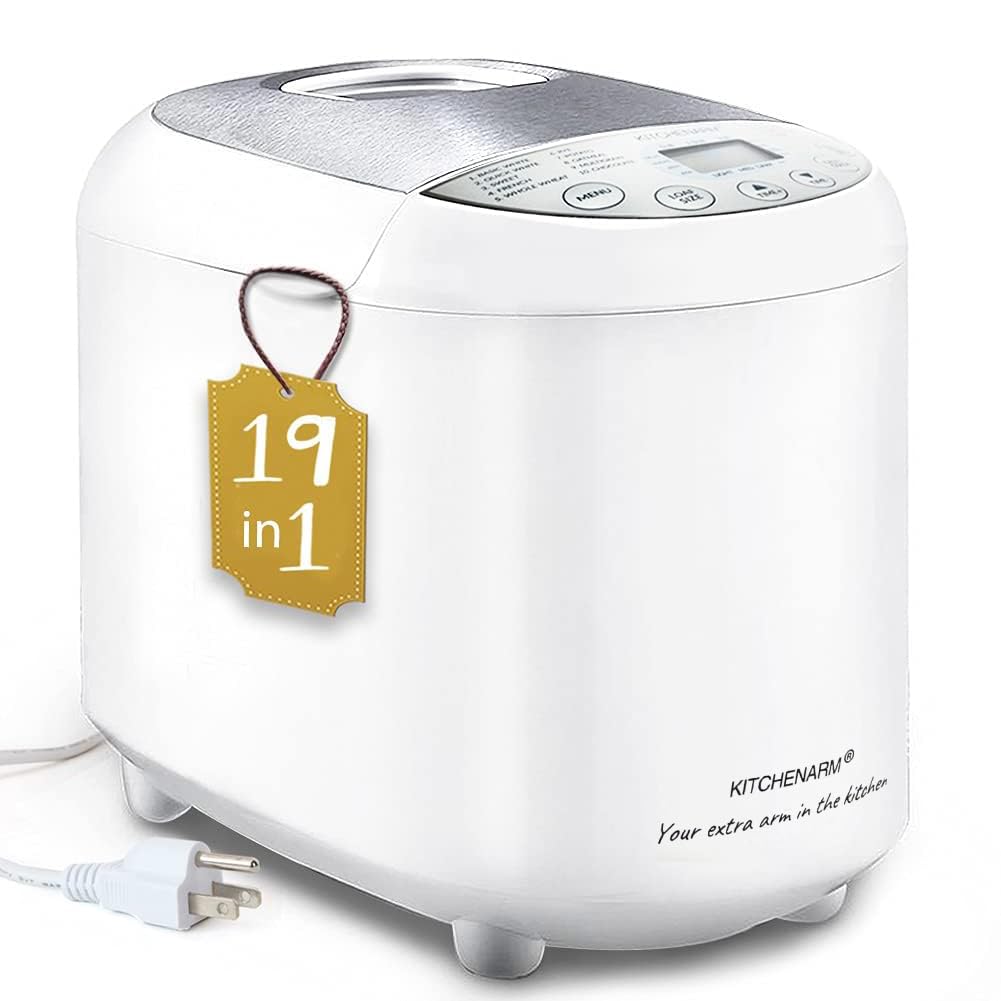
4. KITCHENARM 19-in-1 Bread Machine
Fifty-seven printed recipes and a two-year warranty make this the machine that holds a nervous first-time baker’s hand.
The spec that separates this pick from the others is the recipe support: 57 recipes in the printed book, with hundreds more on the manufacturer’s online recipe cloud. For a beginner, that is the difference between staring at a machine and knowing exactly what to load into it. The 19 menus split into 11 bread menus (basic white, sweet, French, whole wheat, gluten-free, multigrain, sourdough), 7 non-bread menus (cake, jam, yogurt, dough), and one fully programmable Home Made menu where you set each stage’s time yourself.
Setup is genuinely one-press once you settle on a recipe. The machine remembers your menu, loaf size, and crust color between bakes, so the second time you make the same loaf you just add ingredients and hit Start. It supports most pre-packaged bread mixes, which removes the measuring anxiety a lot of first-timers feel. The 15-hour delay timer and nut/paddle alarms are there for later, and the non-stick pan wipes clean after each bake. It runs quieter than older machines owners have replaced, and at 8.6 pounds it moves between counters without effort.
The main friction is documentation of quantities. A few recipes give some ingredients in spoons rather than grams, so you will do a bit of conversion if you bake by weight — the recipes that list both cups and grams are the ones to start with. Some recipes on the first bake under-rose, and the fix is to follow the written recipe exactly rather than improvising. Neither is a fault in the machine; it is the nature of a learning curve. The 4.5+ star standing and the two-year warranty backing it mean a bad first loaf is a recipe problem, not a reason to give up.
Why beginners gravitate here
- 57 printed recipes plus an online recipe cloud takes the guesswork out of the first dozen bakes
- Remembers menu, loaf size, and crust color so repeat bakes become one-press operations
- Fully programmable Home Made menu lets you set knead, rest, rise, and bake times yourself
- Two-year product warranty and lifetime customer service back it up
The parts that need patience
- Some recipes list yeast, oil, and honey in spoons rather than grams, so weight-based bakers do conversions
- A few recipes under-rose on the first attempt until you follow the written amounts exactly
- The pan needs a twist to lock and release rather than sitting straight in
Best for: the baker who wants a recipe book to lean on and a machine that remembers their favorite loaf settings.
Not for: anyone who wants to eyeball ingredients and improvise — this machine rewards following the printed recipe precisely.
5. Zojirushi Bb HAC10 Home Bakery Mini Breadmaker, 1 Lb (White)

The counter-space answer for one or two people who want a fresh small loaf and nothing more.
The first thing to understand is the size. This machine bakes only 1 lb loaves — roughly six to eight slices — and that is its purpose, not a limitation. If you live alone or as a pair and hate throwing away half a loaf, a 1 lb bake is the right shape. At 8.5″W x 11.25″D x 12.25″H it fits under a standard cabinet, and it weighs 16 ounces as a unit, so it is easy to move. The 120-volt, 450-watt build handles 1 lb cakes and breads, with settings for cookie/pasta dough and fresh fruit jams plus a quick-bake cycle that finishes in under two hours.
What makes it beginner-friendly is consistency: first-time bakers report perfect bread on the very first bake. First-time bakers report perfect bread from the very first bake, and the machine is quiet enough that you forget it is on. The pan is thick and solid, cleanup is quick with a non-stick kneading blade and baking pan, and the buttons are simple. The 13-hour delay timer and LCD with a viewing window are enough control without overwhelming a novice. It also does not heat up the kitchen, which is a real plus in summer.
The honest trade-offs are small and specific. The recipe book is basic, and some owners find themselves looking up recipes online rather than using the included one. The kneading blade coating wears over long use — a modest replacement part, replaced separately from the pan. A few people note the cake setting is the weakest feature. And because you can add nuts or raisins only manually, you need to be around the machine at the right moment. These are small frictions, not failures, and owners who have run theirs for years at a few bakes a week still describe dependable loaves.
The case for small: 1 lb loaves, 13-hour delay timer, compact under-cabinet footprint, and quiet operation — a machine built for one or two people who want fresh bread without waste.
Know going in: mix-ins go in by hand, the recipe book is basic, and the cake setting is the least-loved function — buy it for bread and dough, not cake.
Made for: singles and couples with limited counter space who want a fresh 1 lb loaf a few times a week.
Wrong fit if: you need to feed a family from one loaf or want the recipe book to carry you — you will lean on the internet for recipes.
6. Breville BBM800XL Bread Maker

The machine that lets you tune a loaf until it is exactly right, then save the recipe for good.
This is a bread maker for the beginner who plans to become a tinkerer. It runs 13 programs, but the real feature is nine custom settings you can build and store — modify any automatic program’s timings and crust, then save it as your own loaf. The collapsible kneading paddle folds away before baking starts so your bread can rise around it, which shrinks the paddle hole and leaves a cleaner bottom slice. An automatic fruit and nut dispenser drops mix-ins at the right moment without you standing there waiting, and a 60-minute power-interruption backup keeps a bake running through a short outage.
The build speaks to the price. At 830 watts and 16.8 pounds in brushed stainless steel, it kneads with authority and produces up to a 2.5 lb loaf, giving you 1 to 2.5 lb size options in one machine. The LCD guides you from dough to finished loaf and an interior light lets you peek without opening the lid. For a busy household, the draw is set-and-forget: load it, walk away, and return to a finished loaf about three hours later. Owners who have burned bread in cheaper machines describe a reliable bake here once the recipe is dialed in.
The trade-off is expertise, and a bit of variability. This machine rewards layering ingredients correctly — wet on the bottom, dry on top — and it runs louder than the quietest picks when the dough is dry, which is actually a useful signal to add water. The collapsible paddle has its supporters and its skeptics, so test that it folds freely on day one. As with any machine this complex, read the manual’s guidebook closely; it is dense but thorough. For a first-timer who wants one-button simplicity, this is more machine than you need — but for someone who wants to grow into custom loaves, it is the most capable option on this list.
Why it’s the premium choice
- Nine custom settings let you modify and save your own recipes alongside 13 automatic programs
- Collapsible paddle folds before baking to shrink the hole in the bottom of the loaf
- Automatic fruit and nut dispenser plus 60-minute power-interruption backup
- 830-watt motor, 2.5 lb capacity, and an interior light for checking progress without opening the lid
What you’ll have to learn
- Louder than the quietest picks when dough is dry, which is your cue to add water
- The collapsible paddle has mixed reactions — some report it not folding properly
- Rewards careful ingredient layering (wet bottom, dry top) rather than casual dumping
Built for: a beginner with ambitions — you want to tune crust, timing, and mix-ins and save the result for repeat bakes.
Skip if: you want the simplest one-button machine — this one asks you to learn its layering and settings first.
Know the Specs
Loaf capacity and why it matters
Capacity is listed in pounds — 1 lb, 1.5 lb, 2 lb, up to 2.5 lb — and it describes how much dough the pan holds, which translates to how many slices you get. A 1 lb loaf is roughly six to eight slices, best for one or two people. A 2 lb loaf feeds a family and gives you sandwich slices plus toast. Machines that offer multiple sizes in one pan, like 1 / 1.5 / 2 lb, let you scale to your household instead of baking more than you can eat.
Programs, presets, and custom cycles
A program is a preset sequence of knead, rest, rise, and bake times built for a specific loaf — basic white, whole wheat, gluten-free, dough only, and so on. More programs mean more types of bread without manual timing. A custom cycle, found on the Breville and KITCHENARM, goes further and lets you set each stage’s time yourself. For a true beginner, a handful of well-chosen presets covers most needs; the extra programs become useful as you branch out.
The delay timer and keep-warm function
The delay timer lets you load the pan in the evening and set the machine to start and finish so bread is warm at a chosen hour — 15 hours is common, 13 hours on the Zojirushi. The keep-warm function then holds the finished loaf at temperature, typically for an hour, so it does not go cold before you get to it. Together they turn the machine into a breakfast appliance rather than a weekend project.
Paddle design and crust control
The kneading paddle sits in the pan and mixes the dough, and it leaves a hole in the bottom slice of every loaf — unavoidable in this category. A collapsible paddle, like the Breville’s, folds away before baking so the bread rises around it and the hole is smaller. Crust control is a separate setting, usually light, medium, or dark, that adjusts bake time to change how browned the outside gets. Neither affects how the inside of the loaf turns out.
Common Questions
Do I need to knead the dough myself with a bread maker?
Can a beginner bread maker bake gluten-free bread?
How big a loaf should I bake for one or two people?
Why is there a hole in the bottom of my bread?
Can I put nuts and raisins in a beginner bread maker?
How long does a loaf take from start to finish?
Is a bread maker cheaper than buying bread?
Do I need special bread flour or will all-purpose work?
Can I set a bread maker to finish at breakfast time?
How do I clean a bread maker pan?
The Bottom Line
The beginner bread maker most first-timers should buy is the Elite Gourmet 2 Lb Programmable Bread Maker in Mint, because 19 one-touch programs, three loaf sizes, and a 15-hour delay timer make a real loaf a one-button job. If recipes are what you are short on, the KITCHENARM 19-in-1 bundles 57 printed recipes and a two-year warranty. And for a one- or two-person kitchen with no counter to spare, the Zojirushi Mini bakes a tidy 1 lb loaf under a cabinet. Whichever you pick, start with the basic white program and let the machine handle the kneading, rising, and baking.
How we choose
We do not accept paid placement. Every pick is matched to a real buyer and a real use-case; we do not hands-on test units.
Sources
Specifications: manufacturer listings and product documentation. Review insights: verified customer reviews, as of October 2026. Pricing: not shown on this page (it changes often); check the current price via the retailer link.
As an Amazon Associate, Aappliancez earns from qualifying purchases. This does not affect which products we feature.