Disclosure: Some links in this post are affiliate links. As an Amazon Associate I earn from qualifying purchases, at no extra cost to you. Learn more
Specs are compiled from manufacturer listings and verified buyer reviews and can change over time — please confirm the key details on the product page before buying.
Beetroot supplements are a genuinely confusing shelf, because some bottles are capsules you swallow and others are powder you stir into water — and the dose you actually get can be wildly different from one to the next. The quick answer: if you want the most straightforward daily habit, a capsule wins; if you want volume and flexibility, a powder wins. Below you get five real options sorted by what each one actually delivers, so you can pick the format that fits your routine and never buy blind.
This guide is built by comparing the manufacturers’ published specifications and the patterns across verified customer reviews, so you get each pick’s real strengths and trade-offs instead of marketing spin.
Two facts do most of the sorting here: capsules give you a fixed dose you can count on, while powders let you adjust the scoop and stretch the supply. That single choice shapes everything you’ll read in this roundup of beetroot supplements.
Top Picks

How To Choose The Best Beetroot Supplements
The first decision is not brand — it is format. A capsule asks nothing of you beyond a glass of water. A powder asks you to measure, stir, and drink something that tastes like beets. Know which of those two you’ll actually keep doing, because a supplement only helps if the habit survives past week two.
Capsule or powder, and what each one changes about your day
A capsule gives you a fixed dose every single time, which makes consistency easy. A powder lets you dial your serving up or down and usually stretches further per container, but it needs a scoop, a shaker or a spoon, and a tolerance for the earthy flavor. Buyers who travel or eat breakfast standing up tend to do better with capsules.
Read the serving count before the milligram number
A big bottle is not automatically a long supply. Look at the serving size on the label and divide the total count by it, because that is how many days the container genuinely covers. A 180-capsule bottle taken two at a time is 90 days of use, not 180 available doses. This single number is the fairest way to compare value across formats.
Understand what “concentrated” does to the dose
A 20:1 extract is a concentrate, meaning the raw beet material was reduced to a fraction of its original weight before it went in the capsule. That is why a concentrated capsule can be labeled at a much lower milligram figure than a whole-root capsule and still be a serious dose. Do not compare a 600 mg extract directly against a 2,400 mg whole-root product — they are measuring different things.
Check the filler list and the third-party testing note
The cleanest labels name organic status, say non-GMO, and tell you the batch was lab tested. Multi-ingredient formulas are worth reading closely, because added nutrients change what you are getting in each tablet. If you already take other supplements, scan for overlap before you stack them.
Side-by-Side Comparison
| Model | Best For | Format | Dose Per Serving | Servings | Amazon |
|---|---|---|---|---|---|
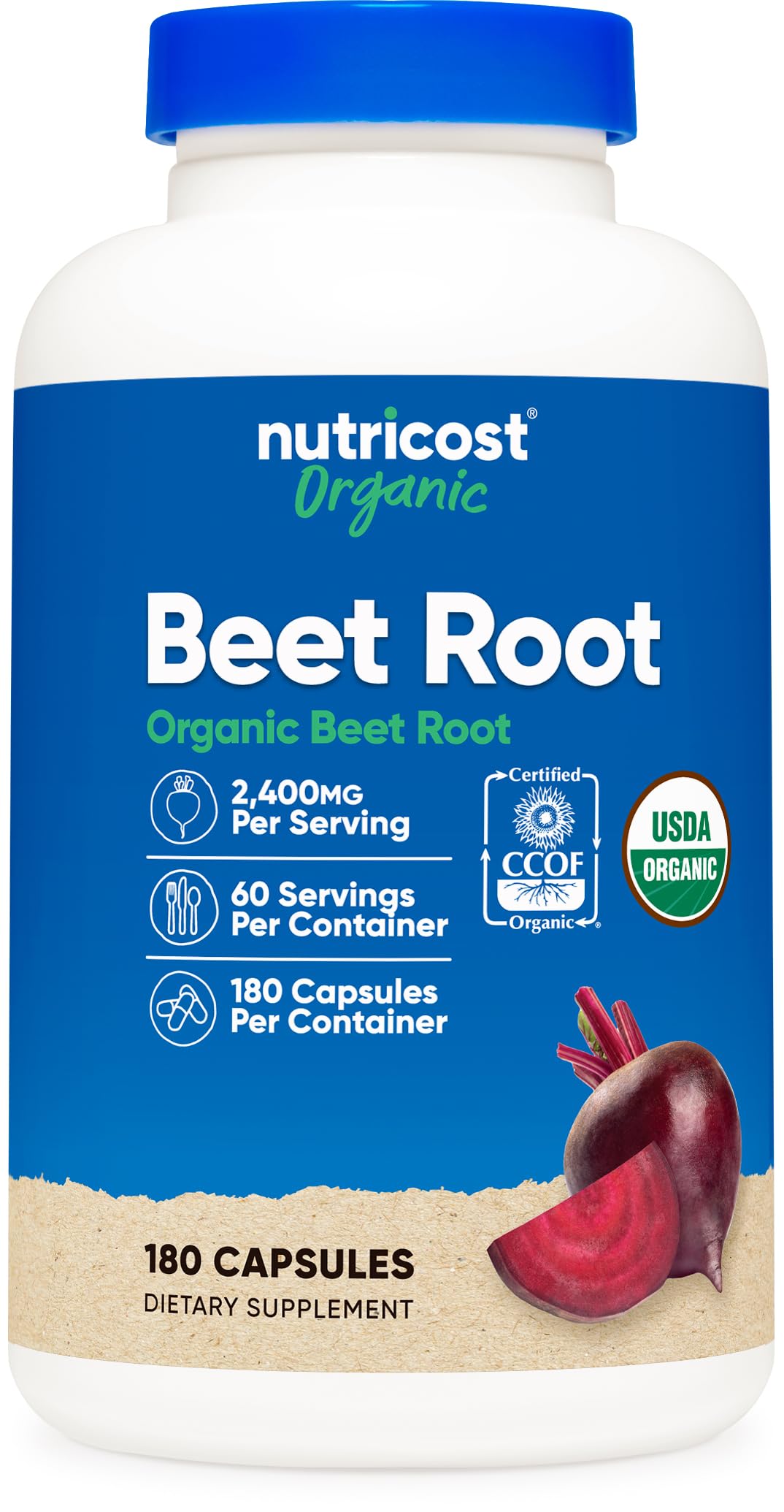
| Nutricost Organic Beet Root 2400mg★ Best Overall | Easy daily capsule habit | Capsules | 2,400 mg | 60 | Amazon |
| Nutricost Organic Beet Root PowderBest for Mixing | Mixing into kefir and smoothies | Powder | 1 scoop (approx. 1 rounded tsp) | — | Amazon |
| Micro Ingredients Beet Root Complex | Longest-lasting supply | Tablets | 2 tablets | 200 | Amazon |
| Beet Root Extract 20:1 Concentrated | Concentrated extract dose | Capsules | 600 mg (2 capsules) | — | Amazon |
| NatureBell Organic Beet Root Powder | Bulk powder, long supply | Powder | 4 g per scoop | Up to 565 | Amazon |
Detailed Reviews
1. Nutricost Organic Beet Root 2400mg, 180 Capsules
Our pick — 4.5+★ from 1,000+ verified ratings; the strongest balance of quality and price.
A whole-root capsule so easy to keep taking that it disappears into your morning habit.
Start with the number that decides everything else here: 2,400 mg of organic beet root per serving, delivered as two vegetarian capsules. That is a whole-root dose rather than a concentrate — four times the milligram figure of the 20:1 extract pick further down, though the two are measuring different things entirely. Read the dose as raw beet material, and the size makes sense.
The bottle holds 180 capsules, which works out to 60 servings of two. That is about two months of daily use from one container, and the count never leaves you guessing how far in you are. For anyone who wants to stop thinking about a supplement after they swallow it, this format is the whole point. As buyers describe it, the capsules are easy to swallow and there is no beet taste or smell to deal with — a real advantage if the vegetable itself puts you off.
What wins people over is plain effectiveness. Reviewers repeatedly credit it with better circulation and steadier blood pressure, and one year-long user put it simply: “I’ve been taking them for about a year, as they say it’s good for circulation.” Speeding that up is not how this category works, though — several people note it takes a few weeks before anything registers, and a few feel nothing at all. The recurring gripe is digestive rather than serious: some buyers mention constipation, so pair it with plenty of water.
Where this bottle earns its keep
- 2,400 mg of organic whole beet root per two-capsule serving
- 180 capsules equals 60 servings — a clean two-month run
- No beet flavor or smell to get past
- Certified organic, vegetarian, gluten free and non-GMO
What to keep in mind
- Results build slowly, and a few users report none at all
- Some buyers report constipation and pair it with extra water
- Darker spots inside the capsules are normal, not a fault
Reach for this if: you want one bottle that quietly covers two months of daily capsules with a real 2,400 mg dose.
Think twice if: you measure progress week to week — this is a slow-build format, not a quick hit.
2. Nutricost Organic Beet Root Powder
A single-ingredient beet powder for people who already drink something every morning.
This is one pound of USDA-certified organic beet root juice powder with a serving scoop tucked in — roughly one rounded teaspoon per serving. There is nothing else in the bottle: no sweetener, no fruit flavoring, no filler. If you want to know exactly what you are taking and nothing else, that short ingredient list is the entire case for it.
Smoothness is what the reviews talk about most, and it holds up. The powder dissolves without grit in water, and it stirs into kefir or a smoothie without changing the texture of the drink. People who like beets describe it as tasting like drinking the vegetable itself, which is a compliment in this category and a warning at the same time. If you dislike beets, this is the wrong format for you, full stop.
Two practical notes worth knowing before you order. The tub looks half empty on arrival because the powder compresses in transit — shake it and the fill level reveals itself. And it genuinely needs a stir rather than a dump, so give it a few seconds in the glass. Pre-workout users report a good pump and steadier energy through the session, though the effect scales with your scoop size.
Pure by design: One ingredient, certified organic, and no sweetness added — you taste beetroot and only beetroot, which is exactly what some buyers want.
The honest trade-off: That strong earthy flavor is divisive. Pre-workout buyers rate the pump and blood flow highly but admit the earthy taste takes getting used to.
Suits you if: you already blend a daily drink and want a clean, single-ingredient scoop to drop into it.
Not your format if: you need a flavorless dose — the beet taste here is real and unapologetic.
3. Micro Ingredients Beet Root

Four hundred tablets, two hundred days — the pouch that refuses to run out.
Run the math on the supply and this one stands apart. Four hundred tablets at two per day is a 200-serving pouch — more than three times the 60 servings in the Nutricost capsule bottle above. If restocking is the thing that keeps tripping up your routine, a single pouch carries you well past half a year.
It is not just beet root either. The formula stacks beet root with grape seed extract and CoQ10, which turns it into a broader daily wellness tablet than a single-ingredient capsule. Tablets are small and easy to swallow, there is no beet aftertaste to speak of, and the ingredient list is built without soy, dairy, gluten and tree nuts. Every batch is third-party lab tested, which matters when you are committing to months of the same product.
Buyers most often describe steadier readings, and one reports a documented drop sustained across multiple doctor visits. There is an honest catch on availability: this pouch has gone out of stock for stretches, and the subscription price moved upward once it returned. Worth knowing before you build a routine entirely around one supplier. The tablets, though, are the reason people keep coming back — easier to stay consistent with than a powder.
Why the pouch wins people over
- 200 servings from 400 tablets — the longest run in this lineup
- Beet root plus grape seed extract and CoQ10 in one tablet
- Small, easy-to-swallow tablets with no beet aftertaste
- Free of soy, dairy, gluten and tree nuts; third-party lab tested
Plan around this
- Stock has run out for long stretches before
- Subscription cost rose after a restock, per buyer reports
- Packaging has arrived in a different format than pictured
Best for: anyone who wants to buy once and forget about restocking for the better part of a year.
Watch out for: supply gaps — keep a backup if you rely on a subscription.
4. Beet Root Extract 20:1 Concentrated Supplement 180 Caps

The concentrate for buyers who want a smaller capsule to do more work.
Do not let the 600 mg figure fool you into thinking this is the weak option. It is a 20:1 concentrated extract, meaning the raw root was reduced twentyfold before encapsulation — so that 600 mg is a far denser dose than the number suggests next to a whole-root product. Each two-capsule serving is standardized to no less than 4% nitrates, the compound buyers in this category are actually chasing.
It also adds 10 mg of black pepper extract, a 4:1 concentrate included to help your body absorb the beet compounds instead of passing them through. Quality is the thing this bottle is judged on, and it holds up — every batch is third-party lab tested in the USA, and the capsules are vegetarian, gluten free, soy free, dairy free and caffeine free. Made in a GMP-certified facility adds a layer of process control that the label makes a point of stating.
Where it lands in daily use: buyers describe easy swallowing with no aftertaste or burping, and a few mention a firmness or fullness sensation roughly half an hour after taking it. The 180-capsule bottle stretches to a few months at the label dose, which is where the value argument sits. One note on the marketing — the front label leans on words like potent and premium, so read the nitrate standardization instead and let that be your guide.
The concentrate advantage: A 20:1 extract with 4% nitrate standardization and black pepper extract for absorption — real formulation depth rather than a bigger milligram badge.
Caveat to weigh: Concentrated extracts are not directly comparable to whole-root doses, and the bottle duration depends entirely on whether you follow the two-capsule serving.
Pick this one if: you would rather take a smaller, denser capsule and you care about standardized nitrate content.
Look elsewhere if: you specifically want whole organic beet root in the capsule rather than an extract.
5. NatureBell Organic Beet Root Powder 5Lbs

Five pounds of beet powder that will outlast your blender, your jar supply, and probably your resolution.
Sheer volume is the headline: five pounds of organic beet root powder per pouch, one scoop delivering 4 g of fresh beet root, and up to 565 total servings. Nothing else in this lineup comes close on servings, and it is sourced from whole beet root skin and flesh rather than peel alone. If you go through a scoop a day, this is a supply measured in seasons, not weeks.
Quality and taste are what buyers bring up constantly, and the earthy-sweet flavor is a genuine point in its favor — one buyer describes it as “a nice pure beet flavor” and calls it first rate. It dissolves into water, smoothies, tea, yogurt or oatmeal, and at higher doses it turns your drink a vivid red, which people treat as visible proof they got the real thing. Nothing artificial or filler-based is in the pouch.
Here is the catch, and it is worth planning for. The powder is fine enough that it clumps hard in the bag, and some buyers hit rock-hard lumps that need sifting before they will dissolve. The ziplock seal can also fail because fine powder works into the grooves, so transferring the contents into mason jars on arrival is the smart move. Do that, and the lumps and the seal both stop being a problem.
Where the volume pays off: Up to 565 servings of organic whole-beet powder from one pouch, mixable into almost anything you already drink or eat.
The clump reality: Fine powder compacts in transit and some bags arrive with lumps that need breaking up — sift or jar it and the issue goes away.
Right choice if: you want the longest possible run from one purchase and don’t mind scooping daily.
Wrong choice if: you would rather not deal with sifting, jar transfer, or a strong earthy flavor in your glass.
Know the Specs
Whole Root vs. Concentrated Extract
A whole-root capsule lists the actual weight of dried beet root you swallow — 2,400 mg in the Nutricost bottle means exactly that much beet material per serving. A 20:1 extract works differently: the raw root was reduced to a fraction of its weight first, so a 600 mg capsule can carry far more beet material than the number implies. Never compare the two milligram figures against each other; they describe different stages of processing.
Servings, Not Bottle Size
The only fair way to compare how long a container lasts is to divide the total count by the serving size. Two capsules per serving turns 180 capsules into 60 servings, and 400 tablets into 200. This number tells you the real cost of your daily habit far better than the container look or the front-of-label promise.
Why Nitrates Get Standardized
Most people buy beet root for its naturally occurring dietary nitrates, the plant compounds behind its reputation. A formula that states a standardized nitrate percentage — like the 4% minimum on the 20:1 extract — is telling you how much of that compound you can expect per serving rather than leaving it to batch variation.
Powder Texture and Mixability
Powders live or die on how they behave in liquid. Fine powder dissolves fast but compacts in the bag; coarser powder flows better but can leave grit. A scoop included in the container saves you guessing the serving size, and shaking rather than stirring tends to break up clumps more effectively. Storing powder in a sealed jar after opening keeps it free-flowing.
Common Questions
Is beetroot powder or a capsule better for daily use?
Why does a 600 mg beet extract capsule cost more than a 2,400 mg whole root one?
How many capsules should I take each day?
How long does a bottle of beetroot capsules last?
Why did my beet powder arrive looking half full?
My beet powder has hard lumps that will not dissolve — is it spoiled?
Can I mix beetroot powder into something other than water?
Does beetroot supplementation change the color of your urine?
What should I check before combining beetroot with other supplements?
Are these beetroot supplements third-party tested?
The Bottom Line
For most people, the beetroot supplements pick that does the most work is the Nutricost Organic Beet Root 2400mg — a 2,400 mg whole-root dose across 60 servings, in a capsule with no beet taste to negotiate. If you want the longest stretch between purchases, the Micro Ingredients 400-tablet pouch covers 200 servings and adds grape seed extract and CoQ10. And for anyone who prefers a scoop over a capsule, the NatureBell 5-pound pouch delivers up to 565 servings — just plan to jar it on arrival to keep the clumps away.
How we choose
We do not accept paid placement. Every pick is matched to a real buyer and a real use-case; we do not hands-on test units.
Sources
Specifications: manufacturer listings and product documentation. Review insights: verified customer reviews, as of October 2026. Pricing: not shown on this page (it changes often); check the current price via the retailer link.
As an Amazon Associate, Aappliancez earns from qualifying purchases. This does not affect which products we feature.