Disclosure: Some links in this post are affiliate links. As an Amazon Associate I earn from qualifying purchases, at no extra cost to you. Learn more
Specs are compiled from manufacturer listings and verified buyer reviews and can change over time — please confirm the key details on the product page before buying.
The hard part about a bee problem is not finding a can of spray — it is standing close enough to use one without getting stung. That is why reach matters more than anything else on this shelf. A 27-foot stream keeps you out of the flight path; a contact killer stops the colony before it rebuilds. These five picks split by job: ground nests, nests behind siding, and pet-safe porch treatments.
This guide is built by comparing the manufacturers’ published specifications and the patterns across verified customer reviews, so you get each pick’s real strengths and trade-offs instead of marketing spin.
Reach, spray form, and residue matter more than brand name here. The gap between a 27-foot stream and a 5-foot one decides whether you fix the nest or call someone. This breakdown of the bee killer spray shelf shows which can fits the nest you actually have.
Top Picks


How To Choose The Best Bee Killer Spray
The single biggest mistake people make with bee spray is buying for the bug instead of buying for the nest. Where the nest sits decides everything — the height, the material, and how close you have to get. Work out the nest location first, then match the can to it. Get that order right and you treat the nest once instead of three times.
Match the spray form to where the nest lives
A foaming aerosol is the right tool for an exposed nest you can see from a distance. The foam clings to the nest instead of dripping off, so the treatment keeps working after you walk away. A liquid spray suits surfaces you want to coat — siding, eaves, baseboards — where you need the formula to sit and linger. A dust is a different animal entirely: it works best for a hole you cannot see into, like the brick gap by a garage door or a cavity behind siding, because the powder coats whatever walks through it. Pick the wrong form and you can spray three times and still have bees.
Distance is the spec that protects you
Every serious can of bee killer advertises a spraying range, and that number is your safety margin. A stream that reaches 27 feet lets you treat a nest from the driveway instead of standing under it. A can that only reaches 12 feet still works, but you are closer to the flight path, which matters most if anyone in the house is allergic to stings. Check the stated range before you buy, not once the nest is buzzing.
Timing and technique do the rest
Spray at dusk, when bees and hornets are least active and most of the colony is inside the nest. Stand with the wind at your back so the spray drifts away from you, not into your face. If you are treating a nest you plan to remove physically, give the formula time — at least a day — before you touch it. Returning foragers after a treatment mean the nest needs a second pass, not a different product.
Side-by-Side Comparison
| Model | Best For | Form | Stated Spray Reach | Container Size | Amazon |
|---|---|---|---|---|---|
| Spectracide Wasp and Hornet Killer Aerosol, 20-Ounce, 3-Pack★ Best Overall | High nests you want to hit from the driveway | Foaming aerosol | Up to 27 feet | 20 oz, 3 cans | Amazon |
| Bonide 363 Spider and Ground Bee Killer, 2 Pack of 10 ozTop Performer | Cavities and ground-bee holes you cannot see into | Dust | — | 10 oz, 2 packs | Amazon |
| Stem Kills Wasps, Hornets and Yellow Jackets | Pet-conscious households treating porches and eaves | Liquid spray | 5 to 6 feet | 10 fl oz | Amazon |
| WASP&HRNT KILL 20OZ 2PK | Big yards with repeated nests all summer | Foaming aerosol | — | 20 oz, 2 cans | Amazon |
| Mighty Mint Peppermint Oil Insect Repellent Spray, 16 oz | Patios and entryways you want bugs to avoid | Ready-to-use peppermint spray | — | 16 oz | Amazon |
Detailed Reviews
1. Spectracide Wasp and Hornet Killer Aerosol, 20-Ounce, 3-Pack
Our pick — over 4.5★ from 1,000+ verified ratings; the strongest balance of quality and price.
A 27-foot stream lets you kill the nest without standing underneath it
If your nest is up under a roofline, in a tree, or anywhere you would rather not walk up to, this is the can to reach for. The stated reach is up to 27 feet, and that distance is the whole point — you can stand on the driveway, aim up, and let the stream do the walking for you. It kills on contact and it eliminates the nest rather than just scattering the colony, which is why it holds the top spot here. Three 20-ounce cans in the pack means you are not halfway through a second nest when you run dry.
What wins people over is simple effectiveness. That is the thing buyers talk about more than anything else by a wide margin, followed closely by how well it puts down wasps specifically, and then by the spraying distance itself. A recurring sentiment is that it works on ground hornets from 25 to 30 feet and does not leave a nasty smell behind. Another common note is that the stream is strong enough to hit pests while keeping a safe distance — one buyer puts it plainly: “This is the only wasp spray we purchase anymore.”
The honest catch is can size. The same customers who love how it works are split on how much product you actually get per can, and value lands as a mixed point in the feedback rather than a clean win. So this is the pick for someone with real nests to clear and a few cans to spend, not for someone chasing the lowest cost per treatment. Against the Stem botanical can below, this one sprays dramatically farther — 27 feet versus 5 to 6 feet — so the trade-off is reach against gentler ingredients.
Where it earns its place
- Up to 27 feet of reach keeps you clear of the flight path
- Kills on contact and eliminates the nest rather than just repelling
- Foaming aerosol clings to the nest so it keeps working after you walk away
- Three 20-ounce cans cover multiple nests in one season
What to weigh first
- Opinions on value are split — not everyone feels the can lasts long enough
- Contains a chemical insecticide, so it is not the pet-safe choice
- Liquid aerosol can drift in wind, so check your stance before spraying
Reach for this if: your nests sit high, far, or anywhere you would rather not stand beside them.
Think twice if: you need a pet-safe formula around a toddler or a dog, since this is a chemical aerosol.
2. Bonide 363 Spider and Ground Bee Killer, 2 Pack of 10 oz
The dust that gets into the hole no spray can reach
Ground bees that nest in a brick gap or behind siding are a completely different problem from a hanging nest, and this is the only pick here built for it. It is a dust, not a liquid — a fine powder that carries a 0.25% Permethrin active ingredient and comes with a snorkel tube applicator (a thin flexible nozzle) so you can puff powder into a cavity you cannot see into. The bees walk through it on the way in and out, and it keeps working between visits. If two spray cans already failed on your ground nest, this is the format that tends to close it out.
Effectiveness is what carries this one, and it is followed closely by bee reduction — meaning people track both that it works and that the activity actually stops. The picture owners paint is consistent: ground bees in a garage door brick hole came out coated white, then nothing in or out for a week. Yellow jackets behind siding went away with one application. There is also a value angle that comes up — for a lot of people this dust costs far less than bringing in a pest control service.
Two things to know before you commit. First, it is a powder, so it is dusty to apply and it needs to be placed inside the entry point rather than sprayed over the surface. Second, shipping has been slow for some buyers. This is not the pick for a wasp nest under an eave — for that, the 27-foot Spectracide above is the right tool. This one is for the hole, the gap, and the cavity.
The cavity specialist: a snorkel-tipped 0.25% Permethrin dust that reaches into brick gaps and behind siding where no liquid stream lands.
What to plan for: powder application is messy, and some orders have taken a while to arrive — order before the season turns.
Best fit: ground-nesting bees and yellow jackets tucked into a hole, gap, or wall cavity.
Not the one for: an exposed hanging nest you want to hit from a distance.
3. Stem Kills Wasps, Hornets and Yellow Jackets

A botanical can for the porch you share with pets and kids
Households that need to treat a nest near where the dog plays face a real problem: the strongest sprays are the ones you least want around pets. This 10-fluid-ounce can is formulated with geraniol and lemongrass oil, carries no added dyes or fragrance, and the maker states it is safe for use around people and pets when used as directed. It is a liquid spray rather than a foam, and it targets wasps, hornets, and yellow jackets. For a nest on a porch, an eave, or a camera housing, that combination is the reason to pick this one over a chemical aerosol.
People who use it describe the same pattern: spray at dusk, and the nest is empty by morning with the wasps dead below it. One small can reportedly handled three medium paper wasp nests, about four inches each, at four seconds apiece. The botanical scent is described as light rather than harsh, and it does not linger the way a chemical smell does. In the smell department, the geraniol and lemongrass blend beats what people expect from a bug spray.
The trade-offs are real and worth knowing. It is oil-based, so it leaves a greasy residue on whatever it touches — camera lenses and composite decking are the surfaces people flag. The scent, while mild, still bothers some noses, and one buyer had a mild reaction to the smell and used a mask. Reach is short: about 5 to 6 feet of spray, so you need to get reasonably close. Compared with the 27-foot Spectracide, you trade distance for gentler ingredients — and at 10 fluid ounces, it is also the smallest can on this list.
Why pet households pick it
- Plant-based formula with geraniol and lemongrass, safe for use around people and pets when used as directed
- Light botanical scent with no added dyes, fragrance, or harsh chemical odor
- Works fast — nests treated at dusk are often clear the next morning
- Rated highly by buyers who specifically wanted a milder option
What you give up
- Sprays only 5 to 6 feet, so you have to get much closer than with an aerosol
- Oil-based formula leaves a greasy residue that needs wiping off surfaces
- Smallest can here at 10 fluid ounces — a nest-heavy season needs repeat purchases
- The botanical scent is mild but still noticeable indoors or in tight spaces
The right call when: pets, kids, or scent sensitivity rule out a harsh chemical can.
Know before you spray: short reach and oily residue mean you plan the angle before you pull the trigger.
4. WASP&HRNT KILL 20OZ 2PK
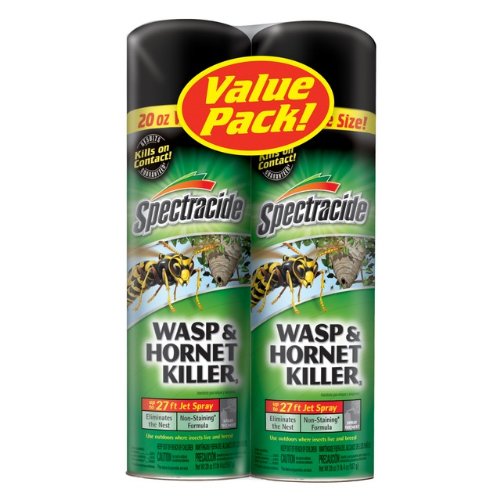
Two full cans that take on more than just wasps
Reach for this pair when your yard has been under siege for a whole summer and one can will not get you to fall. The twin pack holds two 20-ounce cans, or 40 fluid ounces total — four times the volume of the 10-ounce Stem can — so you can treat nest after nest without a mid-season trip to the store. The formula knocks down wasps, hornets, and yellow jackets, but it also lists tent caterpillars, scorpions, and ants on the label, which makes it the widest net on this list. It is a foaming aerosol, unscented, and it kills on contact.
Buyers who used it describe running out after a long summer of nests around a backyard porch, treating what needed treating, and going back to the same can the next time. For a big yard, the volume is the draw — 40 fluid ounces covers ground a smaller two-pack cannot, and a single 20-ounce can of this size is the kind of thing owners label a go-to.
Two honest limits. Spray distance is the soft spot — it does not reach nearly as far as the 27-foot Spectracide at the top of this list, and it is not the tool for a nest way up under a roofline. It also covers yellow jackets less convincingly than it does wasps and hornets, so if yellow jackets are your main problem, the Bonide dust handles that job more directly. For a mid-range two-pack with a broad kill list, though, it is a sensible backup to keep in the garage.
Volume play: 40 fluid ounces across two foam cans gives you enough to work through an active season without restocking.
Grab this one if: you want a broad-label twin pack with plenty of product for repeated nests.
Look past it if: your nests are high enough that long-range reach matters more than cans on the shelf.
5. Mighty Mint Peppermint Oil Insect Repellent Spray, 16 oz

A peppermint bottle that clears the patio and smells like a spa
This is the odd one out on this list, and it is worth understanding why. It is a 16-ounce ready-to-use peppermint oil spray, not a nest killer — the point is to make your space unpleasant for insects so they stop showing up, and to drop the ones you catch directly. Spray it on baseboards, entryways, and patios, and the mint keeps working as a deterrent while it lingers. For someone whose actual problem is ants, roaches, and crickets around a porch rather than a hornet nest under the roof, that is a different and very useful job. It is also a natural spray many people reach for as a replacement for pest control chemicals.
Where it shines is speed on contact. It kills insects fast, particularly crickets, which reportedly drop within seconds of a direct spray. The scent is the piece people single out most — a crisp, clean peppermint aroma rather than a chemical smell, and it doubles as a mild residual deterrent because bugs avoid where it has been sprayed. It is also a big bottle of concentrated peppermint oil, so a 16-ounce can covers a lot of ground for the money.
Be clear about what this does and does not do. It is a repellent first and a killer second — it kills what you spray it on, but it will not wipe out a colony or a nest the way an aerosol or a dust will, and one buyer describes it as a bug repellent rather than a killer. The smell is also a matter of taste: the aroma is strong and can get overwhelming if you over-apply, and it fades faster than you might expect on a breeze. Think of it as the maintenance layer — the spray you keep by the back door to handle strays — not the one you grab for an active nest.
What it does better than the rest
- Kills on contact, dropping crickets within seconds of a direct hit
- Strong peppermint scent doubles as a residual deterrent around entryways
- Large 16-ounce ready-to-use bottle with concentrated peppermint oil
- Pet-friendly formula made for people who avoid chemical pest control
Where its limits sit
- Repellent-heavy — it will not eliminate an active nest or colony
- The mint aroma is strong and can overwhelm in a closed space
- Fragrance fades quickly outdoors, so you reapply more often
Best used for: patios, entryways, baseboards, and quick one-off kills where the mint scent is part of the appeal.
Not for: a hornet or ground-bee nest that needs knocking out.
Know the Specs
Spray reach and why it protects you
Every serious bee killer lists a maximum spraying distance, and that figure is really a safety spec. A longer stream means you stand farther from a defensive swarm, which matters most in households with anyone allergic to stings. The Spectracide can reaches up to 27 feet, while the Stem botanical spray reaches about 5 to 6 feet. Pick based on where the nest actually is — high and distant nests need the longer throw.
Aerosol, liquid, or dust
The form decides which nests you can treat. Foaming aerosols produce a clinging foam that stays on the nest instead of dripping off, so they work well on exposed nests. Liquid sprays coat a surface and leave a film, which suits siding and eaves. Dusts are a fine powder applied with a narrow tube, and they work best in a cavity or a ground hole where the insects walk through the powder on the way in and out.
Active ingredients and pet safety
Synthetic formulas typically use a named chemical active ingredient to kill on contact. Botanical options rely on plant extracts such as geraniol and lemongrass oil, which is why they are the pick in homes that need something used around pets and people when used as directed. Neither format is harmless — read the label and follow the timing and application directions regardless of which you choose.
Timing the application for full colony kill
Bees and hornets are most active in the heat of the day and least active at dusk. Spraying at sunset means more of the colony is inside the nest at once, so the treatment reaches more of them. Stand with the wind at your back to avoid spray drift, and wait at least 24 hours before removing a treated nest.
Common Questions
Can I use bee killer spray indoors around pets?
How far should a bee killer spray reach?
Is a dust better than a spray for ground bees?
What is the difference between a bee killer and a bee repellent?
Will peppermint oil spray kill wasps and hornets?
How long should I wait before removing a treated nest?
Can bee killer spray stain my deck or siding?
Does bee killer spray work on yellow jackets?
How many nests will one can of bee killer spray handle?
Should I spray a bee nest at night or during the day?
The Bottom Line
For most bee problems, the bee killer spray winner is the Spectracide Wasp and Hornet Killer Aerosol, 20-Ounce, 3-Pack because its foam kills on contact and its 27-foot stream keeps you out of the flight path while you work. If your problem is ground bees in a hole or yellow jackets behind siding, grab the Bonide 363 Spider and Ground Bee Killer, 2 Pack of 10 oz — the snorkel tube and 0.25% Permethrin dust reach where no spray does. And for keeping the patio clear without harsh chemicals, the Mighty Mint Peppermint Oil Insect Repellent Spray, 16 oz is the one to keep by the back door. Whatever you pick, spray at dusk, stand with the wind at your back, and give the nest a full day before you touch it.
How we choose
We do not accept paid placement. Every pick is matched to a real buyer and a real use-case; we do not hands-on test units.
Sources
Specifications: manufacturer listings and product documentation. Review insights: verified customer reviews, as of October 2026. Pricing: not shown on this page (it changes often); check the current price via the retailer link.
As an Amazon Associate, Aappliancez earns from qualifying purchases. This does not affect which products we feature.