Disclosure: Some links in this post are affiliate links. As an Amazon Associate I earn from qualifying purchases, at no extra cost to you. Learn more
Specs are compiled from manufacturer listings and verified buyer reviews and can change over time — please confirm the key details on the product page before buying.
Your bedroom is the one room where your music, your late-night TV, and your quiet Sunday morning all have to share the same four walls. That’s why a bedroom speaker has to be small enough to sit on a nightstand or shelf, but still powerful enough to fill the room without sounding thin or tinny. This guide cuts through the noise and shows you which bookshelf and powered monitor pairs actually deliver clean, room-filling sound for a bedroom setup — and which trade-offs you can live with.
This guide is built by comparing the manufacturers’ published specifications and the patterns across verified customer reviews, so you get each pick’s real strengths and trade-offs instead of marketing spin.
Your bedroom should be a place where music sounds good, not just background noise. A pair with a 4-inch driver and a silk dome tweeter turns a nightstand into a real stereo setup. This breakdown of the best bedroom speakers will help you pick the right one for your turntable, TV, or desktop PC.
Top Picks

How To Choose The Best Bedroom Speakers
A bedroom isn’t a concert hall, and the speakers that win in a studio or living room don’t always win next to your bed. What you need is a pair that sounds full at low-to-moderate volume, fits the surface you actually have, and connects to whatever gear you already own — a phone, a turntable, a TV, or a desktop PC.
Driver size and how it shapes your bass
The driver is the round cone that pushes air and creates sound. Bigger drivers — measured in inches across the cone — typically move more air and produce deeper bass. A 4-inch driver works well on a shelf or nightstand, while a 5.25-inch driver can reach lower notes and fill a larger bedroom without distortion. If bass punch matters to you, look at the woofer size first.
Powered vs. passive: do you need a receiver?
Powered speakers have an amplifier built into one of the cabinets, so you plug the speakers straight into the wall and connect your phone, TV, or turntable directly. Passive speakers need a separate amplifier or receiver to run them, which adds another box, another cable, and more desktop clutter. For most bedroom setups, a powered pair is the simpler and cleaner choice.
Inputs that matter for a bedroom setup
Bluetooth lets you stream from a phone or tablet with no cables across the room. Optical and coaxial inputs carry digital audio from a TV or computer with no conversion loss. RCA and AUX handle turntables, mixers, and older gear. If you plan to hook up multiple sources — say a TV and a turntable — look for speakers with at least two inputs so you aren’t constantly swapping cables.
Side-by-Side Comparison
| Model | Best For | Driver Size | Connectivity | Power / Amp | Amazon |
|---|---|---|---|---|---|
| Edifier R1280T★ Best Overall | Best Overall | 4″ full range + 13mm tweeter | Dual AUX / RCA | Powered (built-in) | Amazon |
| Prosonic BT30Best for TV & Movies | Best for TV & Movies | 4″ full range + 0.75″ tweeter | Bluetooth 5.3, Optical, Coaxial, AUX | 80W | Amazon |
| OHAYO 60W | Best Compact Pick | 3″ carbon fiber full range + 0.75″ tweeter | Bluetooth 5.3, RCA, AUX, USB | 30W x 2 | Amazon |
| Majority D40 | Most Versatile Inputs | 4″ bass driver + 30mm tweeter | Bluetooth, Optical, RCA, USB, SD | 60W | Amazon |
| MEVOSTO DS19 | Best for Turntables | 5″ woofer + 1″ silk dome tweeter | Bluetooth 5.4, RCA, AUX, USB | 36W RMS (built-in) | Amazon |
| Sony SSCS5 | Best for Hi-Res Audio | 5″ driver (3-way, 3-driver) | Bluetooth | Needs separate amp | Amazon |
| Klipsch R-50M | Best Premium Pick | 5.25″ spun-copper woofer | Bluetooth | Needs separate amp | Amazon |
Detailed Reviews
1. Edifier R1280T Powered Bookshelf Speakers
Our pick — 4.5+★ from 19,000+ verified ratings; the strongest balance of quality and price.
The 4-inch bookshelf pair with 19,000+ ratings and a 13mm silk dome tweeter.
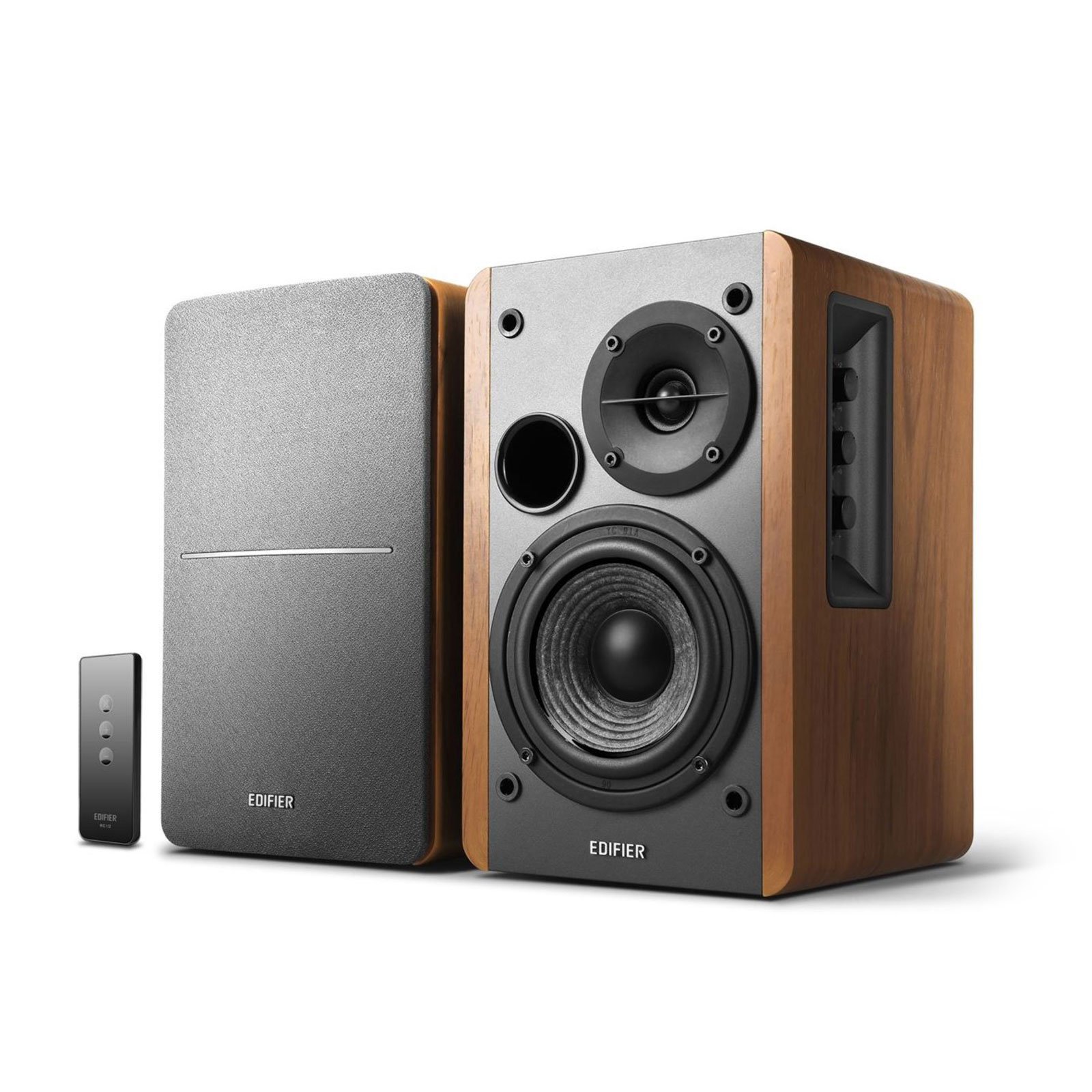
The Edifier R1280T is the crowd favorite for a reason. With 4.5+ stars across 19,000+ owners, it’s the pair most bedroom listeners land on when they want real stereo separation without turning their room into a studio rig. The 13mm silk dome tweeter (a soft, lightweight dome that handles high notes smoothly) and 4-inch full-range driver work together to produce natural, balanced sound that doesn’t fatigue your ears after an hour of listening.
Setup is genuinely plug-and-play. Dual AUX inputs let you connect two devices at once — say your phone and your PC — without swapping cables every time. The included remote handles volume, and the side-panel knobs give you hands-on control over bass and treble. The classic wood-finish MDF cabinet (medium-density fiberboard, a dense wood composite that resists resonance) looks like furniture rather than tech gear, which matters when the speakers live on a bedroom shelf.
The honest catch: customers describe the treble as light even with the knob maxed, and the out-of-box EQ runs flat. Some tweaking — in your phone’s equalizer or through the side knobs — brings out the best in them. Bass is strong for a 4-inch driver, but this is not a thumping, sub-heavy speaker. If you want chest-pounding low end for movies, the Klipsch R-50M at 5.25 inches goes deeper. But for music, podcasts, and TV in a bedroom, the R1280T is hard to argue with. And as several owners have noted, there is no subwoofer output, so you are working with what the drivers give you.
What earns the top spot
- 13mm silk dome tweeter and 4-inch driver deliver natural, balanced stereo sound
- Dual AUX inputs connect two devices simultaneously — no cable swapping
- Remote plus side-panel bass and treble knobs give you real EQ control
- Wood-finish MDF cabinet blends into bedroom decor instead of standing out
- Plug-and-play setup with generous cable lengths right from the start
Where it asks for patience
- Treble is light even at maximum — plan on some EQ adjustment
- Out-of-box flat EQ may disappoint until you tune the knobs
- No subwoofer output limits future bass upgrades
Grab these if: you want proven, well-reviewed sound for a small bedroom used for music, TV, and casual listening from two devices.
Pass if: you need deep, subwoofer-level bass or want a wireless-first setup with TV optical output — the Prosonic BT30 above handles that better.
2. Prosonic BT30 White Bookshelf Speakers
Optical and coaxial inputs plus an 80W built-in amp for TV audio without a receiver.
If your bedroom doubles as a movie room, the Prosonic BT30’s 80W built-in amplifier and multiple digital inputs make a strong case. Optical and coaxial inputs let you run a lossless digital connection straight from your TV or computer — no analog conversion loss, just clean audio. Buyers report connecting them via optical cable to a 75-inch Insignia TV, and one reviewer wrote that their man cave “sounds like a studio.” Bluetooth 5.3 keeps wireless streaming stable from your phone or tablet.
The 4-inch full-range bass driver and 0.75-inch silk dome tweeter sit inside an MDF wooden enclosure with a plastic face covering. It’s a clean, modern look that reads as white decor rather than black tech gear — useful if your bedroom leans light and airy. A built-in DSP (digital sound processor, which shapes and cleans the audio signal) and DRC (dynamic range control, which keeps the loudest and quietest parts listenable) round out the sound processing. Volume and input switching live on the included remote, and the bass and treble knobs sit on the side of the main speaker. The 10-meter Bluetooth range is plenty for a bedroom.
Know the trade-offs before you buy. Bass runs heavy and can overpower at low volume — a few owners found them less than ideal for quiet, low-bass listening at night. The IR remote uses proprietary codes, meaning you can’t program your Google TV, Fire Stick, or Roku remote to control volume or mute. And treble runs light, so a quick phone EQ adjustment brings out the highs. Singing Wood Family backs these with a 24-month warranty and lifetime technical support, which adds real confidence.
Where it shines: A bedroom theater setup with optical TV audio and 80W of clean power. Few pairs at this level give you this many input types in one powered box.
What to expect: Heavy bass from the start and a proprietary remote that won’t play nice with your universal remote.
Worth it for: renters and movie lovers who want digital TV audio and wireless streaming from one compact pair.
Think carefully if: you mostly want quiet late-night listening — the bass bias works against you here.
3. OHAYO 60W Computer Speakers

A 3-inch driver and 60W total in a cabinet that fits a crowded nightstand.
The OHAYO delivers 30 watts per side — 60W total — from a 3-inch carbon fiber full-range driver and a 0.75-inch carbon fiber silk dome tweeter. Carbon fiber is a stiff, lightweight material that helps keep the cone from flexing and muddying the sound. In this pair, the result is clear, crisp highs and a surprisingly present mid-bass, thanks to a rear bass port that pushes low-end depth out the back of the cabinet. The MDF wooden enclosure cuts down on box resonance, meaning you get sound from the drivers, not from the cabinet rattling along.
Compact is the operative word. These fit next to a TV or on a small apartment shelf, and the space-saving design won’t eat your desktop. On the front panel, a physical volume knob sits within easy reach during a game or a music session — no fumbling for an app. Bluetooth 5.3 handles wireless streaming, while RCA, AUX, and USB inputs cover everything from a PC to a turntable to a streaming device. They’re not waterproof, so keep them away from the bathroom or any splash zone. Setup takes minutes and the box includes the active speaker, the passive speaker, a power cable, a data cable, and a 3.5mm audio cable.
What wins people over is the sound-to-size ratio. Buyers consistently call the audio quality high, with clear, crisp highs that fill a small room. The recurring note is that the volume control and long-term reliability draw mixed feedback — a handful of units don’t hold up the way the sound quality suggests. That’s worth knowing if you’re hard on your gear. The 20 KHz frequency response covers the audible highs well, but if you want deep low-end rumble, this isn’t the pair for that.
The case for it: 60W total power in a footprint that disappears on your shelf, with carbon fiber drivers that keep the highs clean and the price tag easy on the wallet.
One real caveat: The volume knob and durability have drawn mixed notes from owners — this is a great pair if you treat it well, but not a battle tank for constant abuse.
Best fit: tight bedrooms, dorm rooms, and gaming desks where every inch of surface counts and you want genuine stereo sound.
Look elsewhere if: you need deep bass or expect the construction to survive heavy travel.
4. Majority D40 Active Bookshelf Speakers

Bluetooth, optical, RCA, USB, and SD playback through one 60W amp.
The Majority D40 packs 60 watts of amplified sound into a solid wood cabinet with a 4-inch bass driver and a 30mm tweeter. It’s the input options that set it apart: Bluetooth for wireless streaming, optical for a clean digital TV connection, RCA for older gear, USB and SD card slots for direct MP3 playback, and AUX for everything else. That’s more ways to connect than most pairs in this range offer, and it means you can run your bedroom TV, phone, laptop, and even a USB drive full of music through one set.
The side buttons and included remote handle volume, bass, and treble adjustments — and the remote comes with batteries. Owners note that bass and treble are adjustable without any bass or treble level indicator, so it’s a tune-by-ear affair rather than a screen-guided one. Bluetooth range reaches 10 meters, easily covering a bedroom, and connection to phones, tablets, and laptops runs smooth and stable. The front-glossy finish and wooden cabinet look sharper than the price suggests, and the whole package includes all the cables you need: RCA and AUX, plus optical. Developed in Cambridge, UK, and backed by a 3-year warranty.
The catches are real but manageable. The auto Bluetooth pairing drains power over time, and there’s no auto power-off — so if you leave them on, they’ll stay on. The left-right cable is hard-wired at 58 inches, which limits how far apart you can place the speakers, so if you want wide stereo separation on a big dresser, this pair fights you. The sound runs a touch recessed and concert-hall tuned, with weak tweeters that some listeners find thin at the top end. Best for medium rooms and higher volumes rather than hush-quiet listening.
Input flexibility leads the pitch: Bluetooth, optical, RCA, USB, and SD playback in one 60W package. If you’ve got a mix of old and new gear, this is the pair that keeps up.
Note the placement limit: The 58-inch hard-wired left-right cable and auto Bluetooth power drain are the two things most owners adjust around.
Pick it if: you want to connect everything — TV, phone, laptop, USB stick — without adding a single box.
Skip the wide-separation dream: the 58-inch fixed cable and recessed sound keep this in the nearfield role, not the wide-stage role.
5. 5-Inch Powered Bookshelf Speakers

Dual 5-inch woofers and a 36W RMS built-in amp for turntables with a phono preamp.
Vinyl has a physical warmth that cheap Bluetooth speakers flatten, and the MEVOSTO DS19 is built with that in mind. Dual 5-inch woofers (the driver that handles bass and low-mid frequencies) paired with dual 1-inch silk dome tweeters push sound through a built-in 36W RMS amplifier, so you get full-frequency stereo without needing a separate receiver. Bluetooth 5.4, RCA, and AUX inputs let you connect a turntable with either a built-in or external phono preamp, and the 15-meter Bluetooth range is one of the widest in this lineup.
The DS19 also supports USB digital audio, running straight into a computer without any analog conversion. Physical bass and treble knobs live on the speaker itself, so you can dial in the sound physically rather than through an app. The included remote adds control from wherever you’re sitting. Each cabinet measures 5.9 by 6.1 by 9.7 inches (width, depth, height) — which means it needs a roomy desk or a record-player cabinet with real depth, not a narrow nightstand. A 12V/15V/18V DC input lets you run them off RV or boat power if your setup ever goes mobile, and an 18V/2A adapter is included.
The US version of the DS19 doesn’t support Dolby Audio, so if you want surround-sound TV playback, check your TV’s audio output options before buying. There’s also a practical reminder from the maker: confirm your device is compatible with the audio output options supported before purchasing, especially if you plan to use a USB connection, since USB ports vary in whether they carry audio output. The wood grain finish has been a hit with owners, and performance consistently exceeds expectations at the price. For a bedroom record setup, it’s a strong value.
Where it wins
- Dual 5-inch woofers and dual 1-inch silk dome tweeters deliver true full-range sound
- 36W RMS built-in amp means no separate receiver needed
- Bluetooth 5.4, RCA, AUX, and USB digital audio cover vinyl, PC, and streaming
- 15-meter Bluetooth range is generous for any bedroom size
- Independent physical bass and treble knobs plus an included remote
Things to know first
- No Dolby Audio support — check your TV output settings
- USB audio requires a compatible port; not all devices work
- Each speaker measures 5.9 x 6.1 x 9.7 inches — needs real desk space
Dial it in: vinyl collectors who want warm, room-filling vinyl playback without a separate receiver taking up shelf space.
Check compatibility first: the missing Dolby support and USB audio port requirements mean this pair demands a quick pre-purchase compatibility check.
6. Sony SSCS5 3-Way 3-Driver Bookshelf Speaker System

A 3-way, 3-driver design that splits the signal across separate woofers, mids, and tweeters.
The Sony SSCS5 is a 3-way, 3-driver design — meaning it splits the audio signal across three separate drivers instead of two. Each driver is tuned for a narrower frequency range, which typically reduces overlap and lets each note appear more precisely in the soundstage. The bundle includes the speaker pair plus two Studio Monitor Isolation Pads, which sit under the cabinet to cut vibration transfer to the shelf and clean up bass response. Sony describes the design as drawing on its high-end SSAR Series, with fine timing alignment across the whole frequency range for natural bass.
High-Resolution Audio support is a headline spec here. Sony’s implementation captures music at a higher rate than a CD, with both more audio samples per second and greater bitrate accuracy per sample. Whether your bedroom rig can extract what high-res files offer depends heavily on your source player and amp — but the speaker pair itself is built with that headroom in mind. Buyers have described these as accurate and neutral-toned bookshelf speakers that shine with a good amplifier. One owner, using them with a turntable setup, called them “outstanding” and said they’d buy them again. Note that these are passive speakers — they need a separate amplifier or receiver, so factor in a 100W-class amp like the one a reviewer paired with them.
The 5-inch driver reaches noticeably lower than the 3-inch driver in the OHAYO, giving you more weight in the low end from the start. Highs run slightly forward of the bass, so mild EQ and smart positioning — or the isolation pads in the box — can even out the balance. At least one disappointed owner found the midrange dominant and the tweeters weak, describing them as not full-range. But with an amp that matches their neutral character, these reward you with real scale for the money. They’re a great fit if you’ve already got a receiver and want to upgrade the sound, not build a wireless system from scratch.
How it differentiates: The 3-way, 3-driver architecture and included isolation pads push it beyond what most bedroom speakers at this level offer for detail and instrument placement.
The passive caveat: No built-in amp means you need a receiver or amplifier to run them — which adds cost and a box.
For audio fans who already own an amp: accurate, neutral sound with real high-res headroom for turntable and digital setups.
Not for plug-and-play bedrooms: without a separate receiver, these have no way to make noise.
7. Klipsch Reference Next-Generation R-50M Horn-Loaded Bookshelf Speakers

A 5.25-inch spun-copper woofer and 90° x 90° Tractrix horn — passive, so it needs a receiver.
Klipsch’s R-50M wears the loudest badge in this lineup: a 5.25-inch spun-copper woofer, the largest in the group, paired with a 90° x 90° Tractrix horn and a Linear Travel Suspension (LTS) aluminum tweeter. The horn shapes and directs high frequencies across a wider listening window, so the balance isn’t razor-thin. The LTS tweeter design uses a rigid aluminum diaphragm with a Kapton suspension to reduce distortion and pull out fine detail. Its spun-copper woofers borrow technology from Klipsch’s Reference Premiere series, with steeper cone angling for a smoother, more accurate response.
The MDF cabinet with scratch-resistant, textured wood-grain vinyl gives it a clean, modern look with hidden fasteners, an edge-to-edge horn, and low-profile magnetic grilles. It’s the sharpest-looking speaker here in the flesh, and it’s compact enough to slot into tighter bedroom spots without dominating the room. Like the Sony SSCS5, the R-50M is a passive speaker — you’ll need a separate amp or receiver, so plan for the extra component and its footprint. For a 5.1 home theater setup, owners mention it rounds out the surround array well.
The sound signature is Klipsch through and through: dynamic, punchy, and forward, with real attack on drums and brass. For bedroom use, that forwardness can feel loud if you’re sitting close, and some listeners find the horn-loaded highs bright at neighborly volumes — that’s the classic Klipsch trade-off, not a defect. With 4.5+ stars across 600+ owners, it’s the highest-rated passive option in this guide, and it beats the Sony SSCS5 in this lineup on both driver size (5.25 inches vs. 5 inches) and the sheer presence of its high-frequency horn. If your bedroom doubles as a small theater and you can give the speakers a little space, this is the pair that delivers movie-theater scale.
Why it earns the premium badge
- 5.25″ spun-copper woofer is the largest driver in this lineup for deep, punchy bass
- 90° x 90° Tractrix horn widens the balance for flexible bedroom placement
- LTS aluminum tweeter with Kapton suspension cuts distortion for detailed highs
- Magnetic grilles, hidden fasteners, and scratch-resistant wood-grain vinyl look sharp and modern
The honest trade-offs
- Passive design — needs a separate amp or receiver, adding cost and a component
- Forward, dynamic sound can feel bright in a close-up bedroom setup
For the home theater fan with a receiver: the 5.25-inch woofer and horn-loaded tweeter give this lineup its biggest, boldest sound.
Think twice if: you want a plug-in-and-go setup or listen at whisper volume right beside the speakers.
Know the Specs
Driver Size and Frequency Range
Driver size measures the width of the cone that moves air. Bigger cones move more air and typically reach deeper bass. In this lineup, the smallest is the OHAYO’s 3-inch driver, and the largest is the Klipsch R-50M’s 5.25-inch spun-copper woofer. Between those, the Edifier and Prosonic run 4-inch full-range drivers with dedicated tweeters — a design that uses one cone for most of the sound and a small dome for the high notes. If you want bass you can feel in your chest, go bigger. If your bedroom is small and you listen at low volume, a 3-inch driver like the OHAYO’s stays clean and uncluttered.
Powered vs. Passive: Which Is Right for Your Bedroom
A powered speaker, like the Edifier, Prosonic, OHAYO, Majority, or MEVOSTO, has an amplifier inside the cabinet. You plug it in, connect your device, and you’re done. A passive speaker, like the Sony SSCS5 or Klipsch R-50M, has no built-in amp — it needs an external receiver or amplifier to make sound. Powered speakers make more sense for a typical bedroom desk or nightstand since they take less space and fewer cables. Passive speakers reward you with more upgrade flexibility and the chance to use a favorite existing amp, but they require planning and more shelf real estate.
Connectivity Options Explained
Bluetooth lets you stream wirelessly from a phone, tablet, or PC — the higher the version, the more stable and efficient the connection. Bluetooth 5.3 and 5.4 cover the latest in this lineup (Prosonic, OHAYO, MEVOSTO). Optical and coaxial inputs carry digital audio from a TV or computer without analog conversion loss — Prosonic and Majority are the only picks that offer these. RCA and AUX handle turntables, mixing boards, and older electronics. USB audio input is useful for a desktop PC connection. If you need to run several devices at once, the Majority D40 and MEVOSTO DS19 cover the widest mix of sources.
Bass, Treble, and EQ Control
Bass and treble knobs let you shape the sound to your room and tastes. Side-panel controls on a powered speaker mean you can dial in adjustments without digging through apps. The Edifier R1280T, Prosonic BT30, Majority D40, and MEVOSTO DS19 all offer physical bass and treble controls. Remote controls are handy for volume from across the room. The Edifier, Prosonic, Majority, MEVOSTO, and OHAYO all include remotes. If you like to tweak and tune, prioritize speakers with real knobs over app-only controls.
Common Questions
Can I connect a turntable directly to powered bedroom speakers?
How do I connect bedroom speakers to my TV?
What size speakers fit on a nightstand or small shelf?
Do I need an amplifier for the Sony SSCS5 or Klipsch R-50M?
Is Bluetooth good enough for critical listening in a bedroom?
Can I use bedroom speakers with a PS5 or gaming console?
How much space do bedroom speakers need behind them?
What’s the difference between a bookshelf speaker and a studio monitor?
Which bedroom speakers are best for TV and movie watching?
The Bottom Line
For most bedroom setups, the Edifier R1280T remains the safest bet — real stereo separation, a plug-and-play ARC-to-3.5mm-connection, and a build that scores top marks for both sound and appearance over thousands of ratings. If your bedroom doubles as a TV room, the Prosonic BT30 gives you optical and coaxial inputs plus 80W of digital power. If you spin vinyl, the MEVOSTO DS19 is the one to reach for. Whichever you pick, give your bookshelf speakers a few inches of space to breathe and a solid surface to sit on, and your bedroom will sound better than you thought possible.
How we choose
We do not accept paid placement. Every pick is matched to a real buyer and a real use-case; we do not hands-on test units.
Sources
Specifications: manufacturer listings and product documentation. Review insights: verified customer reviews, as of October 2026. Pricing: not shown on this page (it changes often); check the current price via the retailer link.
As an Amazon Associate, Aappliancez earns from qualifying purchases. This does not affect which products we feature.