Disclosure: Some links in this post are affiliate links. As an Amazon Associate I earn from qualifying purchases, at no extra cost to you. Learn more
Specs are compiled from manufacturer listings and verified buyer reviews and can change over time — please confirm the key details on the product page before buying.
If you are waking up with rows of bites and you have already thrown out a mattress, here is the short answer: the right spray stops an infestation because it kills the bugs you can see and leaves a residue that keeps killing the ones you cannot. Skip the foggers and the no-name aerosols. What matters is a product that kills on contact, keeps working after it dries, and can be sprayed directly on seams, tufts, and bed frames without wrecking the fabric.
This guide is built by comparing the manufacturers’ published specifications and the patterns across verified customer reviews, so you get each pick’s real strengths and trade-offs instead of marketing spin.
Below you will find how to read an EPA-registered label, which active ingredients actually knock bed bugs down, and which sprays hold a residue long enough to catch newly hatched nymphs. Every pick here is a real, EPA-registered product you can apply yourself, and this breakdown of the bed bug insecticide market tells you exactly which can to grab first when the bites start.
Top Picks

How To Choose The Best Bed Bug Insecticide
Most people buy the wrong can for one of two reasons: they grab a contact killer and expect it to keep working for weeks, or they grab a long-residual product and expect the bugs to drop the instant they spray. Neither spray does both jobs well. You want a product that knocks down the adults you can find and a residue that catches the hatchlings you cannot.
Read the active ingredients before anything else
The label tells you which kind of fighter you are holding. A product built around dinotefuran and pyriproxyfen, for instance, pairs a fast knockdown with an insect growth regulator that interferes with hatching. A plant-extract formula works differently and tends to be chosen by people who want to spray a mattress their child sleeps on. Both are legitimate; they just solve different parts of the problem.
Match the spray to the surface
Bed frames, baseboards, and carpet take a heavier treatment than the mattress itself. Water-based, non-staining formulas are the ones you can put on fabric without a visible mark. Solvent-heavy aerosols can streak paint and leave an oily trail on walls. Check the label’s approved use list before you point the nozzle at anything upholstered.
Plan for repeat treatments, not one
No single can ends an infestation. Eggs hatch on their own schedule, so a product with a short residual needs to go down again after the first round dries out. That is why a can lasting a few weeks is often a better buy than a bigger container with no residual claim at all. Budget your number of cans around a treatment schedule, not a single spray day.
Side-by-Side Comparison
| Model | Best For | Volume | Residual Claim | Key Active | Amazon |
|---|---|---|---|---|---|
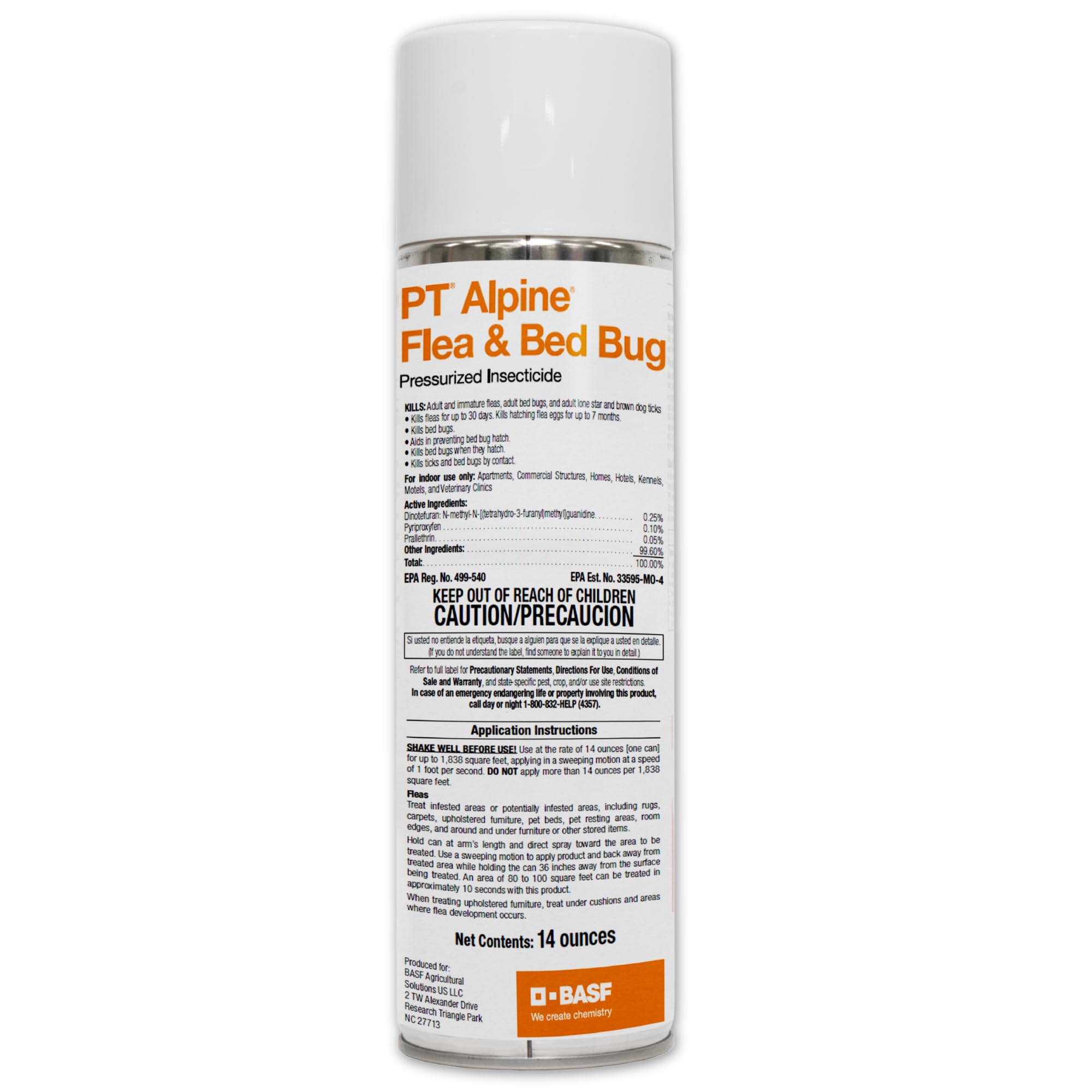
| BASF PT Alpine Flea & Bed Bug Killer★ Best Overall | Overall knockdown plus residual | 14 fl oz | Up to 3 weeks | Dinotefuran | Amazon |
| Good Night Bed Bug SprayBest for Odorless | Odorless, budget-friendly maintenance | 16 oz | — | — | Amazon |
| Bedlam Insecticide Spray | Resistant strains and long storage | 17 fl oz | — | — | Amazon |
| Bed Bug Killer 16 oz EcoVenger by EcoRaider | Plant-based, child and pet households | 16 oz | Two weeks (dried) | Geraniol, cedarwood oil | Amazon |
| Harris 5 Minute Kill Time Bed Bug Killer | Fast kill plus a month of protection | 32 fl oz | Up to 30 days | — | Amazon |
Detailed Reviews
1. BASF PT Alpine Flea & Bed Bug Killer
Our pick — 4.5+★ from 1,000+ verified ratings; the strongest balance of quality and price.
Three actives in one can, and a residue that keeps hunting after the spray dries.
What sets this one apart is the chemistry stack. Dinotefuran at.25% is the fast knockdown, pyriproxyfen at.10% is an insect growth regulator (it stops eggs and nymphs from developing into breeding adults), and prallethrin at.05% adds a quick flush. That combination explains why it is the crowd favorite here — 4.5+ stars across 1,200+ owners.
One 14-ounce can covers up to 2,625 sqft according to the label, which is measured in perimeter spraying at the wall-floor junction rather than soaking an entire room. The chemistry is also the reason a professional would recognize it: dinotefuran is approved for public health use and food handling establishments. You can spray headboards, box springs, mattress edges, tufts, folds, sides, and seams, and the formula dries rapidly without soaking the fabric.
Residual control is rated for up to 3 weeks on multiple surfaces, and the label states it aids in preventing bed bug hatch while the dual actives keep targeting hatching eggs for up to seven months. Compare that with a contact-only spray: this one is still working on a Tuesday when you sprayed on a Sunday. It is also labeled for luggage — you can spray directly into pockets, seams, folds, and around wheels after a hotel stay.
What justifies the top slot
- Three actives cover fast knockdown, hatching eggs, and flushing out hiding bugs in one can.
- Up to 3 weeks of residual on multiple surfaces, so a re-treatment plan can actually be spaced out.
- Non-staining and quick-dry, so a mattress edge or box spring spring is not left damp or marked.
- Labeled for luggage pockets and seams — a practical travel weapon as well as a home one.
What to keep in mind
- The label explicitly says do not apply to an entire mattress — edges, tufts, folds, sides, and seams only.
- Takes about an hour to dry, and it is slippery while wet, so keep everyone off the floor until it sets.
- Coverage of 2,625 sqft assumes perimeter spraying, not full-room soaking.
Buyers report it putting down infestations in weeks rather than months, and it is the product pest control companies have used in the field. Follow the directions — vacuum daily during treatment, and repeat because eggs hatch on their own clock. Do not expect one can to end a heavy infestation on its own.
Go with this: you want a single can that both drops pests on contact and keeps working after it dries, and you want to spray seams, frames, and luggage without ruining anything.
Look elsewhere: if you cannot ventilate properly or follow a strict re-treatment schedule, because this formula wants airflow and repeat visits.
2. Good Night Bed Bug Spray
The can you reach for when the spray has to go down while everybody is still in the room.
Good Night takes a different route than the BASF pick. There is no knockout chemical listing — the label simply states it eliminates bed bugs, lice, ticks, fleas, and dust mites, and that it is odorless and water-based. For a lot of households, that is exactly the trade they want: something that can go on carpet after vacuuming and around a bedroom without sending everyone outside for an hour.
Where it fits best is maintenance rather than a heavy first strike. Long-term owners spray carpets monthly and beds weekly before a sheet change, and treat it as a prevention habit rather than a rescue can. That tracks with the way most infestations get re-established: a few bugs survive in a seam, then repopulate. Consistent repeat sprays close that door. It also handles dust mites and lice, so a bed you have drained and cleaned does double duty.
The honest catch is the smell question. The label says odorless, and plenty of people back that up, but the review pages tell a split story — some noses do register something, and it can still trigger sinus sensitivity even without a detectable scent. Suit up with ventilation and give it an hour. Also note the size: 16 ounces gets you roughly the same volume as the BASF can, so budget more than one for a whole apartment.
Where it wins: the combination of water-based and odorless makes it one of the easier sprays to put down in a room where children sleep, and the label covers five targets — bed bugs, lice, ticks, fleas, and dust mites — so you are not buying a second product for the carpet.
Where it needs a partner: it is not marketed as the aggressive knockdown can, so pair it with a proper contact spray and a residual treatment if the infestation is established rather than light. Treat it as part of the plan, not the entire plan.
The right call for: you want an odorless, water-based can to spray beds and carpets on a routine, and you are willing to re-apply regularly.
skip it if: you are dealing with a heavy, established infestation and need the hardest immediate knockdown on the shelf.
3. Bedlam Insecticide Spray

The can for bugs that have already shrugged off a store-bought spray.
Bedlam is built specifically for pyrethroid-resistant bed bugs — a strain that has been through enough household pesticide to survive it. The label also lists bed bug eggs, fleas, ticks, dust mites, carpet beetles, and clothes moths as targets, which makes it the broadest label in this group. That resistance coverage is the reason pest control techs and property managers keep it in the truck.
Its secret weapon is transfer effect. It does not drop a bug instantly — instead the bug picks up the residue and carries it back to the harborage, where it spreads to the nest. On a 188-unit property, a manager used Bedlam for spot-spraying light residual cases after heat treatments failed, and a Bedlam-and-diatomaceous-earth combination was the routine on a stubborn home. The 17-fluid-ounce can is paired with a 3-year shelf life when stored at room temperature, so a spare can does not expire in the closet.
Two things to plan for. Reapply roughly every three weeks across three to five treatments, because transfer effect is a slow burn, not a knockout punch. And watch the surface: it can streak walls, so keep it on baseboards, frames, seams, and bedding rather than paint. Mask up and keep pets out for about four hours after spraying.
The specific strength: the label’s resistance coverage and transfer effect solve a problem most sprays ignore entirely — a bug population that has already survived other products.
The realistic limit: it is not the one-spray-and-done can. You will buy more than one, apply it on a schedule, and if the strain is still failing after that, the label’s own guidance points toward switching products rather than soaking harder.
Pick it when: cheaper sprays have already stopped working on your bugs, or you want a can that stays viable in the closet for years between outbreaks.
Think twice if: you need results by tomorrow morning, since Bedlam spreads through the nest rather than dropping bugs on contact.
4. Bed Bug Killer 16 oz EcoVenger by EcoRaider
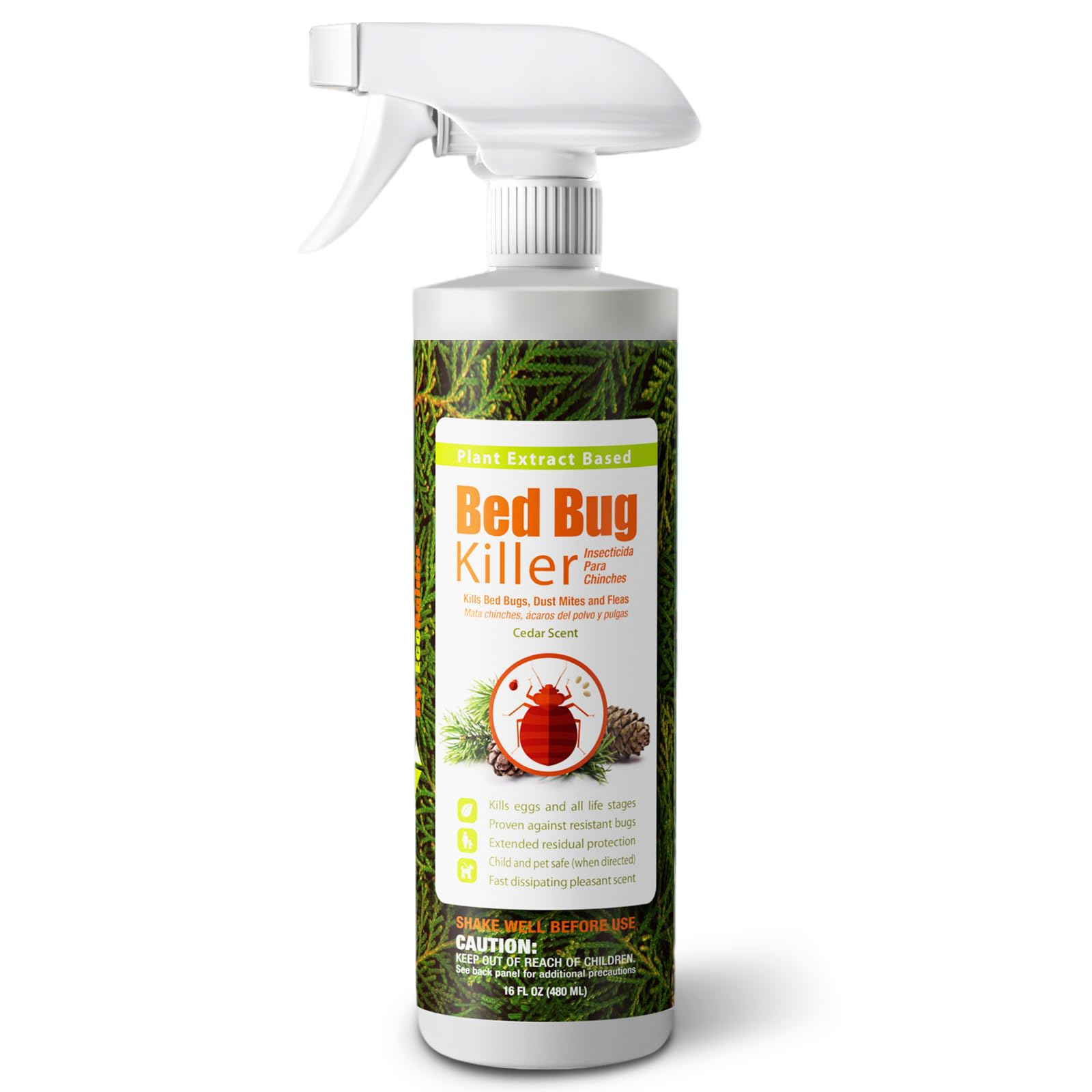
Geraniol and cedarwood oil, and a dry residue still killing a full two weeks later.
EcoVenger is the one you put on a mattress your kid sleeps on without the whole room clearing out first. Its actives are geraniol, cedarwood oil, sodium lauryl sulfate, glyceryl dicaprylate, silica hydrate, glyceryl monooleate, and water, and it carries USDA BioBased certification plus a dermatological safety claim from the maker. A published university study ranked it the top natural product against bed bugs among 12 tested, with a dry residual that held up for two weeks.
The label claims 100% efficacy on adults and nymphs on contact, the highest performance in destroying bed bug eggs, and proven control of bed bugs resistant to traditional pesticides. In practice that is what makes the repeat work worthwhile — a bed bug under direct exposure is inactive and stays dead, and cracks and crevices keep yielding bodies for weeks afterward. A four-week, bug-free stretch on a home infestation is the usual verdict once it is used consistently.
The weak point is not the formula, it is the hardware. The nozzle assembly is the recurring complaint in this lineup — a trigger that gives out, a bottle that cracks within a session, and instructions small enough to be hard to read. The maker does offer free replacement for damaged nozzles, so keep that route in mind rather than writing the whole formula off. The smell also splits opinion: it is a cedar-and-geraniol scent rather than a chemical one, and some find it strong enough to want the windows open.
Why it’s the safe-household choice: it is the only pick here that is a botanical blend certified non-toxic and labeled for direct use on mattresses and box springs.
The recurring gripe to plan around: the sprayer and bottle are the fragile part. Buy the larger format if it is available, transfer into your own pump sprayer if you have one, and keep the free-replacement offer in your back pocket.
Reach for it if: someone in the house is sensitive to chemical sprays or you are treating a crib-adjacent or pet-adjacent room and want a plant-extract formula you can put on fabric.
Look elsewhere if: you want the toughest industrial chemistry or a sprayer that will survive a full bottle, because that is where this one delivers less than 100%.
5. Harris 5 Minute Kill Time Bed Bug Killer

Five minutes to a dead bug, thirty days of standing guard after that.
Harris attacks the problem on two fronts and puts a number on each. The formula kills bed bugs at all life stages, including eggs, within 5 minutes of contact, and the residual protection is rated for up to 30 days. Compare that with the BASF can’s 3-week surface claim: this one stretches the guard time and adds an egg kill inside the 5-minute window. It is EPA-registered for indoor use under EPA Reg. No. 1021-2793-3, and the 32-fluid-ounce volume is the largest can in this lineup.
The formula is water-based, odorless, and non-staining, so it goes on baseboards, cracks, crevices, bed frames, mattresses, furniture, and fabrics and dries clear. The odor history here is genuinely quiet — people who are used to a sharp chemical smell get suspicious at first, then find that it did the job. On the practical side, the label’s whole-home approach means you are spraying the entire room perimeter, not just the bed, which is where a lot of first-time treatments fall short.
It is a two-person job if you want a full home crawl, and it wants daily reapplying for the first two weeks in a live infestation, then scheduled visits to hold the line. The one recurring nuisance is shipping rather than formula: some cans arrive dented or leaking in transit, so inspect the box before you start. Harris as a brand has been selling pest control since 1928, so the instruction depth on the label is worth the read.
Where the numbers land: 5 minutes to kill and 30 days of residual are the best-outlined timeline in this group, and 32 fluid ounces means fewer cans bought mid-treatment.
What it asks of you: a daily spray schedule for the first couple of weeks, and a careful check of the box on delivery so a leak does not get opened on the carpet.
Best suited to: a whole-room or whole-home treatment where you want a stated kill time and a month of coverage from one larger can.
Not the one if: you only need an occasional touch-up, since this volume and the 30-day residual are overkill for one bed frame.
Know the Specs
Contact kill versus residual action
These are two separate jobs. Contact kill means the bug dies when the spray hits it, which is what you use on a bug you can see. Residual means the spray dries down and keeps killing whatever crawls across it later, which is what catches the nymphs that hatch from eggs you never found. Look for a product that states both. A 5-minute contact kill with 30 days of residual covers both jobs in one product, while a contact-only can needs a second product laid down behind it.
Why an insect growth regulator matters
An insect growth regulator (IGR) is a compound that stops a nymph from maturing into an adult that can breed. It does not kill outright — it breaks the life cycle. When it is paired with a knockdown active, the combination does two things at once: it drops the adults you can find, and it blocks the next generation from replacing them. That is the difference between a treatment that looks better for a week and one that holds. Read the label for an IGR by name rather than trusting the marketing front of the can.
Reading the square-footage claim correctly
A large square-footage number is almost always measured in perimeter spraying — the joint where the wall meets the floor, plus the frames and seams — not coverage of every square inch of carpet. So a can listing 2,625 sqft does not mean 2,625 sqft of soaked floor. Plan your can count around the seams, baseboards, box springs, and bed frames you intend to treat, and buy a spare. Running out mid-treatment and leaving a half-done room is how infestations come back.
Storage, shelf life, and nozzle care
Most of these sprays keep for years when stored at room temperature and out of direct heat, so a spare can is worth keeping between outbreaks. The part that fails first is usually not the formula but the sprayer, and the smaller trigger units crack more often than the can itself. Store the can upright, clear the nozzle after each use, and if a trigger does fail, check the maker’s replacement policy before buying a whole new can.
Common Questions
Can I spray bed bug insecticide directly on my mattress?
How long does a bed bug spray keep working after it dries?
Do these sprays kill bed bug eggs?
What is a pyrethroid-resistant bed bug and why does it matter?
How many cans will I need for a one-bedroom apartment?
Are these safe around pets and children?
Why does my spray smell if the can says odorless?
How often should I re-treat, and how long do I have to keep going?
Does a non-staining spray actually leave no mark on walls and carpet?
Should I combine two different bed bug products?
The Bottom Line
If you want the shortest route to a bug-free bedroom, the BASF PT Alpine Flea & Bed Bug Killer is the one to start with — three actives that knock bugs down, block hatching eggs, and hold a residue for up to 3 weeks on a surface you can spray without staining it. That combination is why it tops this list.
If you are treating an established home and want a stated kill time plus a 30-day residual in a bigger can, the Harris 5 Minute Kill Time Bed Bug Killer gives you the clearest timeline. If the bugs have survived other sprays, switch to the Bedlam Insecticide Spray for its resistant-strain coverage. And if there is a child or a pet in the room you are treating, the EcoVenger by EcoRaider is the plant-based formula with a two-week dry residual to back it up.
Whichever can you pick, treat it as a schedule rather than a single day: spray, dry, vacuum, launder everything that will fit in a hot dryer, and come back for a second round. That is the plan that actually ends an infestation, and every product on this list is built to fit into it.
How we choose
We do not accept paid placement. Every pick is matched to a real buyer and a real use-case; we do not hands-on test units.
Sources
Specifications: manufacturer listings and product documentation. Review insights: verified customer reviews, as of October 2026. Pricing: not shown on this page (it changes often); check the current price via the retailer link.
As an Amazon Associate, Aappliancez earns from qualifying purchases. This does not affect which products we feature.