Disclosure: Some links in this post are affiliate links. As an Amazon Associate I earn from qualifying purchases, at no extra cost to you. Learn more
Specs are compiled from manufacturer listings and verified buyer reviews and can change over time — please confirm the key details on the product page before buying.
You are losing sleep in your own bed, and the not-knowing is almost worse than the bites. Here is the short answer: if you need to look for bed bugs with your own eyes, a UV flashlight is your fastest tool, and if you want to stop them reaching your mattress in the first place, a passive interceptor trap under each leg does the work while you sleep. This guide covers both kinds, because they solve two different halves of the same problem.
This guide is built by comparing the manufacturers’ published specifications and the patterns across verified customer reviews, so you get each pick’s real strengths and trade-offs instead of marketing spin.
Detection is the part most people get wrong, and the right tool depends on whether you are hunting live bugs or guarding a bed. Below you will find what each device actually does, where it falls short, and how to tell whether the bed bug detector you are eyeing fits your situation or just adds clutter to your bedroom.
Top Picks
How To Choose The Best Bed Bug Detector
Two completely different devices get sold under this name, and picking the wrong type is the mistake almost every first-time buyer makes. A UV flashlight is an active tool: you switch it on and scan with it, and the bug’s residue glows under the beam. A plain interceptor trap is passive: you tuck it under a furniture leg and check it days later. Decide which job you actually need before you read another spec sheet.
Pick the tool that matches the job
You need a flashlight if you want to find the source right now — the seam of a mattress, the back of a headboard, the piping around a hotel bed. You need an interceptor if you want to prove a room is clear, keep bugs off a bed you already own, or know the moment a treated room is reinfested. Many people end up wanting one of each, and they serve different moments.
Wavelength: the spec that changes everything
A UV flashlight’s wavelength, measured in nanometers (nm), decides how much of the glow you actually see. A 395nm light sits in the violet range and puts out a visible purple wash alongside the ultraviolet. A 365nm light sits deeper in the ultraviolet and, with a black filter lens, blocks most of the visible purple so the fluorescence stands out. That difference decides whether a stain looks obvious or looks like a purple reflection.
What a trap has to fit
An interceptor only works if your furniture leg lands inside its well. The common mistake is buying on the headline number — a listing that says “4×4” may describe the outer footprint, not the usable opening in the middle. Measure the widest part of your bed or couch leg before you order, and check the listing’s stated opening against it.
Side-by-Side Comparison
| Model | Best For | Type | Detection Method | Key Spec | Amazon |
|---|---|---|---|---|---|
| Kobra UV Black Light Flashlight 395nm★ Best Overall | Scanning a whole room fast | UV flashlight | 395nm ultraviolet beam | 128 LEDs, 23W | Amazon |
| LUXNOVAQ 365nm UV FlashlightSharpest Eye | Precise seam-by-seam inspection | UV flashlight | 365nm with black filter lens | 3200mAh rechargeable | Amazon |
| ShieldFlex TruGuard 12 Pack | Guarding multiple beds or furniture | Interceptor trap | Passive climb-in well | 12 pieces, polypropylene | Amazon |
| 12-Pack White Passive Monitor | Wide furniture legs | Interceptor trap | Passive climb-in well | 4.25-inch opening | Amazon |
| UV Optics LED Black Light Flashlight | Campers and hotel checks | UV flashlight | LED ultraviolet beam | 1.8W, AA batteries | Amazon |
| Riddy Bed Bug Detection Kit | Early warning with scent lure | Lure trap kit | Scent lure plus climb-in trap | 4 traps and 4 lures | Amazon |
| SenSci BlackOut 4-Pack | Commercial-grade monitoring | Interceptor trap | Passive climb-in well | 4 devices, plastic | Amazon |
Detailed Reviews
1. Kobra UV Black Light Flashlight 395nm
Our pick — 4.5+★ from 6,500+ verified ratings; the strongest balance of quality and price.
Sweep a whole hotel room in one pass and watch every stain light up.
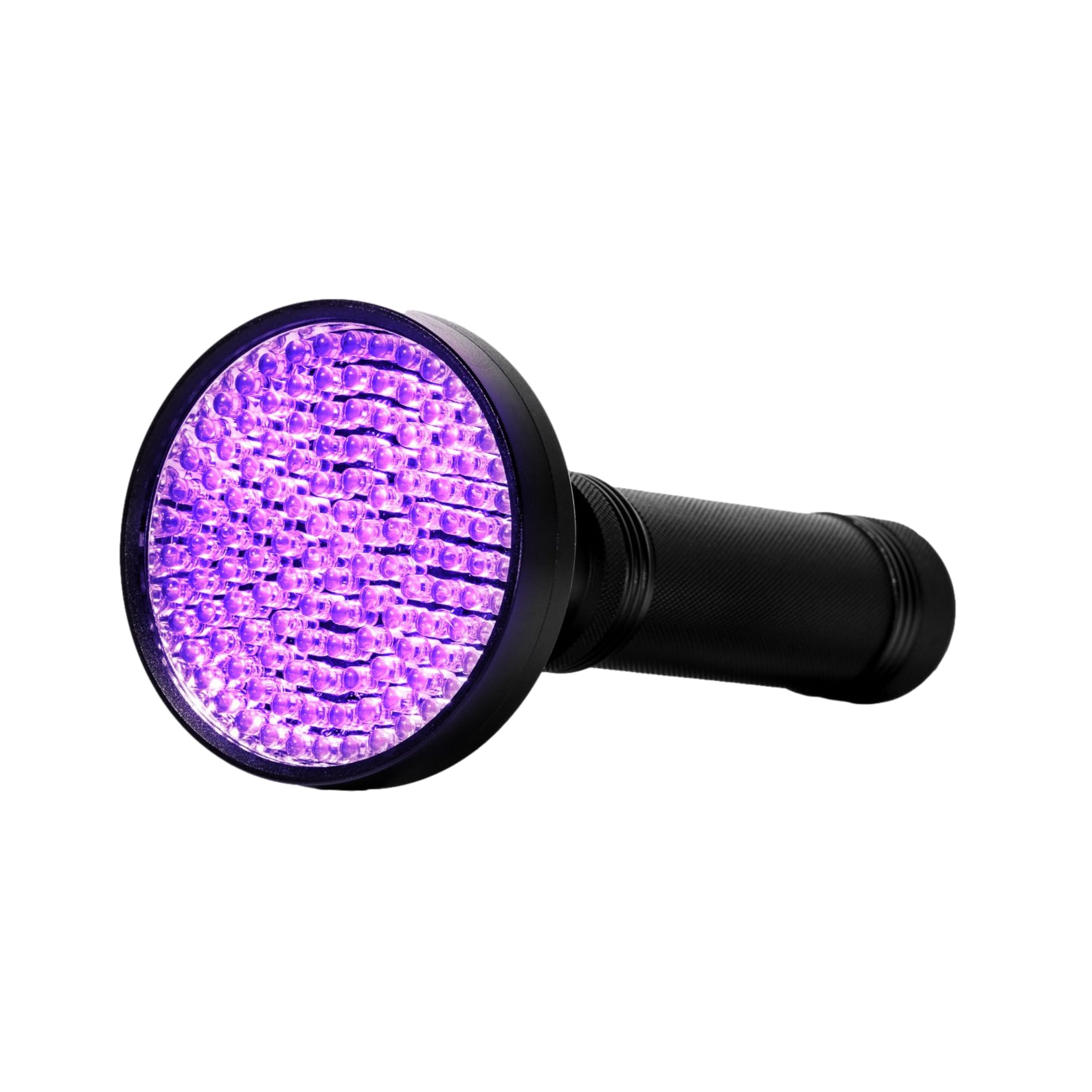
If you want to cover ground quickly, this is the one to grab. It throws 128 LEDs at 23W of output in the 390-395nm range; the maker compares that against standard 51- or 12-LED flashlights. In plain terms: you walk into a room, sweep the wall, and the marks show up without you hunting inch by inch. The beam carries up to 32 feet into darkness with an 8-foot spread, so one slow pass across a carpet or a headboard tells you what you are dealing with. That reach is 32 feet versus the compact LUXNOVAQ’s rated 20 feet, and the illuminated width is where the Kobra earns its place at the top of this list.
Owners treat it as a workhorse. Scorpion hunting comes up constantly as the reason people buy it, glowing neon green from yards away, and the same brightness makes pet accidents pop on carpet and tile. Someone once used it as a home science demo for kids — and reported that it behaves like a magnifying glass for things you would rather not know about your hotel bed. It runs on 6 AA batteries, which you should stock before a trip rather than after, and there is a wrist strap plus an anti-slip grip on a rugged aluminum body that the maker calls waterproof and shockproof.
Here is the honest limit. The light is strong but it is not surgical, and it is not a leak detector. Buyers report it “didn’t show any of the water damage” in a hallway where a different brand’s light did, so do not buy this expecting to find a plumbing leak. The center of the beam runs hot and falls off quickly at the edges, meaning contrast depends on the distance you hold it. Fresh, wet urine is also the hardest thing for any UV light to catch, while older dried spots show up clearly in full dark.
Where the beam wins
- 32-foot range with an 8-foot sweep means one pass covers a lot of room.
- Brightness is the defining trait — stains on carpet and tile jump out.
- Rugged aluminum housing with an anti-slip grip and wrist strap.
- Runs on 6 AA batteries, so no charging schedule to plan around.
What to expect before you buy
- Holding it far from a surface weakens the contrast fast.
- Fresh urine barely registers; older dried spots show up best in full dark.
- The body is chunky — bigger than it looks in the photos.
Buy it if: you are scanning rooms, carpets, or a yard and want the widest, longest sweep available.
Think twice if: you want to spot a tiny seam stain from arm’s length — go for the 365nm filter light instead.
2. LUXNOVAQ 365nm UV Flashlight Black Light Rechargeable
The filtered 365nm beam that turns a purple wash into a clean, readable glow.
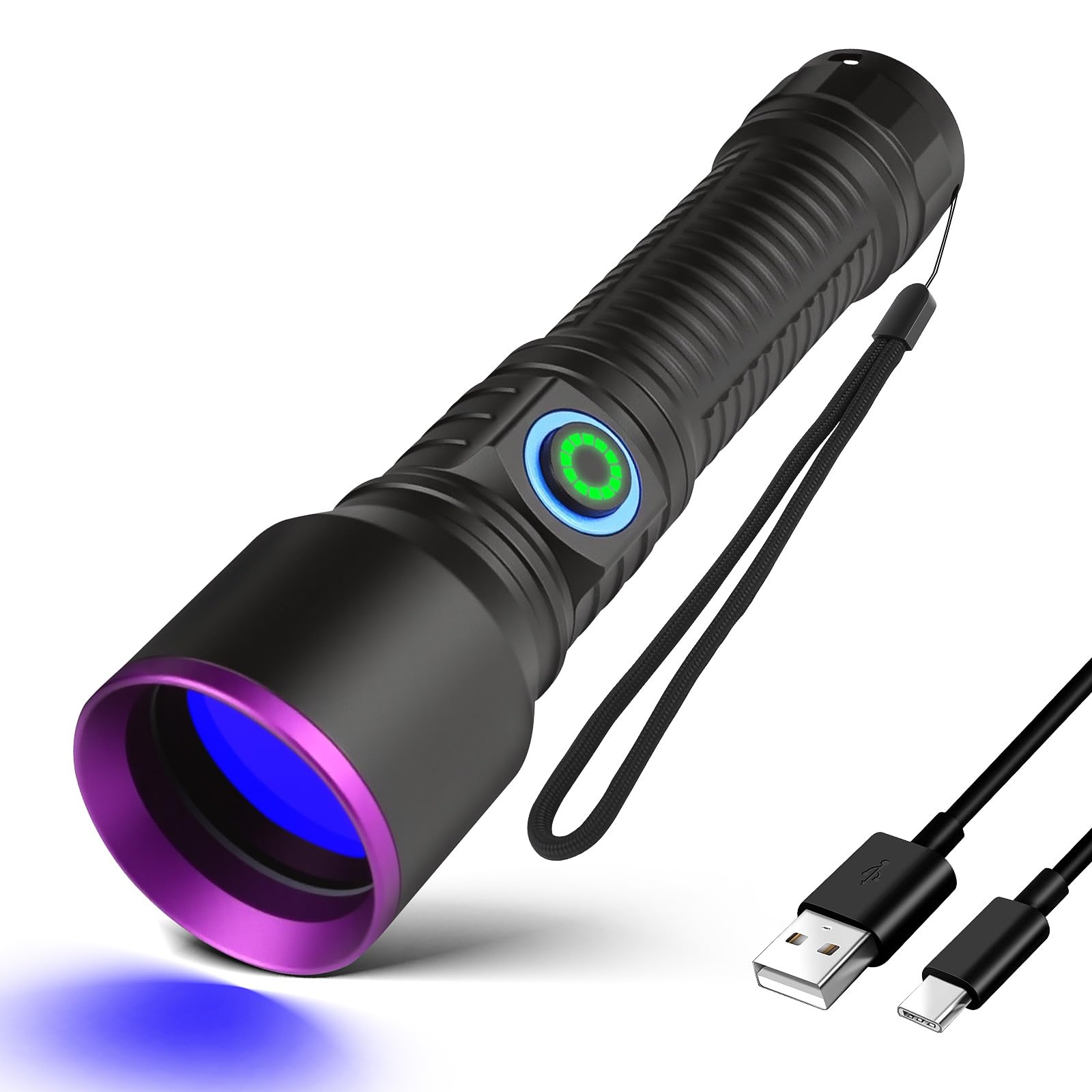
The number that matters here is 365 — as in 365nm, the wavelength that a black filter lens works with to cut out the visible purple light. The LUXNOVAQ pairs its 4-core LED with that filter, and the maker says the filter blocks 99% of visible light, leaving pure fluorescence instead of a violet haze. For bed bug inspection that is the whole game: a residue glows against a dark surface instead of drowning in a purple reflection. It is the reason this light reads crisper than the Kobra’s 390-395nm beam at close range, and it is a specific edge, not a vague one — a narrow 5.43-inch body weighing 159 grams that slips into a drawer but still throws a rated 20 feet.
Power is sorted by a 3200mAh rechargeable battery charged over USB-C, rated for up to 8-10 hours per charge. In real use, though, battery life has more to do with how hard the light works than its capacity. Build quality is the quiet strength: a metal body, a rubberized switch, a lanyard, and a green/red indicator that tells you where the charge stands. One clever detail is that the battery compartment opens from more than one point — odd the first time, harmless once you get used to it — and the housing is described as staying warm rather than hot after long sessions. Users with cats have used it to spot ringworm and hidden urine, and it also gets picked up for fluorescent inspection work on aerospace parts and for finding dropped items at night.
The trade-off is patience. A 365nm light needs a genuinely dark room to work its magic, and its narrow beam means you scan seam by seam rather than sweeping a whole wall. It also competes with itself in a small way: its rechargeable battery needs a full charge, while the Kobra runs on AA batteries you swap in and forget.
The precise pick: take this for hotel-room checks, mattress seams, and any inspection where you want to see the stain, not the lamp.
Reach for the other one: if you need a broad sweep in a hurry or you prefer batteries you can replace on the road.
3. ShieldFlex TruGuard X Bed Bug Interceptor — 12 Pack

Four legs, one bed, and twelve interceptors that catch bugs on the way up.
A box has twelve interceptor traps to place under bed and furniture legs, which is the real story here — you are not buying a single gadget, you are buying a perimeter. The design is deliberately simple: bugs climb into the well and cannot climb back out, so every night your furniture legs stop being a highway up to the mattress. It is passive: set the traps under the legs and check them every few days.
What wins people over is the base plate. The polypropylene base is reinforced specifically because generic traps crack under the weight of a large bed — this one is built to sit under a frame and stay flat. Owners have leaned on that: a heavy sleeper on the bed above, months of it, and the traps are still intact underneath. The white color is not cosmetic either, because trapped bugs are far easier to spot against a pale well. The effectiveness is the thing buyers talk about most, and once the traps are installed they tend to stay in place as a standing precaution, catching the odd stray before it ever reaches the sheets.
Two honest notes. First, the “4×4” label is looser than it sounds, since the walls taper inward and the chamfered corners shave the usable opening down. Measure your leg: the practical maximum is a 3-5/16-inch square post, a 3-11/16-inch round post, or a 3-11/16 x 2-15/16-inch rectangular one. Second, no trap ends an infestation by itself — it monitors and guards, while heat treatment or professional work does the clearing. Some buyers add a light dusting of powder to the well for a slicker wall, though anyone with cats will want to skip that step.
What it is best at: stopping the climb. Placed under each leg of a bed or bench, the traps create a wall that catches bugs on their way to you and holds them there for inspection.
What it will not do: kill a whole infestation. Use it to monitor and block the climb, not to clear the infestation.
Fits best: a household protecting more than one bed, or a landlord guarding a furnished unit.
Check first: the widest part of your furniture leg — anything past the stated dimensions will sit on top rather than drop in.
4. Bed Bug Interceptors — 12-Pack White Passive Monitor
Built for the chunky bed frames and oversized couch legs the others leave out.
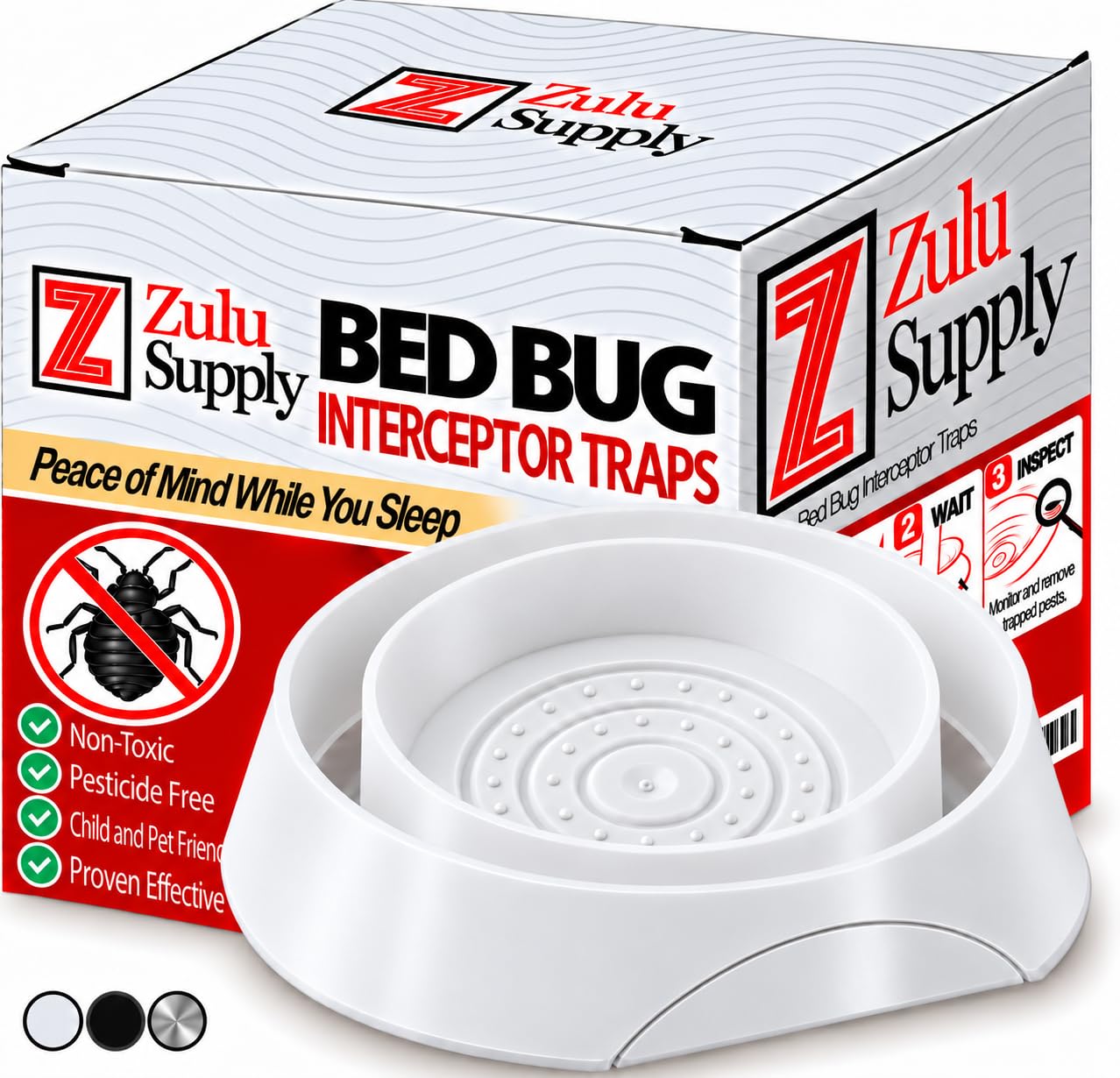
Start with the opening, because that is the whole pitch: 4.25 inches across fits the wide, boxy legs that trip up most interceptors. If you have been measuring your headboard posts and worrying they are too big for a standard well, this is the set to check first. The one-piece plastic construction means there is no base to snap on and no assembly to get wrong — you lift the leg, slide the trap under, and set it down on a clean, level surface.
You look into the smooth inner wall, see what is there, and either keep going or call for help. The smooth-walled design is intentional: bugs that get in cannot get a grip to climb back out. For anyone in an apartment building where treatment is a building-wide event, this is a low-effort way to keep your own bed off the menu while the professionals handle the rest — and unlike a UV light, it works unattended.
The catch is that this is purely a monitor. Strip away the marketing and there is no lure, no additive, no scent — just plastic and a smooth wall. That is fine if you already have a plan running and simply want eyes on the situation. It is not enough on its own if you are trying to catch an active infestation from scratch.
The size argument: a 4.25-inch opening beats the tapered, tighter wells on the TruGuard set — but only if you actually need the extra room. On a slim bed leg, both sets perform the same job.
Choose this for: a large-legged bed frame or a piece of furniture the narrow traps will not swallow.
Pass if: your legs are slim and standard-sized — an ordinary well will do the same work.
5. UV Optics Powerful LED Ultraviolet Black Light Flashlight

A pocket checker for hotel rooms, campsites, and suspicious currency.
The framing here is travel, not living room. This light is built to go into a bag and come out in a hotel room, a tent, or a rental, where you want a quick read on what the sheets and surfaces are hiding. It runs on AA batteries, so you can carry spares anywhere, and a heavy-duty nylon lanyard keeps it from slipping out of your grip at the worst moment. The maker’s own description sums its purpose neatly: it is a tool for “seeing what you’ve been missing.”
In the right hands it delivers. It has been used as a complete inspection step in a do-it-yourself bed bug plan — checking a mattress surface after spraying and traps were set, then re-checking after the follow-up window. It also does the standard dinner-a neat extra of making treated currency and ID cards obvious.
The honest read: feedback on this one splits. The functionality and general quality are the two things buyers discuss, and neither lands cleanly on one side — some find it excellent and some are underwhelmed. A realistic expectation is what protects you here. Treat it as a supplementary travel checker that helps you confirm what you already suspect, rather than a professional-grade inspection tool. The narrow beam and modest 1.8W output mean fine scanning still demands close, deliberate passes.
Reasons it earns a slot
- AA batteries mean no charger to pack or forget.
- Rubber grip and nylon lanyard suit a bag-and-go routine.
- Good for quick spot checks on bedding, currency, and camping gear.
The reality check
- Output is modest, so expect close-range work rather than broad sweeps.
- User experience varies — some find it impressive, others do not.
Suits the traveler: anyone who wants a light that lives in a suitcase and gets pulled out in a strange hotel room.
Not the inspector: if you are formally checking a home or a commercial property, the higher-output and filtered options will serve you better.
6. Riddy Bed Bug Detection Kit, 4 Pack
A trap that gives itself a head start by smelling like a person.
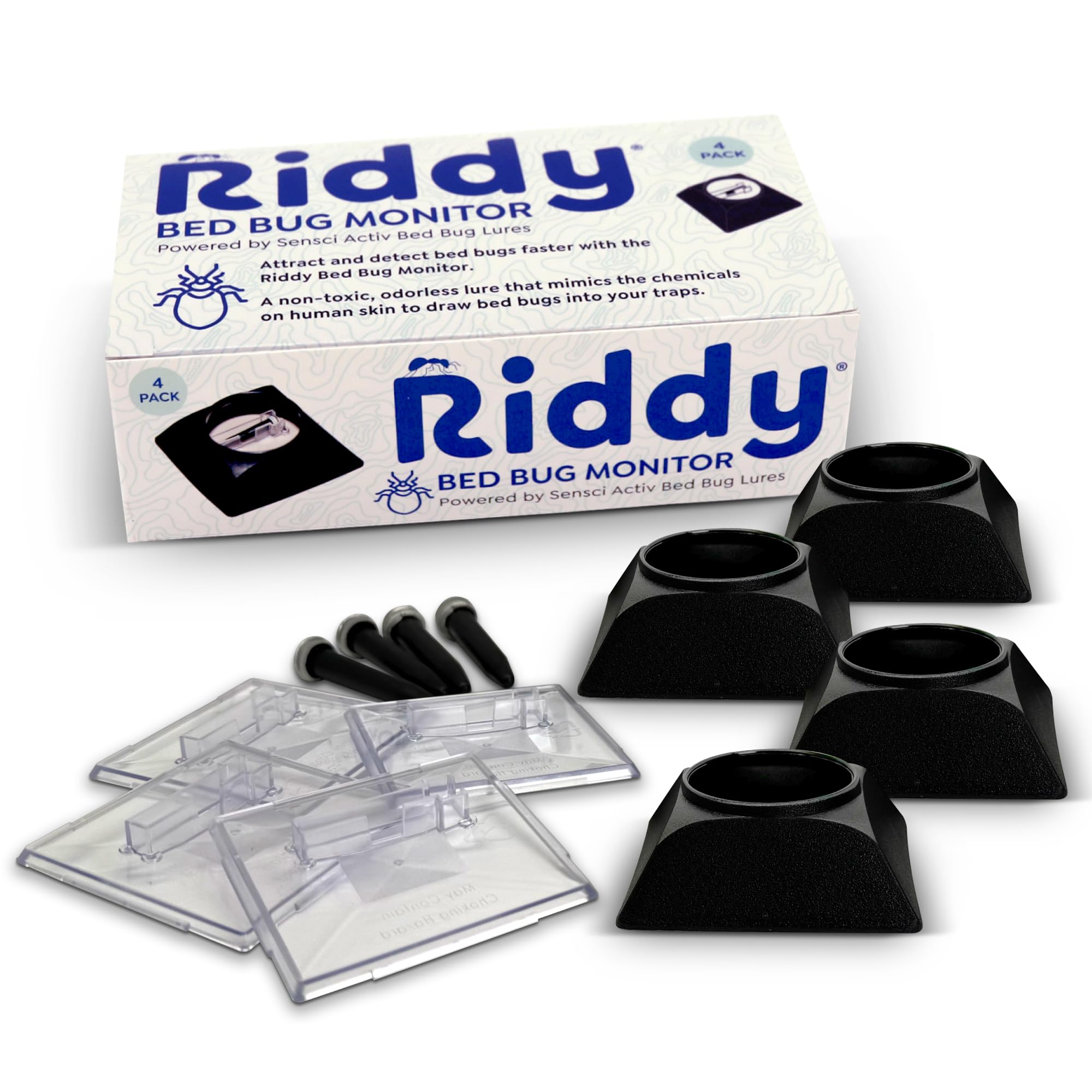
Most interceptors wait for a bug to wander in. This kit tries to pull one in. Each of the four traps takes a Sensci Activ lure that mimics human scent, and the idea is that a curious bug follows the smell into a well it cannot climb out of. Setup takes seconds — the base snaps to the pyramidal top, the lure vial drops into its holder, and you slide the whole thing under a bed leg or behind a piece of furniture. No tools, no chemicals, no electricity, and the maker states the lure lasts 90 days and reuses fine.
Put it under a recliner in a rental property and it does a job a passive trap cannot: it confirms whether bugs are actually present, which is the question every landlord loses sleep over. It pulls in more bed bugs than plain sticky-board traps, which gives you firmer evidence before you call an exterminator. Pop one in a suitcase for a hotel stay and you have a discreet monitor for the trip home.
The catch is the score, and it is honest. This kit is the least proven of the group and the feedback reflects that — one reviewer noted assembling the set and finding only two bases for four tops and four vials, while others simply caught nothing and could not tell whether that meant the room was clean or the lure was ineffective. The two conclusions are hard to separate with this kit alone. Keep expectations calibrated: it is a supplement for confirming what is there, not a substitute for a professional inspection.
Where the lure earns its keep: early warning in a quiet, cleared room, or proving a rental is clean before you hand over the keys.
Worth it when: you want active attraction plus a discreet footprint under a bed or in luggage.
Look elsewhere if: you want a simple, proven, set-and-check trap — the passive interceptor sets are the safer bet.
7. SenSci BlackOut Bed Bug Detector — 4-Pack
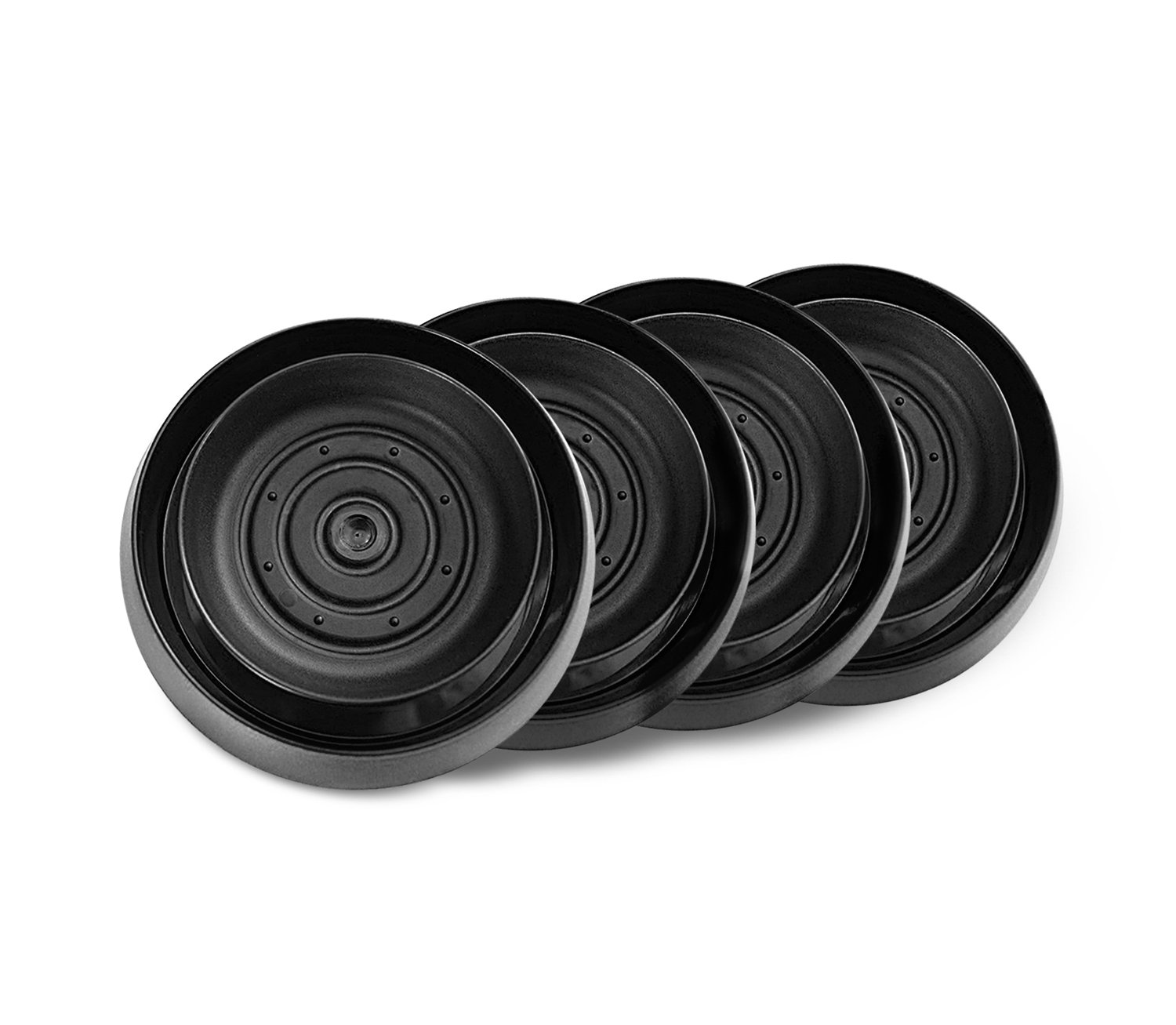
The black-well interceptor that turns dark furniture legs into a bug trap.
Color is the design idea here. The BlackOut is molded in black because, per the maker, dark tones draw bed bugs in, and the well is then built so they cannot climb back out. It is 4 devices to a pack, and it is the most professionally-minded option on this list: it was designed by BedBug Central’s Jeff White, and the maker claims it detects up to 95% of infestations within two weeks. Whether you are a homeowner in the middle of treatment or a property manager keeping tabs on a building, that is a meaningful claim to weigh.
It has real fans in the commercial world. Hotels and rental operators use these to tell whether a small population survived a treatment, which is a different job from catching a full-blown infestation — and one it handles well. The rubbery, non-slip center means the leg stays put, and the outer ruts are deliberately slick. One detail owners value: there is no powder or additive to add, so it is clean to handle and safe to leave in place indefinitely. It is crack-and-break resistant plastic built to outlast the problem.
The recurring headache is packaging. One owner opened the box and found only the plastic traps and nothing else, which left the set doing nothing. That said, the design is proven when it arrives complete, and the crowd here is warmer than you might expect given the packaging stories.
Why pros keep these in rotation
- Dark color and slick wells do the attracting so you do not have to.
- No powders or additives needed — clean to handle and quiet to live with.
- Crack-and-break resistant and made for repeated inspection.
What can go wrong
- An occasional box arrives incomplete, so inspect before you install.
- The four-pack contains four devices — if you need to guard more than one bed, you will need additional packs.
The professional’s choice: a landlord, hotel operator, or diligent homeowner who wants the most proven design in the group.
The DIY alternative: if you want a simple premade trap and do not need the professional pedigree, the twelve-pack sets offer more coverage.
Know the Specs
Wavelength (nm)
Nanometers measure where on the light spectrum a UV flashlight sits, and the number tells you what you will actually see. A 395nm light glows visibly purple, which is easy on the eye but can wash out faint stains. A 365nm light with a black filter lens cuts most of that visible purple and lets the fluorescence dominate — better for spotting the tiny tell-tale marks in a mattress seam, though it needs a dark room to work.
Beam Range (ft)
Beam range is how far the light reaches before it stops being useful. Long throws like 32 feet let you sweep a whole wall or carpet from a step back; short throws around 20 feet push you into a closer, more careful inspection. Neither is better on its own — a long beam covers more ground, a short one keeps focus tight.
Interceptor Opening
The usable opening is what decides whether a trap works under your furniture. The package footprint is not the same number, because walls often taper inward and the corners may be cut for strength. Measure the widest point of your bed or couch leg and check it against the stated figure before ordering.
Passive vs Lured Traps
A passive interceptor just catches anything that climbs in. A lured trap adds a scent pouch that mimics human presence to draw bugs closer. The lure helps with early detection in a quiet room; it cannot make a trap replace a treatment. Either way, the trap monitors — it does not clear an infestation on its own.
Common Questions
Will a UV flashlight actually show bed bugs themselves or just their stains?
Is 365nm better than 395nm for bed bug inspection?
How many interceptor traps do I need for one bed?
Can a trap alone get rid of bed bugs?
Do I need to put powder in a bed bug interceptor?
How long does a lure last in a trap?
Will a bed bug interceptor fit under a heavy bed frame without cracking?
How quickly can a monitor tell me whether I have an infestation?
Can I travel with a bed bug detector in my luggage?
The Bottom Line
For most people, the bed bug detector that earns its place first is the Kobra UV Flashlight, because its 128 LEDs and 32-foot beam let you sweep a whole room before you commit to anything bigger. If you prefer precision over sweep, the filtered LUXNOVAQ 365nm is the sharper eye for seams and hotel bedding. And for guarding a bed while you sleep, the ShieldFlex TruGuard twelve-pack is the straightforward, proven barrier — buy a set and stop guessing.
How we choose
We do not accept paid placement. Every pick is matched to a real buyer and a real use-case; we do not hands-on test units.
Sources
Specifications: manufacturer listings and product documentation. Review insights: verified customer reviews, as of October 2026. Pricing: not shown on this page (it changes often); check the current price via the retailer link.
As an Amazon Associate, Aappliancez earns from qualifying purchases. This does not affect which products we feature.