Disclosure: Some links in this post are affiliate links. As an Amazon Associate I earn from qualifying purchases, at no extra cost to you. Learn more
Specs are compiled from manufacturer listings and verified buyer reviews and can change over time — please confirm the key details on the product page before buying.
The worst thing about buying glass measuring ware is that a bargain beaker can look perfect on screen and arrive with a bottom that wobbles on your hot plate. That is the real decision here, not brand names. What you want is thick, uniform borosilicate walls, graduation lines you can actually read at eye level, and a spout that cuts the pour instead of dribbling down the outside. This guide covers which beakers deliver exactly that for lab work, soap making, brewing, and kitchen duty.
This guide is built by comparing the manufacturers’ published specifications and the patterns across verified customer reviews, so you get each pick’s real strengths and trade-offs instead of marketing spin.
Some beakers crack on a hot plate; others are a pain to scrub clean. The right pick depends on wall thickness and honest markings, and this breakdown of beaker glassware shows you which models get both right.
Top Picks

How To Choose The Best Beaker Glassware
A beaker is a simple object, and that is exactly why the cheap ones fall apart. Glass quality, wall thickness, and marking accuracy do all the real work. Get glass quality, wall thickness, and marking accuracy right, and the only remaining choice is capacity.
Borosilicate 3.3 Is the Baseline, Not a Bonus
Borosilicate 3.3 is a glass recipe built to handle quick temperature swings without cracking. It is the reason you can move a beaker from a hot plate to a cool counter. Ordinary soda-lime glass is not made for that kind of stress.
Many of the models here also meet ASTM E960, a published standard for lab glass. You do not need to memorize the code. Just know that a beaker listing it has been made to a recognized specification rather than a vague promise.
Wall Thickness Tells You How Long It Lasts
Thickness is the number that decides whether a beaker survives a knock against the sink. A 3.2mm wall on a heavy-duty model is noticeably beefier than the thin glass on a general-purpose set. Thicker walls also spread heat more evenly on a hot plate.
The trade-off is weight. A thick-walled beaker feels substantial in the hand and pours a little heavier. For anyone using a beaker more than once a month, that extra weight is the right trade for even heat and fewer chips.
Read the Graduations Before You Trust Them
A tolerance of roughly ±5% means the marking is close, not exact. For soap making or brewing, that is perfectly fine. For analytical chemistry, you want a beaker whose scale you have checked against a graduated cylinder.
Watch the graduation range too. Some beakers print their lines from 50ml up to 500ml on a 600ml vessel, which means the top of the jug has no marking at all. Check that the scale actually covers the capacity you plan to fill.
Side-by-Side Comparison
| Model | Best For | Capacity | Wall / Material | Graduation | Amazon |
|---|---|---|---|---|---|
| Karter Scientific 213G9 Erlenmeyer (Case of 36)★ Best Overall | Bulk brewing and yeast starters | 500 ml | Borosilicate 3.3, ASTM E960 | 50ml, 200ml to 500ml | Amazon |
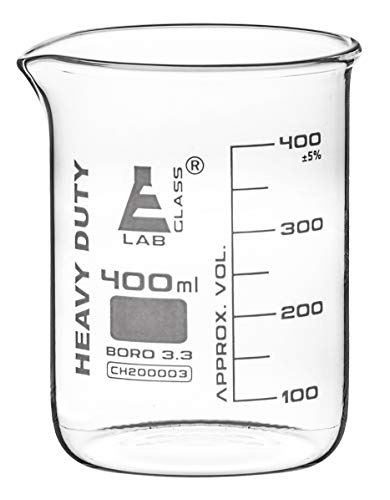
| EISCO Heavy Duty Beaker 400mlThickest Value Pick | Heat and chemical work | 400 ml | 3.2mm borosilicate 3.3 | Every 50ml, ±5ml | Amazon |
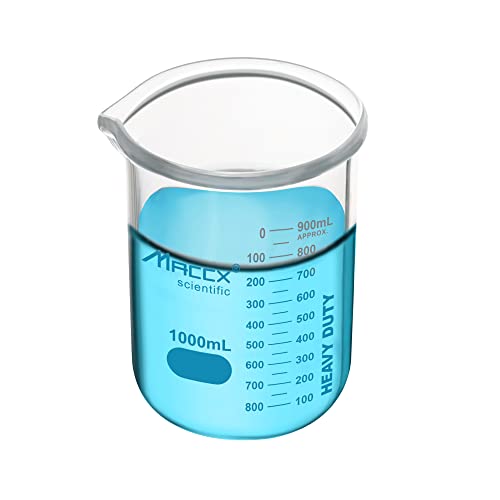
| Maccx HDBK1K0-001 1000mlBest for Big Batches | Large-batch mixing | 1000 ml | Thickened 3.3, ASTM E960 | Double scale | Amazon |
| ONiLAB Measuring Beaker Set (5 sizes) | One-stop size range | 50–1000 ml | Borosilicate 3.3, ASTM E960 | ±5% tolerance | Amazon |
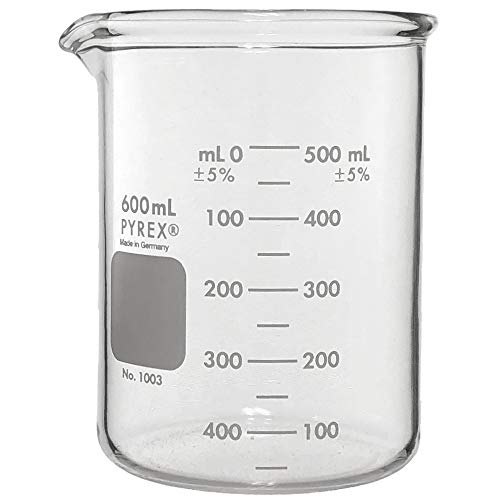
| Pyrex 1003 600mL Griffin | Cocktails and pour-over | 600 mL | Borosilicate, heavy duty | 50–500 mL every 50 | Amazon |
| ONiLAB 250mL Beaker 6-Pack | Replacing broken beakers fast | 250 ml each | Borosilicate 3.3, ASTM E960 | Printed graduation | Amazon |
| Labvida LVAC013 1000ml | Dishwasher and ultrasonic cleaning | 1000 ml | Heavy duty 3.3, ASTM E960 Type II | Double scale, ±5% | Amazon |
| Corning Pyrex 1000-1L with Watch Glass | Bar work and magnetic stirring | 1000 ml | Borosilicate, low form Griffin | 50ml, 100ml to 1000ml | Amazon |
| Relaxweex 3-Piece 1000ml Set | Hot plate and batch production | 1000 ml each | Borosilicate, uniform wall | Printed scale | Amazon |
| Pyrex Corning 5-Piece Beaker Set | A full working size ladder | 50/100/250/600/1000 ml | Borosilicate | Printed graduations | Amazon |
Detailed Reviews
1. Karter Scientific 213G9 500ml Erlenmeyer Flask
Our pick — 4.5+★ from 2,500+ verified ratings; the strongest balance of quality and price.
Thirty-six inert borosilicate flasks that turn a starter into a production line.
The case of 36 is the whole point. You get 36 identical 500ml Erlenmeyer flasks, each with a 50ml graduation interval and printed marks running from 200ml up to 500ml. For a homebrewer running yeast starters on rotation, that means no washing between batches and no waiting on a single flask to cool. The crowd favorite behind this pick tells the story plainly — thousands of owners, a 4.5+ rating, and a quality score that dwarfs everything else they talk about.
The narrow mouth is what makes it a flask rather than a beaker. That tight opening cuts evaporation and stops a splash when you swirl it, and it takes a stopper when you need an airlock. Owners use these on stir plates constantly, and the round bottom plus the 3.3 borosilicate glass body handles the heat. Nobody is fighting these onto a magnetic stirrer.
What separates this from a single thick beaker is the shape, not the durability. A Griffin low-form beaker like the EISCO 400ml is short and wide with a spout, built for pouring. This is tall and narrow at 186mm with a 107mm body, built for holding and swirling. But there is a real catch. Some units ship with a slightly uneven bottom or an inconsistent opening, and the largest flasks in the family do not list their stopper size anywhere, so you measure and re-order. In a case of 36, one wobbly flask is not a crisis, because you have 35 more.
Where the thirty-six pack pulls ahead
- 36 identical flasks means zero downtime for starters and small batches
- 50ml graduations from 200ml to 500ml for quick volume checks
- Narrow mouth reduces evaporation and accepts a stopper
- 3.3 borosilicate, built to ASTM E960
What you should know first
- No rubber stopper included in the box
- Bottom flatness and opening size vary more than lab-grade buyers expect
Reach for the case if: you brew, culture, or batch anything regularly and hate cleaning glass between runs.
Pass when: you need one precision vessel for careful analytical work — a heavy-walled single beaker serves you better.
2. EISCO Heavy Duty Beaker, 400ml — 3.2mm Uniform Walls
A 3.2mm wall that takes a drop and asks for more.
Durability is the thing everyone raves about here, and it comes from a measurable place: 3.2mm of uniform borosilicate 3.3 glass. In real terms, that is a wall thick enough to shrug off a knock against the sink rim. Owners who have used these for months retell the same moment — the beaker went down, and it did not chip. The glass is what people talk about most, and the thickness is right behind it.
Compare it to the Maccx 1000ml above and the difference is capacity, not quality. The Maccx holds 1000 ml to this one’s 400 ml. If you are mixing a big batch of resin or soap, the larger vessel wins. If you want one tough little beaker that lives on the bench, the 400ml EISCO is the easier one to reach for. The white graduations print every 50ml at ±5ml accuracy, and the vessel is microwavable and autoclavable, so it handles steam sterilizing without complaint.
Here is the honest limit. At 400ml, this is a pouring and mixing vessel, not a bulk storage container, and the 8-ounce weight means it sits solidly rather than tipping on a hot plate. Nothing about that is a flaw — it is simply what a low-form Griffin beaker at this size is. Buy it as a 400ml bench beaker and its 3.2mm wall will outlast a stack of thin general-duty glass.
The case for the 3.2mm wall: uniform borosilicate 3.3 with white graduations every 50ml, in a shape that pours cleanly from the spout.
The honest trade: 400ml only goes so far — larger batches need the 1000ml beakers further down this list.
This is your beaker if: you want one hard-working vessel for classroom demos, garage chemistry, or small soap batches.
Move along if: your recipe calls for a full liter or more in one pour.
3. Maccx HDBK1K0-001 34oz (1000ml) Upgraded Glass Beaker
A full liter in one vessel, with a wall you can feel in your hand.
Capacity is the headline: 1000 ml, or 34 fluid ounces, in a single low-form beaker. That is a meaningful step up from the EISCO’s 400ml — two and a half times the volume in one pour. For candle makers working wax batches or anyone mixing in quantity, that headroom removes the double-batch step entirely, and it does it without the extra handling that comes with juggling two smaller vessels.
The upgraded version adds a thickened wall and a double scale, and it is made to ASTM Specification E960, Type I requirements. The extra-large marking spot is a small thing that matters every single time you fill it — you can see the volume line from across the bench without crouching. Heat is handled too; candle makers run this over a hot plate and report no issues with the glass.
The thing buyers notice most is the weight and thickness in the hand. It feels like a real instrument, not a decorative glass. Storage is the other quiet win, because the beaker ships in a fitted box designed to hold it properly. Combined with 34oz capacity and that solid feel, this is the practical choice for anyone whose batches outgrew their old beaker. The catch is simple: at this volume a thick glass vessel is heavier to lift and pour when full, so pour with two hands.
What 1000ml buys you: a full liter of working volume, double-scale markings, and a thickened borosilicate 3.3 wall built to ASTM E960.
The size reality: full, it is a heavy pour — plan your grip before you lift.
Best for: candle makers, resin casters, and anyone mixing in 1000ml quantities.
Think twice if: you only ever measure small amounts — the smaller 400ml or 600ml beakers suit light work better.
4. ONiLAB Glass Measuring Beaker Set, 5 Sizes (50ml–1000ml)

Five graduated sizes that cover nearly every pour you will ever make.
Why buy one when five sizes solve the problem in one go? This set runs 50ml, 100ml, 250ml, 500ml, and 1000ml, all in uniform-wall borosilicate 3.3 with a ±5% tolerance and ASTM E960, Type I compliance. That range means a small essential-oil tincture and a full liter of soap base both get the right vessel. Buyers report it works beautifully for soap and chemical combinations, and the big marking spots make checking volume quick.
The set weighs 1.61 pounds in total and the glass handles heat well. Anyone who makes cold-process soap knows the lye solution gets hot fast — these beakers take it in stride. The measurement markings are printed in milliliters, so there is no mental conversion at the bench.
Where this set asks for care is breakage. Durability is the one place owners split: some beakers take a knock and keep going, others chip or crack. That pattern is worth knowing before you buy, because it tells you how to treat them. Keep them off tile floors and out of a crowded sink, and wash by hand where you can. Do that, and the value holds up well. This is the smart purchase for a beginner who does not yet know which size they will use most.
What makes the set work
- Five sizes from 50ml to 1000ml in one purchase
- Uniform borosilicate 3.3 walls with a ±5% tolerance
- Extra-large marking spot across the range
- Heat resistant enough for soap making and hot mixtures
Before you commit
- Durability is uneven — handle them like glass, not like plastic
Buy the set if: you are kitting out a home bench and want every common volume ready to go.
Look past it if: you want one heavy-duty vessel that handles rough handling — the EISCO’s 3.2mm wall is tougher.
5. Pyrex Heavy Duty Griffin 1003 600mL Beaker
A bartender’s beaker disguised as lab glass.
The 600mL Pyrex earns its spot on the bar cart, not the lab shelf. Owners use these as their mixing glass for cocktails, and the 600ml size lands comfortably for a standard drink with ice. The heavy-duty build handles banging and stirring — the wall is thick enough that a stainless spoon will not damage it if you keep the pressure reasonable, and the spout pours without dribbling. It is a stronger pour-over vessel for coffee too, standing in for a carafe and giving you a clear sight line as it fills.
Durability is the clear standout, and the thickness is something owners notice right away. It handles the thermal swing from a hot brew to a cold rinse without protest. For precious-metal refiners, the borosilicate body resists etching from strong acids over repeated use, so it keeps its shine beyond the kitchen experiments. The graduations run every 50ml from 50ml up to 500ml, which leaves the very top of the jug unmarked — worth knowing if you always fill to capacity.
Where it differs from the ONiLAB set above is the single-vessel focus. You get one durable 600ml beaker at a heavy-duty spec rather than five general-duty ones. The glass handles the rough stuff and the weight lets you pour without a wobble. That is the classic trade: a few dollars more for the heavy-duty 600mL wall instead of thin glass, paid back in years of service.
The one for: home bartenders, pour-over coffee drinkers, and small-batch mixers who want a tough everyday glass.
Look elsewhere if: you need the top of the scale marked all the way up — grab the Corning 1000-1L below for full-volume graduations.
6. ONiLAB 250mL Glass Beaker, 6 Pieces

Six 250ml beakers so a broken one never stops your work.
Six beakers at 250ml each, all borosilicate 3.3 with ASTM E960, Type I compliance. They are low form with an extra-large marking spot, which is the detail that speeds up soap making and batch work. The whole lot weighs 1.43 pounds, so shipping is manageable and storage is easy in a drawer. When a beaker chips, you swap it out and keep going — no downtime mid-batch.
What people use these for spans from soap to gold refining, with the glass handling the heat and the printed ml markings doing their job. The 250ml size is the flexible middle ground: big enough for a meaningful mix, small enough to fit on a crowded bench. Unlike the single 600ml Pyrex above, this is a working reserve, so you always have a clean one on hand.
The honest note is durability. It is the mixed part of the picture, as you would expect with any thin-ish general-duty set. Some beakers take a bump, others chip. Keep them off tile and wash them by hand, and six 250ml beakers will cover a soap or classroom bench for years. For a busy soap maker or a teacher stocking a classroom, the numbers work out in your favor.
Why it earns a place: six identical 250ml beakers means you always have a spare, and the large marking spot keeps measurements quick.
What it asks: keep them off hard tile — durability is the variable here.
Great pick for: soap makers, teachers, and anyone who breaks glass often enough to want backups.
Not your match if: you want one premium vessel that can take serious abuse.
7. Labvida LVAC013 1000ml Heavy Duty Beaker
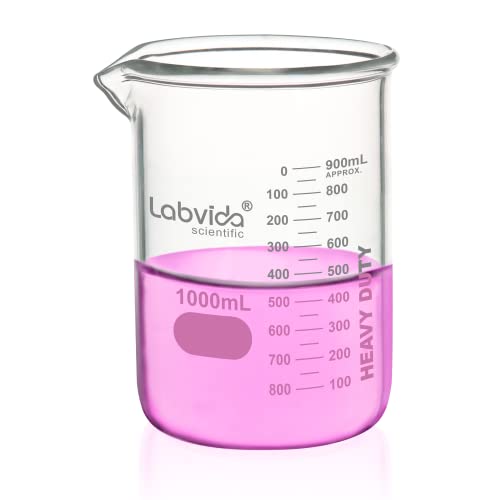
The one-liter beaker you can toss in the dishwasher when you are done.
Cleaning is where the Labvida earns its place. It is machine washable, including in a lab ultrasonic cleaner and a home dishwasher, so you are not stuck hand-scrubbing a sticky residue. At 1000ml, or 34 fluid ounces, with a ±5% tolerance, it handles a full liter without you doing the arithmetic. For anyone whose least favorite part of a batch is the cleanup, this is a smart pick on that detail alone.
The glass is heavy-duty 3.3 borosilicate with uniform wall thickness, and it meets ASTM Specification E960, Type II requirements. The low form keeps the center of gravity low, the double scale makes reading easy from either side, and the well-shaped spout pours cleanly. A stable base means the beaker stays put on the bench, so you can leave it standing while you work with both hands.
Shipping safety is handled too. These are thick-walled beakers sent in upgraded packaging that protects each one, so the strength of the glass actually arrives intact. Compare it to the Maccx 1000ml above and the two are close on capacity; the Labvida sells itself on that dishwasher-friendly surface and the packaging care. If cleanup speed matters more than anything else, this is your liter.
What sets it ahead: machine washable — dishwasher and ultrasonic cleaner included — at a full 1000ml with a double scale.
The limitation: at a full liter the beaker gains weight, so pour with two hands.
Choose it if: you want a big beaker that goes straight in the dishwasher and never needs special handling in the sink.
skip it if: your work is small-volume and a full-liter vessel just gets in the way.
8. Corning Pyrex 1000-1L Beaker with 125mm Watch Glass

Real Corning Pyrex, a full liter of markings, and a glass lid on top.
Genuine Corning Pyrex is why this one sits at the top of the list on quality. The graduations run at 50ml, then 100ml, all the way to 1000ml, so you can actually measure the full advertised liter instead of guessing. That is the detail the five-piece set below gets wrong on most of its beakers, and it is exactly why this single vessel is worth choosing over a general set when accuracy at the top of the range matters. The included 125mm watch glass (a round glass lid) makes a proper cover for slow heating and dust alike.
Owners use these in bars as an aid to incorporating ingredients with a magnetic stirrer, and the perfectly flat bottom is what makes that work cleanly. Once you have a stir bar spinning on a truly flat base, you stop chasing a wobbly whirlpool. The thicker glass and full-volume markings also separate it from off-brand beakers, and the scale has been spot-checked against a graduated cylinder.
Durability is the consistent theme. Accidental tumbles off the base to the counter have been handled without a crack, and the one-liter size handles most applications without you switching vessels. The trade here is straightforward: it is a single beaker at a premium grade, so you are paying for the name, the flatness, and the full scale rather than for variety. If you want one dependable liter for stirring and measuring, that is an easy call.
The Pyrex advantages
- Full 1000ml graduations so the top of the range is genuinely readable
- Flat bottom for stable magnetic stirring
- 125mm watch glass included as a lid
- Thicker glass than off-brand beakers, with a checked scale
Worth weighing up
- One vessel only — no small or mid sizes in the box
Top choice for: bar programs and home labs that stir on a magnetic plate and want a truly flat, fully marked liter.
Not ideal if: you need a range of sizes — the five-piece Pyrex set at the bottom serves that better.
9. Relaxweex 3-Piece 1000ml Borosilicate Beaker Set

Three full liters of working glass, with a heavy base for the heat.
Three 1000ml beakers in one order is a lot of working glass. Each has an inner diameter of about 4.21 inches and a height of roughly 5.87 inches, which is a good size for big batches without the beaker becoming too tall to reach into for a stir. The Griffin low form is cylindrical and transparent with a uniform wall thickness, which means heat spreads evenly across the base instead of leaving a hot patch in the middle.
The thick base is exactly what you want on a hot plate, and it is what owners single out. That uniform wall thickness is the reason the whole three-piece set weighs 2.5 pounds — real glass, not thin shells. The printed scale is clearly visible and made not to fade, so you are not squinting at half-rubbed markings after a few months of use.
Packaging is the quiet strength here. Each beaker ships in its own foam bag, which is the reason these tend to arrive whole. The value angle is honest too, and durability is genuinely good for a general-duty set. One thing to note: the beakers are listed in a pink colorway, so check the listing if a specific color matters to you. As three identical one-liter workhorses, this set suits anyone producing in volume who needs a spare on the shelf at all times.
Made for: soap producers and hot-plate users who want three identical one-liter vessels with thick, even bases.
Less suited to: buyers who want a size ladder — these are all 1000ml and all the same.
10. Pyrex Corning Griffin Low Form Beaker Set (Set of 5)

Five real Pyrex sizes that cover nearly every situation you can hand a beaker.
This is the size ladder done properly. You get 50ml, 100ml, 250ml, 600ml, and 1000ml in genuine Corning Pyrex borosilicate glass, all in the low-form Griffin shape. For e-liquid mixing, tinctures, and cocktails, that spread means the right vessel for the job every time. The 600ml is perfect for mixing cocktails, and the set as a whole weighs 3.5 pounds, so it feels like a real kit rather than a stack of glasses.
What sets this apart from the ONiLAB set earlier is the pedigree. The glass is clear with no bubbles or flaws, and the markings are clean and crisp without blemishes. Owners describe the packaging as meticulous, with each container secured in its own slot, and the quality of that packing reinforces what arrives inside. Durable if cared for is the fair read — these are Corning No. 1000 spec, which is thinner glass than the heavy-duty 1003 above, but perfectly fine for anything outside serious lab abuse.
One quirk you should know about: on some sets, four of the five beakers do not print the top measurement line, so the full advertised capacity cannot be read exactly. Only the largest carries it. That is the kind of detail that matters if you routinely fill to the brim, and a reason some buyers wind up guessing at the top end. For ordinary measuring on the lower markings it changes nothing, so know which kind of user you are before ordering.
What the set delivers: five genuine Pyrex sizes from 50ml to 1000ml, clean markings, and careful packaging.
The catch to know: top-of-range markings are missing on most beakers in some sets, so full capacity is not always readable.
Right for you if: you work across many volumes and want authentic Pyrex across the whole range.
Consider the heavy-duty single instead if: you routinely work right up to the top line and need it marked.
11. Aeseusia Heavy Duty 500ML Beaker, Double Scale
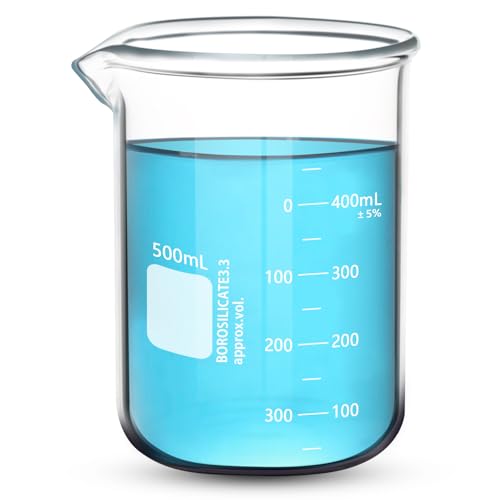
A 500ml beaker with a spout built to pour without the mess.
The V-shaped spout is the detail that sells this one. It controls the flow rate and stops the spill that turns a careful pour into a wiped-down bench. For people mixing facial and haircare products, that matters — you are pouring small, careful amounts, and a clean spout keeps them where you want them. The glass is 2.5mm thick borosilicate 3.3 in a uniform wall, and the vessel is autoclavable with strong chemical durability.
At 500ml it hits a useful middle. The graduations print from 100ml to 400ml with lines every 50ml and a tolerance of about ±5%, so it is a comfortable working size for classroom demos, home labs, and chemistry sets. The cylindrical shape and the flat bottom make it stable on the bench. Comparing it to the EISCO’s 400ml, you gain a little capacity and a spout; you give up a touch of wall thickness at 2.5mm against 3.2mm.
What gives this beaker range is that it does not live only in the lab. Owners have used it to check a mower’s gasoline, and the clear glass made it easy to spot dark fluid and decide what to do. Others keep one by the coffee maker as a rinse cup. The thick wall survives hot and cold liquid, which is the everyday test any good beaker has to pass. At 2.5mm, this 500ml beaker rewards careful handling rather than rough knocks.
Pick this one if: you pour carefully — skincare, coffee, small chemical mixes — and want a spout that behaves.
Go bigger if: you need a full liter; the Maccx and Labvida beakers above cover that volume better.
Know the Specs
Borosilicate 3.3 and Thermal Shock
Borosilicate 3.3 is a glass recipe that resists cracking when the temperature changes fast. That is why you can pour a hot liquid into a cold beaker, or move one from a hot plate to a cool bench. The “3.3” refers to the glass’s thermal expansion behavior, and a lower figure means less stress across a temperature swing. Ordinary kitchen glass is not made to the same recipe, so treat soda-lime glass as a different material entirely.
Wall Thickness in Millimeters
Wall thickness is measured in millimeters, and it predicts how the beaker handles a knock. A 3.2mm wall on a heavy-duty model is noticeably beefier than the thin glass on a general set. Thicker walls spread heat more evenly, which helps on a hot plate. The trade-off is added weight and a heavier pour when the beaker is full.
Graduation Interval and Tolerance
The graduation interval is the spacing between the printed measurement lines — every 50ml is common. The tolerance is how far off that line can be, and ±5% is a normal figure for general-purpose beakers. So on a 500ml beaker, a 50ml spray is within spec. For precise work, verify the scale against a graduated cylinder. Also check the range the lines cover, since some beakers stop marking well below their total capacity.
Low Form Griffin vs. Erlenmeyer
A Griffin low-form beaker is short and wide with a straight wall and a pouring spout. You use this shape on a hot plate or bench top. An Erlenmeyer flask, like the Karter Scientific above, is taller with a narrow mouth and a conical body, which reduces evaporation and takes a stopper. Same glass, different job. Choose by if you need to pour and stir, or hold and swirl.
Common Questions
Can a borosilicate beaker go directly on a hot plate?
What does the ±5% tolerance actually mean on a beaker?
Does a beaker with a narrow mouth fit a stopper?
Can I put a glass beaker in the dishwasher?
Is an Erlenmeyer flask better than a Griffin beaker?
Why do some beakers only print graduations up to 500ml on a 600ml vessel?
How thick should a heavy-duty beaker wall be?
What is ASTM E960 and does it matter for a home user?
Can I use these beakers for food and drink?
How do I stop a glass beaker from chipping in the sink?
The Bottom Line
For most buyers, the beaker glassware winner is the Karter Scientific 213G9 Erlenmeyer case because 36 identical inert flasks eliminate the cleaning bottleneck that slows every brewer and cultivator down. If you want one genuinely tough single vessel, grab the EISCO 400ml with its 3.2mm walls. And for a full liter you can stir on a magnetic plate with markings that reach the top, the Corning Pyrex 1000-1L with watch glass is the one to reach for.
Whichever you pick, buy on wall thickness and graduation range rather than on the picture. A beaker that survives its first month of hot-plate cycles and sink knocks usually lasts years, and the 3.2mm-walled models here are built for that service.
How we choose
We do not accept paid placement. Every pick is matched to a real buyer and a real use-case; we do not hands-on test units.
Sources
Specifications: manufacturer listings and product documentation. Review insights: verified customer reviews, as of October 2026. Pricing: not shown on this page (it changes often); check the current price via the retailer link.
As an Amazon Associate, Aappliancez earns from qualifying purchases. This does not affect which products we feature.