Disclosure: Some links in this post are affiliate links. As an Amazon Associate I earn from qualifying purchases, at no extra cost to you. Learn more
Specs are compiled from manufacturer listings and verified buyer reviews and can change over time — please confirm the key details on the product page before buying.
A battle belt only works if it stays put while you move, kneel and run. The wrong one creeps up, sags under a loaded holster, or loosens halfway through a range day. The right one keeps a holster and pouches locked to your hips without creeping up or sagging. Below are seven belts that hold up in that exact job, ranked by build, adjustability and how much weight they actually carry.
This guide is built by comparing the manufacturers’ published specifications and the patterns across verified customer reviews, so you get each pick’s real strengths and trade-offs instead of marketing spin.
Some of these belts run 1.75 inches wide and take MOLLE pouches, while others use a two-belt system with a padded back panel. A few are built for airsoft and weekend range trips, and a few are built for daily duty. The best battle belts are the ones that match your load and your waist, and this list spells out which one does what.
Top Picks

How To Choose The Best Battle Belts
Most buyers treating themselves to a belt rig are buying a belt for the first time since the belt they wore before stretched or went floppy under load. What decides whether a rig works is not the fabric colour or the cool factor. It is whether the belt sits close to your hips, holds its stiffness and lets you swap pouches around. These five things cover almost every choice you will face.
The two-belt system, explained
Most picks here give you two belts: an inner belt that threads through your jeans’ loops so it works on its own, and a wider outer belt that carries pouches and velcros over the top. That setup means you can rip the outer belt with all your gear attached off at the end of the day, and nothing on the outer belt has to be re-strung. If you only want a single belt for light airsoft weekends, it is a feature you can skip.
Width and stiffness decide whether it sags
A 1.75-inch-wide belt spreads the load over more of your hips than a narrow belt does, and a stiffer belt holds a pistol and mags up without the belt curling. Look at what the belt is made from — 1000D nylon (a dense, tear-resistant fabric often used for tactical gear) is the common standby. A 1000D nylon belt that arrives stiff will loosen up at the buckle after a few sessions.
MOLLE compatibility and pouch fit
MOLLE is a grid of webbing loops that lets you weave a pouch onto a belt in a fixed spot. On some builds the loops are tight from the start, and the first attachments take patience. That tightness is what stops the pouch moving around later. Check that the webbing runs all the way around the outer belt if you plan to put a pouch behind your back, and think about whether a belt has a spot for a holster.
The buckle is the stress point
The buckle takes the full tension of the belt, so it is the part that fails first if it is cheap. A quick-release buckle opens with one hand, so you can drop the outer rig without undoing pouches. A metal or stiff polymer buckle holds tension better than plastic but often arrives stiff and needs breaking in. If you are likely to wear this near doors, cars or fabric that snags, know that hook-and-loop fastening will catch loose shirt material.
Getting your waist size right
Too many of these belts have no overlap at the shortest setting for a mid-range waist, which means a gap opens under your belt loops. Check the listed waist range and pick a size where your waist sits in the middle, not at the very top. The adjustable ones that come apart and re-attach give you more slack for bulky winter layers.
Side-by-Side Comparison
| Model | Best For | Waist Range | Belt Width | Setup | Amazon |
|---|---|---|---|---|---|
| YAKEDA Quick Release Airsoft Belt★ Best Overall | First rig on a budget | 29.5–44.8 in | 1.75 in | Inner + outer, 7 pieces | Amazon |
| KRYDEX Tactical Battle BeltBest Support Pad | Steel support pad | — | 2 in outer / 1.5 in inner | Inner + outer + pad | Amazon |
| Bear Armz Tactical Battle Belt | Loaded-down field days | 30–46 in | 1.75 in | Inner + anti-slip pad | Amazon |
| BOMTURN 7 in 1 Battle Belt | Storage on a budget | 34–50 in | — | Padded belt + inner + 5 pouches | Amazon |
| YAKEDA Rigger Airsoft Belt | EDC and dress-up | 26–44 in | 1.75 in | Inner + outer, 8 pieces | Amazon |
| PETAC GEAR Cobra Buckle Belt | Long-haul duty wear | 28–45 in | 2 in outer / 1.5 in inner | Inner + outer, 2 inner belts | Amazon |
| KORE 1.75″ MOLLE Battle Belt | Precise fit tuning | 24–48 in | 1.75 in | Inner + outer, ratcheting | Amazon |
Detailed Reviews
1. YAKEDA Tactical Battle Belts 7 PCS
Our pick — 4.5+★ from 750+ verified ratings; the strongest balance of quality and price.
Seven pieces in one box and a waist range that opens up to 44.8 inches.
This is the belt to start with if you have never worn a battle belt and want the whole setup in a single box. It ships as seven pieces: two belts and five separate pouches. The outer belt runs 1.75 inches wide, which spreads the load further across your hips than a slim belt will, and the inner strip has hook fabric that goes through your pants loops and attaches to itself. The belt’s waist runs from 29.5 inches at the small end to 44.8 inches at the large end, so one unit covers a very wide spread of bodies.
The double adjustment is the part that makes it stay put. There is a button in the middle, both ends adjust, and the pouches lock onto the belt instead of dropping off. What wins people over most is the build for the money — buyers report keeping several, including the words “ive bought 5 to date (3 black, 2 multicam) for me, my brothers and my girlfriend”. That kind of repeat buying is the clearest sign the construction holds. It weighs 2 pounds as a set, so it is not a featherweight in your bag, but on your waist the weight spreads out and it disappears.
Getting the fit right is the real trade-off here. Reviewers who run a 29-inch waist say it has to shrink all the way down, and waists smaller than that will find it hangs. The pouches also come pre-attached, so a different layout means undoing them first. And there is no built-in spot for a holster, so you will mount your holster to the MOLLE webbing (the grid of fabric loops for clipping gear on) instead. Both are easy fixes if they fit your plan, and both are reasons a duty officer would look further up this list.
What earns it first place
- Seven pieces included: 2 belts plus 5 pouches you can swap around
- 1.75-inch outer belt spreads weight over the hips
- Double adjustment at both ends keeps the buckle centred
- Inner belt threads your pants loops and works on its own
What you should plan around
- Fits big waists better than small ones — 29.5 inches is the floor
- Pouches ship pre-mounted, so rearranging takes a few minutes
- No built-in holster mount; you will add one to the webbing
Reach for this if: you want a complete rig out of one box to learn on, or you are kitting out more than one person.
Look elsewhere if: your waist is under 29.5 inches or you need a duty-grade holster mount built in.
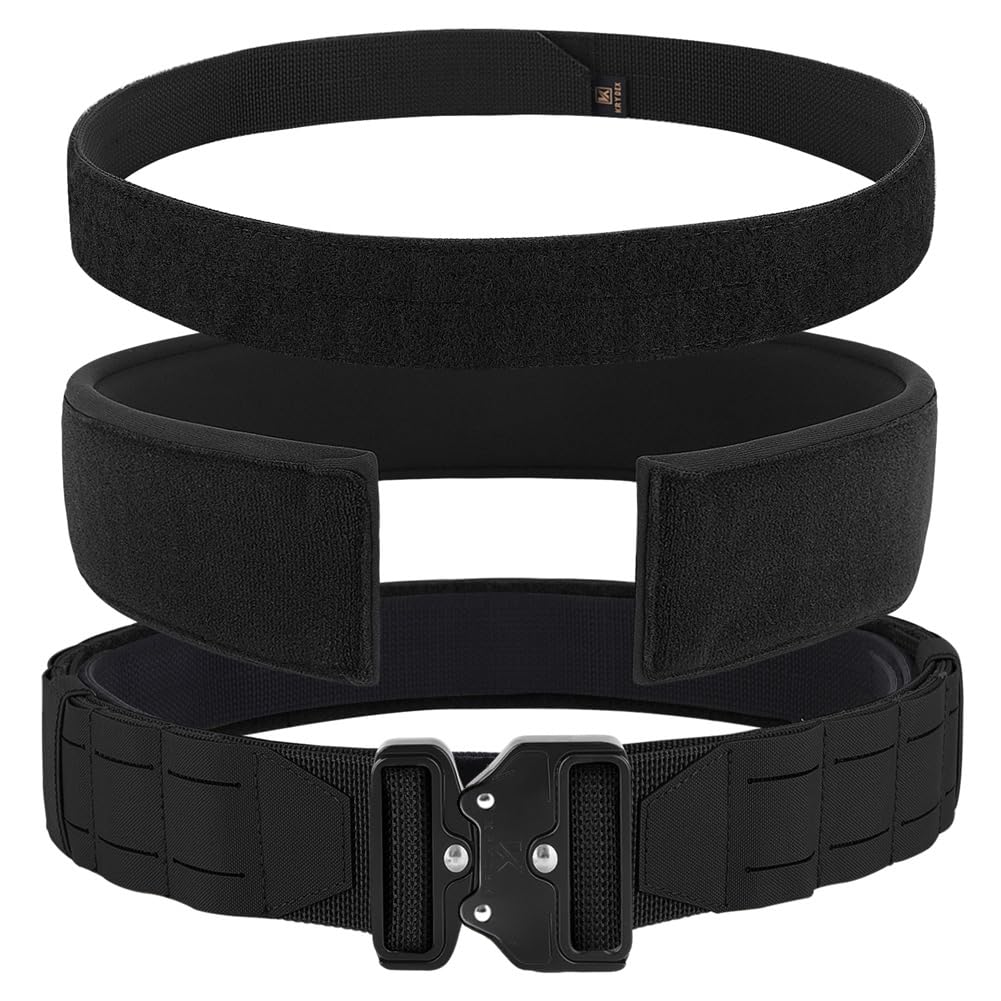
2. KRYDEX Tactical Battle Belt 2 Inch
The widest outer belt in this lineup, with a pad built to sit under the load.
Three pieces arrive in this kit: a 2-inch MOLLE outer belt, a 1.5-inch loop inner belt and a 3-inch back support pad. That 2-inch width is the widest outer belt here, and the pad is the genuinely useful part — it spreads pressure across your back instead of driving the belt edge into you. If you are strapping on mags and a dump pouch for a long day, that pad is doing real work. This is the same layout PETAC GEAR and KORE run, just at a lower buy-in.
Owners describe it as comfortable straight away and stiff enough for rugged use. It holds up field-testing, and the inner belt is rigid enough that it stays locked to your pants while the outer rig velcros over. Users call it easy to adjust and good value. The word that keeps coming back is “comfortable” — the group that wears it hard reports it stays that way through repeated range days.
Here is where a heavy load tests it. With a lot of weight on the belt, the adjustment tends to work loose over time, and one long-term user reported exactly that: “My only issue is with a lot of weight on the belt. The adjustment seem to want to slip and come loose.” The fix is simple — a strip of tape over the adjustment point, or just re-tightening when you suit up. The webbing around the buckle also feels less stiff than the rest, and the MOLLE loops are tight on a fresh belt, so thick-lipped attachments take more care to thread. All of that is manageable if you keep your total load moderate.
Rigidity where it counts: the outer belt and pad together are the reason it holds position on a long day. A loaded rig on a stiff belt and a soft one feel totally different at hour six.
The caveat worth knowing: with heavy weight, the adjustment creeps. That is a rig-up problem, not a build problem, but it means checking the tension before every session rather than once a month.
Pays off for: anyone who wants a wider support belt at an entry-level price and will keep their setup reasonably light.
Think twice if: you plan to hang serious weight on it from day one without re-tightening the adjustment.
3. Battle Belt Heavy Duty Nylon

A belt that claims it holds up to 100 pounds of combat gear.
If you carry a heavy load, the 100-pound rating is the number that decides whether this one is for you. The belt is built from 1000D nylon (a dense, heavy-woven fabric that resists tearing and scuffing), so it stands up to hard use. It comes as a matched pair: a 1.5-inch inner belt that fits most pants loops and a 1.75-inch outer belt lined with MOLLE (the webbing grid for clipping on pouches). A 2-inch anti-slip pad underneath lets you wear the outer belt over a garment without it riding up.
You get a size for most waists: small covers a 30-to-34-inch waist, medium covers 34 to 41, and large covers 41 to 46. A powerlifter at 6 foot 2 and 330 pounds reported wearing it at the waist across six range days with five rifle mags, five pistol mags and a dump pouch. He said the support was excellent and the buckle was top-notch once it broke in. That is about as hard a test as this belt will see, and it passed. The buckle is stiff from the start, and a little gun oil gets it running smooth.
Two honest notes on the nylon. It can fray at the raw MOLLE ends, and a lighter will tidy that up — one reviewer noted “some nylon fraying (fixed with lighter)”. The laser-cut loops are also very tight at first, which is what you want for security and a nuisance when you first add attachments. The inner belt threads through pants a little grudgingly at the start too, but the two-belt system as a whole is a favourite because the outer rig can come off without undoing a single pouch.
Load-bearing verdict: the 2-inch anti-slip pad and the stiffness of 1000D nylon are what hold a loaded setup flat against your hips. Compared with the KRYDEX above, this one is built to the same pattern with a wider pad and full MOLLE around the belt.
Break-in reality: the buckle and MOLLE webbing both need a little use before they feel right. Plan the first session as a shakedown.
Best match for: shooters carrying real weight who want a pad and full MOLLE coverage without moving to duty pricing.
Skip only if: you want a belt that feels broken-in on day one.
4. BOMTURN Tactical Battle Belt 7 in 1 Set

Waist range runs from 34 to 50 inches and takes a lot of gear with it.
A bigger waist is exactly who this belt is built for. Its range starts at 34 inches and runs to 50, the widest waist window in this whole lineup and well ahead of the YAKEDA belt’s 29.5-to-44.8 range. It weighs 1.2 kg as a set, so it is a full rig rather than a slim belt. The seven pieces give you real storage: one padded MOLLE belt, one built-in fixed belt, one AK/AR mag pouch, one bottle bag, one ammunition bag, one multipurpose bag and one folding pouch.
Wearing it all day depends on the padded back and the honeycomb mesh foam pad, which spread the load and let air through. Owners mention comfort and a breathable feel with a lot of pocket space. One large-framed user said “I’m a big guy and it fits, you can mix and match and this belts holds.” The moveable pouches let you shift your layout around. And because the belt itself comes apart, you can pull the inner strip out and run it alone when you want something lighter.
The two things to know before you order. The buckle is plastic, not metal, so if you want a one-hand quick-release metal buckle you are looking at the wrong belt. And a few of the pouches can arrive with a stitching defect — one buyer found two that were “not sew correctly”. The belt itself runs a touch loose if you are moving fast, so for running and hard drills a stiffer build like the Bear Armz belt above suits better. For hikes, cosplay and casual range days, it is a lot of kit for the money.
Why it earns its place
- 34–50 inch waist range, the widest here
- Five pouches plus two belts in one box
- Padded mesh back stays breathable on long days
- Pouches move around so you can build your own layout
Set your expectations
- Plastic buckle, not a metal quick-release
- Stitching on the pouches is not always tidy
- Runs loose for running and hard fast movement
Buy this when: you want maximum pouch storage and a wide waist range for weekends on the trail or at the range.
Pass on it if: you need a metal quick-release buckle or a belt that stays tight through sprinting.
5. YAKEDA Tactical Battle Belt with Pouches

One size that adjusts from 26 to 44 inches, no measuring tape needed.
This is the YAKEDA belt done a step up from the first pick. You get eight pieces: one inner belt, one outer belt, two mag pouches, a radio pouch, a dump pouch, a multi-function pouch and a storage pouch. The outer belt is 1.75 inches of double-layer nylon webbing, and the buckle is metal rather than plastic, with a quick-release that lets you detach the outer rig in one motion. Both ends adjust, so it fits 26 to 44 inches without you measuring anything first.
The strength here is how it sits on a full-sized frame. A 6-foot-2, 280-pound owner at a 38-inch waist reported it “feels solid doesn’t bounce around”, and with mags, a holster and grenades mounted it felt “like in extension of my body”. That is the feeling a good two-belt system produces — the rig moves as one piece with you. Owners describe it as tough, with plenty of MOLLE for attachments, and well worth the build quality. The inner belt runs through standard jeans loops and stays comfortable all day, which is what makes it work as an everyday carry rig as much as a range belt.
Where it drifts is top-end gear you add later. The pouch quality is the weak point — a dump pouch that ripped on first unfold and a medical pouch that ran small for real supplies are the kind of complaints that show up. Buyers also note the adjustment can loosen over long wear, which is easily solved by sewing or taping the adjustment point in place. A buyer running it hard called it “a nice beginner’s battle belt”, and that is the right read. The belt itself is sound; it is the add-on pouches that keep it a starter kit.
The fit story: a 26-to-44-inch adjustment range on a full-size belt is unusual at this level. Compared with the first YAKEDA pick, this one reaches down to a 26-inch waist, so smaller frames have more room to work with.
Upgrade path: treat the included pouches as a starting set and buy your serious pouches separately. The belt underneath is the part worth keeping.
The right rig for: everyday carry and range days on bigger frames, or anyone who wants one size to fit the whole household.
Budget for later: replacement pouches, since the included ones are the weakest link in the box.
6. PETAC GEAR Tactical Battle Belt Cobra Buckle

A genuine Cobra buckle that will not release under load, plus a spare inner belt.
The Cobra buckle is the headline and it is worth understanding why. It is a metal buckle designed so the lock cannot open on one side while it is under load, which matters if the belt is holding your gear up and something catches the release. The rest of the kit is a 2-inch MOLLE outer belt, a velcro-backed inner belt and a second inner belt — so you always have a backup liner with your pants. Sizes run from a small at 28 to 33 inches up to an X-large at 41 to 45 inches.
This is the one that holds up over the long haul. A wearer reported two years of continuous use across conditions from the arctic to the southeast US, and said it is “still holding up as well as the day it arrived”. That tracks with owners finding it comfortable and strong, with size adjustment that stays tight on long hikes. A medium fits a 36-inch waist with a few inches of overlap left over. The whole thing is nylon, so there is no stretch to it, and the buckle slides slightly from side to side in use — the trade-off for a buckle that stays shut under load.
Two things to weigh. First, the buckle and the layout add up to a stiffer, more cumbersome belt to don and doff than a simple loop belt, so you will not be throwing it on for a ten-minute errand. Second, a few users find the stiffness uneven and report a flimsier feel right around the buckle than on the rest of the belt. Neither undermines the belt’s ability to hold weight, and the long-service record is the stronger signal. This is a duty belt that happens to work as a range belt, not the other way around.
The reason to spend here
- Genuine Cobra D-ring buckle that will not release under load
- Two inner belts included, so you always have a liner
- Size adjustment holds tight through long hikes
- Proven over two-year use in extreme conditions
The honest trade-offs
- Stiffer and slower to take on and off than a simple loop belt
- The buckle slides a little from side to side
- The area right around the buckle feels less stiff than the rest
Worth it for: duty, patrol and anyone who wears a rig for years and wants the buckle to be the last thing that ever fails.
Not for you if: you want a belt you can throw on and off in five seconds for casual range days.
7. KORE 1.75″ MOLLE Battle Belt

Ratcheting micro-adjustment in quarter-inch steps, cut to your exact size.
Every other belt here is adjusted by pulling a strap through a buckle and hoping the overlap lines up. This one is different. A hidden track sewn into the back of the belt clicks in quarter-inch increments, so you dial the fit to the notch instead of the nearest hole. That is the same ratcheting idea KORE built its reputation on, and here it is applied to a 1.75-inch MOLLE outer belt. The outer belt runs a 7mm thickness, and the maker rates the outer belt to carry 20 pounds of load.
Precision fit is where this belt earns its keep. The system comes with over 20 sizing options and you cut the belt to length, so a 24-inch waist and a 48-inch waist both get a belt that overlaps properly instead of gapping. The outer belt is rigid enough to hold a holster, mag pouches and a med kit without the whole rig shifting or sagging. The inner liner velcros through your pants loops, so you can rip the outer rig on and off. Long-time duty wearers put it bluntly: one called it the best belt of a law enforcement career, and another reported it “works with all gear” and stays comfortable through a full shift.
The catch is the velcro. The hook side is aggressive, so it grabs loose shirt fabric when you put the belt on, and users report the belt pulling threads out of work shirts over time. If your shirt hangs over the belt, that is a real annoyance. This is also the premium buy in this lineup, so it is the one to consider last rather than first. For anyone whose job is the belt, that premium is easier to justify than for a weekend airsoft player. For everyone else, the Bear Armz or KRYDEX options above give you most of the function.
The fit advantage in plain terms: quarter-inch steps mean the belt fits the same way on day one and month twelve, whether you are wearing a t-shirt or a winter coat over it. No other belt in this list adjusts that finely.
The one downside to plan for: the velcro hooks and shirt fabric are not friends. If you wear a tucked work shirt, expect some snagging at the waistline.
Choose this if: fit precision matters more to you than price and you wear a rig for a living or near enough.
Consider the alternative if: you want most of the function at a lower outlay and do not need quarter-inch adjustment.
Know the Specs
MOLLE webbing
MOLLE is a grid of horizontal webbing loops sewn onto a belt. You weave a pouch’s straps through the loops and snap it down, so it stays put instead of sliding around your waist. A belt with MOLLE all the way around lets you put gear behind your back; one with MOLLE only on the front limits where you can mount things.
Inner and outer belt systems
An inner belt threads your pants loops and holds your trousers up. The outer belt velcros over the inner one and carries all the gear. The advantage is that you can take the whole loaded outer belt off without moving a single pouch, then put it back on in the same position.
Belt width and load
Width is measured side to side across the belt. A 1.75-inch or 2-inch belt spreads weight across more of your hip than a narrow one, and on a stiff material like 1000D nylon that extra width stops the belt from curling under a holster. Narrow belts still work for light setups; they just flex sooner.
Buckles: quick-release and Cobra
A quick-release buckle opens with one hand or one push. A Cobra-style buckle is a metal buckle designed so that a single side cannot release under load. Both make donning and doffing faster. The trade-off is stiffness. A heavier buckle can feel stiff at first and often needs a little use to loosen up.
Waist size and overlap
Every belt has a waist range, and the range is where it fits, not just where it closes. You want your waist in the middle of the stated range so there is overlap under the buckle. If your waist sits at the very top of the range, the belt will have little left to tighten.
What 1000D nylon means
The “D” stands for denier, a measure of how heavy the yarn is. 1000D nylon is a dense, thick weave that resists tearing and scuffing, which is why tactical gear uses it. It is stiff off the roll and holds shape, but raw cut ends can fray, and a quick pass with a lighter seals them.
Common Questions
Will a battle belt fit over my jeans or only over tactical pants?
How much weight can a battle belt actually carry?
Do I need an inner belt if my pants already have a belt?
Why does my new battle belt feel so stiff?
Can I put a pistol holster on a battle belt with no built-in holster mount?
What is quarter-inch micro-adjustment and why does it matter?
Are these battle belts legal to wear in public?
Should I buy a kit with pouches or buy the pouches separately?
How long does a 1000D nylon battle belt last?
Is a 1.75-inch belt or a 2-inch belt better for carrying gear?
The Bottom Line
For most people buying a first rig, the battle belts winner is the YAKEDA 7-Piece Belt. It puts two belts and five pouches in one box, adjusts across a 29.5-to-44.8-inch waist, and its 1.75-inch outer belt carries a full load without sagging. If you want the support pad and the widest outer belt, the Bear Armz Tactical Belt is the one built to hold up to 100 pounds of gear. And for duty-level fit that clicks in quarter-inch steps, the KORE 1.75″ MOLLE Battle Belt is the precision pick.
Before you order, know this: the pad and the buckle are the two parts you actually feel on a long day, so spend your money there. The right belt matches its width and stiffness to the weight you hang on it and the waist you wear it at. Once the width and waist range line up, the rest depends on how you lay out your pouches.
How we choose
We do not accept paid placement. Every pick is matched to a real buyer and a real use-case; we do not hands-on test units.
Sources
Specifications: manufacturer listings and product documentation. Review insights: verified customer reviews, as of October 2026. Pricing: not shown on this page (it changes often); check the current price via the retailer link.
As an Amazon Associate, Aappliancez earns from qualifying purchases. This does not affect which products we feature.