Disclosure: Some links in this post are affiliate links. As an Amazon Associate I earn from qualifying purchases, at no extra cost to you. Learn more
Specs are compiled from manufacturer listings and verified buyer reviews and can change over time — please confirm the key details on the product page before buying.
Mold only grows where moisture lingers, so the fan that actually dries your bathroom is the one worth owning. This guide walks you through eleven bathroom exhaust fans that move real air, sized and specced for the job rather than for the showroom.
This guide is built by comparing the manufacturers’ published specifications and the patterns across verified customer reviews, so you get each pick’s real strengths and trade-offs instead of marketing spin.
You will see how airflow, sones, duct size and retrofit fit decide whether a fan clears steam in minutes or merely hums along. The right bathroom fan to prevent mold has to match your room size and your existing duct before anything else.
Top Picks


How To Choose The Best Bathroom Fan to Prevent Mold
Mold needs standing moisture on a surface for hours, so the fan’s job is to swap humid air for dry air fast enough that surfaces stop staying wet. That starts with the right CFM number, not the brand name on the grille.
Match CFM to the room, not to the loudest label
CFM stands for cubic feet per minute — how much air the fan pulls out in sixty seconds. A 50 CFM fan suits a tiny half-bath, while a 110 CFM fan handles a full family bathroom. Undersize the fan and the mirror stays fogged long after you towel off; oversize it in a small room and you may pull conditioned air out faster than you need.
Read sones and decibels as comfort, not just bragging rights
A sone is a perceived-loudness unit, and 1.0 sone reads roughly like a quiet fridge hum. The 2.0 sone fans here sit closer to a soft conversation. Quieter matters because a fan you can stand to leave running is one that actually finishes drying the room. Decibels (dB) measure sound pressure, so 40 dB is a useful cross-check when a listing quotes both.
Check the duct before you fall for the airflow number
A fan rated 110 CFM through a 4-inch duct loses real airflow on a long run with bends. Keep runs short, seal the joints, and use the larger duct option when the fan offers one. A backdraft damper (the flap that shuts when the fan is off) keeps humid outside air and pests from creeping back in.
Side-by-Side Comparison
| Model | Best For | Airflow | Noise | Duct / Mount | Amazon |
|---|---|---|---|---|---|
| Panasonic FV-0511VFL1 WhisperFit★ Best Overall | Best Overall | 110 cfm | 3 selectable speeds | 4″ or 6″ / ceiling | Amazon |
| Fanspex Ceiling Exhaust FanBest Value | Best Value | 110 cfm | 40 dB / 1.0 sone | Ceiling mount | Amazon |
| Harrier Hardware 70 CFMQuietest Small Room | Quietest Small Room | 70 cfm | 2.0 sone / 40 dB | 3″ / ceiling | Amazon |
| Zeyzer Black Bathroom Fan | Best for Wall Mount | 110 cfm | 1.0 sone / <34 dB | 5.9″ / ceiling or wall | Amazon |
| Voltset 4 Inch Duct Fan | Most Airflow | 280 cfm | 30 dB | 4″ / duct mount | Amazon |
| Shinebella Wall-Mounted Fan | Best for RV | 4 speeds | Noise-reduced blades | Wall mount | Amazon |
| Homewerks 7140-50 | Small Bathrooms | 50 cfm | 1.0 sone | 4″ / ceiling | Amazon |
| KAZE APPLIANCE SNP100 | Premium Pick | 100 cfm | 0.8 sone | 4″ / ceiling | Amazon |
| OREiN 2-in-1 Fan with Light | Best with Light | 110 cfm | 2.0 sone | 4″ or 3″ / ceiling | Amazon |
| Akicon Ultra Quiet Fan | Best Looking | 80 cfm | 2.0 sone | Ceiling mount | Amazon |
| Broan-NuTone Fan with Light | Retrofit Favorite | 110 cfm | 1.0 sone | 4″ / room side | Amazon |
Detailed Reviews
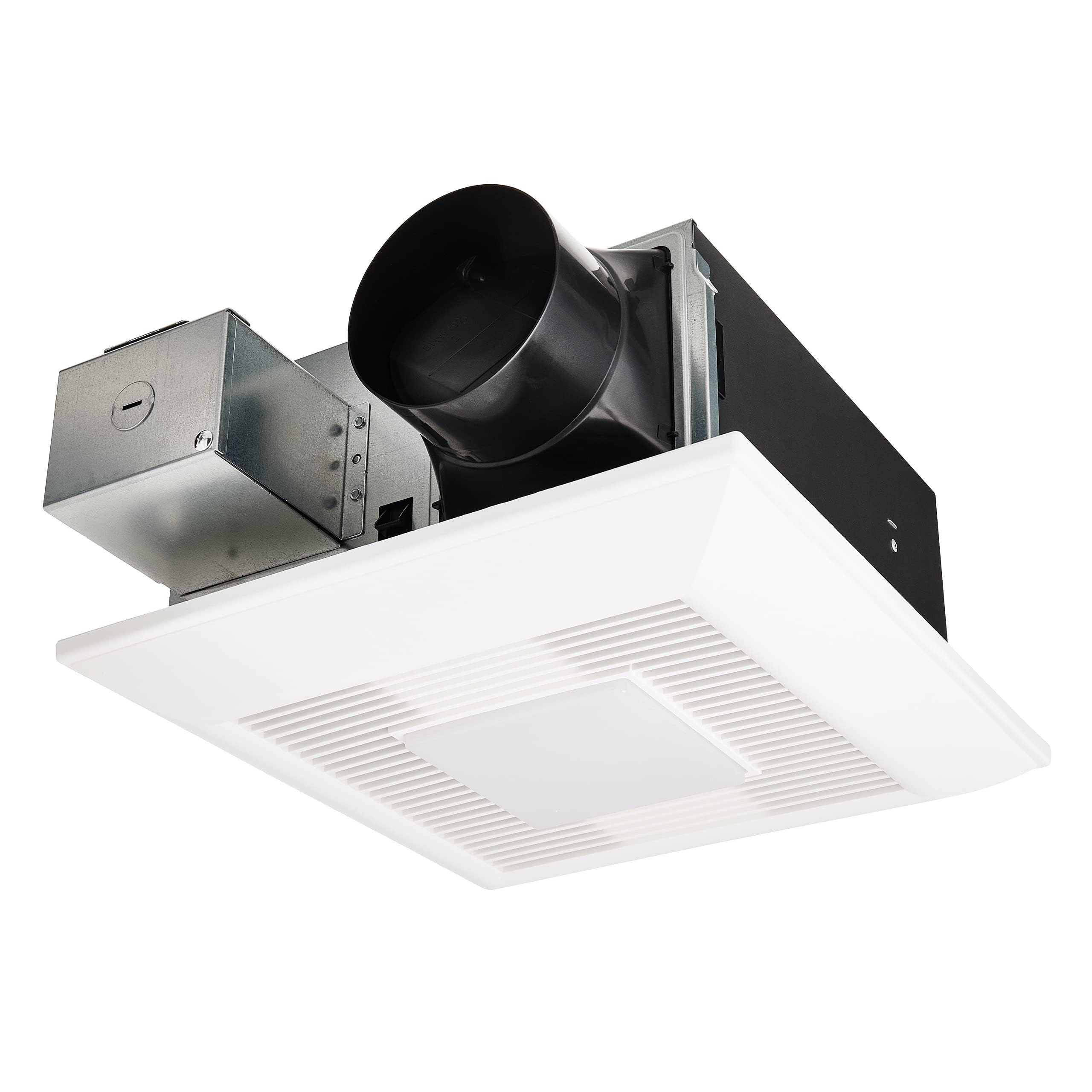
1. Panasonic FV-0511VFL1 WhisperFit Bath Fan
Our pick — 4.5+★ from 900+ verified ratings; the strongest balance of quality and price.
One fan, three airflow settings, and a light that actually lights the room
The defining trick here is Pick-A-Flow: a switch on the unit lets you set 50, 80 or 110 CFM (cubic feet per minute — how much air it moves) to match the room you have. Movers and shakers of the line are the build and the fit. It is a 4.5+ star fixture with 900+ owners, and the thing that wins people over is outright quality — the motor, the housing, the way it goes in. Installation earns the second-biggest nod because the single-hinged Flex-Z Fast bracket lets one person hang it without climbing into the attic.
A DC/ECM motor (a brushless, electronically controlled motor that sips power) drives the airflow, and the fixture arrives with a dimmable 10W LED plus a sub-1W night light. You can wire it to 4-inch or 6-inch ducting, which matters — a 110 CFM fan pushed through a long 4-inch run loses pull, so the 6-inch option is your friend on a big bathroom. The one dimension worth measuring first is the 10.25-inch square housing; it swaps into many existing cutouts but not all.
Where it stumbles is the paperwork. It is also a premium-tier unit, so budget shoppers will feel the difference next to the Fanspex below. And the light leans cool-toned rather than warm — fine for grooming, less flattering than you might expect.
Why it takes the crown
- Adjustable 50/80/110 CFM covers small, medium and large bathrooms from one box
- Dimmable 10W LED plus a low-power night light built in
- Flex-Z Fast bracket simplifies a solo retrofit
- ENERGY STAR certified and offered in 4-inch or 6-inch duct options
Where it asks more of you
- Instructions are weak — plan on a video walkthrough
- The LED reads cool-toned, not warm
- Premium-tier pricing and a fixed 10.25-inch housing footprint
Best for: a full bathroom where you want to size the airflow once and be done.
Measure first: the 10.25-inch square cutout and your duct run — long 4-inch runs should step up to 6-inch.
2. Fanspex Bathroom Ceiling Exhaust Fan
Budget-tier muscle: 110 CFM and a copper motor without the premium tag
If you want bedroom-scale airflow without stretching the budget, this one brings 110 CFM to the party. Here is the head-to-head worth noting: the Fanspex moves 110 cfm against the Harrier’s 70 cfm, so it clears a bigger room faster. At 40 dB (roughly 1.0 sone — a quiet-hum loudness) it keeps noise tame, and it is sized for a space of 129 to 172 square feet.
What earns the fan-quality praise is the enclosed copper motor — thermally protected and permanently lubricated, which means it shrugs off bathroom damp and dust. The 26W draw is a welcome surprise next to the 50W units it competes with, and the included wiring joints, screws and manual mean you are not hunting for extras. Just measure your cutout: the housing runs 9.1 by 9.1 to 9.8 by 9.8 inches, and that is the one box you must tick before buying.
Noise is the honest variable. Some installations feel quieter than expected; others report a slight chatter or rumble, and the flutter flaps on the housing can let small pests in when the fan is off. Treat it as a strong-value workhorse, not a whisper-class luxury unit. The mixed durability signal on a few units is worth knowing, but the bulk of owners are clearly satisfied.
What lands: big 110 CFM airflow, a sealed copper motor, and a 26W appetite that keeps daily running gentle on the electric bill.
What to watch: noise can vary by install, and those housing flaps are worth a look if bugs are a concern.
Reach for it if: you have a medium bathroom and want the most airflow for the least spend.
Look elsewhere if: you need near-silent operation or a motor service that does not mean a whole-unit swap.
3. Harrier Hardware Bathroom Exhaust Fan 70 CFM
Whisper-grade for a half-bath, with a 3-inch outlet that simplifies a swap
You get quiet, steady steam removal for a small bathroom: 70 CFM (cubic feet per minute — the volume of air it moves) is the balance for a compact room, and 2.0 sones (about 40 dB, roughly a quiet library) means you can leave it running without wincing. What wins people over is quietness without a corner-cutting motor — owners describe it as barely noticeable, yet it still pulls steam and stops the mirror fogging. Quiet plus steady airflow is exactly the mold-fighting combination you want.
The galvanized steel housing is built to shrug off bathroom and attic moisture, and it is UL listed for over-tub and shower use with GFCI. A 3-inch duct outlet makes it drop-in friendly for older small fans. Wiring is beginner-level: a straightforward two-switch setup that even first-timers manage. The blade measures 7.5 inches, so the removal and refit are simple.
Two honest notes. The motor mounts opposite on some replacements, so a full-unit swap is the path — not a quick motor-only exchange. And the clip-on cover uses thin wire springs, so handle it with care during the swap. Neither dims the fact that it is an easy, quiet way to dry a small room day after day.
The quiet win: 2.0 sones at 70 CFM lets it run long enough to actually clear humidity, not just make noise for two minutes.
The service reality: a full-unit replacement is the long-term service path, so plan accordingly.
Best fit: a small bathroom or powder room where noise is the deal-maker, not raw CFM.
Think twice if: you need a high-CFM fan for a large wet room or a motor-only future repair.
4. Zeyzer Black Bathroom Fan 110 CFM 1.0 Sone

The rare fan that looks good in black and mounts up a wall as easily as a ceiling
Most bathroom fans are white and forgettable. This one is black and happy on either a ceiling or a wall, which makes it the pick for anyone whose installation is wall-only. With 110 CFM and a listed 1.0 sone (under 34 dB), it suits a high-humidity room like a bathroom, kitchen, garage or basement without making you shout over it.
The ABS plastic housing and fan wheel are built to resist ultraviolet yellowing, so it stays looking sharp. The ball-bearing motor is specced for quiet running and a long service life. The 5.9-inch duct standard means it slips into many existing openings; the process takes only a 6.3 to 6.7-inch hole and needs connection to duct, no fastening ring required. Owners point to appearance as a big plus alongside easy fitting.
The variable is noise — many installs feel genuinely quiet, a few land louder than hoped. And the flap cover is clear plastic rather than a hinged metal baffle, so do not expect a premium shutter. At 4.0+ stars it sits below the top picks, reflecting that spread rather than a dealbreaker.
Where it shines
- Mounts on ceiling or wall — a real option when a ceiling cut is off the table
- 110 CFM clears high-humidity rooms like baths and basements
- Black, UV-resistant finish that reads modern
- Simple install with a 6.3 to 6.7-inch opening
The trade-offs
- Noise varies — some installs louder than the spec suggests
- Clear plastic flap instead of a hinged baffle
- Lower overall rating than the top picks
Go for it when: a wall install is your only practical route and you want airflow without visual noise.
Weigh this instead: if you need guaranteed silence or a metal baffle, the Panasonic above is the safer bet.
5. Voltset 4 Inch Duct Fan
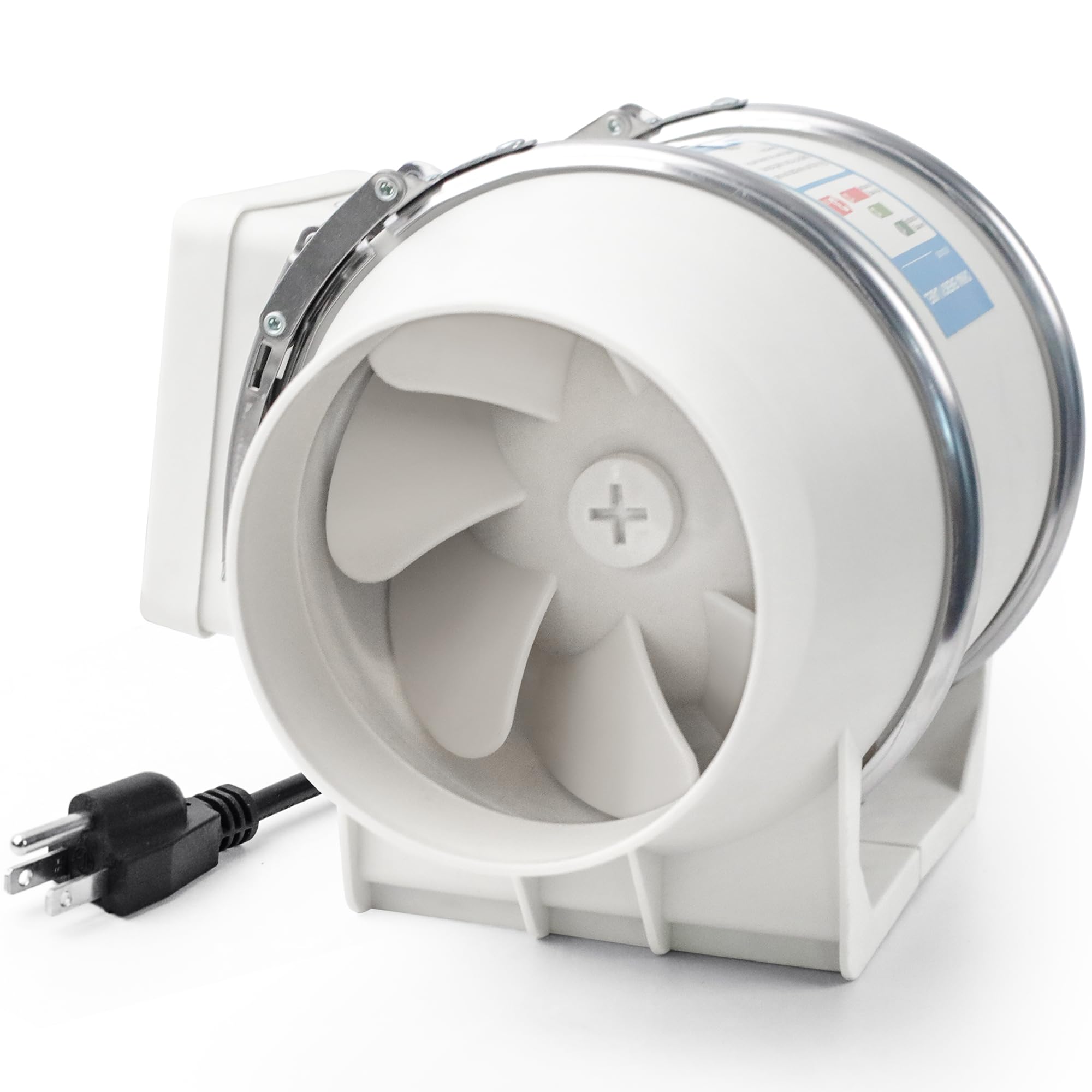
An inline brute that pushes 280 CFM and shrugs off long duct runs
This is a different animal: an inline duct fan, not a ceiling grille. The 280 CFM rating is the headline, and the 2200 RPM motor (revolutions per minute) is the engine behind it. That headroom pays off on long duct runs where a standard fan chokes — buyers report it pulling strong through a good length of flex duct. Its 30 dB operation keeps the noise gentle for something this powerful.
What lands is functionality: it moves serious air, it moves it quietly, and the two-speed remote means you control it from across the room — handy when it is tucked in ducting above the ceiling. Build quality reads solid with good cooling, and the compact footprint fits tight basement or window spaces with ease.
The honest catch: a few owners say it does not quite hit the claimed 280 cfm, and one unit failed after months. It also needs its own power drop, so plan on a switched outlet or smart plug if you want scheduling. But this is the pick for anyone making a real venting project of a basement, workshop or laundry room.
The power play: 280 CFM and 2200 RPM make it the airflow king of this lineup, with 30 dB steadying the noise.
The caveat: real output may fall short of the badge, and it wants a dedicated power feed rather than a wall switch only.
Pick this if: you are venting a large or awkward space through long ducting and need raw pulling power.
Skip the inline route if: you want a simple drop-in ceiling grille — this one wants ducting and a switch of its own.
6. Shinebella 8.5-Inch Oscillation Fan

A compact wall fan that gets air moving where a ceiling grille cannot reach
For tight or odd spaces like an RV bathroom or a camper bedroom where a ceiling cutout is not an option, this wall-mounted oscillation fan moves air without any ductwork. It is not an exhaust fan — it is a wall-mounted oscillation fan. The 8.5-inch fan swings 90 degrees on its own and 120 degrees by hand, and its four speed settings mix air through a stagnant corner so moisture has fewer places to settle.
What buyers appreciate is the remote — it changes speed, sets the timer (0.5, 1.5, 4 or 8 hours) and sticks to the fridge surface so it does not vanish. The seven blades are balanced to keep the breeze soft and quiet, and the frame comes apart for cleaning. It takes up little wall space but still moves real air.
The catch is its role: it stirs air, it does not exhaust it outdoors. Use it alongside a proper vent fan, not instead of one. And the top two speeds can rattle slightly when oscillating, with the remote sensor blocked if you angle the head down. Manageable quirks for the flexibility it gives you.
The value: remote control, a built-in timer, and 90-degree oscillation in a small wall unit that saves counter space.
The reminder: circulation is not extraction — pair it with a real exhaust fan to move humid air outside.
Suits: RV bathrooms, campers and small rooms where a wall fan is your only practical airflow tool.
Not the same job as: a ceiling exhaust — this one circulates, it does not vent outdoors.
7. Homewerks 7140-50 Bathroom Fan

A whisper-quiet 1.0 sone workhorse for the half-bath reality check
Fifty CFM at 1.0 sone is the right fit for a small bathroom — exactly the size where a quiet fan can run for twenty minutes without you noticing it. It manages spaces up to 50 square feet, and the galvanized steel housing resists bathroom moisture. The no-cut, ceiling-mount design keeps the installation simple, and the 4-inch duct connector is standard.
The performance numbers here are unflashy but real: it clears toilet-room odor and steam with a decent draft, and the modern-style grille blends into the ceiling. The push-in connectors are convenient going in, though they are a pain going out — you may need to cut wires if you remove it. The exhaust port sits on one side, which can complicate alignment with an existing hole.
There is a mixed durability signal around the plastic clip that holds the spring, so fit the cover gently on day one. Otherwise it is a quiet, dependable small-room fan that does a narrow job well.
Why it works here: 1.0 sone at 50 CFM is exactly the quiet, right-sized combo for a powder room, and the ceiling grille stays discreet.
The honest note: the side-mounted exhaust port can force a new ceiling cut to line up with your duct.
Reach for it if: you have a small bathroom under 50 square feet and want quiet ventilation without drama.
Weigh this instead: a larger wet room wants more than 50 CFM — look at the 110 CFM picks above.
8. KAZE APPLIANCE SNP100 Extractor Fan
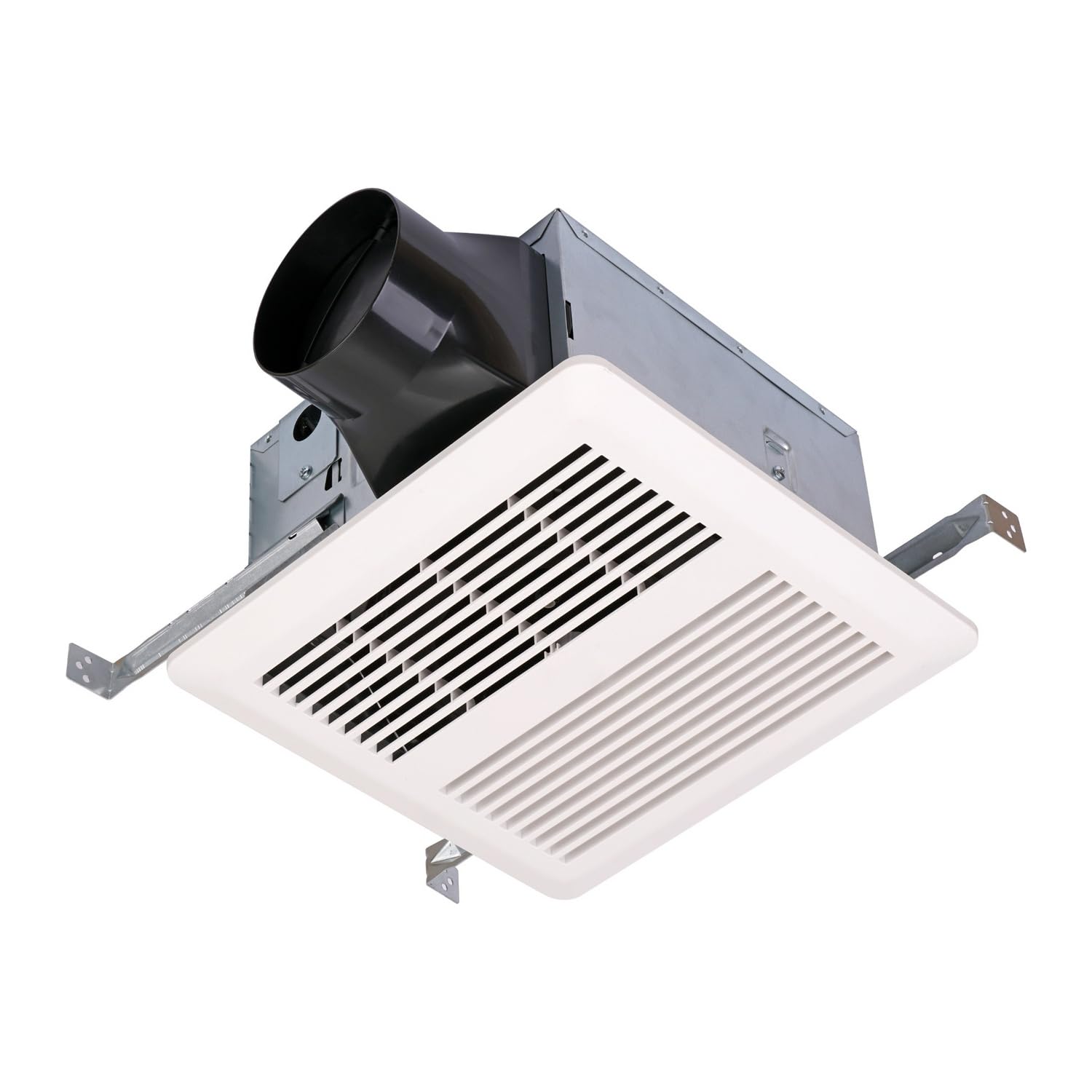
Premium build, 100 CFM at a claimed 0.8 sone, and a warranty behind it
The headline is a quarter of a dB past whisper: 100 CFM at a claimed 0.8 sone. The brand rates it for bathrooms up to 100 square feet and says it exchanges the air in an 8-by-5-foot room with an 8-foot ceiling in about 3.2 minutes. At that exchange rate, shower steam clears before it soaks into grout and drywall. The one-piece removable blower assembly makes future service easier, and the 26-gauge galvanized housing resists moisture.
Installation is the standout for tight retrofits — it goes in from the room side without attic access. The included hanger bars handle new construction too. It connects to a 4-inch duct and requires a 9.5 by 9.5-inch ceiling opening. With HVI, ENERGY STAR and ETL listings plus a three-year consumer warranty, it is a defensible premium pick.
Noise is where expectations and reality can part ways: in a small bathroom with a short duct rise, the measured loudness can land above the marketing figure. It is not unreasonable, just not always whisper-level in every room. Factor that in if near-silence is your top priority.
Why it earns premium status
- 100 CFM clears a bathroom up to 100 square feet quickly enough to keep surfaces dry
- Installs from the room side — no attic access needed
- HVI, ENERGY STAR and ETL listed, with a three-year warranty
- Removable blower assembly simplifies future maintenance
What to plan around
- Real loudness can exceed the 0.8-sone claim in small, short-duct rooms
- Needs a specific 9.5 by 9.5-inch ceiling opening
- Assumes its own mounting direction, which may require extra work
Best for: a family bathroom up to 100 square feet where drying speed beats absolute silence.
Worth a look: if near-silence is non-negotiable, a lower-sone unit like the Panasonic may suit you better.
9. OREiN 2-in-1 Bathroom Exhaust Fan

One box does the exhausting and the lighting, at a daylight-bright 5000K
The practical draw is the combination: 110 CFM of ventilation plus a 1000-lumen LED at 5000K (a crisp daylight white). That brightness matters for grooming and makeup, and it means one fixture covers two jobs. It handles spaces up to 110 square feet at 2.0 sones, which sits comfortably quiet. Installation is from the room side with no attic access, and it fits 7.36 by 7.68-inch openings with 4-inch or 3-inch duct options via the included reducer.
What wins people over is quietness and performance together — it clears steam and odor well and lights the room at the same time. Built for long service with ENERGY STAR, ETL and HVI listings, it also carries a 5-year warranty. For a single-fixture upgrade, that is a tidy package.
The mild caveat is airflow consistency: some rooms clear steam fast, others feel it lag a touch. The frame install can be fiddly on a retrofit, so having attic access helps. All said, it is an easy all-in-one for most bathrooms.
The combo payoff: 110 CFM of extraction and 1000 lumens of 5000K light from one ceiling cut — fewer fixtures, fewer holes.
The install note: a retrofit is smoother with attic access, and steam-clearing can vary by room size.
Best for: bathrooms where you want the fan and a bright daylight light in one tidy fixture.
Think twice if: you need guaranteed near-silent operation or a large-room fan at max CFM.
10. Akicon Ultra Quiet Bathroom Exhaust Fan

A frosted-glass fixture that happens to vent a bathroom beautifully
This is the pick for someone who cares what the ceiling looks like. The frosted-glass cover in brushed nickel and the three selectable LED color temperatures (3000K, 4000K, 5000K) let you tune the ambience to the room. Behind the pretty face is an 80 CFM, 2.0-sone fan that suits spaces up to 80 square feet — enough to pull out shower humidity without the grille cheapening the look.
What wins people over is the quietness combined with the looks and the quality. Remove the glass cover and the install is straightforward, and the housing measures 8-1/2 by 8-1/2 by 5-3/4 inches with a 13-inch light-cover diameter. It is cUL and HVI listed, and the 3-year limited warranty backs it. Owners note how well it pairs with other fixtures, and several bought a second for a matching install.
The one rough edge is fragility in shipping — a few glass covers arrive damaged. Check your box on delivery and you are fine. Otherwise this is the aesthetic-first choice that still does the ventilation job properly.
The standout: a frosted-glass, three-color LED light that lifts the whole bathroom, backed by an 80 CFM, 2.0-sone fan.
The caution: the glass cover can arrive shattered, so inspect on delivery.
Best for: the bathroom where you want the fan to look like a design feature, not an appliance.
Weigh this instead: if you need 110 CFM for a large room, choose a higher-CFM unit.
11. Broan-NuTone Bathroom Exhaust Fan

A retrofit-first 110 CFM combo with a light color you can actually tune
Retrofit is the whole point here: this Broan-NuTone replaces an existing fan from the room side without attic access, and the 110 CFM clears spaces up to 105 square feet. The 1.0 sone rating keeps it whisper-low, and the four selectable LED settings (3000K, 3500K, 4000K, 5000K) remember your last choice so you set the warmth once. A full-perimeter intake grille resists dust build-up and keeps it looking cleaner between cleans.
Performance is the draw: the fan pulls steam and humidity out of a large bathroom efficiently, and many owners mention the upgrade is dramatically quieter than the old unit it replaced. The housing fits a 2-by-6 stud bay, and the grille measures 12-1/4 by 12-1/4 inches, so measure your opening before ordering.
The honest gripe is the cover clips — the wire-spring attachment can fight you and the cover may pop off a few times before it seats. The install also has fiddly moments around the exhaust hose and rafter access. Neither issue stops it from being a strong retrofit choice for anyone with attic access to tidy up behind.
Why it retrofits well
- 110 CFM at 1.0 sone covers a large bathroom quietly
- Four LED color temperatures from 3000K to 5000K, saved automatically
- Room-side install with no attic access required
- Full-perimeter intake grille stays cleaner longer
Where it gets fussy
- Cover clips can be tricky to seat properly
- Hose placement and rafter access add install time
- Needs a 2-by-6 bay and a matching ceiling opening
Best for: replacing an existing fan without cutting into the attic, with a light color you can tune.
Be ready for: a fiddly cover-clip fit and a little patience around the exhaust hose.
Know the Specs
What CFM Actually Means
CFM (cubic feet per minute) is the volume of air a fan moves each minute — the single number that decides whether your bathroom dries out. A 50 CFM fan suits a small half-bath; a 110 CFM fan clears a full family bathroom. Match your fan to your room size and your existing duct, because a big fan on a starved duct cannot hit its number.
Sones vs. Decibels
A sone is a perceived-loudness scale, where a lower number is quieter to the ear. Decibels (dB) measure raw sound pressure. A 1.0-sone fan reads far quieter than a 2.0-sone unit. Quieter matters because a fan you can tolerate running longer actually finishes drying the room, and that is what stops mold before it starts.
Common Questions
What CFM do I need for a bathroom to keep mold away?
Is a lower sone rating always better for a bathroom fan?
Will a 4-inch duct really choke a 110 CFM fan?
Can I install a bathroom exhaust fan without going into the attic?
How long should I run the fan to actually stop mold?
Do I need a fan with a light, or is the vent alone enough?
What is a backdraft damper and why does it matter?
Why does my new fan sometimes feel louder than its sone rating?
How do I clean and maintain a bathroom fan so it keeps pulling air?
Is an inline duct fan a good replacement for a ceiling exhaust fan?
The Bottom Line
For most bathrooms, the bathroom fan to prevent mold to buy is the Panasonic FV-0511VFL1 WhisperFit — Pick-A-Flow lets you set 50, 80 or 110 CFM (cubic feet per minute — the volume of air it moves) to the room, the dimmable LED and night light are built in, and the Flex-Z Fast bracket makes a solo retrofit genuinely easier. If raw airflow on a tight budget is the priority, the Fanspex brings 110 CFM and a sealed copper motor for the least spend. And for a large basement or workshop that needs real pulling power through long ducting, the Voltset inline fan is the one to reach for.
The crowd favorite here is telling: the Panasonic holds a 4.5+ star rating across 900+ owners, and that consensus points to a fan that is quiet, dependable and easy to fit. Before you buy, measure your ceiling opening, confirm your duct diameter and run length, and decide if you want a light baked in. Get those three right and any of these picks will dry your bathroom properly — which is the whole point.
How we choose
We do not accept paid placement. Every pick is matched to a real buyer and a real use-case; we do not hands-on test units.
Sources
Specifications: manufacturer listings and product documentation. Review insights: verified customer reviews, as of October 2026. Pricing: not shown on this page (it changes often); check the current price via the retailer link.
As an Amazon Associate, Aappliancez earns from qualifying purchases. This does not affect which products we feature.