Disclosure: Some links in this post are affiliate links. As an Amazon Associate I earn from qualifying purchases, at no extra cost to you. Learn more
Specs are compiled from manufacturer listings and verified buyer reviews and can change over time — please confirm the key details on the product page before buying.
Bass strings are the hardest in the band to tune by ear — they move slowly, they hum at low frequencies most cheap tuners barely register, and on a loud stage the room noise swallows the note entirely. The fix is a clip-on tuner that reads vibration straight off the headstock instead of listening to the air. Here are five that get the job done, from a rechargeable workhorse to a precision instrument for the player who wants the needle dead still.
This guide is built by comparing the manufacturers’ published specifications and the patterns across verified customer reviews, so you get each pick’s real strengths and trade-offs instead of marketing spin.
A tuner that hears vibration rather than sound is what keeps a low B string honest in a noisy room. That single design choice matters more than any feature list, which is why every pick below is built around a vibration sensor. This is how you narrow down the bass clip-on tuner that will actually hold pitch on a dark stage.
Top Picks

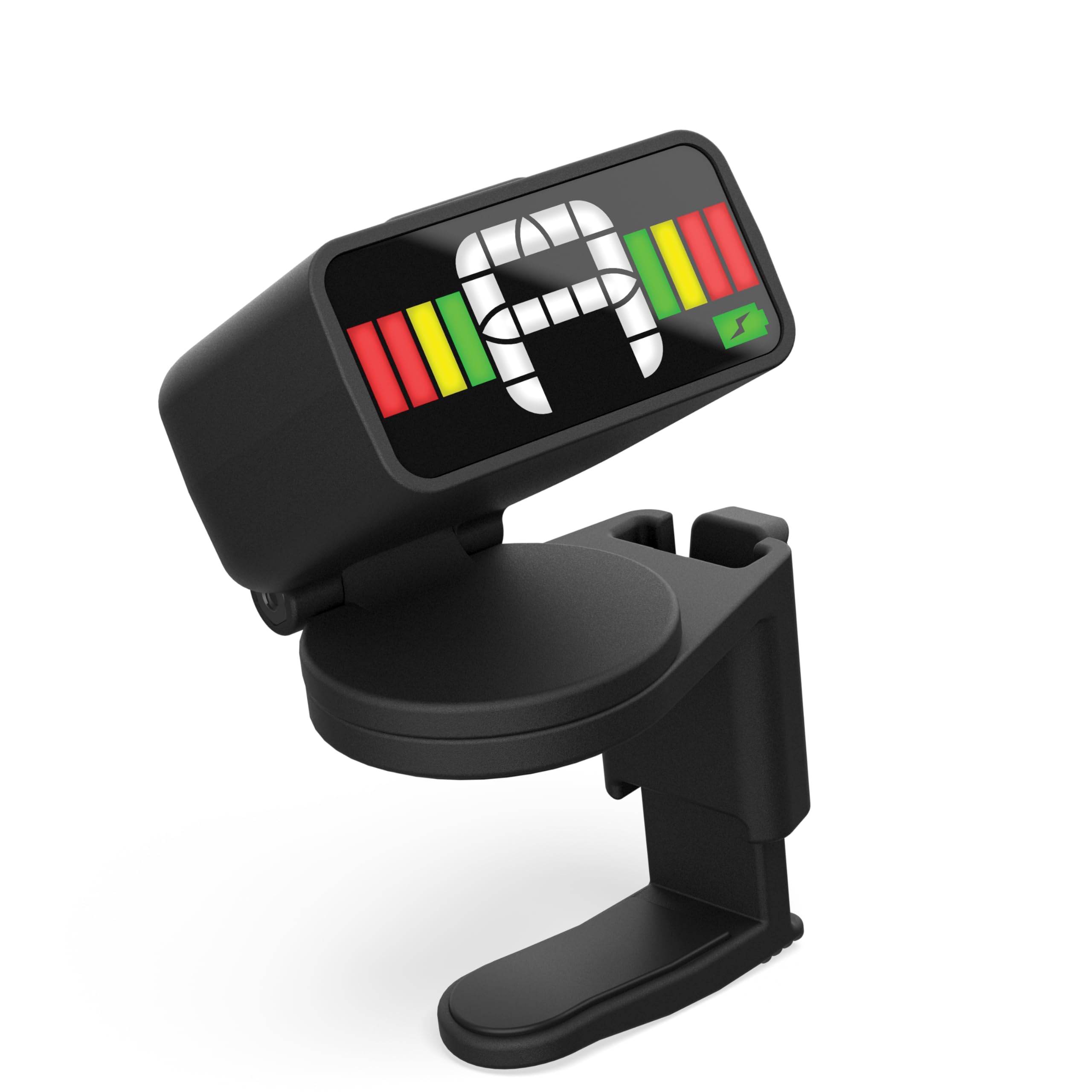
How To Choose The Best Bass Clip-on Tuner
The mistake most players make is buying a tuner built for guitar and expecting it to handle a low B string. Bass notes vibrate slower and sit far lower in pitch, and plenty of tuners simply give up near the bottom of the neck. Everything below is about picking the sensor, accuracy, and power setup that survives a real bass rig.
Vibration sensing beats listening
A clip-on tuner that uses a piezo transducer (a small sensor that feels the instrument’s vibration through the headstock) ignores the room entirely. That is why it still reads your note while a drummer is warming up three feet away. A microphone-based tuner in the same room will chase whatever is loudest, which is usually not your bass.
Accuracy in cents, and why the low end needs headroom
Tuning accuracy is measured in cents — one cent is one hundredth of a semitone, so a smaller number means a tighter reading. Precision figures are worth checking, but the bigger practical question is whether the tuner responds fast enough on a low E or B string. Slow detection is the most common bass complaint, because you end up overshooting and then waiting for the display to catch up.
Calibration range and pitch reference
A calibration range in Hz (hertz — cycles per second of the reference pitch) lets you tune to something other than standard concert pitch. If you play with a piano, a fixed recording, or a band that drifts a little sharp, being able to nudge the reference matters. Most tuners anchor at 440Hz, and some let you adjust upward or downward from there.
Power: rechargeable versus disposable
A rechargeable tuner means never hunting for coin cells before a set. The trade-off is that when it dies mid-show, you charge it rather than swapping in a fresh cell. Players who gig constantly sometimes prefer a battery they can replace in seconds. Players who mostly practice and rehearse usually love the rechargeable route.
The clip itself
The clamp has to grip a headstock firmly without marking the finish. Watch for a padded jaw with a soft material like silicone, and check whether the display swivels — a tuner you cannot angle toward your eyes is a tuner you will squint at all night.
Side-by-Side Comparison
| Model | Best For | Accuracy | Power | Mount | Amazon |
|---|---|---|---|---|---|
| Snark Rechargeable Clip-On Tuner (SN-RE)★ Best Overall | Everyday bass and guitar duty | — | USB rechargeable | Rubber-coated clip | Amazon |
| D’Addario Micro Rechargeable Headstock TunerMost Discreet | Leaving on the headstock permanently | Piezo transducer | USB-C, 22 hours per charge | 360° swivel padded clamp | Amazon |
| Aroma Clip On Rechargeable Chromatic Tuner | Multi-instrument players on a budget | ±0.5 cents | USB-C, up to 5.5 hours per charge | Dual-axis 360° silicone-padded clip | Amazon |
| LT-2 Guitar Tuner Rechargeable Clip On | Acoustic and electric string players | — | USB-C, 6+ hours per charge | 360° rotation, 180° tilt | Amazon |
| Korg Guitar Tuner (SHPRO) | Precision tuning where it counts | ±0.1 cents | — | Swivel clip | Amazon |
Detailed Reviews
1. Snark Rechargeable Clip-On Tuner (SN-RE)
Our pick — 4.5+★ from 950+ verified ratings; the strongest balance of quality and price.
The rechargeable workhorse that ends the coin-cell hunt for good.
The thing that makes this the pick for most bass players is simple: no batteries to buy. It recharges from any USB source through the included cable, so one charging session covers weeks or months of normal use. Owners back that up in reviews: “The battery lasts a long time I use this all the time and have not needed to recharge it in months.”
What wins people over beyond the power setup is the rubber coating on the body. That coating damps stage vibrations and handling noise, so the sensor reads your string and not the kick drum shaking the riser. The display is bright enough to read in a dim venue, and the clip holds firm on a headstock without a wrestling match. At 19.87 g it is light enough that you forget it is clamped on.
The honest catch is on the very bottom end. Response on the lowest strings is slower than on guitar strings, and that can roughly double the time it takes to dial in a low E or B. Detection lag is the other thing to plan around — the display can trail a fast tuning peg, so turn slowly and let it catch up. Neither issue shows up on guitar at all, which tells you where the limit sits.
What earns its keep
- No batteries to buy — recharges over USB from the included cable.
- Rubber coating keeps stage rumble from confusing the reading.
- Bright display and a clip that stays put on the headstock.
- Light at 19.87 g, so it never feels like a lump on the neck.
Where it asks patience
- Low E and lower bass strings take noticeably longer to register.
- Note detection can trail a fast peg turn, so tune slowly.
Take this one if: you want a rechargeable clip-on that handles bass and guitar duty without fuss.
Think twice if: you gig so often that a dead tuner mid-set needs a swappable cell rather than a charging cable.
2. D’Addario Micro Rechargeable Headstock Tuner
A tuner so small it disappears behind the headstock until you need it.
Twenty-two hours of tuning per charge is the number to remember here. That comes from a USB-C rechargeable battery, and combined with an auto-off function it means the tuner is essentially always ready when you pick up the instrument. A 6-inch USB-C cable is in the box, so there is nothing extra to buy on day one.
It reads vibration through a piezo transducer rather than a microphone, and the calibration range spans 410–480Hz — a genuinely wide window for matching a piano, a fixed tuning, or a band that sits off concert pitch. The full-color screen is easy to read, and the 360-degree swivel mechanism with an adjustable padded clamp lets you find a viewing angle that works. At 1.41 oz you will not notice it on the neck.
Tuner quality is the thing everyone raves about, and the compact size is right behind it — a lot of players simply leave one clamped on each instrument and forget it is there. Compare it to the Korg below and the split is clear: the Korg reads to ±0.1 cents for precision work, while this one trades that last sliver of accuracy for a display and footprint that vanish on stage. The recurring gripe is the clamp — it feels lighter-duty than the rest of the build, though it grips firmly and holds up.
The case for it: leave it on the headstock permanently, charge it a few times a year, and never think about tuning gear again.
One thing to watch: the padded clamp leaves a rubber footprint on some finishes, so check your instrument’s headstock before you commit to leaving it on.
Reach for this if: you want one tuner per instrument and a display that is barely visible when the unit is off.
Look elsewhere if: you need the tightest possible cent-level precision for studio intonation work.
3. Aroma Guitar Tuner Clip On Rechargeable Chromatic Tuner

Precision specs and five instrument modes at the entry-level end of the shelf.
Half a cent of accuracy is the headline, and it is a real figure — a high-sensitivity piezo sensor rated to ±0.5 cents. That is tight enough that when the display says you are in tune, you are genuinely in tune. The HD color screen uses an anti-glare design and a color-coded system: yellow for flat, red for sharp, and blue when you land on pitch. No squinting at a needle and guessing which side of center you are on.
Five modes — Guitar, Bass, Violin, Ukulele, and Chromatic — cover an entire instrument rack, and A4 calibration adjusts from 430 to 450Hz for matching a fixed reference. The dual-axis 360-degree rotation and silicone-padded clip let you angle the display exactly where you want it without scratching the finish. Power comes from a rechargeable lithium battery over USB-C, and buyers report “Just one hour of charge gives you up to 5.5 hours of continuous use or several days with normal use.”
Buyers praise the functionality most and the build quality close behind, and the body holds up to rough handling over months of use. The honest note is speed: pitch detection is slower than the snappier tuners here, so on a quiet stage you may wait a beat for the reading to settle. One charging quirk worth knowing — it wants a USB-A to USB-C cable, not USB-C to USB-C, so use the cable it ships with.
Why it punches above its tier: ±0.5 cents and a five-mode lineup is a lot of tuning tool for a budget-tier clip-on.
The trade-off: detection is a touch slow, so give the display a moment before you reach for the peg.
Pick it for: a multi-instrument player who wants tight accuracy without moving up a tier.
Pass if: you tune fast between songs and want instant note capture.
4. LT-2 Guitar Tuner Rechargeable Clip On Tuner

A full-color display that tilts and swivels until you can read it from anywhere.
An hour and a half on the charger buys you more than six hours of continuous tuning, and a three-minute auto-off means it does not drain sitting in the case. The internal micro sensor reads pitch from the instrument’s vibration, so ambient noise never gets in the way — the LT-2 tunes cleanly in a room where a microphone tuner would be chasing the loudest sound.
Pitch calibration spans 430Hz to 450Hz, and the manual is clear about where to set it: 440Hz for most instruments, 442Hz for violin. Five modes — chromatic, guitar, bass, ukulele, and violin/viola — extend to banjo, mandolin, cello, and nearly any acoustic or electric stringed instrument. The display rotates a full 360 degrees and tilts 180 degrees, and at 0.776 oz it barely registers on a headstock.
Versus the Aroma above, the runtime is the separator: six-plus hours of continuous use against 5.5 hours per charge. The physical limit is worth flagging early — it clips to a headstock or a flat surface above the strings, which makes it a non-starter on headless guitars. On a standard bass or acoustic it sits fine and handles drop tunings without complaint. The screen sits a little tall, which is the one cosmetic knock.
What it brings to the stand
- More than six hours of continuous use from a 1.5-hour charge.
- Full-color LCD with 360° rotation and 180° tilt for any angle.
- Five modes covering bass, guitar, ukulele, violin, and chromatic.
- Auto-off after three minutes idle keeps the battery healthy.
What limits it
- Needs a headstock or flat surface — no go on headless guitars.
- The display sits a little tall, which some find bulky.
Best matched to: string players who switch instruments and want one tuner that covers the whole rack.
The catch: if your bass has no headstock, this clamp has nothing to grab.
5. Korg Guitar Tuner (SHPRO)

The precision instrument for players who want the needle dead still.
Point one of a cent is the spec that defines this tuner — an ultra-high accuracy of ±0.1 cents. That is the tightest figure in this lineup, and it is exactly why the Korg earns its place at the top tier. If you set intonation yourself or tune to a fixed reference where a hair off-cent really matters, this is the tool that shows you the hair.
The 3D visual meter is the other defining feature, with three display modes to read pitch: a green light, a strobe, and a partial strobe. Players tend to use the green light to get in the neighborhood and the strobe to dial it in precisely, which makes tuning fresh strings quick work. The clip holds firmly with flexibility, and the display swivels in every direction so you can angle it toward your eyes.
Against the D’Addario above, the difference is pure precision: ±0.1 cents here versus a piezo sensor with no published cent rating there. Two things to plan for. It runs on a battery rather than a rechargeable cell, and the battery life is described as okay rather than excellent — so keep spares in the case. And while the display is very bright and readable in low or moderate light, it can get hard to read in direct sun.
What it delivers: the tightest accuracy here, at ±0.1 cents, backed by a responsive shuttle switch and a meter you can fine-tune against.
What to know: no rechargeable option and a battery that is merely adequate — this is a tuner you power with spares, not a cable.
Made for: the player who sets intonation and wants a strobe-grade reading they can trust.
Skip if: you tune mostly in bright daylight or want to charge rather than swap batteries.
Know the Specs
Accuracy in Cents
A cent is one hundredth of a semitone, so a smaller accuracy number means a tighter reading. The Aroma is rated to ±0.5 cents and the Korg to ±0.1 cents, and that gap is what separates a general-purpose tuner from a precision one. For everyday band tuning, half a cent is plenty. For intonation work where you are chasing a beat, tenths matter.
Calibration Range in Hz
Hertz measures the reference pitch — 440Hz is standard concert pitch. A tuner with an adjustable range, like the D’Addario’s 410–480Hz or the LT-2’s 430–450Hz, lets you match a piano or a fixed tuning that sits slightly sharp or flat. If you only ever tune to standard pitch, this spec may never come up.
Piezo Transducer vs Microphone
A piezo transducer reads the instrument’s vibration through the headstock, so it ignores the room. A microphone tuner listens to the air, which is why it chases whatever is loudest on a noisy stage. Every pick here uses a vibration sensor, which is exactly what a bass player needs when the drummer is warming up.
Rechargeable Power and Runtime
A rechargeable tuner runs on a USB-charged lithium cell. The D’Addario claims 22 hours per charge, the LT-2 more than six hours of continuous use, and the Aroma up to 5.5 hours with a one-hour charge. Longer runtime means fewer trips to the charger. A disposable battery, by contrast, swaps in seconds — which is why some gigging players still prefer it.
Common Questions
Will a clip-on tuner work on a five-string bass with a low B?
Do I need a tuner designed for bass specifically, or will a guitar tuner do?
How accurate should a bass clip-on tuner be?
Will the clip damage the finish on my headstock?
Rechargeable or disposable battery for gigging?
What does the Hz calibration setting actually do?
Why does my tuner struggle in a loud venue?
Can I use one clip-on tuner across guitar, bass, and ukulele?
How long does a rechargeable tuner last on a charge?
Is a clip-on tuner accurate enough for recording?
The Bottom Line
For most bass players, the bass clip-on tuner winner is the Snark Rechargeable Clip-On Tuner (SN-RE) because its rechargeable power, rubber-damped body, and firm clip handle bass and guitar duty without hassle. If you want a tuner that disappears on the headstock and stays ready for months, grab the D’Addario Micro Rechargeable. And for intonation work where a tenth of a cent matters, the Korg SHPRO is the one to reach for.
Here is the one honest nudge: the Snark carries the crowd-favorite weight with 4.5+ stars across 900+ ratings, and it earns that for everyday bass and guitar duty. If that is you, start there.
How we choose
We do not accept paid placement. Every pick is matched to a real buyer and a real use-case; we do not hands-on test units.
Sources
Specifications: manufacturer listings and product documentation. Review insights: verified customer reviews, as of October 2026. Pricing: not shown on this page (it changes often); check the current price via the retailer link.
As an Amazon Associate, Aappliancez earns from qualifying purchases. This does not affect which products we feature.