Disclosure: Some links in this post are affiliate links. As an Amazon Associate I earn from qualifying purchases, at no extra cost to you. Learn more
Specs are compiled from manufacturer listings and verified buyer reviews and can change over time — please confirm the key details on the product page before buying.
You do not need a smart fridge that plays music. You need one that keeps milk cold, keeps ice cream solid, and does not force you to chip ice out of the freezer with a spatula. That is the whole job of a basic refrigerator, and the ten models below do it with different trade-offs on space, defrost style, and how much of a footprint they take up in a small kitchen.
This guide is built by comparing the manufacturers’ published specifications and the patterns across verified customer reviews, so you get each pick’s real strengths and trade-offs instead of marketing spin.
The picks here run from compact apartment units to a full counter-depth French door, and each one earns its spot on a different strength. Below is the practical breakdown of the best basic refrigerator for a spare room, a garage, or a first apartment.
Top Picks


How To Choose The Best Basic Refrigerator
Strip a refrigerator down and you get a compressor (the pump that moves the cooling gas), a sealed box, and a thermostat (the switch that holds the temperature). Everything else is convenience. So your decision depends on four things: how much food you actually store, whether you are willing to defrost by hand, how much noise you can live with, and whether the box will physically fit where you plan to put it.
Frost-free versus manual defrost
Frost-free means the fridge runs a small heater cycle and drains the meltwater, so ice never builds up on the freezer walls. Manual defrost means you unplug the unit and melt the ice yourself, usually a couple of times a year. If the fridge lives in a garage or a basement you visit weekly, manual is tolerable. If it is your daily kitchen fridge, frost-free is the one feature worth paying for.
Capacity is not one number
A 10 cubic foot fridge with a 2 cubic foot freezer gives you 8 cubic feet of fresh food. That split matters far more than the headline number, because a deep freezer drawer and a shallow wire shelf hold very different amounts of actual groceries. Check the freezer figure before you assume the total is enough.
Energy use in plain terms
Annual energy consumption is measured in kWh, or kilowatt-hours — the unit your electricity bill is built on. A fridge rated at 200 kWh a year draws noticeably less than one rated at 465 kWh a year. Over a decade that gap adds up, which is why the Energy Star label is worth checking on any unit you plan to run constantly.
Fit, swing, and leveling
Measure your opening before you fall in love with a finish. A reversible door lets you flip the hinge so the door opens the direction your kitchen allows. Adjustable leveling legs matter on uneven garage floors. And a flat back with a recessed handle buys you inches against a wall.
Side-by-Side Comparison
| Model | Best For | Capacity | Defrost | Annual Energy | Amazon |
|---|---|---|---|---|---|
| Upstreman 11.6 Cu.Ft. Double Door★ Best Overall | All-round apartment pick | 11.6 cu. ft. | Frost Free | 310 kWh | Amazon |
| KoolMore 18.5 cu. ft. French DoorBest for Small Kitchens | Small kitchens wanting a modern look | 18.5 cu. ft. | Automatic | 465 kWh | Amazon |
| Kenmore 18.1 cu. ft. Top MountMost Storage | Full-size family storage | 18.1 cu. ft. | Automatic | 367 kWh | Amazon |
| Frigidaire EFR753 Retro | Retro styling on a budget | 7.5 cu. ft. | Manual | 200 kWh | Amazon |
| Hamilton Beach HBFR786 7.5 cu. ft. | One or two people | 7.5 cu. ft. | Manual | 5 kWh | Amazon |
| KoolMore 7 Cu. Ft. Garage Ready | Garage or basement | 7.1 cu. ft. | Manual | 333 kWh | Amazon |
| BLACK+DECKER BR1000HW | Frost-free on a mid budget | 10 cu. ft. | Frost Free | 297 kWh | Amazon |
| Hamilton Beach HBFRF6892 Convertible | Fridge or freezer, your call | 6.8 cu. ft. | Automatic | 300 kWh | Amazon |
| Frigidaire 10 CU FT Top Mount | Backup or second fridge | 10 cu. ft. | Frost Free | 300 kWh | Amazon |
| Frestec 12.1 CU Ft FR 1202 BK | Quiet operation first | 12 cu. ft. | Automatic | 316 kWh | Amazon |
Detailed Reviews
1. Upstreman 11.6 Cu.Ft. Double Door Refrigerator
Our pick — 4.5+★ from 100+ verified ratings; the strongest balance of quality and price.
The 11.6-cubic-foot box that quietly does the whole job without ever asking you for a scraper.
Here is the short version: this is the basic refrigerator that behaves like a grown-up appliance. The auto-defrost system pushes cold air through the freezer so ice never crusts over, which means you never schedule an afternoon to unplug it and melt the walls. The freezer section alone holds 3.2 cubic feet and the fresh section holds 8.4 cubic feet, so you get real frozen storage instead of a token ice shelf. It is Energy Star rated at 310 kWh a year.
The performance is what wins people over — it holds temperature steadily whether the shelves are packed or nearly bare. It also chills fast, with ice ready in roughly two hours according to buyer reviews. Owners describe it as silent, quieter than far more expensive kitchen fridges, and the brushed stainless door hides smudges. The door is reversible, so you can swing it left or right depending on where your counter run ends. One practical note: there is no light inside the freezer, and the workaround buyers use is a small rechargeable motion-sensing light strip.
Versus the Frigidaire 10 cu. ft. top-mount, this Upstreman holds 11.6 cubic feet against 10, and its 310 kWh annual draw is the higher of the two against 300 kWh. The two are close on running cost, so the capacity edge is the real reason to pick this one. It is also the highest-rated pick on this list at 4.5+ stars across 100+ ratings.
Where it earns its keep
- Frost-free operation means no manual ice scraping, ever
- 8.4 cu. ft. fridge plus 3.2 cu. ft. freezer gives real frozen storage
- Whisper-quiet compressor that owners compare favorably to high-end fridges
- Energy Star rated at 310 kWh a year
What to plan around
- No interior freezer light from the start
- Higher annual draw than the Frigidaire 10 cu. ft. — 310 kWh vs 300 kWh
- Owners of larger households wish for a 20 cu. ft. version
Reach for it if: you want a small-footprint fridge that defrosts itself and stays silent in an open kitchen.
Look past it if: you cook for a family of four — the 11.6 cu. ft. total will feel tight.
2. KoolMore 30-Inch French Door Refrigerator
French-door looks and 18.5 cubic feet of space that still slide into a 30-inch cavity.
If your kitchen was built for a smaller box, this is the pick that stops you from having to remodel. It is counter depth, which means the front sits roughly flush with your cabinets instead of jutting out into the walkway. Inside, you get 18.5 cubic feet, two large freezer drawers, 6 door bins, and adjustable glass shelves. A double-flow cooling system with digital temperature control spreads cold air evenly so produce and meat do not sit in warm pockets. It runs at 465 kWh a year, the highest draw on this list, which is the honest cost of the extra size and the French-door layout.
The quiet operation is what owners rave about most. The inverter compressor is barely audible, and owners who came from a louder reciprocating-compressor fridge notice the difference immediately. In practice, a freezer setting of one snowflake holds 0°F while two snowflakes keeps the fridge at 39°F. Stainless shows fingerprints, so it wants a damp cloth now and then. The interior light is dimmer than some would like. Note that buyers report no ice maker is included, and standard ice trays do the job.
Against the Kenmore 18.1 cu. ft. top-mount, this KoolMore carries the same practical family size — 18.5 against 18.1 cubic feet — but in a French-door format rather than a single top freezer door. The trade-off is energy: 465 kWh a year here versus 367 kWh for the Kenmore. If lowest running cost is your priority, the Kenmore wins that one; if you want the counter-depth look, this one earns its keep.
The layout advantage: a French door means you open half the fridge for a quick jug grab, so less cold air spills out — a real benefit when the fridge sits in a busy walkway.
Budget the fingerprints: flat stainless without protruding handles looks sleek but shows every touch, so keep a microfiber cloth nearby.
Best fit for: a 30-inch kitchen opening where a full-size fridge simply will not fit.
Think twice if: you want the lowest possible power draw — 465 kWh a year is the highest here.
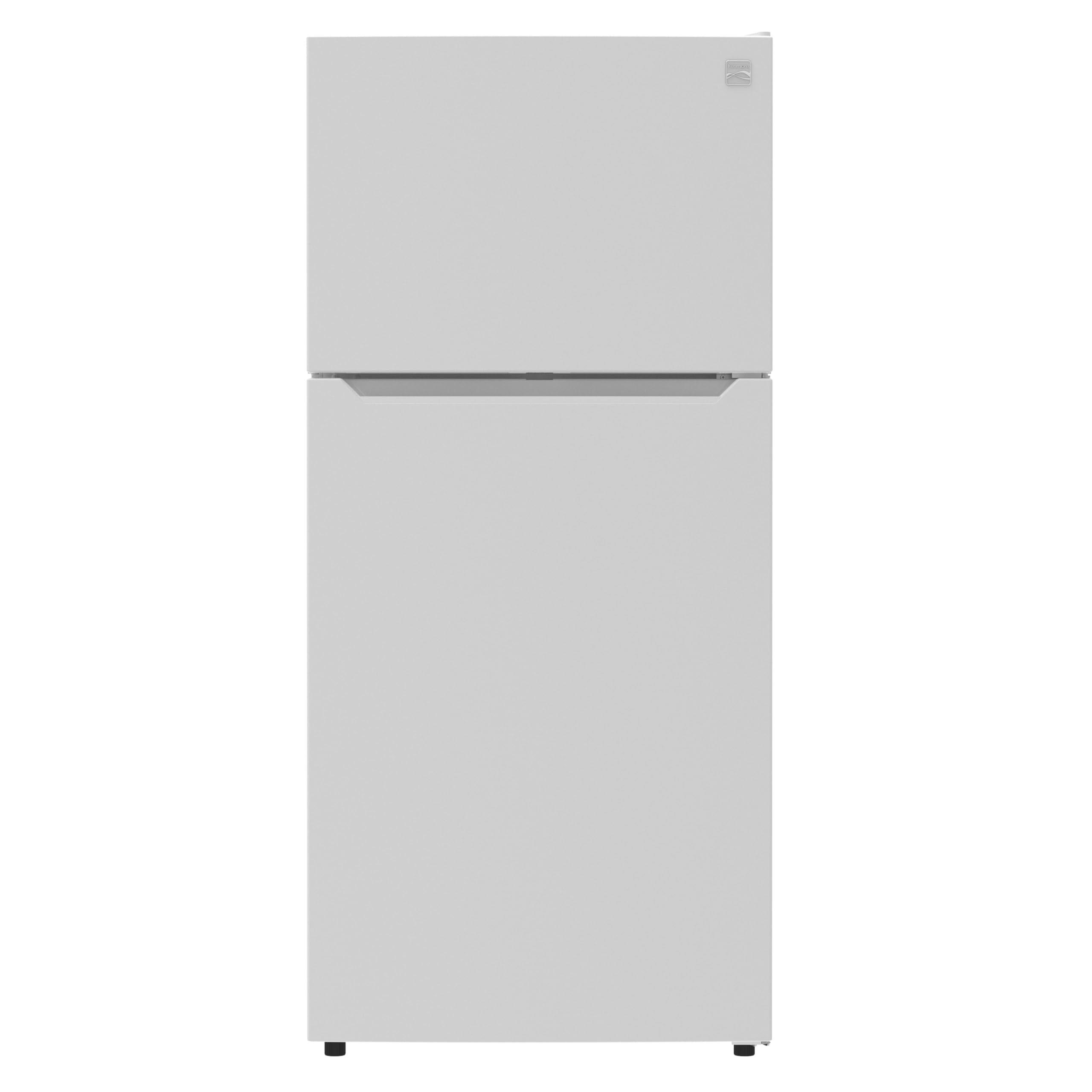
3. Kenmore 18.1 cu. ft. 30″ Wide Top Mount Refrigerator
Family-size storage in a 30-inch footprint, with an inverter compressor that keeps the temperature steady.
This is the pick for a household that actually fills a fridge. It packs 18.1 cubic feet into a standard-depth body, with 4.77 cubic feet of that in the freezer. The edge-to-edge tempered glass shelves adjust to take a sheet cake or a party tray, and there are 4 clear door bins plus 1 gallon-sized bin for the big jugs. Two full-width freezer door bins keep the frozen peas and ice pops reachable. Two humidity-controlled crispers hold produce, and the inverter compressor — a motor that varies its speed instead of switching fully on and off — maintains a consistent temperature quietly. It is Energy Star certified and runs at 367 kWh a year.
The performance is the strongest signal: it does its job well, and people describe the interior as genuinely roomy. The upper and lower door trays are a good size. The design is sleek, the operation very quiet, and it is widely considered a great buy for the money. The recurring honest caveat is temperature control — some units cool exactly as they should, while a few report the fridge compartment not cooling properly. When a fridge arrives, let it sit level and give it hours to settle before you judge the temperature. Also worth knowing: slamming the lower door can pop the top one open, and the bottom door has little floor clearance.
Compared with the KoolMore French Door, this Kenmore uses 367 kWh a year against 465 kWh, and holds 18.1 cubic feet against 18.5 — nearly the same food space at a lower running cost. What you give up is the counter-depth French-door format. If your kitchen opening can take a standard-depth box, this is the more economical way to get the same family capacity.
Why it holds up: the inverter compressor keeps temperatures even, and the gallon door bin plus the two freezer bins mean fewer things get lost at the back.
Set it up right: level it carefully on arrival and let it run for several hours before you trust the reading — most cooling complaints trace back to setup.
Pick this when: you want a real family fridge at standard depth and care about the power bill.
Skip the idea if: your cabinets demand a flush counter-depth front — this one sticks out further than the KoolMore.
4. Frigidaire EFR753 Retro Refrigerator
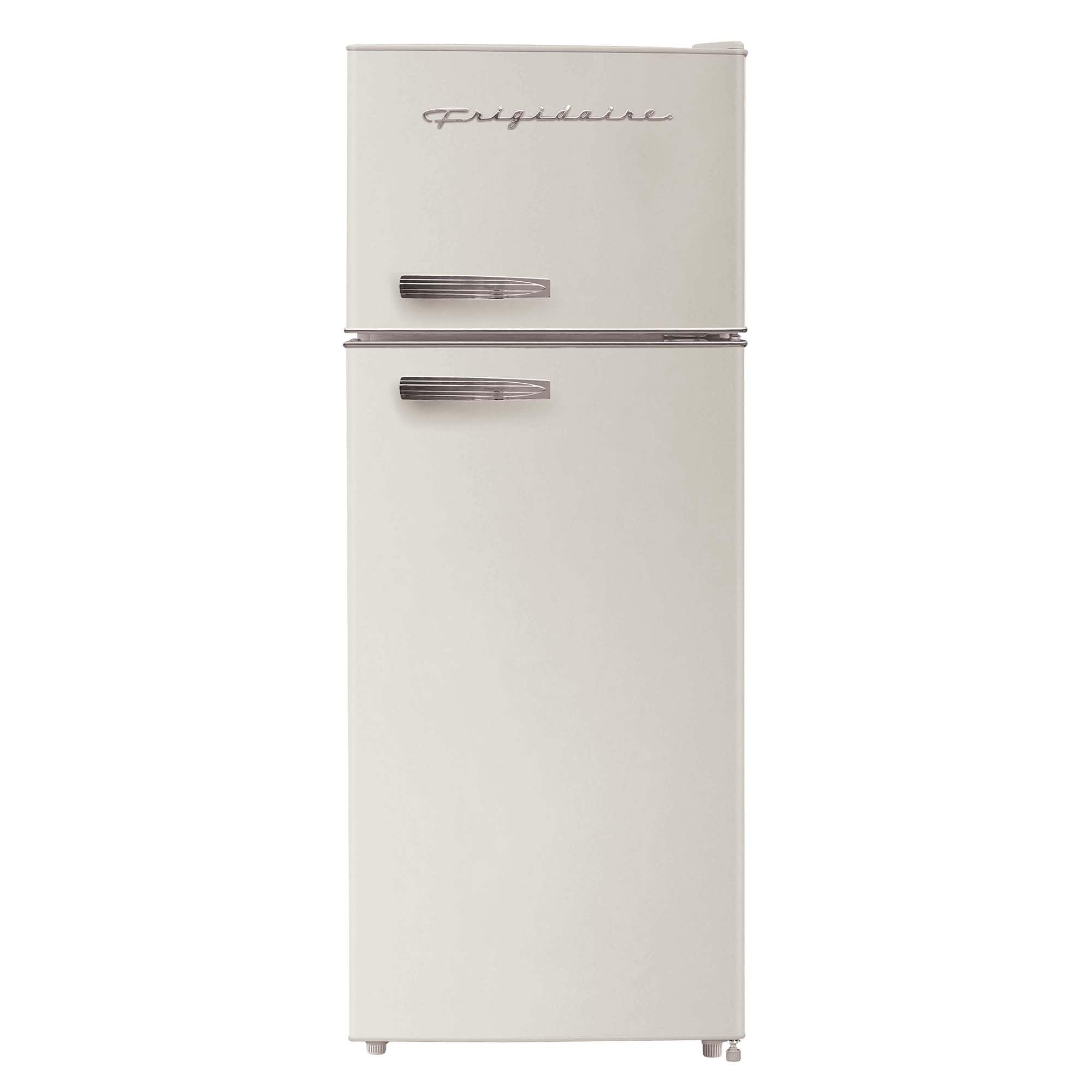
Cream-colored retro styling with chrome handles, at a capacity that suits a studio or a basement bar.
The retro shape is the reason most people stop scrolling, and the 7.5 cubic feet of storage backing it up is the reason they keep it. You get three adjustable spill-proof glass shelves that contain a tipped bottle instead of letting it drip down onto everything below. There is a dedicated door bin for frozen foods, a vegetable and fruit crisper, and bright incandescent lighting inside. At 200 kWh a year it is the most energy-frugal pick here, which matters for a second fridge that runs around the clock.
The size is what wins people over — it suits a one-person household and tucks into a basement corner while holding more than its footprint suggests. The catch that shows up again and again is the single thermostat: it controls both compartments together, so finding a setting that keeps the freezer at freezing and the fridge at safe cold takes some fiddling. A few units also arrive with a ding in the base despite clean packaging. And it is manual defrost, which means an occasional melt-out rather than an automatic cycle. Set the temperature carefully and leave the bubble water out of the freezer.
Put it beside the Hamilton Beach 7.5 cu. ft. and the capacity is a dead match at 7.5 cubic feet each. The difference is energy and finish: this Frigidaire draws 200 kWh a year against the Hamilton Beach’s far lower stated figure, and it looks like a 1950s kitchen appliance rather than a plain black box. If the look matters to your space, that is the deciding factor.
The look is the buy: chrome recessed handles and a cream matte finish turn a utility fridge into part of the decor.
The one-system catch: one thermostat for both zones means dull temperature juggling until you dial it in.
Choose this if: the fridge is visible and you want it to look like furniture.
Go elsewhere if: you refuse to defrost by hand — this one is manual.
5. Hamilton Beach HBFR786BLACK6COM Refrigerator

A black retro box that holds a surprising amount for two people without eating the kitchen.
The draw here is roominess in a small footprint. You get 7.5 cubic feet split across a top freezer and a fresh section, with spill-proof glass shelves that trap spills and door bins that hold more than you expect. The reversible door lets you hang it left or right, and adjustable legs keep it level even on a sloping garage floor. It is manual defrost, so plan on an occasional ice melt, and the matte black finish hides smudges better than stainless.
What comes through clearest is effectiveness — it does exactly what a fridge should, and the internal space feels bigger than the exterior suggests. Door shelving takes a lot of the clutter out of the main compartment, and it runs whisper-quiet without cycling constantly. Set expectations on the freezer: there is no inner freezer door and the frozen space is limited, so it rewards disciplined packing. Packaging is the recurring gamble — units occasionally arrive dented from rough shipping, and the door shelves are a touch narrow for some standard cartons. Ordering from a seller with good freight handling pays off.
You get the same 7.5 cubic feet of space as the Frigidaire Retro here, but in matte black instead of cream. The maker states an annual draw of 5 kWh (kilowatt-hours, the unit on your power bill), far below the Frigidaire Retro’s 200 kWh on paper. If you want the darker finish in a garage or man cave, this is the one that disappears into the shadows.
The space trick: generous door bins pull small items out of the main box, so 7.5 cubic feet stretches further than the number suggests.
The delivery caveat: shipping damage is the recurring risk, so inspect the box before you sign.
Right for: one or two people who want a compact unit with a retro dark finish.
Not for: a family that needs real freezer volume — this freezer is shallow and wants discipline.
6. KoolMore 7 Cu. Ft. Upright Freezer/Refrigerator

Built to keep its cool in a 0–110°F garage, and it flips between fridge and freezer on demand.
Most fridges hate a hot garage. This KoolMore is rated to run in ambient temperatures from 0°F to 110°F, which is the whole point — it will not strain in summer heat or a cold snap. It holds 7.1 cubic feet and converts between refrigerator mode, which runs 34–50°F, and freezer mode, which runs -11–10°F. A conversion takes 180 minutes, so you can flip it before a party or when extra frozen food shows up. The door reverses to open either way, the controls are mechanical and straightforward, and it is finished in stainless outside and metal inside. Annual energy draw is 333 kWh.
Temperature retention is the thing it does best — the seal is strong and it freezes evenly and quickly, which is exactly what you want in a garage freezer. Owners who run two units in a low basement ceiling say they look great and run quietly. The honest caveats: it is manual defrost, so ice has to be melted out, and the thermostat is coarse. On the fridge setting, some find it runs warm; one notch colder and it can over-freeze. Some units also arrive dented, and a few note constant humidity inside. If it arrives damaged, contact the brand — owners mention refunds were made.
Compare it with the Hamilton Beach convertible on size: this KoolMore carries 6.5 cubic feet of freezer capacity against the Hamilton Beach’s 6.8 cubic feet total. In freezer terms the KoolMore holds slightly less raw freezer space, but it is the only pick here rated for garage temperatures from 0°F to 110°F — a different job entirely.
Garage-first design: the 0–110°F ambient rating is the whole reason this fridge exists, and the 180-minute conversion adds real flexibility.
The coarse-thermostat trade: dialing in a perfect fridge setting takes patience, because one notch can swing from too warm to frosting.
Built for: a garage, utility room, or basement that swings from freezing to hot.
Pass on it if: you want a set-and-forget thermostat — this mechanical control needs dialing in.
7. BLACK+DECKER 10 Cu. Ft. Top Mount Refrigerator, BR1000HW
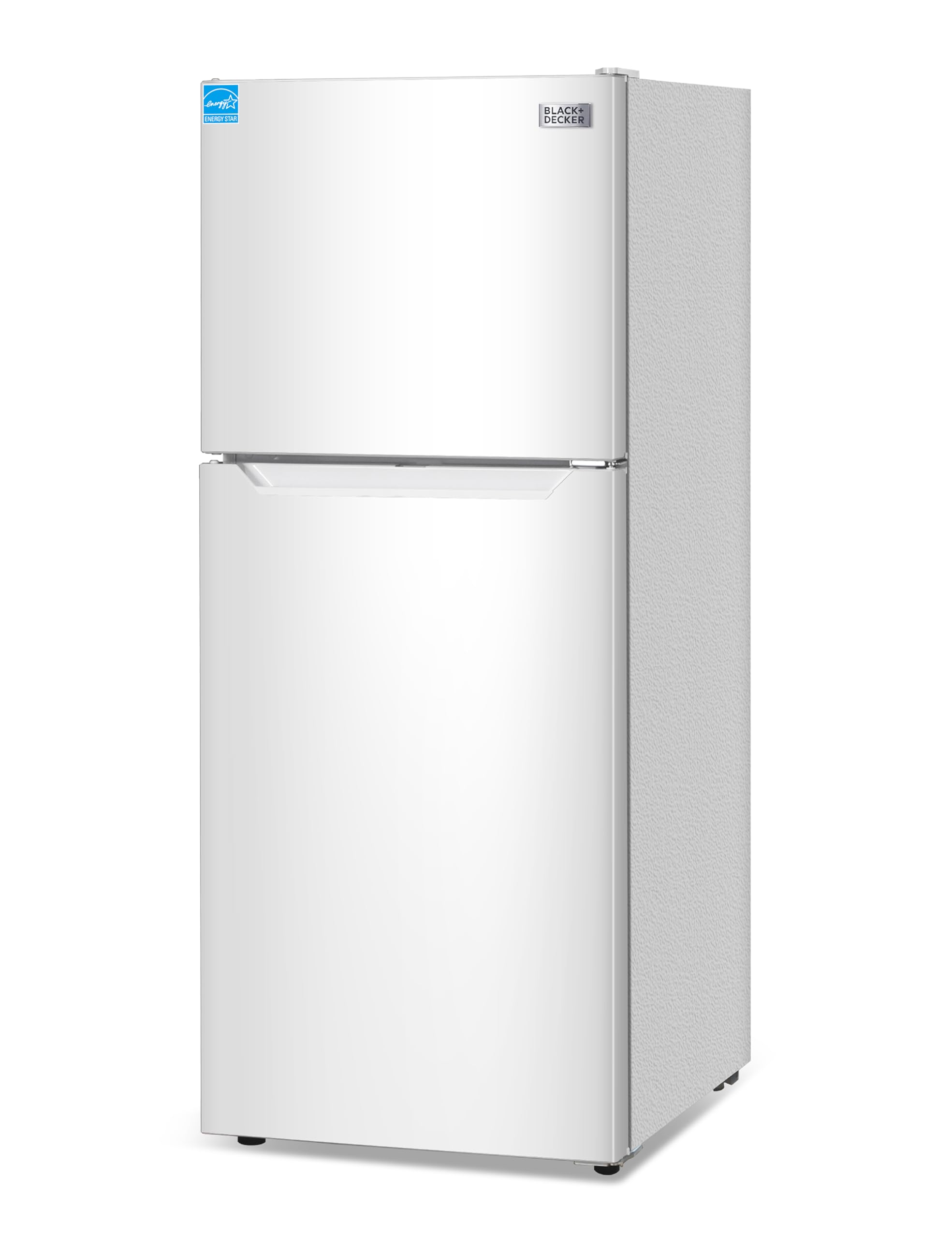
Frost-free auto-defrost and Energy Star efficiency in a top-mount box sized for apartments.
This is the middle-ground pick: 10 cubic feet split with 2.8 cubic feet in the freezer, frost-free auto-defrost so you never scrape, and Energy Star certification to keep the power bill modest. That efficiency shows in the 297 kWh annual figure — the lowest of the larger fridges on this list. The wire freezer shelf is removable so a big turkey or a bulky bag of frozen goods can drop straight in. Temperature control is adjustable across both compartments, the door reverses, and there are 4 door shelves for condiments and smaller items.
Buyer sentiment splits, which is worth knowing honestly. The people who are happy with it are genuinely happy — one calls it a beautiful refrigerator they should have acquired years ago, and delivery crews who leveled it and wiped it down get credited for a smooth setup. The friction shows up around reliability and service: customers note units arriving with a dead freezer, and long customer-service back-and-forth over repairs. As with any appliance at this tier, the warranty and seller matter as much as the unit. Buy from a seller with clear return terms and test the freezer on day one.
Against the Upstreman 11.6, this BLACK+DECKER gives you 10 cubic feet against 11.6 and a lower annual draw at 297 kWh versus 310 kWh. The Upstreman wins on space; this BLACK+DECKER wins on running cost and offers a removable wire freezer shelf the other does not. The gap is small enough that size should decide, not energy.
The efficiency story: 297 kWh a year with Energy Star certification is the best energy figure in the mid-size group here.
Check it fast: test the freezer the day it arrives, so any dead-on-arrival issue lands inside the return window.
A smart fit for: a tenant or first-apartment owner who wants frost-free and efficiency at a mid-tier price.
Hold off if: you have no patience for service calls — buy from a seller with a clear return policy.
8. Hamilton Beach HBFRF6892 Fridge/Freezer

One click and this box goes from a backup freezer to an extra fridge.
One box that switches jobs beats two single-purpose machines. This Hamilton Beach is a 6.8 cubic foot upright that converts between freezer and refrigerator with a single click, so the same box handles holiday meat overflow and then turns into extra drink storage the rest of the year. The door has a recessed handle and a reversible hinge (you can mount it to open left or right), so it fits a tight corner either way. Removable glass shelves wipe clean, and a slide-out transparent bin runs along the bottom. It uses automatic defrost (it clears frost itself, no scraping) and runs at 300 kWh a year, with leveling legs to keep it steady.
The size is the part that lands well — a nice medium footprint that fits a dorm, an RV, or a workplace break room. The honest note is on quality and cooling consistency: some units run cold and quiet for months, while a few arrive from shipping with a dented door or a missing bracket pin that lets the door hang. It is a convertible, so it does one job or the other — not both at once. If the door arrives damaged, reverse the swing or contact the seller rather than forcing it.
Set it beside the Frigidaire 10 cu. ft. top-mount and the comparison is size against flexibility: this Hamilton Beach holds 6.8 cubic feet total, while the Frigidaire gives you 10 cubic feet. If you need a true backup for overflow — a second freezer for a chest-freezer gap — the Frigidaire holds more food. If you need one box that switches jobs, this is the one.
The switching trick: a single click flips freezer to fridge, so the unit earns its space year-round instead of sitting empty.
Shipping reality: door dents and bent pins happen in transit, so inspect on arrival and use the reversible hinge if needed.
Suits: an RV, dorm, or break room that needs one flexible box.
Don’t expect: a full-size backup for a big family — 6.8 cubic feet total is modest.
9. Frigidaire Top Mount Refrigerator
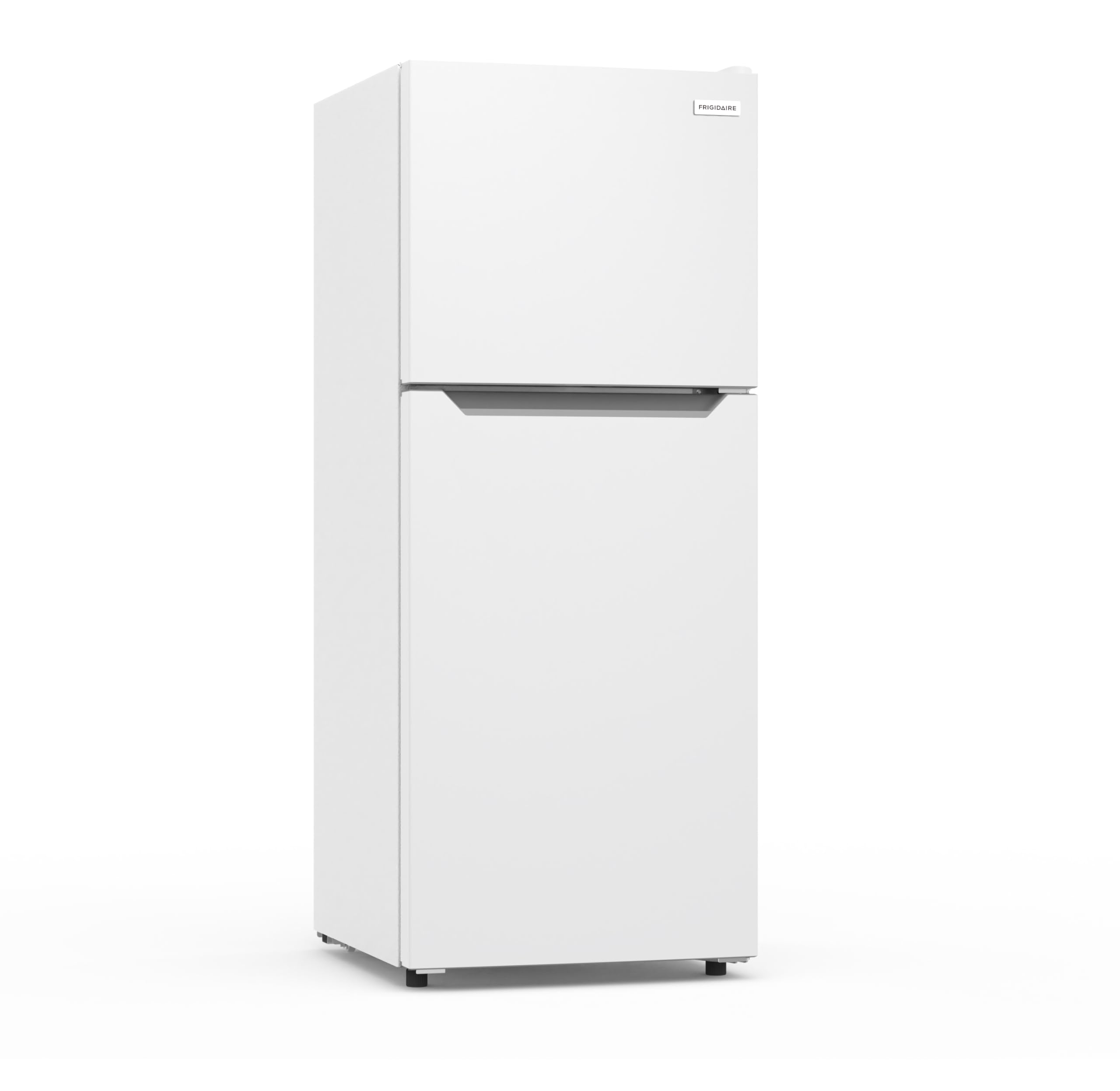
A 10-cubic-foot fallback that plugs in and just works when the main fridge gives out.
This is the fridge you buy when the appliance you already own dies, and the reviews read exactly that way — buyers describe picking it up as a backup for a main Samsung refrigerator that stopped working. Items arrive well packaged and intact, easy plug-and-play, no fuss. The freezer holds 2 cubic feet, the fresh section 8 cubic feet, and it is frost-free so ice never builds up. There is a built-in interior lamp to find food faster, an adjustable thermostat, and reversible doors with a single door shelf. It runs at 300 kWh a year.
A 10 cubic foot total is comfortably enough for one person, and several buyers run two small fridges instead of one giant one for convenience. The honest caution is on the seller side: the warranty path runs through the seller, and not every seller offers local service — one reviewer noted the frame bent and the seal failing with no warranty support. So confirm who you are buying from and what the return policy covers. On the plus side, the fold-up design means it fits a galley kitchen, a camper, or a garage without dominating the space.
Next to the KoolMore 7.1 cu. ft., this Frigidaire gives you 10 cubic feet of total capacity against 7.1, so it holds more food. And its 2 cubic foot freezer is a genuine freezer compartment, not a shelf. Where the KoolMore wins is garage-temperature tolerance; this Frigidaire is a standard indoor fridge. If you need indoor backup space at moderate cost, this is the safer pick.
The simple-win factor: well packaged, frost-free, and plug-and-play, it does its job without drama.
Check the seller: warranty support varies by seller, so confirm local service or a clean return before buying.
Good for: a backup or second fridge where the main unit just failed.
Don’t choose it for: a freezing garage in deep winter — it is an indoor-rated unit.
10. Frestec 12.1 CU Ft Refrigerator with Freezer, FR 1202 BK

Twelve cubic feet of frost-free space built around a compressor you can barely hear.
The headline strength is quiet. This Frestec runs a whisper-quiet compressor that owners compare to a silent room — you will not notice it cycling from another room. Alongside that you get 12 cubic feet of frost-free storage, so cold air circulates through both zones and you never defrost by hand. There are removable glass shelves and a wire shelf for taller items, an automatic LED interior light, and a removable door seal for cleaning. Temperature control offers five settings, and it runs at 316 kWh a year.
The size and quiet make it a good fit for a basement overflow fridge, a garage, or an office kitchen, and several buyers run it exactly there. The friction is on cooling consistency and build quality: some units cool well and stay cold even on hot garage days, while others report it not getting as cold as a normal fridge, or the freezer door not sealing. One design note that matters — with no pressure-relief valve (a vent that evens out air pressure when you shut the door), shutting the fridge door can pop the freezer open, so close both deliberately. Units arriving dented are the other recurring shipping risk.
Against the BLACK+DECKER BR1000HW, this Frestec holds 12 cubic feet against 10, which is a real advantage if the fridge sits in a garage. Its annual draw is 316 kWh against the BLACK+DECKER’s 297 kWh. The Frestec wins on capacity and noise; the BLACK+DECKER wins slightly on energy.
Silence you notice by its absence: the quiet compressor is what people call out first, and 12 cubic feet makes it a practical warehouse for a garage.
Close it with care: the missing pressure-relief valve means a slammed door can nudge the freezer open, so shut both intentionally.
Top choice for: a garage or basement where noise and capacity both matter.
Look elsewhere if: you need pin-precise temperature control — some units run warmer than advertised.
Know the Specs
Cubic Feet and the Fridge/Freezer Split
Capacity is measured in cubic feet, the volume of usable space inside. A 10 cubic foot fridge is not 10 cubic feet of fresh food — part of it is freezer. Check the split, because a deep 2 cubic foot freezer holds far more than a shallow shelf of the same rated volume.
Annual Energy Consumption in kWh
A kWh is a kilowatt-hour, the unit your power bill uses. A fridge rated at 200 kWh a year uses noticeably less electricity than one rated at 465 kWh. That gap becomes real money over the life of the appliance, especially on a unit that runs every hour of every day.
Frost-Free vs Manual Defrost
Frost-free (also called auto-defrost) runs a short heater cycle to melt ice and drain the water, so you never chip it out by hand. Manual defrost means unplugging the fridge and melting the ice yourself. Frost-free adds a little energy use but saves hours of labor over the years.
Reversible Doors and Leveling Legs
A reversible door lets you move the hinge so the fridge opens the direction your room allows. Leveling legs let you correct a sloping garage floor so the door seals and the compressor sits correctly. Both are small features that make the difference between a clean install and a fridge that never quite closes.
Common Questions
What is a basic refrigerator, and how is it different from a full-feature one?
Do I need a frost-free refrigerator, or can I live with manual defrost?
How much freezer space comes with a 10 cubic foot refrigerator?
What does Energy Star certification actually save me?
Can a convertible fridge/freezer replace having both a fridge and a freezer?
Will a garage-ready refrigerator work in cold winter temperatures?
What is the difference between a reversible door and a fixed-swing door?
Why do some refrigerators arrive dented, and what should I do?
How long does a basic refrigerator usually last?
Is a top-freezer or French-door refrigerator easier to fit in a small apartment?
The Bottom Line
For most people shopping for a basic refrigerator, the winner is the Upstreman 11.6 Cu.Ft. Double Door because it pairs true frost-free operation with 11.6 cubic feet, a reversible door, and 310 kWh a year — and it carries the highest rating here at 4.5+ stars across 100+ ratings. If the fridge opening is a tight 30-inch gap and you want a modern counter-depth look, grab the KoolMore 18.5 cu. ft. French Door. And for a garage that swings from freezing to hot, the KoolMore 7 Cu. Ft. Garage Ready Convertible is the one to reach for, thanks to its 0–110°F ambient rating.
A final nudge worth acting on: the frost-free mid-size picks here — the Upstreman, the BLACK+DECKER, and the Kenmore — are where most buyers land, and each one earns that spot on a real spec rather than a marketing line. Read your opening dimensions first, decide whether you will defrost by hand, and the right unit on this list picks itself.
How we choose
We do not accept paid placement. Every pick is matched to a real buyer and a real use-case; we do not hands-on test units.
Sources
Specifications: manufacturer listings and product documentation. Review insights: verified customer reviews, as of October 2026. Pricing: not shown on this page (it changes often); check the current price via the retailer link.
As an Amazon Associate, Aappliancez earns from qualifying purchases. This does not affect which products we feature.