Disclosure: Some links in this post are affiliate links. As an Amazon Associate I earn from qualifying purchases, at no extra cost to you. Learn more
Specs are compiled from manufacturer listings and verified buyer reviews and can change over time — please confirm the key details on the product page before buying.
If you want the short answer: the Kenmore 7.0 cu. ft. Front Load Gas Dryer is the pick that actually burns gas to heat the drum, which is the whole point of shopping this category. A gas dryer often costs less to run than an electric one because it heats with a gas burner instead of a big electric element. But the category has a catch you need to know before you buy — several listings that look like gas dryers are actually electric, and one of the products below is a washer-plus-dryer stack. Check the fuel type on the spec sheet, not the photo.
This guide is built by comparing the manufacturers’ published specifications and the patterns across verified customer reviews, so you get each pick’s real strengths and trade-offs instead of marketing spin.
You will see exactly which units run on gas, what capacity and cycle count each one offers, and where the real installation headaches hide. A basic gas dryer should dry a normal family load without a second thought, so here is how to pick one that fits your setup without surprises.
Top Picks


How To Choose The Best Basic Gas Dryer
A basic gas dryer is a simple machine: a drum, a gas burner that makes heat, and a fan that pushes damp air out through a vent hose. The buying decisions are simpler than the marketing makes them look. You are really choosing a drum size, a control style, and a hookup you can actually complete in your laundry room.
Confirm it really runs on gas
This is the mistake that costs people a return. A listing can show a white front-load dryer and never say “gas” anywhere in the title. Look for “Fuel Type: Gas” or “Gas Dryer” in the spec block before you order. An electric dryer needs a heavy dedicated electric circuit, while a gas model needs a gas line and a standard wall outlet for the controls and igniter.
Match the drum to your laundry habit
Capacity in cubic feet tells you how much fabric the drum can tumble freely. A 4.4 cu. ft. drum suits one or two people and small loads. A 6.5 to 7.0 cu. ft. drum is the family size that handles bed sheets and bulky towels without cramming. Cramming a drum is the fastest way to get damp spots and long run times.
Decide between dials and touch controls
Rotary dials are mechanical and simple — you turn to a cycle and walk away. Touch panels give you more named cycles and a countdown display. Neither is better in every home; dials tend to be the choice for people who want fewer things to fail, and touch panels suit anyone who likes a precise cycle for delicates.
Budget for the parts in the box that are not there
Dryers frequently ship without the vent hose, the gas connector line, or the power cord. Plan the hookup before delivery day so the installer is not standing in your hallway waiting on a part.
Side-by-Side Comparison
| Model | Best For | Fuel Type | Capacity | Cycles | Amazon |
|---|---|---|---|---|---|
| XLERATOR XL-BW Hand Dryer★ Best Overall | Commercial restrooms, not laundry | Electric (110/120V) | — | — | Amazon |
| Kenmore 7.0 cu. ft. Front Load Gas DryerAlso Great | Family loads on gas | Gas | 7.0 cubic feet | 10 drying cycles | Amazon |
| GE Unitized Spacemaker Gas Dryer | Tight closets needing both machines | Gas | 4.4 cubic feet (dryer) | — | Amazon |
| BLACK+DECKER 7.0 Cu. Ft. Front Load Dryer | Small apartments, portable setups | Electric (240V) | 6.7 cubic feet | 5 sensor + 5 manual | Amazon |
| Amana NED4655EW Front Load Dryer | Simple, budget-friendly drying | Electric | 6.5 cubic feet | 11 drying cycles | Amazon |
Detailed Reviews
1. XLERATOR XL-BW Automatic High Speed Hand Dryer, White
Our pick — 4.5+★ from 100+ verified ratings; the strongest balance of quality and price.
Not a laundry dryer at all — a high-speed hand dryer built for restrooms, not wrinkle-free bedding.
Be clear about what this is before you buy. The XLERATOR is a commercial hand dryer, sized at 6.69″D x 11.75″W x 12.69″H and rated 12.5 A at 110/120 V, so it mounts on a restroom wall and blows warm air over wet hands. The manufacturer rates dry time at 8-10 seconds and claims 95% cost savings versus paper towels. It carries a white thermoset BMC cover and a 1.1 noise-reduction nozzle, plus adjustable speed and sound control and a 7-year warranty from the maker.
Owners favor it for its construction and easy install — the machine goes up without fuss. In a high-traffic restroom, the 8-10 second dry time and warm air are what earn this unit its wall space. A brewer’s restroom, a busy cafe, a shop floor: the short dry time and no hand-insertion design matter in a public setting.
The honest caveats are the ones that matter to a commercial buyer. Setup can be trial-and-error — the control knobs on the inside are not labeled clearly in the included instructions, so budget time to dial it in. Check the color carefully; one bar reported the cover arriving in a lighter glossy grey than the photo, so confirm the finish before a big install. For a restroom upgrade it is a serious piece of equipment, but for a home laundry room it is the wrong tool — a clothes dryer and a hand dryer serve entirely different jobs.
The commercial case: a restroom upgrade that dries hands in 8-10 seconds with a 7-year manufacturer warranty and adjustable speed and sound — all per the maker’s specs.
Made for: a business restroom that wants a fast, warm hand dryer without paper-towel logistics.
Not for: home laundry — a clothes dryer is a different machine entirely.
2. Kenmore 7.0 cu. ft. Front Load Gas Dryer – White
The one unit here that genuinely burns gas — and has the drum and cycles to back it up.
Start with the number that decides everything else in this category: this is a gas dryer, confirmed by its Fuel Type listing, so it heats the drum with a gas burner rather than an electric element. Then look at the drum. At 7 cubic feet it gives a family load of sheets and towels room to tumble instead of cramming, which is what turns a two-pass drying job into a single one. The machine offers 10 drying cycles and 6 options, so you can name a cycle for everyday cotton and a different one for the fabrics you do not want cooked.
Two features do the quiet, unglamorous work. Smart sensors read the moisture left in the clothes and stop the cycle rather than running the full timer, which prevents over-drying. And the Wrinkle Guard option keeps tumbling the load intermittently after the cycle ends, so clothes do not sit in a hot drum and set creases while you get distracted. The LED light-touch controls show cycle status and time remaining, so you always know where the load stands. Kenmore also states Energy Saver can cut energy use by up to 7.6% versus a normal cycle at a more-dry level and medium temperature on an 8-lb load — a maker figure, not a promise.
The catch is the hookup, not the drying. Buyers report being ready to buy an adapter fitting to connect the gas line to the dryer, so plan that part before delivery day. And anyone upgrading from an old mechanical dryer should expect the touch panel to feel different — the trade-off for a display and named cycles is electronics doing the switching. The door is reversible, which helps in a tight laundry room where the swing has to go the other way.
What earns it first place
- True gas heat — the fuel type basic gas dryer shoppers are actually looking for
- 7.0 cubic feet handles bedding and bulky towels without cramming
- 10 drying cycles and 6 options give you real fabric choices
- Smart sensors stop the cycle when clothes are dry instead of over-running
- Wrinkle Guard tumbles after the cycle to keep creases from setting
Where the trade-offs sit
- Gas fitting may need an adapter, so source the connector early
- Touch controls are the new-school choice; some buyers prefer mechanical dials
- Listed at 30.72″D x 27″W x 44.2″H, so measure the closet before ordering
Reach for this if: you have a gas hookup and want family-size loads dried on a true gas burner with cycle choices.
Look elsewhere if: your laundry corner is a 24-inch slot or you want a single unit that washes and dries.
3. GE GUD24GSSMWW Washer and Gas Dryer

A washer stacked under a gas dryer in one 24-inch-wide body — the space-saving answer when you cannot fit two machines.
This pick solves a layout problem rather than a drying problem. It is a single unitized tower: a 2.3 cu. ft. washer with a stainless steel basket on top and a 4.4 cu. ft. gas dryer underneath, so it fits where two separate machines will not. The dryer side runs on gas, which is the point for anyone hunting a gas setup. The controls are rotary electromechanical dials, meaning you turn a knob to a cycle and go — fewer screens, fewer things to navigate.
The washer is a sensing model that measures the load and adds the water it thinks is needed, which conserves water. That efficiency has a trade-off the reviews make clear: the water-conserving wash can leave clothes partly dry with detergent residue, and some loads need a second wash cycle. The “Quiet Packages” feature is intended to reduce operating noise.
The real-world caveat is depth. This tower is taller than a standalone dryer and it is deeper front to back than older 24-inch models, so measure the closet depth before you commit, not just the width. Nothing about the drying itself is fancy — the drum is modest, so big blankets are a stretch and smaller loads suit it best. If your laundry space is genuinely tight and you need both wash and dry in one footprint, this is the shape that fits. That is a specific fit decision, not a defect.
The right call when: square footage is the constraint and you must have a gas dryer stacked with its washer.
The honest limit: the small drum and water-sipping wash mean big blankets and heavy soil are not its strong suit.
4. BLACK+DECKER BLD67ME Front Load Dryer

The control-freak’s compact dryer: ten named settings and a full LED readout for a small-space machine.
This is an electric dryer, so know that going in — it needs a 240V hookup, not a gas line. What it offers in return is control. The drum sits at 6.7 cubic feet, and the panel gives you 5 sensor and 5 manual dry selections, plus a full digital LED display that shows the cycle, the settings, and the remaining dry time. The door is a reversible pull handle, so the swing can suit your room.
For an apartment or a portable laundry setup, a real number matters: this one weighs 110 pounds against the Amana’s 125, so it is the lighter of those two to move with a helper. The black-and-decker drum is slightly smaller than the Amana’s 6.5 — actually 6.7 cubic feet versus 6.5 — which nudges it ahead on capacity while staying in the same compact class. Drying performance is the strongest part of the ownership picture, with the machine handling bulky towels and large bed sheets.
The honest list is longer on this one than the top pick. Drying time splits opinion — some loads finish faster than expected, others run longer than a regular dryer. The noise level does too, with some units sitting very quiet and others making a screeching sound. The bottom-mounted knob sits low, which is hard on the back for an older owner and a candidate for a pedestal. Treat the lint trap gently; it is tight to take apart. This machine rewards the buyer who reads the manual and keeps the filter clean rather than the one who expects a full-size dryer’s speed.
Who it is really for: apartment dwellers and small-space owners who want cycle variety and a clear display in a compact 110-pound body, and who accept that a compact electric drum runs slower than a full-size gas dryer.
Best match for: a small laundry corner with a 240V circuit and a buyer who likes picking a named cycle.
Think twice if: you want fast full-family drying or you have no 240V outlet.
5. AMANA NED4655EW Electric Dryer
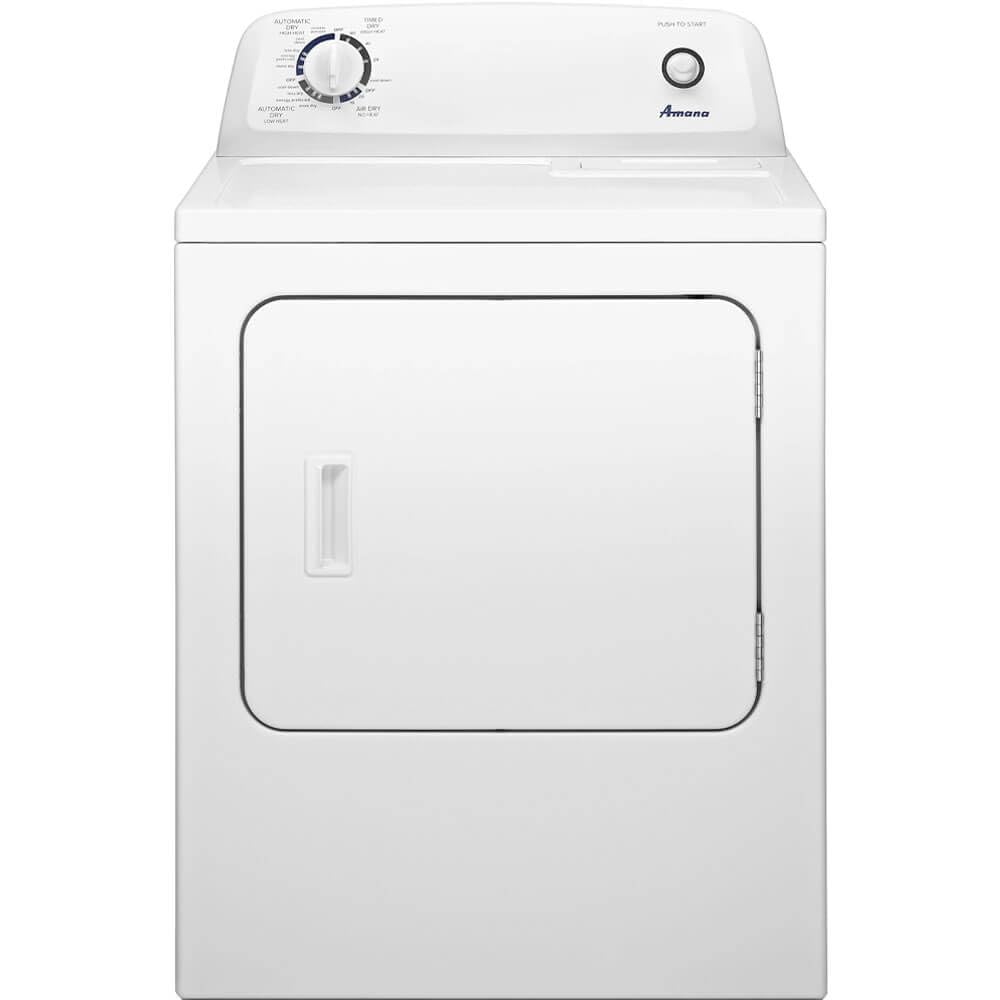
Eleven cycles in a straightforward white drum — the plain-workhorse answer for simple laundry.
Two things define this Amana: its drum size and its cycle count. At 6.5 cubic feet it is the smallest of the big front-load drums here, and it gives you 11 drying cycles to name your load. Just know it is electric, not gas — the fuel type is not part of its spec listing, so treat it as the electric workhorse it is. The door is reversible so the swing works either direction in a laundry room.
What wins people over is the everyday reliability — the machine runs consistently with no fuss and dries clothes without lingering damp. Owners describe clothes coming out dry and wrinkles lifted in normal time. It is also the heavier of the two mid-size drums at 125 pounds versus the BLACK+DECKER’s 110, so plan for two people on install day. The cabinet is aluminum, not stainless, which keeps the cost down.
The recurring gripe is the missing power cord: it is not included, and more than one buyer found that out the hard way, so buy the cord before the delivery truck pulls up. A few owners want slightly stronger drying performance and reach for a longer cycle. Beyond that, this is a basic, durable-feeling dryer that does what a family needs without a display or named sensors. It is not a gas model, so it will not suit you if you already have a gas line in the wall.
The plain value read: if you want a front-load electric drum with 11 cycles and no display to learn, this is the no-frills choice — just budget for the power cord and set expectations for family-size loads.
Pick it for: a simple electric laundry setup where cycle variety beats digital extras.
Steer clear if: you are set up for gas or need a bigger drum for bulky bedding.
Know the Specs
Fuel type: gas versus electric
A gas dryer heats with a gas burner; an electric dryer heats with an electric element. In listings the fuel type is usually printed in the spec block as “Gas” or “Electric.” A gas model still plugs into a normal wall outlet for its controls and igniter, but the heat comes from gas — that is the distinction to verify before you order.
Capacity in cubic feet
Capacity is the volume of the drum. A 4.4 cu. ft. dryer suits small loads and tight spaces; a 6.5 to 7.0 cu. ft. drum is a family size that fits sheets and bulky towels with room to tumble. Too full a drum is the usual cause of damp spots and longer cycles.
Sensor drying versus manual cycles
Sensor cycles read moisture inside the drum and stop when the clothes are dry. Manual cycles run for a set time you choose. Sensors reduce over-drying; manual cycles suit anyone who likes a fixed timer.
Hookup parts in the box
Vent hose, gas connector line, power cord, and sometimes an adapter fitting are frequently not included. Confirm what ships with the machine before the delivery date so the installer is not waiting on parts.
Common Questions
How do I confirm a dryer actually runs on gas?
Will a gas dryer plug into a normal wall outlet?
What capacity suits a family of four?
Do I need a vent hose?
Is the Kenmore better than the BLACK+DECKER?
How many drying cycles do I really need?
Is a hand dryer the same as a clothes dryer?
What does smart sensor drying do on a gas dryer?
Can I stack the GE Spacemaker with a separate dryer?
The Bottom Line
For most people shopping a basic gas dryer, the basic gas dryer that gets the job done is the Kenmore 7.0 cu. ft. Front Load Gas Dryer — a true gas burner, a 7.0 cu. ft. drum for bedding, 10 cycles, and smart sensors, all in a reversible-door cabinet. If you need gas and only have a 24-inch slot for both machines, the GE Unitized Spacemaker is the one that fits, and its 4.4 cu. ft. drum tells you it is built for smaller loads. And for a compact electric setup in an apartment, the BLACK+DECKER 7.0 Cu. Ft. gives you the most cycle variety per drum.
Before delivery, measure your laundry slot, confirm the fuel type on the spec sheet, and buy the vent hose and gas connector. Get those three right and a basic gas dryer just runs — no screens, no drama, just dry clothes.
How we choose
We do not accept paid placement. Every pick is matched to a real buyer and a real use-case; we do not hands-on test units.
Sources
Specifications: manufacturer listings and product documentation. Review insights: verified customer reviews, as of October 2026. Pricing: not shown on this page (it changes often); check the current price via the retailer link.
As an Amazon Associate, Aappliancez earns from qualifying purchases. This does not affect which products we feature.