Disclosure: Some links in this post are affiliate links. As an Amazon Associate I earn from qualifying purchases, at no extra cost to you. Learn more
Specs are compiled from manufacturer listings and verified buyer reviews and can change over time — please confirm the key details on the product page before buying.
A basement window that leaks, warps, or won’t open does three things at once: it lets in water, it keeps the room gloomy, and it can fail an inspection. The fix is rarely the fanciest window on the shelf. It’s matching the right frame material, the right pane setup, and the right size to the hole you actually have. This guide walks through nine real picks — sliding vinyl units, tempered-glass replacements, and the well covers and AC gear that sit alongside them — so you can solve the damp-and-dark problem without guessing.
This guide is built by comparing the manufacturers’ published specifications and the patterns across verified customer reviews, so you get each pick’s real strengths and trade-offs instead of marketing spin.
Frame material, pane count, and the roughness of your opening decide almost everything about how a basement window performs over time. Whether you are patching a damp storage room or swapping a whole row of failing sashes, the picks below cover the range, and this rundown of the best basement replacement windows explains what each option does well.
Top Picks

How To Choose The Best Basement Replacement Windows
Start with the opening, not the window. A basement wall is usually thicker and rougher than an above-grade wall, so the exact width and height of your existing hole decides which units are even candidates. Measure the rough opening twice before you shop.
Frame material sets the lifespan
Vinyl frames won’t warp, peel, or corrode, which is why they show up so often below grade where damp air sits against the frame year-round. Aluminum frames stay lighter and are often paired with tempered glass for a crisper look. Either way, rust resistance is the trait that keeps a basement window serviceable.
Glass type decides safety and quiet
Double-pane insulated tempered glass gives you two layers of glass with a sealed gap between them. That gap slows heat transfer and muffles outside noise, and the tempered treatment means the pane breaks into small dull pieces rather than sharp shards. For a room people actually use, that combination is worth the extra weight.
Sizing and installation reality
Most sliding basement windows install by fitting the unit into the opening, screwing the top into place, and sealing the gap with foam sealant. Recessed models sit further back into the wall, which means the installed window ends up smaller than the stated size — always check the size chart. If your opening is oversized or irregular, budget for extra sealing work.
Side-by-Side Comparison
| Model | Best For | Frame / Material | Size | Weight | Amazon |
|---|---|---|---|---|---|
| Vinyl Basement Sliding Window, 36″ x 24″ White★ Best Overall | Most basements, sheds, and garages | Vinyl with double-pane insulated tempered glass | 36 x 24 inches | 24 pounds | Amazon |
| 2060 Window Well Polycarbonate CoverBest for Egress Wells | Covering an existing well opening | Polycarbonate | 46 x 75 x 6.5 inches | 15 pounds | Amazon |
| ZAFRO 8,000 BTU Window Air ConditionerBest Small-Room Cooler | Cooling a finished basement room | Window-mounted, R32 refrigerant | Cools up to 350 sq ft | — | Amazon |
| Antarctic Star 12,000 BTU U-Shaped Window AC | Large rooms and full-window light | U-shaped window unit, R32 refrigerant | Cools up to 550 sq ft | — | Amazon |
| Kathfly 2 Pack Basement Window 32” x 18” | Replacing two small recessed openings | Tempered glass with rust-resistant aluminum frame | 32 x 18 inches | 18.08 pounds | Amazon |
| StakWEL Emergency Egress Window Wells | Meeting egress code in a finished basement | Maintenance-free modules | 54 x 40.5 x 20 inches | 25 pounds | Amazon |
| Uhome Portable Air Conditioner, 8000 BTU | Rooms where a window unit won’t fit | Stand-alone portable with window kit | Up to 350 sq ft | — | Amazon |
| Medium Sloped Clear Polycarbonate Window Well Cover | Standard wells that pool rainwater | Polycarbonate with aluminum bracing | 55″ W x 26″ L | — | Amazon |
| Clear Polycarbonate Large Egress Window Well Cover | Wide egress wells on a finished build | Polycarbonate with rust-free aluminum bracing | 54″ W x 38″ L | — | Amazon |
Detailed Reviews
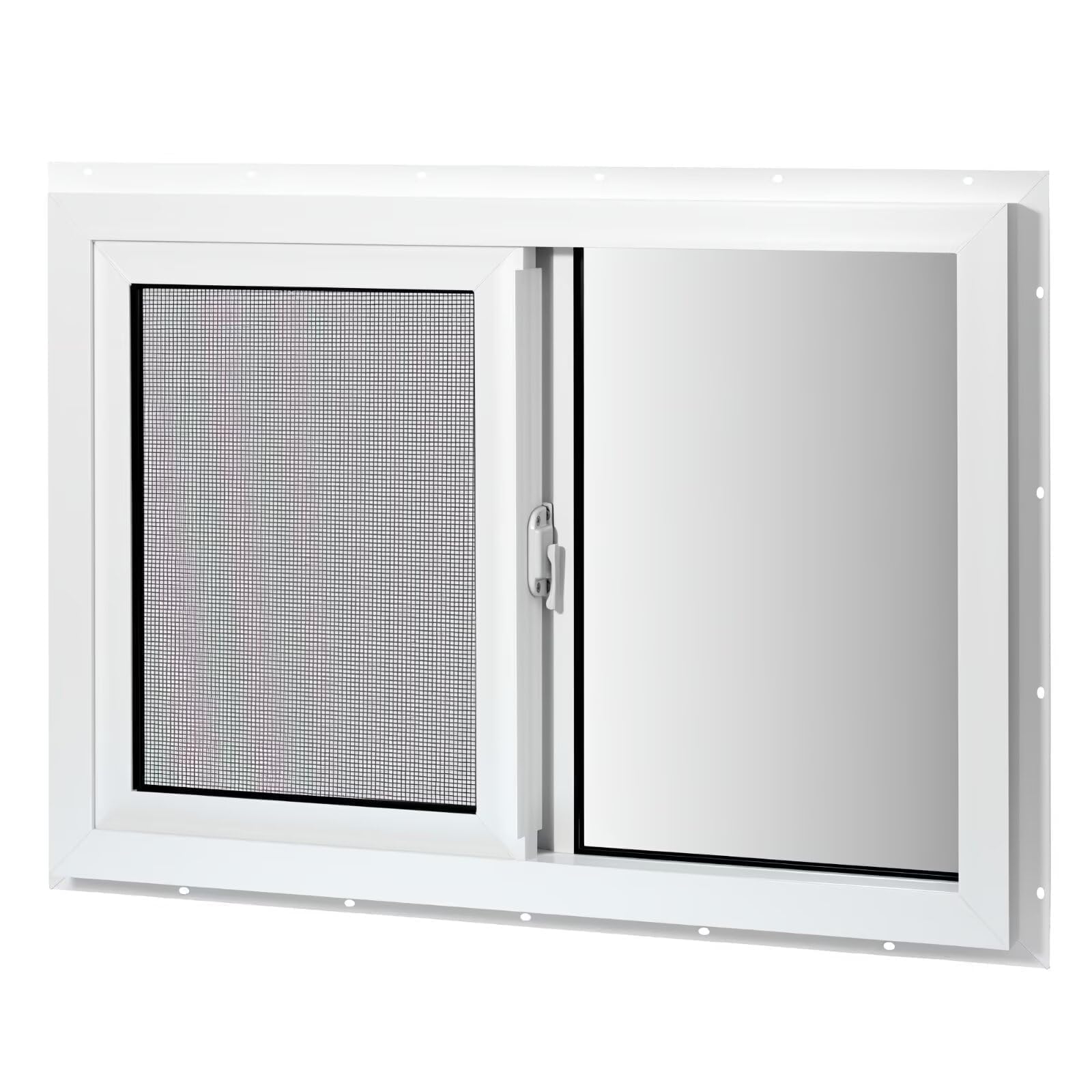
1. Vinyl Basement Sliding Window, 36″ x 24″ White
Our pick — 4.0+★ from 100+ verified ratings; the strongest balance of quality and price.
The vinyl slider that treats a rough basement opening like an easy Saturday job
A rust-resistant vinyl frame that won’t warp, peel, or corrode is why this 36 x 24-inch slider leads the list. Vinyl shrugs off the constant damp that eats steel and wood below grade, so the sash keeps sliding long after cheaper frames would have swollen shut. You get double-pane insulated tempered glass too — two sealed layers that slow heat loss and quiet outside noise, with a pane that crumbles into dull pieces instead of sharp shards if it ever breaks.
Owners rate the build quality high for the price, which is what keeps this slider at the top. As buyers report: “I installed two windows three years ago in my new shed and added a third for extra lighting this past year.” Repeat purchases like that say more about the frame than any spec line.
Installation is deliberately beginner-friendly: fit the window into the opening, screw the top down, and fill the gap with foam sealant. Two sliding rails let you park the sash in the middle or to the side, and the mesh screen lifts straight out for cleaning. According to the maker, the matching hardware and lock come in the box.
The honest catch is the latch. Durability feedback on this window is genuinely split — most owners find it solid, but a few report broken latches after a season of use, so treat the lock gently and don’t force the sash against the stop. That is the one thing to watch, and it is a small slice of an otherwise steady picture.
What earns it top billing
- Vinyl frame will not warp, peel, or corrode in damp basement air
- Double-pane insulated tempered glass cuts noise and heat transfer at once
- Removable mesh screen and dual sliding rails make venting and cleaning easy
- 24-pound weight is light enough for a one-person install
What to keep in mind
- Latch hardware is the recurring weak point — a few owners mention breakage
- 36 x 24 inches only fits openings at or near that size
Reach for this if: you want one window that handles damp, noise, and airflow without a contractor.
Weigh the latch: if your household is hard on hardware, budget for a sturdier aftermarket lock.
2. 2060 Window Well Polycarbonate Cover
The clear cover that lets light pour in while leaves stay out of your well
If your basement window sits at the bottom of a well, the cover is half the project. This one is 15 pounds of clear polycarbonate that holds up to 500 pounds of weight, so snow, a stray foot, or a falling branch won’t cave it in. At 15 pounds it is a full 9 pounds lighter than the vinyl window above — easy for one person to lift into position on a ladder.
The prop-open design is the feature that matters most for safety. In an emergency you push the cover up and climb out, which is why it suits an egress well rather than a decorative one. At 46 x 75 x 6.5 inches it’s sized to span a wide, shallow well opening rather than a deep round one, so measure your well’s outer footprint before ordering.
Clear polycarbonate does double duty: debris stays out, but daylight still reaches the glass below, which is the whole point of a cover on a basement window. Leaves, twigs, and small animals have nowhere to settle.
Where it fits the plan: this is the right companion piece if your new basement window opens into a well that collects yard waste every fall.
Measure twice: the 46-inch depth and 75-inch width suit a specific well shape — a cover that’s too large or too small is the usual failure point on well covers.
A confident pick for: anyone upgrading a well-served basement window who wants light in and debris out.
Check the shape first: the wide 46 x 75 footprint only makes sense on a matching well.
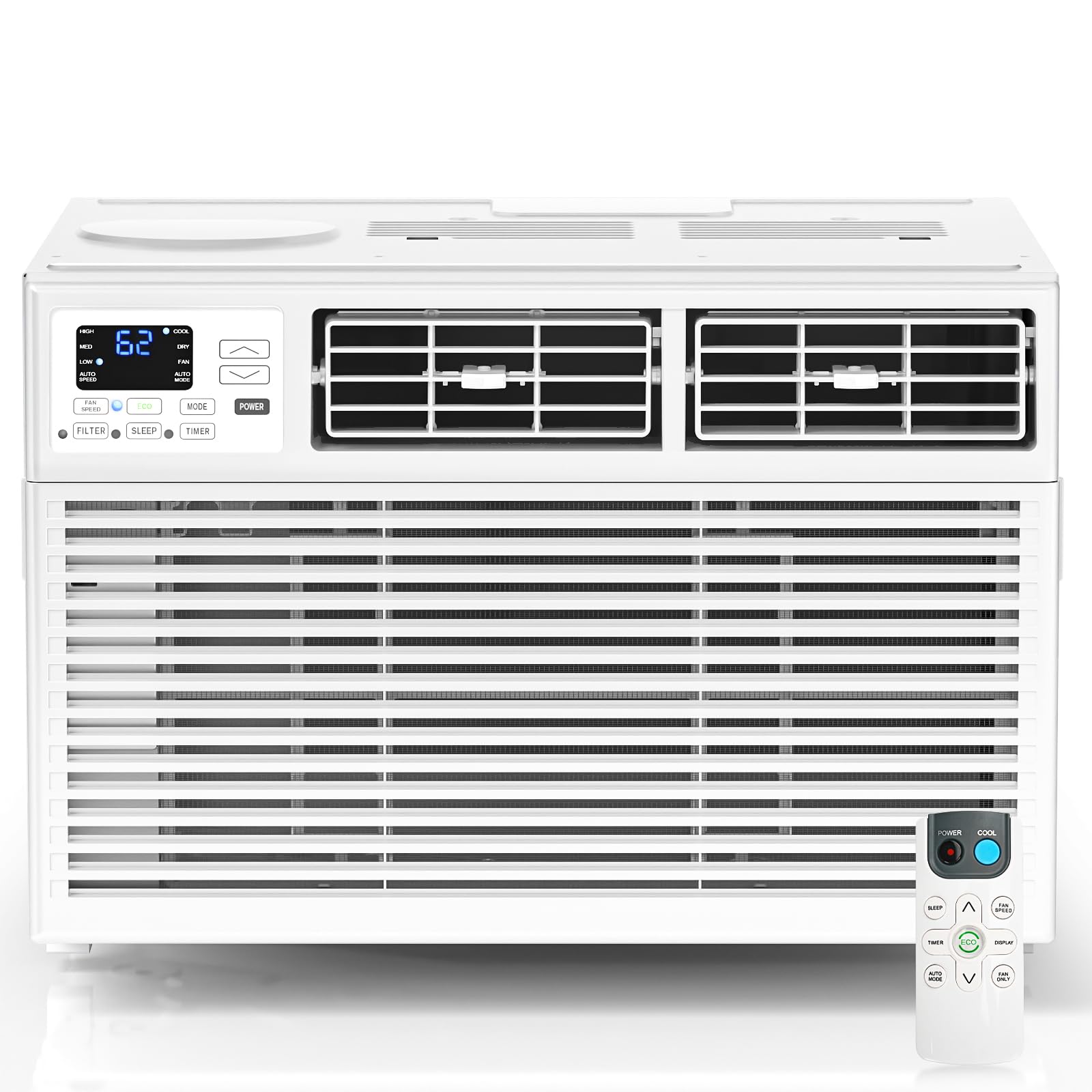
3. ZAFRO 8,000 BTU Window Air Conditioner
A compact window AC that turns a stuffy finished basement into a sleeping room
A finished basement turns into a usable room the moment it stops feeling like a cellar, and 8,000 BTU of cooling power covering up to 350 square feet does exactly that. That’s the same coverage as nothing else here at this output, and it’s a fraction of the Arctic Star 12,000 BTU further down, which stretches to 550 square feet — a much larger draw from the same wall outlet grid. Set against that bigger unit, this one uses 540 watts against 690 watts of annual energy consumption, so the smaller room cools for less draw.
The controls are the fun part: 7 operating modes and 4 fan speeds from either the remote or the panel, plus adjustable louvers you aim where you want the air. Installation is designed for a standard double-hung window between 23 and 36 inches wide, and the illustrated manual walks you through the included hardware.
The recurring gripe is noise. This unit is rated as low as 45 dB, and the quiet is real, but it doesn’t run as silently as the box implies. Owners put it plainly: “Cools fantastically! Although it doesn’t run as quietly as they stated, but I am very happy with it.” The Eco thermostat also runs warm, kicking in only after a noticeable temperature rise, so set your target lower than you think.
It cools a smallish room without fuss, and the R32 refrigerant and 24-hour timer round out the energy story.
The real-world read: good cooling beats perfect silence in a basement, and this one delivers on the cooling side with 7 modes and 4 fan speeds to dial in comfort.
Best suited to: a basement bedroom or home office where you want fast cold air and remote control.
Know the trade-off: the Eco thermostat cycles late and the fan runs louder than advertised, so it isn’t the pick for someone who needs near-silent operation.
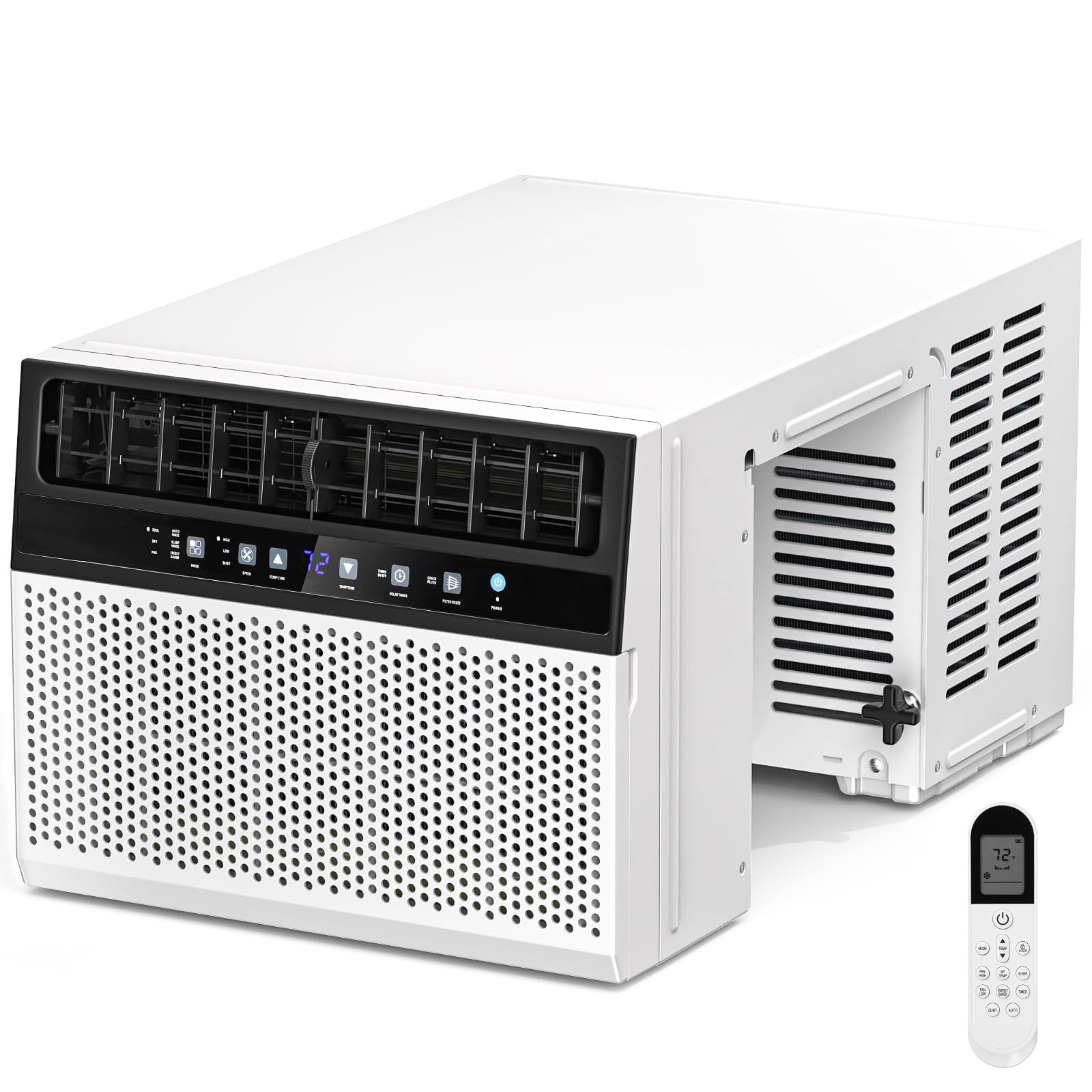
4. Antarctic Star 12,000 BTU Window Air Conditioners
The U-shaped unit that cools a big room without blocking your view
The U-shaped cutout is the reason this AC exists in a window-well basement. Instead of a box that seals off the whole sash, the U-frame lets the window close down into the channel, so you keep most of the glass and a lot more daylight — a real difference in a lower-level room that’s already short on sun. Regular windowsills just mount the unit flat against the glass, which is exactly what this design avoids.
With 12,000 BTU of cooling power covering up to 550 square feet, it handles a large finished basement better than the ZAFRO’s 350-square-foot reach above — an extra 200 square feet of room, drawing 690 watts of annual energy against the ZAFRO’s 540 watts. That output is meant for a living room, bedroom, dorm, or office rather than a closet. Six functions cover cooling, fan, and dehumidifier work, and a 24-hour timer plus a Mytemp sensor let the unit hold your target temperature while using less energy.
Installation is genuinely quick, and owners describe it in minutes rather than hours. A digital display with LED lighting makes night adjustments easy, and the remote keeps you in your seat. As one happy installer reported, it goes from box to running in a very short window and cools a hot, humid room faster than expected.
The trade-off is fit and the running cost over time. Fit feedback is split — it suits some windows perfectly and misses others — and value feedback is the weakest part of the picture, with some owners feeling the long-term cost doesn’t match the sticker. An inner reservoir can also trip a shutdown every few hours once it fills, and the fix is draining the cap or hose.
Why the U-design stands out
- Cools up to 550 square feet, the widest reach on this list
- U-shape preserves most of the window glass for daylight
- Six functions including dehumidifier plus a 24-hour timer
- Mytemp sensor holds your setting while running leaner
Where it asks patience
- Fit is hit-or-miss depending on your window
- Inner reservoir can force a periodic drain or shutdown
- Value pushes some owners to look at cheaper window units
Pick this one when: you want to cool a bigger basement room and keep your view intact.
Skip the guesswork: measure your window frame against the U-channel before ordering, since the fit varies unit to unit.
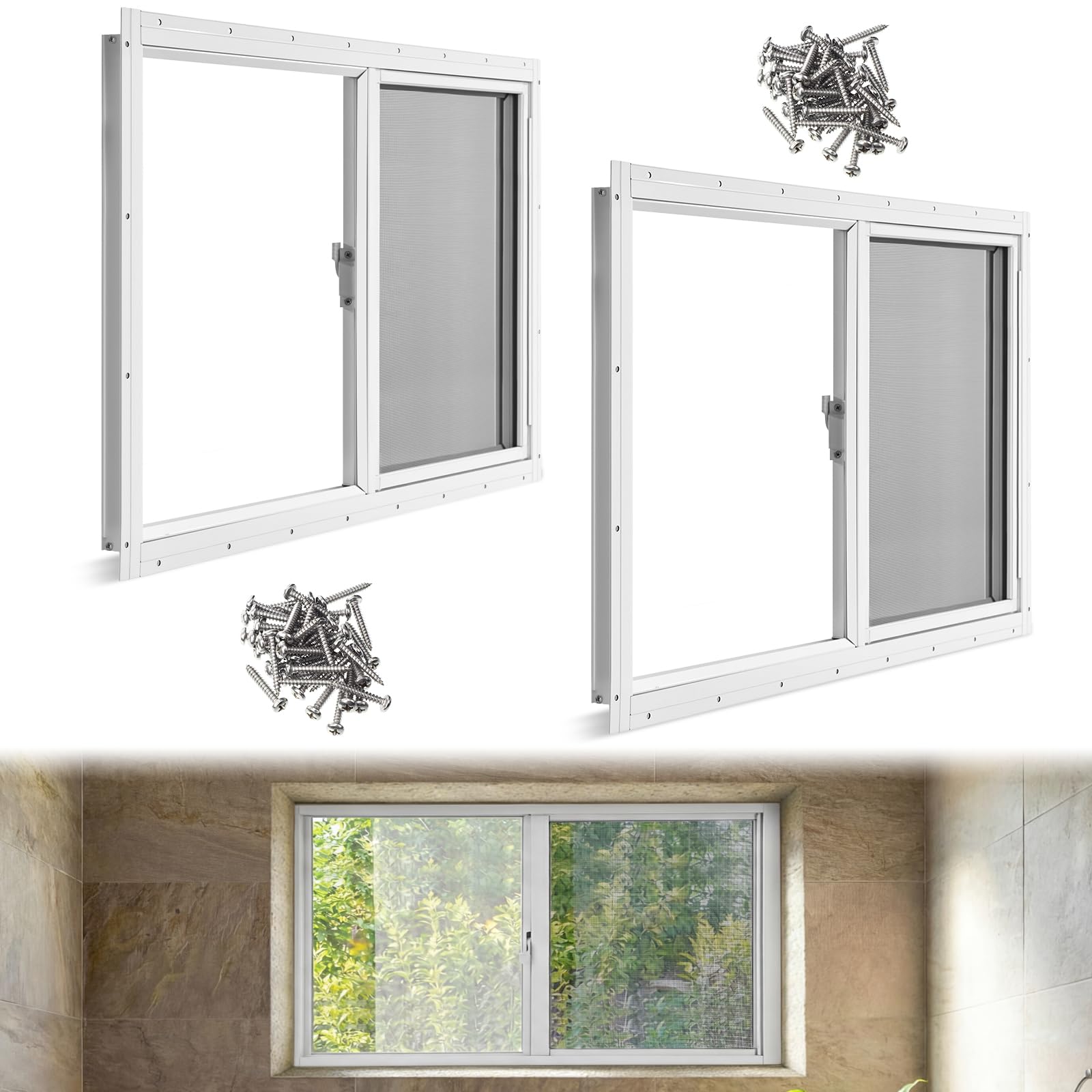
5. Kathfly 2 Pack Basement Home Window 32” x 18”
Two small tempered-glass windows that turn a dark shed or basement corner bright
Buying two at once is the smart move when you’re patching several small openings on the same wall — and this pair arrives with tempered glass, a removable screen, and a pack of screws in one box. A rust-resistant aluminum frame keeps the weight down to 18.08 pounds for both, so lightening the load on a rough masonry wall is easy.
The recessed design is the detail to understand before you order. These sit back into the wall for a clean, streamlined exterior, which means the installed window ends up noticeably smaller than the 32 x 18 inch stated size. Read the size chart carefully — the manufacturer is explicit that your opening needs to be smaller than the window. Sliding requires both hands to press the upper and lower latches at the same time, and snap-in holes on the center and sides hold the glass open at any of three positions. The screen keeps small animals out while letting air move.
Quick installation and clean looks are the two things owners keep coming back to. The glass-and-frame combination covers sheds, chicken coops, barns, garages, and basements, so one order solves a whole outbuilding.
What you give up is strength. The construction is light, and a couple of units have arrived bending or damaged in transit.
Worth buying if: you have two matching small openings and want a matched pair that installs with basic tools.
Check the recess: because they are recessed, they only suit openings smaller on the outer face than the window’s listed size.
Your pick if: you’re dressing up two sheds, a barn wall, or a small basement window at the same time.
Order slightly under your opening: recessed frames need a smaller hole than the window itself, and the size chart is the only guide that matters.
6. StakWEL Emergency Egress Window Wells

The stackable well that turns a basement window into a code-compliant escape route
If you are pulling permits on a finished basement, this is the piece that gets you past inspection. The StakWEL well satisfies IRC 2018 building code requirements for emergency egress in finished basement areas, and the unique Grip/Step design adds a handle plus a gusseted step to climb out on — which is the point of an egress window in the first place. Maintenance-free modules will never rust, rot, or need replacing, and they slide together to build the exact height your foundation needs.
Natural light and ventilation are the bonus: a well lets daylight into lower-level living areas and the soft earth-tone color blends with a basement interior. At 54 x 40.5 x 20 inches and 25 pounds per module, a single person can stack the units. What separates this from a plain liner is the built-in ladder — several owners confirm the well is genuinely climbable, not just code-compliant on paper.
The install is a real DIY project, not a five-minute job. Anchor bolts, a hammer drill, and around six bolts per stack are needed, and a full multi-well setup can run a solid day. Ordering early matters too — a special truck handles delivery. What you gain is a huge light bump over rusted old liners and a well that meets code for a fraction of what a contractor quotes.
The bottom line: for code compliance and safer egress, this modular well earns its place with a ladder, a rust-free build, and stackable height.
Built for: a basement project that needs to pass inspection and give the family a real way out.
Plan the install: bring the right drill and anchor bolts — the well itself is easy, but the wall work is the long part.
7. Uhome Portable Air Conditioner, 8000 BTU

The rolling AC for basement rooms where a window unit simply won’t fit
Not every basement room has a window you can hang an AC in, and that is where a stand-alone portable earns its keep. This one rolls on built-in wheels with a 6-foot cable and a window mount kit in the box, so you can move it between rooms and only need a hose outlet to the outside. It’s rated at 8,000 BTU for up to 350 square feet of space alongside the ZAFRO’s matching coverage.
Three modes cover cooling, dehumidifying, and fan — and the dehumidifier lifts up to 40 pints of moisture a day, which matters in a basement that already fights damp. The cooling range runs from 60°F to 86°F in one-degree steps, the 24-hour timer handles scheduling, and a remote keeps the controls in your hand. Bucket-less self-evaporating operation means less emptying, and the washable filter lifts out for a rinse.
The trade-offs are noise and a fiddly install. Owners describe this as among the loudest units they’ve owned, and a couple found the window sealing plate too small for a standard window without cutting. Cooling is the strength — several owners say it chills a small basement room hard and fast, and it’s still running after years of summer use.
Worth knowing: portability and a 40-pint-per-day dehumidifier make this a good fit for a below-grade room with no usable window.
The install can bite: the included window plate fits some frames poorly and may need trimming, so budget an hour for setup.
Choose this if: you have a basement room with no window recess and want movable cooling plus moisture control.
Think twice if: quiet matters most — this unit runs loud enough to notice.
8. Medium Sloped Clear Polycarbonate Window Well Cover 55″ W x 26″ L
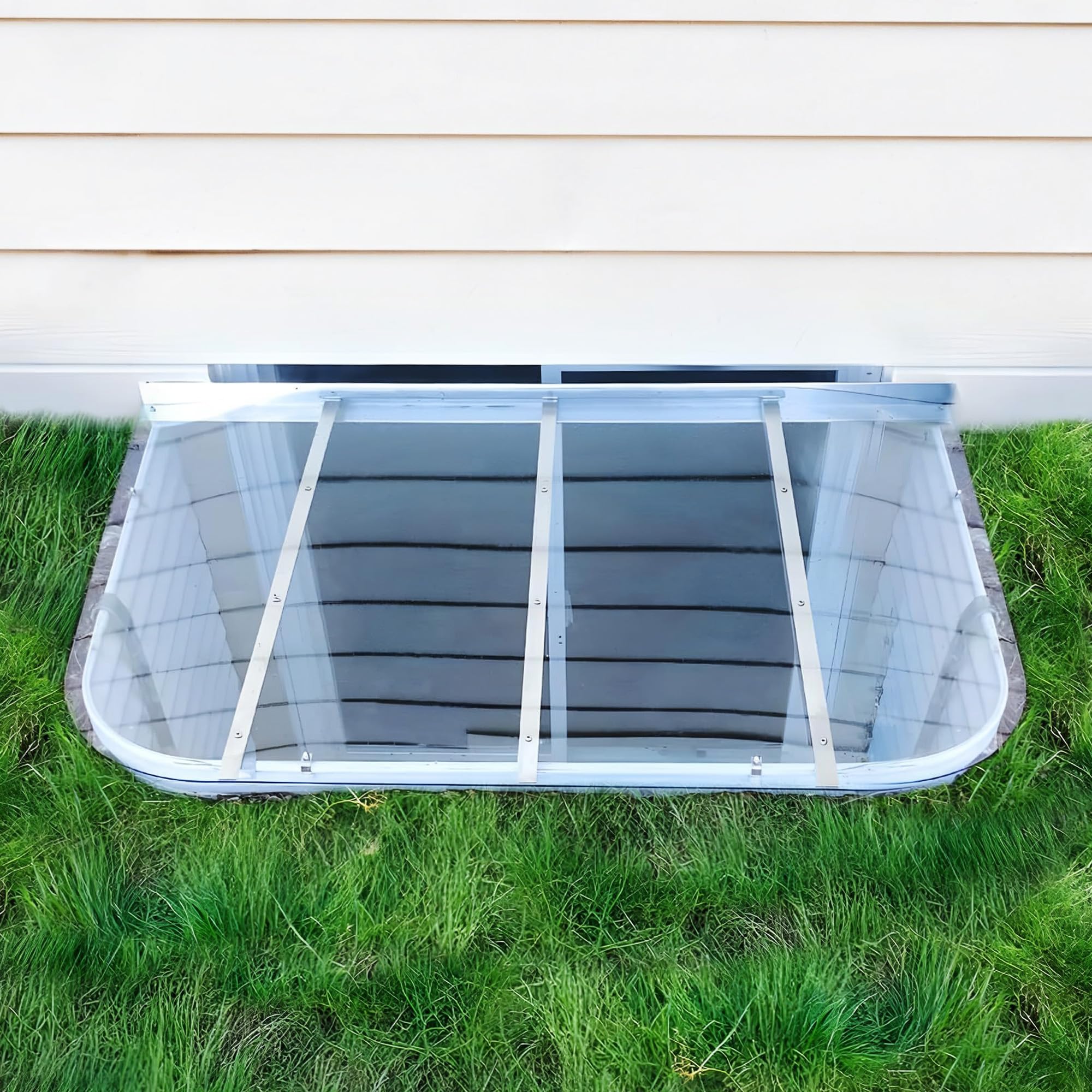
The sloped cover that sends rain and snow away from your basement window
A sloped top is the feature that keeps a basement window dry, and this 55″ W x 26″ L cover is built with exactly that pitch. Rain and snow run off instead of pooling on the glass below, which is the single most common source of a wet basement window. Made from clear polycarbonate in the USA, it lets daylight through while blocking debris, weather, and the cracking that plagues plain plastic covers.
Two reinforcements back up that sloped shape: a UV-resistant coating that guards against yellowing and fading, and rust-free aluminum bracing that shrugs off hail and harsh weather. The screws and hardware come in the box, so install is a screw-in job rather than a fabrication project.
What owners notice is how straightforward the fit is. Owners describe it as easy to put on and sized accurately, and when one cover arrived damaged in shipping, the company replaced it quickly. The sloped profile also looks clean against a wall, and the lifetime warranty covers cracking and fading.
The one thing to plan for is thickness. Because the cover is heavy-duty, its depth can be too much to slide under a tight obstruction like paneling or a conduit — a few owners seal above the cover instead of tucking it under. Measure your clearance before you commit.
The clear win: a sloped, UV-coated, aluminum-braced cover that keeps water out and light in, with a lifetime warranty behind it.
Best for: standard wells that collect water and debris and need a low-fuss clear cover.
Clearance check: its sturdy thickness may not tuck under paneling or a pipe, so confirm the gap first.
9. Clear Polycarbonate Large Egress Window Well Cover Sloped 54″ W x 38″ L

The bigger, thicker egress cover built to hold its shape over a wide well
When your well is wide and serves an egress window, the cover has to be strong enough to stand on and clear enough to see through. This 54″ W x 38″ L unit counters both with.177″-thick clear polycarbonate and rust-free aluminum bracing, and it’s rated to hold up to 500 lbs of weight. The sloped shape sheds rain and snow away from the casement window rather than letting it pool.
Two protective layers do the aging work: a UV-resistant coating that guards against sun damage and keeps the cover clear, and a corrosion-resistant aluminum support that resists rusting. It meets IRC Egress Code standards, so it satisfies the same compliance box as the StakWEL well above — just in cover form for a wide opening. The hardware, installation guide, and vapor gap all come in the box.
Owners single out the build quality, and the thick polycarbonate and aluminum bracing back it up the moment it’s in your hands. A couple of owners describe the material as clear, sturdy, and attractive, and the fit as accurate to the listed size. The sloped profile also stops water from pooling on top, which is exactly what a cover should do.
The honest friction is cost and fit precision. Value is the weakest part of the feedback picture, with several feeling it’s on the pricey side. A couple of units arrived too big despite careful measuring, so triple-check against Window Well Supply’s dimensions before ordering — a wide cover is unforgiving of a mismatch.
What backs the build
- Rated to hold up to 500 lbs with aluminum bracing and thick polycarbonate
- IRC Egress Code compliant for a wide well serving an escape window
- UV-resistant and corrosion-resistant for lasting clarity
- Sloped design sheds water away from the window
Where it costs you
- Value is the weakest part of the picture — it’s a pricey cover
- Size is unforgiving, and a few owners found it too big despite measuring
Meant for: a wide egress well on a finished build where you want strength, clarity, and code compliance.
Measure before you buy: the 54-inch width leaves little room for error, so verify against the listed dimensions first.
Know the Specs
Frame Material: Vinyl vs Aluminum
Vinyl frames won’t warp, peel, or corrode, so they tolerate the damp air that hangs around a basement wall year-round. Aluminum frames stay lighter and often arrive paired with tempered glass for a crisper exterior look. Both resist rust, but vinyl shrugs off moisture swings better over a long service life.
Pane Setup and Glass Type
Double-pane insulated tempered glass gives you two layers of glass with a sealed gap between them. That gap slows heat transfer and dulls outside noise, while the tempered treatment means the pane breaks into small dull pieces rather than sharp shards. For a basement room people actually use, it’s the combination to look for.
Rough Opening and Recessed Sizing
Measure the actual hole, not the old window’s label. Recessed models sit back into the wall, so the installed window ends up smaller than the stated size — always check the manufacturer’s size chart. Forgetting this is the single most common reason a basement window order gets returned.
Egress Compliance
If a basement room is finished and used for sleeping, code often requires an emergency escape opening and, sometimes, a compliant window well. Look for wells and covers that state IRC compliance, and check whether a ladder or step is built in so the opening is genuinely usable, not just compliant on paper.
Common Questions
Will a 36 x 24 inch basement window fit my existing opening?
Do I need tempered glass in a basement window?
What is a recessed basement window and how does it change sizing?
How do I stop water from pooling in my window well?
Do I need an egress window well to pass inspection?
How long does a vinyl basement window frame last?
Can I install a basement window myself or do I need a contractor?
What is the difference between a window well cover and a window well?
Can I cool a basement without a standard window unit?
How heavy is a basement window to lift alone?
The Bottom Line
For most basements, the winning basement replacement windows pick is the Vinyl Basement Sliding Window, 36″ x 24″ White because a rust-resistant vinyl frame, double-pane insulated tempered glass, and a beginner-friendly install cover damp, noise, and light in one unit. If you need to cool a bigger finished room while keeping your view, grab the Antarctic Star 12,000 BTU U-Shaped Window AC with its 550-square-foot reach and preserve-the-glass frame. And for a wide egress well that has to stay dry and code-compliant, the Clear Polycarbonate Large Egress Window Well Cover is the one to reach for.
How we choose
We do not accept paid placement. Every pick is matched to a real buyer and a real use-case; we do not hands-on test units.
Sources
Specifications: manufacturer listings and product documentation. Review insights: verified customer reviews, as of October 2026. Pricing: not shown on this page (it changes often); check the current price via the retailer link.
As an Amazon Associate, Aappliancez earns from qualifying purchases. This does not affect which products we feature.