Disclosure: Some links in this post are affiliate links. As an Amazon Associate I earn from qualifying purchases, at no extra cost to you. Learn more
Specs are compiled from manufacturer listings and verified buyer reviews and can change over time — please confirm the key details on the product page before buying.
Baseboards collect the most dust per square inch of any surface in the house, and they sit too low to reach standing up. A handle around 56 to 60 inches long lets you stand upright and sweep that ledge from above. The five picks below cover every approach: a squeegee-and-scrub combo, a wall mop with six pads, a purpose-built baseboard duster, a fan-blade tool, and a corner specialist. If you only want the short answer, the 3 in 1 Floor Scrub Brush with Long Handle is the crowd favorite, with 4.0+ stars across 1,000+ ratings, and it swivels into tight shower corners as well as baseboards.
This guide is built by comparing the manufacturers’ published specifications and the patterns across verified customer reviews, so you get each pick’s real strengths and trade-offs instead of marketing spin.
Skirting boards collect dust you rarely see until you look from a low angle. Test your reach first. A 55.9-inch pole clears most painted baseboard heights without a ladder or bent back. baseboard cleaning tool fits inside that plan.
Top Picks

How To Choose The Best Baseboard Cleaning Tool
Three numbers decide whether a baseboard tool saves your knees or sits in a closet. Handle length is first. Pad attachment is second. Head shape is third.
Match the handle to your ceiling and your height
A baseboard tool works when the pole is long enough that your shoulders stay relaxed while the head sits on the skirting. The shortest pole in this group runs 30-40-50 inches across three adjustable sections, which suits floors and low walls. The longest reaches 79 inches, which is long enough that you are not fetching a ladder for ceiling corners or fan blades. If you are tall, or your baseboards sit under a high ceiling, lean toward 55.9 inches and up. A pole shorter than your standing reach puts you back on your knees.
Chenille for dust, microfiber for damp wiping
The pads do two different jobs and it helps to keep them apart. Chenille has a deep, fuzzy pile that grabs loose dust and cobwebs off the top edge of a baseboard. Microfiber is the denser fabric you dampen for sticky residue, splash marks, and window glass. A kit that ships with both types, like the two chenille plus two microfiber set on the pad-based models here, covers dusting day and deep-clean day without you buying extra. Check the pad count before you buy, because the counts range from 4 up to 6 across these picks.
Look at how the head moves and how the pad sticks
A rotating or multi-angle head is what lets you sweep along the baseboard face and then flick sideways into a doorway corner without changing position. The one catch to watch is the pad fastener. Velcro-backed pads are easy to swap but the tape side can lift over time. A locking head helps when you are working overhead near a ceiling, because it stops the head from flopping backward mid-stroke. If you plan to clean baseboards only, a fixed flat head is enough; if you also want walls and ceiling fans, a pivoting head lets you angle the pad without repositioning the pole.
Side-by-Side Comparison
| Model | Best For | Handle Length | Pads Included | Item Weight | Amazon |
|---|---|---|---|---|---|
| 3 in 1 Floor Scrub Brush with Long Handle★ Best Overall | Scrubbing baseboards and grout | 30-40-50 inches (3 sections) | — | 0.76 kg | Amazon |
| Wall Cleaner Mop, 79-Inch Handle, 6 PadsBest Reach | Walls, ceilings, and high baseboards | 40-79 inches (5 sections) | 6 (3 microfiber, 3 chenille) | 1.7 pounds | Amazon |
| JEHONN Baseboard Cleaner Tool, 56 inches | Dusting the baseboard ledge | 55.9 inches | 4 (2 microfiber, 2 chenille) plus brush | 0.93 kg | Amazon |
Detailed Reviews
1. 3 in 1 Floor Scrub Brush
Our pick — 4.0+★ from 1,000+ verified ratings; the strongest balance of quality and price.
One tool that scrubs the baseboard, scrapes the residue, and pinches up the hair.
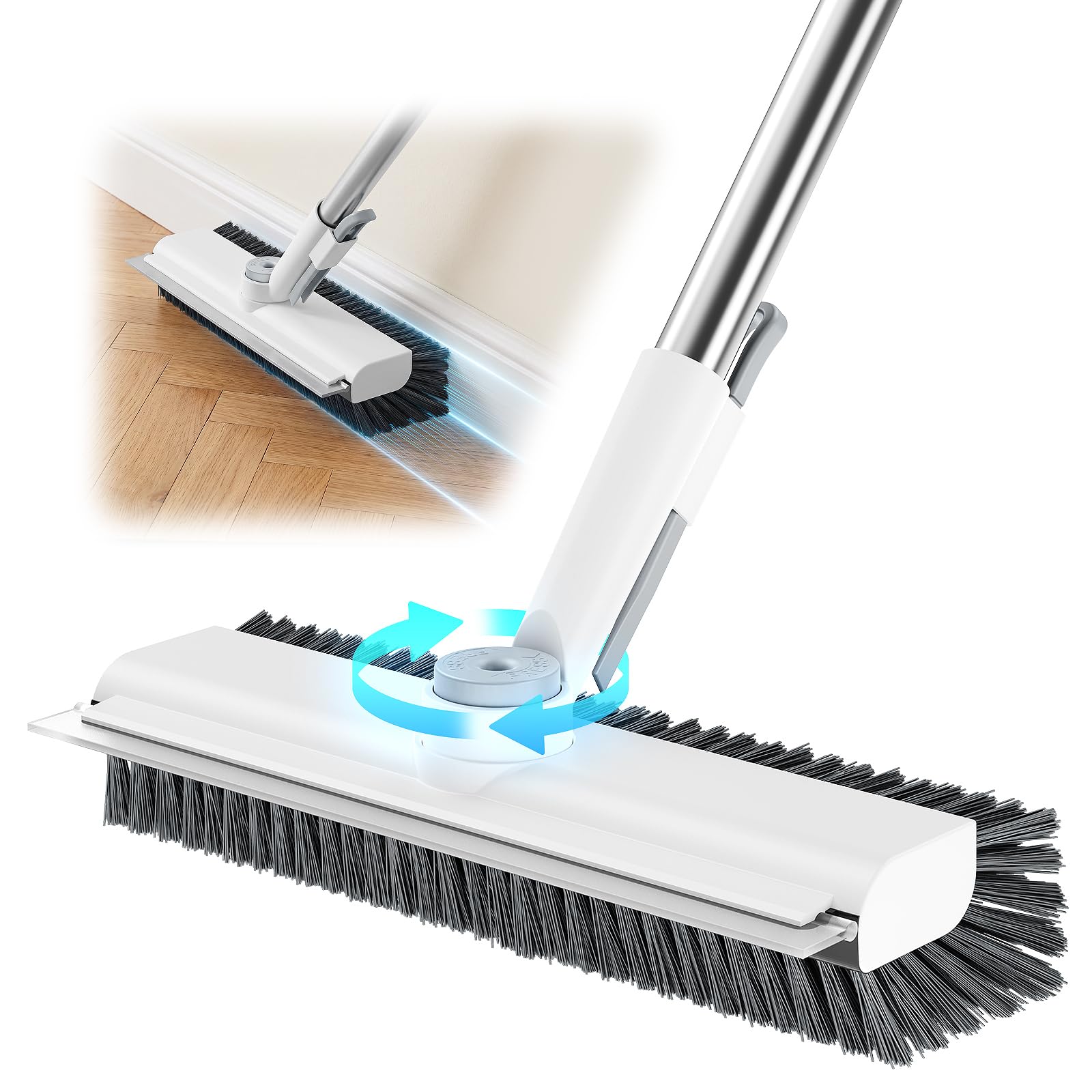
Scrub brushes are built for grout lines, but that same stiff PVC bristle does the honest work on scuffed baseboards and floor trim. What separates this one is that it is genuinely three tools on one pole: stiff bristles for scrubbing, a rubber squeegee for scraping dirty water off tile, and a set of tweezers for lifting hair and debris out of the corner gap. The head rotates at the press of a button, so you can stand at the wall and angle the brush into a baseboard without moving your feet.
The pole splits into three adjustable lengths at 30-40-50 inches, and you set your own working height rather than accepting whatever the manufacturer chose. It is the lightest tool in this lineup at 0.76 kg, and it is the only one here that skips the pad system entirely — stainless steel handle, PVC bristles, rubber scraper. That is also why it undercuts the dedicated baseboard models on price while doing more jobs.
What wins people over is the build quality relative to what you pay, and then the raw scrubbing power on grout and spot stains. Owners note it handles an inflatable hot tub, and the swivel head pivots into tight shower corners that a flat mop cannot enter. The honest trade-off: the bristles are stiff, which is exactly what scrubs a baseboard but can be too firm for a delicate painted surface — go gentle on soft finishes, or switch to one of the pad tools for those runs. The handle has three set lengths rather than full extension, so if you want one continuous 56-inch pole this is not it.
The three-in-one case
- Bristles, squeegee, and tweezers on a single tool, so baseboard scum, tile sludge, and trapped hair are one pass apart
- Rotating head with a push-button swivel reaches into corners and shower cubicles without repositioning
- Lightest pick here at 0.76 kg and the cheapest way into a long-handle scrub setup
Where it asks for care
- Stiff PVC bristles can scuff a soft painted baseboard, so use a light touch on older trim
- Handle steps through three fixed lengths instead of extending continuously
Take this one if: you want to scrub baseboards, grout, tiles, and the tub with a single light pole you set to your own height.
Pass on it if: your baseboards are delicate painted mouldings that need a soft pad rather than stiff bristles.
2. Wall Cleaner Mop 6 Pads
The reach champion — long enough to dust baseboards and vaulted ceilings from the same spot.
Five extension rods thread together with no screws, and that is what gets you from 40 inches up to 79 inches. Set it short for baseboard runs and long for ceiling fans and the tops of door frames. The triangular head swivels a full 360 degrees and, crucially, it locks — so when the pole is stretched out and you are leaning back to reach a ceiling, the head stays flat instead of flipping over on you. That locking feature is the detail that makes a long pole usable up high.
The pad kit is the largest here at six pieces: three microfiber pads for the wet jobs like mopping and windows, three chenille pads for dry dusting and soaking up spills. Against the JEHONN baseboard tool, this mop reaches 79 inches versus that model’s 55.9 inches, and the head is a flat triangle rather than a conforming baseboard profile — so you gain reach and pad count but give up the moulding-hugging shape. Buyers report it as the affordable route to dusting walls and fans, and you can dust walls and fan blades from the floor.
The reach-and-hold story: the 79-inch maximum and the locking triangular head are the two things that keep this steady when you are working above your head, and the six-pad kit means you are not ordering refills the week it arrives.
The honest snag: durability is the softer spot on this mop across owner feedback, and the swivel mechanism gets mixed notes — so this is a tool to treat as a helper for high and awkward spots, not a heavy scrubber for the baseboard scuffs a bristle brush handles.
Reach for this if: your cleaning list includes ceiling fans, high walls, and long baseboard runs and you want to stay off a ladder.
Look elsewhere if: you want one stiff scrubbing tool for caked-on baseboard dirt — a bristle brush does that better.
3. JEHONN Baseboard Cleaner Tool 56 inches
The only pick shaped to sit on the baseboard ledge itself instead of sweeping past it.
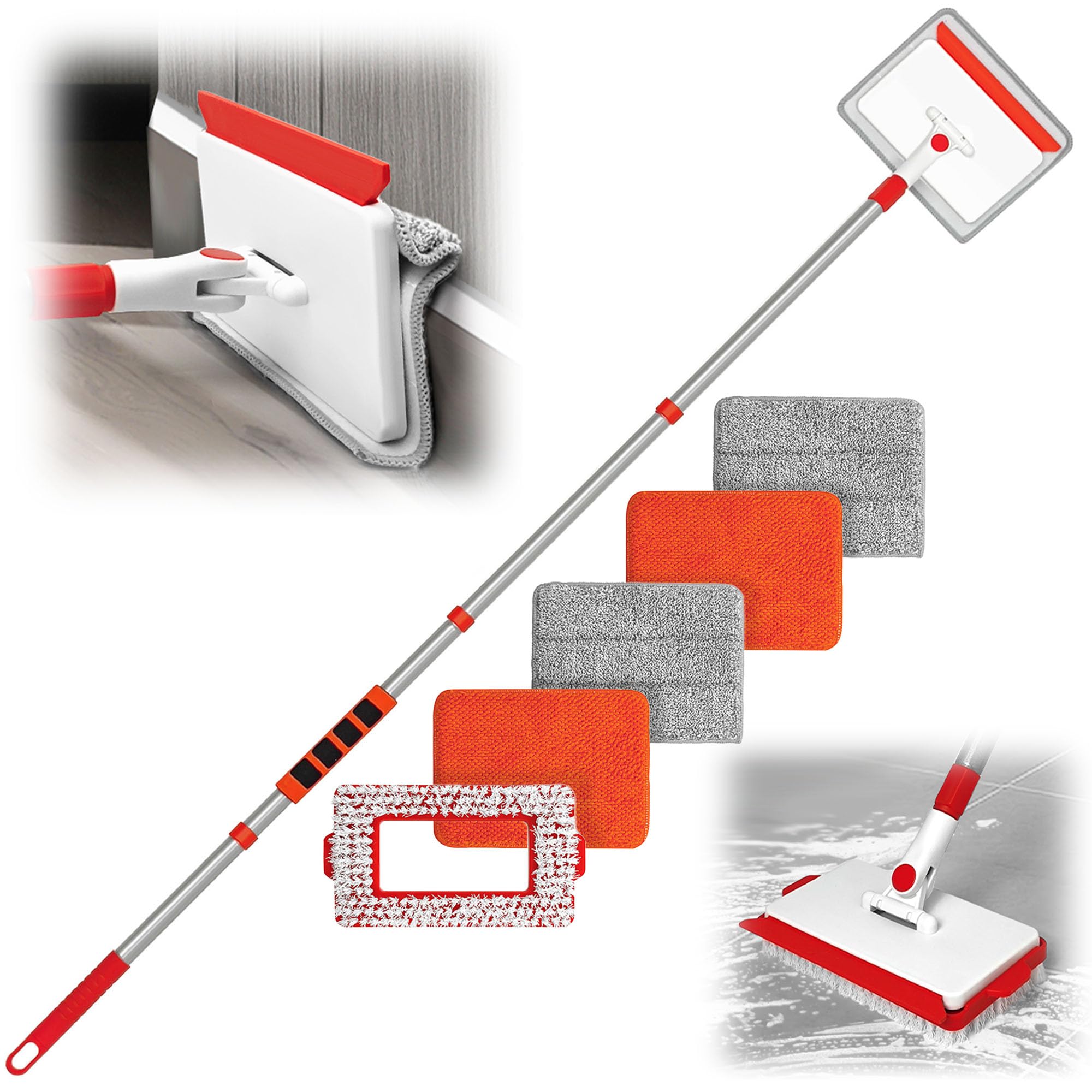
Most long-handle tools are flat and ask you to aim at a thin horizontal strip. JEHONN did the opposite: the panel carries a convex ridge that matches the profile of a baseboard and door moulding, so the pad hugs the curved top edge as you pull it along. Fold that ridge flat and the same head becomes an ordinary flat mop for floors. You get 55.9 inches of pole, which lets you stand upright for the sweep, plus a separate stiff bristle brush for scrubbing stubborn marks on tile, marble, and linoleum.
Four pads come in the box — two microfiber for damp mopping and glass, two chenille for dry dusting and pulling down cobwebs. There is a built-in silicone squeegee bar for scraping dirty water off shower doors and windows, and a 180-degree rotating head that turns both ways to reach dead corners. It hangs on the wall when you are done.
Where this stumbles is the fitting that holds it all together. The pad tape lifting off the head after the first use is the durability note that shows up most, and the swivel can pop loose under pressure, so treat both gently. A couple of owners also find the head could be bigger and that the stiff brush does not conform to every baseboard angle. The upside is that the pad-and-convex-panel design solves the exact job the flat mops sidestep.
What the design gets right: a panel with a convex ridge that actually curls over the baseboard top edge — the one shape here made for trim rather than floors.
What to handle carefully: the Velcro attaching the pads can peel after the first use, so keep the head clean and press the pads down flat when you load them.
This suits you if: baseboard and door moulding dusting is the job you keep putting off, and you want a head built for that exact edge.
Then think twice if: you expect to press hard into caked dirt — the swivel joint prefers a light, steady pull.
Know the Specs
Handle length and what it buys you
The number on the listing is the maximum pole reach, usually measured in inches or centimetres. A 55.9-inch or 60-inch pole lets most adults stand straight while the head contacts a standard baseboard. Stretch to 79 inches and you can dust a ceiling fan or a high wall without a ladder. Short poles in the 30-40-50 inch range suit floors and low trim. Longer is not automatically better for baseboards — a very long pole can feel whippy when you press down, so pick the shortest length that still reaches your highest strip.
Pad material, pad count, and how they attach
Chenille is the deep, fuzzy fabric for dry dusting and cobwebs. Microfiber is the dense fabric you dampen for sticky marks and glass. Kits here carry anywhere from four to six pads, split between the two types. What matters as much as the count is the fastener: most of these heads use Velcro-style tape, which makes swapping pads fast but can lift with repeated use. A head that locks flat is the other feature note, because it stops the pad from rolling over when you are working overhead.
Common Questions
How long a handle do I need to clean baseboards without kneeling?
What is the difference between chenille and microfiber pads on a baseboard duster?
Will a long-handle baseboard tool scratch my painted walls or trim?
Do these baseboard tools need screws or tools to assemble?
Which baseboard cleaner is better for corners and door mouldings?
Can I use one of these on ceiling fans as well as baseboards?
Are the cleaning pads washable and reusable?
What wears out first on a baseboard cleaning mop?
How do I store a long-handle baseboard tool without it taking over a closet?
Is a scrub brush or a duster mop better for baseboard cleaning?
The Bottom Line
For most homes, the baseboard cleaning tool that covers the widest range of jobs is the 3 in 1 Floor Scrub Brush with Long Handle — bristles, squeegee, and tweezers on one light pole that adjusts to your height. If your highest strip is well above your head, the Wall Cleaner Mop and its 79-inch reach keep you off the ladder entirely. And when the job is specifically the curved top edge of the baseboard itself, the JEHONN Baseboard Cleaner Tool is the one shaped for it. Whichever you pick, a head shaped for the baseboard profile will clear more dust off skirting than a flat mop. It holds 4.0+ stars across 1,000+ ratings.
How we choose
We do not accept paid placement. Every pick is matched to a real buyer and a real use-case; we do not hands-on test units.
Sources
Specifications: manufacturer listings and product documentation. Review insights: verified customer reviews, as of October 2026. Pricing: not shown on this page (it changes often); check the current price via the retailer link.
As an Amazon Associate, Aappliancez earns from qualifying purchases. This does not affect which products we feature.