Disclosure: Some links in this post are affiliate links. As an Amazon Associate I earn from qualifying purchases, at no extra cost to you. Learn more
Specs are compiled from manufacturer listings and verified buyer reviews and can change over time — please confirm the key details on the product page before buying.
When the neighbour’s dog walks past the fence and your dog starts barking, you cannot be standing there every single time to redirect it. A bark control device covers the moments you are not standing there. Some react to the bark on their own; others let you send a cue from across the yard. Which type fits depends on your dog’s size, your living situation, and how much correction you are willing to use.
This guide is built by comparing the manufacturers’ published specifications and the patterns across verified customer reviews, so you get each pick’s real strengths and trade-offs instead of marketing spin.
Two families show up here. Remote training collars let you fire a beep, a vibration, or a static pulse with your fingertip. Stationary ultrasonic units sit on a wall or fence and send out a high-pitched tone dogs hear but you mostly do not. A remote collar follows the dog and lets you time the correction; a stationary box guards one spot unattended. This breakdown covers the bark control device options that still hold up once the new-gadget excitement fades and the barking starts again at 6 a.m.
Top Picks
How To Choose The Best Bark Control Device
Your first decision is not brand or budget. It is if you need a collar or a box. A collar rides on the dog and works wherever the dog goes. A stationary ultrasonic box sits in one spot and guards that spot. A collar on a dog that only barks at one gate, or a box on a dog that barks all over the yard, will not fix the barking. Name the exact spot and moment you are fixing before you buy.
Fence barking versus indoor nuisance barking
A dog that patrols the fence line and barks at whatever passes needs a correction you can time yourself. A remote collar gives you that control, because you choose when a correction lands and you can pair a beep with a recall word. A stationary unit works too, but only inside its coverage area. A wall-mounted box cannot help once the dog is forty feet down the yard.
Indoor barking at hallway noises flips the answer. There, a unit that plugs into a wall or sits on a shelf handles the job with nothing in your hand at all.
Match the correction to the dog, not to the dial
Remote collars offer three channels of feedback: an audible tone, a vibration, and a static pulse (a brief electrical pulse at the collar). Most dogs respond to the tone or the vibration alone once they link it to the word you are already using, and the static channel goes unused. That matters because the same static pulse that feels trivial on a 90-pound shepherd can be startling on an 18-pound terrier. For a small or sensitive dog, look for a collar that dials the static channel down to the very bottom step and also offers a mode that skips static entirely.
Waterproofing and battery chemistry
An outdoor unit takes more abuse than a collar. Rain, sprinklers, and a hose-down after a muddy walk all land on the housing. Look for a stated rating you can compare. IPX7 means the receiver survives a dunk in water. IP65 means the housing shrugs off rain and dust. So an IP65 box on a fence post keeps working through a wet winter.
Battery life splits cleanly by type. A collar battery is measured in days, because it is small and the dog wears it. A wall unit is measured in months, because it only wakes when a bark triggers it.
Side-by-Side Comparison
| Model | Best For | Adjustable Levels | Water Rating | Weight | Amazon |
|---|---|---|---|---|---|
| 2-in-1 Dog Bark Collar with Remote & Training Collar★ Best Overall | Yard and fence-line training | 3 sensitivity levels | IPX7 | — | Amazon |
| Holercoco Automatic Ultrasonic Dog Bark Deterrent (Q13) | Unattended indoor and patio coverage | 6 sensitivity levels | IPX6 | 8.8 ounces | Amazon |
| Queenmew Dog Bark Deterrent with 4 Ultrasonic Transmitters (H1) | Hands-off outdoor mounting | 3 frequencies | IP65 | 7.4 ounces | Amazon |
| FORNIHE Anti Barking Device, Long Range 50 Ft | Simple one-spot bark discouraging | 3 modes | — | 11.7 ounces | Amazon |
Detailed Reviews
1. 2-in-1 Dog Bark Collar
Our pick — 4.0+★ from 1,000+ verified ratings; the strongest balance of quality and price.
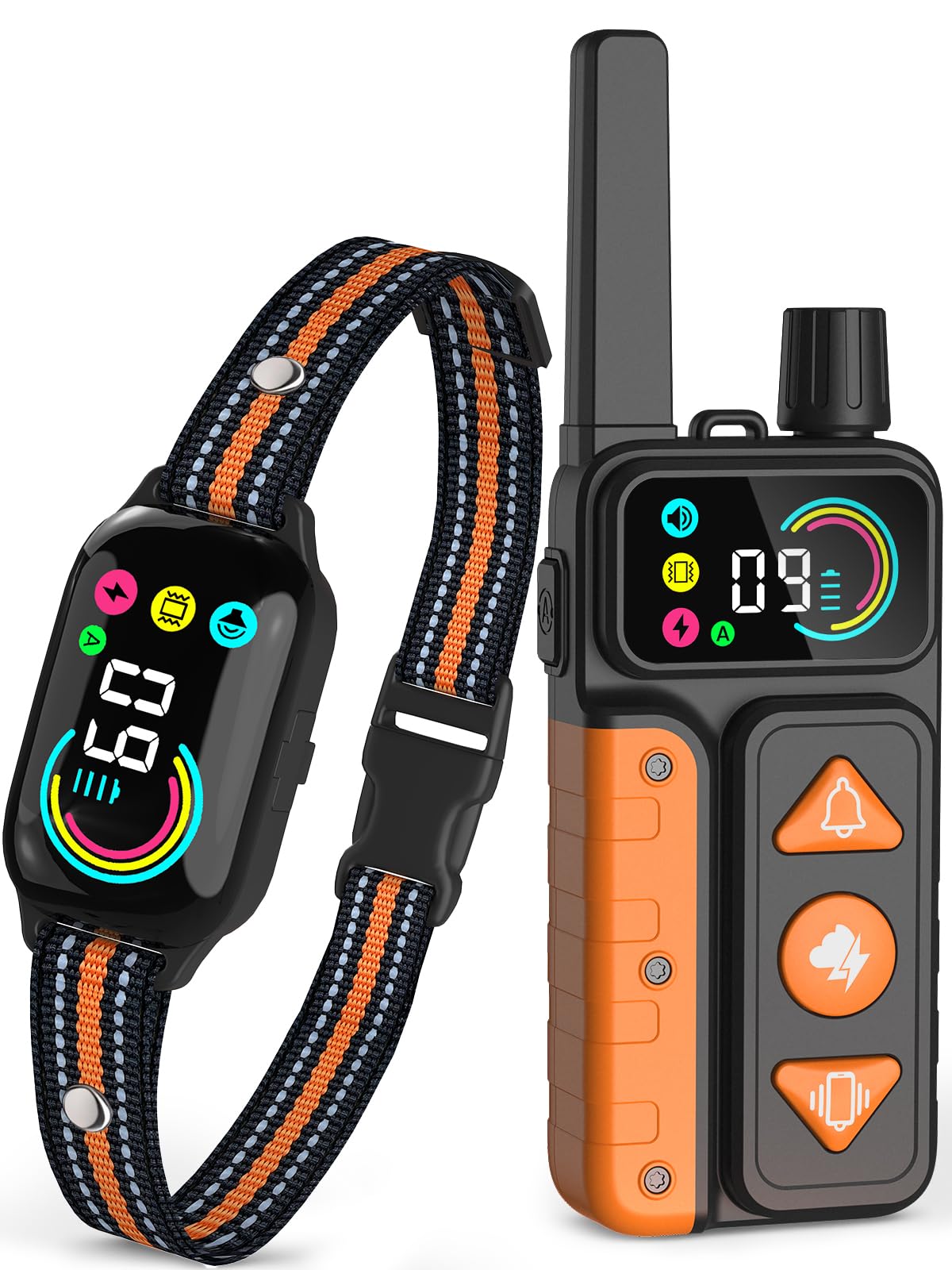
A 3300FT remote collar that lets you fire a beep, vibration, or static pulse from the back door while the dog works the fence line.
This collar earns the top spot because its remote reaches up to 3300FT in open ground — far enough that you can send a cue from the back door or across a park while your dog works the fence line. That beats the stationary ultrasonic boxes here, which only cover the spot where you mount them. The receiver is rated IPX7, meaning it survives a dunk in water, so a wet yard will not end the session early. The strap fits dogs from 5 to 120 lbs, covering a Chihuahua and a Labrador Retriever with one collar.
what separates it from the other options is how many choices the remote gives you: beep levels 1 through 9, vibration levels 1 through 16, and static levels 1 through 99, plus a No-Shock mode that pairs the beep with the vibration and nothing else. Automatic bark detection runs on 3 adjustable sensitivity levels — steps that decide how loud a sound must be before the unit treats it as a bark. The ultrasonic Holercoco below offers 6 sensitivity levels, so if fine-grained tuning of the trigger is your priority, that unit leads there. For a collar, three levels is enough to stop the device firing at a car door slamming down the street.
Battery is where a collar usually disappoints. This one is generous on paper: up to 180 days from the rechargeable remote and up to 40 days from the receiver, each refilling in roughly 2 hours. So the remote becomes something you top up once or twice a season. A safety lock keeps a pocket press from firing a correction while you carry it.
Why owners keep it on the hook
- 3300FT of remote range keeps the dog reachable well out in the yard, so a cue lands when you are nowhere near it
- Static dials all the way down to level 1, with a separate No-Shock beep-and-vibrate mode beside it
- IPX7 receiver survives rain and splashes without coming off the dog
- One remote switches between two receivers, so two dogs can each have their own levels
What to plan around
- Static tops out at level 99, and a correction that strong is far past what most dogs need — start at the bottom and work up
- The receiver is a noticeable lump on a very small dog like a Chihuahua
- Durability is the one area where feedback splits, so treat the strap and housing with some care
Reach for this if: your dog barks at the fence line, the front window, or on walks, and you want a remote that works two dogs and survives a wet yard.
Look elsewhere if: you want a device that works when you are not home at all — the automatic bark detection helps, but the stronger move for a fully unattended setup is a stationary unit.
2. Holercoco Anti Barking Device

A shelf-mounted ultrasonic box with an AI sound-recognition chip that fires on a real bark with nobody in the room.
This unit wins its place with 6 sensitivity levels — six steps for setting how easily it triggers, double the 3 on the 2-in-1 collar above. That range helps when a quiet whine should not count but a full bark should. If the barking happens while you are at work, asleep, or simply not in the room, a hands-off unit beats a remote you are not holding. A dedicated AI sound recognition chip (the maker’s term for a processor that studies sound patterns) separates a genuine dog bark from a television, a conversation, or road noise. When it registers a bark, it fires with nobody pressing anything. It weighs 8.8 ounces, the lightest unit in this roundup.
The adjustable side is unusually deep for a stationary box: 3 intensity settings control how strong the correction is, and two emitters described as the equivalent of 6 standard heads spread the tone wider than a single-emitter box. That cuts the dead spots a dog can learn to sit inside. Four response modes let you stack or drop the beep and the flash light as you see fit.
Power is built for a shelf or a patio: a 2200mAh rechargeable battery rated up to 60 days per charge, with a 3 to 4 hour refill, and an IPX6 housing that shrugs off rain and hose spray but is not built for submersion. Set sensitivity low at first. Buyers report that the unit can be touchy — a quiet bark still registers, and a quiet bark is not always a real one. Keep it on the lower steps until you know how the chip reads your house.
The case for a stationary box: 6 sensitivity levels and 3 intensity settings give you more fine-tuning than the collar, and the 2200mAh battery runs up to 60 days between charges so it stays useful in a hallway, a covered patio, or a kennel run.
Know before you mount it: results here genuinely split — some dogs settle quickly and some barely register the tone at all. Buy it if you want an unattended solution and you are prepared to nudge the sensitivity a few times in the first fortnight. It is not the pick for a household that wants a guaranteed response on the first press of a button.
Its best fit: apartment or house where the barking happens when nobody is standing there to intervene, and the room has a wall or shelf to sit the unit on.
Where it will not suit you: a dog that has already ignored ultrasonic tone before, or a yard so large that one housing cannot cover the whole barking zone.
3. Queenmew Dog Bark Deterrent Devices
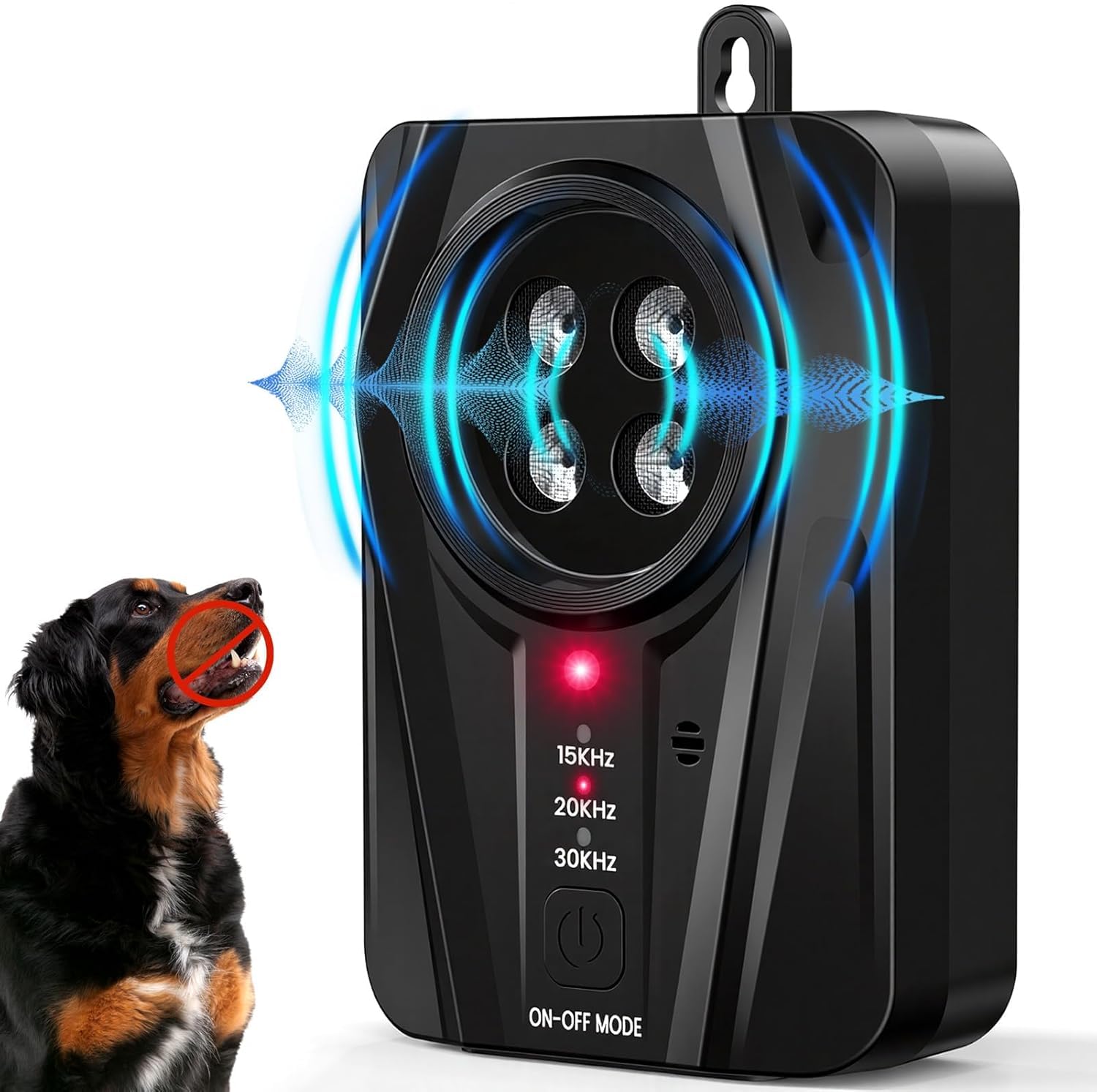
Four ultrasonic transmitters in one IP65 housing that screws to a fence post and covers a fixed outdoor zone with no collar on the dog.
Four built-in transmitters on one housing make this the pick for a kennel run, a side gate, or a stretch of fence you want covered without strapping anything to the dog. It also weighs 7.4 ounces, lighter than the 11.7-ounce FORNIHE below, which helps if you are screwing it onto a thin fence panel that should not sag. The maker lists a frequency range of 15 to 30KHz — the pitch band the emitters put out — so you can tune the tone to a dog’s size and temperament, with three adjustable modes inside that band.
The housing is rated IP65, meaning it handles rain, snow, and dust rather than a full dunk. So a fence-mounted unit keeps working through a wet winter. It mounts to a fence, a wall, or a tree, and a 1500mAh battery is rated up to 30 days per charge over USB. The maker’s own advice is to fully charge it before the first use. There is also a two-week training note in the listing — the manufacturer asks that you give the dog that long to adjust to a sound it may not like at first.
Read the 50FT range figure with the same grain of salt as any ultrasonic box. It is a clear-air measurement, and a fence, a hedge, or a wall between the unit and the dog will trim it. The listing also describes the coverage in one place as 33 feet, so treat the bigger number as the ceiling rather than the everyday reality. The honest pattern in the feedback is that this style of device is a coin flip dog to dog — plenty of owners get a quiet yard, others find their dog is simply not moved by ultrasonic tone and never will be. That is a limitation of the technology, not a fault of this unit, and it is why some households are better served by the 2-in-1 collar above.
Why it earns its spot: IP65 weatherproofing plus four transmitters on one mountable housing is the strongest combination here for covering a fixed outdoor zone without a collar.
The genuine trade-off: ultrasonic deterrents do not work on every dog, and the range only holds up in open air. If your dog has never reacted to a high-pitched tone, this is not the tool that will change that.
Pick this one when: you have a fixed spot — a gate, a kennel, a back patio edge — and you want it guarded around the clock without a collar in the picture.
Skip it when: the barking follows the dog all over the property, or you need the correction to land on a specific moment you choose.
4. FORNIHE Anti Barking Device
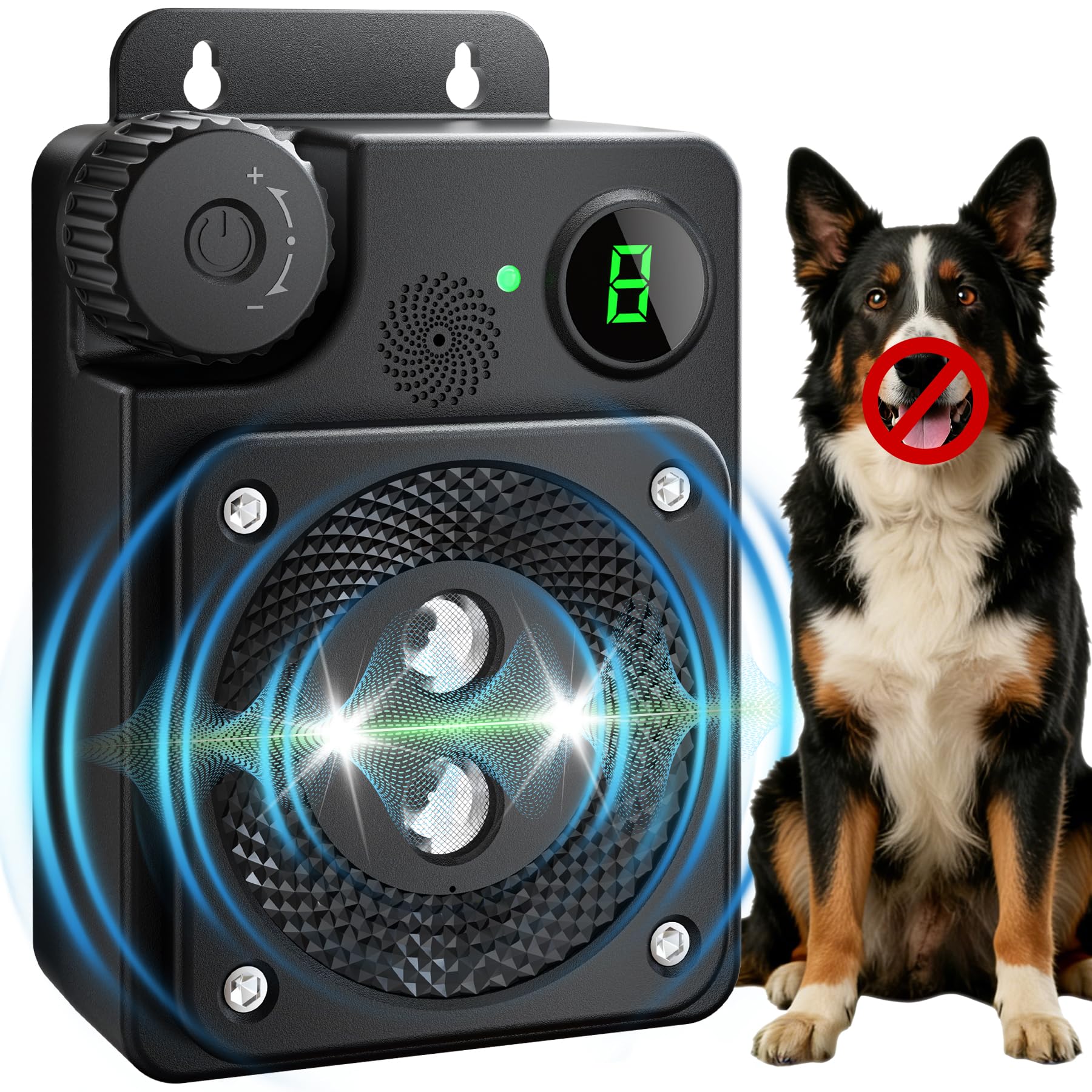
A single AAA-powered box with three modes and no pairing or charging routine.
A AAA battery comes in the box, so this unit works the moment you point it and switch it on — no pairing, no charging routine. That is the pitch of a one-box design, and it is why this is the least fussy pick in the group. It weighs 11.7 ounces, making it the heaviest unit in this roundup, and its package runs about 6.97 x 4.65 x 2.05 inches, bulkier than the 6.93 x 3.94 x 1.54-inch Holercoco above. On power the two take different roads: this one runs on a user-replaceable AAA while the Holercoco relies on a 2200mAh rechargeable cell rated for up to 60 days.
Where it fits is the neighbour problem. Owners mention that the unit “Effectively stopped neighbor’s dog from barking at fence day and night,” with a follow-up that setting 5 is the balance and setting 8 is too sensitive because it triggers on passing traffic or wind. Reviewers also consistently describe the operation itself as straightforward, which is the whole point of a three-mode box.
Two limitations deserve a straight answer. The housing carries no stated water rating, unlike the IP65 Queenmew or the IPX6 Holercoco, so keep it on a covered porch, in a garage, or on an indoor sill rather than an open fence post. And the battery is the recurring weak point in feedback, with reports of a unit that would not hold a charge beyond a few days. Treat it as a simple indoor or sheltered box, and keep the receipt ready if you draw a short-lived one.
Worth it for: a renter or first-timer who wants to point a single box at one noisy spot and see whether ultrasonic tone even registers with the dog.
Think twice if: the unit will live outdoors in the rain, or your dog has already shrugged off ultrasonic deterrents before.
Know the Specs
Sensitivity Levels and Trigger Accuracy
A sensitivity level sets how loud or how distinctive a sound has to be before a device treats it as a bark and responds. Turn it up and a quiet whine or a distant dog down the street can trip the unit. Turn it down and only a close, deliberate bark sets it off. That is why a unit with more steps lets you aim the trigger more precisely, and why starting low and walking the setting up is almost always the right first move. A device that fires at traffic noise will correct a dog for doing nothing, which is exactly the confusion you want to avoid.
Waterproof Ratings and Where You Mount It
An IP code is two digits describing how well a housing keeps out solids and liquids. The first digit covers dust, the second covers water, and the numbers rise with protection. IPX6 means the housing handles strong water spray, which suits a patio or a covered run. IP65 means it shrugs off dust and rain, fine for a fence or a wall. IPX7 means the receiver survives being submerged, which is what you want on a collar worn through muddy walks and hose-downs. Match the rating to the weather the unit will actually sit in, not the weather you hope for.
Common Questions
Is a remote training collar better than an ultrasonic bark box?
Will an ultrasonic bark control device work on my dog?
What static level should I start at on a training collar?
How long does the battery actually last on these devices?
Can one remote control two dogs wearing different collars?
Will the collar fit a small dog like a Chihuahua or a large breed like a German Shepherd?
Does the 50FT range claim hold up through fences and hedges?
Can I use an indoor ultrasonic device near a dog crate or kennel?
How is a vibration correction different from a static one?
Do these devices need a phone app or Wi-Fi to work?
The Bottom Line
For most people, the bark control device that earns the top spot is the 2-in-1 Dog Bark Collar with Remote & Training Collar, because it puts the timing in your hands, reaches 3300FT, survives a wet yard at IPX7, and gives you a No-Shock mode alongside a static channel you can dial down to level 1. If your dog barks when nobody is home, the Holercoco Automatic Ultrasonic Dog Bark Deterrent is the one to mount, thanks to its 6 sensitivity levels and a 2200mAh battery rated for up to 60 days. And for a fixed outdoor zone you want guarded without a collar, the Queenmew unit with four transmitters covers a fence or kennel better than anything else in this group. Whichever way you go, the same rule applies: start at the lowest setting, watch the dog, and only turn things up if the barking outlasts the first attempt.
How we choose
We do not accept paid placement. Every pick is matched to a real buyer and a real use-case; we do not hands-on test units.
Sources
Specifications: manufacturer listings and product documentation. Review insights: verified customer reviews, as of October 2026. Pricing: not shown on this page (it changes often); check the current price via the retailer link.
As an Amazon Associate, Aappliancez earns from qualifying purchases. This does not affect which products we feature.