Disclosure: Some links in this post are affiliate links. As an Amazon Associate I earn from qualifying purchases, at no extra cost to you. Learn more
Specs are compiled from manufacturer listings and verified buyer reviews and can change over time — please confirm the key details on the product page before buying.
If your bareback pad slides back a few inches every time you trot, you already know the real problem: most pads grip the horse but let you skate on top. The picks below fix that from both sides. A good bareback pad has to do two jobs at once — stay locked to a sweaty back and give your seat bones enough cushion to survive a long trail — and the nine pads here are the ones that actually manage it, ranked by how well they hold, how thick they pad, and how honestly they fit real horses from ponies to drafts.
This guide is built by comparing the manufacturers’ published specifications and the patterns across verified customer reviews, so you get each pick’s real strengths and trade-offs instead of marketing spin.
You will see which pads use a grippy suede top versus a rubberized underside, what 1-inch foam really feels like under a canter, and where a girth runs out of holes on a stocky build. Here is the honest shortlist of the best bareback saddle pad options for riders who want close contact without the slipping.
Top Picks


How To Choose The Best Bareback Saddle Pad
A bareback pad is not a saddle, and the moment you expect it to hold you upright like one, you will be disappointed. It puts a grippy, cushioned layer between your seat and your horse’s spine, so you get close contact without bruising. Two things decide whether a pad works for you: how it grips, and how it fits your horse’s girth line.
Grip comes from two surfaces, not one
The top face is what keeps your seat from skating — suede, microsuede, or a synthetic suede all give that fuzzy hold. The bottom face is what keeps the whole pad from creeping backward across the horse’s back, usually a rubberized or open-weave non-slip layer. A pad with grip on only one face will still slide somewhere. Look for both, and check whether the girth itself is elasticized or tacky-textured, because a slippery girth undoes a grippy pad.
Padding thickness changes the feel, not just the comfort
Thin fleece keeps you close to the horse and lets you feel every stride — great for schooling your balance. A dense foam center, like the 1-inch foam on some pads, mutes the bounce and saves your seat bones on long trails. Neither is better — thin fleece suits riders schooling their balance, dense foam suits riders logging long trail hours. New riders and anyone with hip or back sensitivity usually want more foam, while experienced bareback riders often prefer the thinnest layer that still stops bruising.
Measure the girth before you fall in love with the pad
Most fit complaints trace back to the girth, not the pad. A pony or a narrow-built horse can leave you on the tightest holes with slack still showing, while a broad draft cross may need extra holes punched. Check the girth’s buckle-to-buckle length and how many holes it offers on each side. A removable girth is a real advantage, because you can swap in a leather or neoprene cinch that suits your horse without buying a whole new pad.
Side-by-Side Comparison
| Model | Best For | Top Surface | Padding | Girth Included | Amazon |
|---|---|---|---|---|---|
| Best Friend Western Style Bareback Saddle Pad★ Best Overall | All-round trail and schooling | Synthetic suede | High-density foam | Matching non-slip girth | Amazon |
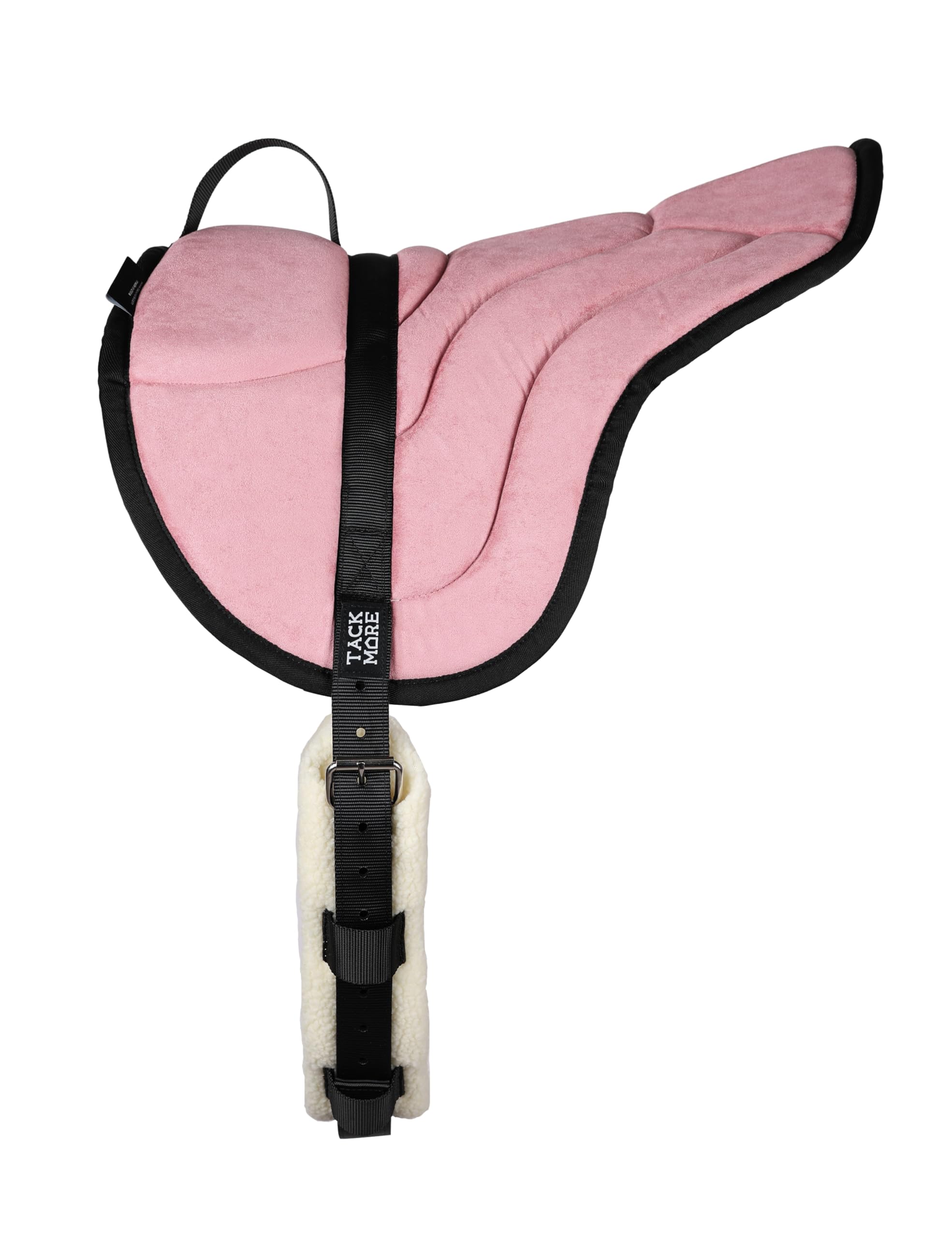
| Tackmore Bareback Pad for HorsesBest for Smaller Frames | Smaller and chunkier builds | Anti-slip suede | 2 cm base plus 1.5 cm reinforced zones | Adjustable multi-hole girth | Amazon |
| Harrison Howard Horse Riding PadBest for Learning | Learners and hot-weather rides | Non-slip microsuede | Plush Berber fleece underside | Removable fleece-covered girth | Amazon |
| Harrison Howard Western Bareback Saddle Pad | Long days with gear to carry | Synthetic microsuede | Thickened shock-absorbing plus fleece | Removable fleece-covered girth | Amazon |
| Kensington Fleece Bareback Pad | Riders who want deep cushion | Heavy-duty fleece | 1″ thick foam center | Double billet straps | Amazon |
| Mustang Microsuede Bareback Pad | Quick bareback schooling | Microsuede | Felt center with fleece bottom | Fleece-lined adjustable girth | Amazon |
| Hilason Suede Leather Bareback Pad | Riders wanting leather and breast collar | Genuine suede leather | High-density shock-absorbing foam plus fur | Adjustable girth with breast collar | Amazon |
| Intrepid International Comfort Plus | Trail and leisurely western riding | Breathable suede | Contoured foam with wither relief | Elasticized girth, 22″ buckle to buckle | Amazon |
| CHRIST Werner IBERICA Plus | Hard-to-fit and sensitive backs | Sheepskin over foam panels | Two foam panels with dual sheepskin layers | Girth sold separately | Amazon |
Detailed Reviews
1. Best Friend Western Style Bareback Saddle Pad
Our pick — 4.5+★ from 550+ verified ratings; the strongest balance of quality and price.
The pad that stays put on a wide horse without you cranking the girth
This is the one to buy if you want a single pad that does the whole job. The synthetic suede top gives your seat something to hold, and the non-slip breathable bottom and girth keep the pad locked to the horse. Between them sits high-density foam, contoured so it follows the back rather than bunching at the wither. It weighs 3.3 pounds and measures 24 x 16.6 x 4.2 inches, which is pad-sized rather than saddle-sized — enough surface to sit on, not enough to feel like you are riding in a chair.
The non-slip bottom and girth hold this pad on a wide, round back where other pads creep, and riders have tested it with the girth off. As owners put it: “generous straps fit 15.3hh horse with room to spare.” The same pad draws praise for a firm, dense, non-shifting fill and for pockets that actually hold a phone and a water bottle on the trail. Its 4.5+ star standing across 500+ ratings depends on one thing: it stays put.
You get a workhorse, not a luxury item. The straps have room to expand, so a standard or wide quarter horse fits comfortably and a mutton-withered build can work too — but a pony-sized horse sits outside its balance, and the included water bottle is the weak link in the kit. Two D-rings up front let you clip a breastplate if you want one. Care is a wipe-down, and the tan color holds true to the photos over time.
Where It Wins
- Non-slip bottom and girth hold the pad in place on wide, round backs
- Dense high-density foam does not shift or flatten under a canter
- Side pockets and a water bottle holder for trail gear
- Two D-rings for a breastplate; front strap helps you mount
Where It Gives
- Not sized for ponies — the smallest builds fall outside its range
- The bundled water bottle is the one part that does not last
- Grip is for staying put, not for balancing you like a saddle
Buy this if: you want one non-slip pad for trail and everyday schooling on a standard-to-wide horse.
Think twice if: your horse is pony-sized or you expect the pad to hold you upright in the saddle’s place.
2. Tackmore Bareback Pad
A plush sherpa underside that hugs a compact back instead of bridging it
Where the Best Friend pad scales up to wide horses, this one is built for the compact end — and it does it with layer on layer of cushion. The base is 2 cm of cushioned support for shock absorption, and the ergonomically reinforced zones add another 1.5 cm of padding on top of that. A soft anti-slip suede surface keeps you from skating, while a sherpa fleece lining follows the natural curve of the back so the pad sits down into it rather than perching.
What people keep coming back to is how quick and plush the whole thing feels. Riders report it being “perfect size for my smaller 14.2 hand horse,” and the same pad has earned its keep on a chunky pony and a Fjord — horses that usually fight a poor fit. The multi-hole girth and quality metal hardware let you dial in the adjustment, and the slim handle up top is one of the few that riders say is thin enough to clip an air vest to. Comfort is the whole pitch here, and it lands: riders describe the transition from a big leather saddle as “so much better riding with this one.”
The catch a new rider should know about is the girth tension. It wants to be snug, and on some horses it still walks back a little no matter how hard you pull. There is also the bare-leg detail — if you ride in shorts, the band rising from the cinch can rub after an hour. Neither is a flaw in the build; both are quirks you learn to work around with a thin saddle pad underneath or a swap to a longer cinch.
The real draw: a cushioned, curve-following pad that fits small and round builds where bigger pads bridge and slide.
The honest hitch: getting the girth fully snug can take some fiddling, and the cinch band can rub bare skin on long rides.
Made for: the rider on a 14-to-15-hand horse, cob, or Fjord who wants cushion and close contact.
Look elsewhere if: you need a pad for a full-size draft or you want to ride in shorts for hours on end.
3. Harrison Howard Horse Riding Pad
A grippy teaching pad that keeps nervous learners centered in the heat
This pad answers a specific question most reviews never address: what should a beginner ride in during summer? The answer is a breathable microsuede top over a plush Berber fleece underside — the suede gives a roughout-like hold that keeps a wobbly rider over the middle of the horse, while the fleece cushions the back and cuts pressure on the spine. It ships with a removable fleece-covered girth that adjusts on both sides, plus a grab handle if you want a handhold while mounting.
The sizing is where it surprises people, in a good way. It seats a 14.5-to-15-inch rider nicely and still gives a 16-to-17-inch western seat room to spare. The double off-billets leave plenty of holes on a mustang around the 1200 lb mark, so it suits everything from a small mare up through a draft cross. Fit comes up again and again as the strong point, and the cushioning draws quiet praise for being genuinely padded rather than token fleece. On a 40-inch Shetland pony it still stayed put, which is no small thing for a pad that also handles bigger stock.
Two things to weigh honestly. The grip is mixed — most riders get a perfect amount of hold, but some find it on the light side, so it is a stability aid rather than a lock. And the buckle straps are thin; a rider who swapped the cinch noted they look like they could wear through. Treat the straps with care and swap the girth to a leather one if you want it to outlast the seasons.
Why Riders Pick It
- Microsuede top gives a roughout-like grip that keeps a learner centered
- Fits a 14.5-to-15-inch seat and still leaves room for a 16-to-17-inch western seat
- Berber fleece underside cushions the spine on long rides
- Removable matching girth adjusts on both sides
What To Keep In Mind
- Grip is on the lighter side for some riders
- Thin buckle straps can wear with hard use
- Not a substitute for a saddle when you need real security
The match: beginners, kids, and hot-climate riders who want grip plus a breathable, padded layer.
The caveat: if you need a firm lock under an unbalanced seat, this is a helper, not a harness.
4. Harrison Howard Western Bareback Saddle Pad
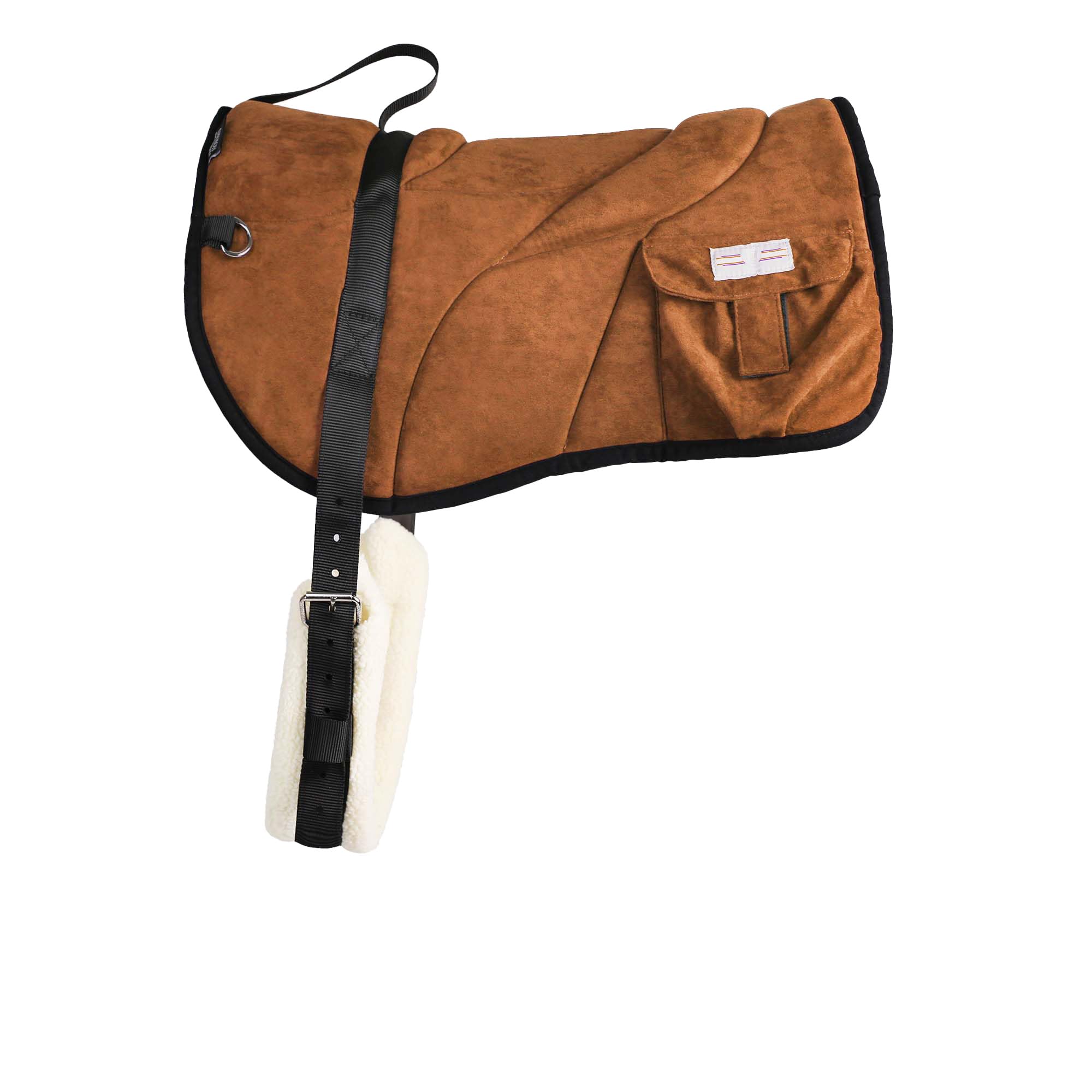
Two pockets, a holding handle, and thick padding for a ten-mile first ride
If your bareback riding means hours in the hills, gear storage matters as much as cushion. The right pocket is cut to hold a water bottle with an elastic strap to keep it there, and the left pocket is a multipurpose cargo pouch sized for keys, a phone, and treats, closing with touch-fastening tape. The same microsuede that gives the top its grip is paired with thickened shock-absorbing material and a thick fleece underside, so both rider and horse get relief. At 29 x 36 inches it drapes plenty of surface over the back.
What people notice first is how much padding sits between you and the horse. Riders describe the cushion as thick enough to feel the horse without feeling its spine, and the fit lands on high-withered horses and older backs alike. Stable enough for a ten-mile first ride layered over a wool pad, and the buckles glide smoothly for easy adjustment mid-saddle. The holding handle is a smart touch for mounting without gripping the pad itself. Pockets are the second big reason riders choose this over the plainer Harrison Howard pad above — the phone pouch keeps a device secure with its Velcro top and has room for a trail snack alongside.
The one thing to get right before you order is color. The listing names are unreliable — a pad ordered as red can arrive hot pink, and burgundy can read purple. A few also note the metal parts can rust if you hose them down often, so dry the hardware after a wash. The color surprise is not a defect in the build, but it is a real disappointment if the match matters to you.
Best-in-list storage: a dedicated water bottle holder plus a cargo pocket make this the trail-ready pick.
The color gamble: pad names and actual shades do not line up, so treat the swatch as a suggestion rather than a promise.
Reach for this if: you mount long and want pockets for a bottle, phone, and treats without a saddlebag.
Pass it over if: an exact shade match to your other tack is a must.
5. Kensington Fleece Bareback Pad — 1” Thick Foam Center

Heavy-duty fleece over a full inch of foam for riders who feel every stride
This pad takes the padding question seriously. The center is 1 inch of foam wrapped in heavy-duty fleece, so your seat bones land on a real cushion rather than a token layer. The pad runs 29 inches long and 36 inches wide with double billet straps, giving you plenty of holes to fit the billet to different horses and riders. A center mount handle sits at the balance point so you can pull yourself up safely instead of hauling on the mane.
The result, for a rider who wants comfort on long rides or light arena work, is a pad that stops the bounce without feeling like a saddle. It works on a 14.3-hand small mare with enough hole options to fit her smaller build, and also on a 15-hand gelding — a real range of sizes from one pad. The fleece is soft against the horse and the plaid trim lets it match other Kensington gear, if that matters to you. Horse and rider both settle into it; riders say their horses prefer it to a regular saddle for bareback practice.
One honest limitation: the strap quality could be better. It fits multiple sizes and the padding is thick, but the straps are the part that wears, so check the billets before you cinch up on a windy day. Otherwise, this is a straightforward, well-made pad with fewer moving parts than most — which is part of the appeal.
The Case For It
- 1 inch of foam absorbs the bounce better than a thin fleece layer
- Center mount handle helps you climb on safely and steadily
- 29-inch by 36-inch surface with double billet straps for a wide fit range
- Heavy-duty fleece is soft against the horse and easy to brush clean
What To Watch
- Strap quality is the weak point — inspect before each ride
- More foam means a little less direct feel under your seat
- Best for lite arena work and long trails, not fast technical riding
Suits: the rider who wants thick, plush cushion for long rides on a range of horse sizes.
May not suit: the rider who wants maximum bareback feel and minimal padding.
6. Mustang Microsuede Bareback Pad Navy, One Size

A sticky microsuede surface that grips your jeans as well as the horse
Slide it on, cinch the fleece-lined girth, and go. The Mustang pad is the quick-fix option — 2.95 pounds, a microsuede top, a felt center, and a fleece bottom for the horse. Its real trick is that the suede-like fabric holds your seat as well as the horse’s back, so it feels secure even without a girth on a calm horse. As one rider summed it up: the suede face “is nice a grippy for my own butt too.”
The included girth fits up to 52 inches, which is generous — but the girth is also where the honest limits start. A 14.2-hand Morgan fits, with the girth on near the tightest holes on both sides, so a smaller pony is out. On a girthy Icelandic mare, one rider could not get it snug enough even on the tightest hole and sent it back rather than risk it. But when the size is right, the pad does its job: a Tennessee Walker mare that refused to move under a traditional saddle went happily in this one, and riders report it staying put through cantering and small circles.
The one to weigh is long-distance stability. This pad has a slippery streak — some riders find it walking back about three inches over a flat ride, so it is better for shorter sessions than for all-day trails. The nylon handle is also a bit floppy to grab in a hurry. Both are manageable quirks, not deal-breakers, but they tell you who this pad is for.
What it does well: sticky microsuede top and fleece bottom give a secure quick-ride feel on a fit horse.
Where it slides: the pad can walk back on longer rides, so it earns its keep in the arena and on short trails.
Pick it for: short bareback sessions on a 14-hand-and-up horse where you want instant grip.
Skip it for: a pony-sized horse or an all-day trail where you need a pad that stays put for hours.
7. Hilason Suede Leather Bareback Pad with Breast Collar Girth

Real suede over shock foam, with a breast collar to keep it from walking
If you want the feel of genuine leather rather than a synthetic, this is the one to look at. The top is real suede, the middle is a high-density shock-absorbing foam, and the underside is thick fur that stops the pad pulling hair and trapping heat. It comes as a complete system, with an adjustable breast collar and girth straps linked by metal D-rings. That breast collar is the standout piece: it holds the pad forward on the horse, so mounting causes hardly any slide even on a swayback build.
What owners praise is the construction. Heavy stitching, made in the USA, a pad that stays put going up and down mountains on long hot rides. Riders with a lower-back injury note the combination of real suede grip and foam cushion left them comfortable and their horse cool. On a 14-hand, 800 lb horse it fits well, and even on a young 650 lb Vanner cross it can be made to work with an extra hole punched and a pony girth while the horse fills out. Heavy stitching and real suede make this a pad built to last seasons.
Two honest points. The fit is mixed — bigger horses work best, and the pad wants extra holes on the smallest builds. And the stirrups, where they are fitted, should not bear your weight; they concentrate load on a thin strap and can end up bugging the horse. Treat this as a bareback pad with mounting aids, not a light saddle. A more serious note worth flagging: one rider had the girth come loose repeatedly on a first trot and lope, which is worth double-checking on every ride.
What Feels Right
- Genuine suede top over shock-absorbing foam with a thick fur backing
- Breast collar keeps the pad forward — mounting causes minimal slide
- Heavy stitching, made in the USA, built for seasons of riding
- Stays put on long hot mountain rides and keeps the horse cool
The Fit Reality
- Runs large on small builds — may need extra holes or a pony girth
- Stirrup leathers are short; stirrups should not bear your weight
- Check the girth security carefully on every ride
Reach for it if: you want a leather pad with a breast collar that holds forward on a bigger horse.
Leave it if: you need a precise fit on a small pony or expect to ride in the stirrups.
8. Intrepid International Comfort Plus Western Bareback Saddle

A contoured trail pad that grips through canter, jumps, and creek crossings
Description here is a double layer of defense against slipping. On top is a breathable suede working against your jeans; underneath is an open-weave non-slip material gripping the horse. The contoured shape clears the withers, and the suede and fleece build absorbs shock to cut fatigue for rider and horse alike. It measures 21 3/4 inches long with a 16-inch drop, and the attached girth runs 22 inches buckle to buckle. Dee rings at the pommel and cantle let you clip gear or a breast collar, and the elasticized girth closes the gap between pad and horse.
The grip is the headline, and owners feel it immediately. This pad holds through jumping, creek crossings, and fast riding — one rider called it secure even in shorts, which is about as good as a grip gets. The whole tuck-and-roll fleece overlay adds a soft, contoured surface that helps on a trot, and the ultra-padded area below the withers is what keeps you seated through the bounce. It fits a wide range of horses from small to large, and the tacky-textured girth means the whole system resists sliding.
Real-world honesty: the pad is stiff when new and takes a few rides to soften, and the billets hang a bit awkwardly on the sides. The pad shape also doesn’t always match the photo exactly. Some find the middle less padded than the thigh areas, which can show up when posting on a high-withered horse. None of that stops it being a trail workhorse — but it does mean you should add a saddle pad underneath if your horse has a sensitive back.
The trail read: sticky suede over open-weave non-slip bottom gives the strongest confirmed hold of the list through canter and jumps.
Break-in needed: expect some stiffness at first and billets that sit awkwardly until the pad molds to the horse.
Go with this: for active trail riding and western work where grip under motion matters most.
Reconsider if: you want a soft, broken-in feel from day one or a pad that matches its product photo exactly.
9. CHRIST Werner Horse Bareback Pad IBERICA Plus

Handmade lambskin and foam panels built for backs nothing else fits
This is the premium end of bareback riding, and it earns the price by solving a problem the cheaper pads cannot: fitting horses whose withers and width sit at opposite extremes. It is built like a treeless saddle, with two foam panels and two layers of genuine lambskin, in 30 mm thick lambskin that distributes pressure and absorbs sweat so the back stays dry. The removable foam inlays and D-rings let you attach stirrup straps if you want them, and the whole thing is machine-washable once you pull the foam out.
The fit range is the reason riders choose it. One owner has a horse with a huge withers that is hard to fit and another that is as broad as a draft — both settled in comfortably with no sore spots. On a 14-hand wide cob it fits perfectly, so much so that this is the second bareback saddle the owner has bought. Riders describe genuine comfort and stability, with a pad that moves freely under a well-going mare. It suits Warmblood, Pony, and Shetty sizes, with the Shetty using a thinner 20 mm lambskin.
Two practical limits. The pad can slip under the belly when you mount by gripping it — one rider tried three different girths and still had to return it, so it works best on small horses mounted without hauling on the pad. And it does not come with a girth, so budget for one separately. Care is easy despite the sheepskin, though washing demands removing the foam and a proper lambskin detergent.
Why It Costs More
- Real 30 mm lambskin over two foam panels, built like a treeless saddle
- Fits both extreme high withers and very broad, draft-like backs
- Removable foam inlays and D-rings allow stirrup straps
- Machine-washable when you remove the foam inlays first
What To Plan For
- Girth is not included — add one to your order
- Can slip when mounting by gripping the pad on a larger horse
- Needs a lambskin-safe wash routine to stay soft
Best suited to: the rider with a hard-to-fit or sensitive-backed horse who wants genuine sheepskin comfort.
Not the one if: you want an all-in-one kit with a girth, or you mount by gripping the pad on a big horse.
Know the Specs
Top Surface Material and Grip
The top face is what keeps your seat from sliding — synthetic suede, microsuede, genuine suede, or fleece. A suede or microsuede top gives a fuzzy hold that works like roughout leather, keeping your jeans planted through a trot. Fleece tops, like the Kensington, feel softer but grip a little less; a heavy fleece over foam trades some grip for greater comfort. The best pads use a grippy top AND a non-slip bottom, because one alone lets the pad creep under your weight.
Bottom Surface and Non-Slip Backing
The underside is what keeps the whole pad from walking backward across the horse’s back. Rubberized, open-weave, or tacky-textured bottoms grip the hair and stop slip, and a closely-related detail is the girth — elasticized or tacky-textured girths add another line of defense. If your pad slides during a ride, the underside or the girth is where the problem lives, not the top.
Padding: Foam vs. Fleece
Padding decides how much of the horse’s stride you feel. A dense foam center, such as a 1-inch foam, soaks up the bounce and saves your seat bones; a thin fleece layer keeps you closer to the horse and lets you feel every stride. Neither is better in the abstract — they serve different riders. New riders, or anyone with sensitive hips or back, often benefit from more foam; experienced bareback riders tend to prefer as little as possible.
Girth Length and Fit Range
The girth, not the pad, is where most fit problems show up. A pad with a girth that runs out of holes on the tightest setting leaves slack on a narrow horse, so look at buckle-to-buckle length and hole count. A removable girth is a real advantage, letting you swap in a leather or neoprene cinch that suits your horse without replacing the pad. Double billet straps give you more adjustment range, and D-rings at the pommel and cantle let you add a breast collar for extra security.
Common Questions
Will a bareback pad fit both a pony and a draft cross?
Does a bareback pad replace a saddle for balance?
How do I stop my bareback pad from sliding back?
How thick should the padding be on a bareback pad?
Can I ride in shorts with a bareback pad?
Is real sheepskin worth it over synthetic fleece?
How do I clean a fleece or sheepskin bareback pad?
Do bareback pads come with a girth?
Can I attach stirrups to a bareback pad?
How long should a bareback pad last?
The Bottom Line
For most riders, the best bareback saddle pad is the Best Friend Western Style Bareback Saddle Pad because it solves both slipping problems at once — a synthetic suede top to hold your seat and a non-slip bottom and girth to hold the horse — with high-density foam that does not shift under a canter. If your horse is small or round and you want a plush sherpa underside that follows the curve, the Tackmore Bareback Pad fits a 14.2-hand horse beautifully. And for long trail days where you need pockets, a bottle holder, and a handle, the Harrison Howard Western Bareback Saddle Pad is the one to reach for.
The Best Friend pick backs that up with a 4.5+ star standing across 500+ ratings from riders who keep coming back to the same pad on the same horse. Whichever you choose, buy it for your horse’s build and your riding style: a grip-first pad for the arena, a cushion-first pad for the trail, and a sheepskin pad only if your horse’s back has been hard to fit.
How we choose
We do not accept paid placement. Every pick is matched to a real buyer and a real use-case; we do not hands-on test units.
Sources
Specifications: manufacturer listings and product documentation. Review insights: verified customer reviews, as of October 2026. Pricing: not shown on this page (it changes often); check the current price via the retailer link.
As an Amazon Associate, Aappliancez earns from qualifying purchases. This does not affect which products we feature.