Disclosure: Some links in this post are affiliate links. As an Amazon Associate I earn from qualifying purchases, at no extra cost to you. Learn more
Specs are compiled from manufacturer listings and verified buyer reviews and can change over time — please confirm the key details on the product page before buying.
If your bandsaw keeps wandering off the line, the blade is usually the culprit, not your technique. A sharp, correctly sized blade with low tension makes the saw feel like a different machine. This guide sorts out which blades cut clean, which ones stay sharp, and which ones fit your saw in the first place.
This guide is built by comparing the manufacturers’ published specifications and the patterns across verified customer reviews, so you get each pick’s real strengths and trade-offs instead of marketing spin.
Ordering the wrong blade length is the most common return reason for bandsaw blades. So before you buy, you need to know which measurements actually matter. Below, we match real specs with real owner experience. Our honest shortlist of the best bandsaw blades for wood tells you exactly where to start.
Top Picks

How To Choose The Best Bandsaw Blades for Wood
Start with fit. A blade that is the wrong length is useless to you no matter how well it cuts, so measure your saw’s wheel-to-wheel requirement and only then shop tooth count. The picks below range from a compact 59-1/2″ assortment to a sawmill blade over ten feet long, and each one only works on the machines it was built for.
Match the length and thickness to your saw first
Length is the deal-breaker. A 59-1/2″ blade is made for a small 9″ bench-top saw, while the long resaw and sawmill blades are for full-size machines and portable mills. Thickness matters next — a blade with a 0.38-inch item thickness is a stout piece of steel that a light-frame saw cannot tension adequately, so a manufacturer’s recommended blade thickness must be respected or the frame risks damage.
Read the tooth count for the work you actually do
Fewer teeth per inch clears wood fast and leaves a rougher edge, while more teeth per inch gives a finer finish and slower feed. A 4 TPI blade is built for resawing thick stock and slicing smooth veneer, whereas a 14 TPI blade handles detail and small curves. Hook angle and tooth geometry also shape how the blade bites, so match the tooth count to the task rather than chasing the highest number.
Do not overlook tracking and tension setup
Even the best blade cuts poorly if it is set wrong. You need the blade to run centered on the wheel, tracking straight, and tensioned to the maker’s guidance — a low-tension blade is designed to run cooler without asking your motor for more horsepower. If you skip that setup step, expect wandering cuts no matter what blade you bought.
Side-by-Side Comparison
| Model | Best For | Blade Length | Tooth Count | Item Thickness | Amazon |
|---|---|---|---|---|---|
| Timber Wolf 1/2″ X 93-1/2″, 4 Tpi★ Best Overall | Resawing thick stock on a 14″ saw | 93.5″ | 4 | 0.03 inches | Amazon |
| Olson Saw FB19282DB 82-Inch HEFBBest for Scroll Work | Moderate scrolling and small shop projects | 82″ | 4 | 0.03 inches | Amazon |
| POWERTEC 59-1/2 Inch 3PK Assortment | Small 9″ bench-top saws | 59.5″ | 18 | 0.38 inches | Amazon |
| 3423VPC Timber Wolf 3/4″ Resaw Blade | Wide-lumber resawing | 93.5″ | 9 | 0.03 inches | Amazon |
| Wood-Mizer 144″ Sawmill 5-Pack | Portable sawmill owners | 144″ | 144 | 0.04 inches | Amazon |
| BATHTOI 25 Pack 12″ Reciprocating Blades | Nail-embedded demo wood | 12″ | 12 | 0.04 inches | Amazon |
| Diamond Extreme 14″ Metal Cutting Blade | Rescue and demolition metalwork | 14″ | 24 | 0.14 inches | Amazon |
Detailed Reviews
1. Timber Wolf Bandsaw Blade 1/2″ X 93-1/2″, 4 Tpi
Our pick — 4.5+★ from 550+ verified ratings; the strongest balance of quality and price.
The blade that turns a wandering 14″ saw into a straight-cutting machine.
This is the pick for anyone with a 14″ bandsaw who is tired of fighting drift. It runs at 93.5″ long, 1/2″ wide and 0.03 inches thick, and those modest dimensions let it wrap small wheels without cracking. The selling point is low tension: a low-tension blade needs less horsepower from your motor to cut the same stock, which is exactly what a hobby saw needs.
Cut quality is what owners talk about more than anything else. The 4-tooth pitch (4 teeth per inch, a coarse spacing built for clearing chips fast) slices through thick hardwood, and buyers report resawing 1/8″ slices from 3″ hard maple — perfectly straight and very smooth. On a seasoned ash test, one owner says the blade “cut seasoned ash ‘like butter'” on a Ridgid 14″. The 5.6-ounce blade runs cooler too, because the steel is alloy and high silicon, so the cut edge stays cleaner.
What is not perfect? The weld. That is the one weak spot owners bring up, and a few find the weld finish less tidy than they would like. Expect to spend some time on setup, too — moving the guides and guards, then tuning tracking and tension can eat half an hour. But the trade-offs are small against how much straighter the saw cuts, and the low-tension design means your motor strains less. For a 14″ saw owner who resaws, it is the most sensible first blade upgrade.
Why Owners Keep Buying It
- Low tension lets a small motor cut thick stock without bogging
- Thin 0.03-inch kerf wastes less wood and flexes around tight wheels
- Runs cooler and holds its edge, so cuts stay straight longer
- Clear instructions are a genuine help for first-time replacement
Where It Falls Short
- Weld quality is the recurring gripe — some blades arrive less tidy than others
- Setup takes real time; budget about 30 minutes for tracking and tension
- Sharp and springy out of the coil — wear gloves when you open it
Best for: 14″ bandsaw owners doing resaw work on thick hardwood.
Think twice if: your saw is a compact 9″ bench-top model — this blade will not fit, and the POWERTEC 59-1/2″ is the correct length.
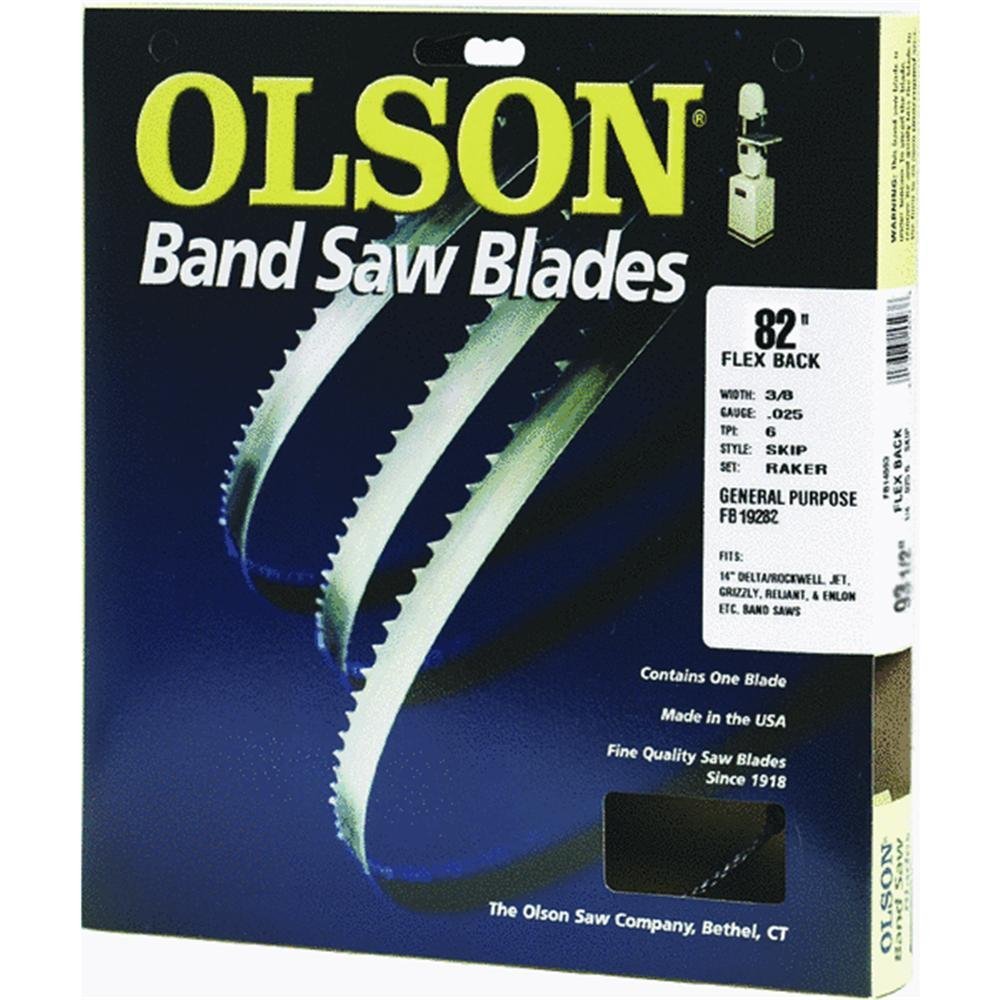
2. Olson Saw FB19282DB 3/8 by 0.025 by 82-Inch HEFB Band 4 TPI Skip Saw Blade
A narrow 3/8″ skip-tooth blade for tight curves and small wooden projects.
The Olson is the one for a woodworker chasing curves rather than wide boards. It measures 82″ long, 3/8″ wide and 0.03 inches thick, and the narrow kerf lets the saw steer through scrolling work with less binding. That slim profile also makes it a bad choice for anyone wanting to resaw, since the wider Timber Wolf pick at 93.5″ is the blade for slicing thick stock.
What cuts well here is the skip-tooth geometry. At 4 teeth per inch, the skip pattern has extra space between the teeth, so chips clear fast and the cut runs smooth on soft and hard woods. Buyers use it for wooden spoons and toy projects with good results, and the edge holds up better than its mild steel look suggests — one owner who cut ipe reports it still cuts fine months later.. It fits standard 82″ saws closely as the manufacturer promises.
The obvious trade-off is the weld. On some blades the weld line is visible and a little rough, clicking as it passes the guide blocks, so a light touch-up with an abrasive is worth doing before the first cut. Beyond that, this is a reliable everyday blade for small-shop scrolling and light re-sawing of trim stock. It fits most 82″ saws, and the pricing is arguably one of the better value calls for a narrow blade.
The case for it: 82″ length, 3/8″ width and skip-tooth 4 TPI add up to a blade that turns corners without fighting, which is what small crafting work needs most.
The catch: some welds come through rough and click against the guides — an abrasive touch-up sorts it, but you should not have to.
Reach for this if: your saw needs an 82″ blade and your projects are curves, spoons, and small toy parts.
Look elsewhere if: you plan to resaw boards — an 82″ blade is simply not the length for a 14″ floor saw.
3. POWERTEC 59-1/2 Inch Bandsaw Blades Assortment 3PK (13604)

Three blades in three tooth counts for anyone with a compact 9″ saw.
If you own a small 9″ bench-top saw, this set gives you three blades to start with: a 59.5-inch by 1/8-inch by 14 TPI blade (14 teeth per inch, for fine detail), a 59.5-inch by 3/8-inch by 6 TPI scroll blade (6 teeth per inch, for curved cuts), and a 59.5-inch by 1/4-inch by 6 TPI wood blade. With both 6 and 14 TPI, you can swap blades depending on the wood you feed through—fine detail or coarser cuts.
The steel is carbon with a heat-resistance treatment and a welded joint, and owners mention blades that track straight. Owners see clean cuts in soft and hard woods, and the steel gauge works well on saws built for it. One Delta BS100 owner calls it the longest-lasting blade they have run on that saw. Cutting performance and sharpness are the two things people rave about, and the set price makes it a budget-friendly entry point for a new owner.
Be honest about your saw before buying, though. On a light-frame 9″ saw, this blade’s 0.38-inch item thickness can be too stiff to tension properly, and a frame that cannot handle the force risks damage. It is a fine blade for saws built for it, so check your model’s blade thickness recommendation first. On top of that, the edge life is not endless — a couple of weeks of moderate use will shorten the blade’s bite. A little care and correct tension go a long way.
What you get for the money: a three-blade set at 59.5 inches with a 14 TPI fine blade and two 6 TPI blades, which gives a new owner every tooth count they need for small-saw work.
The honest caveat: that 0.38-inch thickness is heavy for a flimsy frame — verify your 9″ saw can tension it or a lighter gauge is the smarter buy.
Pick this if: you run a 9″ Delta, Craftsman, Ryobi, Skil or B&D saw and want a blade wardrobe without spending much.
Pass on it if: your saw frame feels flexy — a lighter gauge is easier on the machine.
4. 3423VPC 93.5″ by 3/4″ Timber Wolf Bandsaw Blade

A 3/4″ wide resaw specialist that chews through maple and walnut without wandering.
This is the big brother of the top pick: still 93.5″ long, but 3/4″ wide instead of 1/2″. That extra width stiffens the blade through the cut, which matters when you split wide lumber. And with 9 teeth it is built for resaw work, not tight cornering — think of it as the blade you leave on the saw for slicing boards rather than cutting curves.
The teeth are milled, and that method leaves them sharper than stamped teeth. The maker also induction-hardens the whole blade, which keeps the tooth edge harder for longer, and the steel is more ductile than standard high carbon, so it flexes rather than cracks. Customers note resawing 6″ x 3′ boards without trouble and holding up to daily use. At 6.4 ounces, it stays light on the wheels compared to a heavier stock blade.
The recurring gripe is consistency. A few reviewers point out the blade losing its dead-straight tracking over time, with a bit of front-to-back movement and stray teeth scuffing the cut. That is not universal — many report dead-straight tracking with clean finishes. But plan to tune the guides carefully, and check the blade’s tracking before you start a run of veneer. For wide resawing on a 14″ saw, though, nothing in this list cuts deeper or with less wander.
What wins people over: milled, hardened teeth at 3/4″ width cut wide hardwoods cleanly, and the low-tension design keeps the load off a modest motor.
The fair warning: tracking consistency can slip over time, so inspect the guides and re-check tracking before a critical cut.
Best suited to: woodworkers who resaw wide boards on a 14″ saw and want the stiffest blade in the class.
Not for: scroll work or tight curves — the 3/4″ width is the wrong tool for corners.
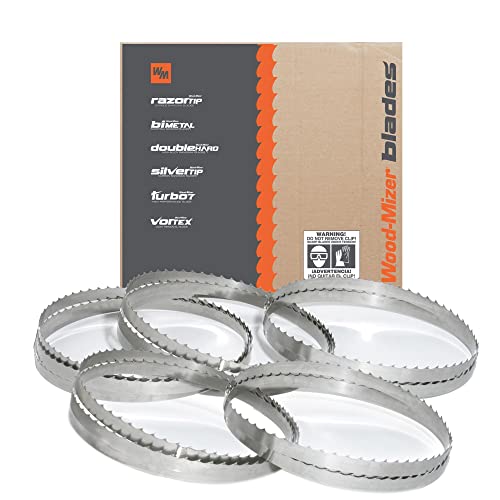
5. Wood-Mizer 144″ Sawmill Bandsaw Blades 5-Pack DoubleHard 10°
Five 144″ blades for portable sawmill owners who burn through steel.
These are for portable sawmills only, not bench-top woodworking saws. Each blade runs 144″ long and 1-1/4″ wide with 0.042-inch thick DoubleHard steel and a 10° hook angle, so it eats through mixed species including white oak and hickory. The 5-pack format means you always have a sharp spare when the current one dulls.
The steel is the story. DoubleHard high-alloy steel sharpens and holds an edge longer than standard carbon steel, and the 10° hook angle is a general-purpose grind for mixed wood. Owners on Woodland Mills and Harbor Freight mills report these blades stay sharp much longer than the stock blade and use thicker, better steel — and cost less than some of the cheap sawmill blades. Sharpness and value are what buy people over most.
There is a genuine durability question at the weld. A few shoppers say that a handful of blades broke at the weld after minimal use, while most run fine for a long time. Treat a broken weld as an occasional bad unit rather than the pattern, and tension each blade accurately to protect the weld. If your mill runs big hardwood logs all day, keeping a spare in the 5-pack makes sense.
What Earns Its Place
- 144″ length and 1-1/4″ width fit select Wood-Mizer, Harbor Freight, Norwood, Timbery and Woodland Mills mills
- DoubleHard alloy steel stays sharp longer than standard carbon
- 10° hook angle handles mixed species without switching blades
- 5-pack means fewer mid-job interruptions when a blade dulls
The Honest Drawback
- Some units fail at the weld with light use — inspect each blade and check tension
- A 144″ blade is sawmill-specific and useless on a 14″ woodworking saw
- Sharpening requires a CBN grinding wheel, which is an extra tool
This is the right buy if: you run a portable sawmill and want a sharp blade always within reach.
Look past it if: you cut boards on a stand-mounted 14″ saw — these will not fit.
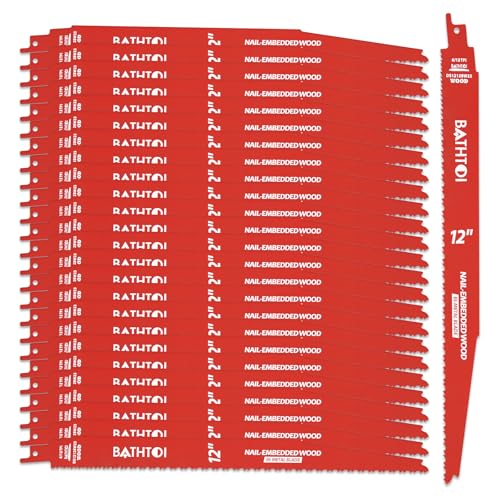
6. BATHTOI 25 Pack 12 Inch 6/12 Tpi Reciprocating Saw Blades
Twenty-five demo blades for anyone who hacks through nail-embedded wood all day.
A quick note on scope: this is a 25-pack of 12″ reciprocating saw blades (Sawzall style), not a bandsaw blade. They suit outdoor pruning, demo work, nailed wood and PVC, and they fit all brands of reciprocating saw. Each blade is 0.04 inches thick in Bi-Metal Steel with 8% Cobalt, which the maker says resists dulling longer than ordinary metal. With 12 teeth at a 6/12 TPI dual pattern, they clear both rough demolition wood and metal.
Contractors appreciate the value in a bulk pack. One general contractor says they “work as good as any name brand” and call them great value. A shop owner with 30 years in the trade says one blade outlasted two cheaper glued blades, cutting nail-embedded wood like butter and staying reusable. The coated surface helps, too — a non-stick finish on the blade cuts friction and helps it last.
The honest caveat is quality spread. Feedback splits about evenly: some buyers find the blades excellent and worth the money, while others find the steel softer than expected. That said, for a high-volume renovation job where you change blades often, a bulk box is a budget-friendly way to keep the saw running.
Where it shines: a 25-pack of 12″ Bi-Metal blades with 8% Cobalt at 0.04 inches thick is a lot of cutting capacity for demolition work, and each one can survive nail hits that would ruin a wood-only blade.
Where it stumbles: blade-to-blade consistency is not perfect, so if you demand uniform quality across every blade in the box, buy a trusted brand instead.
Worth it for: contractors and renovators who want a big box of demo blades that fit any reciprocating saw.
Skip it for: fine cabinet work — 6/12 TPI is a coarse demo tooth, not a finish tooth.
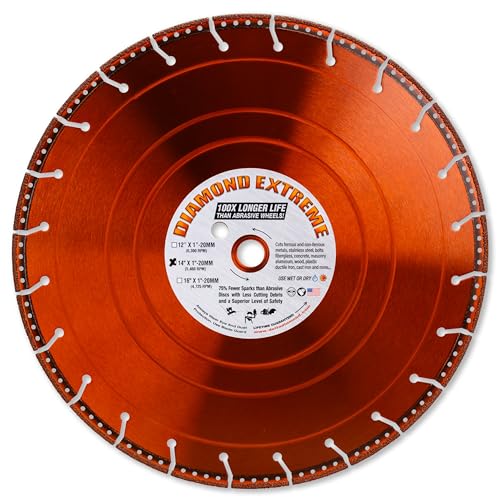
7. Diamond Extreme 14 Inch Metal Cutting Diamond Blade
A diamond-edged 14″ cutter built for rebar, steel pipe, and rescue work.
This is a very different tool from the wood blades above. It is a 14″ metal-cutting diamond blade with a 1″-20mm arbor, made for a cut-off or rescue saw, not a bandsaw. The vacuum-brazed diamond coating is designed to cut rebar, structural steel, stainless, pipe and angle iron — the kind of work where a traditional abrasive wheel would wear down fast.
The core advantage is that the steel core keeps its diameter as it wears. Abrasive wheels shrink and lose cutting depth, while this one holds its size all the way through, and the maker claims one blade replaces up to 100 abrasive wheels.. Buyers report 8+ hours cutting 1/2″ mild steel and grade 8 bolts, plus 7×7 tubing with 3/8″ wall. One fabricator ran the same blade for three months with more controlled cuts, and it still sliced 1/4″ steel smoothly.
The trade-off is speed and noise. Thicker than a thin cutting disc, it cuts a bit slower, and it throws heavy hot sparks that demand goggles and long sleeves. It is also not a precision instrument — one weekend fabricator found the cut quality only okay and still needed grinder cleanup. But for demolition, rescue and heavy fabrication, it outlasts abrasive wheels many times over.
Built for: demolition, fabrication and rescue crews cutting metal all day on a 14″ cut-off saw.
The limits: slower than a thin disc and throws serious sparks — plus a warranty that only covers the first 50% of diamond life.
Know the Specs
Tooth Count (TPI)
Teeth per inch, or TPI, sets how fast a blade cuts versus how smooth the edge is. A 4 TPI blade has coarse spacing that clears chips fast, so it excels at resawing thick stock and slicing veneer. A 14 TPI blade has fine spacing, which slows the feed but gives smooth edges and clean detail work. Choose the tooth count for the cut you make most often, not the highest number you can find.
Blade Length
Length must match your saw’s wheel-to-wheel requirement exactly, or the blade will not tension or track. A compact 9″ bench-top saw takes a 59.5″ blade, a 14″ floor saw takes a 93.5″ blade, and a portable sawmill takes a 144″ blade. Check the length stamped on your old blade or in the saw’s manual before ordering — this is the single most common fit mistake in the category.
Low Tension and Tooth Geometry
Low-tension blades are built to run cooler and straighter on saws with modest horsepower, so your motor does not bog down in thick hardwood. Tooth geometry (whether the teeth are milled, stamped, or skip-tooth) affects how cleanly the blade bites and how well it steers. A skip-tooth pattern clears chips better for scrolling, while milled teeth cut sharper than stamped ones from the start.
Blade Width and Thickness
Width controls stiffness: a 3/4″ blade stays rigid through wide resaw cuts, while a 3/8″ blade steers through curves. Thickness affects how much force the blade can take before it flexes or cracks, but too much thickness on a light frame can be untensionable and damage the saw. Match thickness to the saw’s recommended range, not just to the blade’s appeal.
Common Questions
How do I know which bandsaw blade length my saw needs?
What tooth count do I want for resawing thick hardwood?
Will a 0.38-inch thick blade work on my small 9″ bandsaw?
Why does my new blade wander off the cut line?
Do low-tension blades really need less motor power?
How long should a bandsaw blade stay sharp?
Can a metal-cutting diamond blade cut rebar and pipe on a bandsaw?
Do reciprocating saw blades for nail-embedded wood fit every brand of saw?
How do I stop a blade from breaking at the weld?
Should I choose a wide blade or a narrow one for my projects?
The Bottom Line
For most woodworkers, the pick is the Timber Wolf Bandsaw Blade 1/2″ X 93-1/2″, 4 Tpi. Its low-tension design and 4-tooth coarse cut slice thick hardwood cleanly on a 14″ saw, and it is the best-regarded blade in this set. If you want the widest, stiffest resaw blade for splitting wide boards, reach for the 3423VPC Timber Wolf 3/4″ Resaw Blade. And for a compact 9″ bench-top saw, the POWERTEC 59-1/2″ 3PK Assortment gives you three tooth counts in one purchase.
How we choose
We do not accept paid placement. Every pick is matched to a real buyer and a real use-case; we do not hands-on test units.
Sources
Specifications: manufacturer listings and product documentation. Review insights: verified customer reviews, as of October 2026. Pricing: not shown on this page (it changes often); check the current price via the retailer link.
As an Amazon Associate, Aappliancez earns from qualifying purchases. This does not affect which products we feature.