Disclosure: Some links in this post are affiliate links. As an Amazon Associate I earn from qualifying purchases, at no extra cost to you. Learn more
Specs are compiled from manufacturer listings and verified buyer reviews and can change over time — please confirm the key details on the product page before buying.
If standard sticky plasters leave you with a red, itchy rectangle, the fix is the adhesive itself, not the pad. The right bandage for an adhesive allergy uses silicone, mineral-based glue, or a latex-free fabric strip that lets go gently; an acrylic-glue plaster can peel off a layer of skin with it. Below are five picks ranked by how gently they release, with the exact materials, pad sizes, and pack counts spelled out so you can choose in one pass.
This guide is built by comparing the manufacturers’ published specifications and the patterns across verified customer reviews, so you get each pick’s real strengths and trade-offs instead of marketing spin.
You will see which strips use silicone adhesive, which use bamboo fiber with a mineral-based glue, and where each option gives up hold in exchange for gentleness. The strongest overall pick in this set is the Hysimedy pack, a 60-count variety box of silicone strips that comes off without pulling, and it is the one I would start with for bandages for adhesive allergy.
Top Picks

How To Choose The Best Bandages for Adhesive Allergy
The single decision that matters is what the sticky layer is made of. Read the adhesive line before the pad size, because a perfect fit on a bandage that welts your arm is still money spent on a drawer ornament.
Silicone adhesive versus acrylic glue
Silicone adhesive is the gentler family. It holds through normal movement but releases with a slow, steady lift instead of a rip — the difference between a bandage that comes off and one that takes skin with it. Standard plasters typically use an acrylic-based glue that bonds harder and pulls more on removal. If your reaction is a raised, itching patch shaped exactly like the plaster, you are reacting to that glue, and moving to a silicone strip is the usual first move.
Latex free is not the same as adhesive free
Latex is the rubber in the stretchy part of a bandage, and a latex allergy is a separate issue from an adhesive allergy. A strip can be latex free and still use a harsh glue. Check both lines on the label — “latex free” and the named adhesive — before you assume a strip is safe for you.
Match the pad to the wound, not the other way round
A small round pad suits a finger prick. A long incision or a joint crease needs a bigger, flexible pad that bends with you. Oversized strips on a knuckle bunch up and peel at the edges; undersized pads on a wide scrape leave the gauze stuck to the middle of the wound. Measure the wound, then pick the strip.
Side-by-Side Comparison
| Model | Best For | Adhesive Type | Pack Count | Pad / Strip Format | Amazon |
|---|---|---|---|---|---|
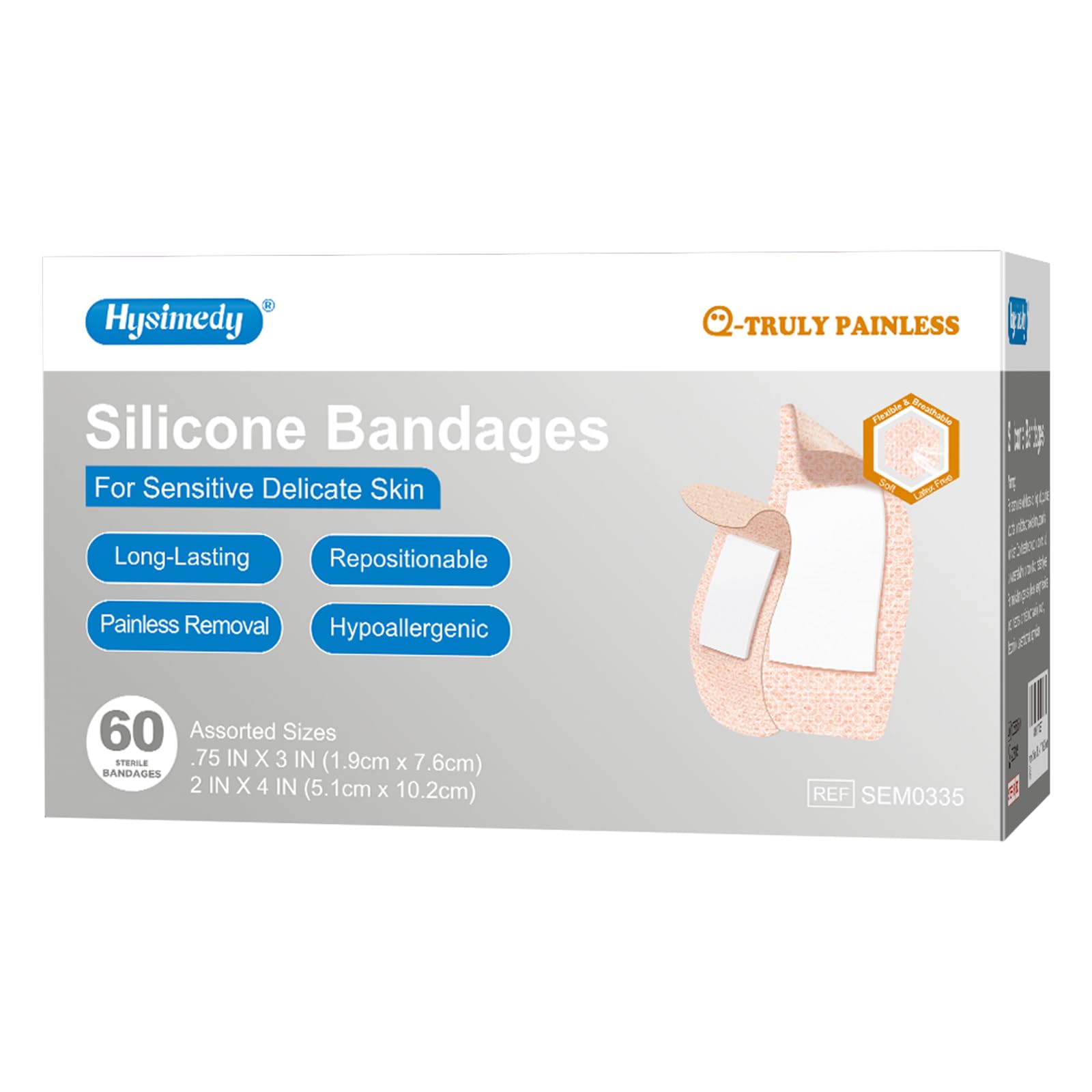
| Hysimedy Silicone Bandages Variety Pack★ Best Overall | Everyday cuts on fragile skin | Silicone, latex and rubber free | 60 counts | Small and large pad sizes | Amazon |
| CareUs Silicone Adhesive BandagesBest for Bigger Wounds | Larger wounds and post-procedure cover | Silicone, latex free | 32-count (8ct x 4) | XL strips | Amazon |
| Niceful Silicone Super Absorbent Dressing | Heavy drainage and long incisions | Silicone with adhesive borders | 10 per pack | 4″×8″ large dressing | Amazon |
| PATCH Bamboo Bandages Mixed Sizes | Plastic-free household first aid | Mineral-based pressure sensitive adhesive | 100 piece value pack | Mixed sizes | Amazon |
| PATCH Coconut Oil Panda Bandages | Kids with adhesive allergies | Mineral-based pressure sensitive adhesive | 100 piece value pack | Large strips | Amazon |
Detailed Reviews
1. Hysimedy Silicone Bandages Variety Pack
Our pick — 4.5+★ from 1,000+ verified ratings; the strongest balance of quality and price.
A 60-count silicone variety box that lets go without taking skin with it — the calm default.
Sixty bandages in a mix of small and large sizes, all built on a four-sides-sealed silicone adhesive that is latex free and rubber free. The pads are cotton, sized 0.47″x1.06″ on the small strip and 1.34″x2.05″ on the large, and the maker says they are 2x more absorbent than the standard pad. The cotton pad does not stick to a healing scrape, so changing the strip does not reopen the wound.
The silicone also makes the strip repositionable. Set it crooked, lift it, move it — the stickiness survives a second try. On an elbow crease, a flexible strip bends with the joint, stays put through movement, and still lifts away cleanly at the end of the day. Where this pack edges ahead of the CareUs strips is the size spread — you get small and large pads in one box instead of one XL format, so a fingertip and a forearm scrape are both covered from the same tin.
What wins people over is plain effectiveness on fragile skin. One buyer put it perfectly: they were 80, with really thin skin, and a regular plaster used to peel their skin off on removal — this one “come[s] right off with no skin and no pain.” The honest catch is adhesion: silicone grips more lightly than acrylic, so a strip near a crease on oily skin can work loose within the hour. Plan to swap those spots more often and the gentleness is still worth it.
Where It Earns Its Place
- Silicone adhesive with four sealed sides lifts off without pulling skin.
- Two pad sizes — 0.47″x1.06″ small and 1.34″x2.05″ large — cover fingertips and forearms.
- Repositionable, so a crooked first stretch is not wasted.
- Latex free and rubber free, with cotton pads that will not stick to the wound.
The Honest Trade-Off
- Gentler glue means less hold — oily or sweat-prone spots can lift within the hour.
- Silicone holds lightly on high-friction areas like a bending elbow crease.
Start Here If: your skin reacts to standard plasters and you want one box that handles daily household cuts on every body size.
Plan Around This: keep a second strip handy for oily, high-movement spots where the gentle hold gives way early.
2. CareUs Silicone Adhesive Bandages Large Sizes
The oversized silicone strip for wounds that need real coverage, not a thumbnail patch.
Where the Hysimedy box spreads itself across small and large pads, CareUs commits to one thing: size. You get 32 individually wrapped XL strips in four 8-count packs, each on a silicone adhesive rated for up to 24 hours of hold and built for delicate, sensitive, and elderly skin. Latex free and breathable, the fabric layer lets air move through while the silicone does the gentler work on your skin. Those individual wrappers matter more than they look — they keep the pad sterile in a first-aid kit that sits in a car through summer.
The buyer stories here centre on the same scene: a dressing that stays put and then leaves quietly. One household used them on a 99-plus-year-old mother with fragile skin and a latex allergy — the strip adhered well, then released without welting the skin. Another describes a post-surgery user with a genuine adhesive allergy wearing these daily for two weeks with no irritation, adding a little extra gauze early on when drainage was heavier. Holding firm and releasing gently is exactly what an adhesive-allergy buyer needs from a strip.
Recurring note on the hold: it is closer to a mild, older-skin-friendly tack than a heavy-duty grab, which suits the audience but can mean more frequent changes on a sweaty area. And it is a heavier pad than a slim strip, so it sits a touch bulkier under a shirtsleeve. Neither is a fault; both are simply the trade a bigger silicone dressing asks of you.
Where it beats the pack: genuine XL coverage combined with silicone gentleness — the hard combination to find.
The catch: one XL shape per box, so a knuckle scrape will look like a strip wearing a coat.
Reach For This: a scraped knee, a post-procedure incision, or an adult who needs a strip that actually spans the wound.
Pass It By: you mostly need tiny fingertip pads — the 60-count Hysimedy box fits that job better.
3. Niceful Silicone Super Absorbent Wound Dressing

A 4″×8″ silicone-bordered pad that swallows serious drainage and still peels off gently.
This is not a plaster; it is a dressing. Each pad is 4″×8″ with silicone adhesive borders running around the edge, so it sticks down flat and covers a long incision — an achilles repair, a knee replacement, an abdominal or shoulder line — without needing tape over the top. The maker rates the absorbency at 20 times, driven by an SAP polymer core (a super-absorbent material that traps fluid inside the pad). The SAP core pulls heavy drainage into the middle of the pad, so the wound edge stays dry instead of sitting in fluid.
The people who need this are dealing with real wounds, and the pattern is consistent. A below-knee amputee used the dressings on a stump wound and rated the fluid absorption highly, keeping the wound dry inside and out. The borders stay put through everyday movement and come away with a slow, deliberate lift. The soft contact layer does not fuse to the wound, so each change does not rip off a forming scab.
Here is the trade to weigh honestly. This is a large-format dressing aimed at bigger, wet wounds, which means on a small scrape it is like using a raincoat as a napkin — more pad than you need. It can also lose its grip once it is heavily saturated or when sweat builds under the border. On a long surgical incision with real drainage, though, the size and the fluid lock are exactly why you would want it in the house.
Why it stands out: 4″×8″ of coverage with silicone borders and a fluid-trapping SAP core — engineered for wounds that drain, not nicks that do not.
One honest note: size and capacity are built for large wounds, so it is overkill on tiny ones.
Built For: long incisions, pressure areas, and any wound draining enough to need a real absorbent pad under gentle borders.
Look Elsewhere: your need is a quick patch for a paper cut — this dressing is simply too big for the job.
4. PATCH 100 Piece Value Pack Mixed Sizes Bamboo Bandages

A hundred bamboo strips with a mineral-based glue — plant fiber instead of plastic, gentler on reactive skin.
The material is the draw here. These are 100% organic bamboo fiber strips held on with a mineral-based pressure sensitive adhesive (the sticky layer is built from minerals rather than a standard chemical glue). They are latex free and plastic free, and the maker says they break down in garden soil within weeks. The package itself is a chunkier 4.49 x 3.19 x 3.11 inches — noticeably more box than the CareUs sleeves, which is simply what a hundred mixed-size strips look like stacked together.
For someone whose skin flares at the faintest standard adhesive, the bamboo-and-mineral route is the one most often worth trying first when silicone is not on the shelf. There is a striking story behind that: a buyer who reacts to most bandages — including hydrocolloid and Tegaderm — with burn-like rashes and open wounds wore this brand for two years with no reaction. Quality is what the crowd praises most, and the strips hold through a normal day of hand-washing and fidgeting. If every other strip in the drawer has betrayed your skin, this is a sensible trial run.
The mineral adhesive splits opinion on stickiness. On some skin it holds well, on others it gives up early, and a minority find it leaves a goopy residue that needs washing off afterwards. The mixed size range is the other small friction — for a longer wound, you end up joining a couple of strips. Weigh that against a hundred-strip box you can hand out to the whole household and the trade reads fair.
What sells it: plant-fiber strips, a mineral-based glue, and a hundred of them in one box for a household that burns through plasters.
Worth knowing: adhesion varies by skin type, and the glue can leave a tacky residue behind.
Pick It When: you want a bulk, plastic-free option and your skin has rejected standard adhesive before.
Keep Looking If: you need one long strip — this range makes you join pieces on bigger wounds.
5. PATCH Coconut Oil Panda Bamboo Bandages, 100 Pieces
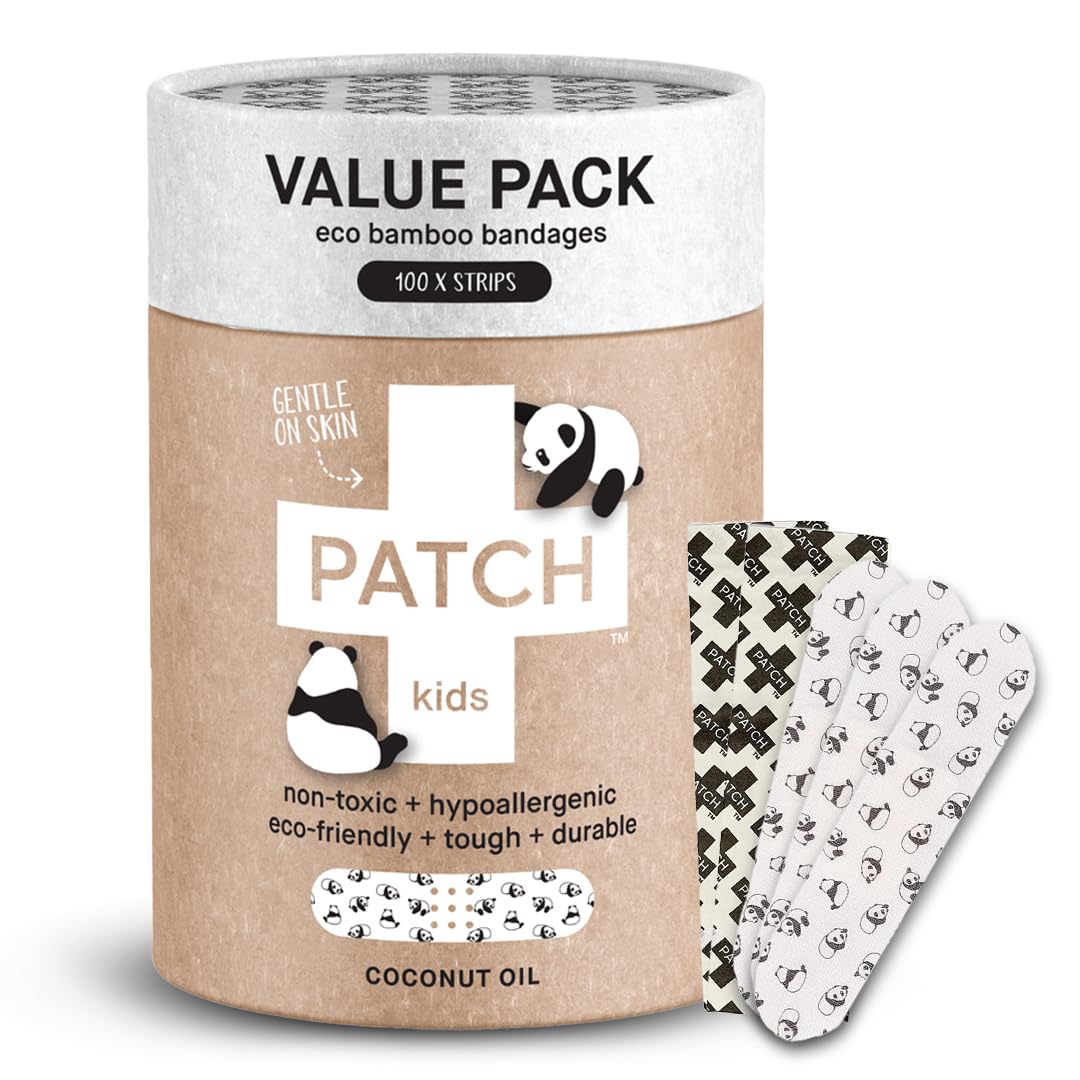
The panda-print box for kids who react to regular plasters but still want a fun one to show off.
Same bamboo idea as the mixed-size PATCH box, with one twist: these large strips are infused with coconut oil. They use 100% organic bamboo fiber and the same mineral-based pressure sensitive adhesive, latex free and plastic free, and the maker says the strips compost in garden soil within weeks. You get 100 of them, and the panda print is the part that matters if your child is the one with the plaster on. The package runs 4.69 x 3.27 x 3.19 inches — a full box of a hundred.
This is the option that tends to win over a household with an allergic child. A parent reported that a daughter with adhesive allergies wears these with no reaction, and that they last a full day of running and jumping without falling off. The eco side is a real bonus rather than the headline — chemical-free, plastic-free, and they come off without a fight at bath time. For a kid who would otherwise peel a plaster off the moment you turn your back, a panda print they want to keep on is a real benefit.
Where it gives ground is water. Hand-washing is fine, but a pool or a long soak takes these off quickly, and the adhesion has been inconsistent across batches — some find it too light, others have hit a batch where the glue grabs harder than they wanted. Coconut oil infusion is a nice touch for comfortable wear, not a cure for anything. On dry land, with a kid who plays hard, the panda box is a solid pick.
The Case For It
- 100 large bamboo strips with a mineral-based adhesive — one box lasts a season.
- Coconut-oil-infused bamboo fiber, latex free and plastic free.
- Fun panda print that kids actually leave on.
- Compostable, with a chemistry-free formulation.
Where It Slips
- Comes off fast in a pool or a long soak.
- Adhesion has run light on some batches and too strong on others.
Made For: families with a child whose skin flares at standard plasters and who need a strip that survives play.
Not for Pools: a swim session or a bath will float these right off, so keep a water-friendly backup on hand.
Know the Specs
Adhesive type
This is the single most important thing on the box for reactive skin. Silicone and mineral-based adhesives lift away gently; acrylic-based glue grabs harder and tends to pull skin on removal. If you react to a standard plaster, match a new one to the named adhesive first and the pad size second.
Latex free
Latex is the rubber used in stretchy bandage backing. A latex-free strip solves a rubber allergy — it does not automatically solve an adhesive allergy. You want both lines covered: latex free, plus a gentle named adhesive.
Pad size and absorbency
Small cotton pads (Hysimedy uses 0.47″x1.06″ on the small strip) suit minor cuts. Large absorbent pads (Niceful’s 4″×8″ dressing) handle heavy drainage and long incisions. A bigger pad than the wound means a better seal, a dry wound edge, and less agonising on removal.
Waterproof versus breathable
Waterproof dressings survive a shower but trap moisture under the film. Breathable fabric lets air through and handles sweat better. Most allergic-skin buyers get more out of breathable fabric for daily wear and save waterproof for showers or swimming.
Common Questions
What is the difference between a latex allergy and an adhesive allergy?
Are silicone bandages better for adhesive allergies?
Do bamboo bandages work as well as regular plasters?
How long can I leave a bandage on?
Can I swim or shower with these bandages on?
What does SAP core mean on a wound dressing?
Are silicone bandages safe on elderly or very thin skin?
How do I keep a strip on a bending elbow or knee?
Are adhesive bandages compostable or recyclable?
What if my skin still reacts to a silicone bandage?
The Bottom Line
For most people dealing with adhesive reactive skin, the winner is the Hysimedy Silicone Variety Pack because it combines silicone gentleness, two pad sizes, and a 60-count box in one go — and the crowd favorite sits at 4.5+ stars across 1,100+ ratings. If you need to cover a large wound or an incision, the CareUs XL strips give you real size on a silicone adhesive. And if the wound is draining hard, the Niceful 4″×8″ dressing pairs silicone borders with a fluid-trapping SAP core — the right tool for the right wound.
How we choose
We do not accept paid placement. Every pick is matched to a real buyer and a real use-case; we do not hands-on test units.
Sources
Specifications: manufacturer listings and product documentation. Review insights: verified customer reviews, as of October 2026. Pricing: not shown on this page (it changes often); check the current price via the retailer link.
As an Amazon Associate, Aappliancez earns from qualifying purchases. This does not affect which products we feature.