Disclosure: Some links in this post are affiliate links. As an Amazon Associate I earn from qualifying purchases, at no extra cost to you. Learn more
Specs are compiled from manufacturer listings and verified buyer reviews and can change over time — please confirm the key details on the product page before buying.
An open wound asks two things of a bandage: soak up what seeps out, and come off without tearing the new tissue underneath. The pads below do both, but they split into two clear jobs. If you are covering a surgical incision or a draining wound, you want a thick absorbent pad held on with tape or a binder. If you need something that stays put on its own while you move, you want a bordered island dressing with sticky edges and a non-stick center. Decide between those two types first; size and pack count follow from there.
This guide is built by comparing the manufacturers’ published specifications and the patterns across verified customer reviews, so you get each pick’s real strengths and trade-offs instead of marketing spin.
Drainage level and skin sensitivity decide most of this, so the list runs from heavy-drainage pads to stick-on bordered dressings. Below you will find the best bandage for open wound care sorted by what each one actually does well.
Top Picks

How To Choose The Best Bandage For Open Wound Care
A dressing for an open wound has one job above all: manage fluid. A pad that saturates in an hour means constant changes and soaked clothes. A pad that holds for half a day lets you sleep. Sort every option by how much drainage it can take, then by how it stays attached.
Absorbency comes from the core, not the wrapper
The absorbent part of a pad is a cellulose core — plant-fiber pulp that wicks fluid in and spreads it sideways instead of letting it pool in one spot. A hydrophobic back layer (one that actively pushes water away) stops that fluid from striking through to your shirt or sheet. Sealed edges keep lint from shedding into the wound. Those three layers decide how long a pad holds fluid, regardless of brand.
Pads versus bordered island dressings
A plain abdominal pad has no adhesive. You hold it on with medical tape, a binder, or dressing retention tape. That makes it ideal for large incisions and heavy drainage, because you can layer it and swap it fast. A bordered island dressing has sticky edges and a non-stick center pad, so it goes on by itself and peels off cleanly. It suits smaller wounds, joints that bend, and spots you need to cover without help.
Sterility and individual wrapping
An open wound is a direct path into the body, so a pad labeled sterile and wrapped on its own is the safer default. Individually wrapped pads also stay clean in a first-aid kit for months. A bulk box works fine at home as long as each pad inside is still sealed.
Size against the wound, not the box
The pad should overhang the wound by a comfortable margin on every side so drainage has somewhere to spread before it reaches the edge. Too small and fluid wicks onto skin and clothing. Oversized pads are awkward on a bending knee but fine on a flat back or abdomen.
Side-by-Side Comparison
| Model | Best For | Pad Size | Adhesive | Pack Count | Amazon |
|---|---|---|---|---|---|
| Medline NON21450H Sterile Abdominal Pads★ Best Overall | Heavy drainage and post-op incisions | 5″ x 9″ | None — needs tape or binder | 25 | Amazon |
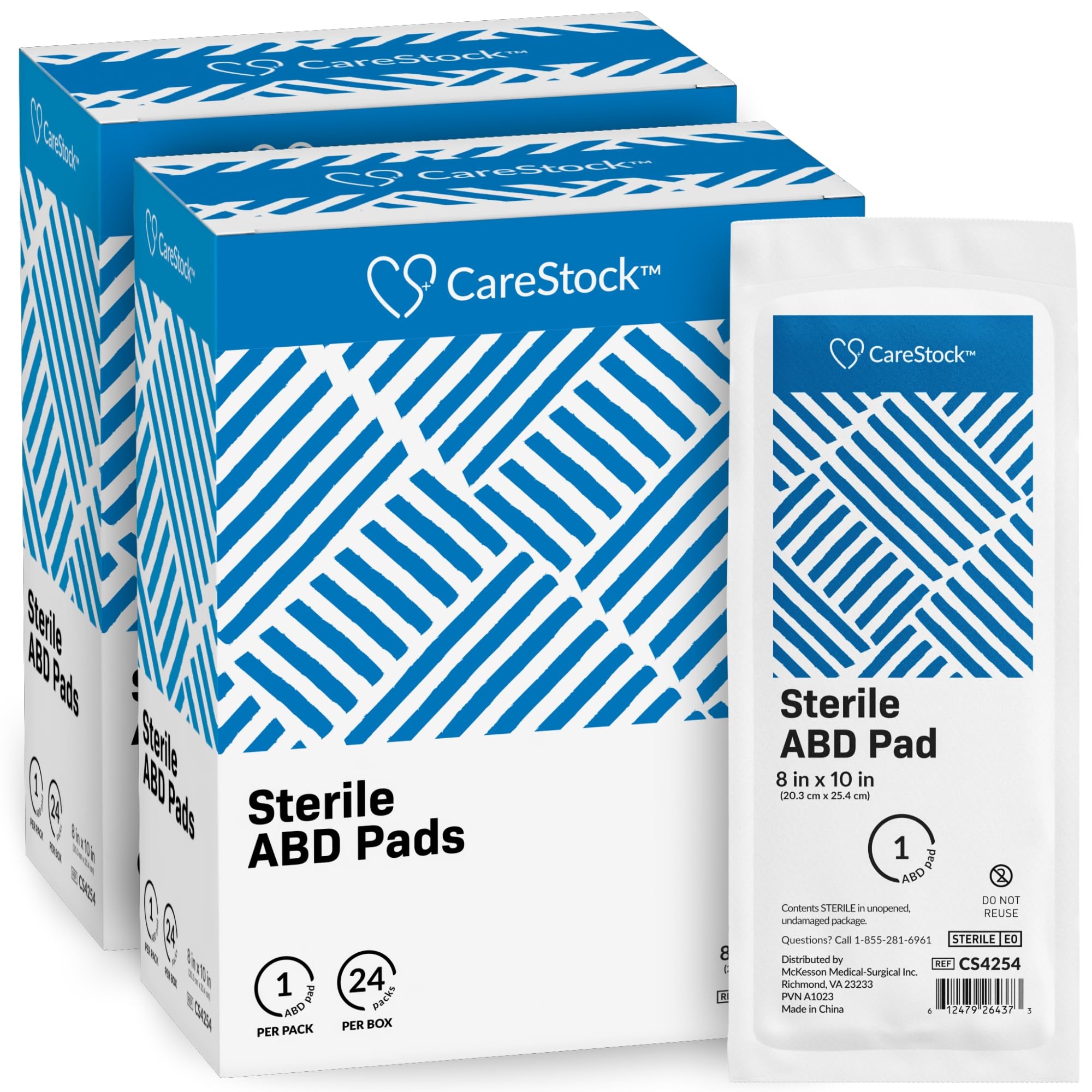
| CareStock Abdominal Pads 8 x 10 inMost in a Box | Bulk supply for large wounds | 8″ x 10″ | None — needs tape or binder | 48 | Amazon |
| Ceeport Island Dressing 4″x10″ | Self-sticking cover for bending joints | 4″ x 10″ bordered | Acrylic adhesive border | 25 | Amazon |
| HEALQU Bordered Gauze Island Dressing | Long narrow incisions and sensitive skin | 4″ x 10″ with 2″ x 7.5″ pad | Adhesive border | 30 | Amazon |
| McKesson Sterile ABD Pads | Heavy exudate in home or clinical care | 8″ x 10″ | None — needs tape or binder | 48 | Amazon |
Detailed Reviews
1. Medline NON21450H Sterile Abdominal Pads, 5″X9″, 25 Count
Our pick — 4.5+★ from 7,500+ verified ratings; the strongest balance of quality and price.
The layered pad that keeps a draining wound off your clothes for hours.
For most open wounds that actually weep, this 5″ x 9″ rectangular pad is the pick because of its three layers. A soft non-woven outer layer pulls fluid inward, a thick cellulose center holds it, and a hydrophobic back (a water-repelling backing) blocks strike-through (fluid soaking through to your clothes). Fluid hits the outer layer, gets wicked inward, and spreads sideways instead of pooling. Your shirt stays dry because the back actively resists the moisture. All four edges are sealed, so you are not picking lint out of a fresh incision.
Owners build their whole dressing routine around these pads. They get used for surgical drains, pressure sores, and abdominal incisions, and the reason depends on absorbency plus price. One reviewer sums it up: “They do last several hours before I need to change them” — and half a shift between changes is exactly what you want for a wound that has to stay covered overnight. What earns the most goodwill here is the cost per pad against how much fluid each one holds. Effectiveness lands right behind that, and the two together explain why this box gets reordered over and over.
Here is the catch, and it is a small one. There is no adhesive anywhere on this pad, so you need tape, a binder, or retention dressing to keep it in place — it will not hold itself on a moving knee. The other thing to know: the outer wrap can arrive with the top of the box opened, though the pads inside stay individually sealed and intact.
What patients keep buying it for
- Hydrophobic back blocks fluid from reaching clothes or sheets
- Sealed edges keep lint away from the wound bed
- Soft outer layer does not scrape the edges of an incision
- 25 sterile pads in one box, so dressing changes are quick
What to plan around
- No self-adhesive — pair it with tape or a binder
- 5″ x 9″ may be undersized for a very long abdominal incision
Made for: Anyone managing real drainage who wants a pad that stays sealed and dry for hours.
Add tape too: It has no sticky edge, so budget for a roll before you need it.
2. CareStock Abdominal Pads, 8 x 10 in, 48 Pack
Twice the pad count of the Medline box, in a wider 8 x 10 inch size.
If you are changing dressings daily for weeks, the numbers on the CareStock box do the talking. You get 48 individually packed sterile pads at 8″ x 10″, against 25 pads in the Medline box above — nearly double the supply in one order. The extra width also helps when a wound is broad rather than long, and one owner covers both a wound and the healthy skin around it with the same pad. The pad has a super-absorbent core, sealed edges to keep fluid from leaking out the sides, and a lint-free surface made to stay out of the healing process.
Quality is what this product is known for, and it shows in how people describe the size. Owners call the pads larger than most and say that extra coverage suits a long dressing or a back wound well. Softness and general protection round out the picture. What surprised one buyer enough to put it in a review was that a previous brand leaked — these do the absorbing job and hold together, which is the whole point of a pad this thick.
The trade-off is honestly about the wound, not the pad. These 8″ x 10″ pads are bulky on a small cut and overkill for a scraped knuckle, and there is no adhesive here either, so tape or a binder still does the holding. The 48-pad count only saves money if you are changing dressings daily for weeks. If you need a handful of pads for a two-day scrape, buy smaller. For a multi-week recovery, 48 pads mean fewer reorders.
Worth it when: Your dressing changes are daily and you want to stop reordering every week. The sealed edges and super-absorbent core keep a broad wound site dry between changes.
Sizing reality: These are big pads. Trim-free coverage on a large incision, but they will hang off a small wound.
The bulk buy: Pick this if your recovery stretches across weeks and you need a large pad on hand at all times.
Skip the bulk: A small scrape does not need 48 oversized pads taking up cabinet space.
3. Ceeport Island Dressing 4″x10″ 25 Pack

A 4 x 10 inch dressing that grips on its own and peels off without ripping.
This is the pick when you cannot tape something down — a knee that bends, a shoulder, a spot you cannot reach with both hands. The design is an island: a soft non-woven fabric body with a hypoallergenic acrylic adhesive only around the border, and a non-stick, highly absorbent pad in the center. Sticky at the edges, bare in the middle, so the pad never fuses to the open wound. The breathable gauze center lets oxygen and moisture vapor move through while it soaks up leakage, and the protective frame around the edge keeps the fit gentle. It conforms to body contours, which is what lets it hold on a joint instead of popping loose.
Where this dressing earns its place is post-surgical joints. It covers knee and hip replacement incisions and stays put while the knee bends, and the adhesive holds up through a shower. Removal is the other half of the story — the border sticks, the center does not, so a dressing change does not pull at the wound. That sticky border plus non-stick center is why the 4″ x 10″ rectangle covers a long knee or hip incision a round bandage cannot span.
Two honest notes come with a bordered dressing, and you should weigh both. Adhesiveness is genuinely mixed here: some wearers get hours of hold, and others find the border will not stick at all, typically on skin that is damp, oily, or very mobile. If you have sensitive skin, the acrylic adhesive can also irritate it, so test a corner on healthy skin first. Both issues point at the same practical fix: dry the skin fully before you apply, and press the whole border down for a few seconds.
Why it fits a bending joint: The acrylic adhesive border sits only on the outer frame, so the 4″ x 10″ dressing stays anchored while the center pad covers a knee or hip incision without sticking to it.
Right for moving parts: Choose this for a knee, hip, or shoulder incision where tape and a loose pad keep sliding off.
Skin-check first: Dry skin and a patch test matter here, because the adhesive border is the part that has to hold.
4. HEALQU Bordered Gauze Island Dressing, 4″x10″, 30 Pack
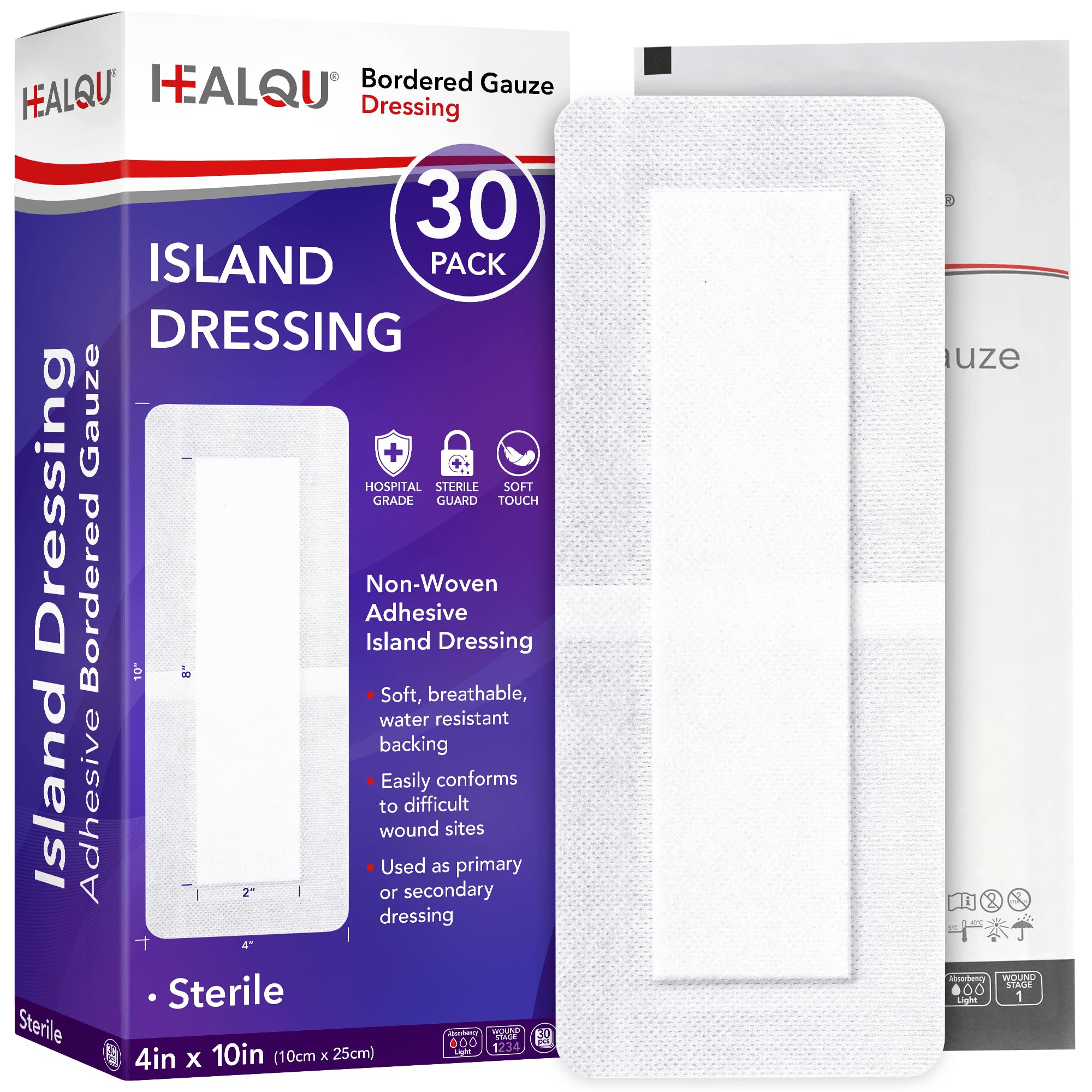
A narrow bordered dressing built for the incision nobody stocks in a drugstore.
Trying to find a long, narrow bandage at a pharmacy is its own small frustration. This Healqu pack solves that: a 4″ x 10″ dressing with a 2″ x 7.5″ center pad, sticky on the border, non-stick over the wound, individually wrapped and sterile, with a water-resistant non-woven backing. Peel, stick, and go. The adhesive means you are not fighting with a roll of tape on a wound you can barely see, and the narrow center pad lines up with a surgical incision better than a round gauze square.
What puts this ahead for scar and incision work is how it behaves at both ends of the job — holding when you want it to and letting go without drama. The water-resistant backing holds through sweat and brief shower exposure, so the dressing can stay on for a few days between changes. Removal is reported as easy on sensitive skin despite the hold, which is the balance a lot of bordered dressings get wrong. It is also a solid pick under sports tape, and it covers the long, thin incisions a standard bandage misses entirely.
Be clear about the sizing catch. The center pad measures 2″ x 7.5″, so it covers a narrow wound rather than a broad one — a wide abdominal incision will outgrow it. Size feedback on this one is genuinely mixed, with some wearers finding it exactly right and others finding it not what they expected, which usually traces back to reading the center-pad dimensions rather than the dressing outline. Check those two numbers against your wound before you order, and you sidestep the whole issue.
The case for keeping a box
- 4″ x 10″ bordered dressing covers long, thin incisions a round bandage cannot span
- Water-resistant backing holds up through activity and some shower exposure
- Border holds securely, then peels off with little discomfort on sensitive skin
- Individually wrapped sterile pads suit a first-aid kit that sits for months
Where it runs short
- 2″ x 7.5″ center pad is narrow — a wide wound will need a different pad
- Not meant for heavy drainage the way a thick abdominal pad is
For narrow incisions: This is the one for a long surgical line, a staple-removal site, or a puncture that keeps bleeding a little.
Check the center pad: 2″ x 7.5″ of absorbent cover only, so a wide wound needs a bigger pad underneath.
5. McKesson Sterile ABD Pads 8 x 10 in 48 ct
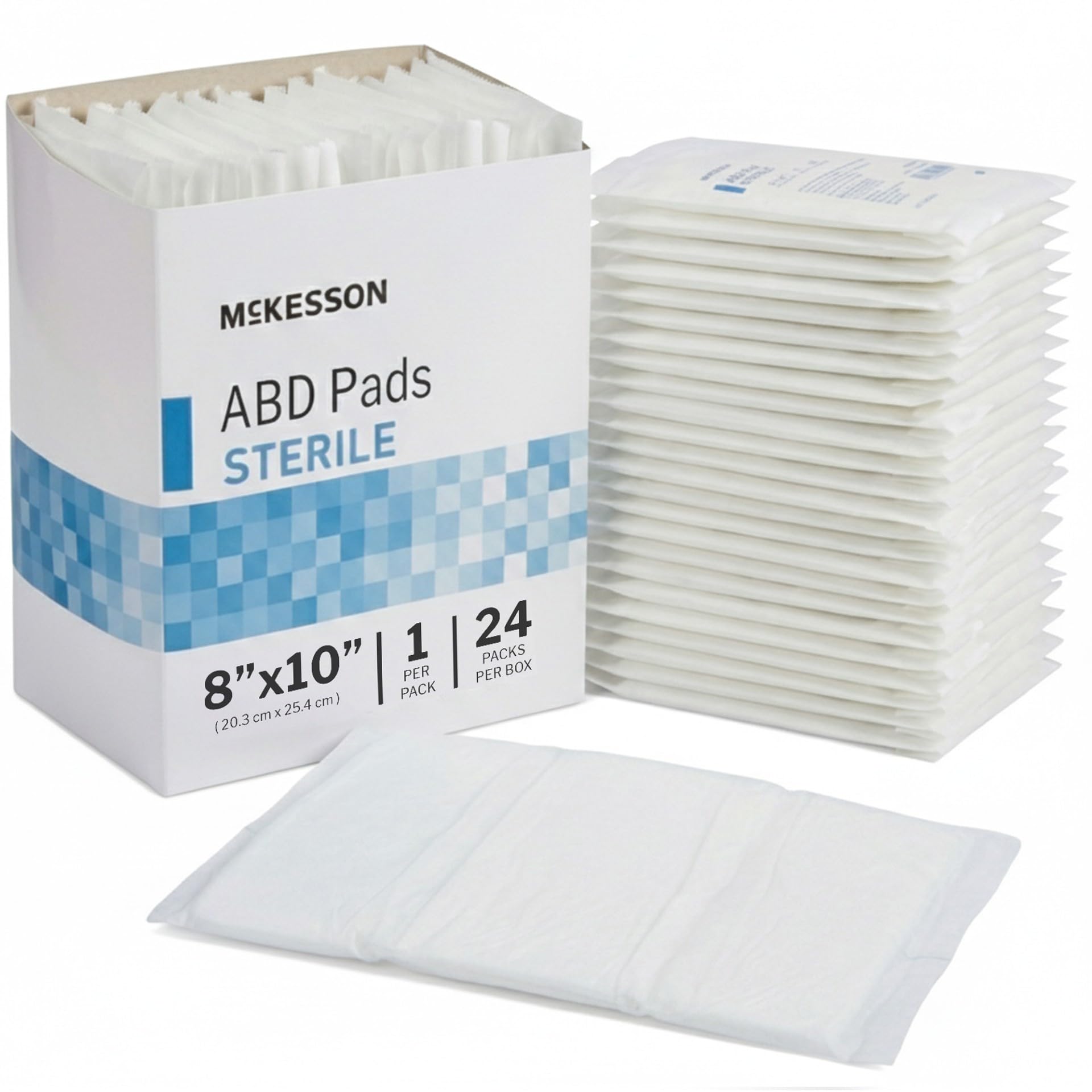
The thick, lint-free pad for wounds that keep putting out fluid.
When the drainage is heavy — a lymphedema wound, a trauma site, a large abdominal incision — you need a pad that holds volume, and this McKesson box is built for exactly that. The inner cellulose core wicks fast and retains fluid to keep the wound site dry. The soft non-woven exterior is lint-free, so it does not stick to healing tissue or shed fibers into the wound. A sealed edge design contains fluid and blocks side leakage, and every pad is sterile and wrapped on its own to keep it clean between changes. The 8″ x 10″ size is the one meant for post-surgical and heavy-draining injuries.
Professional-grade is how buyers describe these, and the absorption is why. The cellulose core absorbs many times the pad’s own weight in fluid, and the pad stays flat rather than bunching under an abdominal binder. One buyer laid two 8″ x 10″ pads end to end over a roughly 12-inch abdominal incision and got comfortable cushioning under the abdominal binder. It is also worth checking against the CareStock box: both are 48-pad 8 x 10 packs, and the McKesson carries the clinical labeling some home caregivers look for.
The one caveat to hold in mind is sizing precision. A buyer measured these at closer to 8″ x 9″ and described them as thin for really heavy drainage — which cuts against the clinical claims if your wound is producing a lot. Most people are happy with the coverage, and the pad handles typical post-op drainage without trouble. Just size up your expectations on a very wet wound, or layer two pads, and plan for tape or a binder since there is no adhesive on this one either.
The wound-care angle: The cellulose core speeds fluid away from the site and the lint-free exterior resists sticking, which is what keeps a draining wound clean between dressing changes.
Honest limit: A minority find these run slightly narrow of 8″ x 10″ and thin under truly heavy drainage — most post-op wounds are fine, but size up your plan for a very wet site.
Built for volume: Go with McKesson when the wound is producing a lot of fluid and you want a pad with strong retention and a sealed edge.
Mind the sizing: It can run a touch narrower than stated, so check coverage against your incision.
Know the Specs
Absorbency and the cellulose core
The absorbent middle of a pad is the cellulose layer — plant-fiber pulp that pulls fluid in and spreads it sideways so it does not pool in one spot. That sideways spread is why a pad with a thick core holds more than a thin gauze square of the same size, and why it keeps a draining wound dry for longer between changes. A pad with a hydrophobic back layer actively pushes moisture away so it does not reach your shirt or sheet.
Bordered island versus plain pad
A plain abdominal pad has no adhesive and relies on tape or a binder. A bordered island dressing wraps a non-stick center pad inside an adhesive border, so it sticks to healthy skin around the wound and lifts off cleanly. Choose the bordered kind for a joint that bends or a spot you cannot reach with both hands. Choose the plain pad for heavy drainage, larger incisions, and layering.
Sterile and individually wrapped
An open wound is a direct path into the body, so a pad labeled sterile and sealed on its own is the safer baseline. Individually wrapped pads stay clean in a first-aid kit for months and drop straight onto the wound without handling. A bulk box is fine at home as long as each pad inside is still sealed.
Pad size and sealed edges
The pad should overhang the wound on every side so fluid has room to spread before it reaches an edge. Sealed edges contain that fluid and cut down on side leakage and lint shedding. Too small means drainage wicks onto skin and clothing; oversized means an awkward fit on a bending knee.
Common Questions
Should I use a plain pad or a stick-on bordered dressing for an open wound?
What does non-adherent mean and why does it matter on a fresh incision?
Will an abdominal pad stay on without tape?
How often should I change a dressing on a draining wound?
How do I stop a bordered dressing from peeling off in the shower?
What size pad do I need for a long surgical incision?
Are these pads sterile, and does that matter for an open wound?
What is the difference between an abdominal pad and a gauze island dressing?
Can I use these on a wound that is bleeding or heavily weeping?
Do the bordered dressings work under tight clothing or an abdominal binder?
The Bottom Line
For most open wounds that actually drain, the bandage for open wound to start with is the Medline NON21450H Sterile Abdominal Pads — the hydrophobic back (a water-repelling backing) blocks strike-through (fluid soaking through), the cellulose core holds fluid for hours, and 25 sterile pads keep you in supply without overbuying. If your recovery stretches over weeks, the CareStock 8 x 10 pads double the pad count and give you a wider pad for a broad wound. And when the wound sits on a knee, hip, or shoulder that moves, reach for the Ceeport bordered island dressing — it grips on its own and peels off without pulling at the site. Match the pad to your drainage level and wound location, and dressing changes become routine instead of a struggle.
How we choose
We do not accept paid placement. Every pick is matched to a real buyer and a real use-case; we do not hands-on test units.
Sources
Specifications: manufacturer listings and product documentation. Review insights: verified customer reviews, as of October 2026. Pricing: not shown on this page (it changes often); check the current price via the retailer link.
As an Amazon Associate, Aappliancez earns from qualifying purchases. This does not affect which products we feature.