Disclosure: Some links in this post are affiliate links. As an Amazon Associate I earn from qualifying purchases, at no extra cost to you. Learn more
Specs are compiled from manufacturer listings and verified buyer reviews and can change over time — please confirm the key details on the product page before buying.
Loose speaker wire is the reason your left channel crackles and your right one drops out halfway through a film. A good banana plug (the gold-tipped connector that push-fits into the back of your receiver and speaker) turns that mess into a click-in, screw-down connection you never have to think about again. The short answer: match the plug to your wire gauge first, then to your binding posts — get those two right and even a mid-range set will outlast your speakers.
This guide is built by comparing the manufacturers’ published specifications and the patterns across verified customer reviews, so you get each pick’s real strengths and trade-offs instead of marketing spin.
Below you’ll find which plug grips thin 18 AWG wire and which one swallows thick 10 AWG, plus the fit quirks that actually decide whether a plug seats firmly. Here is the shortlist of the best banana plugs for speakers, ranked by how they hold wire and seat in real binding posts.
Top Picks

How To Choose The Best Banana Plugs for Speakers
Buying the wrong plug is almost always a gauge problem, not a quality problem. A plug rated for thick cable will not clamp thin wire, and a plug built for thin wire will not accept a fat conductor without a fight. Nail the gauge match, then worry about the finish.
Match the plug to your wire gauge first
Wire gauge (AWG) is a thickness rating — a lower number means a thicker copper core. Thin 18 AWG wire is common in budget speaker runs, while 12 AWG and 10 AWG are the heavy stuff used for long runs and bigger rooms. A plug that covers 10–18 AWG will handle nearly any home setup you throw at it.
Where owners get stuck is the middle. Thick, stiff copper takes patience to feed into a small terminal, and thin wire can slip unless the clamp bites down hard. Check the stated gauge range on the listing before anything else.
How the plug grips the wire
Three designs dominate. Self-crimping teeth bite into the conductor as you screw the shell down. Dual set screws pin the wire from two sides so it cannot back out. FanLock-style sleeves press the conductor against the inner wall without any screws at all. All three work; the difference shows up during installation.
The tip size question
Standard binding posts (the red and black terminals on your receiver and speakers) expect roughly a 4mm tip. Many plugs ship nearer 4.6mm, which is fine in most posts but snug in tight rack installs. If your posts are shallow or crowded, a slightly slimmer tip seats easier.
Side-by-Side Comparison
| Model | Best For | Wire Gauge Support | Connection Style | Quantity Included | Amazon |
|---|---|---|---|---|---|
| Sewell SW-29863-12 Deadbolt★ Best Overall | Overall grip and easy install | Up to 8 AWG (10 AWG suggested) | Self-crimping teeth | 12 pairs | Amazon |
| HannLinte 12AWG Speaker CableReady-Made Runs | Ready-made cable runs | 12 AWG | Pre-terminated banana plug | 1 pack, 3 feet | Amazon |
| FosPower Banana Plugs | Budget multi-pack value | 12 AWG to 18 AWG | Dual set screws | 6 pairs (12 pcs) | Amazon |
| Nakamichi FanLock Excel | Premium fit and no-screw setup | 10 AWG to 18 AWG | FanLock press sleeve | 6 pairs (12 pcs) | Amazon |
| Mygatti 16/2 Flat Cable | Hiding wire along walls | 16 AWG | Pre-terminated banana tip | 2 pack, 10 feet | Amazon |
Detailed Reviews
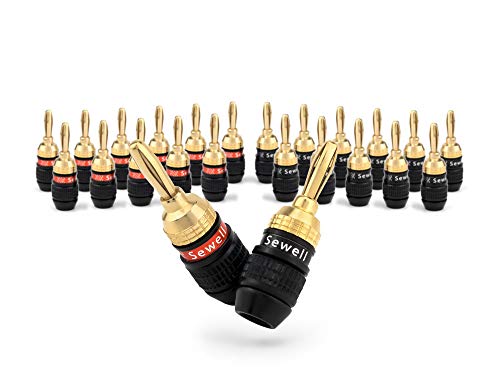
1. Sewell SW-29863-12 Deadbolt Banana Plugs, 12 Pairs
Our pick — 4.5+★ from 14,500+ verified ratings; the strongest balance of quality and price.
Twelve pairs of tool-free plugs that bite down on everything from thin wire to heavy 10 AWG runs.
For anyone rewiring a whole home theater in one go, this is the simplest buy on the list — twenty-four plugs in the box, no soldering iron and no screwdriver required. The Deadbolt design uses self-crimping teeth that clamp the conductor as you twist the shell down, so the wire is held by a mechanical bite rather than a friction fit.
These plugs grip 12 AWG and 14 AWG cable firmly, so your connection stays put with the wire most receivers and bookshelf speakers use. The gauge range is the headline: they accept wire up to 8 AWG (thick wire), with 10 AWG the suggested balance. As owners put it: “These worked great with 14-gauge wire, and I wouldn’t recommend using them on anything much smaller than that.”
Each plug carries a 24K gold plating over a steel tip, and red and black labels make polarity obvious at a glance. The tip measures 4.6mm at its widest, which seats in standard binding posts but is snug in a crowded rack — and it can be compressed back toward 4mm for a firmer hold. The catch is the effort with stiff copper: dense, thick conductors can take ten minutes or more per plug to feed in, while soft 14 AWG slides through in seconds. Crimp carefully on the first attempt and fold the strands into two thick halves so nothing gets thinly spread.
Where the Deadbolt Delivers
- 24 plugs in one box handles a full surround setup without reordering
- Self-crimping teeth hold 12 AWG and 14 AWG wire without coming loose
- No soldering, no set screws — twist and you’re done
- Red and black labels keep polarity straight across every run
What To Expect Going In
- Stiff, dense copper takes real patience to install
- The 4.6mm tip feels snug in tight, crowded binding posts
- A 12-pair box overshoots a small 3 or 5 speaker setup
Go here first: anyone wiring a 5.1 or larger system who wants a no-tools install and a grip that holds.
Second thought if: your receiver sits in a cramped rack where a slimmer tip would seat easier.
2. HannLinte 12AWG Speaker Cable, 3 Feet with Banana Plugs
Skip the termination job entirely — this arrives with banana plugs already bolted on both ends.
Not everyone wants to crimp twelve connectors. This cable hands you a finished 3-foot run of 12 AWG wire with a gold-plated banana plug bolted at each end, ready to plug into a receiver and a speaker from the start. The conductor is 99.99% oxygen-free copper, and the braided jacket plus PVC Y-boot protects your speaker finish while keeping the cable bendable.
Installation is the appeal — again, no tools, no stripping, no set screws. At 12 AWG it is a heavier gauge than the 16 AWG flat cable further down this list, which suits longer runs. Long-time audiophiles describe it as a cable you do not have to spend a fortune on to get right.
You get 3 feet of reach, which suits a receiver sitting right beside the speaker and little else. One buyer summed it up: “I just couldn’t use them because they were 2 inches too short for my use case.” A second catch: the knurled collar (the textured ring you grip) on the banana plugs can arrive loose, so twist it tight before you plug in. The cable itself is somewhat stiff — tight bends work but keep them away from the connector ends.
The real draw: zero termination work on a 12 AWG oxygen-free copper run, with gold-plated plugs bolted on at both ends and a braided jacket protecting the finish.
Measure before you buy: 3 feet is short. Confirm the gap between your speaker and receiver, because a couple of inches makes this unusable in many rooms.
Made for: a desk setup or a speaker sitting close to the amp, where factory-terminated cable saves the whole install job.
Think twice if: your speakers sit across the room — a longer run or loose plugs plus your own cable is the better route.
3. FosPower Banana Plugs, 6 Pairs / 12 Pcs

A closed-shell plug with two set screws that grips everything from thin 18 AWG up to chunky 12 AWG.
The FosPower set is the flexible middle-ground pick: a closed-type barrel that covers the widest gauge span on this list, from 18 AWG all the way up to 12 AWG. That range means it will not strand you if you later swap thin wire for thicker cable. Two set screws pin the conductor from both sides so it cannot slip, and the closed shell isolates the wire from shorts.
Where the value really lands is the plating. Each connector is gold plated to resist corrosion, and the collar is color coded for polarity, so your cabling looks tidy and professional rather than like a tangle of bare copper. As owners put it: “Worked easily with the 12ga. & 14ga. Speaker wire I was using!”
Two small things to know. The set screws are tiny and can fall out if you back them fully out, and they may rattle loose in shipping — screw them all the way in and dump them out before install. The red and white markings could also be clearer. Neither is a reason to skip it; just budget a few extra minutes on the first plug.
Why it earns its spot: the 12–18 AWG range is the broadest here, double set screws hold wire tight, and gold plating plus color-coded collars keep the back of your receiver looking sharp.
Best fit: a first-timer rewiring a small system who wants one set to cover whatever wire gauge the speakers came with.
One caution: those tiny set screws need care — do not unscrew them fully or you will be hunting for them on the floor.
4. Nakamichi FanLock Excel Series, 6 Pairs
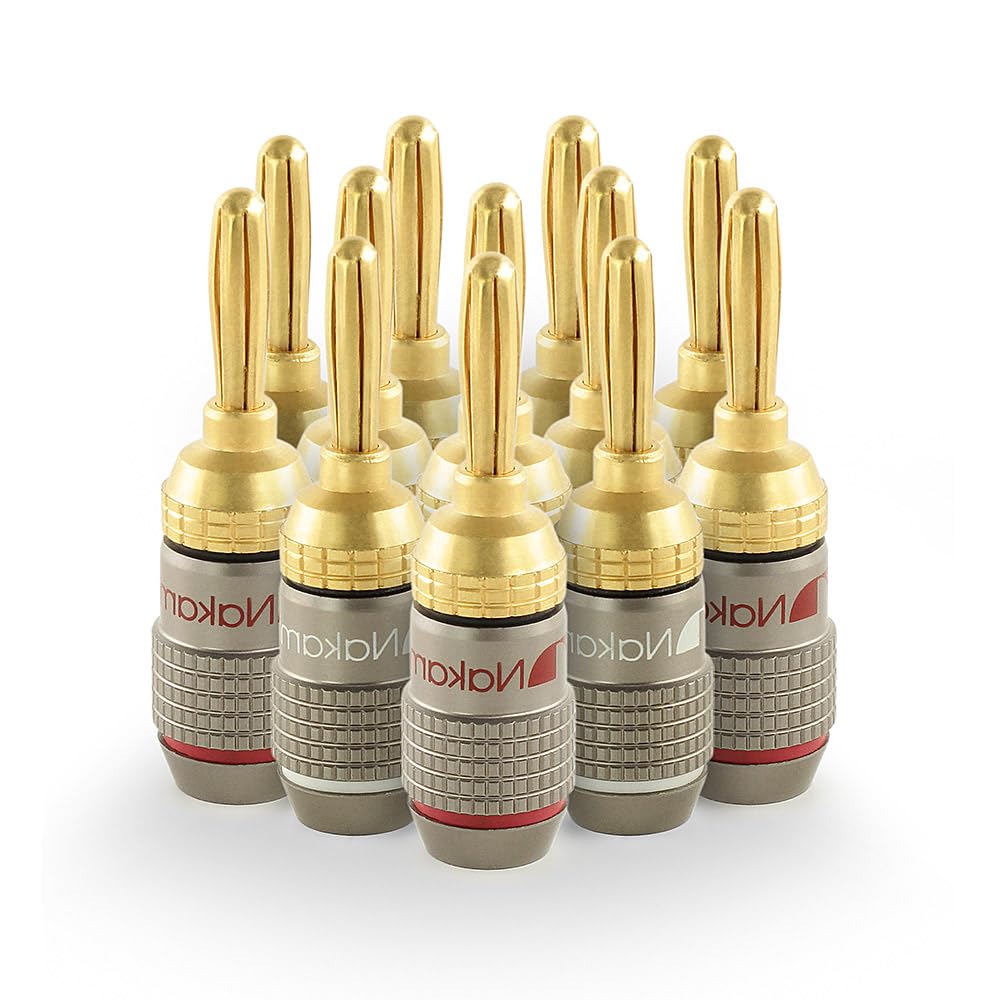
A screwless FanLock sleeve that presses wire tight in seconds and seats in tight binding posts.
These are for the person who has fought with tiny set screws and sworn never again. The FanLock design works like a fan pressing open against the inside of the barrel — you push the stripped wire in and the sleeve grips the conductor with no screws, no soldering, and no tools. Setup takes seconds, and the outer sleeves are non-conductive, so you are not adding a short risk behind the receiver.
These plugs resist tarnishing over time because gold plating goes directly over a copper core from tip to bottom, with no nickel underlayer (a middle metal layer). That is why the finish looks a little dull rather than mirror-bright. They handle 10 AWG down to 18 AWG, so thin and thick wire both work, and they fit tight rack installs where bulky plugs will not seat. Buyers report 14-gauge Monster cable sliding in very nicely.
For a buy-once-and-forget approach it justifies the premium: heavy, solid-feeling plugs with a screwless sleeve that stays put.
The FanLock Advantage
- No screws — wire presses in and stays put in seconds
- 10–18 AWG range covers thin and heavy cable alike
- Direct gold over copper with no nickel layer
- Non-conductive sleeves keep the install safe
Where It Costs You
- The premium tier of the list — you pay more per pair
- Only 6 pairs, so a large setup may need two boxes
Pick it if: you want the fastest install on the list and do not mind paying more for a plug you will keep for years.
Maybe not if: you are wiring eight speakers at once — two of the budget sets cover more runs for less.
5. Mygatti 16/2 Flat Speaker Cable, 2 Pack 10 FT

The cable you slide under the carpet — flat, transparent, and pre-tipped with gold banana plugs.
If your problem is not the connector at all but the wire running across the floor, this is the answer. Each cable is a flat-profile 16 AWG pair with banana tips already attached at both ends, and the flat shape lets it tuck along walls, around corners, or slide under carpet so it disappears. You get two 10-foot runs in the pack, both with a transparent jacket and a yellow polarity marker.
The conductor is tinned oxygen-free copper rather than the cheaper copper-clad aluminum, which resists corrosion on outdoor runs. Gold-plated double banana tips resist discoloration and give a stable, tight connection when firmly seated.
Here is the catch worth knowing before you order. Push them in firmly for the tightest hold. It is also 16 AWG, thinner than the 12 AWG HannLinte above, which suits short decorative runs far better than long high-power ones.
What makes it useful: a flat, transparent jacket that hides under carpet or along a wall, twin 10-foot runs in one pack, tinned oxygen-free copper, and banana tips pre-attached at both ends.
The fit caveat: the plugs run large. If your speaker ports are shallow or narrow, test one before committing the whole run.
Reach for it when: the cable has to disappear — under a rug, behind a baseboard, or along a wall you cannot see.
Look elsewhere if: you need a long high-power run or your speaker ports are tight, where a standard-sized plug is the safer bet.
Know the Specs
Wire Gauge (AWG) — The Match That Matters
AWG is a thickness rating where a lower number means a thicker copper core. A plug built for 10–18 AWG will clamp both a thin 18 AWG run and a chunky 12 AWG one, which is why the range is the first thing to check. Get a plug rated only for thick wire and thin cable will slip; get one rated only for thin wire and heavy copper will not fit.
Gold Plating — Corrosion, Not Magic
A gold-plated connector resists tarnish and corrosion at the contact point, so the connection stays clean over years of use. It does not improve sound quality on its own, and the duller look on some plugs simply means the gold sits directly over copper with no nickel underlayer. That direct plating is a durability choice, not a cosmetic one.
Tip Size and Binding Posts
Standard receiver and speaker binding posts expect roughly a 4mm tip. Some plugs measure 4.6mm at the widest and still seat fine in most posts, but a crowded rack or a shallow terminal makes a slimmer tip easier to push in. Plugs with compressible tips can be squeezed back toward 4mm for a firmer fit.
Grip Style — Teeth, Screws, or Sleeve
Self-crimping teeth bite in as you twist the shell, dual set screws pin the wire from two sides, and FanLock sleeves press the conductor against the barrel without any hardware. All three give a solid electrical connection; the real difference is install time and how much fiddling the tiny screws demand on your first plug.
Common Questions
Will these banana plugs fit my 14 gauge speaker wire?
Do banana plugs actually improve sound quality?
What is the difference between a 4mm and 4.6mm banana plug tip?
Can I use banana plugs with 18 gauge wire?
Do I need to solder banana plugs onto speaker wire?
How do I tell positive from negative on a banana plug?
Are gold plated banana plugs worth it over bare copper?
How long should speaker cable be for a banana plug run?
Can I use banana plugs for outdoor speakers?
Why do my banana plugs feel loose in the speaker?
The Bottom Line
For most people, the banana plugs for speakers winner is the Sewell Deadbolt set because it gives you 12 pairs with self-crimping teeth that grip everything from 12 AWG to heavy 10 AWG, with no tools needed. Rated 4.5+ stars across 14,000+ owners, it is the one to buy if you are wiring a full surround system. If you would rather not terminate anything yourself, grab the HannLinte 12AWG cable with plugs already attached. And for cable that has to vanish under a rug, the Mygatti flat run is the one to reach for.
How we choose
We do not accept paid placement. Every pick is matched to a real buyer and a real use-case; we do not hands-on test units.
Sources
Specifications: manufacturer listings and product documentation. Review insights: verified customer reviews, as of October 2026. Pricing: not shown on this page (it changes often); check the current price via the retailer link.
As an Amazon Associate, Aappliancez earns from qualifying purchases. This does not affect which products we feature.