Disclosure: Some links in this post are affiliate links. As an Amazon Associate I earn from qualifying purchases, at no extra cost to you. Learn more
Specs are compiled from manufacturer listings and verified buyer reviews and can change over time — please confirm the key details on the product page before buying.
If your desk chair leaves your lower back stiff by 3pm, a ball chair swaps that fixed slump for a seat that keeps you subtly moving all day. The catch is that “ball chair” covers two very different things: a half-dome trainer you exercise on, and a full inflatable seat you work from. Get the wrong one and you will be disappointed. This guide sorts out which is which, which ones hold air, and which ones actually fit under a standard desk.
This guide is built by comparing the manufacturers’ published specifications and the patterns across verified customer reviews, so you get each pick’s real strengths and trade-offs instead of marketing spin.
You will see the weight ratings, the seat heights, and the honest weak spots — like pumps that fight back and covers that feel scratchy. By the end you will know exactly which seat matches your desk and your back. Here is the practical breakdown of the best ball chair options for a home office or a home gym.
Top Picks

How To Choose The Best Ball Chair
The first decision is not brand or color. It is which of the two ball chairs you actually need. A half balance ball is a dome on a flat base — you stand on it, squat on it, do push-ups on it, and it lives in the corner until workout time. A full ball chair is a seat you park at a desk for hours. Buy a dome expecting an office chair and you will be sitting on the floor.
Match the seat height to your desk
This is the number that decides whether a full ball chair is usable. A seat that tops out around 20 inches sits low against a standard desk, and taller users will feel their knees ride high. Models that reach 23 inches suit many standard tables. A wobble stool that adjusts from 21 to 31 inches is the flexible pick if you split time between a sitting desk and a standing desk.
Check the weight rating and the base
A rating printed in pounds tells you how much the ball and base are built to hold. Half-ball trainers here are rated from 660 lbs up to 1500 pounds, which covers heavy use and shared gym space. Full ball chairs tend to be rated lower, around 250 to 400 lbs, because the frame and legs carry you rather than a thick rubber dome. Read the number, do not assume it.
Air retention is the real durability test
An inflatable seat is only as good as its valve and its wall thickness. A ball that needs a top-up every couple of weeks, or one that springs a leak in the first months, turns a posture tool into a chore. Look for anti-burst construction and a listed wall thickness where the maker gives one. Then treat the included pump as a bonus, not a guarantee — several of these ship with pumps that owners end up replacing with a compressor or an electric inflator.
Side-by-Side Comparison
| Model | Best For | Type | Weight Rating | Height / Size | Amazon |
|---|---|---|---|---|---|
| ZELUS 25in. Balance Ball★ Best Overall | Home gym core and balance work | Half balance ball | 1500 pounds | 25″L x 25″W x 8″H | Amazon |
| Original Starfish Ball ChairTop Performer | All-day desk sitting with a frame | Framed ball chair | 400 pounds | Two heights via legs or feet | Amazon |
| Sportneer Half Balance Ball | Physical therapy and stretching | Half balance ball | 660 pounds | 5mm thick PVC shell | Amazon |
| YOGIVO Sitting Ball Chair | Budget desk sitting with a cover | Covered sitting ball | — | 24 inch | Amazon |
| Misolant Big and Tall Office Chair | Long reclining work sessions | Ergonomic desk chair | — | 90°-155° recline | Amazon |
| Backerz Standing Desk Stool | Standing desk and treadmill desk | Wobble stool | 220 LBS | 21-31 inch adjustable | Amazon |
| Safco Zenergy Inflatable Chair | Active sitting with four legs | Framed ball chair | 250 pounds | 20″ or 23″ seat height | Amazon |
Detailed Reviews
1. ZELUS 25in. Balance Ball
Our pick — 4.5+★ from 800+ verified ratings; the strongest balance of quality and price.
The half dome that shrugs off a 1500-pound rating and still fits in a closet corner.
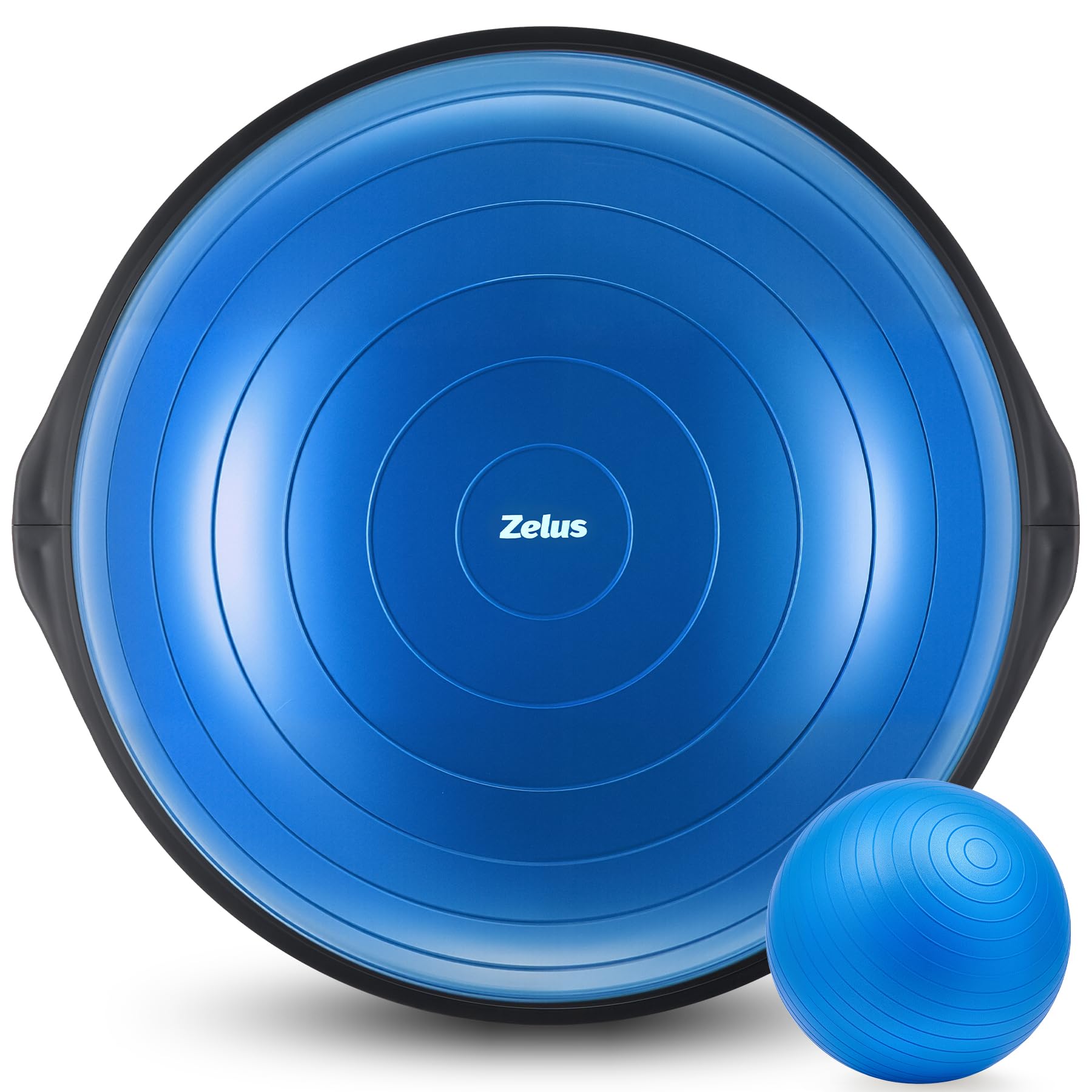
This is the pick if your goal is training, not desk sitting. The Zelus is a half balance ball — a dome on a flat base that you stand, squat and press on to force your core and legs to work harder than a stable floor would. The dome sits 8 inches high on a 25-inch base, so the whole thing is low and wide. It slides under a bed or behind a couch without a fight.
Where it earns its place is the headline number: a 1500-pound maximum weight recommendation on a textured PVC ball and a flat ABS base. That is a far higher rating than the full ball chairs further down this list, which are rated at 250 and 400 pounds. The wide base grips the floor through anti-slip TPR matting, and the textured surface keeps your hands and feet from skating. Two resistance bands come in the box with wide cushioned grips, plus a foot pump and an extra ball.
The honest catch is the pump. Owners who inflate a lot of gear find the included foot pump underwhelming, and some swap in an air compressor to fill the dome fast. A second quirk: because you flip the flat rubber side down to work, the small impressions on that side can press into bare feet, so wear shoes for footwork. Neither issue touches how the dome itself performs. What wins people over is the build — the well-made feel is the thing praise centers on, with balance work a close second. One buyer sums it up plainly: “Quality product, good price, easy to inflate.”
Where it pulls ahead
- 1500-pound weight rating — the highest on this list, so heavy and shared use are fine
- 25-inch wide base with anti-slip TPR matting keeps the dome planted mid-set
- Bands, foot pump and an extra ball arrive together, so you can train on day one
- 8-inch profile stores flat and out of the way between sessions
The honest caveats
- The included foot pump is weak — plan on a compressor or electric inflator for repeat fills
- Flat rubber underside can press into bare feet during footwork
Reach for this if: you want one tough dome for squats, push-ups, planks and balance drills at home.
Pass it by if: you want a seat for desk work — this trainer is for standing on, not sitting at for hours.
2. Original Starfish Ball Chair
A ball chair with a steel backbone, so you get the wobble without the roll-away.
Most inflatable seats put you on a bare ball that wanders off mid-sentence. The Starfish fixes that with a CFS high-strength low-alloy steel frame and four legs, plus a 100% explosion-proof ball core rated to a 400-pound maximum load and tested and certified by SGS. You sit in a chair that happens to be round, rather than balance on a sphere and hope.
The appearance is what most people notice first — this is a chair that looks like furniture, not a gym toy, and the Deepspace Grey finish plus the CozyProtect slipcover go a long way toward that. Comfort and back support follow closely behind, with the frame doing the heavy lifting so the ball only has to handle the bounce. Assembly is straightforward with the included instructions; an electric pump makes inflating and measuring the ball far easier than the manual route. The infinite360 Caster load-bearing system rolls quietly and locks on all four wheels, and four fixed feet come in the box if you would rather the chair stay put.
Two gripes are worth knowing before you order. The seat runs tall — great for a 5’7″ sitter, and the frame adds height on top of the ball, so shorter users may find their feet dangling. And the supplied ball has been known to slip down through the frame despite full inflation, with some owners swapping in their own 65cm ball. Air retention is the weakest thread overall; a leaky first unit is possible, though the warranty replacement path has moved fast. What everyone keeps coming back to is the look and the support — the two things that keep this chair at a desk instead of a closet.
The desk-chair case: a steel frame, locking casters, a washable slipcover and a 400-pound certified capacity turn a bouncy ball into a piece of office furniture you can roll between monitors.
Measure before you commit: the frame adds height, so check your desk clearance and your own leg length first — this is the tallest-feeling pick here.
Best match: taller desk workers who want real back support and a chair that looks intentional in a home office.
Think twice if: you are on the shorter side or want a ball you can swap out easily — the frame’s height and the undersized included ball are the friction points.
3. Sportneer Half Balance Ball

The dome that rehab patients reach for when the clinic brand is out of reach.
If your physical therapist had you on a half ball, this 5mm PVC dome is the closest home match for the money. The Sportneer is built from 5mm thick non-toxic PVC and ABS and rated to 660 pounds, which is the middle of the range here — lighter-duty than the Zelus at 1500 pounds, heavier-duty than the 250-pound Safco sitting chair. The honeycomb-textured top and 8 anti-skid pads under the base keep it from sliding while you shift your weight.
Owners use it for exactly the jobs a dome is good at: post-surgery quad and glute work, balance drills for a 70-year-old, and pitching practice for a kid. The build quality is what buyers single out most, with the overall function a distant second. It inflates easily with the included foot pump and a linked video, and one long-term user reports six months of steady use without needing a reinflation. Two detachable resistance bands add arm and shoulder work, and they come off when you do not want them.
The trade-off is durability at the edges. A few of these boards have given out after about three months of steady use, which is worth weighing if you plan to hammer it daily. Watch the valve and the seam, keep it away from sharp edges, and it behaves. For occasional rehab sessions and family balance games, it holds up well. As owners put it, this one is built like a tank — “VERY solid and well-made balance ball.”
Closest clinic feel: 5mm PVC walls, 8 anti-skid pads and a 660-pound rating give you a stable platform for balance and stretching work at home.
The durability watch: a small number of units have failed around the three-month mark, so store it away from heat and sharp edges and check the valve seal.
Go here if: you are rebuilding strength after injury or want a family-friendly wobble board that kids can jump on too.
Look elsewhere if: you need a desk seat — this is a floor trainer, and daily heavy loading is where its lifespan thins.
4. YOGIVO Sitting Ball Chair
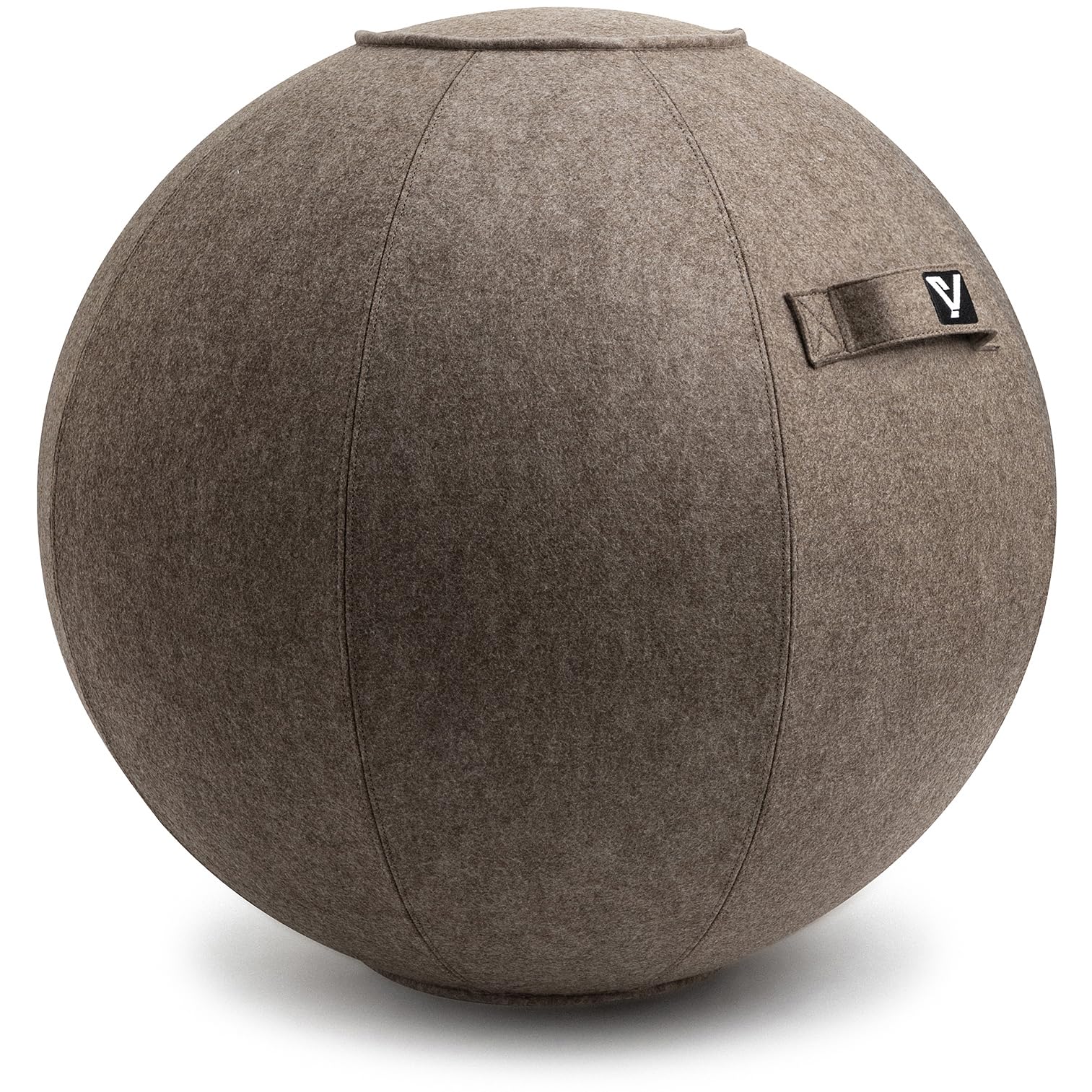
A covered 24-inch ball that costs a fraction of the design-brand seats and looks the part.
This is the entry point into active desk sitting, and the appeal is simple: you get a gold-brown ball with a fitted cover, a carry handle and a pump in one box, and the whole package undercuts the premium ball chairs by a wide margin. The cover does the heavy lifting on looks — it turns a plain inflatable into something that passes as a piece of furniture in a living room or a study.
Buyers use it for long desk stretches and for pregnancy back relief. One notes it sits equally high as a much pricier design-brand chair and that the balanced bottom stops it rolling away, while another with severe back pain from a standard office chair reports relief once the ball is filled fully and tight inside the cover. A full inflation is not optional here: the cover has to be snug for the support to work, which is where an electric pump earns its keep. Quality is the thing most people flag first, with stability close behind.
The honest limit is air retention over the long haul. A few users top it up every couple of weeks, and some units have started leaking badly around the three-month mark. If that happens under the 12-month guarantee, be ready to follow up — the replacement process has not always moved quickly. Then there is the cover itself: one buyer found the fabric scratchy enough to return it. Weigh those against the price and this is still the smart way to test whether active sitting suits you before spending big.
The sweet fit: first-timers testing active sitting on a budget, and anyone who wants a home-office seat that looks like decor.
Before you buy: expect to add air now and then, and buy only if you are comfortable chasing a warranty claim if the seam gives out.
5. Misolant Big and Tall Office Chair

Not a ball at all — the recliner for people who want comfort plus a stretch between sessions.
Every other pick here is round and wobbly. This one is a conventional padded desk chair, and it belongs on this list for a specific reason: some backs do better on a solid seat than a ball, and the Misolant gives you a 90°-155° tilt so you can go from upright working to fully reclined for a break. The retractable footrest pulls out to prop your legs and tucks back under when you are done.
It is the most feature-loaded chair in the group. You get a curved backrest with integrated lumbar support, perforated leather upholstery for airflow, and a reinforced steel base with dual-lock safety mechanisms to hold steady at any angle. The chair has passed BIFMA testing and carries SGS certification. Assembly runs about 25 minutes with the included manual. On the quality front it is one of the strongest performers here, with value for money and sturdiness following close behind — this is the crowded-favorite of the group.
What you give up is the whole point of a ball chair: there is no micro-movement, no subtle instability keeping your core awake. The seat cushioning is also a matter of taste, with some describing the padding as firmer than they expected and others finding it supportive. One buyer had a back that did not line up squarely with the seat, causing a slight sideways lean. If your goal is to stop slumping through a long shift, though, the lumbar support and the recline range are hard to argue with.
What it brings to a desk
- 90° to 155° recline with dual-lock safety — you can lean back and trust it to hold
- Retractable footrest props your legs during long sitting sessions
- Perforated leather and integrated lumbar support for warmer, more supported hours
- BIFMA-tested and SGS-certified steel base for stability at every angle
Where it trades off
- No instability at all — it will not engage your core the way a ball or wobble stool does
- Cushioning divides opinion; some find the seat firmer than expected
Choose it for: long work-from-home shifts where you want back support and a recline, not a wobble.
Skip it for: active sitting — if core engagement is the goal, a ball or wobble stool does that job and this one does not.
6. Backerz Standing Desk Stool

The perching stool that rises to 31 inches and wobbles without letting go.
If you split your day between a sitting desk and a standing desk, a fixed-height ball chair leaves you stranded. The Backerz adjusts from 21 to 31 inches with two buttons under the seat, so it meets you at whichever desk you are at. A second size covers 16 to 24 inches for shorter setups. The base has a non-slip rubber footplate and rocks with you in a controlled wobble.
The active-sitting idea takes a few days to feel normal, then it clicks — the constant micro-movement keeps your balance and posture working while you type. It pairs naturally with a standing desk and a treadmill desk, giving you a place to perch when standing or walking gets tiring. The compact footprint frees floor space, and the 2.4-inch thick HR60 molded foam seat adds some cushion where you need it. It was tested to 10,000 cycles and is rated to support up to 220 LBS. Height and posture support are the two things buyers rate highest here, right behind overall quality.
The honest downside is the seat. On a long day that flat cushion has been called hard, and the flat top can let you slide forward into an uncomfortable lean if you are not sitting square. A few users have also reported screws for the plastic cover under the seat working loose. For an hour or two of active perching, or for a treadmill-desk break, it does its job well. For eight-hour marathons, it is not the seat for you.
Why it fits standing desks: a 21-31 inch height range with a two-button adjust and a rocker base makes it the most flexible perch on the list, and the 220 LBS rating covers lighter users comfortably.
The seat reality: the flat 2.4-inch foam pad grows hard and slide-prone over long sessions, so it rewards short bursts of active sitting over all-day marathons.
Pick it when: you alternate between standing and sitting and want a compact stool that follows you.
Look past it if: you need serious padding for long, uninterrupted desk hours.
7. Safco Zenergy Inflatable Chair

A four-legged anti-burst ball you can set at 20 or 23 inches and forget about rolling.
This is the chair that teaches a yoga ball to sit still. The anti-burst ball has four legs underneath, so you get the posture and bounce of a ball without the rolling that makes a bare sphere so annoying at a desk. Set it with just the feet and the seat height is 20 inches; add the legs and feet and it rises to 23 inches. Both options ship in the box, so you pick the match for your desk.
Owners describe it as less bouncy than a plain yoga ball and far easier to manage than a loose ball — the subtle rock keeps you moving without turning work into a balancing act. Posture is what it does best, with assembly following close behind. It looks cleaner than an exposed ball, the black mesh cover disappears into a room, and it is Greenguard-Certified, which speaks to healthier indoor environments. Assembly is fast: the manual pump fills the ball in minutes and the whole chair comes together comfortably in under half an hour. The legs glide on hardwood rather than rolling, which keeps your floor scratch-free.
Two things to weigh. It has a 250-pound maximum user weight and weighs 15 pounds itself, so it is the lighter-duty build among these chairs. And the height is a real variable: at 20 inches it can feel low against a standard desk, so taller workers should plan on the 23-inch setup. One leg extension has been reported to stick so it cannot be shortened. Sitting more than half an hour on any ball chair can stiffen your lower back — if you need firm lumbar support, a solid chair is the better tool. For active sitting in short bursts, this is a well-made version of the idea.
Why it works at a desk
- Anti-burst ball on four legs — bounce without the roll-away
- Two heights in the box, 20 or 23 inches, so you can match your desk
- Greenguard-Certified with a neat black mesh cover that fits an office
- Manual pump fills it in minutes and the chair assembles in under half an hour
What to keep in mind
- 250-pound user capacity is the lowest of the framed chairs here
- The 20-inch setting runs low for standard desks; plan on the 23-inch build
It suits: desk workers who want the posture nudge of a ball with the stillness of a chair, and who like a clean, certified build.
Not the one for: heavier users or anyone chasing firm lumbar support — the low rating and soft bounce point you toward a solid chair instead.
Know the Specs
Weight rating in pounds
This is the load the ball and base are built to hold, and it sorts the list into two groups. Half-balance domes here carry ratings from 660 lbs up to 1500 pounds because a thick rubber dome on a wide base takes the load directly. Full sitting ball chairs carry lower ratings — 250 pounds for the Safco, 400 pounds for the Starfish — because a frame or legs carry you and the ball handles only the bounce. A wobble stool like the Backerz lists 220 LBS. Always read the specific rating rather than assuming a ball is tough.
Seat height and desk fit
Seat height decides whether a ball chair works at your desk or leaves your knees too high. Fixed ball chairs sit around 20 or 23 inches; the YOGIVO is a 24-inch ball; the Backerz adjusts from 21 to 31 inches. If you use a standard sitting desk, aim for a height that lets your elbows rest level with the desk. If you use a standing desk or an adjustable one, a height range that climbs into the high 20s keeps the chair usable when you raise the desk.
Anti-burst construction and wall thickness
A ball that splits under you is a safety problem, not just an inconvenience. Anti-burst and explosion-proof cores are built so the material fails slowly rather than popping. The Sportneer lists a 5mm thick PVC shell, which is a concrete number to compare against. Where a maker gives no thickness, treat the anti-burst wording as a feature claim and store the chair away from heat and sharp edges to protect the wall.
Stability: base, legs, and casters
A half dome relies on a wide flat base and anti-slip matting to stay put. A full ball chair adds a frame or legs so it behaves like furniture. Casters let you roll between monitors but can wander; locking casters — like the Starfish’s four-wheel lock — let you switch between moving and staying fixed. If your floor is hardwood, glides or rubber footplates protect it better than bare wheels.
Common Questions
What is the difference between a half balance ball and a full ball chair?
Will a ball chair fit under a standard desk?
How much weight will a ball chair hold?
Do ball chairs lose air over time?
Is a ball chair good for back pain?
Can I use a half balance ball for desk sitting?
How long does it take to get used to sitting on a ball chair?
What pump do I need to inflate a ball chair?
Can kids use a ball chair or balance ball?
Should I switch from a regular office chair to a ball chair?
The Bottom Line
For most people who want one do-everything ball chair for a home gym, the ZELUS 25in. Balance Ball wins because its 1500-pound rating outclasses everything else here and its wide, anti-slip base stays put through squats and planks. If you want a seat for desk hours, the Original Starfish Ball Chair brings a steel frame, locking casters and a 400-pound capacity that turn a ball into real furniture. And for a standing-desk perch you can raise and lower, the Backerz Standing Desk Stool covers 21 to 31 inches in one compact base.
Whichever you pick, measure your desk height and check the printed weight rating before you order — those two numbers decide whether a ball chair feels like a tool or a nuisance. Buy the one that matches the way you actually sit.
How we choose
We do not accept paid placement. Every pick is matched to a real buyer and a real use-case; we do not hands-on test units.
Sources
Specifications: manufacturer listings and product documentation. Review insights: verified customer reviews, as of October 2026. Pricing: not shown on this page (it changes often); check the current price via the retailer link.
As an Amazon Associate, Aappliancez earns from qualifying purchases. This does not affect which products we feature.