Disclosure: Some links in this post are affiliate links. As an Amazon Associate I earn from qualifying purchases, at no extra cost to you. Learn more
Specs are compiled from manufacturer listings and verified buyer reviews and can change over time — please confirm the key details on the product page before buying.
If your homemade baguettes keep coming out pale and soft instead of crackly and golden, the pan is doing more of the work than you think. A perforated tray lets hot air reach the underside of the dough, so steam escapes and the crust sets properly. The Chicago Metallic Commercial II is the one most bakers end up keeping, holding 4.5+ stars across 2,000+ ratings.
This guide is built by comparing the manufacturers’ published specifications and the patterns across verified customer reviews, so you get each pick’s real strengths and trade-offs instead of marketing spin.
You will see how many loaves each tray bakes, which materials warp and which hold their shape, and where silicone and cast iron genuinely beat steel. Read on for a clear, no-hype breakdown of the baguette baking pan.
Top Picks


How To Choose The Best Baguette Baking Pan
A baguette pan is really three decisions rolled into one: how the air reaches the dough, how many loaves you need at once, and what the metal or silicone does after a hundred trips through a hot oven. Get those three right and you stop fighting your bake.
Perforations decide your crust
The holes in the bottom of the tray are the whole point. They let steam escape from under the loaf and pull hot air around the dough, which is what turns a soft roll into a crisp baguette. A solid tray traps that moisture and steams the bottom instead of browning it.
How many channels, and how wide
Two-channel trays suit a small household and standard ovens, while three- and four-wave pans feed a crowd in one pass. Channel width is the quieter spec. Narrow grooves shape thin, classic baguettes, and wider ones handle sub rolls and hoagies but can crowd a full three-loaf bake.
Carbon steel, aluminum, cast iron, or silicone
Thick carbon steel heats fast and evenly, aluminum is lighter and quick to warm, and cast iron holds heat like a brick but weighs far more. Silicone bends and stores flat, yet it can feel floppy once loaded with wet dough. Each trade-off shows up in daily handling, not just the first bake.
Side-by-Side Comparison
| Model | Best For | Material | Loaves | Oven Max | Amazon |
|---|---|---|---|---|---|
| Chicago Metallic Commercial II★ Best Overall | Crowd-pleasing everyday bakes | Steel | 3 | — | Amazon |
| CHEFMADE Perforated Baguette PanCrust Champion | Even professional-style browning | Carbon Steel | 3 | — | Amazon |
| USA Pan Bakeware French Baguette PanUSA-Made Classic | Thin, traditional-length loaves | Aluminum | 3 | 450°F | Amazon |
| HAWOK Enameled Cast Iron Baguette Baker | Steamy, bakery-style crust | Cast Iron | 2–5 | — | Amazon |
| Barlket Baguette Pan Kit | Beginners who want the full kit | Carbon Steel | 3 | — | Amazon |
| IBILI Baguette/Tejas Mould | Wide, rustic Tejas-style bakes | Metal | 4 | — | Amazon |
| Tiawudi 2-Pack Baguette Pan | Baking a big batch at once | Carbon Steel | 4 | 450°F | Amazon |
| KITESSENSU Nonstick Baguette Pan | Budget-friendly daily baking | Carbon Steel | 2 | — | Amazon |
| AMAGABELI Nonstick Baguette Pan | Sourdough baguettes on a budget | Stainless Steel | 3 | 446°F | Amazon |
| Mrs. Anderson’s Double Baguette Pan | PTFE and PFOA-free baking | Carbon Steel | 2 | 480°F | Amazon |
| Lekue 4 Cavity Mini Baguette Pan | Rolls, buns, and small loaves | Platinum Silicone | 4 | — | Amazon |
| FETESUR Silicone Perforated Baguette Pan | Flat storage and sandwich loaves | Silicone | — | — | Amazon |
| Superstone Baguette Baker | Serious crust-chasing bakers | Stoneware | 3 | — | Amazon |
| Yupjlia Baguette Bread Pan | First-timers on a tight budget | Carbon Steel | 2 | 446°F | Amazon |
Detailed Reviews
1. Chicago Metallic Commercial II Baguette Pan
Our pick — 4.5+★ from 2,000+ verified ratings; the strongest balance of quality and price.
Heavy-gauge aluminum that bakes three full-size loaves with even heat across every channel.
This tray bakes up to 3 baguettes or sub rolls side by side, and it builds heat across all three channels from heavy-weight aluminum. That even spread is why centers cook through instead of staying doughy. The perforated base does the crust work, letting air move around the dough so you get the crackly, evenly browned shell a great baguette needs.
What wins people over is how long it lasts. It carries a lifetime warranty, and the two-layer nonstick means loaves slide right off with a light oil or a parchment liner. The pan is dishwasher safe, though hand washing keeps that coating in better shape over the years. One handy extra: it can cold-proof sourdough overnight and go straight into the oven the next morning.
The catch is size. The listing calls it 16 by 9 inches while the spec row reads 9″D x 16″W x 1″H, so measure your rack before ordering. Compare that to the Chicago’s 9-inch depth against the Yupjlia’s longer 15-inch footprint and the narrower 6.3-inch width, and you can see the Chicago takes up a squarer chunk of shelf. A few bakers also find the channels tighter than they expected for fat loaves.
What earns its keep
- Perforated base pulls moisture away for a crisp, browned crust
- Heavy-weight aluminum spreads heat evenly across three channels
- Lifetime warranty backs the build
- Works for proofing and baking in the same pan
Where it asks for care
- Hand washing preserves the nonstick better than the dishwasher
- Channel width may feel snug for oversized loaves
Reach for this if: you bake three loaves at a time and want a tray that lasts through years of weekend batches.
Look elsewhere if: you need a slim profile that tucks into a shallow cabinet or a very tight oven shelf.
2. CHEFMADE Perforated Baguette Pan, 15-Inch 3 Wave Loaves
A champagne-gold carbon steel tray with a strengthened rim that resists warping bake after bake.
The standout here is the 0.8mm carbon steel with a strengthened edge, built to keep its shape when the oven gets hot. It holds 15.2 by 9.6 inches across three 2-inch channels, so you shape three evenly sized baguettes in one pass. The food-grade silicone coating is non-Teflon and PTFE & PFOA free, which matters if you would rather skip those coatings on a surface that touches your bread.
Performance is the reason it climbs this high. Owners find it works better than expected and browns evenly, and the non-stick releases without a fight. The ultra-ventilated design pushes heat around the dough for a proper crust, and cleanup is quick by hand or in the dishwasher. If you like a golden, bakery-style finish on the underside, this delivers it.
Here is the honest trade-off: the narrow 2-inch channel shapes slender baguettes, and some bakers find it too cramped for the fatter loaves they had in mind. Measure the width you actually want before you commit. It weighs 1.3 pounds, so it stays steady on the rack without feeling like a brick.
Build read: thick steel plus a strengthened rim gives this tray real staying power, and the silicone coating keeps release clean.
Fit note: it is the crust specialist of the list, but the slim channels suit classic baguettes more than chunky sub rolls.
Best matched to: bakers chasing a slim, crackly, restaurant-style baguette who want a coating without PTFE or PFOA.
Think twice if: your household wants thick rolls and hoagie-sized loaves instead of slender sticks.
3. USA Pan 3-Loaf Baguette Pan
Thin, traditional-length loaves shaped by three 16-inch wells.
Each of the three wells runs 3 inches across and 16 inches long, which is what gives you a genuine thin baguette instead of a stubby roll. The aluminum body warms quickly and evenly, and the pan is oven safe to 450°F. A perforated bottom lets moisture escape so the crust crisps while the inside stays warm and chewy. The nonstick silicone coating is made without PFAS, PTFE, PFOA and BPA.
Owners lean on the made-in-USA construction and the professional look, and several like proofing and baking in the same tray. The vent holes earn steady praise for a crispier crust than a solid pan. A lifetime warranty sits behind it, too.
Two practical wrinkles to know. The center well runs narrow, so a full three-loaf bake can feel tight and many end up fitting just two wide loaves. There are also no hand holds, and the open bottom can slip into oven rack grooves, so setting it on a cookie sheet solves both. It cleans up with a light spray and a quick wash.
The promise: a classic thin baguette profile with quick, even aluminum heating and a cleaner nonstick formula.
The catch: no handles and a snug center channel mean careful oven handling, best done over a sheet pan.
Worth it for: bakers who want slim, long baguettes and a nonstick coating free of PFAS, PTFE, PFOA and BPA.
Skip if: you routinely bake three thick loaves at once or want built-in handles for hot-oven lifting.
4. HAWOK Enameled Cast Iron French Baguette Baker

Cast iron with a lid that traps steam the way a Dutch oven does.
Where perforated trays vent moisture, this one does the opposite and seals it in. The tight-fitting lid holds steam and flavor so you get a thick, crispy crust with a light, airy inside. The whole set runs on cast iron for even heat, and the inner trays carry a nonstick enamel coating so baguettes release cleanly. It arrives as a full kit: a lid, two baking trays, an oversized and a small transfer board, a proofing cloth, a silicone brush, a dough whisk, and a dough chopper.
The color and craft win people over. Bakers describe it as a plastic-free pan that exceeded expectations, with a lifetime-durability feel and a glazed, pumpkin-orange exterior. Greasing before the first bake gives a solid crust, and one fan calls it the best baguette baker after many earlier failures. The lid even doubles as a serving plate.
Plan for some prep. This is bare cast iron on the cooking surface and needs standard seasoning, which took a couple of rounds to reach a truly nonstick finish. At 9.5 pounds it is heavy to lift, and it is hand wash only. It is a different tool from a light sheet pan, not a swap for one.
Why steam lovers pick it
- Lid traps moisture for a thick crust and light interior
- Enameled nonstick trays release baguettes cleanly
- Delivered as a complete proofing and scoring kit
- Lid doubles as a serving plate
What to expect going in
- Needs standard cast-iron seasoning before it is truly nonstick
- Heavy at 9.5 pounds and hand wash only
Made for: bakers who love the Dutch-oven steam method and want one kit that covers proofing, scoring, and baking.
Not the one if: you want a light, fast tray you can drop in the dishwasher after a weeknight bake.
5. Barlket Baguette Pan Set

A perforated carbon steel tray, proofing cloth, and dough cutter bundled for the first-timer who owns none of it.
Instead of a bare pan, you get a perforated carbon steel tray, a proofing cloth, and a stainless steel dough cutter in one box. The 15 by 11 inch tray with wave-shaped slots bakes 3 loaves at a time and keeps them evenly spaced for consistent heat. Evenly drilled holes pull steam off the surface so the crust browns crisp while the middle stays soft. Wide handles on both sides give a firm grip when you pull it from a hot oven.
Weekend bakers appreciate the arc-shaped corners, which protect your hands, and the thickened food-grade carbon steel that holds up to repeated high heat without warping. It releases bread without a fight and cleans up fast. The size is the thing buyers praise most, since three loaves cover a family dinner without a second batch.
The honest limit: it is a solid value kit rather than a premium heavy-gauge pan, so treat the nonstick kindly with hand washing and a light oil coat. If you already own a cutter and cloth, you are paying for extras you do not need.
What you get: a complete proof, score, and bake setup in one order, with handles that make the hot-oven lift safer.
The trade-off: the extras only make sense if you are starting from nothing.
Grab it if: you are buying your very first baguette pan and want the cutter and proofing cloth included.
Pass if: you already own scoring tools and only need the tray itself.
6. IBILI 824804-4 Baguette/Tejas Mould

A four-channel nonstick metal mould built for wide Tejas-style loaves and sandwich rolls.
This is a metal mould with a nonstick finish and a 2-year warranty, sized for four channels so you can bake a broad tray in one go. The Spanish Tejas shape leans wider than a classic baguette groove, which suits sandwich rolls, sub buns, and the softer loaves you would pile with fillings. It reads as an unfussy, no-frills bakeware piece rather than a heavyweight sheet.
What it brings is breadth. Four channels let you turn out a full tray for a lunch spread or a party platter without a second round. The nonstick surface means loaves come out without a wrestle, and cleaning stays simple. The 2-year warranty is a modest but real safety net on the build.
Know what you are buying. The four channels are shallower and wider than the deep 2-inch grooves on a dedicated baguette tray, so they shape rustic loaves more than thin, crackly sticks. Check the channel count against your usual bake before deciding.
The angle: four wide channels for sandwich and Tejas loaves, with a nonstick finish and a 2-year warranty behind it.
The reality check: it is a broad-shallow mould, so treat it as a sandwich and roll pan rather than a slim baguette shaper.
Fits best: bakers making wide sandwich loaves and Tejas bread who want four channels in one tray.
Better elsewhere if: you are chasing thin, deeply grooved classic baguettes.
7. Tiawudi 2 Pack Baguette Pan

Two 15 x 13-inch carbon steel trays, four wells each, that turn one mixing session into a full family batch.
You get two heavy-duty carbon steel pans, each 15 by 13 by 1 inch with a 2.8-inch channel width, so together you can bake up to 4 loaves per tray across a big run. The perforated surface circulates air around the dough for a light interior and a golden crust. It is oven safe to 450°F, and a lifetime guarantee backs the set.
The pitch is straightforward: prepare once and bake enough for the whole table. The food-grade nonstick releases loaves cleanly, cleaning is dishwasher friendly, and the four-well layout lets you bake side by side without crowding. The sturdier loads handle rolls and sandwich bread just as well as baguettes.
The word “flimsy” does surface. A few bakers find the trays flex when loaded with heavy wet dough, so support the base if you pile on a dense batch. The nonstick is also fine rather than bulletproof, so a light oil coat helps. For volume baking these still earn their place.
Best quality: two trays for the price of one makes big-batch baking genuinely practical, backed by a lifetime guarantee.
Honest caveat: the panels can flex under a heavy, wet load, so a firm base helps.
Pick this one: when you regularly bake for a full household and want two trays to rotate through the oven.
Not for you if: you only ever bake a single small batch and want one rigid, single pan.
8. KITESSENSU Baguette Pans

A 15-inch two-groove nonstick tray that proofs and bakes in one pan, so you can skip the proofing baskets.
The 15-inch length handles most loaf sizes, and the two curved grooves shape the underside of each loaf into a tidy arc. Evenly spread pores across the pan push air around the dough so the crust turns golden and crisp, and the nonstick surface releases baguettes without a struggle. One tray covers fermenting the dough and baking it, so you can skip the proofing baskets and cloth.
The value read is strong. A 10-year warranty sits on a budget sheet, which is more coverage than many pans at twice the reach offer. Owners find the browning beautiful and the bread slides off clean with no fuss.
One thing to guard against: this tray rusts more readily than premium aluminum or well-seasoned steel, so dry it thoroughly after every wash and never leave it soaking. Two grooves also mean two loaves at a time, which may feel limiting for a big family bake. Treat it as a capable starter that rewards a little care.
Why it earns the spot: a full proof-and-bake tray with a 10-year warranty at an entry-level reach.
The maintenance note: it can rust if left damp, so dry it fully and skip the soak.
Ideal when: you want a low-cost, two-loaf tray to learn on and don’t mind drying it by hand.
Look further if: your kitchen routine leaves pans sitting wet in the sink.
9. AMAGABELI Nonstick French Baguette Pan, 3 Loaf, 15″x11″
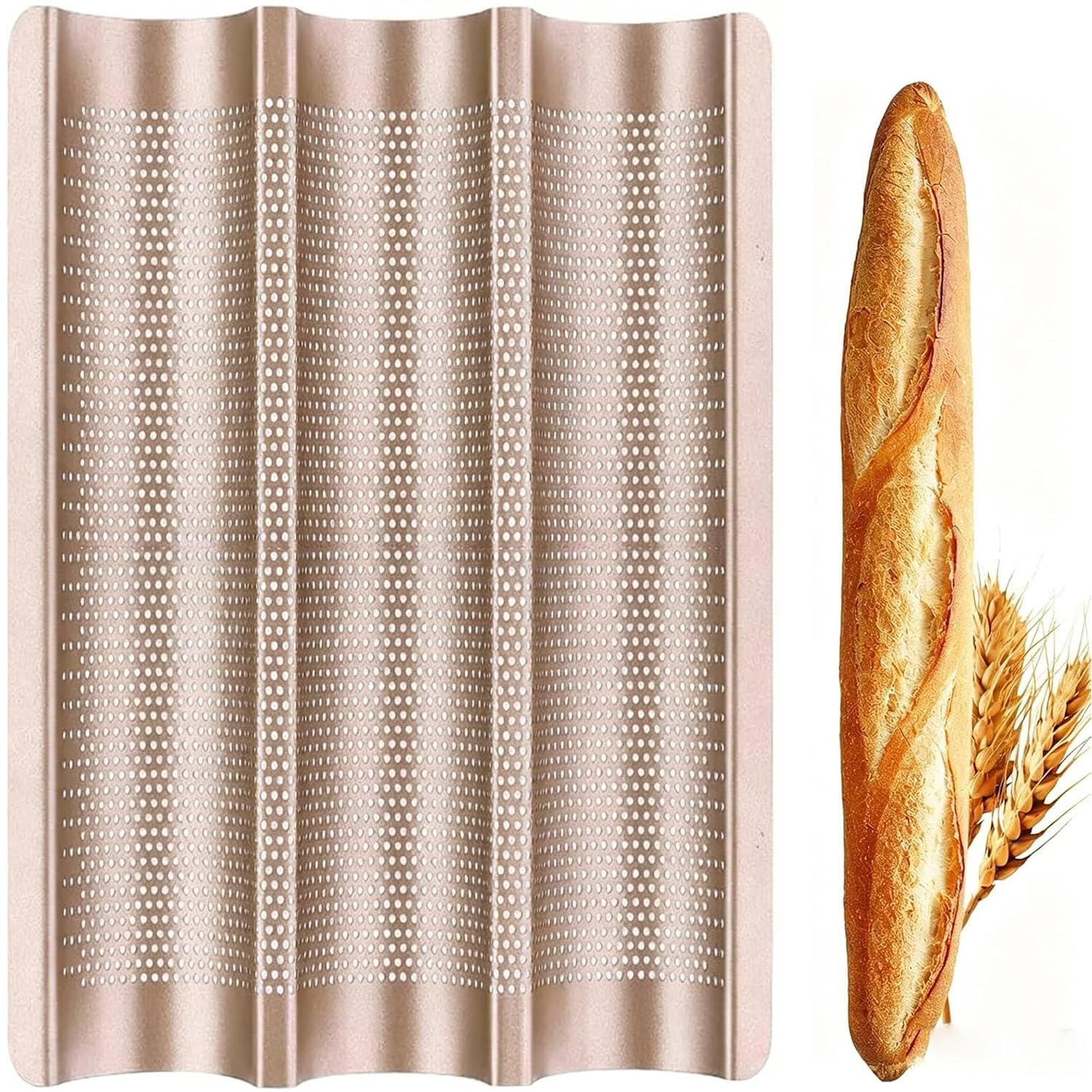
A 15 x 11-inch perforated tray that bakes three loaves and holds up to 446°F for hot sourdough bakes.
The 15 by 11 inch tray bakes 3 loaves at once and holds up to 446°F, so it keeps pace with hot sourdough bakes. Perforations across the base let moisture escape and air flow around the loaves, which helps them brown and crisp evenly. The smooth crimped edges are rounded rather than sharp, so they are easy on your hands when you slide it out. It is dishwasher safe for quick cleanup.
Sourdough is where it shines. Owners find it performs especially well for sourdough baguettes and value the easy clean. The food-grade nonstick releases loaves cleanly, though a light butter coat before the first bake sets it up better.
The mixed signals are worth noting. Some find the tray sturdy while others describe the coating coming up onto the bread after repeated use, so treat the nonstick gently and avoid metal tools. The build is best on gentle duty rather than a hundred-strong bakery run.
Where it delivers: three loaves, a 446°F ceiling, and a dishwasher-safe body tuned for sourdough.
The caution: the coating can lift over time, so keep tools soft and skip harsh scrubbing.
Strong fit: a sourdough baker who wants three loaves at a high-heat bake without a premium spend.
Consider others if: you use metal scrapers in the pan or expect coating to stay pristine for years.
10. Mrs. Anderson’s Baking Non-Stick Double Baguette Pan
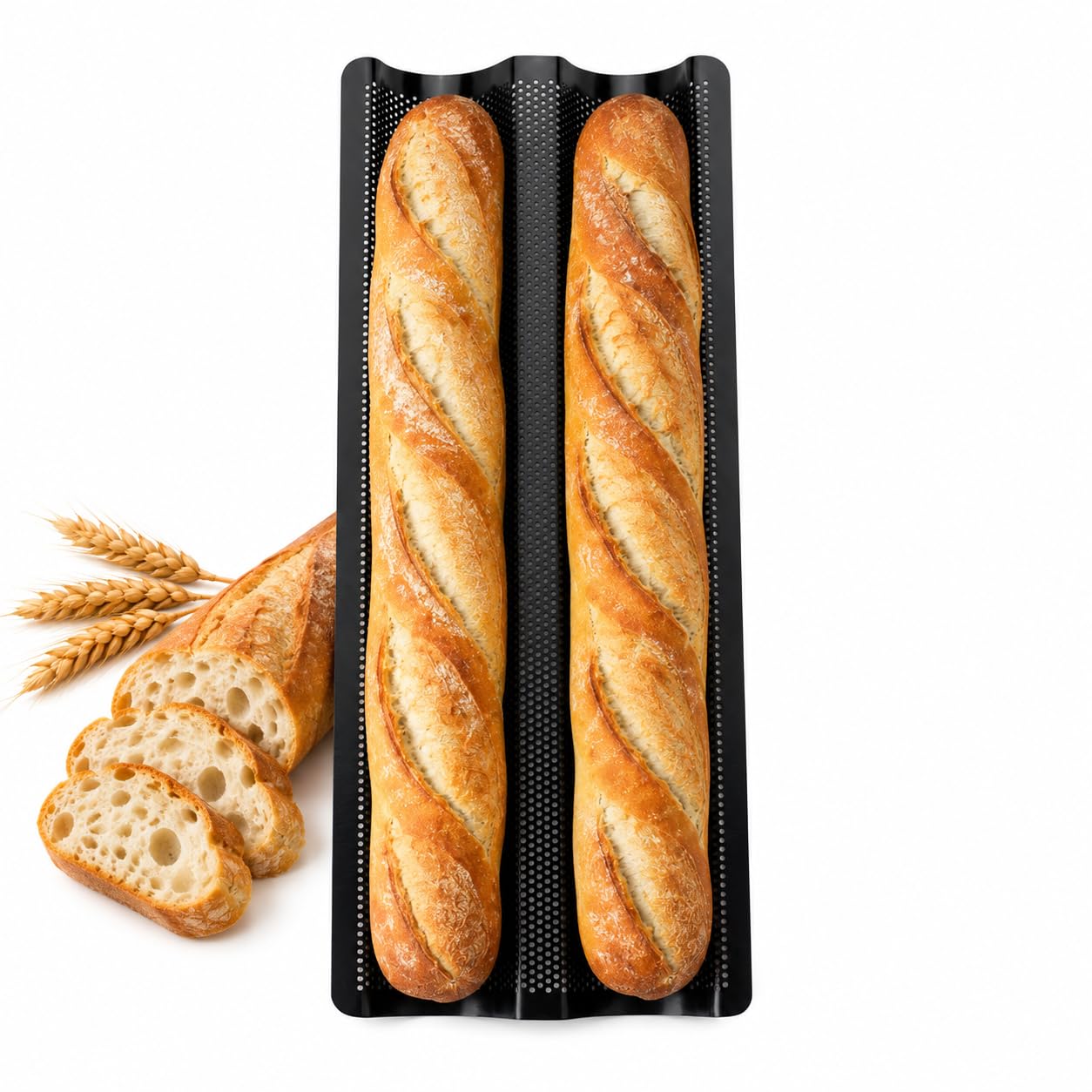
A two-loaf tray with a high heat ceiling and a coating you can feel good about.
The headline here is the coating: carbon steel body, premium PTFE and PFOA-free nonstick, and a heat ceiling of 480°F. Perforations let moisture escape for crisp, evenly browned bread, and the 1-millimeter-thick heavyweight build spreads heat evenly. It measures 15.375 by 6.25 by 1 inch and holds two loaves, so it suits a pair of baguettes rather than a full family batch.
The reinforced rim is the quiet hero. It keeps the tray from warping through hot cycles, which is the failure that shortens the life of thinner pans. Dough proofs and bakes right in the channels, and the nonstick releases it clean. Use wooden or nylon tools, never cut in the pan, and hand wash and dry it thoroughly to keep the surface intact.
Two limits worth flagging. The two channels mean you bake a pair at a time, so a crowd wants a second round or a wider tray. And the 6.25-inch width runs on the small side, which some bakers find tight for fat loaves. Measure before you commit.
The draw: a PTFE and PFOA-free nonstick, 480°F heat ceiling, and a reinforced rim that resists warping.
What to plan around: a two-loaf, 6.25-inch-wide tray you handle by hand rather than the dishwasher.
Suits you if: you want a clean-coating, high-heat two-loaf tray and don’t mind hand washing.
Widen the search if: you need more than two loaves or roomier channels for large baguettes.
11. Lekue 4 Cavity Micro Perforated Mini Baguette Baking Pan

A flexible four-cavity silicone mold for rolls, buns, and mini baguettes.
This mold is platinum silicone with micro perforations, so air moves through the holes for a crunchier crust. It holds 4 cavities and works just as well in the microwave, oven, or freezer, which makes it a go-anywhere piece. A special nonstick treatment means you only need to oil it once before the first use to activate it, and it is dishwasher safe afterward.
The size fits small-form baking. Owners like it for hot dog buns and stuffed pizza rolls, and its flexibility means it bends and stores almost anywhere. It cleans up in the dishwasher without a fuss.
The honest wrinkle is the holes. Wet dough can push down into the perforations, and that is a cleanup job you will not skip. It is also a mini format, so it shapes small rolls and buns rather than full-length baguettes. If you want slender table loaves rather than sticks, size up.
Why it works: platinum silicone, micro perforations, and multi-appliance use for rolls, buns, and mini loaves.
The fiddly bit: dough can stick in the holes, so plan a scrub after wetter batches.
Good for: bakers who want flexible, dishwasher-safe molds for hot dog buns, rolls, and mini baguettes.
Not ideal for: full-size baguettes or very wet doughs that clog the perforations.
12. FETESUR Silicone Perforated Baguette Pan

A bendy, featherweight mold that stores flat and cleans in the dishwasher.
Made from food-grade silicone and fiberglass, this 17.7-inch perforated mold is built to flex and last, and it cleans up in the dishwasher. The perforations let steam escape for a proper baked crust, and it moves between the microwave and the oven without missing a step. You can use it for sandwiches, French bread, and baguettes, and it rolls or folds flat when you are done.
The portability is the appeal. It is a flexible mold rather than a rigid tray, so it tucks into a drawer and suits sandwich-style loaves and Subway-style sub rolls. The nonstick surface releases bread cleanly and wipes down fast between bakes.
One honest note: silicone molds can feel floppy once loaded with a slack, wet dough, so set the mold on a sheet pan before you lift it to the oven. A few bakers also want more structure from the sides. It is a light, flexible tool, not a heavy-gauge steel sheet.
The upside: flexible, dishwasher-safe silicone that stores flat and handles sandwich loaves and baguettes.
The workaround: support it on a sheet pan when the dough is heavy or wet.
Goes well with: small kitchens that need flat storage and hands that dread scrubbing metal corners.
Different pick if: you want a rigid tray that holds its own shape in the oven.
13. Superstone Baguette Baker, Unglazed Stoneware
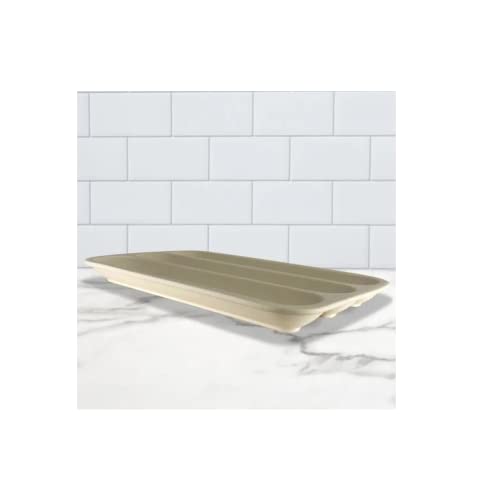
Stoneware that soaks up moisture to build the crackly crust of a serious bakery.
The 16.25 by 9.5 by 1.25 inch baker has room for 3 loaves at once, and the unglazed interior absorbs moisture so the crust crackles the way bakery bread does. It is fired at 2100°F, so it takes high oven heat in stride, though you should avoid open flames.
Stoneware behaves differently from metal from the very start. It wants seasoning before the first use, and each loaf goes in with a light oil on the bottom plus a sprinkle of cornmeal. Over time the finish darkens and slowly becomes its own nonstick surface, getting better with age rather than wearing down. The result is a deep, artisan crust that steel rarely matches.
Recognize what you are signing up for. Stoneware is heavier than a thin sheet, it wants hand care rather than a dishwasher cycle, and it takes a little break-in time before it stops clinging. It also asks you to avoid open flames. If you bake often and love a deeply crusted loaf, that care pays back.
Why it stands out: an unglazed stoneware body fired at 2100°F that absorbs moisture for a bakery-grade crust, darkening into its own nonstick over time.
The commitment: seasoning first, light oiling every bake, and hand care rather than dishwashing.
Goes to: the dedicated baker chasing a deep, crackly croûte who will happily season and hand care for stoneware.
Wrong pick if: you want a low-maintenance tray you can toss straight into the dishwasher.
14. Yupjlia Baguette Bread Pan, Nonstick Perforated, 2 Loaves

A slim 15 x 6.3-inch carbon steel tray that turns out two bakery-shaped baguettes for very little money.
The 15 by 6.3 inch footprint is the slimmest here, and it bakes two baguettes in one pass. Thickened carbon steel spreads heat through the vent holes at the base, pushing air around the dough for a crisp, golden shell and a soft, airy middle. It holds up to 446°F, which covers everything from sourdough to hoagie rolls. The food-grade, BPA-free nonstick releases bread cleanly and wipes down fast.
The size is the thing buyers like most, since two well-shaped loaves fit a normal oven shelf without crowding. It measures right at home on a standard rack, and it works just as well for proofing the dough as for the final bake. A quick butter rub before the first use sets the nonstick up nicely, and a parchment liner helps with wet, high-hydration dough.
One rookie mistake to dodge: do not overfill the grooves. Overloaded dough spills over the sides and ruins the loaf shape, so stay under the rim. It is also a two-loaf tray, so a family bake wants a second round. For a first pan at entry-level reach, though, it does the job.
Best quality: slim two-loaf carbon steel with a 446°F ceiling and a clean-release nonstick at the lowest reach on the list.
Keep in mind: fill the grooves only part way, and expect two loaves rather than a full batch.
Start here if: you want a low-cost, slim pan to learn on and mostly bake two baguettes at a time.
Step up instead if: you need a full three-loaf batch or heavier-gauge steel for frequent bakes.
Know the Specs
Perforation and Airflow
The small holes across the base are what separate a crackly baguette from a soggy one. They let steam escape from under the loaf and pull hot air around the dough, so the crust sets and browns while the inside stays soft. A pan with more, evenly spaced holes (like the CHEFMADE’s ultra-ventilated base) bakes a crisper shell than a solid tray every time.
Channel Count and Width
Channels are the curved grooves that shape each loaf. Two grooves suit a small household; three and four let you bake a family batch at once. Width matters just as much: a slim 2-inch channel makes classic thin baguettes, while a wider 2.8-inch groove handles sub rolls and hoagies. Match the width to the bread you actually eat.
Material and Heat Behaviour
Carbon steel heats fast and evenly, aluminum warms quickly and stays light, and cast iron holds heat like a brick but weighs more. Unglazed stoneware absorbs moisture for a deep artisan crust but wants seasoning and hand care. Silicone bends, stores flat, and cleans easily, yet it can feel floppy once loaded with wet dough.
Oven Temperature Rating
The heat ceiling tells you how hot the pan can safely go. Ratings here run from 446°F up to 480°F, and stoneware is fired to 2100°F for high oven heat. If you bake hot and fast for a dark crust, check this number before you buy, and always stay under the rated limit to protect the nonstick finish.
Common Questions
Do I really need a special pan to bake baguettes?
How many baguettes does a standard pan bake at once?
What is the difference between a perforated pan and a solid one?
Will a baguette pan fit in my home oven?
Can I proof dough directly in a baguette pan?
Do I need to grease the pan before baking?
Are silicone baguette pans as good as metal?
How do I keep my baguette pan from rusting?
What is the best way to stop dough sticking in the grooves?
Can I bake sub rolls or hoagies in a French bread pan?
The Bottom Line
For most home bakers, the baguette baking pan that earns its place is the Chicago Metallic Commercial II, because its heavy-weight aluminum spreads heat evenly across three channels and the perforated base delivers the crackly crust that defines a real baguette. If you want steam-sealed, bakery-grade crust, reach for the HAWOK Enameled Cast Iron Baker. And when you want to start from nothing at the lowest reach, the Yupjlia gets you baking two well-shaped loaves without spending much at all.
How we choose
We do not accept paid placement. Every pick is matched to a real buyer and a real use-case; we do not hands-on test units.
Sources
Specifications: manufacturer listings and product documentation. Review insights: verified customer reviews, as of October 2026. Pricing: not shown on this page (it changes often); check the current price via the retailer link.
As an Amazon Associate, Aappliancez earns from qualifying purchases. This does not affect which products we feature.