Disclosure: Some links in this post are affiliate links. As an Amazon Associate I earn from qualifying purchases, at no extra cost to you. Learn more
Specs are compiled from manufacturer listings and verified buyer reviews and can change over time — please confirm the key details on the product page before buying.
Your back hurts, and you want a belt that holds your lower spine steady while you lift, drive, or stand through a long shift. The short answer: buy on fit first, then on how the belt keeps itself from sliding up. A back support belt only helps when it sits in the right spot and stays there — a loose or rolling belt just shifts the pressure onto your ribs or hips. Below are five belts that do that job, sorted by what each one is genuinely best at.
This guide is built by comparing the manufacturers’ published specifications and the patterns across verified customer reviews, so you get each pick’s real strengths and trade-offs instead of marketing spin.
Sizing is where most returns start, so measure your waist at the navel before you pick anything. Here is the honest breakdown of the back support belt category, with the fit quirks of each design spelled out plainly.
Top Picks
How To Choose The Best Back Support Belt
Two back support belts can look identical on a listing and feel completely different on your waist. Three things decide it: where the belt sits, how much vertical structure it carries, and whether it stays put when you bend. Get those right and you will actually wear it. Get them wrong and it ends up in a drawer.
Measure at the navel, not your pants size
A back support belt wraps around your belly button, not your hips, so your jeans size tells you very little. The FITTOO belt, for example, runs from a Small at 27.5″ to 33.25″ up to a 2XL at 41.5″ to 46.5″, measured around the navel with a soft tape. Take that measurement standing up, and if you land at the edge of a range, size up.
Brand charts also disagree with each other. The FEATOL chart sends one buyer’s husband to a Large when he wears an XXL in everything else, so real owners often ignore the chart and order their clothing size instead. Expect to double-check before you commit.
Vertical stays versus a lumbar pad
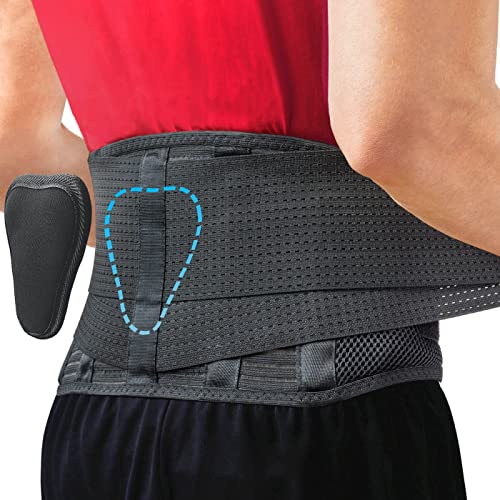
Vertical stays are stiff strips sewn into the back panel that keep the belt from rolling or bunching as you move. A lumbar pad is a small cushion that presses into the curve of your lower back for extra compression. The Sparthos belt uses both — vertical moves plus an adjustable lumbar pad — and the FEATOL pairs four support strips with its own removable pad.
Will you wear it under clothes or over them?
This decides the whole design. Slim belts like the Lightweight Back Brace at 4 inches wide and 220g slip under a shirt for the office or a commute. Bigger, stiffer builds like the MUELLER go over a shirt and stay there, which suits lifting and yard work but shows under fitted clothing.
Side-by-Side Comparison
| Model | Best For | Support Structure | Weight | Closure | Amazon |
|---|---|---|---|---|---|
| Sparthos Back Brace★ Best Overall | All-day wear under clothes | Vertical stays plus adjustable lumbar pad | 390 g | Hook & Loop | Amazon |
Detailed Reviews
1. Sparthos Back Brace Black-S
Our pick — 4.0+★ from 69,000+ verified ratings; the strongest balance of quality and price.
The belt that holds its line through a full shift without riding up your ribs.
The trick that keeps this belt in place is vertical support stays — stiff ribs sewn into the back panel that stop the fabric from rolling or bunching. Pair that with an adjustable lumbar pad that presses into the curve of your lower back, and you get compression exactly where you want it. It is the pre-computed winner here for good reason: the crowd favorite at 4.0+ stars across 69,000+ owners, with quality the thing buyers praise most and support a close second.
This belt’s real strength is wearing it under your clothes. A size-S wearer at 5’7″, 133lb and a 31″ waist found it invisible under fitted clothing, so it disappears under a work shirt. The double-strap closure adjusts far enough that one husband who wears an XXL in everything else skipped the brand’s chart, ordered his own size, and got a perfect fit. At 390g it feels firm without locking you in. The build is nylon, plastic and polyester at 0.15-inch thick, which keeps it slim against your spine.
Honest limits: this belt runs warm. Long walks will leave you a little sweaty under the mesh, and the stiffness that prevents rolling also means you feel it more when you bend deep. Sizing is the other mixed signal — plenty of owners find it true to size, others find it generous, so measure rather than trust the chart. Compared with the slimmer Lightweight Back Brace below, the Sparthos trades a touch of discretion for noticeably more structural support.
The case for this one
- Vertical stays plus adjustable lumbar pad keep the belt from rolling or riding up.
- Double-strap closure adjusts to fit, and it stays invisible under fitted clothes.
- Breathable fabric keeps sweat in check during normal wear.
- Firm support that does not feel restrictive on your lower back.
Where it gives a little
- It runs warm during longer walks and sweaty shifts.
- Sizing feedback is split between true-to-size and too large.
- Stiff enough that deep bending feels noticeably stiffer.
Reach for this if: you want one belt that works under work clothes, on the gym floor, and through a lifting session without constant readjusting.
Consider the slimmer pick if: heat bothers you or you need the belt to vanish under a dress shirt all day.
2. FEATOL Back Brace

Six sizes from a 24.4-inch waist to 74.8 inches — this is the belt for hard-to-fit bodies.
Most belts offer three sizes and hope. FEATOL sells from a Small/Medium that fits 24.4 to 29.8 inches around the navel all the way to a 5XL that fits 68 to 74.8 inches. That range is the single most useful thing about it for anyone who has fought a chart and lost. Inside the shell sit four strong support strips plus a removable lumbar pad, so it wraps the lower back with real all-around compression rather than a single pressure point.
The elastic neoprene inner band flexes with you while the outer hook-and-loop strap gives a wide adjustment range, which is why it stays put through prolonged standing and walking. Buyers with sciatica and low-back pain report roughly 75% pain relief right after putting it on. The material is breathable, so it will not turn into a hot compress on a mild day. It weighs 16 ounces and measures 10 x 9 x 2 inches — a compact footprint next to the taller MUELLER below at 7.88 x 2.88 x 9.88 inches, though both weigh the same 16 ounces.
The catch is the sizing chart itself. The stated ranges are accurate, but some owners find the cut runs small, so you will want to err toward the larger of two sizes if you are at a boundary. Several also note it needs to sit against a base layer to avoid slipping during heavy movement.
Best for: anyone hard to fit — big bellies, small frames, and everything across the middle.
Skip if: you want a belt stiff enough to hold a heavy deadlift with no give.
3. MUELLER Sports Medicine Lumbar Back Brace with Removable Pad
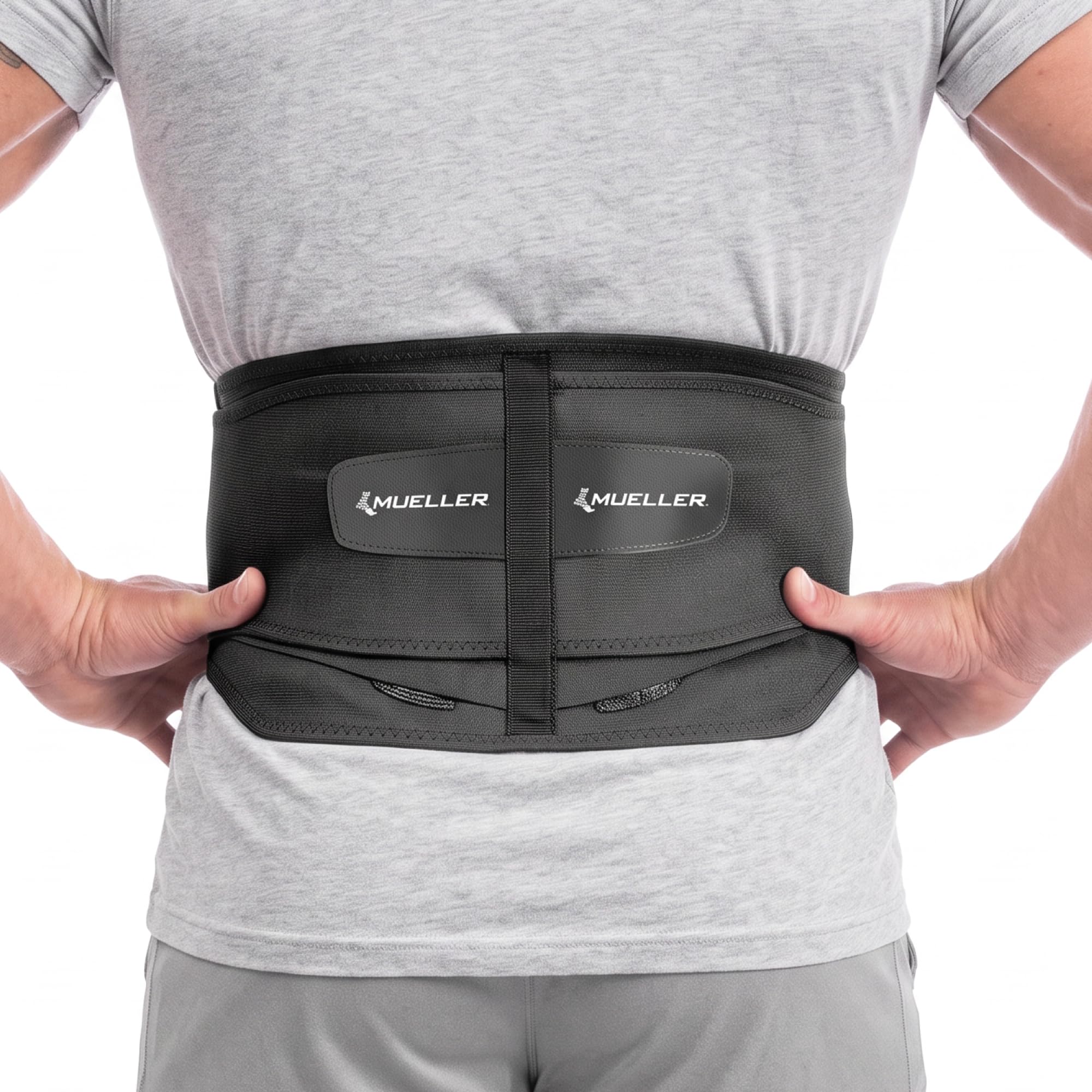
Four steel springs do the heavy pushing, and this belt cinches tighter than the rest.
Where the Sparthos uses flexible stays, the MUELLER builds its back panel around four steel springs — firm, springy supports that deliver targeted compression you can feel through the strap. owners with sciatica find it excellent behind the wheel, cinching tight enough to hold posture for a long drive. A 6’4″, 275lb owner in the Plus size at a 44-46″ waist says it holds his spine straight and keeps discs from slipping. The stitching and heavy velcro get a lot of praise — the quality is what wins people over most.
Here is the trade-off. This belt is bulky, stiff and heavy enough that it belongs over a shirt, not under dress clothes. It also covers part of the lower stomach, so your measurement has to account for belly girth; the 50″ maximum on the largest size looks generous to some owners. The proportions run 7.88 x 2.88 x 9.88 inches, and it weighs 16 ounces.
Two careful notes from the user side: a 77-year-old wearer rates it four stars purely for bulk, loving the support, and physical therapy guidance in the wider community warns against wearing any rigid brace constantly. Treat it as a stop-gap for lifting and driving, not a 24-hour uniform.
What it nails: Firm, spring-loaded compression with tight seams and ample velcro — the build is this belt’s strongest selling point. It fits a 34″ waist with room to spare and slips on and off easily.
What to plan around: The bulk. Wear it over a shirt, and budget for a little extra room across the belly in sizing.
Pick it for: lifting, driving long distances, and anyone who wants the firmest push this line-up offers.
Not it for: under-clothing wear or a dress code that needs a low profile.
4. Lightweight Back Brace for Lower Back Pain Under Clothes

A 220g, 4-inch-wide belt that hides under a T-shirt and still holds your lower back.
If the MUELLER above is the workhorse, this is the commuter. At 220g and 4 inches wide, it is built to disappear — a size that fits under a T-shirt, under a belt line, even under a holster, according to owners. The bottom strap is perforated neoprene, a stretchy rubber-like foam with holes punched through it, so it moves with your hips as you bend and twist while staying breathable. None of that would matter if it did not support, and here it delivers: for its size, the lumbar support at the belt line surprises people.
What sold the design on the slimmer build is wearability. One wearer with missing lower-back discs and a daily bending job got through a full shift pain-free; another with degenerative discs rates it above the MUELLER for non-exercise use. The velcro holds securely, quick on-and-off makes it practical for a commute, and because it sits so low-profile, it works for golf, gardening, housework or a desk day.
The honest caveats are few but real. A physical therapist advised one wearer not to keep it on full time, so this is a support for hard stretches, not all day every day. A small group finds the 4-inch width too narrow for their liking, and the maker notes a mild new-neoprene smell out of the pack that airs out over a few days. This is a support belt, not a cure.
Great fit for: office workers, commuters, and anyone who wants support that stays invisible.
Hard pass if: you need maximum compression for heavy lifting — go for the spring-loaded picks.
5. FITTOO Back Brace with Removable Suspenders & Lumbar Pad
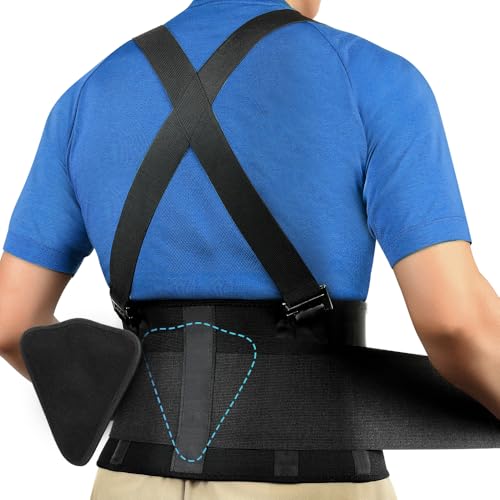
Criss-cross suspenders hold this belt down through bending, lifting and warehouse shifts.
Most belts slide up as you move. The FITTOO adds a pair of removable criss-cross suspender straps that run over the shoulders — not just extra support, but an anti-slide system. Four flexible stays keep the lower back upright or extended, and a contoured lumbar pad presses into the curve of your spine for steady compression. Double-pull level-two tension straps let you dial the tightness in two stages like a real lifting belt.
It is built for the workday, not the desk. Owners in warehouse, construction, moving and sanitation jobs report it stays firmly in place through bending and lifting, with the build feeling sturdy and supportive without excess bulk. The suspenders and pad both come off, so you can strip it down to a plain belt when the work changes. Sizing runs S at 27.5″ to 33.25″ up to a 2XL at 41.5″ to 46.5″, measured around the navel.
The proof here is thinner than the top picks, with a smaller pool of reviews behind it, so treat it as a strong specialist rather than a battle-tested crowd favorite. And if you plan to hand-wash it, do so sparingly — the polyester build and velcro deserve a gentle hand rather than a hot machine cycle.
Why it earns a spot
- Removable criss-cross suspenders stop the belt sliding during heavy movement.
- Four flexible stays keep your lower back supported through long shifts.
- Contoured lumbar pad adds targeted compression to the lumbar curve.
What to weigh up
- A newer model with a smaller review pool than the established picks.
- Suspender straps take a little extra setup time to position correctly.
Built for: warehouse, construction, moving and sanitation workers who bend and lift all shift long.
Think twice if: you mostly want a discreet belt under office clothes.
Know the Specs
Vertical Stays and Support Strips
These are the stiff ribs sewn into the back of a belt — the Sparthos calls them vertical support stays
Common Questions
Should I measure my waist or my pants size?
How long can I wear a back support belt each day?
Can I wear a back support belt under my clothes?
What is the difference between vertical stays and a lumbar pad?
Will a back support belt help sciatica?
Which size should I order if I am between two sizes?
Do removable suspenders really stop the belt sliding up?
Can I machine-wash my back support belt?
The Bottom Line
Want one back support belt that covers under clothes, the gym and a lifting session? The Sparthos Back Brace is the pick, with vertical stays (stiff upright strips that hold the belt’s shape) and an adjustable lumbar pad keeping it stable and comfortable. Hard-to-fit body? The FEATOL Back Brace covers a 24.4-inch to a 74.8-inch waist. And for heavy lifting, moving or construction, reach for the FITTOO Back Brace and its anti-slide suspenders, which keep it from riding up as you bend.
How we choose
We do not accept paid placement. Every pick is matched to a real buyer and a real use-case; we do not hands-on test units.
Sources
Specifications: manufacturer listings and product documentation. Review insights: verified customer reviews, as of October 2026. Pricing: not shown on this page (it changes often); check the current price via the retailer link.
As an Amazon Associate, Aappliancez earns from qualifying purchases. This does not affect which products we feature.