Disclosure: Some links in this post are affiliate links. As an Amazon Associate I earn from qualifying purchases, at no extra cost to you. Learn more
Specs are compiled from manufacturer listings and verified buyer reviews and can change over time — please confirm the key details on the product page before buying.
If you are buying a brace because a compression fracture has left your mid-back aching and your posture caving forward, the short answer is this: the LSO Back Brace with Maximum Decompression Plate is the pick most people should start with. It targets the lower spine that a thoracic fracture so often drags out of line, and it goes on without help. The rest of this page sorts the seven serious options by the two things that actually matter — how much of your spine the brace covers, and whether you can put it on by yourself.
This guide is built by comparing the manufacturers’ published specifications and the patterns across verified customer reviews, so you get each pick’s real strengths and trade-offs instead of marketing spin.
Thoracic fractures sit high on the back, so a belt that only wraps the waist leaves the injured level unsupported. The braces below split into those two jobs, and each entry tells you which spine levels it covers and how the tightening works. That is the whole decision, and it shapes every pick in this back brace for thoracic compression fracture.
Top Picks

How To Choose The Best Back Brace for Thoracic Compression Fracture
A thoracic compression fracture is a crack or collapse in one of the vertebrae of your upper-to-mid back. The job of a brace here is to hold that section steady, keep you from slumping forward, and take load off the injured bone while it heals. The mistake almost everyone makes is buying a low-back belt and expecting it to reach a fracture that sits several inches higher.
Coverage height is the first thing to check
Braces come in two broad families. An LSO brace (lumbosacral orthosis) wraps the lower back and pelvis. A TLSO brace (thoracolumbar sacral orthosis) climbs higher, over the mid and upper back, often with shoulder straps or a sternal bar. For a thoracic fracture you generally want the taller TLSO shape, because it can push your spine upright instead of only squeezing your waist. The LSO picks on this list still earn their place when the fracture has also thrown your lower back into spasm.
How the tightening works, and why it matters
Most braces here use a pulley system — a set of cords and finger tabs you pull to cinch the brace tight. That design means you do not need to twist or bend to apply it, which matters a lot in the weeks after a fracture. The Nvorliy adds an inflatable airbag you fill with a hand pump, so you can dial compression up or down without re-strapping. If your hands or shoulders are weak, look for a pulley or pump over a plain Velcro wrap.
Measure before you order
Every brace on this page is sized by a body circumference, not by clothing size. Run a soft tape around the point where you will actually wear the brace and match it to the maker’s chart. A brace that is too loose slides and gives no support, and one that is too tight digs in and gets left in the drawer. Several picks list a range that runs wide, so read the chart carefully rather than guessing.
Comfort versus rigidity
Hard front panels and clamshell shells hold your spine straighter, but they are bulky and hot. Softer foam-backed belts are easier to wear for hours and less noticeable under clothes. Think about where you will spend your day — if you sit at a desk or drive, a full rigid jacket can dig into your lap and seatback. If you are mostly upright and walking, the extra rigidity usually helps more than it hurts.
Side-by-Side Comparison
| Model | Best For | Spine Coverage | Sizing | Tightening System | Amazon |
|---|---|---|---|---|---|
| LSO Back Brace with Maximum Decompression Plate★ Best Overall | Lower-back support after a fracture | L1–S1 (lower spine) | 2XL/3XL fits belly 47″–59″ | Dual pulley system | Amazon |
| BraceAbility Lumbar Decompression Back BracePost-Surgery Pick | Post-surgery lumbar recovery | Lumbar (lower back) | Large fits 40″–45″ | Dual-pulley system | Amazon |
| Comfyorthopedic LSO Back Brace | Adjustable one-size lumbar fit | L1–L5 (lower spine) | One size, 25″–48″ abdomen | Dual drawstrings | Amazon |
| TLSO Thoracic Full Back Brace | Mid-back fracture support | Thoracic and lumbar | Large fits 35″–39″ | Mechanical pulley system | Amazon |
| Nvorliy TLSO Full Back Brace | Air-adjustable full-spine support | T2–S1 (full spine) | Medium fits 33″–41″ | Airbag plus pulley | Amazon |
| BraceAbility TLSO Hard Clamshell Jacket | Rigid full-back immobilization | Entire back (upper and lower) | Medium fits 35″–40″ | Dual-pulley system | Amazon |
| TLSO Full Back Brace for Spinal Stenosis & Fractures | Taller-frame thoracic stabilization | Thoracic and lumbar | X-Large fits 45″–50″ | Built-in pulley | Amazon |
Detailed Reviews
1. LSO Back Brace with Maximum Decompression Plate
Our pick — 4.0+★ from 600+ verified ratings; the strongest balance of quality and price.
The lower-back workhorse that most fracture recoveries end up needing, sized generously for a fuller belly.
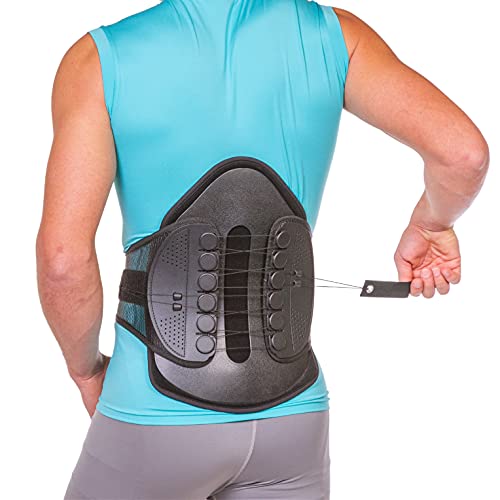
Start with what the LSO brace actually does: it stabilizes the L1–S1 vertebrae, the stack of bones running from your lower back down into your pelvis. When a thoracic fracture has your whole spine guarding and your lower back taking the strain, that base support keeps you from folding the wrong way. The bionic decompression plate sits against that lower segment and holds it steady, so everyday bending and lifting feel controlled rather than risky.
What wins people over is how fast the lower-back relief arrives. Desk workers and people bracing through physical therapy say the support kicks in on the first wear and lets them move with less pain. One buyer summed up the change plainly: “Amazing and you see and feel the difference first time using I had to use extension for the belt two days later I didn’t need it no more.” That fast, self-applied relief is why it earns the top spot.
The dual pulley system is the other smart piece. Finger tabs let you pull the brace tight without wrenching your shoulders, which is a real help if grip strength or upper-body reach is limited after an injury. There are three support levels, including a 26-degree bionic lumbar stretcher for alignment work and a flatter arc for protection. Worth knowing: an occasional unit has cracked with heavy use, and the larger 2XL/3XL size fits a belly of 47″–59″, so measure first rather than guessing up a size.
What sold owners
- Pulley tabs tighten the brace single-handed, so you can put it on without help.
- Three arc settings let you switch between deep lumbar correction and lighter protection.
- Extension belly piece removes as swelling and size change over recovery.
Where it falls short
- A few report the plate assembly cracking over months of hard use.
- It is an LSO, so the highest thoracic level is not directly supported.
Reach for this if: your fracture has left the lower back guarding and you want one brace you can cinch alone.
Go taller instead if: the fracture sits high enough that you need shoulder-strap pull over the mid-back.
2. BraceAbility Lumbar Decompression Back Brace
A wrap-around decompressor built for the discectomy crowd, with a pulley that triples the squeeze.
If you are coming out of back surgery and want support that conforms on its own, this BeltAbility brace earns its following. The dual-pulley system is the headline: by pulling the cords, BraceAbility says you can triple the compression and support you feel, so you dial in the amount you need rather than fighting a fixed strap. It goes on with a wraparound motion, so there is no twisting or bending to lock it down.
Owners recovering from disc surgery and living with sciatica or stenosis consistently report it does its main job. The strong pull is easier to work than cheaper wraps, and one buyer calls it the equivalent of a brace they were given at physical therapy. A recurring practical note: the plastic stays rigid for support but can crack if you lie back on a hard surface, so keep your back off hard floors while it is on. It is hand wash only, which is worth planning for.
Do not expect a truly universal fit. Large runs 40″–45″, and the firm compression that helps many wearers digs in on smaller or wider frames. Think of it as a supportive, snug garment: effective when the size matches you, unpleasant when it does not. The mesh back panel has drawn mixed feedback for feeling flimsy to a few, yet the brace itself holds up for most daily wearers.
Why recovery buyers like it: the wraparound pulley lets you apply strong, adjustable compression without twisting your freshly healing spine.
The honest catch: it is a lower-back belt, so treat it as post-op lumbar support rather than a full thoracic jacket.
Best for: anyone rehabbing a lower-lumbar surgery who needs to self-apply firm support.
Look elsewhere if: your frame runs small or wide enough that the fixed 40″–45″ Large range is a gamble.
3. Comfyorthopedic LSO Back Brace

The size-flexible brace that fits most torsos from one shell, with side pads that steady the spine.
One brace that adjusts from 25″ to 48″ around the abdomen is the reason this Comfyorthopedic model stands out for anyone whose body size shifts during recovery. That patent-listed adjustability means you do not buy a new belt as swelling goes down or appetite returns. It covers the L1–L5 lower spine with a detachable hard foam cushion that contours to your joints, plus two removable side pads that add stability.
What owners praise most is the support itself — the rigid contacts let it hold the lower back firmly while you stand and work. A double-fusion patient found it a genuine help doing chores, and the pull string design keeps the pressure even rather than pinching at one spot. It is FSA and HSA eligible and carries a one-year warranty against manufacturer defects like a broken bolt. Clear written and video fitting instructions are included, which is more than many braces offer.
The trade-offs are real and worth sizing up. The shell is bulky and fairly heavy, and taller users note the fixed height does not extend support where a longer torso needs it. A few mention thin side straps and the occasional break after a week, so treat the straps gently. In short: superb adjustability and support, provided you are not looking for a featherweight belt.
What earned the praise: the one-size range and removable side pads make a snug, stable fit across changing body measurements.
The follow-up question: how long will it sit in your day? The bulky build is best worn in short active stints rather than all-day lounging.
Wear this when: you want firm lumbar bracing without committing to one precise size chart.
skip it if: you are tall and need the brace to reach higher up your back.
4. TLSO Thoracic Full Back Brace

The taller thoracic brace that pulls a slumped spine upright with shoulder straps and a front bar.
This is the pick to look at when the fracture truly sits in the mid-back. Unlike the lower-back belts above, the TLSO Thoracic Full Back Brace reaches your thoracic spine and uses a mechanical pulley system to squeeze from multiple points. Shoulder straps and a front bar combine to pull the spine up straight, easing the loading that comes with a compressed vertebra.
Owners with kyphosis, osteoporosis, and compression fractures report less mid-back pain within a couple of days of wearing it. The build quality draws consistent praise, and one wearer found the orthopedic look familiar: “I LOVE IT BECAUSE I LOOKED EVERY WHERE AND WHEN IT SENT IT ON AMAZON I KNEW I HAD TO HAVE IT THE COST WAS AMAZING IT FIT PERFECT MY BACK IS STARTING TO STAIGHTEN UP.” For a lot of people that postural lift is the whole reason to choose a tall brace over a belt.
Plan around the bulk. The front plate can feel constricting until your body adjusts, and it sits high enough that drivers should think about airbag safety. Sizing runs S through XXL (Large fits 35″–39″), so measure your waist at its narrowest point. And because the front plate does the structural work, keep an eye on it over long daily wear — a cracked front panel has been the one repeated durability note.
Why the lift matters
- Shoulder straps and front bar pull the thoracic spine upright instead of only wrapping the waist.
- Quick-release buckles make it faster to put on and take off than lace-up shells.
- Breathable padding and a spinal cutout reduce heat compared with a solid jacket.
What to expect back
- Bulk and a constricting front piece until you get used to the fit.
- Front plate has cracked under heavy all-day use in a noted case.
Pick this for: a confirmed thoracic or mid-back fracture that needs the spine held tall.
Think twice if: you drive a lot, since the high front plate can interfere with seating and airbags.
5. Nvorliy TLSO Full Back Brace
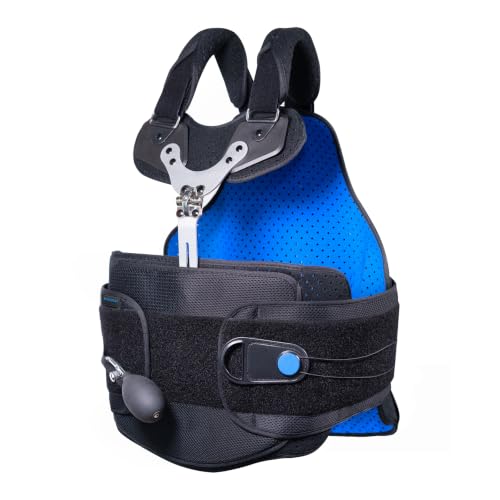
An inflatable full-spine brace you fine-tune with a hand pump, from mid-back down to the tailbone.
The Nvorliy is the only pick here with an inflatable decompression airbag. A hand pump inflates the backing so the fit and pressure adjust without re-strapping, and a pulley system handles the baseline squeeze. Coverage runs T2–S1, spanning the thoracic and lumbar spine in one shell. A height- and angle-adjustable sternal bracket (the vertical piece over your chest) lets you adapt the alignment as your recovery needs change.
What wins people over is the support the airbag delivers. Buyers describe the inflatable backing as supportive, adjustable, and easy to use, and one T6-fracture wearer says their doctor approved it. Shoulder straps are softly padded so they do not dig in, and the breathable eyelet lining is removable for cleaning. It also comes with a 30-day satisfaction guarantee for a replacement or refund if the size misses.
Here is the honest limit: because the shell runs full-length down to the tailbone, sitting is awkward. Users report it becomes uncomfortable past a few minutes in a chair or the driver’s seat, as the bottom edge rides up. The Medium fits a waist of 33″–41″, so measure before you buy, and some find it runs large. If you stand and walk through most of your day, that trade-off rarely bites.
The standout feature: the pump-and-airbag combo lets you change compression on the fly, which is handy when swelling or activity changes through the day.
Know before you order: it is a standing-and-walking brace, not a sitting one — the full-length shell pushes into a chair.
Best matched to: an active recovery where you want precise, adjustable full-spine pressure.
Not for you if: sitting or driving fills more of your day than walking.
6. BraceAbility TLSO Hard Clamshell Jacket

A serious immobilizer that wraps your whole back like a shell, for fractures that need near full rest.
The BraceAbility hard clamshell jacket covers the whole spine, upper and lower, and its dual-pulley system lets you set the compression wherever your recovery sits. It applies like a backpack with soft shoulder straps, so you put it on without twisting or bending.
The quality and sturdiness earn steady praise. Owners note it feels strongly built and the Velcro adjusts across a wide range.
The flip side is fit and ease. The clamshell is sized Medium for a 35″–40″ waist and does not suit every body, with taller users finding the top strap cuts high. It takes some fiddling to position the many straps, and if it lands off-center it will not cinch right. Warmer wearers will notice the heat. Consider it when your doctor specifically wants full-back immobilization, not for casual all-day wear.
Where it earns its keep: the hard shell and full-back coverage hold the spine rigidly, exactly what a fracture needing immobilization calls for.
What you give up: comfort and quick on-off — the strap count and fit range take patience and match well to a specific torso.
Choose this when: you need the most rigid, full-back hold the category offers.
Turn away if: you are tall or want something you can throw on quickly and forget.
7. TLSO Full Back Brace for Spinal Stenosis & Fractures

A tall TLSO sized for a broader waist, with rigid panels and a pulley for thoracic stabilization.
If your waist runs larger, fitting a tall brace gets hard fast. This Brace Align TLSO is sized by an X-Large waist of 45″–50″, and it spans both the thoracic and lumbar spine for fracture and post-op stabilization. Medical-grade rigid panels hold the upper and lower back steady, which is the job when a compressed vertebra needs to stay put while you heal.
The build earns genuine respect. One wearer put it simply: “Was too large for my small frame but made with very good material and quality.” The ventilated neoprene is meant to keep you cool and dry through long recovery sessions, and the built-in pulley lets you tighten or loosen on your own rather than needing a helper. It also includes a free video fitting session with a Brace Direct professional, so you can dial in the adjustment rather than guessing.
The catch is that it only comes in one very specific size and a tall torso is required to use it well. If your waist does not land in that range, this brace will not work no matter how well it is built. Look for a pick with a wider sizing band if you cannot confirm your measurement first — and measure at the spot you will actually wear it.
The quality read: rigid panels and breathable neoprene give firm thoracic control without trapping heat the way a solid shell can.
The size warning: it is built around a 45″–50″ waist, so it is a match made for one body range, not a universal fit.
Made for: a larger-waisted wearer who needs a tall TLSO with rigid, ventilated panels.
Pass on it if: your waist sits outside 45″–50″ or you want a brace with more size flexibility.
Know the Specs
TLSO versus LSO coverage
The letter code tells you how high the brace reaches. An LSO (lumbosacral orthosis) wraps the lower back and pelvis, like the LSO and BraceAbility belts here. A TLSO (thoracolumbar sacral orthosis) climbs over the mid and upper back, often with shoulder straps or a sternal bar, like picks four through seven. For a thoracic fracture, the taller TLSO shape can pull the spine upright rather than only squeezing the waist.
Pulley and airbag compression
A pulley system uses cords and finger tabs so you can cinch the brace without twisting your body. That matters after a fracture, when bending to apply a brace is the last thing you want. The Nvorliy adds an inflatable airbag filled with a hand pump, letting you adjust compression on the fly. Stronger tightening gives more support, but over-tightening digs in — listen to your body and adjust down when it gets uncomfortable.
Circumferences and sizing
Every brace here is sized by a body measurement in inches, not by clothing size. Run a soft tape around the point where the brace will sit and match it to the maker’s range. A loose brace slides and does nothing; one that is too small will not close. Note that some picks use belly circumference and others use waist at its narrowest, so read the specific chart before you order.
Rigid panels and heat
Hard front plates and clamshell shells hold your spine straighter but add weight, bulk, and warmth. Ventilated neoprene and breathable linings ease the heat, but a full jacket will still run warmer than a foam belt. If you sit or drive a lot, a rigid front plate can press into your seat and lift over your lap. Match the rigidity to how much stabilization your recovery actually calls for.
Common Questions
Do I need a TLSO or an LSO brace for a thoracic compression fracture?
Can I put a full back brace on by myself?
How do I measure for a back brace size?
Is it okay to wear a brace for a compression fracture all day?
Will a full back brace help with kyphosis and forward posture?
Can I sit or drive while wearing a thoracic brace?
How long will a back brace last with daily use?
Are these back braces covered by FSA or insurance?
What is the difference between a pulley brace and a Velcro strap brace?
The Bottom Line
The back brace for thoracic compression fracture decision really splits in two. For lower-back guarding and a brace you can cinch without help, the LSO Back Brace with Maximum Decompression Plate is the crowd favorite — 4.0+ stars across 600+ owners — and the one most recoveries should start with. If the fracture truly sits in your mid-back and you need the spine pulled upright, reach for the taller TLSO Thoracic Full Back Brace. And if your waist runs larger and you want rigid, ventilated thoracic support, the Brace Align TLSO is built for that exact frame. Confirm your fracture level and your waist measurement with your medical team, then buy the brace that matches both.
How we choose
We do not accept paid placement. Every pick is matched to a real buyer and a real use-case; we do not hands-on test units.
Sources
Specifications: manufacturer listings and product documentation. Review insights: verified customer reviews, as of October 2026. Pricing: not shown on this page (it changes often); check the current price via the retailer link.
As an Amazon Associate, Aappliancez earns from qualifying purchases. This does not affect which products we feature.