Disclosure: Some links in this post are affiliate links. As an Amazon Associate I earn from qualifying purchases, at no extra cost to you. Learn more
Specs are compiled from manufacturer listings and verified buyer reviews and can change over time — please confirm the key details on the product page before buying.
If you are shopping for a back brace after a fractured vertebra, the thing that matters most is rigid, controlled stabilization — not soft elastic squeeze. A compression fracture needs a brace that holds your thoracic and lumbar spine in a steady position while it heals, and the picks below are chosen for exactly that job. You will see PDAC-approved models, pulley-tightened shells, and inflatable decompression belts, each aimed at a different stage of recovery.
This guide is built by comparing the manufacturers’ published specifications and the patterns across verified customer reviews, so you get each pick’s real strengths and trade-offs instead of marketing spin.
Whether you are days past a fracture or weeks into recovery, fit decides whether a brace stays on. Sizing is measured at the navel or the widest point you plan to wear it, and a brace that rides up or digs in gets left in the drawer by week two. The shortlist below narrows the field to seven models that hold their shape and their position, and each entry tells you plainly who it fits and where it falls short. This roundup of the best back brace for fractured vertebrae focuses on rigid support you can actually wear all day.
Top Picks

How To Choose The Best Back Brace for Fractured Vertebrae
A fractured vertebra changes what you need from a brace. You are not looking for a light elastic wrap to remind you to sit up straight. You are looking for something that limits forward bending and keeps your spine in a neutral line while the bone heals, which is why rigid and semi-rigid shells dominate this category.
Match the brace to your fracture level
A lower-back fracture needs lumbar and sacral stabilization, which is what an LSO brace (lumbosacral orthosis) provides across your lower spine. A fracture higher up in the thoracic region needs a TLSO (thoracic lumbosacral orthosis), which extends up your back to steady the upper section too. Buying a lumbar-only brace for a thoracic fracture leaves the injured area unsupported.
Rigid versus inflatable decompression
Rigid and semi-rigid braces use hard or firm panels plus straps to hold your spine still, and that is the standard approach during fracture healing. An inflatable decompression belt works differently: it pumps air into a chamber to gently stretch and offload the spine, and it suits people who need relief during long periods of standing or sitting rather than a hard shell all day.
Measure at the right spot and size honestly
Most makers size by waist circumference measured at your navel, and the numbers matter. A brace that is too large will slide up when you move, and one that is too small will dig into your ribs. Measure with a soft tape, keep it snug but not tight, and check the maker’s sizing chart rather than guessing. Several picks here also offer free video fittings through the manufacturer, which is a genuinely useful step if you sit between two sizes.
Prescription codes tell you what is approved
You may see codes such as L0457, L0650, or L0637 on the listing. These are PDAC-approved billing codes, and that approval is a signal the brace meets a recognized standard for rigid or semi-rigid spinal support. It also matters if you plan to seek insurance reimbursement, so check whether the model you want carries the code your provider needs.
Side-by-Side Comparison
| Model | Best For | Size Range | Support Type | Approval | Amazon |
|---|---|---|---|---|---|
| VertebrAlign LSO Back Brace L0650★ Best Overall | Lower-back and disc recovery | 23–50 in (plus extension to 66 in) | Semi-rigid with pulley | PDAC L0631, L0637, L0648, L0650 | Amazon |
| LSO Back Brace with Maximum Decompression PlateTop Performer | L1–S1 support with adjustable arc | S/M to 2XL/3XL (23.5–59 in) | Rigid arc plate, dual pulley | — | Amazon |
| BraceAbility Lumbar Decompression Back Brace | Post-op and discectomy protection | Large fits 40–45 in | Semi-rigid, dual pulley | — | Amazon |
| TLSO Full Back Brace L0457 | Thoracic and compression fractures | 23–50 in, trimmable straps | Full rigid shell | PDAC L0456, L0457 | Amazon |
| Bauerfeind LordoLoc | Lower-back stability during activity | Size 4 (sized by maker’s chart) | Aluminum rods, knit | — | Amazon |
| DDS 300 Back Decompression Belt | Long days on your feet | Small | Inflatable air decompression | — | Amazon |
| TLSO Full Back Brace L0464 | Large builds needing heavy-duty rigidity | X-Large 45–50 in | Heavy-duty rigid panels, pulley | — | Amazon |
Detailed Reviews
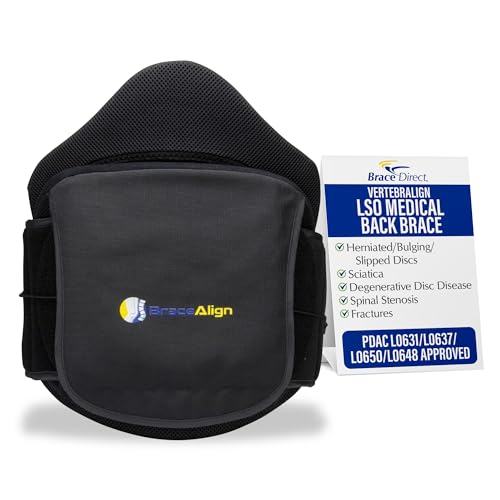
1. VertebrAlign LSO Back Brace for Herniated Disc Relief L0650
Our pick — over 4★ from 300+ verified ratings; the strongest balance of quality and price.
The rigid-backed workhorse that lets you stand up and stay up.
If your fracture sits in the lower back and you still want to do normal things — cook, walk, stand through a phone call — this is the brace to start with. It fits waists of 23 to 50 inches when you measure at the navel, and the maker offers a Plus Extension model that stretches the sizing up to 66 inches for larger builds. That one-handed pulley is the part most people underestimate: you pull the tabs to tighten the brace evenly, so you can dial in support while standing or sitting rather than fighting straps behind your back.
What sets this apart from cheaper soft wraps is the structure. Removable rigid panels let you choose how firm the support is, and the lightweight mesh keeps air moving so you are not overheating mid-afternoon. The listing also carries PDAC approval under four codes — L0631, L0637, L0648, and L0650 — which is the recognized marker of medical-grade lumbar and sacral stabilization. If you want the code language explained, we break it down in the specs section below.
The rigid support is what wins buyers over. Buyers with a serious lower-back problem report this holds their entire core where a light elastic brace only touches the back, and a heavier user notes it held firm for a 260 lb frame while cheaper braces gave out. The honest catch is getting it on — the recurring gripe is that it takes a little practice to line up and tighten, and a few find it hot to sit in for long stretches. It is also the bulkier-looking option, so it does not hide under slim clothing the way a knit brace does.
What earns the top spot
- One-handed pulley tightens evenly so you can adjust while seated, standing, or walking
- Removable rigid panels let you go firmer or softer as healing progresses
- PDAC approved under L0631, L0637, L0648, and L0650 for medical-grade stabilization
- Free video fitting available through the maker to dial in the fit
Where it asks for patience
- Getting it on correctly takes some practice, and it is not a slip-on
- Can run warm for long sitting sessions
- Bulkier look than a knit brace, so it shows under fitted clothes
Reach for this if: your fracture is in the lower back and you want adjustable rigid support you can tighten hands-free.
Look elsewhere if: you need a thin brace that disappears under a shirt, or you sit for very long stretches and run hot easily.
2. LSO Back Brace 2XL/3XL
The one that lets you turn the support up or down as your back changes.
Most braces give you firm or softer and nothing in between. This one gives you three settings by swapping the arc plate, and that arc sits behind your lumbar curve to support the L1 to S1 section of your spine — the lower run of vertebrae most fracture patients are protecting. You pull the finger tabs to tighten, and the dual pulley spreads that tension evenly. An extension piece adds abdominal support for a larger belly, and there is a removable soft plastic plate that can come out if you do not want it.
The sizing runs by belly circumference at the navel: S/M covers 23.5 to 33.75 inches, L/XL covers 33.75 to 47 inches, and 2XL/3XL covers 47 to 59 inches. Measure before you order, and do it with a soft tape so the number is honest. The dual-pulley tension is gentle enough to work one-handed, which matters if grip strength is an issue.
What buyers praise most is how well the three support levels work. Buyers report the difference is obvious on the very first wear — many say they started with the extension in place and were able to drop it within days. Some size up by circumference and find it near-perfect, while a few find the fit off, so the measurement step is not optional. The decompression plate is also note as a trade-off: it is a strong pull, and a brace this firm takes a moment to seat correctly on your back.
Where it pulls ahead: three selectable support levels, a rigid arc plate over the L1–S1 area, and a dual pulley that lets you tighten with finger tabs rather than a full twist-and-cinch.
The one to watch: sizing is by belly measurement, and the firm pull means an off-size brace will feel it — get the tape out first.
Suits you if: you want to adjust how much support you get as the weeks go by, without buying a second brace.
Think twice if: you want something soft and barely-there — this is built firm.
3. BraceAbility Lumbar Decompression Back Brace
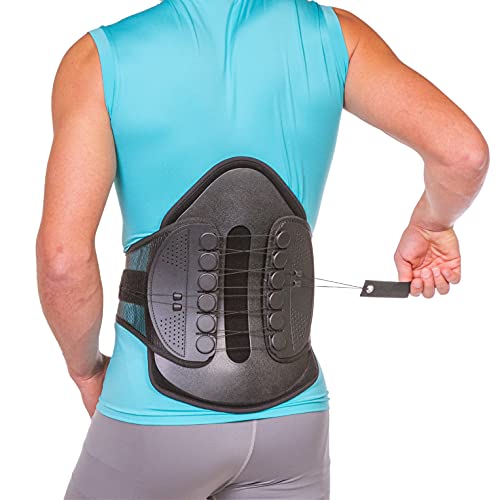
The wraparound belt you put on without twisting or bending.
Putting a rigid brace on is often the hardest part of the day, so this one is built around a simple wraparound you apply without twisting or bending. It is a semi-rigid lumbosacral belt, sized Large for body circumferences of 40 to 45 inches measured at the widest point where you plan to wear it. The dual-pulley system is the real feature here: the maker says it lets you triple the amount of compression compared with a basic strap, so you can keep it light early on and tighten it as recovery moves along.
At 1.3 pounds it is a touch heavier than the maximum-decompression plate brace above at 1.23 pounds, though on your body that difference is not something most wearers will notice. The plastic shell wraps your lumbar area, and the hook-and-loop closure holds it in place. It is aimed at post-surgery recovery, discectomy, laminectomy, disc injury, and muscle spasms, and it is meant to follow you from pre-op through the whole healing arc.
Buyers praise the semi-rigid support most, and many find the dual-pulley pull easier to live with than a cheaper fixed brace. The plastic back panel is the weak point: a few owners describe it as flimsy and prone to shifting when they bend, and one called out that the panel can crack if you lie down on a hard surface with it on. Sizing also runs mixed — some find their usual size too bulky and go down a size.
Reader’s takeaway: the wraparound design and triple-the-compression pulley make this the easiest semi-rigid brace here to apply solo.
Keep in mind: treat the back panel gently and keep it off hard floors — that panel, not the belt, is where wear shows up first.
Choose this if: you want semi-rigid support that you can put on yourself without bending or asking for help.
Pass it by if: you plan to lie flat on hard surfaces often while braced, or you want a firmer, less flexible shell.
4. TLSO Full Back Brace L0457

The full-shell brace for fractures higher up your spine.
When the fractured vertebra is in your upper or mid back, a lumbar belt will not reach it. This TLSO is a full-torso shell that steadies the thoracic and lumbar sections together, and it is explicitly built for kyphosis, scoliosis, compression fractures, herniated discs, spinal stenosis, and post-op recovery. It fits waist sizes of 23 to 50 inches, and the straps can be trimmed to length so you are not left with loose webbing. PDAC approval under L0456 and L0457 marks it as medical-grade thoracic-lumbar support, and there is a free video fitting session available through the maker.
The shell is where the work happens. Soft, ventilated fabric and padded straps are meant to sit against your back all day under clothing, and the panels are firm enough to limit the forward bending that stresses a healing vertebra. Owners describe the adjustable fit coming together quickly — One buyer with a T8 compression fracture reported a three-minute fit and fast pain relief where a heavier clamshell brace had made things worse.
Quality and support are the two strengths that stand out most in owner feedback, and the cushioned straps get steady praise. On the flip side, this is the piece people either find intuitive or frustrating. Some say it fits great; others need help from another pair of hands the first few times, and the shoulder-level fasteners are the fiddly part. Owners with fractures describe wearing it for about 12 weeks, so plan on a real stretch rather than a quick fix.
Why it holds this slot
- Full-torso coverage reaches thoracic and mid-back fractures a lumbar belt cannot
- PDAC approved under L0456 and L0457 for medical-grade thoracic-lumbar stabilization
- Trimmable straps and a 23 to 50 inch range let you dial the fit close
- Ventilated fabric and padded straps suit all-day wear under clothing
Worth knowing upfront
- The shoulder-level fasteners are the tricky part and reward a helper at first
- A few find the assembly hard to decipher without guidance
- It is a fuller shell, so it shows more under fitted shirts
Best matched to: a thoracic or compression fracture that needs upper-back stability and a shell that crosses both spine regions.
Not your pick if: you want a slim lower-back belt, or you would rather not deal with shoulder straps.
5. Bauerfeind LordoLoc Back Support

Four aluminum rods, one lightweight knit — posture help for movement.
Not everyone wants a hard shell. This one uses four flexible aluminum rods, each 9 1/4 inches long, set into the back section to hold your lumbar spine in its natural line and encourage a posture that does not hurt. The knit is lightweight and breathable, so it does not trap heat, and it is machine washable for a brace you wear daily. Velcro fastenings and hand straps make it easy to put on and adjust even if arthritis makes your hands stiff.
The stated goal here is proprioception — that is your body’s sense of where it is positioned — and the idea is that the contact and alignment heighten your awareness of your lower back to keep you stable. Fit is where you need care, and the maker is specific about it: start at your belly button, measure 1 inch down from it, then take your waist circumference from that point with the tape neither too tight nor too loose. The size 4 listing here is not adjustable to a wide range, so use the maker’s own sizing chart and video rather than guessing.
Fit is also the split in owner feedback, and it is the reason to be careful. When the size is right, owners mention it keeps the lower back supported through long sitting sessions and the upper straps hold it firmly in place. When it is wrong, the reviews are blunt — one buyer found it much smaller than expected and a few warn the sizing runs off and returns can be a problem, so measure twice before you commit.
The case for it: discrete, breathable, and machine washable, with aluminum rods that guide the spine rather than lock it, made in Germany with a sizing chart and video the maker expects you to use.
The fair caveat: get the size wrong and this brace is unforgiving, so treat the 1-inch-down belly-button measurement as the whole ballgame.
For you if: you want lightweight, posture-focused support for activity rather than a rigid shell, and you will measure carefully.
skip it if: you need a firm fracture-level hold, or you want a wide one-size-fits-most range.
6. DDS, Inc. 300 Back Decompression Belt

Air, not aluminum — a belt that lifts pressure off the spine.
This one works on a different principle from the rigid braces above. Instead of a hard shell holding your spine in place, it uses an inflatable air system that expands to gently lift pressure off the spine, and you control the compression by pumping it up. The belt contours to your body and is built to fit discreetly under clothing, so you can wear it at home, at work, or during a long day on your feet. This listing is the Small size.
The pump is the movable part of the design, and buyers notice it. One long-term user whose son wears a belt daily over a metal-reinforced spine recommends it as a replacement for pain medication. Another found it hid well under clothes and stayed less bulky than expected, and a third reported a clear difference on a first two-and-a-half-hour walk. It is a belt you pump for a stretch, not a shell you keep on for the full day.
The honest trade-off is heat and feel. The recurring complaint is that you sweat under it, and some find it more comfortable worn over clothing than beneath it. It is also not a replacement for rigid stabilization if your fracture needs a firm hold, so treat this as relief and offloading rather than a rigid recovery shell.
Right for you if: you are on your feet or at a desk for hours and want to pump up air pressure until your lower back eases.
Not for rigid needs: if you need a hard shell to hold a healing vertebra, this air belt is a different job.
7. TLSO Full Back Brace for Spinal Stenosis & Fractures – L0464

The large-build shell with heavy-duty panels and a single-side pulley.
This TLSO is sized X-Large for 45 to 50 inch waists and built for a larger frame, and it is the most heavy-duty shell in this roundup. Medical-grade rigid panels steady both your upper and lower back, which is the point for healing a spinal fracture and easing kyphosis pain. A built-in pulley lets you tighten or loosen the brace for support, and the ventilated neoprene is meant to keep you cool through all-day post-op wear. It carries the same free video fitting offer as the other Brace Align picks.
For bigger builds, the design has a clear edge over cheaper braces. Owners with larger frames report the cheaper models chafed while this one sat more comfortably, and the next-generation string layout — both pulley lines running to one side — makes it less cumbersome to wrap and tighten than the older wrap-around style. It is aimed at fracture, bulging disc, degenerative disc disease, herniated disc, kyphosis, post-surgical back, spinal stenosis, and upper-back pain.
The fair caveats are real. It is best for mid and lower back, and it does not offer the same upper-back support as the TLSO in the fourth slot here, which owners note falls short at the very top of the shell. A few find it awkward and report that it slides up rather than staying put, so getting the 45 to 50 inch measurement right is essential. If your waist sits outside that window, size out of this one entirely.
The strong point: heavy-duty rigid panels and a single-side pulley make this the roomiest, most supportive option for a 45 to 50 inch waist that cheaper braces pinch.
Before you buy: the shallow upper-back hold and tendency to ride up mean the waist measurement is everything — confirm you are inside 45 to 50 inches first.
Pick this when: you have a larger build that cheaper braces chafe, and you want a rigid TLSO that tightens with one pulley.
Keep looking if: your waist falls outside 45 to 50 inches, or you need strong upper-back support from the shell.
Know the Specs
PDAC L-Codes
Those L-numbers on a listing — L0457, L0637, L0650 — are PDAC-approved billing codes, which is the marker that a brace meets a recognized standard for the support level it claims. A TLSO like the L0457 covers both the thoracic and lumbar regions, while an LSO like the L0650 targets the lower spine. If you plan to ask your insurer for help covering a brace, matching the code to what your provider needs can save a fight later.
Sizing by Waist and Belly Circumference
Most braces here are sized by a tape measure around your waist, taken at the navel or the widest point where you will wear it. The number is not a suggestion — a brace that is too loose will slide up your ribs when you move, and one that is too tight will dig in. Some makers add a free video fitting session, which is worth booking if your measurement lands between two sizes or you carry weight around the middle.
Common Questions
Will a lumbar brace work for a thoracic compression fracture?
How do I measure my waist so the brace actually fits?
What is the difference between a rigid shell and an inflatable decompression belt?
Can I put a rigid back brace on by myself?
How long do I need to wear a brace for a fractured vertebra?
Is a softer knit brace good enough for a fracture?
Do these braces help me get insurance reimbursement?
Can I wear a back brace directly against my skin?
What is the difference between an LSO and a TLSO brace?
How long does a rigid back brace last before it wears out?
The Bottom Line
For most people shopping for a back brace for fractured vertebrae, the winner is the VertebrAlign LSO Back Brace L0650, because it pairs PDAC-approved medical-grade stabilization with a one-handed pulley you can tighten while standing, plus removable panels that adjust as your recovery moves. If your fracture is in your upper back, the TLSO Full Back Brace L0457 reaches the thoracic section a lumbar belt can’t. And if you spend your day on your feet and want to pump pressure off your spine rather than lock it still, the DDS 300 Decompression Belt is the one to reach for. Whichever you choose, get the waist measurement right on the first order — it is the single step that decides whether a brace helps or ends up in the drawer.
How we choose
We do not accept paid placement. Every pick is matched to a real buyer and a real use-case; we do not hands-on test units.
Sources
Specifications: manufacturer listings and product documentation. Review insights: verified customer reviews, as of October 2026. Pricing: not shown on this page (it changes often); check the current price via the retailer link.
As an Amazon Associate, Aappliancez earns from qualifying purchases. This does not affect which products we feature.