Disclosure: Some links in this post are affiliate links. As an Amazon Associate I earn from qualifying purchases, at no extra cost to you. Learn more
Specs are compiled from manufacturer listings and verified buyer reviews and can change over time — please confirm the key details on the product page before buying.
The right back brace for degenerative disc disease has to hold your lower back steady without digging in, rolling up, or forcing you to stop mid-lift. This guide covers five braces that owners actually keep wearing, and it explains which one suits a desk-bound day, which one helps during heavy lifting, and which one adds a hot-or-cold pack when you need it. The single most important decision happens before you buy anything, though — you have to measure your waist at the navel and match it to the maker’s chart, because every brace here lives or dies by fit.
This guide is built by comparing the manufacturers’ published specifications and the patterns across verified customer reviews, so you get each pick’s real strengths and trade-offs instead of marketing spin.
Start with the fit, then pick the support style that matches your worst hour of the day. Below you’ll find sizing charts, stay counts, compression systems, and the honest trade-offs, so you can choose the right back brace for degenerative disc disease.
Top Picks

How To Choose The Best Back Brace for Degenerative Disc Disease
Degenerative disc disease means the cushions between your vertebrae have worn down, so your lower back needs outside help holding its shape through a long day. A brace does that by wrapping firm compression and stiff vertical support around your lumbar spine. Pick the level of support you can actually tolerate for hours, not the stiffest brace on the shelf.
Measure your waist at the navel, not your trouser size
Every sizing chart here is built around your belly-button circumference, measured with a soft tape. Pants sizes lie, and a brace that’s too small can’t be stretched into comfort. A brace that’s slightly large can always be cinched tighter, which is why a few of these makers tell you to size up when you sit between two sizes.
Decide between stays and a decompression plate
Stays are the stiff bars sewn into the back panel — they’re what stops the belt from folding over when you sit or bend. A count of 3 to 5 stays gives you a firm spine line with some flex. A molded decompression plate, like the one on the premium LSO pick, is a bigger rigid arch that runs higher up your spine and is aimed at correcting posture rather than just hugging it.
Match the tightening system to your hand strength
Basic straps with finger loops are quick to pull and easy to re-tighten solo. A pulley system multiplies your tug, so a light pull produces firm compression — useful if gripping and yanking a strap is hard on your hands. Both work; the pulley simply asks less of you.
Think about how it feels under a shirt
Mesh panels and thin nylon let heat escape, so you’re not damp after an hour at a desk. Low-profile designs sit flat enough to hide under everyday clothing. The trade-off for that slimness is usually a little less rigid bracing than a bulky belt gives you.
Side-by-Side Comparison
| Model | Best For | Support Build | Tightening | Size Range | Amazon |
|---|---|---|---|---|---|
| FEATOL 5-Stays Lumbar Support Belt★ Best Overall | All-day wear at work | 3 memory-aluminum stays + 2 support plates | Adjustable dual straps with finger loops | S to 5XL (25.6–65 in) | Amazon |
| Bracepost Bionic Spine Back Brace with Cold PadBest for Flare-Ups | Icing flare-ups at home | Bionic spine stays + side spring strips | Wide Velcro with crossover adjustment | XL | Amazon |
| ASPEN Lumbar Support Back Brace | Heavy lifting and loading | Inelastic nylon belt, no stays listed | Patented 4:1 pulley system | Large (36″–42″) | Amazon |
| NEENCA Back Brace for Lower Back Pain Relief | Desk days to yard work | Multi-point support, breathable mesh | 2 elastic Velcro straps | S to XXL (25.9–65.0 in) | Amazon |
| LSO Back Brace with Maximum Decompression Plate | Posture correction at the desk | Bionic decompression plate, L1–S1 | Pulley system with finger tabs | L/XL (33.75–47 in) | Amazon |
Detailed Reviews
1. FEATOL Back Brace 5-Stays
Our pick — 4.5+★ from 1,000+ verified ratings; the strongest balance of quality and price.
The brace that stays on your spine through a full day of lifting, standing, and driving.
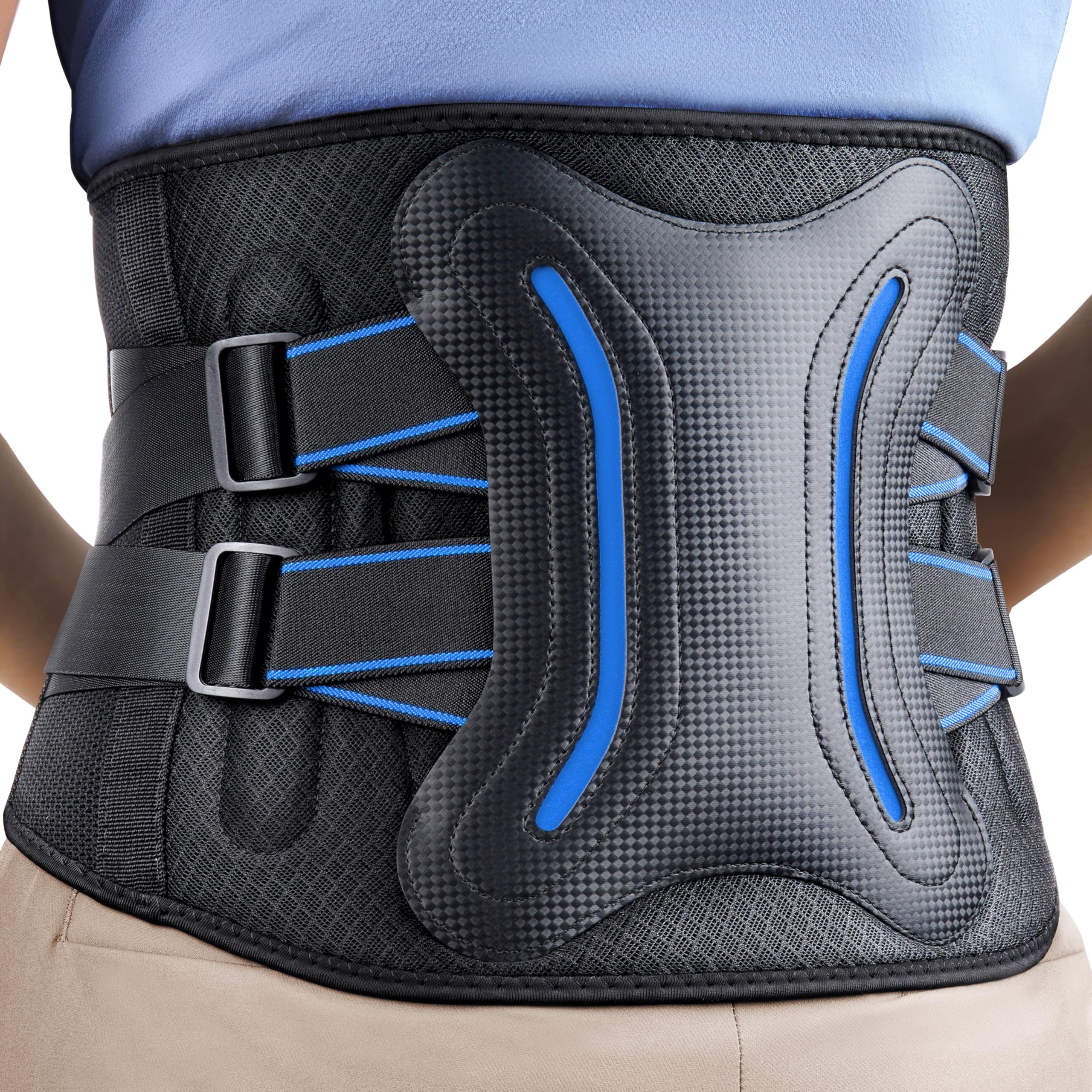
Five reinforced bars hold the shape of your lower back — three memory-aluminum stays plus two support plates — and the outer stays run sideways so the belt doesn’t roll or bunch up when you sit. That no-roll detail is the one that keeps you wearing it past the first hour. The panel wraps 360° around your lumbar spine and the dual-tension straps let you set a looser feel for walking and a firmer pull for lifting, all without undoing the whole belt.
Where it earns its keep is breathability. The mesh panels vent heat, so an hour in the brace doesn’t leave you swampy underneath. Owners who wear it for house moves and landscaping report the end-of-day ache easing and the hook-and-loop closure still gripping after repeated use. Sizing is the one thing to get right: the waist chart runs from 25.6 to 65 inches across seven sizes, and the L covers a 34.3 to 38 inch waist — which is why a relaxed 36 inch waist lands firmly in L. Buyers report “Size L fits 36\” waist accurately.”
Nothing here is invisible. The rigid panel is a visible bulge under a fitted shirt, and this is a bracing brace rather than a subtle sleeve — it also isn’t machine washable, so spot-cleaning is on you. But if you want firm support for moving boxes, standing at a bench, or driving, this is the balance most people want.
What holds up well
- Lateral stays stop the panel rolling and bunching when you sit
- Mesh venting keeps the lumbar area cool through long wear
- Dual straps re-tighten solo for walking or heavy lifting
- Seven sizes cover waists from 25.6 to 65 inches
What to accept
- Rigid back panel shows through tighter clothing
- Not washable — wipe-and-air only
- May shift on a leaner build once fully tightened
Wear it daily if: you want one brace that flexes between walking, lifting, and desk sitting without readjusting from scratch.
Size up first if: you sit between two sizes on the waist chart — the belt runs a touch large.
2. Back Brace Reusable Ice Pack
A compression belt and a therapy pack in one piece, so icing your back stops being a separate chore.
The detail that sets this one apart is the pocket sewn into the back panel for a reusable cold-or-hot pack. Chill the pack in the fridge or warm it in the microwave and you get temperature therapy right where the discs sit, without holding a bag against yourself. Just as useful: the interior has soft silicone strips on both sides that grip your back so the belt doesn’t migrate when you bend, sit, or stand up again.
Support comes from a “bionic spine” build — memory-aluminum stays shaped to mirror the curve of your spine, plus metal spring strips on the sides that flex with you. The fabric is soft modal with breathable holes, and the front is narrowed so it doesn’t press against your thighs when you sit. The Velcro is deliberately wide so it lies flatter under a shirt. Note the size on this listing: it’s the XL, filled out to fit.
Two honest notes from long-term use. The Velcro is strong out of the gate but the front patch has a tendency to weaken over time, and durability is a split experience — most describe solid construction while a few say a unit wears out after a stretch. As owners put it about the fit: “We had to get a larger size & so happy we did!” Owners say the cold pack plus the belt’s support helps them move more easily. Think of this as the brace for sore-back days rather than a permanent heavy-work belt.
The pack is the point: having a hot-or-cold insert built into the panel is what makes this different from every plain belt here, and the silicone grips keep it from sliding when you move.
Keep an eye on: the front Velcro patch, which is the weak link owners flag over time — seat it flat and don’t force it.
Reach for this if: your back flares and you want icing and support in one step instead of two.
Look elsewhere if: you need a rigid stay-lined belt for constant heavy lifting.
3. ASPEN Lumbar Support Back Brace, Patented Pulley System

A light pull delivers serious compression, and the inelastic belt acts like a stiff outer shell.
The number that defines this brace is 4:1 — the patented pulley system multiplies your tug four-fold, so a gentle pull tightens it firmly. That’s a big deal if gripping and hauling hard on a strap is hard on your hands. Two separate tabs let you set the top and bottom of the belt independently, so you can dial compression into exactly the spot that aches. The nylon is inelastic, meaning it doesn’t stretch, so it behaves like an external skeleton across your lower back.
Serious lifters feel that difference during heavy sessions — the belt hugs the lumbar spine and keeps its line through hours of loading. It’s also thin, low-profile, and breathable, with no neoprene smell to put up with. One thing to plan for: it runs small. A waist that sits on the boundary between two sizes should go up, because you can always tighten a larger belt but you can’t stretch a smaller one. The size chart on this listing tops out at Large for 36 to 42 inch waists.
Because there’s zero give, this is not the one for cardio or athletic movement. It’s built to brace you while you stand, walk, and lift, not to bend and stretch with you. If disc pain cuts your walking distance short, owners say this firm, inelastic hug is what keeps them moving.
The pulley earns it: the 4:1 system is the whole reason to buy this one — firm compression with a light pull and precision top-and-bottom tuning.
The catch: inelastic means no stretch, so it locks you upright for lifting and walking but fights you during anything athletic.
Made for: heavy loading days and long standing, where you want an unmoving shell around your lumbar spine.
Wrong pick if: you need a brace that flexes through running or fast moving.
4. NEENCA Back Brace For Lower Back Pain Relief

A multi-point panel that spreads support wide across your lower back and stays cool under a desk shirt.
This one is built for the long haul of daily routine — sitting at a desk, then running errands, then lifting something heavy. The multi-point support design spreads compression across your lower back and abdomen, with two elastic Velcro straps you adjust independently so each side gets the pull it needs. The fabric is breathable mesh, which is the reason you can leave it on through a long working morning without overheating.
The size range here is the widest of any brace on this list by a stretch. The chart runs from a Small at 25.9 inches to an XX-Large at 65.0 inches, and the maker is blunt about how to pick: measure your waist at your navel, don’t assume, and don’t use your trousers size. That last point matters, because the fit is the most-discussed topic on this listing and the honest result is that most people who measure land correctly while a few who guess get it wrong.
Slim enough to wear under clothes, it can still feel a little short on the back panel rather than contoured to your spine’s curve. A minority find the belt rides up through the day and gives less support, though a quick re-adjust fixes it. On the plus side, both the lifters and the desk workers agree it holds strong through the day. For a brace you put on in the morning and forget about, that’s the winning shape.
Where it shines
- Independent side straps tune the left-right pull separately
- Breathable mesh keeps a long wear surprisingly cool
- Six sizes cover 25.9 to 65.0 inches at the navel
- Slim profile sits under a normal shirt
Trade-offs to note
- Back panel can ride up through the day
- Less contoured to the spine’s curve than some
- Riding high means a quick re-adjust now and then
Suit it to: desk-then-errand days where you want support you can forget is on.
Swap it out if: you need a rigid, unmoving panel for constant heavy loading.
5. LSO Back Brace with Maximum Decompression Plate

A molded arch that runs up your spine, adjustable to three support modes for posture work.
The standout build here is a bionic decompression plate that stabilizes the L1 to S1 vertebrae — the span of your lower spine — and is built to align your lumbar into extension. What makes it unusual is that the arch adjusts to three support modes: crank it to the biggest 26-degree bionic stretch for correction work, dial it back to protect the lumbar and sacroiliac, or remove the arch entirely to keep your spine supported for prevention. You can shift the level of support to match the job in front of you.
Tightening runs on a pulley system with finger tabs, so a light pull gives you the compression you want. That design is aimed squarely at people with limited grip strength, so if hauling straps is hard on your hands, this is the kinder path. There’s also an adjustable extension Velcro pocket piece and a removable soft plastic abdominal plate that add coverage around the belly, which helps if you carry weight there or are recovering after a birth. The listed L/XL fits bellies from 33.75 to 47 inches, so measure at the navel before you order.
Durability is the mixed report here — most describe it as a sturdy, effective brace that keeps going, while a smaller set say theirs broke after a couple of months. Treat the arch and the straps with a little care and don’t overtighten the pulley past comfort. Used the way owners use it, sitting long stretches and bending less, it earns its spot as the most structure-focused brace on this list.
Three ways to wear it: full 26-degree arch for correction, reduced arch to protect, or no arch for prevention — nothing else here gives you that range.
One honest gripe: a portion of owners mention the build failing sooner than expected, so size and re-tighten carefully and treat the pulley with restraint.
Best for: posture correction and long sitting where you want a rigid arch guiding your lower back.
Not the one if: you want a soft, nearly invisible belt for all-day office wear.
Know the Specs
Stays vs. decompression plates
Stays are the stiff vertical bars sewn into a brace’s back panel — typically 3 to 5 of them — and their job is to stop the belt folding when you sit or bend. A decompression plate is a larger molded arch that runs higher along the spine and is aimed at guiding your posture, not just hugging it. More stays and a plate mean firmer bracing, but also more bulk under a shirt.
Pulley tightening systems
A pulley system routes the belt’s straps through a harness so a light pull multiplies into firm compression — the Aspen’s patented 4:1 ratio is the clearest example. That matters when grip strength is limited. Plain adjustable straps with finger loops are quicker but ask more of your hands. Both let you re-tighten solo during the day.
Waist measurement at the navel
Every size chart here is keyed to your belly-button circumference, measured with a soft tape. Pants sizes don’t transfer, and a brace that’s too small can’t be stretched into comfort. If you land between two sizes, a larger belt can always be cinched down; a smaller one cannot be widened.
Hot and cold pack inserts
Some braces, like the Bracepost, sewn in a pocket for a reusable pack you chill or warm before wearing. It adds temperature therapy without holding a separate bag in place. A plain compression belt can’t do this, so if icing your back at home is part of your routine, the pack is a real reason to choose that model.
Common Questions
Will a back brace help degenerative disc disease?
How do I measure my waist for one of these braces?
Is a pulley brace better than a strap brace?
Can I wear a back brace under my clothes?
Should I sleep in a lumbar brace?
How do I clean a back brace that isn’t washable?
Will a brace let me keep lifting and working?
What’s the difference between the FEATOL and the NEENCA brace?
Is the Bracepost cold pack a gimmick?
How long should I wear one each day?
The Bottom Line
For most people with degenerated discs, the back brace for degenerative disc disease winner is the FEATOL 5-Stays Lumbar Support Belt because five reinforced bars stop the belt rolling when you sit, the mesh keeps you cool, and the dual straps flex between walking and lifting. If heavy lifting is your whole day, grab the ASPEN Lumbar Support with its 4:1 pulley for firm compression from a light pull. And for desk-bound posture work, the LSO Back Brace with its three-mode decompression arch is the one to reach for.
How we choose
We do not accept paid placement. Every pick is matched to a real buyer and a real use-case; we do not hands-on test units.
Sources
Specifications: manufacturer listings and product documentation. Review insights: verified customer reviews, as of October 2026. Pricing: not shown on this page (it changes often); check the current price via the retailer link.
As an Amazon Associate, Aappliancez earns from qualifying purchases. This does not affect which products we feature.