Disclosure: Some links in this post are affiliate links. As an Amazon Associate I earn from qualifying purchases, at no extra cost to you. Learn more
Specs are compiled from manufacturer listings and verified buyer reviews and can change over time — please confirm the key details on the product page before buying.
A light base is the reason most first walkers fail. A determined toddler tips it over or shoves it across the room at speed. All seven picks below are built to hold their ground, whether your baby is still sitting to play or already pulling up and cruising the sofa.
This guide is built by comparing the manufacturers’ published specifications and the patterns across verified customer reviews, so you get each pick’s real strengths and trade-offs instead of marketing spin.
You will see how each walker handles carpet versus hardwood, how the height settings fit a fast-growing baby, and which ones fold away when the playroom gets crowded. Start with seat height and wheel grip, then read on for the baby walkers that stay steady under a wobbly first step.
Top Picks


How To Choose The Best Baby Walkers
Keep your baby steady while they build leg strength and balance, and a walker earns its place. All the songs and lights come second. A narrow base or free-rolling wheels turn the whole thing into a hazard instead of a helper. The specs that fix this are easy to read once you know where to look.
Match the seat height to your baby, not the age on the box
A seated walker only works when your baby’s feet reach the floor flat. Look for adjustable height positions — three is common. Some push walkers set the handle at fixed heights instead. A tall baby in a walker with a low minimum leaves their legs dangling, which teaches nothing. Measure your baby’s leg length from hip to heel before you buy, and check the seat or handle settings against it.
Wheels decide whether it rolls or drags
Hard plastic wheels fly across hardwood and stall on carpet. Rubber-covered wheels and adjustable speed switches give you control: a slower setting for a beginner, faster once they are confident. If your home is mostly carpet, check that the wheels clear the base. Protective bars sitting close to the floor can drag heavily on a normal pile.
Seated walker or walk-behind push walker?
A seated walker surrounds your baby and lets them scoot along with their feet inside the base. A walk-behind push walker puts them on their feet holding a handle, which builds balance closer to real walking. Many modern designs convert between the two, so you get a seat for the sitting stage and a push handle once they stand. Think about which stage your baby is in right now, and whether one product should carry them through both.
Side-by-Side Comparison
| Model | Best For | Walker Type | Adjustability | Key Play Feature | Amazon |
|---|---|---|---|---|---|
| VTech Sit-to-Stand Learning Walker★ Best Overall | Learning to stand and walk | Sit-to-stand push | Two-speed control switch | Five piano keys and phone handset | Amazon |
| Dream On Me Go-GetterBest for Guided Walking | Guided walking with a parent | Seated + walk-behind | Three height positions | Detachable toy and snack tray | Amazon |
| Beright Wooden Activity Walker | Floor play and push practice | Push and pull | — | Xylophone, mirror, shape puzzle | Amazon |
| HYES 5 in 1 Push Walker | Multiple ride-on stages | 5-in-1 convertible | Adjustable rear-wheel speed | Basketball frame with 3 balls | Amazon |
| QDRAGON 5 in 1 Push Walker | Growing from infant to toddler | 5-in-1 convertible | Two adjustable speeds | Basketball hoop and piano keyboard | Amazon |
| Skip Hop Explore & More 4-in-1 | Long-term use from 6 months to 4 years | 4-in-1 convertible | Three handle heights | Light-up keyboard with 5 songs | Amazon |
Detailed Reviews
1. VTech Sit-to-Stand Learning Walker
Our pick — 4.5+★ from 98,000+ verified ratings; the strongest balance of quality and price.
One toy covers floor play and first steps in the same afternoon, because the panel detaches.
A removable activity panel is the reason this VTech tops the list. It lifts off the walker and sits on the floor for a baby who can only sit up. Then it clips back on when they start to pull to stand. You get months of use from one toy instead of buying a floor activity center and a walker separately. It weighs 4.7 pounds, is built from plastic, and rolls on both carpet and bare floors.
Getting a nervous beginner moving is where it earns its keep. A two-speed control switch (a dial that slows the wheels) eases the roll for the early weeks. Then you open it up once your baby has the hang of pushing. It holds up to 35 pounds and stands 18.1 inches at full height, so a 10-month-old fits with room to grow. Frustration-free packaging means it assembles without tools — a birthday gift ready the same day.
The play panel is what keeps babies coming back. Five piano keys and a telephone handset pull a toddler over again and again. Add three shape sorters, light-up buttons and spinning rollers on top. The sounds get mixed reactions: some parents find the melodies wearing after a while, and no volume dial appears in the listed features. Expect to live with the music, or use the panel as a sitting-play toy where the noise stays contained.
What makes the first steps easier
- Panel detaches for floor play, then re-attaches for rolling practice on carpet and bare floors
- Two-speed switch lets you start slow and open up as confidence grows
- Holds up to 35 pounds and reaches 18.1 inches, fitting a 10-month-old with room to spare
- Five piano keys and a phone handset keep a sit-down baby busy for long stretches
What to plan around
- The musical sounds are a matter of taste — some households find them repetitive
- No folding mechanism is listed, so it takes up floor space between sessions
Reach for this if: you want one plastic walker that covers the sitting, standing and first-step stages without tool assembly.
Think twice if: a quiet household is non-negotiable or you need something that folds flat for storage.
2. Dream On Me Go-Getter Baby Walker with Rear Push Handle
A rear handle lets you steer from behind, then the whole thing folds flat for the car boot.
You walk behind your baby instead of watching from across the room, because this one has a rear push handle. You guide the direction while they practise a natural stride. It starts in seated mode with the seat pad in place, then converts to walk-behind push mode once they are on their feet. Three height positions (three seat settings) cover the 6 to 12 month stretch, so the fit keeps up as their legs lengthen.
Cleaning is where this one quietly wins. The fabric seat pad lifts out and goes in the washing machine, so a spilled snack or a leaky nappy does not end the toy’s life. The detachable toy tray doubles as a snack tray for mess-free feeding. That is handy when you need a baby contained and occupied while you get something done.
The honest trade-off sits at the moving parts. Four wheels roll on hardwood, carpet and tile, and the extra-wide anti-tip base does its job. But durability and mobility draw mixed feedback — some buyers report the toy panel stopping after a month, and the wheels get their share of complaints. The height adjustment is also fiddly for a few households. One parent of a five-month-old noted “she’ll be able to start using it” next month. This walker rewards a baby who already sits well, so wait a few weeks if your little one is not yet stable in a seat.
Where it shines: the machine-washable seat and the fold-flat design make it the most practical pick for a household that moves between rooms and the car.
Worth knowing: the toy panel and wheels are the parts to keep an eye on, and the height adjuster can take a few tries to set.
Go for it if: you want to walk behind your baby and steer, and you value a seat you can throw in the wash.
Pass if: your baby is still too small to sit supported — the fit starts around the sitting stage.
3. Beright Wooden Baby Walker

Solid birch instead of plastic, with rubber-banded wheels that spare your floorboards.
Your floorboards stay unmarked, because the wooden wheels carry a thick rubber layer. That is the payoff of building this walker from premium birch plywood (layered wood) rather than moulded plastic. It gives a weightier feel that many parents prefer for a push toy. Non-slip rubber bands (grippy strips) along the base let a toddler brake slowly instead of skidding — a genuinely thoughtful touch for a baby still finding their balance.
The activity side works for a floor sitter as much as a walker. It packs a xylophone, a mirror, a shapes puzzle, beads and gears, all around a marine biology theme. That is eight play methods in the brand’s own description, enough to keep a curious baby busy while they build hand-eye coordination. It suits a sitter, a squatter, a stander or a walker, so it works from the moment they can sit up to the point they are toddling.
The gripes are few, and they come from the size of the thing. At 15 by 14 by 18 inches, it is not a compact toy for a small flat. Assembly needs a screwdriver and the instructions — a step less convenient than the tool-free plastic walkers in this list. As a wooden piece, keep it out of the bath and away from spilled drinks. One owner of a one-year-old said “she loves all of the different activities on it and it definitely helped her to start walking.”
The fit for you: homes that want a natural-material toy with real brake control and a floor-play panel that earns its space.
The catch: it is a fixed-size wooden piece — no height adjustment and no folding, so it stays where you put it.
4. HYES 5 in 1 Push Walker for Toddler Boy

Five modes in one frame, from push walker to scooter to a table with a basketball hoop.
Your toy shelf stays clear longer, because the HYES switches between five distinct modes in a single frame: push walker, scooter, motorbike, entertainment table and activity center. That is more stages than the three-mode designs on this list, so the toy keeps earning its floor space after the first steps are done. The play panel holds a basketball frame with three balls, three shape blocks, three spinning rollers and a removable piano keyboard.
Speed control comes from a soft rubber ring that grips the floor. A white button on the rear wheel rotates to tune how freely it rolls, so you can slow it for a beginner. The triangular table structure (a three-sided base) below is designed to support the legs and encourage a straight walking posture. The frame is ABS plastic (a hard, moulded plastic), and the brand claims it has been fully tested with ASTM (a US safety standards body). With 1,000+ ratings behind it, the basketball frame, shape blocks and removable piano keyboard give it more panel variety than the three-mode designs here.
The build is where you should set your expectations. Assembly draws mixed word of mouth, with the printed instructions coming in for criticism. The activity table feels small in proportion to the rest, and a few households find it tips in walker mode unless you weight the base. The wheel tread on the ride-on modes also wears for some. Treat it as a well-featured plastic toy rather than rock-solid furniture. As a twin grandparent summed up after buying two, “the only model found with 5 uses.”
The real draw: five separate modes and a packed play panel give you the most variety per square foot of any pick here.
Set expectations: assembly instructions are weak and the base can tip in walker mode — budget a firm hand and maybe a weight in the tray.
Pick this when: you want one toy that keeps converting through several stages and you do not mind a firmer hand on assembly.
Look elsewhere if: you need a walker that feels rock-solid in walker mode from day one.
5. QDRAGON 5 in 1 Push Walkers for Toddler Boys

A six-month-old can start here and still be playing with it at eighteen months.
The same frame follows a child from the sitting months into toddlerhood, because this QDRAGON moves through five stages. Those are entertainment center, activity table, push walker, motorbike and scooter. The triangular base is designed to stay steady, the handle is non-slip, and two adjustable speeds slow the roll for a beginner. Smooth edges throughout mean fewer sharp corners to worry about as they toddle.
The play panel is the part that keeps them coming back. It detaches from the frame and carries a basketball hoop with three balls, a shape sorter, spinning rollers and a removable piano keyboard. That mix is built to teach colours, shapes and rhythm while the baby thinks they are just playing. The keyboard comes off, so a baby who prefers to sit and bang keys can do that separately from the walking frame.
Stability is the honest caveat. A parent of a six-month-old who grew with theirs to eighteen months found it perfect for learning to walk. But the recurring theme in reviews is that it tips easily and can run over a parent’s foot when pushed at speed. Height tops out at a maximum of 30 inches, which is generous, and it weighs in around 3.27 kg (about 7.2 pounds). Keep a hand near the handle in the early weeks and it does its job.
Best suited to: families who want the longest possible stage range — from a seated six-month-old to a scooting toddler.
Keep in mind: it can tip when pushed hard, so a steadying hand helps until your baby finds their rhythm.
6. BABY JOY Foldable Activity Walker with Adjustable Height

Six anti-slip pads and a fold-flat frame made for a snug living room.
This is the one that tucks away when floor space is tight. The BABY JOY folds flat after use and stows under a sofa, under a bed, or in the boot of a car. It assembles without any tools, and an assembly video on the product page covers the days when the paper instructions fall short. The fixed wrap-around tray holds snacks, meals or toys, and the removable toys keep a baby busy while they scoot.
Safety features are where this walker puts in the work. It is ASTM and CPSIA certified (meeting US safety and children’s-product rules) and carries six anti-slip pads to reduce the risk of rolling down stairs or slopes. A gap between the front of the walker and the wall is designed to keep fingers from getting pinched. The enlarged base lowers the centre of gravity to resist tipping. The high backrest supports the spine, and the breathable cushion lifts out for cleaning. Three height settings cover babies from 6 to 18 months and up to 30 pounds.
The most-discussed quirk is carpet performance. Six silicone-covered protective bars sit close to the floor, and on a normal-pile carpet they create drag — one buyer found that removing all six bars restored the roll. On hardwood it glides and turns well, and a nine-month-old visiting a hardwood-floored home worked perfectly in it. The leg holes also run small, which matters for a chubbier baby. Know your flooring before you commit.
What wins people over: the fold-flat frame, tool-free assembly and six anti-slip pads make it the most space-friendly and stair-aware pick here.
Your flooring matters: on carpet the protective bars cause drag, and the leg holes suit a slimmer baby better.
Worth grabbing if: you have hardwood floors, limited storage, and want a walker you can pack away between grandparent visits.
Second-guess it if: your home is wall-to-wall thick carpet or your baby carries a little extra around the thighs.
7. Skip Hop Baby Walker 4-in-1
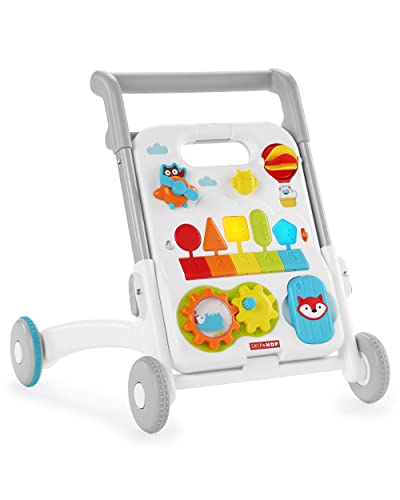
Four ways to play and three handle heights keep this one going from six months to four years.
This is the walker that lasts longest. It converts through four modes — seated, cruising, shopping cart and stroller — and the brand rates it for ages 6 months to 4 years. Three handle height settings (18.3, 20.1 and 21.9 inches) let it grow with a child instead of being outgrown in a season. For a toy that stays in the rotation for years rather than months, that range is the whole argument.
The play panel is the busiest in this bunch. It carries 40+ features, including a light-up musical keyboard that introduces shapes and numbers, five songs, five sound effects and five piano notes. A simple switch flips between song, piano and sound modes. The keyboard plays familiar tunes like ‘Row, Row, Row Your Boat’ and the ABCs. The toy panel detaches so it can be used on the floor or upright in walker mode. It also packs a wobble plane, a click-clack bee, a hot air balloon spinner, rotating gears and a rattle phone with a baby mirror.
The controls reward patience. Non-skid rear wheels and a speed control switch let you slow it for a beginner, and owners mention the response is clear: as one grandparent put it, “can slow it down for beginners.” The catch is that there is no wheel lock, only the slow and fast resistance, and the activity board can work loose if the walker is tipped or lifted the wrong way. The value calculation is the only mixed signal — some households feel the price is a stretch. Build quality wins most people over, since it holds up to rough play and keeps converting into new toys.
Why it earns the premium slot
- Four modes and an age range from 6 months to 4 years give it the longest lifespan here
- Three handle heights (18.3, 20.1 and 21.9 inches) keep the fit right as your child grows
- 40+ play features with a light-up keyboard, 5 songs and a detachable activity panel
- Non-skid rear wheels and a speed switch make it controllable for a nervous beginner
Where it falls short of perfect
- No wheel lock, only slow and fast resistance settings
- The activity panel can work loose if the walker is tipped or lifted the wrong way
- The value calculation is the most debated part of the package
Choose it for: a family that wants one walker to survive all the way to preschool play, with the most activities on offer.
The trade-off: you are paying for the long range and the feature count, so it makes most sense if the toy will actually be used for years.
Know the Specs
Height settings and weight limits
Height positions decide whether your baby’s feet reach the floor flat. A seated walker with three levels, like the BABY JOY or the Dream On Me, adjusts as your baby grows. A push walker uses handle heights instead — the Skip Hop sets its handle at 18.3, 20.1 and 21.9 inches. Weight limits tell you how long the frame stays useful: the VTech holds up to 35 pounds, the BABY JOY 30 pounds. Check both against your baby’s current size so the walker is not outgrown in a season.
Wheels, speed control and flooring
Wheels and speed control are what separate a smooth glide from a runaway toy. A speed switch or resistance dial, like the one on the Skip Hop or the two-speed control on the VTech, lets you slow the roll for a beginner. Rubber-covered wheels, as on the Beright wooden walker, roll without marking hardwood and brake more gradually. On carpet, wheels sitting too close to the base can drag — check the clearance if your home is mostly carpet.
Common Questions
At what age can my baby start using a walker?
How do I stop a walker from tipping over?
Will a baby walker work on carpet?
What is the difference between a seated walker and a push walker?
How long does a baby walker usually last?
Can I fold a baby walker for storage or travel?
Do the musical panels actually keep babies entertained?
What safety certifications should I look for?
Can my baby use a walker if they are tall for their age?
Should I choose wood or plastic for a baby walker?
The Bottom Line
For most families, the baby walkers winner is the VTech Sit-to-Stand Learning Walker because the detachable panel works as a floor toy, a sit-to-stand aid and a rolling walker, all in one plastic frame — and it is the crowd favorite at 4.5+ stars across 98,000+ owners. If you want to walk behind your baby and steer, grab the Dream On Me Go-Getter with its rear push handle and washable seat. And for a child you plan to keep in the toy for years, the Skip Hop Explore & More 4-in-1 is the one to reach for, with four modes and an age range from 6 months to 4 years.
How we choose
We do not accept paid placement. Every pick is matched to a real buyer and a real use-case; we do not hands-on test units.
Sources
Specifications: manufacturer listings and product documentation. Review insights: verified customer reviews, as of October 2026. Pricing: not shown on this page (it changes often); check the current price via the retailer link.
As an Amazon Associate, Aappliancez earns from qualifying purchases. This does not affect which products we feature.