Disclosure: Some links in this post are affiliate links. As an Amazon Associate I earn from qualifying purchases, at no extra cost to you. Learn more
Specs are compiled from manufacturer listings and verified buyer reviews and can change over time — please confirm the key details on the product page before buying.
If you only remember one thing: a gate at the top of the stairs must be screwed into the wall, never wedged in with pressure. Below you’ll find seven real gates, sorted by what they’re actually good at, so you can pick the one that fits your opening and your kid.
This guide is built by comparing the manufacturers’ published specifications and the patterns across verified customer reviews, so you get each pick’s real strengths and trade-offs instead of marketing spin.
You will see how each gate mounts, how wide it stretches, and where it honestly falls short, so you can match one to your staircase instead of guessing. This is a no-hype read on the baby gates for stairs worth bolting to your wall.
Top Picks


How To Choose The Best Baby Gates for Stairs
Stairs break the normal rules. A gate that works fine in a doorway can fail at the top of a staircase, because a doorway is a flat frame you can squeeze against and a staircase is an open drop you cannot. Match the gate to the spot, not the product photo.
Top of stairs versus bottom of stairs
At the top, pick a gate that screws into the wall or banister — called a hardware mount, meaning the brackets are fixed with screws rather than held by outward pressure. Pressure-mounted gates can slip under a determined shove, and a slip at the top of a staircase is the one failure you cannot undo. At the bottom, pressure mounting is fine and saves you patching holes later.
One more top-of-stairs rule that is easy to miss: you want a gate with a door stopper or a no-bottom-bar design, so the gate cannot swing outward over the first step.
Measure all three dimensions before you order
Write down the width of the opening at the top, the width at the bottom, and the height of your banister or baseboard. Stair openings are rarely perfectly square, and several gates here ship with extension kits because a few inches either way decides whether the fit works. If your opening is 78 inches or wider, you are in extra-wide territory and need to look at the panel gates.
Height, bar spacing, and the dog you forgot about
A 30-inch gate is the common standard and keeps toddlers in. If your child is a climber, or you have a large dog, look taller. Bar spacing matters just as much — narrow spacing keeps a tiny puppy or kitten contained, wide spacing lets a determined cat slip through.
Why the latch is the whole product
Every gate on this list has a child-resistant release, usually a two-action latch where you press a button and lift the panel at the same time. That motion is hard for a toddler and natural for an adult. The trade-off is real: a latch tough enough to beat a two-year-old is also slower when you are carrying a basket of laundry.
Side-by-Side Comparison
| Model | Best For | Fits Width | Standing Height | Mounting | Amazon |
|---|---|---|---|---|---|
| Cumbor 30-46″ Gate★ Best Overall | All-round stair pick | 30″ – 46″ | 30.5″ | Pressure or hardware | Amazon |
| Summer Infant Everywhere Extra TallTallest Pick | Tall gate, wide openings | 28.75″ – 39.75″ | 36″ | Pressure or hardware | Amazon |
| keny 29.7″-46″ Gate | Easy no-drill install | 29.7″ – 46″ | 30″ | Pressure | Amazon |
| Cideny 29.4-78″ Extra Wide | Very wide ground-floor openings | 29.4″ – 78″ | 28″ | Wall mount | Amazon |
| Babelio No Bottom Bar | Top of stairs, no trip bar | 29.7″ – 46.5″ | 28″ | Hardware | Amazon |
| Mumeasy 29.7-51″ Gate | Wide openings, no drilling | 29.7″ – 51″ | 30″ | Pressure or hardware | Amazon |
| Fairy Baby 76.4″-81.8″ Gate | Extra-wide pressure fit | 76.4″ – 81.8″ | 30″ | Pressure | Amazon |
Detailed Reviews
1. Cumbor 30-46″ Baby Gate
Our pick — 4.5+★ from 21,500+ verified ratings; the strongest balance of quality and price.
A carbon steel gate that screws into stair posts, then closes behind you without a thought.
The Cumbor is the one gate here that gives you both mounting paths in a single box. You can pressure-mount it in a doorway with no drilling, or hardware-mount it at the top of a staircase for a fixed, load-bearing fit. That dual-mount flexibility is why it tops this list: one gate covers a doorway now and a stair landing later.
Width runs 30″ to 46″ across, and it stands 30.5″ tall, so it clears the standard toddler barrier height. The release is a thumb-press plus lift — a two-part motion a small hand struggles to figure out. It’s built from carbon steel and weighs 13.5 pounds, which tells you it isn’t a hollow plastic frame you can flex with one hand.
Owners are consistently struck by how much hardware comes in the box. You get a foot to hold the gate upright while you work, screws, friction mounts, adhesive, wider spacers for baseboards, an angle adapter for banisters, a drilling template, and two Y-Bolt adapters for round banisters — that last one covers the awkward stair post that stops most installs cold. As buyers report with a 1-year-old grandson and a 6-lb Shorky both in the house: “Passed test with 1-year-old grandson; also blocks 15-year-old, 6-lb Shorky from stairs.” Two notes that recur: do not cut the red zip tie until the gate is fully installed, and the warning stickers on the handle are stubborn to peel off.
What earns it first place
- Works as a pressure fit or a screwed-in hardware mount, so it covers doorways and stair tops alike
- Two Y-Bolt adapters included for round banisters, plus spacers for baseboards and an angle adapter
- Ships with a drilling template and a support foot, which turns a two-person job into a solo one
- Thumb-press plus lift release keeps a toddler from working the latch
- 26.5-inch walk-through opening means you pass through without stepping over anything
Where it asks for patience
- The assembly-warning stickers resist removal and can dull the finish if you rush them
- Measure both the top and the bottom of your opening — stair gaps are rarely parallel
- No bottom bar would trip you, but the included ramp is there to smooth the threshold, so leave it in
Your gate if: you have a stair opening between 30″ and 46″ wide and you want one product that does the doorway now and the staircase later.
Look elsewhere if: your opening is wider than 46″ — you need an extension kit or a different gate entirely.
2. Summer Infant Everywhere Pet and Baby Gate
Six extra inches of height — the difference between a gate your toddler gives up on and one they climb.
Here is the head-to-head that decides it: the Summer Infant stands 36″ tall against the keny’s 30″, a full 6 inches of extra barrier. For a climber, or a household with a large dog that can clear a low bar, that gap is the whole argument. It fits openings from 28.75″ to 39.75″ wide and comes with hardware for a stair-top install plus a no-drill pressure system with wall cups for doorways.
The detail that matters most at the top of a staircase is the door stopper. It keeps the gate from swinging outward over the first step, which is precisely the failure a pressure gate invites. The walk-through door is 19.5″ wide, generous enough that you aren’t turning sideways with a laundry basket.
What wins people over is the sheer solidity — a determined Boxer that had snapped cheaper gates open stays put behind this one, and a toddler who shakes the gate like a prison door finds it doesn’t budge. The recurring gripe is noise: the metal mechanism squeals and clatters as it rotates. It’s a known quirk of a metal gate rather than a defect, but if your staircase is right outside a nursery, plan for it.
Honest read: This is the pick for a stair opening under 40 inches where climbing is the worry. It’s the tallest gate on this list by 6 inches over several competitors, and the door stopper shows the design was thought through for stairs specifically.
The catch: Metal-on-metal rotation is audible, and the instructions are dense enough that a short video search saves you an hour.
Reach for this if: your toddler is a climber or your dog is big enough to clear a standard 30-inch gate.
Think twice if: your stair opening runs past 39.75″ wide — this one won’t stretch far enough.
3. keny 29.7″-46″ Baby Gate
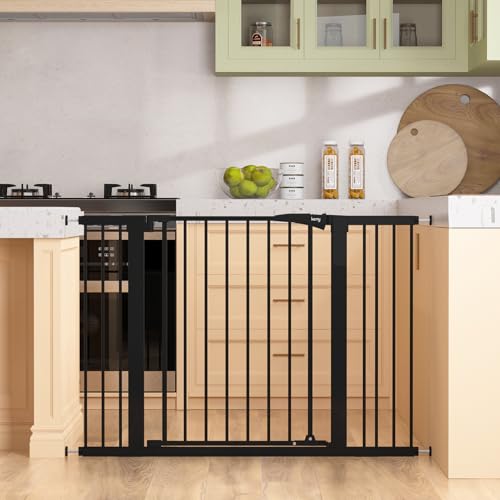
The gate you can hang in a rental hallway in minutes and take down again without a single hole.
The keny is a pure pressure-mount gate: no screws, no brackets, just tension screws you turn until the frame locks against the wall. It fits openings from 29.7″ to 46″ wide and stands 30″ tall, which puts it in the standard range for toddlers and small pets. If your stairs are in an apartment or you simply refuse to put holes in a doorway, this is the one to start with.
Worth flagging: the keny runs 29.7″ to 46″ while the Summer Infant above tops out at 39.75″ — the keny stretches 6.25 inches wider at the top of its range, though it gives up 6 inches of height to do it. Same price, opposite trade-offs: the keny buys width, the Summer Infant buys height.
The auto-close is what makes it worth the money: past a set angle the door shuts itself. Past a certain angle the door swings itself shut, so you never have to remember whether the gate is secure behind you. A dual-lock release keeps the opening to a two-hand motion for adults. The metal frame resists the bending and warping that cheaper plastic and wood gates show after months of a dog throwing itself at them. The one thing to watch: the latch alignment can look off until the pressure screws are fully tightened, and a determined toddler has been known to crack the locking mechanism over time. Tighten evenly and check it periodically.
Why it earns a spot
- No drilling — pressure screws go up and come down in a few minutes
- Auto-close shuts the door behind you past a set angle
- Fits a genuinely wide range, 29.7″ to 46″, with extension kits
- Metal frame handles daily rough play without bending
- Assembles almost fully pre-built — you attach extenders and adjust sliders
What to keep an eye on
- Latch can read misaligned until the screws are tensioned evenly
- Pressure mount is not the safest choice at the very top of a staircase
- Do not cut the red zip tie until installation is complete
Reach for this if: you’re fitting a bottom-of-stairs or doorway spot and want zero drilling.
Think twice if: you need a permanent top-of-stairs barrier — go hardware-mounted instead.
4. Cideny 29.4-78″ Baby Gate

Three folding panels that swallow a 78-inch opening and then fold flat against the wall.
Most gates max out around 46 inches. The Cideny runs from 29.4″ all the way to 78″ wide by using one, two, or all three panels, which makes it the answer for a wide landing, a long hallway, or the bottom of a staircase that sprawls. It stands 28″ tall — shorter than the standard, so this is a barrier for a baby or a small dog rather than a climber.
It’s wall-mounted and reinforced at the bottom with adhesion suction cups, and it carries an anti-trip pedal so you step across without catching a toe. Unlike auto-closing gates, this one opens and closes only when you tell it to, which means no slamming and less wear on the moving parts.
The maker’s own instructions are clear on one point, and it’s the most important thing on this page: they recommend not installing this gate at the top of stairs. The folding joints and wide span suit a ground-floor or bottom-of-stairs barrier. Owners who bought it for dog duty report a strong metal frame that holds up when a dog jumps against it and folds away neatly when not in use. The assembly instructions are muddy and there can be spare parts in the box that aren’t clearly labeled, so give yourself time on install day.
Best for the wide spots: If your opening is between 29.4″ and 78″, no other gate here reaches as far. The folding panels make storage easy and the anti-trip pedal is a thoughtful touch for a busy hallway.
Where it stops: At 28″ tall with folding joints, it isn’t a stair-top gate. Use it as a wide bottom-of-stairs or room-divider barrier and it does its job well.
Your gate if: you need to block a very wide ground-floor opening and want it to fold away between uses.
Look elsewhere if: the installation point is the top of a staircase — the design isn’t built for that.
5. Babelio No Bottom Bar Baby/Dog Gate
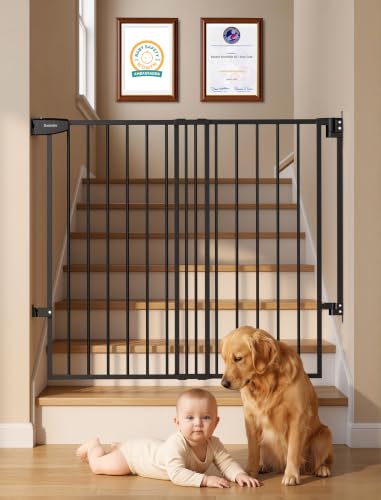
No threshold bar to trip over at the exact spot where a stumble costs the most.
This is the pick if the gate goes at the top of your stairs. Traditional gates leave a bottom bar across the walkway, which is a minor nuisance on flat ground and a real hazard on a landing. The Babelio removes it entirely, so you step straight through. It fits 29.7″ to 46.5″ wide and stands 28″ tall, making it a barrier for babies and small dogs rather than a climber.
It’s hardware-mounted steel, which owners describe as feeling noticeably more secure than a pressure fit — a fair comment, since screws into studs beat outward tension every time. The dual-lock release, the auto-close that swings softly behind you, and the stay-open option for carrying things downstairs are all here. It swings both ways, which matters at a landing where you approach from either side.
The area to plan around is the hardware. The drywall anchors in the box can pull out under a strong dog, so mounting into a stud — or adding a board to the drywall as a backing — is the safer route. A handful of buyers have also seen hinges wear over time. Get the install right and this is a clean, low-profile stair-top gate that keeps a curious dog off steep steps.
The staircase specialist: The no-bottom-bar design is the best feature a stair-top gate can have, and the screwed-in hardware mount backs it up. The included sticker template helps you line up the bracket holes before you drill.
Install prep matters: Budget for better anchors than the ones supplied, and mount into studs wherever your wall allows.
Reach for this if: the gate sits at the top of stairs and you want no bar to catch your foot.
Look elsewhere if: you can’t screw into wall or stud — this one needs a fixed mount to do its job.
6. Mumeasy 29.7-51″ Baby & Dog Safety Gate
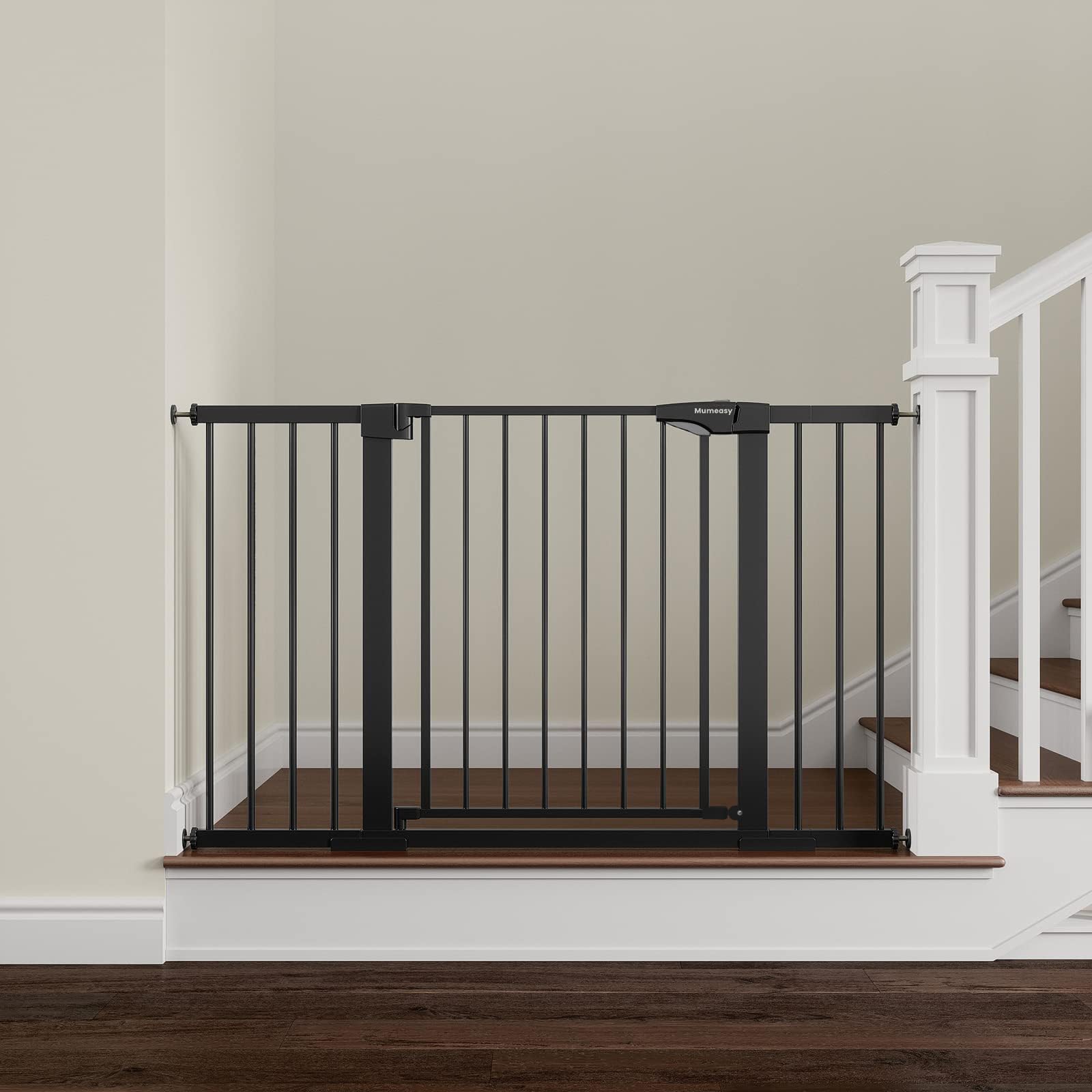
Stretches to 51 inches, opens with one hand, and closes itself when you push past it.
A 51-inch span is a tricky width: too wide for most standard gates, too narrow to justify a three-panel design. The Mumeasy fills that gap with pressure mounting and three extension kits — 2.75″, 5.5″, and 11″ — right in the box. It stands 30″ tall with 2.24″ bar spacing, narrow enough that a tiny puppy can’t squeeze through but roomy enough to see clearly through the frame.
The walk-through door is 22.84″ wide, which the maker describes as wide enough for a 200-pound man to pass without turning sideways. The two-action handle is the standout: one hand opens it while you hold a baby, but the button-press plus lift defeats toddlers and dogs. One owner of a German Shepherd puppy put it plainly: a bold pup that once pushed a standard gate open can’t crack this one.
The honest notes are small. A few buyers have found the actual color reads slightly off-white rather than pure white. Tall dogs can clear the 30-inch height — no surprise, since that’s the standard. And pressure mounting is a doorway and bottom-of-stairs solution; for a top-of-stairs install you want the hardware-mount option or a different gate entirely.
What makes it click
- Reaches 51 inches with the three included extension kits
- 22.84-inch door lets you walk through without ducking or turning
- Two-action handle defeats toddlers and escape-artist pups
- Auto-close shuts the door behind you at the right angle
- No tools needed for the pressure install — walls stay intact
The fine print
- Color can read slightly off-white against true-white trim
- At 30″ tall it won’t hold a determined large dog or a climber
- Pressure mount suits doorways, not the top of a staircase
Reach for this if: your opening lands between 46 and 51 inches and you want to skip drilling.
Think twice if: your dog is a jumper — the 30-inch height won’t stop one.
7. Fairy Baby 76.4″-81.8″ Baby Gate

For the open-plan stair landing where nothing standard comes close to covering the gap.
This gate exists for a specific problem: an opening that runs from 76.4″ to 81.8″ wide. That’s a very wide room opening or stair landing, and the Fairy Baby covers it as a single pressure-mounted unit with extension kits included, standing 30″ tall. Where the Cideny above folds panels to reach 78 inches, the Fairy Baby expands on a single frame — a cleaner look but a heavier one to shift.
The frame is alloy steel with a 2.105-inch gap between vertical bars — narrow enough that a baby or a small pet can’t push their head through. The double-lock release is a press-and-lift at the handle, and the door swings in both directions. The auto-close works intuitively: below a 90-degree angle the door swings itself shut, and past 90 degrees it holds open for you.
Owners of older houses tend to love the way it looks, with its all-metal frame reading like wrought iron rather than plastic, which matters when the gate sits in a hallway you actually see every day. It presses tight enough that it doesn’t shift under a shoving dog. A door that opens only to 90 degrees is also a learning curve at first.
For the widest gaps: If your opening is over 76 inches, the list of gates that fit is short, and this one covers up to 81.8″ without drilling. The wrought-iron look is a real plus in a finished hallway.
Don’t buy it for aesthetics alone: The joints are the weak point under a large strong puppy, and the manual won’t help you much. Expect to spend a little time on the install.
Reach for this if: your opening is between 76.4″ and 81.8″ and you want a pressure fit rather than screws.
Look elsewhere if: you’re guarding against a large, forceful dog — a heavier hardware-mount gate will hold up better.
Know the Specs
Pressure mount vs. hardware mount
A pressure-mounted gate is held in place by turning screws that push outward against your walls until the frame is wedged tight. It leaves no holes, comes down in minutes, and suits doorways and the bottom of stairs. A hardware-mounted gate is fixed with screws into the wall or banister — the same idea as bolting a shelf to a stud. It’s the right choice at the top of a staircase, because it can’t slip under a shove. If you have any doubt at all, screw it in: a gate at the top of stairs should never rely on tension alone.
Width range and extension kits
Every gate here quotes a width range — for example 29.7″ to 46″ — rather than one fixed width, because the frame either telescopes or accepts extension panels that add inches. The low number is the narrowest fit and the high number is the widest with everything attached. Measure the opening at both the top and the bottom before you order; a stair gap that looks square is often a few inches off. If the range doesn’t cover your opening with both numbers, the fit won’t work.
Height and bar spacing
Height is the barrier line. A 30-inch gate keeps most toddlers in, while a 36-inch gate adds a real margin against a climber or a large dog. Bar spacing is the distance between vertical posts: narrow gaps keep a tiny puppy, kitten, or a baby’s head contained, while wider spacing is easier to see through. Both numbers decide whether the gate is suitable, not just whether it fits.
Double lock, auto-close, and the bottom bar
A double-lock release means two actions are needed to open the gate — usually a button press and a lift of the panel — which defeats most toddlers. Auto-close means the door swings shut on its own past a set angle, so it’s secure when you walk away. The bottom bar is the low threshold many gates have along the floor: it adds rigidity but creates a trip hazard at stair tops, which is why some gates are designed without one.
Common Questions
Can I use a pressure-mounted gate at the top of stairs?
How do I measure my stair opening for a gate?
What height gate do I need for a toddler who climbs?
Why do stair gates need a door stopper or a no-bottom-bar design?
Will a baby gate fit between a wall and a stair banister?
How wide a baby gate do I need for an extra-wide landing?
Will a baby gate keep my dog off the stairs too?
How do I stop a gate damaging my wall when I install it?
Do I need to cut the red zip tie before installing my gate?
Can my toddler open a gate with a two-action latch?
The Bottom Line
For most staircases, the baby gates for stairs winner is the Cumbor 30-46″ Gate because it gives you both mounting paths — pressure for the doorway, hardware for the stair top — in one carbon steel frame that reaches 46 inches wide. If your child is a climber, grab the Summer Infant Extra Tall and its 36-inch height. And for the top of the stairs where a bar across the walkway is a hazard, the Babelio No Bottom Bar is the one to reach for. The Cumbor is also the crowd favorite here, at 4.5+ stars across 21,000+ ratings.
How we choose
We do not accept paid placement. Every pick is matched to a real buyer and a real use-case; we do not hands-on test units.
Sources
Specifications: manufacturer listings and product documentation. Review insights: verified customer reviews, as of October 2026. Pricing: not shown on this page (it changes often); check the current price via the retailer link.
As an Amazon Associate, Aappliancez earns from qualifying purchases. This does not affect which products we feature.