Disclosure: Some links in this post are affiliate links. As an Amazon Associate I earn from qualifying purchases, at no extra cost to you. Learn more
Specs are compiled from manufacturer listings and verified buyer reviews and can change over time — please confirm the key details on the product page before buying.
You are standing in the formula aisle reading an ingredient list that reads more like a chemistry set than food, and the words “seed oil” keep showing up where you least expect them. That is the whole point of this shortlist: seven formulas whose ingredient panels you can actually read, sorted by what they do for a baby’s tummy rather than what the front of the can promises. Every pick here is a real product with real owner feedback behind it, and each one fits a different baby and a different budget.
This guide is built by comparing the manufacturers’ published specifications and the patterns across verified customer reviews, so you get each pick’s real strengths and trade-offs instead of marketing spin.
Below you will find the formulas ranked by how gentle they actually behave in daily use, plus plain-English notes on protein type, carbohydrate source, and can size. These are the strongest picks for a baby formula without seed oils.
Top Picks


How To Choose The Best Baby Formula Without Seed Oils
The front of a can sells a mood; the back panel tells you what your baby will actually drink. The panel on the back tells you what your baby will actually drink. Read the back first, and read it in this order: protein source, carbohydrate source, fat source, then can size.
Start with the protein, because that is what a tummy reacts to
Milk protein is the piece most likely to cause fussiness, gas, or spit-up. Some formulas use smaller milk proteins, which are easier for a newborn’s digestive system to break down. Others use goat milk, which forms softer curds during digestion than cow milk proteins do. If your baby has already struggled on a standard cow-milk formula, the protein line is the one to change first.
Then check the carbohydrate — this is where seed oils hide in plain sight
Lactose is the primary carbohydrate in breast milk, so a formula built on lactose is following a familiar blueprint. Corn syrup solids, maltodextrin, and sucrose are cheaper carbohydrate sources and show up on plenty of mainstream cans. A formula that lists lactose and nothing else in that slot is doing the straightforward thing. Read the fat line too, since that is where vegetable and seed oils typically appear.
Match can size to how you actually feed
A combo-feeding parent using one bottle a day gets very different mileage from a can than a parent feeding exclusively. Look at the reconstituted volume a container makes, not just the ounce weight of the powder. One 21 oz can here makes approximately 154 fl. oz. of prepared formula, which is a concrete number you can divide by your daily bottle count before you commit.
Age matters more than brand loyalty
Infant formulas are built for the first year. Toddler drinks are built for 12 months and up, and they are not a substitute for infant formula in a newborn. Several picks below are toddler drinks, and that is not a downgrade — it is a different stage with different nutrition targets. Check the recommended age range before you buy, especially if you are stocking up in bulk.
Side-by-Side Comparison
| Model | Best For | Protein Base | Can Size | Stage | Amazon |
|---|---|---|---|---|---|
| Earth’s Best Organic Gentle Infant Formula★ Best Overall | Gassy, spit-up-prone babies | Organic cow milk | 21 Oz | 3–12 months | Amazon |
| Bobbie Organic Gentle Baby FormulaClosest To Breast Milk | Combo feeding and sensitive tummies | Organic cow milk, smaller proteins | 14.1 Oz | Newborn–12 months | Amazon |
| Mama Bear Gentle Premium Baby Formula | Switching off a name-brand gentle formula | Cow milk | 21.5 Oz | Newborn–12 months | Amazon |
| Bobbie Organic Combo Feeding Kit | Breastfeeding parents who top up | Organic cow milk | 14.1 Oz + drops | Infant | Amazon |
| Kabrita Goat Milk Toddler Drink | Constipated toddlers | Goat milk | 28 Oz | 12–24 months | Amazon |
| Kabrita Goat Milk Infant Formula | Newborns with cow-milk sensitivity | Goat milk, A2 protein | 28 Oz | 0–12 months | Amazon |
| Haven Oat Toddler Formula | Dairy-free households | Oat | 14.1 Oz | 12+ months | Amazon |
Detailed Reviews
1. Earth’s Best Organic Gentle Infant Formula
Our pick — 4.5+★ from 2,000+ verified ratings; the strongest balance of quality and price.
The organic can that keeps a gassy baby’s bottle down, one 21 oz tub at a time.
Of every formula on this list, this is the one that wins on the scoreboard owners actually care about: the bottle that stays down. The label is built around organic milk from grass and grain-fed cows, with lutein, prebiotics, and DHA and ARA folded in — lutein being a nutrient tied to eye development and DHA/ARA being fats tied to brain and eye growth. The proteins are described as easy to digest, which is the phrase that matters if your baby has been through gas, fussiness, or crying after feeds.
The practical number here is yield. One container makes approximately 154 fl. oz. of prepared formula when diluted as directed, and the lid carries simple water-to-formula instructions so you are not guessing at the ratio at 3 a.m. It is sized for 3 to 12 months, so it carries a baby from early infancy through the first year supplementing stage.
What wins people over is the spit-up control — enough that the review pages read like a support group for parents who had given up on gentle formulas. As buyers report, one put it plainly: “This formula is the only one my baby doesn’t throw back up.” Others describe a baby drinking it “like she’s drinking breast milk,” with zero fuss and zero gas. That is an editorial read of a very consistent pattern, not a one-off.
What earns the top spot
- Organic milk base with lutein, prebiotics, DHA and ARA all on the panel
- Approximately 154 fl. oz. of prepared formula per container — a real, dividing-by-bottles number
- Proteins formulated for easy digestion, aimed squarely at gas and fussiness
- Clear water-to-formula instructions printed on the container
Where it asks you to compromise
- Sized for 3–12 months, so it is not a newborn-day-one starter
- Organic sourcing is the reason it sits above the value tier
- Powder prep means you still need clean water and the right ratio every single time
Reach for this if: your baby has already rejected a standard gentle formula with gas, spit-up, or crying, and you want an organic cow-milk base with a documented yield.
Know before you buy: the age window starts at 3 months, so parents of younger newborns should look at the Bobbie Gentle or Kabrita Infant instead.
2. Bobbie Organic Gentle Baby Formula
Lactose and nothing else in the carb slot — the panel a breastfeeding parent can read without flinching.
The ingredient list is the pitch. This formula is built on lactose, the primary carbohydrate source in breast milk, and it deliberately leaves out corn syrup, maltodextrin, and sucrose on the grounds that they are not in human milk either. It is USDA and EU Organic plus Clean Label Project Certified, and each batch runs through 2,000+ quality checks before it ships. The milk proteins are broken into smaller pieces to support digestion — the mechanism behind the fussiness and gas claims.
Here is the honest arithmetic: the Mama Bear tub holds 21.5 oz against Bobbie’s 14.1 oz, so Bobbie is the smaller can despite its heavier 1.59-pound tub. The Mama Bear tub holds 21.5 oz against Bobbie’s 14.1 oz, so a family feeding exclusively will go through Bobbie faster and refill more often. Combo feeders barely notice, because one bottle a day stretches a can considerably.
The consensus is that the formula itself is the star — what wins people over is how well it lands with babies who have rejected everything else. Owners mention a baby who had vomiting on other formulas finally settling in: “Only formula that worked for supplementing from 8 months after others caused vomiting.” A separate thread of feedback finds the “Gentle” can nearly identical to the regular Bobbie in ingredients and nutrition, with only the name and packaging differing — worth knowing before you pay more for the Gentle label.
What the panel promises: lactose-only carbohydrate source, no corn syrup or maltodextrin, USDA and EU Organic, Clean Label Project Certified, and 2,000+ batch checks — a transparent list you can verify line by line.
The awkward detail: the “Gentle” branding invites comparison with the standard Bobbie can, and the recurring observation is that the two look alike on paper. If cost is tight, that is worth a look before committing.
Best fit for the combo feeder: a parent giving one or two formula bottles a day alongside breast milk, where a 14.1 oz can stretches for a while.
The trade-off to accept: exclusive feeders will burn through this can quickly, and the Gentle-versus-Original labelling question is a real one.
3. Mama Bear Gentle Premium Baby Formula

The store-brand can that outsells its own price tag — 21.5 oz of gentle formula for parents switching off a name brand.
Start with the container, because it is where this one quietly beats the field. At 21.5 oz it holds a 52% larger fill than the 14.1 oz Bobbie Gentle can, and the tub itself weighs 1.15 pounds against Bobbie’s 1.59 pounds. You get more formula in a lighter package — a straight win if you are carrying a diaper bag and a backup can at the same time.
The nutrition is aimed squarely at fussy tummies. It is built to be easier to digest and to help reduce fussiness, gas, and crying, with DHA (an omega-3 fat tied to brain development), choline, and 2’FL HMO, a prebiotic that feeds gut bacteria. It is non-GMO, gluten free, and certified kosher by the Orthodox Union, and it covers newborns through 12 months.
What keeps this on the shortlist is the value story, and it is backed by real behaviour — customers note keeping it on a standing subscription: “My daughter used this brand for a year and we kept it on subscription every two weeks!” Others describe it as the swap they made when a name-brand gentle formula ran short, and note the container has a dedicated spot to park the scoop. The mixed feedback lives in consistency: some babies have had severe constipation on it while others sailed through with no issues at all.
The case for stocking up
- 21.5 oz can — the largest fill among the 14.1 oz crowd on this list
- At 1.15 pounds it is the lighter tub, so refills are easier to haul
- DHA, choline, and 2’FL HMO in a gentle-digestion build
- Non-GMO, gluten free, and kosher certified
- Scoop holder built into the container
What to watch
- Constipation is the split verdict — some babies thrive, others struggle
- It is a store brand, so the name on the can is the only thing that differs from what you may be used to
Worth buying when: you are feeding a baby who already does well on a gentle cow-milk formula and you want the biggest can for the least outlay.
Hold off if: your baby has a history of hard stools on gentle formulas — start with a smaller can and watch the first week before subscribing.
4. Bobbie Organic Combo Feeding Kit
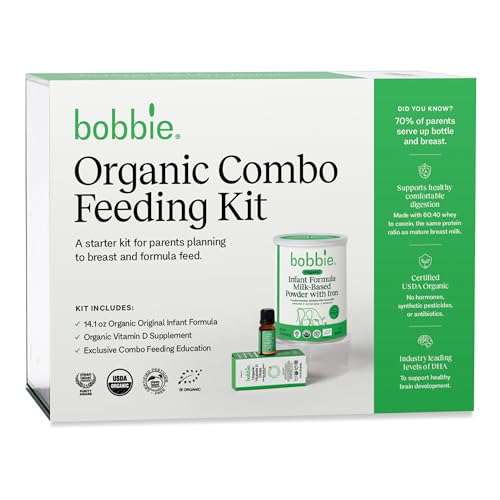
One box that solves both halves of the breastfeeding-plus-formula routine, drops included.
Most parents who top up with formula forget the other supplement entirely. This kit bundles a 14.1 oz can of Organic Original Infant Formula with a 0.3 fl oz bottle of Organic Vitamin D Drops, so the two things a combo-feeding household needs arrive together. The formula carries industry-leading levels of DHA and iron along with choline and vitamin D.
Digestibility is what carries the reputation here. The formula is modeled after breast milk with a complete nutrition recipe, USDA Organic and Clean Label Certified, non-GMO, and made without hormones, synthetic pesticides, or antibiotics. Parents describe the taste as landing close to breast milk and the stomach settling without incident — one theme in the feedback is relief at having something clean on hand when supply runs short. The honest counterweight is cost: opinions split on whether the kit justifies its premium placement.
Why the bundle earns its spot: formula plus vitamin D drops in one purchase means no second order and no forgotten supplement — and the three-drop, 400 IU dosing is built so an extra drop stays harmless.
Pick this up if: you are planning to both breastfeed and formula feed and want the vitamin D side handled in the same box.
Skip the kit if: you formula feed exclusively — the drops are the wrong tool for that, and the standalone Bobbie can covers you.
5. Kabrita Goat Milk Toddler Drink
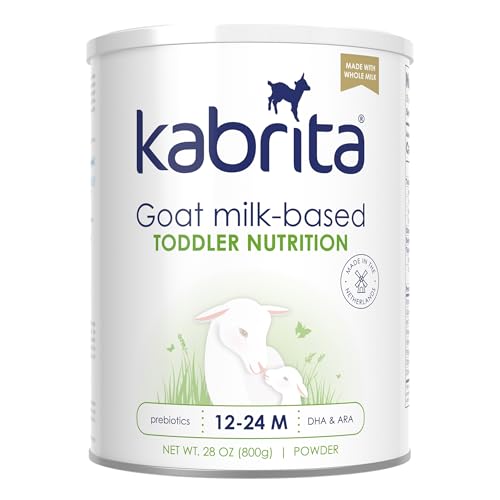
A 28 oz goat-milk tub for the toddler who has been straining on cow-milk formula.
Twenty-eight ounces is the number that changes the maths. That is a full double the 14.1 oz cans elsewhere on this list, so one container covers far more feedings before you reorder. It is built for ages 12 to 24 months with whole goat milk as the first ingredient and primary fat source, sourced from grass-fed goats on family-run farms in the Netherlands.
The digestive logic is straightforward. Goat milk is described as naturally easier to digest than cow milk, which is the whole reason a constipated toddler ends up here. Every batch goes through 300+ independent checks covering heavy metals, pesticides, antibiotics, and plasticizers, and the formula is free from GMOs, corn syrup, antibiotics, and growth hormones. It is built to support growth, gut health, immunity, and brain development for ages 12 to 24 months.
Bowel movements are the recurring theme in owner feedback — normal stools are the headline result parents describe. As reviewers point out: “I recommend it for parents who have toddlers that are constipated. This is way easier on their tummies.” Another household calls it the milk that finally stopped the stomach aches, saving them the daily struggle. Worth flagging honestly: this is a toddler drink, not an infant formula, and it does contain lactose, so it is not the answer for lactose intolerance.
Why toddler parents keep reordering
- 28 oz can — twice the fill of the 14.1 oz options here
- Whole goat milk as the first ingredient and primary fat source
- 300+ independent batch checks for heavy metals, pesticides, antibiotics, and plasticizers
- Free from GMOs, corn syrup, antibiotics, and growth hormones
Where it draws the line
- Toddler drink only — 12 to 24 months, not a newborn formula
- Contains lactose, so it is not suitable for lactose intolerance
- Goat milk has its own taste, and not every toddler takes to it on day one
Made for: the 12-to-24-month transition, especially a toddler who has been constipated on cow-milk formula and needs something gentler.
Look elsewhere if: your child is under a year, or lactose intolerance is the issue rather than general dairy sensitivity.
6. Kabrita Goat Milk Infant Formula
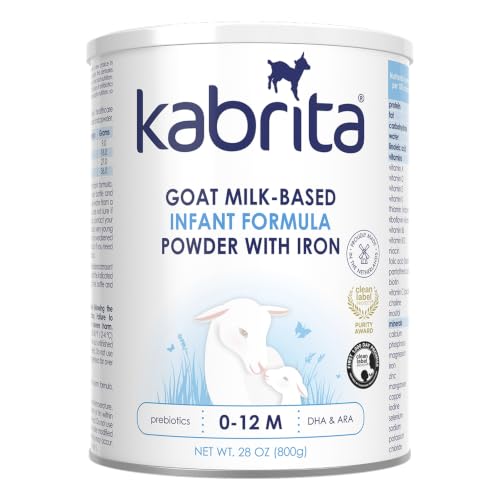
Soft curds, A2 protein, and a can that lasts about a week of full feeding.
If a cow-milk formula has already caused reflux or spit-up in a newborn, this is the swap worth making early. It is a European goat-milk formula designed for gentle digestion in healthy infants from 0 to 12 months, built on goat milk’s naturally gentle A2 protein. The mechanism is physical rather than marketing: goat milk proteins form softer curds during digestion than cow milk proteins, which is what supports easier digestion for newborns and growing babies.
The can is the same 28 oz size as the toddler drink, and one container reportedly covers roughly a week of full feeding. Nutrition includes DHA and ARA, iron, vitamin D, prebiotics, beta-palmitate, and lactose, all aimed at healthy growth and development. It is made without corn syrup, GMOs, antibiotics, or growth hormones, holds all three Clean Label Project certifications, and runs 2,500+ quality and safety checks throughout production covering heavy metals, pesticides, antibiotics, and plasticizers.
What wins people over is how it behaves on a sensitive stomach — no digestive issues, no colic, and a smell that is noticeably milder than the alternative. The review pages sum it up: “We had dairy sensitive babies and I under supply. To supplement, we like this better than Similac Alimentum. No digestive or colic issues.” Some parents also note that a baby who was severely constipated on multiple gentle cow-milk formulas turned a corner within a single can. The split verdict is gastric control — some babies settle, others still constipate.
The core mechanism: A2 goat protein forming softer curds than cow milk, plus 2,500+ safety checks, three Clean Label certifications, and DHA, ARA, iron, vitamin D, prebiotics, and beta-palmitate in the recipe.
What may not land: gastric control splits both ways in the feedback, and goat milk brings its own taste and a premium-tier commitment to every reorder.
Choose it for: a newborn or young infant with cow-milk sensitivity who needs a gentler protein from the very first bottle.
Weigh before committing: if constipation is the specific problem, a smaller trial can first is smarter than a bulk reorder.
7. Haven Oat Toddler Formula, Dairy Free, 12+ Months, 14.1oz

Oat instead of milk, for the toddler whose dairy days are over.
When dairy is off the table entirely, the field narrows fast. This is a 100% plant-based oat formula built for toddlers aged 1 to 3 years, made with USA-grown oat powder and fortified with Scandinavian oat protein. The fat and nutrient profile skips palm oil, soy oil, fish oil, added sugar, and artificial ingredients, and adds DHA from marine algae plus lutein — algae being the plant source of that omega-3 fat rather than fish.
Prebiotics and probiotics are added to support the developing digestive system — the part dairy-free parents tend to worry about most. It is made in the USA and backed by a Farm to Formula Promise with traceable ingredients. The can is 14.1 oz, the same size as the Bobbie cans on this list, so the refill rhythm will feel familiar.
Where it shines is a genuinely restricted diet. Parents describe a toddler with a cow milk allergy who tolerates this one and drinks it happily. The recurring caveat is mixability — some find it dissolves easily, others find it does not, and it separates if a bottle sits. A few parents also find the sweetness higher than they would like. It is the lowest-rated pick here, and the honest read is that this is a specialty option for a specific need rather than a general-purpose formula.
Why dairy-free families reach for it
- 100% plant-based oat base with Scandinavian oat protein
- DHA from marine algae and lutein in the recipe
- No palm oil, soy oil, fish oil, added sugar, or artificial ingredients
- Prebiotics and probiotics for developing digestion
The friction points
- Mixing is inconsistent — separates if the bottle sits
- Some parents find it sweeter than expected
- Toddler stage only, 12 months and up
Buy it when: your toddler cannot have dairy and you need a plant-based oat option with algae DHA and prebiotics in it.
Consider the serving first: shake or stir well and feed straight away, because this one does not hold together once it sits.
Know the Specs
Protein base: cow, goat, or oat
The protein line tells you what your baby’s stomach has to break down. Cow milk is the standard and comes in a range of digestibility profiles depending on how the proteins are structured. Goat milk forms softer curds during digestion than cow milk proteins. Oat is a plant protein with no dairy at all, which matters when a cow milk allergy is the issue. If a standard formula has already caused gas or spit-up, changing the base is the first lever to pull.
Carbohydrate source: lactose versus everything else
Lactose is the primary carbohydrate in breast milk, so a formula listing lactose alone is following the breast-milk blueprint. Corn syrup solids, maltodextrin, and sucrose are alternative carbohydrate sources that appear on many mainstream cans. If your reason for shopping is a cleaner panel, the carbohydrate slot is the fastest place to check whether a can matches that goal.
Can size and reconstituted yield
The ounce weight on the tub is powder, not formula. What you actually feed is the reconstituted volume, so a can that makes approximately 154 fl. oz. of prepared formula tells you far more than the powder weight alone. Divide that figure by your baby’s daily bottle count to see how long one container really lasts — and if you are feeding one bottle a day, a small can stretches a long way.
Stage and age range
Infant formula covers the first year, and toddler drinks cover 12 months and up. They are built to different nutrition targets and are not interchangeable. Check the manufacturer recommended age on any can before you buy a multi-pack, especially if your baby is at a transition point between stages. Buying a toddler drink for a three-month-old is the most common mistake in this category.
Common Questions
Does goat milk formula contain seed oils?
What is the difference between goat milk and cow milk formula for a gassy baby?
Is lactose better than corn syrup solids in baby formula?
Can I give a toddler drink to a baby under 12 months?
How long does one can of formula actually last?
Does organic certification mean a formula is free of seed oils?
What are smaller milk proteins and why do they matter?
Will a dairy-free oat formula mix the same way as a milk-based powder?
Do I need vitamin D drops if I am combo feeding?
Is it safe to switch formulas suddenly?
The Bottom Line
For most families, the baby formula without seed oils pick is the Earth’s Best Organic Gentle Infant Formula, because it pairs an organic milk base and a read-the-back-of-the-can ingredient list with approximately 154 fl. oz. of prepared formula per container — and it is the one that keeps coming up as the bottle a gassy baby actually keeps down. That combination of a clean panel and spit-up control is why it leads.
If you are feeding a newborn under three months or want a lactose-only carbohydrate source, the Bobbie Organic Gentle is the smarter first stop. And if the issue is a toddler straining on cow milk, the Kabrita Goat Milk Toddler Drink in its 28 oz tub is where that particular problem usually gets solved — with the caveat that it is a toddler stage drink, not a newborn formula.
How we choose
We do not accept paid placement. Every pick is matched to a real buyer and a real use-case; we do not hands-on test units.
Sources
Specifications: manufacturer listings and product documentation. Review insights: verified customer reviews, as of October 2026. Pricing: not shown on this page (it changes often); check the current price via the retailer link.
As an Amazon Associate, Aappliancez earns from qualifying purchases. This does not affect which products we feature.