Disclosure: Some links in this post are affiliate links. As an Amazon Associate I earn from qualifying purchases, at no extra cost to you. Learn more
Specs are compiled from manufacturer listings and verified buyer reviews and can change over time — please confirm the key details on the product page before buying.
If you want movie sound that wraps around your room without paying for channels you will never use, a 5.1 receiver is the smart buy — and the Yamaha RX-V385 is the one most people should start with. Five speakers plus a subwoofer is all a normal living room needs. Pick a box that decodes Dolby TrueHD and DTS-HD, passes 4K HDR through cleanly, and has enough HDMI inputs for your console, streaming stick, and cable box.
This guide is built by comparing the manufacturers’ published specifications and the patterns across verified customer reviews, so you get each pick’s real strengths and trade-offs instead of marketing spin.
Four specs decide how a receiver performs in your room: power per channel, room calibration, HDMI 2.1 handling, and streaming support. This breakdown of the av receiver 5.1 market separates boxes with licensed Dolby and DTS decoding from those that only list the logos.
Top Picks


How To Choose The Best AV Receiver 5.1
Start with your room size, not the spec sheet. A 5.1 receiver drives five speakers and one subwoofer — two front, one center, two surround, and a powered sub. In a normal-sized living room, those five speakers place effects behind and beside you. The reason to step up to 7.2 is that it adds two more surround speakers and a second subwoofer output, which only pays off in a big dedicated room.
Decoding: what your receiver can actually read
Dolby TrueHD, DTS-HD Master Audio, and Dolby Atmos are the surround formats on modern discs and streams. A box that only lists Dolby Digital and DTS is decoding older, lower-bitrate audio — it will still play, just with less detail. Check the audio encoding line on the listing: “DTS” and “Dolby TrueHD” are the words you want to see.
Power per channel and speaker impedance
Manufacturers quote wattage at different loads, so the number alone does not tell you everything. What matters in a real room is whether the amp stays clean at the volume you actually listen at. Hard-to-drive speakers (4-ohm or low-sensitivity) need more headroom. If you own bookshelf speakers or efficient towers, a lower-wattage five-channel amp is plenty.
HDMI version and HDCP — the video handshake
HDMI 2.1 carries 4K at 120Hz and 8K, and it is what your PS5 or Xbox Series X wants. HDCP 2.3 is the copy-protection handshake that lets protected 4K and 8K content pass through the receiver to your TV. If either is missing, you get a black screen or a downgraded picture on streaming apps. eARC is the return channel that sends TV audio back into the receiver over one HDMI cable.
Room calibration: why it beats extra watts
Your room reflects and absorbs sound unevenly. Auto-calibration systems (YPAO, AccuEQ, Audyssey MultEQ, Dirac Live) measure your space with an included microphone and correct each channel. In practice, calibration changes the sound more than bumping from 75 to 100 watts.
Side-by-Side Comparison
| Model | Best For | Channels | Video | Room Calibration | Amazon |
|---|---|---|---|---|---|
| YAMAHA RX-V385★ Best Overall | First home theater on a budget | 5.1 | 4K Ultra HD, HDR10, Dolby Vision | YPAO | Amazon |
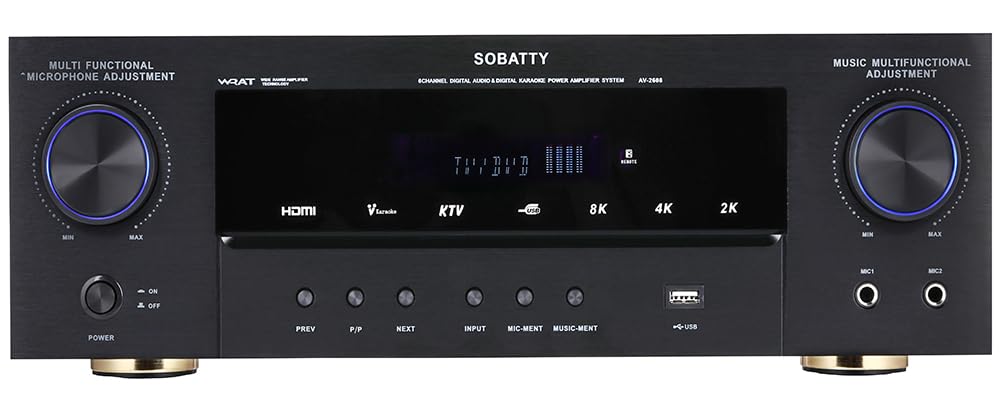
| SOBATTY AV-302Budget Pick | Budget desk and workshop setups | 5.1 | 8K/60Hz & 4K/120Hz passthrough, 48Gbps | — | Amazon |
| Onkyo TX-NR5100Best for Gaming | Gamers wanting 4K/120 VRR | 7.2 | 8K, HDMI 2.1, VRR / ALLM / QFT | AccuEQ | Amazon |
| Sony STRDH590 | Simple plug-and-play stereo fans | 5.2 | 4K HDR, HDCP 2.2 | — | Amazon |
| Onkyo TX-NR6100 | THX-certified home theaters | 7.2 | 8K, HDMI 2.1 40Gbps | AccuEQ | Amazon |
| Denon AVR-S670H | 8K and HEOS streaming | 5.2 | 8K/60Hz & 4K/120 passthrough | Audyssey | Amazon |
| YAMAHA RX-V4A | MusicCast multi-room listeners | 5.2 | 4K120AB & 8K60B, HDMI 2.1 | YPAO | Amazon |
| Denon AVR-X1700H | rich 7.2 with virtual heights | 7.2 | 8K/60Hz & 4K/120Hz, 3 8K inputs | Audyssey | Amazon |
| Marantz NR1510 | Tight shelves under TVs | 5.2 | 4K, 6 HDMI in | Audyssey MultEQ | Amazon |
| Onkyo TX-NR7100 | Large rooms with Dirac Live | 9.2 | 8K/4K 40Gbps, HDMI 2.1 | Dirac Live | Amazon |
| Sony STR-AN1000 | Spatial audio converts | 7.2 | 8K & 4K/120, HDMI 2.1 (6-in/2-out) | D.C.A.C. IX | Amazon |
Detailed Reviews
1. YAMAHA RX-V385 AV Receiver
Our pick — 4.5★ from 3,000+ verified ratings; the strongest balance of quality and price.
The five-channel workhorse that gets a real surround system running without overpromising.
Five speakers, one subwoofer, and a receiver that reads the formats on your discs and streams. That is the whole pitch here, and it is why this Yamaha has held the crowd’s attention — 4.5 stars across 3,000+ owners. It handles Dolby TrueHD, Dolby Digital +, and DTS-HD audio, so the mixes on Blu-rays and most streaming apps decode with their detail intact rather than being downmixed to something flatter.
The YPAO auto-calibration (Yamaha’s built-in room correction, which uses a supplied microphone to measure your speakers and correct each channel) is the quiet hero of this box. Set the mic on a tripod or a stack of books at ear height, run the sweep, and the receiver adjusts levels and distances for you. Four HDMI inputs and one output with HDCP 2.2 handle 4K, HDR10, Dolby Vision, Hybrid Log-Gamma, and BT.2020 color — so your 4K TV and 4K streaming stick pass through without a fight.
Bluetooth is on board for phone music, and a 0–500 ms audio delay control (a manual lip-sync trim) is a genuinely useful inclusion when a streaming app drifts out of sync. The recurring gripe is Bluetooth reliability — some buyers report the connection drops or stops responding. Functionality and Bluetooth both land in mixed territory in the review pages. That is the honest trade-off: superb sound and value, less bulletproof wireless.
Where it earns the crown
- Quality is what buyers praise most, with sound quality close behind — the two things a receiver should nail.
- YPAO calibration adjusts each channel to your room without extra gear.
- 4K pass-through with HDR10, Dolby Vision, HLG, and BT.2020 covers modern sources.
What to know before you commit
- Bluetooth is mixed — a phone stream may drop where a wired HDMI source holds steady.
- Stick to 5.1 speakers; this is a five-channel amp and there is no path to height or surround-back expansion.
Reach for this if: you want the highest-scoring 5.1 receiver here, with calibration and 4K passthrough, without paying for channels you will never use.
Look elsewhere if: your source is mainly phone-to-receiver Bluetooth music rather than HDMI video sources.
2. SOBATTY AV-302 Stereo Receiver, 5.1 Channels Audio Amplifier
Punches above its price on inputs and video, then asks you to live without the extras.
You get two HDMI 2.1 inputs and an eARC output that pass uncompressed 8K at 60Hz and 4K at 120Hz with 48Gbps of bandwidth. That means your PS5 or Xbox Series X can send full-quality video to your TV without losing detail. This is a genuinely modern video section — the same bandwidth figure the high-end boxes brag about — and it is why this SOBATTY pulls in buyers building around a PS5 or Xbox Series X without spending premium money.
The sound is the part people remember. Reviewers describe the 5.1 surround filling the room and the subwoofer output delivering deep bass, and the shop-use case comes up — a TV-and-football setup where it just works. It also reads optical, coaxial, USB, and Bluetooth, so it plays nice with a computer, a turntable, and a phone. Bluetooth pairing is quick and the included remote covers the basics.
Here is the honest part: this is a stereo-decoded amp, not a Dolby/DTS-licensed processor. It does not pass through Atmos or the higher surround formats. One buyer also found the listed dimensions wrong — “Very disappointing! I needed the dimensions to be correct to fit in a box on my ceiling. These are completely wrong.” Measure your shelf before you buy, and know there is no per-speaker level trim via the remote, just bass, treble, and preset EQ.
The value argument
- 8K/60Hz and 4K/120Hz passthrough with 48Gbps bandwidth on two HDMI 2.1 inputs.
- Deep bass from the subwoofer output and full 5.1 room-fill for the money.
The fine print
- Not Dolby/DTS certified — no Atmos or high-bitrate surround decoding.
- No per-speaker level adjustment from the remote; only bass, treble, and preset EQ.
- An occasional unit arrives with dimensions that miss the listing.
Buy it for: the cheapest path to 8K passthrough and Bluetooth in a second room, a shop, or a desk setup where decoding bragging rights do not matter.
Step up if: you need true Dolby or DTS decoding and per-speaker calibration — those live on the higher picks here.
3. Onkyo TX-NR5100 7.2-Channel 8K Smart AV Receiver
Seven channels of gaming-grade video processing, with the setup done the easy way.
If you own a game console, pick this over the five-channel Yamaha because of its gaming video pipeline. It supports HDMI 2.1 with 4K/120Hz HDR passthrough, VRR (Variable Refresh Rate, which kills frame-tearing and stutter), ALLM (Auto Low Latency Mode, which switches the TV into game mode automatically), and QFT (Quick Frame Transport, which shortens lag) — the four features a PS5 or Xbox Series X owner actually wants. You also get eARC carrying Dolby Atmos, DTS-HD Master Audio, DTS:X, and Dolby TrueHD from your TV apps.
Setup is the standout: owners consistently call it easy, and the rear-panel connections are the mixed bag — the front two speakers use twist terminals while the rest are spring-loaded, so budget a little extra patience for the surrounds. The 7.2 channels mean two more surround speakers and a second subwoofer output versus a 5.1 box.
The honest catch is Bluetooth. It syncs but drifts on vocals, and getting AppleTV audio through Bluetooth headphones can require a workaround. One owner’s experience is harder to ignore: “Loud banging sound on power-up, shook unit; 18 months later lost all output connections (TV, Xbox, DVD) though powers on.” Functionality and quality both read mixed across the reviews. Strong value, uneven wireless, occasional reliability risk.
The gaming case: 4K/120Hz with VRR, ALLM, and QFT gives console players the smoothest path from source to screen — a feature set the Yamaha RX-V385 simply does not carry.
The honest counterweight: Bluetooth is the weak link — expect a workaround if you stream phone audio or run wireless headphones.
Pick this when: a current-gen console sits at the center of your setup and you want the gaming video features that matter.
Think twice if: wireless audio is your main listening mode rather than HDMI sources.
4. Sony STRDH590 Receiver
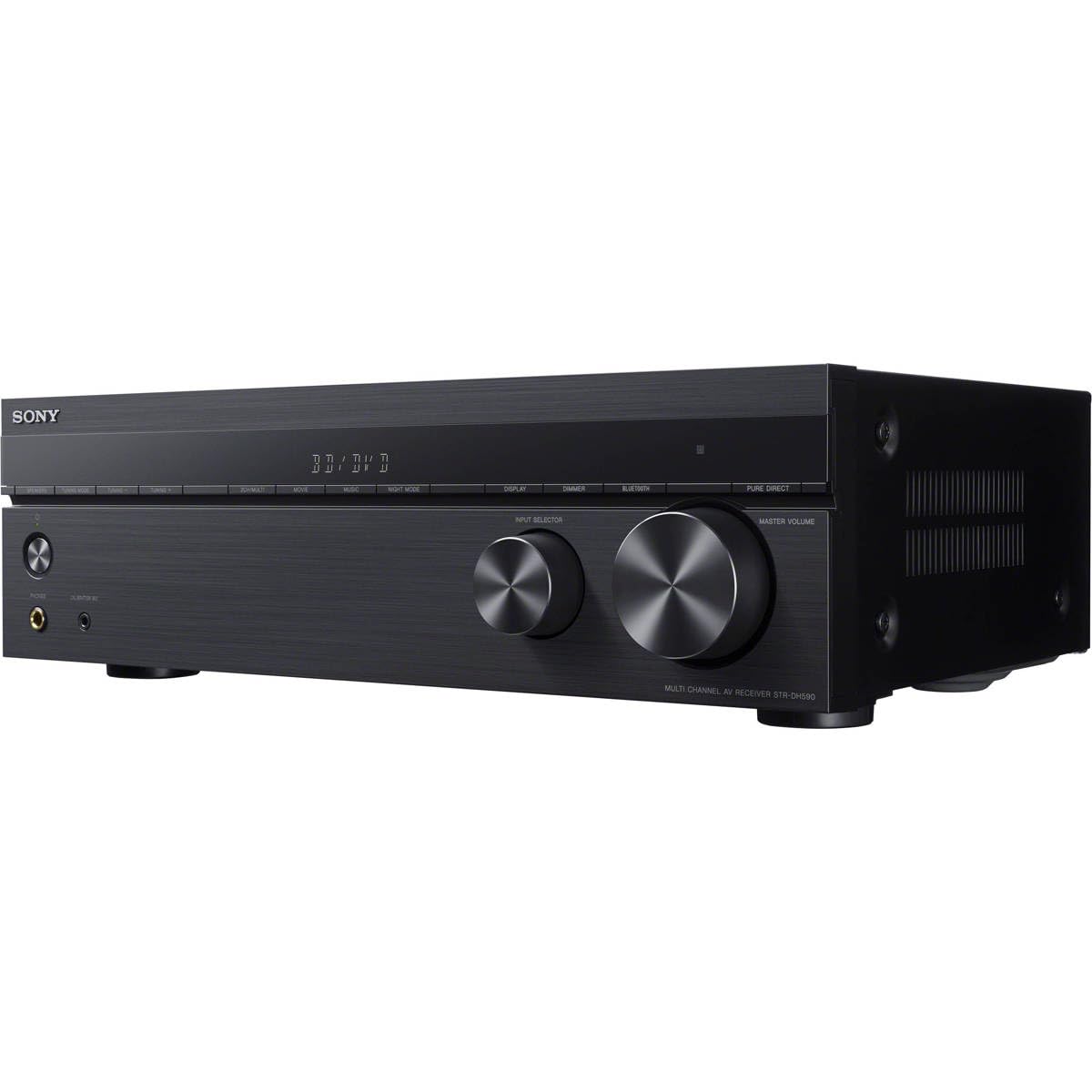
The highest-rated box on this list by sheer volume of happy owners — quality and sound quality stack up in every review sweep.
Two things make this the most-owned receiver on the page: it sounds better than its price suggests, and it sets up faster than most. Owners mention the auto surround configuration works right from the start, and the one-button remote makes switching between FM, TV, and Bluetooth a single press. The 5.2-channel amp is rated 725W across six speakers, and S-Force PRO delivers a virtual front surround effect when you only have two speakers set up.
On video, you get 4K HDR with HDCP 2.2, four HDMI inputs and one output, plus Audio Return Channel. The system also handles a multi-channel stereo setup, an FM tuner, four stereo RCA inputs, two digital audio inputs (one optical, one coaxial), and a 1/4-inch headphone jack. Reviewers call the 4K pass-through sharp with no lag and describe the box as running warm rather than hot.
The trade-off lives in the build and the paperwork. The manual is thin, the rear-panel RCA jacks feel flimsy, and there is no auto-calibration mic included — you set speaker levels by hand. Durability is the aspect owners flag most often in the negative column. Buy it for the sound and the simplicity; accept that the rear connections ask for a gentle touch.
Why it wins the volume game: 4.5 stars across a huge owner base, with quality and sound quality as the top-praised traits — the receiver’s core job, done well.
The build note: no setup mic and flimsy rear RCA jacks mean manual calibration and careful cable handling.
Yours if: you want plug-and-play clarity, a virtual surround mode for two-speaker setups, and the confidence of a long-running crowd favorite.
Not for you if: auto-calibration is a must-have — this one asks you to set levels yourself.
5. Onkyo TX-NR6100 AV Receiver
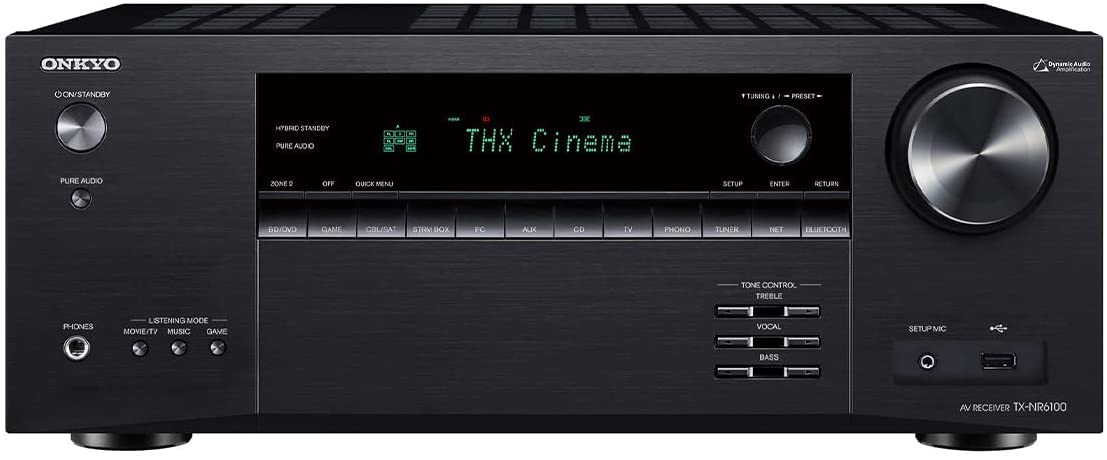
THX-certified dynamics, 5.2.2 Atmos, and enough HDMI ports to retire the switcher box.
The headline feature is the THX Select Certification — a fixed performance bar that the amp and processing have to hit, not a marketing sticker. On top of it sits dynamic audio amplification rated at 210 W/Ch, 5.2.2-channel Dolby Atmos and DTS:X playback, and 8K HDMI 2.1 with 40Gbps across three inputs. The 40Gbps figure is the bandwidth ceiling for 8K/60 and 4K/120 with HDR intact.
Owners describe the sound as detailed and well-positioned, with the height channels adding depth to a 5.1.2 layout. The amp is loud enough with headroom left over, and saved sound modes per device mean you are not re-tweaking every time you switch inputs. Dedicated Zone 2 audio and video lets a second room run its own source. AccuEQ room calibration (Onkyo’s mic-based measurement that trims each channel to the room) is the feature you should run before judging anything.
The honest follow-up question is software stability. A handful of customers note buggy behavior and needing to unplug the unit to recover. Others say they lack headroom for hard-to-drive speakers. If your speakers are efficient and you want certified performance plus extensive inputs, this is a strong pick — just know the occasional software hiccup exists.
What stands out
- THX Select Certification and 210 W/Ch dynamic amplification.
- 5.2.2 Atmos and DTS:X with eight HDMI connections in a common setup.
- Dedicated Zone 2 audio and video for a second room.
Before you buy
- Software bugs pop up in a minority of setups, sometimes forcing an unplug.
- Expects reasonably efficient speakers to hit its rated output.
- Bluetooth is central to the mixed-functionality feedback — HDMI is the safer path.
Best for: building a certified Atmos theater with lots of sources and a second zone, where you want the amp’s size to match the room.
skip it if: you want a set-and-forget box and hate ever touching a power cord to reset.
6. Denon AVR-S670H Receiver

Five amplifier channels of 75 watts each, with HEOS streaming that reaches beyond the theater.
What makes this Denon earn its place is the streaming reach. HEOS (Denon’s whole-home audio system) lets the receiver pull music into other rooms over your network, and Wi-Fi and Bluetooth are both on board alongside Spotify, TIDAL, and more. A dedicated phono input means a turntable plugs straight in without a separate preamp box — a feature the Sony STRDH590 above does not include. Alexa voice control handles volume, track skips, and input changes hands-free.
The video side is fully current: 8K/60Hz and 4K/120 passthrough, Dolby Vision, HDR10+, HLG, and Dynamic HDR, plus VRR, ALLM, and QFT for console gaming. HDMI ARC/eARC returns TV audio over one cable, and HDCP 2.3 covers the copy-protection handshake. The amp itself delivers 75W across five channels.
Owners praise the sound with Polk satellites, the on-screen setup, and easy Home Assistant integration. The recurring caveat is reliability — a mixed signal in the reviews, mostly tied to units that arrived with issues and were returned. That is worth knowing if you want zero hassle, but for most buyers this is a well-loved streaming-forward box with flawless multi-device integration.
The streaming plus: HEOS, Wi-Fi, Bluetooth, a phono input, and Alexa voice make this a multi-room hub, not just a movie amp.
The watch-out: reliability reads mixed — most units are excellent, but a defective one is not unheard of, so buy from a seller with straightforward returns.
The right call for: a five-channel room that also wants music in other rooms and a turntable input.
Maybe not if: you are set on Denon’s higher headroom or you need 7.2 expansion.
7. YAMAHA RX-V4A 5.2-Channel AV Receiver with MusicCast

Five channels with a wireless ecosystem built for playing music in every room of the house.
MusicCast is the differentiator here — Yamaha’s whole-home system that ties the receiver into a network of compatible speakers and lets you send audio room to room. Wi-Fi runs on both 2.4 GHz and 5 GHz bands, and AirPlay 2, Spotify Connect, Pandora, TIDAL, Deezer, Qobuz, Amazon Music HD, SiriusXM, and Napster all stream natively. Voice control works through Alexa, Google Assistant, or Siri via AirPlay 2.
Video is equally current: 4K60, 4K120AB, and 8K60B over HDMI 2.1 with HDCP 2.3 and eARC, on four inputs and one output. Dolby TrueHD, Dolby Digital, and DTS-HD Master Audio decode, and Dolby Vision, Hybrid-Log Gamma, and BT.2020 round out the picture. YPAO automatic room calibration measures and corrects each channel.
The honest story is reliability. A mixed picture emerges — some units run flawlessly for months, others have HDMI handshake issues or need input changes retried. Startup video passthrough is a touch slow, and there is no Atmos. But owners who get a solid unit describe 4K at 120Hz for an Xbox Series X with 5.1 surround and rave about the sound with Klipsch speakers.
Where it shines: MusicCast multi-room streaming, dual-band Wi-Fi, and native app support make it the best network-citizen five-channel pick here.
The split verdict: reliability is uneven — a few units arrive with HDMI handshake quirks, so buy from a seller with easy returns and test the unit early.
It’s a fit for: a connected home that already runs Apple, Alexa, or Google and wants the receiver to join the party.
Don’t pick it if: Atmos decoding is on your must-have list — this is a 5.2 box without height channels.
8. Denon AVR-X1700H 7.2 Channel AV Receiver – 80W/Channel

Seven channels, three 8K inputs, and virtual height effects for rooms that cannot fit ceiling speakers.
Dolby Atmos Height Virtualization is the standout feature — it simulates height effects when you cannot install ceiling speakers, which most living rooms cannot. Add DTS:X and DTS Virtual:X on top, and you get an rich soundstage from a standard 7.2 speaker layout. The amp pushes 80W per channel across seven channels, so you get room-filling sound without distortion. Three dedicated 8K inputs with 8K/60Hz and 4K/120Hz passthrough plus 8K upscaling on all six inputs handle whatever source you plug in.
HDMI support covers 4:4:4 Pure Color Sub Sampling, HDR10, HDR10+, Dolby Vision, and HLG, with HDCP 2.3 and the QMS standard. Six HDMI inputs (plus two digital, two analog, one coaxial, and one phono) give turntables and CD players a home, and two pre-outs let you run dual subwoofers. Built-in HEOS handles multi-room streaming, and a color-coded rear panel plus an on-screen setup guide makes initial wiring easier than most.
Owners describe the easiest receiver setup they have used and a theater-like result once the surround and height speakers are dialed in. Auto-calibration is decent but manual adjustment often beats it in unusual rooms. The Denon HEOS app gets called dated, and a few older 4K TVs have trouble shaking hands with the 8K section. Solid hardware, software that could be friendlier.
Strongest points
- Dolby Atmos Height Virtualization creates height effects without ceiling speakers.
- Three dedicated 8K inputs plus 8K upscaling on all six inputs.
- Color-coded back panel and on-screen setup guide keep wiring simple.
Known limits
- HEOS app is dated and clunky compared to the hardware.
- Auto-calibration needs TV on-screen prompts, and the supplied mic wire is short.
- Very old 4K TVs may not handshake cleanly with the 8K video section.
Built for: a 7.2 room that wants Atmos immersion without cutting holes in the ceiling.
Not the one if: you own an early 4K TV and want a frictionless first connection.
9. Marantz NR1510 AV Receiver
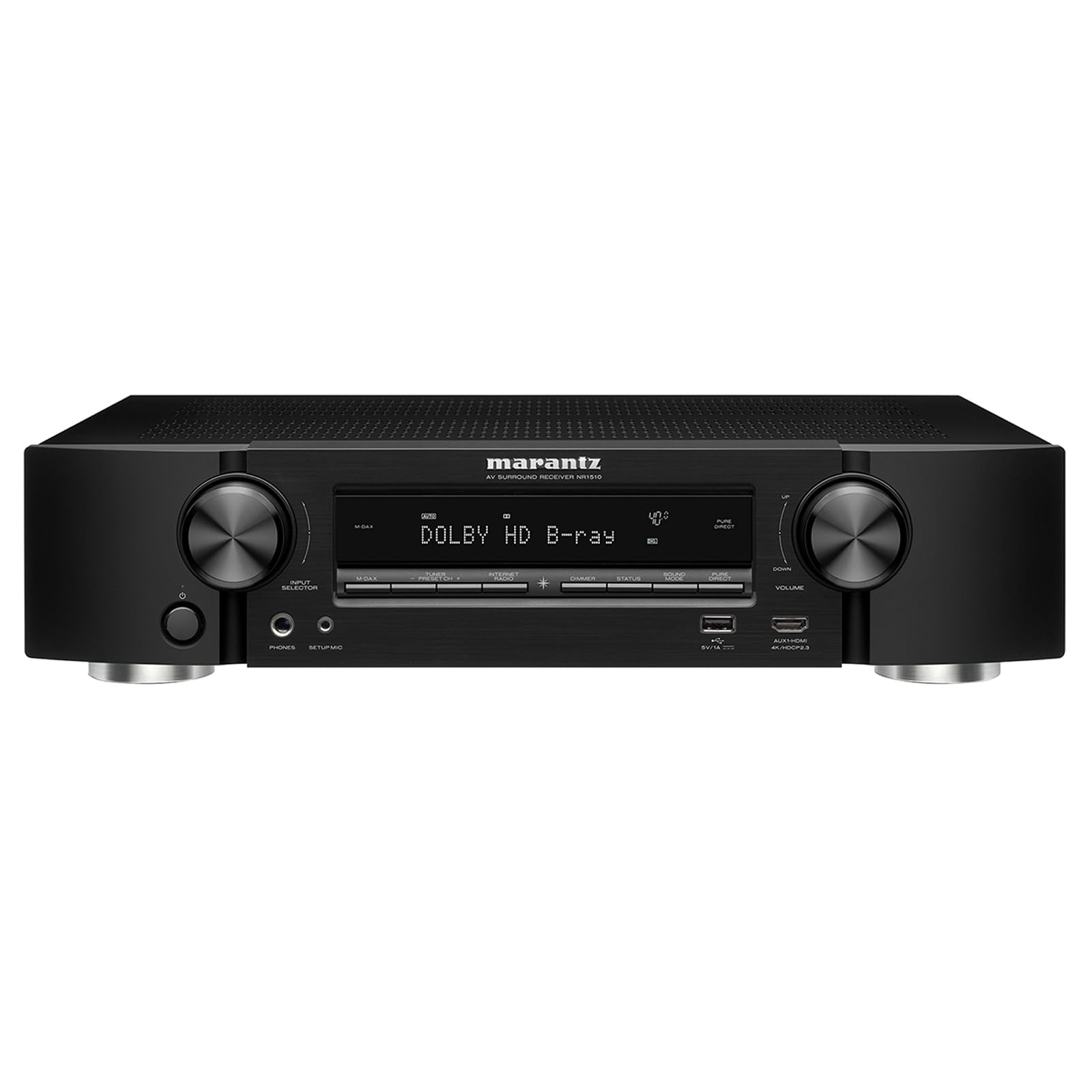
Half-height chassis, full-size sound — the receiver you choose when shelf space is the problem.
At 4.1 inches tall, this Marantz fits where a standard receiver will not go. A typical full-size box runs around six inches high, so this is a meaningful difference for a cabinet or a shelf under a wall-mounted TV. Despite the slim frame, a high-current discrete amplifier delivers 50 watts per channel across all five channels, and the receiver carries full Dolby TrueHD and DTS-HD Master Audio support. The signature Marantz tuning is central to its appeal — owners describe the sound as rich and warm rather than clinical.
Six HDMI inputs plus analog, digital, and phono inputs make it the most flexible connector set here for a small system. HEOS brings Spotify, TIDAL, and Amazon Music HD streaming, and Audyssey MultEQ (Marantz’s room-correction system) measures the room and filters each channel. The rear panel has sturdy connections, and setup flows through an HDMI-connected TV.
The most-praised strength is the software package — the HEOS app and streaming integration come in for praise more than anything else. Power output sits at the lower end of the group at 50 watts a channel, and value-for-money reviews are mixed, so the honest question is whether slimness matters more than headroom. For a small living room with efficient speakers, it does.
The slimline advantage: at 4.1 inches high, this clears cabinet and shelf clearances most full-size receivers cannot, while still delivering Dolby TrueHD, DTS-HD Master Audio, and six HDMI inputs.
The power caveat: 50 watts a channel is enough for efficient bookshelves but not for room-filling output with power-hungry floorstanders.
Made for: a tight cabinet, a bedroom system, or anyone who values the warm Marantz tone and HEOS streaming over maximum wattage.
Better suited elsewhere if: you drive large, low-impedance speakers and need more power.
10. TX-NR7100 9.2-Channel THX Certified AV Receiver
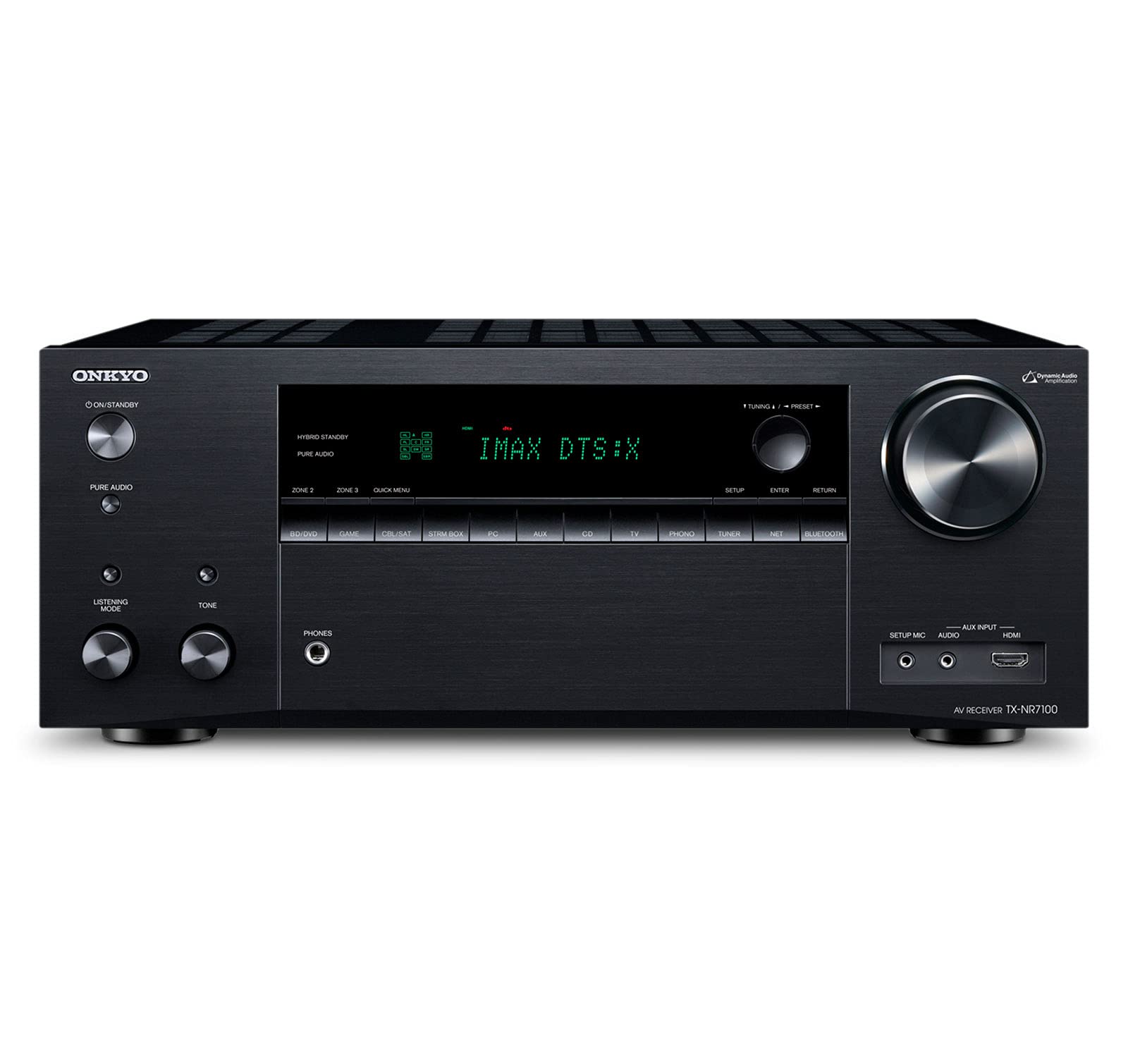
Nine channels of processing with Dirac Live room correction — the most advanced calibration here.
The reason to step up to this Onkyo is Dirac Live, a room-correction system that removes the room’s effect on your sound. You measure with a smartphone and the included wired mic, or use the Dirac Live PC or macOS application with a third-party USB mic for a more precise reading. That is a different class of correction than the automatic sweep on the cheaper boxes, and it lets you position your surround speakers around your room’s real acoustics instead of fighting them.
The rest of the box is equally serious. Nine channels of processing, three HDMI outputs, HDMI 2.1 at 40Gbps for 8K/4K, and discrete Zone 2 HDMI switching so one room can watch a movie while another room watches something else. THX certification sets a performance bar. Dolby Atmos and DTS:X decode, and Dolby Atmos Height Virtualizer simulates height effects if you have no ceiling speakers. Bi-directional Bluetooth sends and receives audio, with aptX HD handling high-bitrate playback to wireless headphones, and DTS Play-Fi allows multi-room synchronizing through the Onkyo Music Control App.
Owners praise the performance and the sound, with Dirac flat-out transforming the experience in well-set-up rooms. The recurring gripes are the slow Dirac configuration and an audio drop on content start. One buyer received an open-box unit sold as new — buy from a reputable seller and inspect the packaging.
The differentiator: Dirac Live with a choice of smartphone-and-mic or PC-based measurement is the most flexible calibrator on this list — with THX certification and 9.2 channels on top.
The annoyance: Dirac setup is slow, and some units drop audio briefly at the start of every clip.
The match for: a large or acoustically tricky room where the correction system has headroom to work — and a buyer willing to spend an hour on room measurement.
Look elsewhere if: you want quick setup and a receiver that behaves identically from the moment it is powered on.
11. Sony STR-AN1000 7.2ch Home Theater 8K A/V Bluetooth Receiver

The most rich spatial sound on this list, with the most demanding setup to match.
It is a 7.2-channel A/V receiver rated 165W (6 ohms, 1 kHz, 1ch THD 0.9%), and the headline is 360 Spatial Sound Mapping. Owners describe the effect as transformative — pressing the SS360 button reshapes a standard surround mix into a fully enveloping soundstage. Digital Cinema Auto Calibration IX handles the room, and Dolby Atmos and DTS:X decode with object-based precision. Video covers 8K and 4K/120 with HDMI 2.1 support across six inputs and two outputs.
Sony’s HDR lineup runs Dolby Vision, HDR10, Hybrid Log Gamma, and IMAX Enhanced. Streaming works through Bluetooth, Wi-Fi, Chromecast built-in, Spotify Connect, and Apple AirPlay, and this one is “Works With Sonos,” so it can integrate with an existing Sonos system. Zone 2 and Zone 3 add multi-zone distribution, and a graphical on-screen interface guides setup. Google Assistant handles voice control.
The honest catch is operational stability. Reviewers point out startup input cycling, a black VIDEO banner, multi-second delays on content changes, and HDCP errors over long runs — some of which required repair. The front display is small and the remote rarely shows the sound field. If 360 Spatial is what you are chasing, this delivers it; expect to babysit the handshake occasionally.
Why it earns the top slot
- 360 Spatial Sound Mapping and Digital Cinema Auto Calibration IX lead the field on immersion.
- 8K and 4K/120 with HDMI 2.1, 6 inputs, and 2 outputs across a broad HDR lineup.
- Chromecast built-in, AirPlay, Spotify Connect, and Works With Sonos cover every major streaming route.
What to expect
- Startup input cycling, black VIDEO banners, and HDCP errors surface in some setups.
- The front display is small and the remote rarely shows sound-field info.
- Long HDMI cable runs (past 100 feet) may need a repeater to hold signal.
Worth it for: a home theater where maximum immersion and the widest streaming compatibility outweigh a bit of handshake babysitting.
Reconsider if: you want a zero-fuss box that never needs a power cycle — the operational quirks are the honest tax on this one.
Know the Specs
Channels: what 5.1 vs 5.2 vs 7.2 vs 9.2 means
A 5.1 receiver drives five speakers (two front, one center, two surround) plus one subwoofer output. The “5” is the speaker count, the “.1” is the subwoofer channel. A “.2” second number means a second subwoofer output, not more speakers. A 7.2 box adds two surround-back speakers and a second sub output — useful only in a larger room. A 9.2 box adds two more channels on top of that, usually for extra height or a second zone. For most living rooms, 5.1 is the balance; going higher only pays off with the room and speakers to support it.
Power per channel and what the wattage really means
The wattage printed on a receiver is measured against a specific load and distortion figure — often 6 ohms at 1 kHz. A higher number does not automatically mean louder or cleaner sound in your room. What matters is whether the amp stays clean at your normal listening volume with your specific speakers. Low-impedance or power-hungry speakers need more headroom; efficient bookshelves run fine on modest power. If your speakers are the easy-to-drive kind, a lower-wattage box can sound just as good as one with a bigger number on the box.
HDMI 2.1, eARC, and HDCP 2.3 explained
HDMI 2.1 is the newest video path — it carries 4K at 120Hz and 8K, which your current-gen gaming console wants. eARC (Enhanced Audio Return Channel) sends TV audio back into the receiver over a single HDMI cable with full surround intact. HDCP 2.3 is the copy-protection handshake that lets protected 4K and 8K content pass through. If any of these are missing, you get a black screen, a downgraded picture on streaming apps, or the TV sends only stereo instead of full surround.
Room calibration systems: YPAO, AccuEQ, Audyssey, Dirac Live
Your room absorbs and reflects sound unevenly, so auto-calibration trims each channel’s level, distance, and tone to your seating position. YPAO (Yamaha), AccuEQ (Onkyo), Audyssey (Denon and Marantz), and Dirac Live (Onkyo’s higher models) all use a supplied microphone to measure each speaker and correct for the room. Dirac Live is the most advanced, offering PC-based measurement and manual tuning. Even the basic versions make a bigger difference to day-to-day sound than a modest bump in wattage.
Common Questions
Do I need 5.1 or 7.2 for a normal living room?
Will a 5.1 receiver decode Dolby Atmos and DTS:X?
What is the difference between 4K passthrough and 8K passthrough?
Does the room calibration microphone really make a difference?
Is HDMI eARC important for streaming apps?
How much power per channel do I actually need?
Do I need a phono input if I have a turntable?
Can I use a 5.1 receiver for a second zone?
Why does my receiver drop signal or show a black screen?
Is Bluetooth good enough for serious music listening?
The Bottom Line
For most people, the best av receiver 5.1 pick is the Yamaha RX-V385 because it nails the essentials — Dolby TrueHD and DTS-HD decoding on five channels, 4K passthrough with HDR10 and Dolby Vision, and YPAO room calibration — at a price that leaves room for speakers. It is the highest-scoring 5.1 receiver here, and the honest truth is very few setups need more channels than this.
If your priority is gaming, step up to the Onkyo TX-NR5100 for 4K/120Hz, VRR, and ALLM — the video path a current-gen console wants. And if you want Atmos immersion without cutting holes in the ceiling, or a slim chassis for a tight cabinet, the Denon AVR-X1700H and the Marantz NR1510 each solve a specific problem this list was built around.
How we choose
We do not accept paid placement. Every pick is matched to a real buyer and a real use-case; we do not hands-on test units.
Sources
Specifications: manufacturer listings and product documentation. Review insights: verified customer reviews, as of October 2026. Pricing: not shown on this page (it changes often); check the current price via the retailer link.
As an Amazon Associate, Aappliancez earns from qualifying purchases. This does not affect which products we feature.