Disclosure: Some links in this post are affiliate links. As an Amazon Associate I earn from qualifying purchases, at no extra cost to you. Learn more
Specs are compiled from manufacturer listings and verified buyer reviews and can change over time — please confirm the key details on the product page before buying.
You can lose a whole Saturday stripping scrap copper by hand, or buy the wrong “automatic” stripper and fight it every time you squeeze. The word automatic covers two very different tools: a palm-sized hand tool and a bench-mounted motorized machine. Decide your job first — a few dozen terminations at a panel, or stripping scrap cable by the mile.
This guide is built by comparing the manufacturers’ published specifications and the patterns across verified customer reviews, so you get each pick’s real strengths and trade-offs instead of marketing spin.
Each pick below shows where it stops being comfortable — gauge limits (American Wire Gauge: a scale where a smaller number means thicker wire), wire types, feeding quirks. That edge is what separates a good purchase from a frustrating one. Here are the practical picks worth your bench space among the field of the Best Automatic Wire Stripper.
Top Picks


How To Choose The Best Automatic Wire Stripper
Pick your wire before you pick the tool. Pull out the cable you strip most often and read three things: its gauge, its insulation type, and whether the conductor is solid (one copper core) or stranded (many thin copper threads). Every choice below flows from that one answer.
Match the gauge range to your real wire
A stripper rated 8-32 AWG covers thin control wire up to heavy building cable in one tool. A tool rated 24-10 AWG handles the thin end beautifully but stops well short of thick feeder cable. Buy outside your actual range and you fight the tool daily.
Hand tool or bench machine?
A hand tool strips one termination at a time and lives in your pouch. A motorized machine feeds continuous scrap cable through a blade and is built for volume, not for panel work. Mixing those two jobs up is the most common buying mistake in this category.
Look for an adjustable length stop
A length stop is a physical block that sets how far the blade bites before it pulls. Set it once and every strip comes out the same length. That matters when you are landing dozens of conductors in a panel.
Check blade material and replacement availability
Blades do the cutting, so their steel and how easily you can swap them define the tool’s working life. A replaceable blade and a spare spring keep a good tool in service rather than in a drawer.
Side-by-Side Comparison
| Model | Best For | Stripping Capacity | Power Source | Weight | Amazon |
|---|---|---|---|---|---|
| VEVOR Electric Wire Stripping Machine★ Best Overall | Scrap copper recycling at volume | 0.06″–0.98″ diameter | 60 W motor | 15.5 kg | Amazon |
| Felo 0715762681Featherweight Pick | Thin and fine-stranded wire | 24 – 10 AWG | Hand powered | 2.08 ounces | Amazon |
| Jokari 20050 Super 4 Plus | Daily all-round hand stripping | 0.2–6 mm² (up to AWG 14) | Hand powered | 0.09 kg | Amazon |
| Mozeyerh Drill Wire Stripper Kit | Drill-driven stripping and twisting | 6-14 AWG | Drill (1/4-inch chuck) | 0.62 kg | Amazon |
| SENDUO Automatic Wire Stripper Machine | Mid-volume bench stripping | 0.04″–0.79″ diameter | 25 W motor or hand crank | 4.75 kg | Amazon |
| KNIPEX 12 40 200 EvoStrip | Wide-gauge bench and panel work | 8-32 AWG | Hand powered | 6.88 ounces | Amazon |
| KNIPEX Nexstrip 12 72 190 | Strip and crimp in one tool | 0.03–10 mm² (AWG 32-8) | Hand powered | 170 g | Amazon |
Detailed Reviews
1. VEVOR Electric Wire Stripping Machine
Our pick — 4.5+★ from 650+ verified ratings; the strongest balance of quality and price.
A bench machine that turns a weekend of scrap copper into a single afternoon.
It wins this list because one 60 W gear motor feeds wire through 7 channels at once — 6 round and 1 flat — for anything from 0.06″ to 0.98″ in diameter. That range covers hard-cover, soft-cover, multi-conductor and mono-filament wire. So you are not sorting scrap into separate piles to match a single blade slot.
What wins people over is raw runtime: it simply keeps going. Buyers report long sessions with no trouble at all, and owners mention it earns back its keep fast. The hole-size markings are the quiet hero here. They let you move between wire sizes without re-dialing the blade each time, and the 65 mn spring steel blade (manganese steel, a tough blade alloy) holds its edge through that repeated work.
Expect two costs: weight and noise. At 15.5 kg it is a stationary bench tool you will not carry to a job site — compare that to the 0.09 kg Jokari hand tool, and these two live in different worlds. Adjustability and noise split opinions among owners, and a few units arrive missing the spare knife and nylon nut the manual lists. Treat the 60 W motor as a puller, not a speed demon, and feed wire at an upward angle rather than shoving it.
Where it pulls its weight
- 7 channels (6 round, 1 flat) cover 0.06″–0.98″ wire without switching tools
- 60 W gear motor with a cast iron body that stays put under load
- Hole-size markings let you swap wire sizes without repeated blade adjustment
- Clear acrylic panel shows the strip in progress so you can watch the blade bite
What to plan around
- 15.5 kg makes it a fixed bench machine, not a portable one
- Adjustability and noise draw mixed feedback from owners
- Some boxes ship without the spare knife and nylon nut the manual lists
Reach for this if: you strip scrap cable in volume and want the machine to pay for itself in a single sustained session.
Look elsewhere if: you need a pouch-sized tool for panel terminations — this one stays bolted to the bench.
2. Felo 0715762681 Automatic Wire Stripper
Two ounces of German steel that shines on thin, fussy wire.
At 2.08 ounces and 6.25″ long, the Felo slides into a shirt pocket and comes out for control-cabinet work. Its rated range is 24 – 10 AWG (0.2 – 6.0 mm²), a narrower span than the KNIPEX EvoStrip’s 8-32 AWG. The Felo trades that wide reach for a tighter, more predictable bite on small conductors. If your work is CAT5e, CAT6 (network cable types) and light stranded hookup wire, that is the right trade.
Owners describe the mechanism clearly: V-shaped teeth bite into the sheathing and a cam (a rotating lever that pulls the jaw back) strips the insulation. Squeeze too hard or too fast and you bite into conductors instead of insulation. The honest advice from the review pages is to squeeze slowly and deliberately. As one owner warns, “Small-gauge stranded wire takes a light touch however, or you risk cutting the wire stands rather than stripping the insulation.” The adjustable stopper lets you set a repeat strip length once you have found that rhythm.
Durability is the mixed note. Quality and stripping performance are the two things owners praise most, but a share of users report quick breakage on 10 AWG wire. Keep it on the thin side and it is a precise everyday companion; feed it heavy 10 AWG daily and you are asking for trouble. Home electronics and light control work suit it best.
Best on the thin end: 24 – 10 AWG with an adjustable stopper that gives you repeatable strip lengths on small conductors.
The honest limit: 10 AWG wire is where the mixed durability reports cluster, so let thicker cable go to a bench machine or a sturdier hand tool.
The tool this replaces: a pair of pliers you have been using for years on small wire.
Where it falls short: anything heavier than its 24 – 10 AWG range asks more of the jaw than the tool is built for.
3. Jokari 20050 Ergonomic Super 4 Plus Automatic Wire Stripper
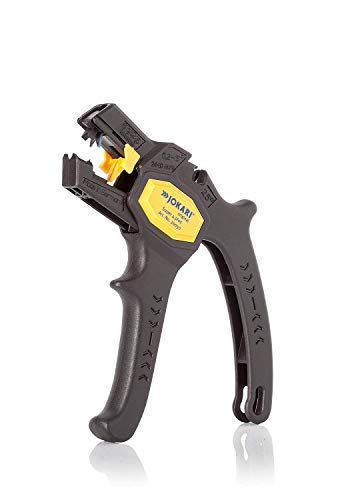
The plier-handle classic that keeps coming back for more wire.
No pick here earns louder loyalty than the Jokari 20050. It handles cross sections up to AWG 14 (2.5 mm²) and 0.2mm-6mm wire, with a plier-handle design, a lockable grip and an adjustable length stopper. At just 0.09 kg it slides into a tool bag pocket and rides to every job unnoticed — a far cry from the 15.5 kg VEVOR machine.
The enthusiasm in the review pages is not subtle. As owners put it: “I STRIP PROB 50+ WIRES EVERY DAY. USED EVERY STRIPPER OUT THERE. THESE HANDS DOWN BEST.” That is a daily production rate, and the tool holds up to it. Spare-blades availability matters too — a worn edge does not retire the whole tool, you just swap the blade.
The limit is the top of the range. Customers note it works great on 14g and smaller, and some say it struggles with 12g and especially 10g wire despite the 10g claim. Treat AWG 14 as the real ceiling and it becomes among the most reliable hand strippers you can carry. Even thinner wire is the Felo’s territory, and the heavy gauge this one leaves behind belongs to the KNIPEX EvoStrip.
Why it wins loyalty: the plier handle, lockable grip and adjustable stopper combine into a fast, repeatable squeeze that electronic repair and home wiring both reward.
Trim the spec sheet: its 10g claim is generous — treat AWG 14 and smaller as the honest working zone.
Buy it if: you strip 14 AWG and smaller all day and want one pocket tool that never argues.
Move on if: 12 AWG or 10 AWG is your daily bread — this one leaves that to the wider-range tools.
4. Wire Stripper for Drill
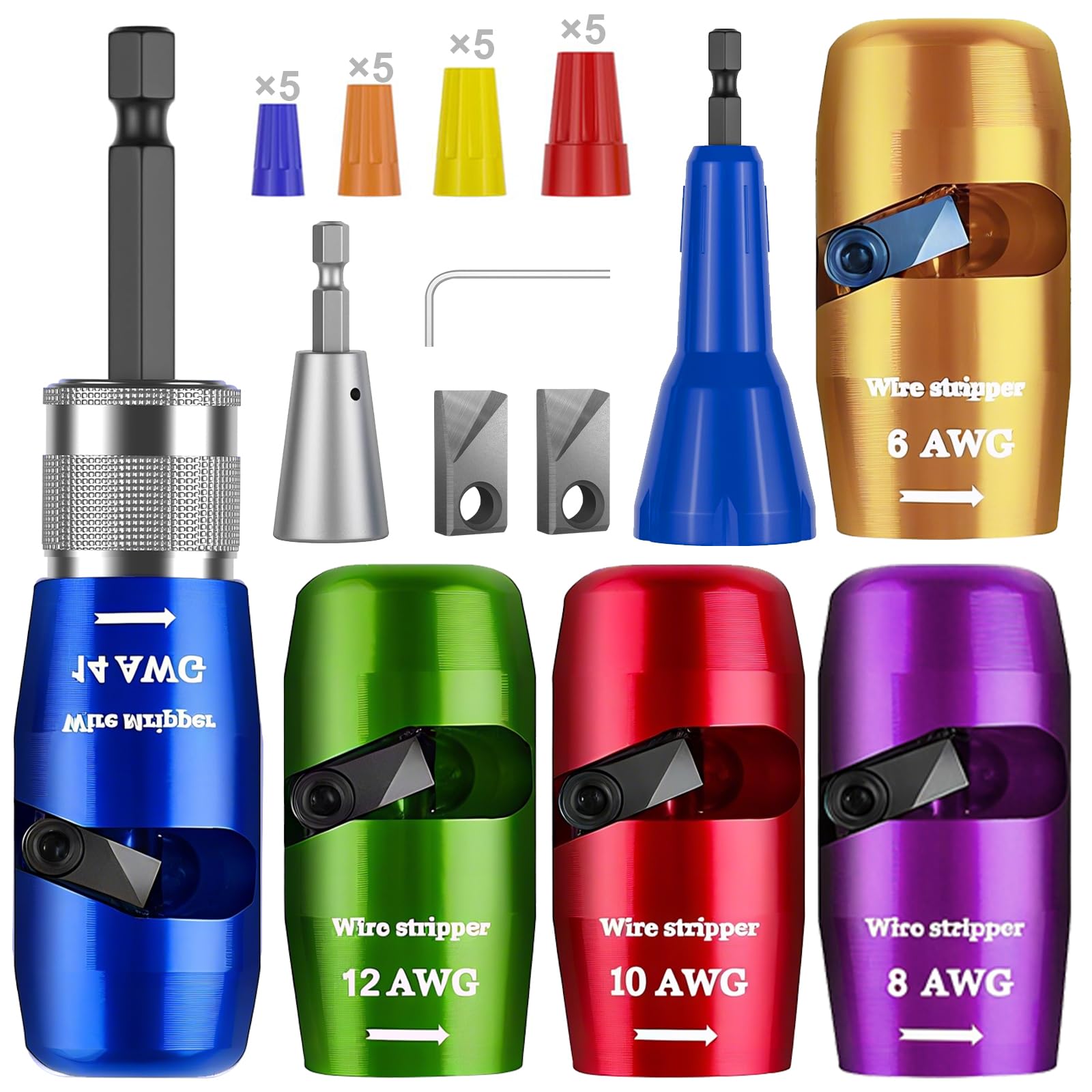
Lend your cordless drill a second job and wire nuts come together in seconds.
Eight pieces turn your own drill into the motor, which is more than you get in any other kit here. Slot one of the 5 stripping sockets into a 1/4-inch chuck and the drill spins the sheath outward along the groove without gouging the core. Those sockets cover 6/8/10/12/14 AWG solid wire, a span that beats the Felo’s 24 – 10 AWG range at the heavy end. The set is 5 strippers, 1 hex tool for blade swaps, 2 wire twisters, plus a carry box.
The twisting side is the sleeper feature. Working with the insulated flame retardant nylon wire caps, the twister is rated to connect 2-5 wires in 10 seconds. That saves your fingers the soreness of hand-twisting — a real gain on a panel with a dozen connections. The 6 AWG socket earns specific praise from EV charger installs, where it strips THHN stranded cable cleanly and keeps every strand intact without nicks or unwinding. A reviewer with 30 years of wire stripping says the set strips to the correct length every time.
Depth is adjustable but easy to knock out of setting in a tool bag or on a ladder, so check it before a run. The wire twister can also be fiddly without clearer guidance in the box. Neither flaw is fatal — match drill speed to gauge and verify the depth setting before every job.
The smart part of the design
- 5 stripping sockets cover 6/8/10/12/14 AWG solid wire
- Twister rated to connect 2-5 wires in 10 seconds with the included nylon caps
- Zinc alloy body with a wear-resistant surface that shrugs off workshop handling
- Works with most corded or cordless drills via a 1/4-inch chuck
Before you start stripping
- Depth setting is easy to bump out of place in a bag or on a ladder
- Twisting function needs more instruction than the box supplies
- You supply the drill — the kit is not self-powered
Pair it with: a variable-speed drill and you have a fast wire-prep station for panel rough-ins.
Think twice if: you want a tool that works without a drill in hand — this kit depends on one.
5. SENDUO Automatic Wire Stripper Machine

A lighter bench machine that rewards patience and punishes rushing.
At 4.75 kg in an aluminum alloy body, the SENDUO gives you bench-machine volume without the 15.5 kg heft of the VEVOR. It runs a 25 W motor and strips round wire from 0.04″ to 0.79″. Hard-cover, soft-cover, multi-conductor and single filament wire are all covered. You can feed it by hand crank or by drill, and reviewers point out it handles wire larger than 1 inch if you pull the guide off and keep the wire in the groove.
This machine rewards setup. One long session stripped 5000 ft of 12-gauge braided wire in about 4 hours at slow drill speed — but only after sorting wires by size and fine-tuning the cutting and drive-wheel spacing. Feed the wire at roughly a 10°-20° upward angle, straighten it before it enters the feed hole, and set the blade to press only gently against the sheath. Done right, it cuts hours of manual work to minutes, and a spare cutting wheel comes in the box.
The honest catch is consistency at the small end. Thin wire below 1/8 inch twists or bounces and feeds poorly, and the customer consensus on build quality is genuinely divided. Treat this as a machine for medium-to-heavy scrap wire where you have time to dial it in. Delicate conductors want a hand tool instead.
Setup is the whole game: sort wire by size, tune the drive wheels, angle the feed upward, and the 25 W motor pulls steady for hours.
Where it fights you: wire under 1/8 inch twists and stalls, and the customer consensus on build quality is genuinely divided.
Worth it for: scrappers who will spend twenty minutes learning the feed angle before running a coil.
Pass if: you want a strip from the very first squeeze — this one needs setup first.
6. KNIPEX 12 40 200 EvoStrip Automatic Wire Stripper, 8-32 AWG
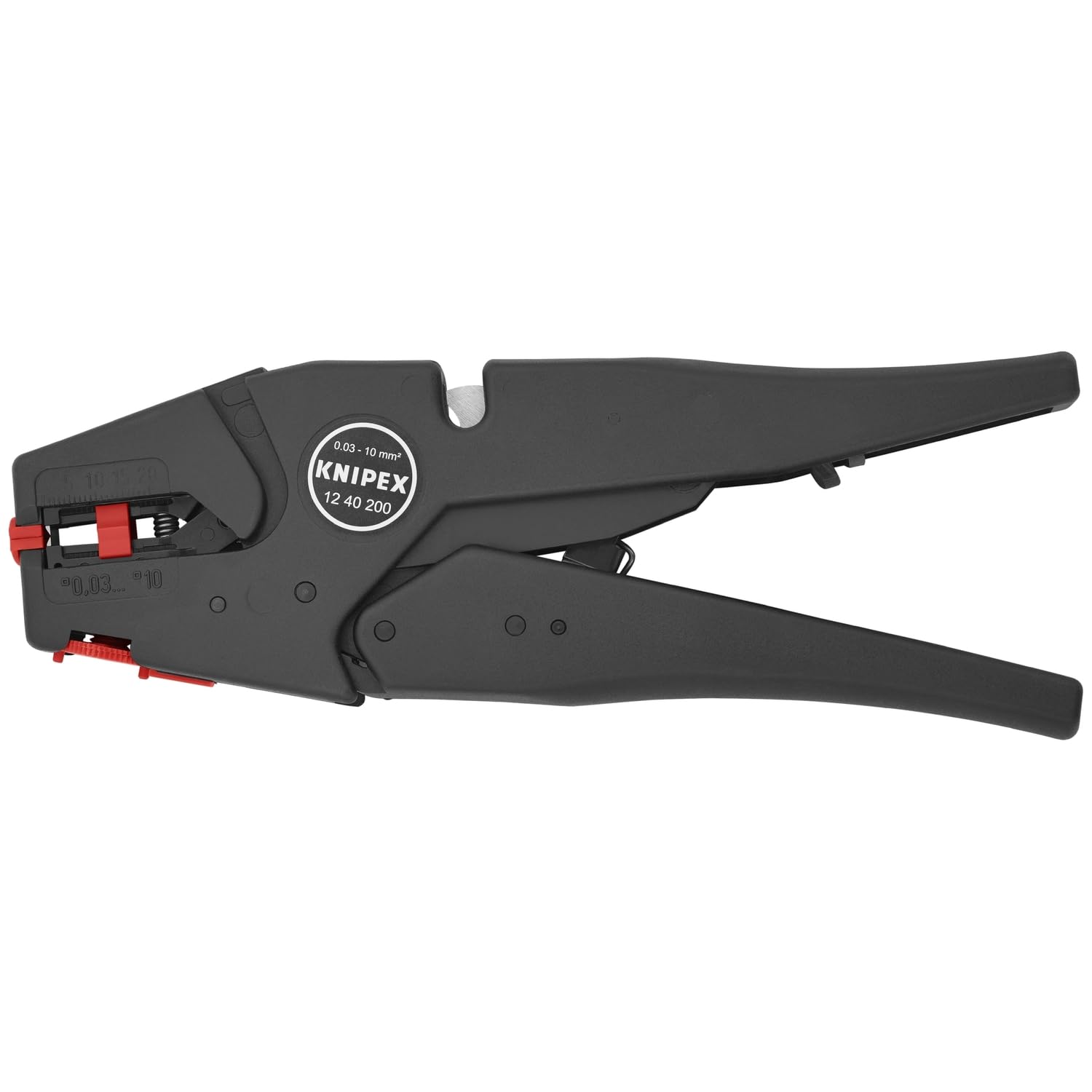
One hand tool that reaches from control wire all the way to heavy building cable.
No other hand tool here spans 8-32 AWG, and that range is why it earns its premium spot. The EvoStrip adapts automatically to each cable’s diameter so it does not nick the conductor — bare copper stays whole. A fine adjustment dial lets you tune cutting depth for special insulation or temperature conditions. For repetitive work, the adjustable length stop runs from 1/8″ to 7/8″ so every strip comes out the same. It cuts copper and aluminum up to 8 AWG multi-stranded and 10 AWG single-stranded.
Dialed in, it is fast. One owner reports six months of use across most wiring projects, stripping insulation in seconds. Another calls it a genuine time saver that roughly doubled efficiency on jobs they usually dread. The fiberglass-reinforced plastic body keeps it at 6.88 ounces, and the blades are oil-hardened special tool steel (heat-treated for a harder edge) that you can replace, along with the clamping jaws and springs.
The recurring gripe is the adjustment wheel, which protrudes and spins out of its setting when slid into a tool pouch. You reset it each time — fine for bench work, annoying on a ladder. A share of owners also find it inconsistent on aged THHN (a common plastic-insulated building wire) and heavy gauge, and the flimsy-feeling plastic body draws criticism. It is the widest range in this lineup, but it wants a careful hand and a settled home.
Why pros reach for it
- 8-32 AWG is the widest span of any tool here, from tiny control wire to 8 AWG cable
- Auto-adapting jaw sets itself to cable diameter to protect the conductor
- Fine adjustment dial tunes cutting depth for special insulation
- Adjustable length stop from 1/8″ to 7/8″ gives repeatable strips
- Replaceable oil-hardened blades, jaws and springs keep it in service
Where it needs care
- The protruding adjuster wheel spins out of setting in a tool pouch
- Some owners find it inconsistent on aged THHN and heavy gauge
- The plastic body feels delicate for the price point
Best for: the bench that needs one tool to cover thin control wire and heavy feeder cable in the same week.
Skip if: you work off a ladder all day and cannot reset a depth wheel every time you holster the tool.
7. KNIPEX Nexstrip Multi-Tool 190 mm, 12 72 190

The panel electrician’s all-in-one: strip, cut and square-crimp without swapping tools.
Strip, cut and square-crimp in one 190 mm frame, and you stop swapping three tools on the bench. It strips flexible and solid conductors from 0.03 to 10 mm² (AWG 32-8) and cleanly cuts up to 10 mm² (AWG 8). It square-crimps single wire ferrules to DIN 46228 parts 1 and 4 (ferrules are the little metal sleeves that finish stranded wire ends), self-adjusting for sizes 0.25 – 4 mm² and 2 x 2.5 mm². The ratcheting mechanism (a ratchet that locks until the cycle finishes) guarantees a complete crimping cycle every time, which is what makes ferrules repeatable in a panel.
For anyone landing ferrules all day, that combination is exactly the point. It weighs 170 g and wears non-slip contoured grips on a glass fibre reinforced plastic body, and it strips with fine adjustment for special insulation or temperature conditions. The people happiest with it are panel electricians who want one tool in hand rather than three on the bench — the EvoStrip covers wider stripping, but this one crimps too.
Two honest caveats. The cable cutter can get in the way during a strip and has caused an accidental cut inside a cabinet. Its strippers also do not handle wire thinner than 20 AWG well, though larger sizes are fine. A few units develop a stuck pressure lever after repeated adjustments. For occasional home wiring and ferrule crimping it is a strong performer; for the very thinnest control wire it is not the pick.
The panel-work combination: strip AWG 32-8, cut to AWG 8, and square-crimp ferrules to DIN 46228 with one ratcheting cycle — a genuine three-tool replacement.
Know its blind spot: wire below 20 AWG is out of its comfort zone, and the cutter needs watching inside a tight cabinet.
Grab this: if ferrule crimping and stripping live in the same afternoon of panel work.
Reconsider: if fine control wire is your main target — this tool’s strength is the larger solid conductor, not the thinnest strand.
Know the Specs
AWG and mm² ratings
AWG (American Wire Gauge) is a scale where a smaller number means thicker wire — 8 AWG is heavy feeder cable and 32 AWG is tiny control wire. A tool rated 8-32 AWG covers the whole spread; a 24-10 AWG tool is built for the thin end. Metric mm² is the cross-sectional area of the copper, and it roughly mirrors the AWG when both are listed. Match the range to the wire you actually handle and you will rarely fight the tool.
Length stop and depth setting
A length stop is a small block that limits how far the blade bites and pulls, so you get identical strip lengths every time. A depth setting controls how deep the blade cuts, so it separates insulation without nicking the copper inside. Both are what make an automatic stripper faster than a plier: you set them once and repeat. Fine-stranded wire needs a lighter depth than solid, which is why adjustable depth is worth seeking out.
Common Questions
Will an automatic wire stripper work on stranded wire?
What is the difference between a hand stripper and a motorized machine?
Does the KNIPEX EvoStrip handle 8 AWG wire?
Can I strip wire with a drill attachment instead?
How do I keep from nicking the copper when stripping?
Can the KNIPEX Nexstrip crimp ferrules as well as strip?
Are replacement blades available for these tools?
How small a wire can the Jokari Super 4 Plus strip?
Can a bench machine handle very large cable?
Do these tools work on solid and stranded wire alike?
The Bottom Line
For most people stripping scrap copper in volume, the best automatic wire stripper is the VEVOR Electric Wire Stripping Machine. Its 60 W gear motor and 7 channels turn a weekend of hand work into an afternoon, and it earns its keep fast. If your work is daily panel and electronics stripping, reach for the Jokari 20050 Super 4 Plus — a 0.09 kg pocket tool with an adjustable stopper that has built genuine loyalty among people who strip 50 wires a day. And if you want strip-and-crimp in a single frame, the KNIPEX Nexstrip covers AWG 32-8 with a ratcheting ferrule crimp that saves swapping tools on the bench.
How we choose
We do not accept paid placement. Every pick is matched to a real buyer and a real use-case; we do not hands-on test units.
Sources
Specifications: manufacturer listings and product documentation. Review insights: verified customer reviews, as of October 2026. Pricing: not shown on this page (it changes often); check the current price via the retailer link.
As an Amazon Associate, Aappliancez earns from qualifying purchases. This does not affect which products we feature.