Disclosure: Some links in this post are affiliate links. As an Amazon Associate I earn from qualifying purchases, at no extra cost to you. Learn more
Specs are compiled from manufacturer listings and verified buyer reviews and can change over time — please confirm the key details on the product page before buying.
If your rotis keep coming out thick, rubbery, or half-raw in the middle, the problem is usually the appliance, not your dough. An automatic roti maker presses and cooks flatbread between two heated plates, so you skip the rolling pin and the tawa dance entirely. This guide sorts the genuinely useful machines from the ones that only look convenient — and tells you plainly which pick fits your kitchen.
This guide is built by comparing the manufacturers’ published specifications and the patterns across verified customer reviews, so you get each pick’s real strengths and trade-offs instead of marketing spin.
Some roti makers press and cook in one go, while others only knead and proof your dough before you finish on a hot pan. The specs that actually change your results are plate width (how big a roti you can fit) and wattage (how fast it heats), and you will find both below in this guide to the best automatic roti maker.
Top Picks
How To Choose The Best Automatic Roti Maker
Two machines can both say “roti maker” and do completely different jobs. One presses and cooks your flatbread between heated plates in a couple of minutes. The other kneads and proofs dough so your arms get a rest, but you still finish each roti on a pan. Figure out which job you actually want first, because everything else follows from that.
Plate size decides your roti size
A 10-inch cooking surface cooks a full-size wrap or a proper chapati without crowding. An 8-inch plate is smaller, so rotis come out narrower and often thicker because the dough has less room to spread. If soft, thin, wide rotis are the goal, plate diameter is the first number to check.
Wattage and heat control
Wattage (the power the machine pulls from your wall) sets how fast the plates reach cooking heat. A 1200W machine and a 1000W machine both work, but the higher figure generally means less waiting between rotis. Just as important is whether you can dial the heat down, since an adjustable setting lets you avoid scorching a delicate dough.
Non-stick plates and cleanup
A non-stick coating on the plates means dough lifts away cleanly and a damp cloth handles most of the cleanup. Removable handles and cord-wrap features matter more than they sound, because a roti maker that stores flat takes up far less cabinet space.
Side-by-Side Comparison
| Model | Best For | Cooking Surface | Power | Item Weight | Amazon |
|---|---|---|---|---|---|
| Victoria Cast Iron Tortilla Press★ Best Overall | Manual pressing and real corn tortillas | 10 inch | — | 10.5 pounds | Amazon |
| Joydeem HMJ-A351 Dough MakerBest for Small Batches | Small-batch kneading plus seasonal proofing | 3.7 quarts | 150W | — | Amazon |
| FineMade Compact 10” Roti Maker | Full-size tortillas with easy storage | 10 inch | — | 3.9 pounds | Amazon |
| StarBlue 10 inch Roti Maker | Faster chapati sessions with a warmer included | 10 inch | 1200W | 4.4 pounds | Amazon |
| Electric Tortilla Press Maker (8 IN) | Hands-off flour tortillas without rolling | 8 inch | — | 5.3 pounds | Amazon |
| Joydeem JD-HMJ7L Dough Maker | Large families and frequent bakers | 6.6 quarts | 250W | 2.61 kg | Amazon |
| FineMade Compact 8” Roti Maker | Small kitchens and light everyday use | 8 inch | 1000W | — | Amazon |
Detailed Reviews
1. Victoria Cast Iron Tortilla Press 10-Inch
Our pick — 4.5+★ from 33,500+ verified ratings; the strongest balance of quality and price.
A 10.5-pound cast-iron press that flattens corn tortillas evenly and outlasts any electric plate here.
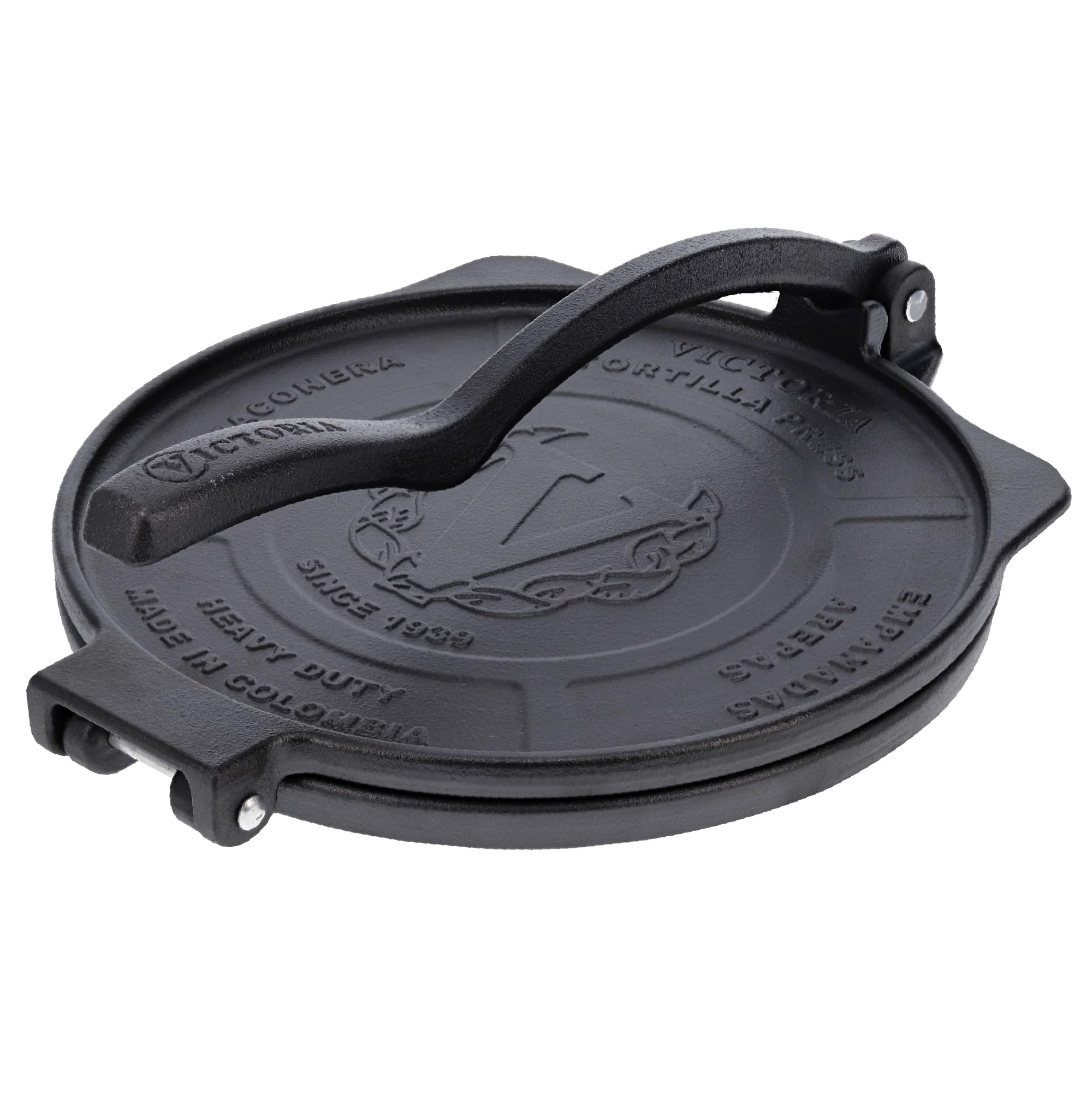
The Victoria press earns its place at the top on stubbornness alone. It is a 10-inch cast-iron press that relies on your own arm strength rather than a heating element, and that single difference is why it tends to last where electric plates eventually cook out. It weighs 10.5 pounds, so it stays planted while you lean into the handle — and it makes a genuinely commanding countertop piece.
Because it is a manual press, it does not cook anything for you. What it does is flatten corn, flour, gluten-free, paleo and wheat dough into an even, round shape across that 10-inch plate. You can also use it for quesadillas, empanadas, arepas, patacones and tostones, which makes it a broader tool than the name suggests.
The practical reality is that this solves the shaping problem but not the cooking step — you still need a hot pan or comal to finish each one. Compare that to the FineMade 10-inch below, which presses and cooks in a single unit but weighs 3.9 pounds to this unit’s 10.5 pounds. Real corn tortillas are exactly where the Victoria pulls ahead, and it never needs a power outlet.
Where it earns its keep
- Heavy-duty cast iron that holds up where electric plates wear out
- 10-inch reinforced plates designed to avoid pinching the dough
- Seasoned with kosher-certified flaxseed oil and free of PTFE and PFOA
- Handles corn, flour, gluten-free, paleo and wheat dough from one press
What to weigh up
- At 10.5 pounds it is a beast to store and lift — heavier than the electric machines here
- You still cook each roti on a pan after pressing, unlike the heated presses
Built for real corn tortillas: if you want an heirloom-quality press that flattens dough beautifully, this is the one.
Think twice if: you want the machine to cook the roti for you — that calls for a heated press instead.
2. Joydeem Electric Dough Maker HMJ-A351
A 150W dough maker that kneads roti dough in intervals and proofs it in a temperature-controlled 3.7Qt bowl.
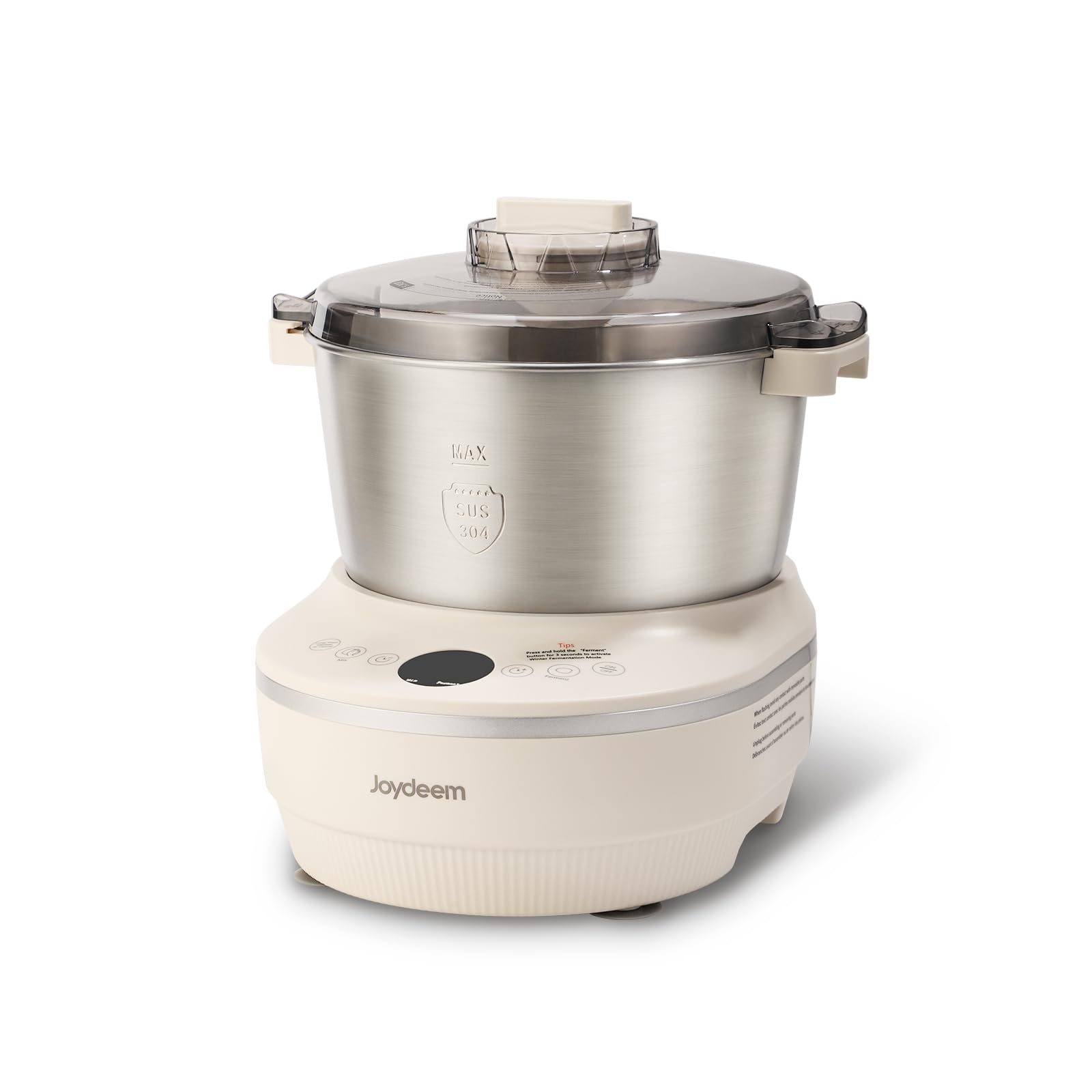
Here is the honest truth about roti making: the rolling and pressing are quick, but the kneading and the resting are what drain an afternoon. This Joydeem is built to handle exactly that half, using a 150W motor that kneads in short intervals to mimic the stop-and-go rhythm of a real hand. Dough for roti, bread, pizza, pasta, sourdough, dumplings and steamed buns all start here.
What sets this unit apart is the fermentation side. There are two modes tied to the seasons: a Summer Mode keeping 35-40℃ and a Winter Mode holding 40-45℃, so you are not guessing at room temperature. Times run in 5-minute steps, from 5 to 90 minutes or 5 to 120 minutes, and the 3.7Qt bowl takes 200g up to 1100g of flour.
The bowl and blade are 304 stainless steel, and the base sits on four silicone suction cups so it stays put and keeps the noise down to 50 db. Focus is what owners talk about most with this machine — the mixing and the hands-off ease are the two things that come up again and again. The trade-off is capacity: this is a small-batch maker, so if you routinely feed a crowd you will want the larger Joydeem below.
The standout spec: dual-mode fermentation with a real temperature range is rare at this size, and it is the reason this machine works in a cold kitchen as well as a warm one.
The catch to weigh: at 3.7Qt it tops out well below the 6.6Qt Joydeem below it, so big families should size up.
Reach for this if: you make rotis or bread for two to four people and want the kneading and proofing handled.
Size up if: you bake double batches — the smaller bowl will hold you back.
3. Joydeem Electric Dough Maker 7.4Qt

A 250W dough maker that kneads a 6.6-quart batch in 15 minutes and kneads plus proofs it in 45.
If you have ever watched a stand mixer strain and overheat over a stiff dough, this machine is aimed squarely at you. The 250W motor handles bread, pizza, buns and dumplings, and it finishes kneading in 15 minutes or kneading plus proofing in 45 minutes. The bowl is 6.6 quarts, a size that takes large batches without the dough climbing the walls.
The design leans on practicality. The touch panel faces up so nothing gets knocked, the suction cup base and weighted body keep it steady, and the top cover lifts off so you can add ingredients mid-knead. The stainless bowl and knife head go in the dishwasher — the base does not — and the whole thing is backed by a 1-year warranty.
Performance is the whole story here, and it is the machine’s calling card. Kneading comes out even and consistent, with dough ready for roti, pizza or loaves without arm work. It does carry a 70 db noise rating, so a heavy knead is audible, and it is a bigger footprint than the 3.7Qt Joydeem above. Documentation has also been a recurring point of friction on this model, so budget a few minutes with the manual.
Why it leads on capacity: a 6.6-quart bowl and 250W of power is the biggest combo in this lineup, so double loaves and big roti batches are no problem.
The honest trade-off: at 70 db it is noticeably louder than the 50 db unit above, and the manual takes some patience.
Pick this if: you feed a large family and want one machine to knead and proof big batches.
Pass if: counter space is tight or you want near-silent operation.
4. StarBlue 10 inch Roti Maker

A 1200W, 10-inch press-and-cook machine that shapes and cooks chapatis in one step, with a roti warmer included.
The feature worth pointing out first is the bundled roti warmer, and it is more useful than it sounds. You get a temperature-control warmer to keep chapatis warm and crisp while you work through the batch, so nothing goes cold before it hits the table. The main unit runs on 1200W at AC 110V with a 10-inch cooking surface, which is a full-size plate for round, fluffy chapatis, tortillas, naans, rotis and parathas.
On the daily-use front, the machine is built for convenience. Power and ready indicator lights tell you when to load the dough, skid-resistant feet hold it steady, and the plates have a non-stick coating that lifts clean with a wipe. It has six heat settings, comes with six settings plus a removable handle for easier carrying and storing, and finishes with cord-wrap storage to keep the counter tidy.
Where owners get the most payoff is time — it does the shaping and cooking in a single appliance, so a stack of chapatis takes a fraction of the time of roll-and-fry by hand. The recurring notes land on durability and consistent results across every batch, so it suits cooks who want speed and consistency rather than a manual tool. The stainless steel housing is the platform, and keeping the plates clean between sessions is the key to keeping it happy.
What wins people over
- 1200W press-and-cook in one unit, no separate tawa required
- Free roti warmer with its own temperature control knob keeps chapatis crisp
- Six heat settings plus power and ready indicator lights
- Removable handle and cord-wrap for easy storage
Worth factoring in
- Some buyers find the rotis thicker than restaurant-thin
- Durability and consistent cooking across every batch are the main recurring notes
The speed play: if getting hot chapatis to the table fast matters most, this rig with its warmer is hard to argue with.
Settle elsewhere if: you want paper-thin rotis every time — that is a manual press job.
5. Electric Tortilla Press Maker 8 IN

An 8-inch heated press that pre-cooks flour tortillas thin in seconds, so you skip the rolling pin.
This press solves a specific frustration: rolling flour tortillas thin enough to cook evenly is a skill, and this machine takes it out of your hands. It runs on 110 volts with an 8-inch plate, and it presses and pre-cooks a flour tortilla in seconds rather than minutes. Insulated legs and an insulated handle keep it safe to move and stable on the counter.
Quality is what owners single out most, and it is the reason this modest-looking press holds its own against fancier machines. It presses a whole batch quickly — the workflow is press every tortilla first, then finish each one briefly on a hot pan. That two-step rhythm is what produces the thin result, and it is what manual rolling struggles to match. It weighs 5.3 pounds, so it is substantial without being a chore.
One caveat worth knowing up front is heat. This press is designed to precook, not to char, so you finish each tortilla on a skillet or comal. A few owners also note there is not quite enough heat on its own, which is exactly why the finishing pan matters. For flour tortillas and sourdough versions, though, the results speak louder than the spec sheet.
Why it earns a pick: an insulated, heated 8-inch press that pre-cooks flour tortillas thin, delivering a hands-off result the rolling pin cannot match.
What to know: it precooks rather than chars, so a finishing skillet is part of the routine.
For you if: you make flour tortillas or sourdough flatbreads and want them thin without the rolling.
Not for you if: you want a single unit to cook roti to a char — this precooks only.
6. FineMade Compact 10” Roti Maker Machine
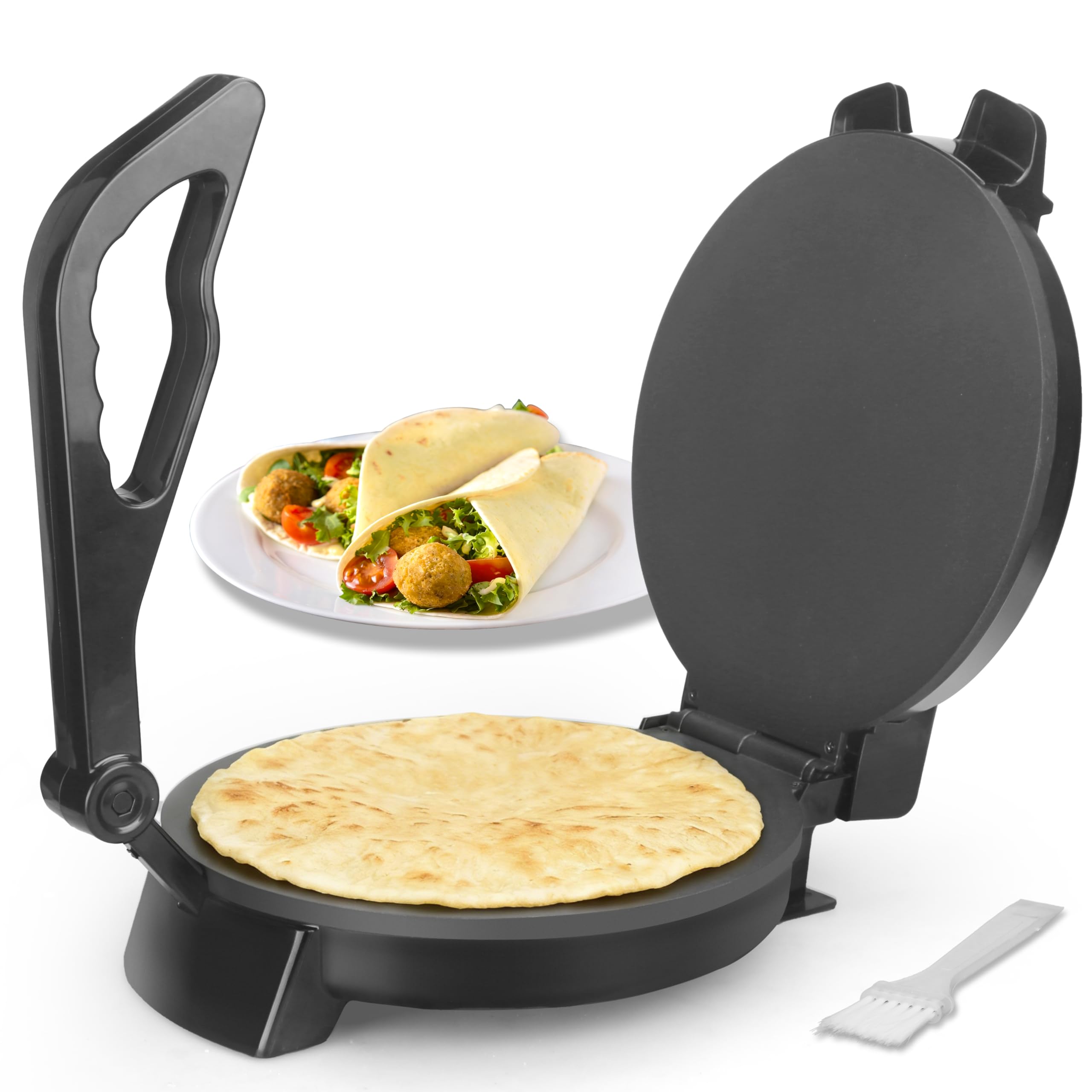
A 10-inch press-and-cook plate for full-size tortillas, with a detachable handle that folds flat for storage.
Size is the whole argument for this machine. The 10-inch cooking surface fits tortillas, rotis, flatbreads and snacks up to 10 inches, so you can make full-size wrap tortillas, taco shells and mini flatbreads on one unit with no extra tools. A smaller 8-inch press simply cannot match that width, and width is what lets a roti spread thin rather than bunch up thick.
It is also built to disappear when you are done. The detachable handle makes storage straightforward and frees up counter and cabinet space, and the non-stick surface wipes clean with a damp cloth. The temperature control lets you dial the heat for a tender, fluffy roti or a crisp, golden-brown one, and the machine works across flour, corn, gluten-free, paleo and wheat tortillas, plus quesadillas, empanadas, arepas and tostones.
The honest limit here is build quality. This is a lighter-duty machine — it weighs 3.9 pounds against the 10.5-pound Victoria at the top — and it needs loose, slightly sticky dough and a high heat setting to give its best results. Drier, firmer dough tends to press out thick and small. So the trick is in the dough, not the machine: keep it wet enough and crank the heat.
The full-size advantage: a genuine 10-inch plate is the single spec that separates this from the 8-inch models, and it is what delivers thin, wide tortillas.
Handle with intent: it wants soft, sticky dough and full heat — firm dough comes out thick.
Go for it if: you want large, thin tortillas and a machine that stores away easily.
Look at the manual press instead if: you prefer heavier, longer-lived construction.
7. FineMade Compact Roti Maker 8”
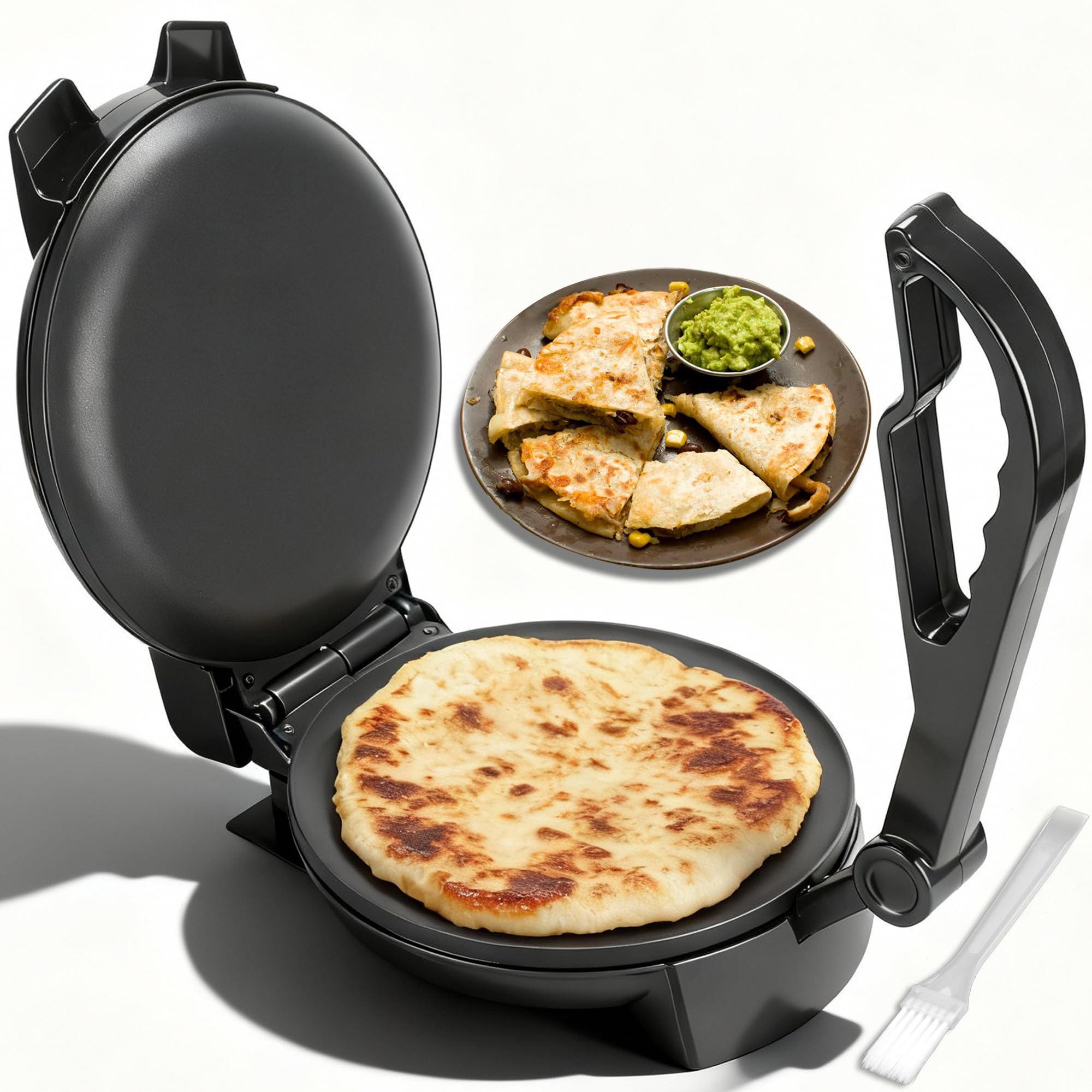
A 1000W, 8-inch press with a U-shaped plate that holds corn tortillas in place for small kitchens.
This is the smallest, simplest machine in the group, and for a lot of people that is exactly the point. At 1000W it heats fast and evenly, and the U-shaped baking plate is shaped to hold standard 8-inch corn tortillas so they do not slide or slip off mid-cook. That little bit of design detail is what makes the difference between a neat round roti and a lopsided one.
Functionality is what gets the nod from the people who use it. It handles rotis, tortillas, chapatis, crepes and even eggs, so it covers breakfast as well as dinner. Temperature control lets you pick the heat level for a soft roti or a crisp one, and the non-stick plate wipes clean with a cloth. It is BPA-free, PFOA-free and PTFE-free, and it comes with a brush and a recipe booklet to get you started.
The trade-off is plate size. This is an 8-inch machine, so rotis come out smaller and, if your dough is too firm, thicker than you might like. The higher-rated 10-inch FineMade above solves that width problem, and if thin, wide rotis are your goal, that is the better tool. For light everyday use in a small kitchen, though, this one does the job with almost no fuss.
What it does well
- 1000W heating for fast, even cooking on a compact frame
- U-shaped 8-inch plate that keeps corn tortillas from sliding
- Non-stick plate wipes clean and is BPA, PFOA and PTFE free
- Doubles as a crepe maker and egg pan, plus a brush and recipe booklet are included
Where it falls short
- The 8-inch plate makes smaller, and sometimes thicker, rotis
- Firm dough tends to come out thick, so it needs a softer mix
Right for a small kitchen: if you want one compact appliance for rotis, crepes and quick eggs, this delivers without taking over the counter.
skip it if: you need full-size rotis — look to the 10-inch models above.
Know the Specs
Plate diameter
The plate is the heated or pressed surface your dough sits on, and its diameter sets the maximum size of your roti. A 10-inch plate lets dough spread wide and thin, which is what most people want in a roti or tortilla. An 8-inch plate is smaller and leaves less room, so the same dough ends up narrower and often thicker. If soft, wide rotis are the goal, pick the larger plate.
Wattage and heat control
Wattage measures how much power the machine draws to heat its plates. Higher wattage generally means the plates reach cooking temperature faster and recover quicker between rotis, which matters when you are cooking a whole batch. Heat control lets you dial the temperature instead of getting one fixed setting, so you can cook a delicate dough gently or blast a firm one without scorching it. Put the two together and you have the difference between an even batch and a burnt one.
Common Questions
Do I need an electric roti maker or a manual press?
Will a roti maker work for both wheat and corn dough?
What plate size do I need for thin rotis?
How long does a roti maker take to cook one roti?
Are roti makers easy to clean?
Can a dough maker replace a stand mixer for roti dough?
Do roti makers need a special circuit or adapter?
Why do my rotis come out thick instead of thin?
How should I store a roti maker between uses?
The Bottom Line
For most people, the automatic roti maker that gets it right is the Victoria Cast Iron Tortilla Press, because it presses an even, round roti or tortilla and is built to outlast every electric plate on this list. If you want the machine to knead and proof for you, the Joydeem JD-HMJ7L turns out large batches with 250W of power and a 6.6-quart bowl. And for small kitchens or quick single-serve flatbreads, the FineMade Compact 8” Roti Maker is the compact one to reach for. If a busy kitchen and a hot stack of chapatis is the goal, the value pick with the bundled warmer is the sensible way in.
How we choose
We do not accept paid placement. Every pick is matched to a real buyer and a real use-case; we do not hands-on test units.
Sources
Specifications: manufacturer listings and product documentation. Review insights: verified customer reviews, as of October 2026. Pricing: not shown on this page (it changes often); check the current price via the retailer link.
As an Amazon Associate, Aappliancez earns from qualifying purchases. This does not affect which products we feature.