Disclosure: Some links in this post are affiliate links. As an Amazon Associate I earn from qualifying purchases, at no extra cost to you. Learn more
Specs are compiled from manufacturer listings and verified buyer reviews and can change over time — please confirm the key details on the product page before buying.
If your wrists ache after ten minutes of cranking dough through a hand roller, an automatic pasta maker is the fix — but not every motorized model is worth counter space. Some knead and extrude dough through a die in one cycle; others just add a motor to a manual roller and call it automatic. This guide separates extruders from motorized rollers so you can pick the type that matches the pasta you cook.
This guide is built by comparing the manufacturers’ published specifications and the patterns across verified customer reviews, so you get each pick’s real strengths and trade-offs instead of marketing spin.
Some machines knead and push pasta out a die in a single cycle. Others roll sheets you cut yourself, which gives you thickness control a die machine cannot match. Below are twelve models ranked by how well they handle real home-kitchen batches.
Top Picks


How To Choose The Best Automatic Pasta Maker
Your first decision isn’t brand or budget — it’s if you want a machine that pushes pasta through a shaped die (an extruder) or one that rolls dough into flat sheets (a roller). An extruder mixes, kneads and pushes dough out in one automated cycle, so you add flour and liquid and walk away. A roller flattens dough between two cylinders, then a cutter slices it into strands; you control thickness with a numbered dial but you feed the dough yourself. Most one-star reviews come from buyers who chose an extruder when they wanted sheets, or a roller when they wanted penne.
Match the machine to the shape you cook most
If your family lives on penne, rigatoni and bucatini, you want an extruder with the matching dies — those tube and ridge shapes can’t be rolled flat. If spaghetti, fettuccine and lasagna sheets are the staples, a roller gives you finer control and lets you press dough down to a paper-thin setting for dumpling wrappers. Extruded pasta also tends to come out slightly thicker and doughier than rolled pasta, so anyone chasing a silky, egg-rich sheet should lean toward a roller.
Watch the flour capacity against your household size
Flour capacity decides whether one batch feeds your table or leaves you running a second. A batch built around 500g of flour feeds roughly four people, while compact models that hold closer to 200g of flour suit one to three servings. If you cook for two, a small machine means less waste and faster cleanup. If you regularly feed a table of six, a large-capacity model saves you running two batches back to back.
Plan for cleaning before you buy
Every machine here demands some cleanup discipline. Extruder parts that touch wet dough usually need to dry first, then get brushed or tapped clean — some are dishwasher-safe. Roller machines with aluminum cutters should never go in water at all, because residual moisture dulls the blade. The practical rule: choose the cleaning routine you’ll actually keep up with, because a machine left dirty in the cupboard stops getting used.
Side-by-Side Comparison
| Model | Best For | Type | Settings / Discs | Thickness Range | Amazon |
|---|---|---|---|---|---|
| Sailnovo 3-in-1 Pasta Maker★ Best Overall | Thickness control on a budget | Roller | 9 thickness, 2 widths | 0.5–3 mm | Amazon |
| VEVOR 150W Automatic (8 shapes)Best for Beginners | Beginners who want one-click pasta | Extruder | 8 discs, 4 modes | — | Amazon |
| Shule Electric with Motorized RollerMotorized Roller | Rolled sheets, motor or hand crank | Roller | 7–9 position dial | 0.5–3 mm | Amazon |
| Shule Electric with Ravioli Roller | Filled pasta and ravioli | Roller | 7 settings, 2 cutter widths | 0.5–3 mm | Amazon |
| VEVOR 150W Automatic (Black) | Large-batch extruding | Extruder | 8 discs, 4 modes | — | Amazon |
| GVODE 3-in-1 Pasta Maker | Compact storage | Roller | 8 settings, 2 speeds + reverse | 0.4–2 mm | Amazon |
| Domestic Electric Noodle Machine | Built-in motor, tidy counter | Roller | 9 settings, 2 cutter widths | 2–7 mm | Amazon |
| Cuisinart PM-1 | Pasta plus bread dough | Extruder | 6 discs, 6 programs | — | Amazon |
| Philips Viva Compact (White) | Small households, everyday use | Extruder | 3 discs | — | Amazon |
| Philips Viva Compact (Black) | Same build, darker finish | Extruder | 3 discs | — | Amazon |
| Marcato Atlasmotor 110V | Lifelong rolled-sheet machine | Roller + motor | 10 positions | 1.5 mm | Amazon |
| Philips 7000 Series HR2660/03 | Cooking for a crowd | Extruder | 8 discs | 1–1.5 mm | Amazon |
Detailed Reviews
1. Sailnovo 3-in-1 Pasta Maker
Our pick — 4.0+★ from 3,000+ verified ratings; the strongest balance of quality and price.
Nine thickness steps and a food-grade build give you sheet control a die machine can’t touch.
If your idea of fresh pasta is a thin, silky lasagna sheet or a dumpling wrapper pressed down to 0.5mm, this Sailnovo roller is the one to reach for. The adjustment knob clicks through 9 thickness settings, and the widest opening rolls dough out to 3mm for a hearty noodle. You press the dough thinner by running it through again and again, which is exactly how you build gluten strength. Then the cutter slices each sheet into strands at either 2.0mm or 4.5mm widths — the narrow side for spaghetti, the wide for lasagna ribbons.
The body is food-grade stainless steel paired with aluminum rollers, so rust stays off the parts that matter. Aluminum is a softer metal than steel, though, and the maker is explicit that the blade attachment should never touch water or the dishwasher — residual moisture dulls the edge over time. Cleaning means brushing or picking the leftover dough out with a wooden stick or toothpick while it’s still soft. Do that and the rollers keep cutting cleanly.
The company says the machine is light enough to shift around and store without a struggle, and at 11.81 inches long it sits on a counter or in a cupboard without drama. What wins people over most is the sheer quality of the build for the tier — it feels like a serious tool, not a toy. The recurring gripe is the table clamp, which some find fussy to lock down on thicker countertops, and the durability reports split between owners who’ve run it for seasons and a few who saw parts loosen early. Dry-brush the rollers and clamp it to a flat, sturdy counter, and it keeps cutting cleanly for years.
The GVODE below is a motorized roller for anyone who wants the same sheet control without cranking, but on pure roll quality and price, this Sailnovo leads.
What earns its keep
- 9 thickness settings from 3mm down to a paper-thin 0.5mm for wrappers and delicate sheets
- Two cutting widths — 2.0mm or 4.5mm — cover spaghetti and lasagna in one pass
- Food-grade stainless body and aluminum rollers stay rust-resistant
- Light enough to store without wrestling it into a cupboard
Where it asks patience
- The blade attachment must be brushed dry — no water, no dishwasher, or the cutters lose their edge
- The table clamp needs a firm, flat surface to hold steady
- It’s a manual crank, so you supply the muscle
Reach for it if: you want to control thickness down to a dumpling-wrapper 0.5mm without spending premium money.
Think twice if: your wrists won’t handle hand-cranking a full batch of stiff dough.
2. VEVOR Electric Pasta Maker 150W
Add flour, add water, press one button — eight shapes drop out without you kneading a thing.
This VEVOR is the machine to buy if you’ve never made pasta in your life. It’s a true extruder: you combine flour and liquid, the two-way kneading rod and four-dimensional mixing mimic a hand-knead, and then the dough pushes out through whichever of the 8 discs you’ve fitted. Four automatic modes mean you don’t have to learn a sequence — a single click starts the cycle. The 500g flour capacity produces enough noodles for about 4 people in roughly 14 minutes, which is faster than most people can prep a sauce.
Those 8 discs are more than most extruders offer at this tier, and they give you shapes a roller simply can’t form. The flip side is the water ratio. The maker is blunt about it: too much or too little liquid and the dough won’t pass through, or it sticks to the machine. Follow the flour-and-water ratio table in the Quick Start Guide, weigh rather than eyeball, and the machine rewards you. Cleanup is easier than you’d guess — let the flour residue dry, tap it off, and the parts are dishwasher-safe. A flour cup, liquid cup, spatula and cleaning brush come in the box.
Owners consistently describe it as taking the hard work out of homemade pasta, and the ease of cleaning gets the same steady praise. What’s worth knowing is that this is a plastic-bodied machine at 11 pounds, so it wants gentle handling rather than being shoved around the counter.
Who it clicks with: complete beginners who want fresh noodles tonight and don’t want to learn a craft to get them.
The honest catch: the water ratio is unforgiving, so measure your liquid carefully or you’ll spend an evening unclogging the die.
Best fit: a first-time maker upgrading from store-bought who wants eight shapes from day one.
Not for: anyone chasing a thin, silky rolled sheet — extrusion makes thicker, doughier pasta.
3. Shule Electric Pasta Maker Motorized Roller
A stainless roller that swaps between motor and hand crank, so you can power through or slow down.
What sets this Shule apart from a plastic extruder is the material: the whole body is stainless steel, with anodized aluminum rollers and cutters that resist corrosion. That matters for a roller you’ll use for years, because aluminum cutters dull fast if they rust. The dial regulates thickness from 0.5mm up to 3mm, and the included attachments cut strands at 1.5mm or 6.6mm — thin spaghetti or wide fettuccine-style ribbons. And because the motor is a detachable piece, you can pull it off after use and pack the machine away tighter.
Running the motor means two speeds of automatic rolling, so a stiff sheet feeds through without your arm doing the work. You can also fit the hand crank and do it yourself when you want finer control. The company warns the motor part is noisy while working, and that’s honest — it’s the sort of sound you’d expect from a 110V motor doing heavy rolling. The body is 6.89 inches long, the most compact roller here, so it tucks into a drawer far more easily than the wider VEVOR or Sailnovo machines.
Functionality earns the most praise, with owners also liking how it handles other soft materials like polymer clay — a sign the rollers turn smoothly under load. The honest caveat is durability: some report the plastic guard pieces chipping over time, so treat the housing gently and expect the motor to be the part to watch. It’s also a wipe-clean-only machine — never wash it or run it through the dishwasher, or you’ll wreck the rollers.
Pick this when: you want a stainless roller that fits in a drawer and lets you choose motor or hand power.
Hold off if: you need silent operation — the motor noise is part of the deal, by the maker’s own admission.
4. Shule Electric Pasta Maker Ravioli Roller

Two rollers, one machine: flat noodles on one attachment, filled ravioli squares on the other.
Most rollers force a choice between strands and filled pasta. This Shule ships with both a cutter and a ravioli roller that stamps out 2cm square pockets — a rare extra at this tier. Seven thickness settings run from 0.5mm to 3mm, and the sheet rolls out up to 150mm wide, so you can fold dough over a filling and seal it in one pass. With the motor fitted it runs automatically; pull the motor and add the hand crank when you want to feel the dough under your fingers.
Stainless steel forms the body, and anodized aluminum does the cutting — the same corrosion-resistant pairing as the compact Shule above. That construction is why the machine feels solid on the counter. What the brand doesn’t hide is that the motor makes noise while it works, and they ask you to weigh that before buying. Two widths of noodle cutter plus the ravioli roller give you genuinely different pasta nights from one box.
The review picture here is genuinely mixed rather than glowing: quality, reliability and durability all draw both good and cautious comments, and motor issues surface in a handful of reports. That’s not a reason to avoid it — it’s a reason to set expectations. Keep the cutters brushed clean after every use, feed it soft dough rather than stiff, and give the motor a break between batches. Brush the cutters after every use, feed it soft dough, and rest the motor between batches.
The extra nobody else ships: a genuine ravioli roller, so filled pasta becomes a weeknight option rather than a project.
What to spoon-feed it: soft dough and clean cutters — the reports of motor trouble cluster around heavy, dense batches.
Perfect for: ravioli lovers who want filled squares without hand-crimping each one.
skip it if: you only cook long noodles — the compact Shule does the same job with fewer parts to store.
5. VEVOR Electric Pasta Maker Black

Same eight-shape engine as the VEVOR above, now in a darker finish with the same big-batch reach.
This black-finish sibling of the VEVOR at position 2 carries the same core numbers: 150W of power, 8 pasta discs, 4 automatic modes, and a 500g flour capacity that feeds about 4 people in roughly 14 minutes. The two-way kneading rod and four-dimensional mixing still do the work of a hand-knead, and a single click starts the cycle. If the blue version is out of stock or you simply prefer a dark machine on the counter, this is the same engine underneath.
Where it differs from its sibling in the reviews is in the consistency of the story. This listing sits at a lower rating, and the review pattern reflects that: some owners find it takes the hard work out of pasta and performs exactly as described, while others say it doesn’t work as intended. That gap usually depends on the water ratio, the same tight window the maker warns about. Weigh your flour, follow the ratio table, and it behaves like the machine one position up.
There are also scattered reports of a unit shattering in transit or early use. That’s not a pattern so much as a reminder that this is a plastic-bodied appliance — pack it carefully, don’t drop it, and give the motor a rest between batches. The dishwasher-safe parts, flour and liquid cups, spatula and cleaning brush all still come in the box.
Choose it when: you want the eight-shape VEVOR engine in black and you’re comfortable weighing ingredients precisely.
Consider the blue one first: the position-2 VEVOR tells the same story with a steadier track record behind it.
6. GVODE Electric Pasta Maker Machine
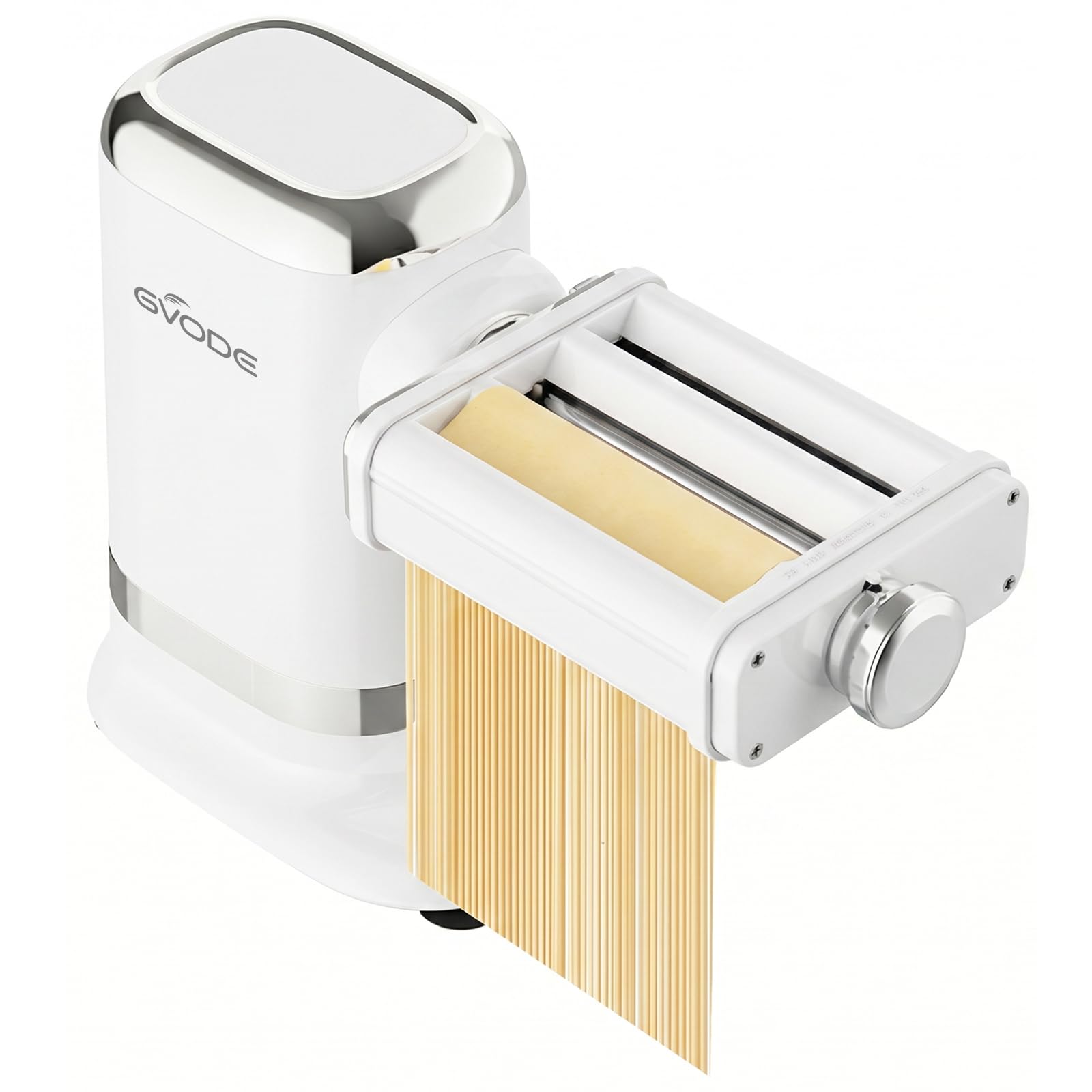
Rolls a sheet as thin as 0.4mm, yet the whole thing lifts off the counter without a strain.
The GVODE rolls dough from 0.4mm to 2mm across 8 thickness settings — the thinnest minimum of any machine here, which is exactly what you want for angel hair or a delicate fettuccine. Two speeds plus a reverse let you back the dough out if it bunches at the rollers instead of forcing it through. It arrives as a three-in-one set: a sheet roller plus cutters for spaghetti, fettuccine and lasagna. For a home cook who wants motorized rolling without a heavy machine bolted to the counter, that combination is the pitch.
Here’s the thing worth knowing: the maker’s own guidance on motor life is specific. Run it in 15-minute batches with a 5-minute cool-down between, and keep the vents on the motor base clear. That rhythm is the single most important habit for a motor that pushes stiff dough. Most “it stopped working” stories trace back to skipping that rest step. Where the drive gears matter, the maker uses metal rather than plastic, so the rollers hold alignment batch after batch. The plastic shell wipes clean in one pass.
Performance earns the most praise — owners find the rollers hold up and the cuts come out clean — and ease of use follows close behind. The catch is the trade between the 8 lb build and raw motor power: this rolls dough like a specialty machine but you need to respect the cool-down. Clean the shell with a wipe, not a soak, and the vent-clearing becomes part of your routine.
The number that matters: 0.4mm — the thinnest sheet setting in this whole guide.
The habit that keeps it alive: 15 minutes of rolling, then a 5-minute rest. Skip it and the motor pays.
Go for it if: you want motorized rolling to a 0.4mm sheet and can lift a compact machine in and out of a cupboard.
Look elsewhere if: you’ll run back-to-back batches for a big party without breaks.
7. Domestic Electric Pasta Maker
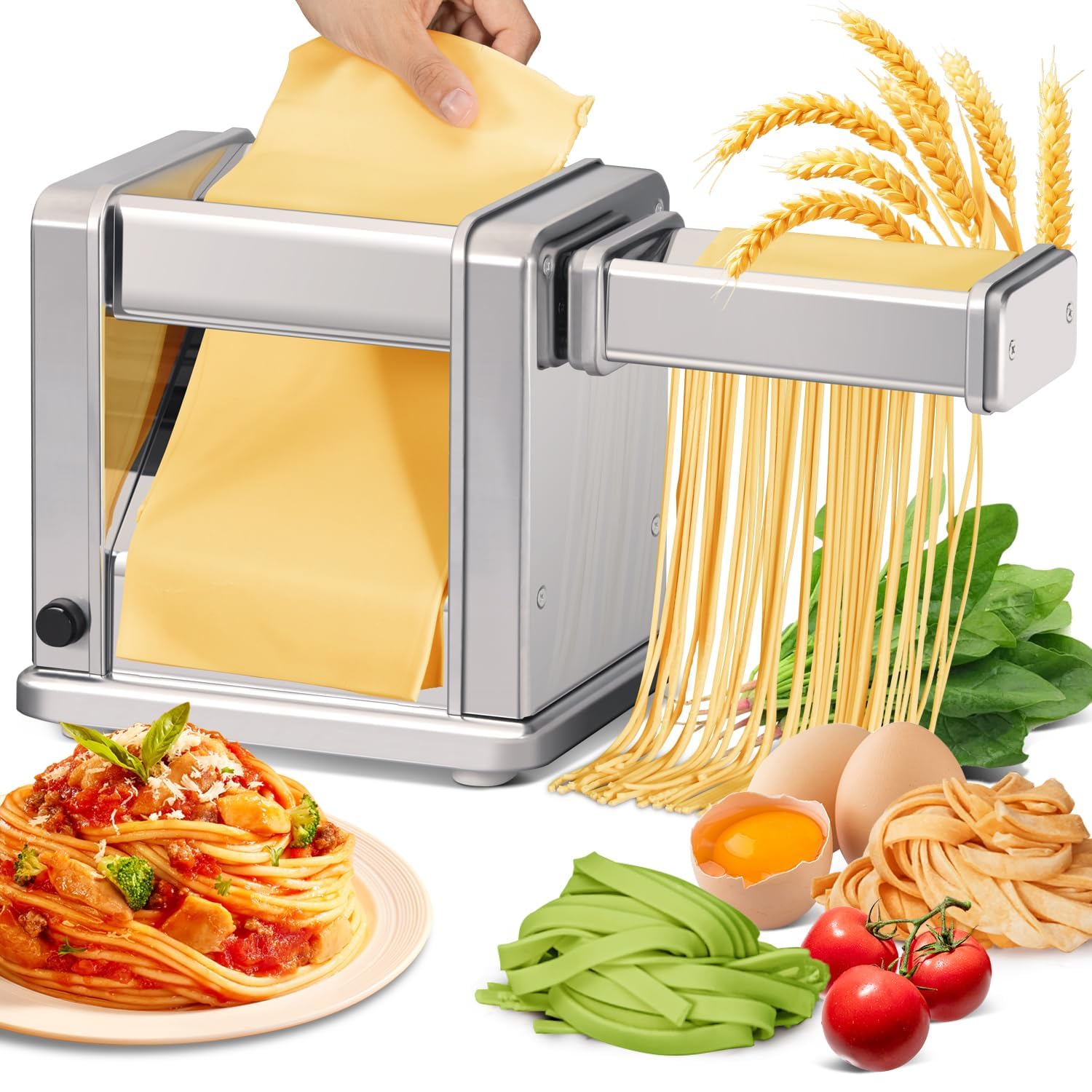
The motor hides inside the stainless body, so there’s no separate box to clamp on or trip over.
What you notice first about this Domestic machine is what’s missing: no external motor box bolted to the side. The 60W motor is built into the stainless steel body, which keeps the counter tidier and means one fewer piece to store. Two cutter heads are included for noodles at 2mm and 6.5mm widths, plus seven thickness options in the roller. That range covers fresh spaghetti and fettuccine, plus wonton and dumpling wrappers when you want to go thin. It’s 15.98 inches long and 13 pounds, so it’s a counter fixture rather than a drawer machine.
The trick with a built-in motor is the dough stiffness it prefers. The brand’s own warning is clear: overly stiff dough can stop the roller or slow it too much, and repeatedly forcing hard dough triggers overheating protection that shuts the machine down. The fix is to cut the dough into pieces around 1cm thick and start pressing at the highest setting, easing it thinner from there. If the machine does shut off, leave it off for at least half an hour before resuming. Respect that routine and the stainless, corrosion-resistant body keeps performing.
Performance is the praise point here — owners like what comes out and find the machine does its job. It’s a quieter listing than the big brands, so the honest frame is that this is a solid mid-tier tool for someone who values a self-contained design over a crowded feature list.
Worth it when: a built-in motor and a stainless body matter more to you than a long list of pasta shapes.
Be ready for: the overheating protection — press stiff dough gently and give it a half-hour rest if it shuts down.
8. Cuisinart Bread, Pasta & Dough Maker Machine, White, PM-1

Two appliances in one box — it extrudes pasta and kneads bread dough without a separate machine.
The Cuisinart PM-1 makes the case for itself differently from the rest of this list. It mixes, kneads and extrudes up to one pound of fresh pasta in about 20 minutes, and it does the same job for up to one pound of bread dough. So if you already bake bread and want to stop buying noodles, one machine covers both. Six discs come in the box — spaghetti, rigatoni, small macaroni, fettuccine and bucatini among them — plus flour and liquid measuring cups, a storage drawer and bag, and a cleaning tool. There’s also a limited 3-year warranty and BPA-free construction.
What people like most is the ease of the basics: setup, cleanup and the pasta that comes out. The extrusion cycle takes about half an hour per pound, and the dough should feel coarse — crumbly-looking mixture still extrudes properly, which surprises first-timers. The instructions are the weak link, and the maker’s own manual earns criticism here. The fix is a quick video tutorial before your first batch, which owners say clears up the stuff the paper doesn’t. Then there’s a more serious caveat worth naming: overly moist dough can seize the machine, and the locknut can be stubborn to remove by hand when it does.
The bowl can also detach mid-run if it isn’t locked in fully, and flour capacity is finite at the small end of the batch scale. This is a dual-purpose machine, not a pasta specialist, so the person who wants flawless noodles every time may find it compromises. The baker who wants fresh pasta on the side will get more out of it.
What you get in the box
- One machine that both kneads bread dough and extrudes pasta
- Six discs including spaghetti, fettuccine, rigatoni, bucatini and small macaroni
- Limited 3-year warranty and BPA-free parts
What to watch
- The manual is thin — plan on a video walkthrough for your first run
- Too-wet dough can seize the machine and jam the locknut
- It’s a jack-of-two-trades, so it won’t out-specialize a dedicated pasta maker
Ideal for: the home baker who wants one appliance for bread dough and fresh noodles.
Not for: a pasta purist who wants a single-purpose machine tuned for perfect extrusion every time.
9. Philips Viva Collection HR2370/05

Kneads and extrudes 2–3 servings in 18 minutes, then stores its own discs in a built-in drawer.
The Philips Viva is the everyday workhorse here — not the fastest, not the biggest, but the one built to live on your counter and get used without ceremony. A uniquely designed stirring bar does the kneading, and the machine pushes out 2–3 servings of fresh pasta in 18 minutes. Three default discs — spaghetti, penne and fettuccine — use a double-extrusion process the brand says keeps noodles consistently smooth. The discs tuck into smart built-in storage, so nothing gets lost in a drawer. With a 40-inch cord, it reaches most counter outlets.
The make-or-break variable is precision. Owners describe it as needing exact measuring: dough should look crumbly, and liquid goes in slowly through the lid slits. A measured 200g of flour with 75ml of liquid yielded about 2.5 servings in roughly 10 minutes, with pasta cooking in 3 minutes. Go gluten-free and the ratio discipline gets even tighter — one owner with celiac in the house found King Arthur 1:1 GF flour came out perfect only when the recipe was followed to the gram. Deviate and you’ll clog it. That’s the machine’s nature, not a flaw.
Performance is the runaway favorite — owners keep coming back to how reliably it turns out great pasta, and the taste gets its own share of praise. The functional complaints and cleaning gripes are there but sit in the middle of the picture, not the top. Cleanup takes real time — about 15 minutes after the dough dries — and any missed residue hardens like concrete, so brush thoroughly.
Best match: a household of one to three that wants pasta on the counter most nights without a big footprint.
Know this going in: measure to the gram and follow the recipe exactly, or expect clogs and a longer cleanup.
10. Philips Viva Collection HR2371/05

The Viva recipe, dressed in black — same 18-minute cycle, same three discs, same tight ratios.
Take the white Viva above, swap the shell to black, and you have this machine. The 18-minute knead-and-extrude cycle is identical, the 3 default discs for spaghetti, penne and fettuccine are the same, and the built-in disc storage and 40-inch cord carry over. What changes is only the exterior and the blade material spec — carbon steel here versus stainless on the white version. If a dark machine matches your kitchen better, you’re not giving up function to get it.
The operating logic is unchanged, and that means the same precision demand. Weigh your flour rather than scooping from a packed cup, err on the side of less liquid, and pour it slowly through the lid slits. Get that right and it extrudes correctly on the first try even without sensors — the motor and program are simple. Pasta dough that looks too dry will still extrude properly, which is the counterintuitive part. If you cook gluten-free, follow the Philips GF recipe exactly; the included book doesn’t have one, but the company site does.
Owners prize the performance and the taste, with the small footprint and light weight making it easy to leave out. The middle-ground gripes about functionality and cleaning are the same as the white model’s — real, but not the headline. Cleanup is easy when you let the dough dry and most parts are dishwasher-safe, though the shaping disc needs a hand wash and stray residue hardens fast.
What you’re really buying: a proven 18-minute extruder, identical to the white Viva, in a black finish.
The one habit: weigh the flour, under-do the liquid, and the disc-cleanup becomes a rinse rather than a scrape.
Pick it if: you want the Viva’s reliability and prefer a black counter machine.
Compare before buying: the white version at position 9 has the same cycle and a stainless blade spec — let finish and availability decide.
11. MARCATO Atlasmotor Electric Pasta Machine

Italy’s benchmark roller, now with a motor — built to be maintained, not replaced.
This is the machine for the person who treats pasta-making as a craft. The Atlas 150 arrives with a Pastadrive motor, a hand crank, and a clamp, and it’s 100% made and assembled in Italy. Ten clearly marked positions let you dial in pasta thickness, and the rollers pull sheets out up to 150mm (6 inches) wide. It’s also compatible with 11 separately available Marcato accessories, so you can add cutters over time. At 9.5 pounds with a chrome steel finish, it’s built to sit on a counter for decades rather than a season.
What makes it different from the cheaper rollers is the design philosophy: it’s meant to be kept and maintained, not thrown out when it wears. The resin scrapers naturally clean the rollers during use, so you just let the machine sit for at least 30 minutes after a batch and brush off the leftover dough. Owners who maintain theirs speak of the pasta quality in near-reverent terms — the sheets are exceptionally smooth and the rolled texture is fine. The motor and cutters lock tightly, and fit and finish is professional-grade. Compared with the compact Shule above, it rolls a wider sheet across a longer dial range, and the motor is purpose-built rather than bolted on.
The honest trade-off is that you’re paying for longevity, and the reviews on value are split. That’s a real risk for anyone pushing thick material through it. For regular dough, the maker’s own maintenance advice — dry-brush, don’t soak, let the scrapers work — is the path to getting years out of it.
Why it commands premium weight
- Made and assembled in Italy, with a 150mm sheet width and ten-position dial
- Compatible with 11 separately sold Marcato accessories to grow over time
- Self-cleaning resin scrapers reduce your cleanup routine to a dry brush
- Roller, motor and cutters lock tightly and roll a wide, evenly pressed sheet
The reality to accept
- You’re paying for durability, and value opinions among owners split
- The motor is the weak link if you push thick, heavy dough through it
- A reviewer reported one unit arriving with a broken internal gear
The right call for: a long-term pasta maker who wants a maintainable Italian machine and a wider sheet.
pass on it if: you want to motor through stiff, thick dough — heavy loads are where the motor gives out first.
12. Philips 7000 Series Pasta Maker HR2660/03

Eight portions in one batch and pasta under ten minutes — the machine built for a full table.
Of every pick here, this Philips 7000 makes the most pasta at once. It produces up to 8 portions of homemade pasta in a single go, and the maker’s figures put a batch at under 10 minutes. That combination — big capacity plus fast cycle — is the whole reason to spend at this tier. ProExtrude technology drives the extrusion, eight discs give you eight shapes, and perfect-mixing technology runs the knead. The 150W motor handles it all, and the parts are non-stick and dishwasher-safe for easier cleanup.
The mixing function reaches beyond pasta too: the same mechanism can handle cookies and kickstart pizza and bread prep, so it pulls double duty in a busy kitchen. For guidance, the HomeID app walks you through step-by-step recipes, including vegan and gluten-free options. The machine is 20 pounds with a metal-and-plastic build, so it’s a counter fixture rather than something you tuck away. Thickness spans 1mm to 1.5mm in its extrusion path.
Performanceis the strongest note here — owners consistently say it makes terrific pasta, with spaghetti arriving in about 5 minutes — and the solid construction backs that up. The pasta quality and speed follow close behind. What you need to know before buying is that the dough extrusion is the recurring weak spot: some owners find it doesn’t perform as advertised, and the machine is a serious spend. Feed it the right hydration, follow the app recipes, and it delivers the batch size.
Where it pulls ahead: 8 portions in under 10 minutes — the largest batch capacity in this guide, for a full table.
The bet you’re making: the highest spend here rewards careful hydration and app-guided recipes; sloppy dough is where the extrusion disappoints.
The obvious choice if: you regularly cook for a crowd and want eight portions from one push of a button.
Think smaller if: you’re feeding one or two — the Viva models above fit that job with less machine to clean.
Know the Specs
Extruder vs. Roller — the core choice
An extruder mixes and kneads dough, then pushes it out through a shaped die, so you load ingredients and let the machine work. A roller flattens dough between cylinders into a sheet and uses cutters to slice strands; you feed the dough, but you control thickness with a dial. Extruded pasta tends to come out thicker and doughier, while rolled pasta is finer and lets you press down to wrappers. Neither is better — the shape you cook most decides the type you should buy.
Flour capacity and batch size
Capacity tells you how much pasta one cycle makes. A 500g flour capacity feeds roughly four people in a cycle, while compact extruders hold closer to 200g for one to three servings. Larger machines reach up to 8 portions in a single batch. Match the capacity to your household so you’re not running double batches for guests, and not dumping half a batch nobody eats.
Thickness range and dial settings
On a roller, the thickness range and dial positions are what let you make everything from thick lasagna to a paper-thin wrapper. Machines here range from 0.4mm to 3mm, with dials holding anywhere from seven to ten positions. More positions and a lower minimum give you finer control — a 0.5mm setting is what you need for dumpling skins and delicate sheets.
Wattage, motor duty and cool-down
The wattage number tells you how hard the motor works and how much dough it can push before it needs a rest. Higher power handles stiff dough better, but even powerful motors want breaks — one brand’s own guidance calls for 15-minute batches with a 5-minute cool-down to protect the motor. Skipping rest steps is behind most “it stopped working” stories.
Common Questions
Is an extruder automatic pasta maker better than a roller with a motor?
How much flour do I need per batch to feed my family?
Why does my pasta dough clog the machine or stick inside?
Can I put pasta maker parts in the dishwasher?
Will the machine make gluten-free pasta?
How loud is an electric pasta maker while it runs?
How long does it take to make a batch of fresh pasta?
Do pasta makers need a rest period between batches?
Can I use a pasta maker for polymer clay?
What thickness setting do I need for dumpling wrappers or lasagna?
The Bottom Line
For most people, the best automatic pasta maker is the Sailnovo 3-in-1 because it gives you a 9-setting dial from 3mm down to a 0.5mm wrapper and two cutting widths, at the most accessible tier on this list — and it holds its ground on build quality. If you’d rather press one button than crank, grab the VEVOR 150W Automatic with its 8 discs and 4 modes. And for cooking for a crowd, the Philips 7000 Series makes up to 8 portions in one batch. A final nudge: the machine that sticks is the one whose cleaning routine you’ll actually keep, so pick the type you’ll maintain before you pick the brand.
How we choose
We do not accept paid placement. Every pick is matched to a real buyer and a real use-case; we do not hands-on test units.
Sources
Specifications: manufacturer listings and product documentation. Review insights: verified customer reviews, as of October 2026. Pricing: not shown on this page (it changes often); check the current price via the retailer link.
As an Amazon Associate, Aappliancez earns from qualifying purchases. This does not affect which products we feature.